9,121 results
1959ref. 141457Tokyo: Nikkatsu 1959. Draft script for the 1959 film. Text in Japanese. With a single notation in holograph pencil. Small-time deliquent criminals greatly enjoy robbing other people but fall into big trouble when they accidentally rob the Yakuza. Brown titled perfect bound wrappers. Title page present. 84 leaves with last page of text numbered 18. Mechanical duplication. Pages Near Fine wrapper Near Fine. Nikkatsu unknown books
1959ref. 141461Tokyo: Nikkatsu 1959. Draft script for the 1959 film. Text in Japanese. Based on Sueko Yasumoto's novel and one of the first examples of media dealing with the plight of zainchi or ethnically Korean Japanese citizens and their identity and struggles. One man has always worked faithfully for the Toho Company and another man is working for an underworld boss trying to scam Toho. They find each other again when one begins trailing and investigating the other. White titled perfect bound wrappers. Title page present. 177 leaves with last page of text numbered 16. Mechanical duplication. Pages Very Good plus wrapper Very Good plus bound with two staples. Nikkatsu unknown books
ref. 160647Hollywood: Motown-Weston-Furie Productions 1971. Final Shooting script for the 1972 film. Copy belonging to early production designer Harry Horner with his name in manuscript ink on the title page. Noted as copy No. 23 on the lower right corner of the title page with manuscript pencil and ink annotations on six pages. According to the AFI Catalog immediately prior to the commencement of photography several last-minute changes were made to the production crew including the replacement of Harry Horner with Carl Anderson. The script found here also co-credits director Sidney J. Furie as screenwriter with Terence McCloy. Furie did not receive a screenwriting credit in the final film. Based on Billie Holiday's 1956 autobiography co-authored by William Duffy which recounts Holiday's troubled rise to fame failed romantic relationships and drug addiction. Diana Ross' film debut. Set in New York and Baltimore. Red untitled wrappers. Title page present dated November 11 1971 noted as Final Shooting Script with credits for screenwriters Sidney J. Furie and Terence McCloy. 134 leaves with last page of text numbered 130. Xerographic duplication rectos only. Pages Near FIne wrapper Near FIne bound in a Near Fine red three-ring binder. Motown-Weston-Furie Productions unknown
1922ref. 158284Beverly Hills CA: Warner Brothers 1922. Set of three vintage hand-tinted lobby cards for the 1922 film. Based on F. Scott Fitzgerald's 1922 novel. A young husband and wife spend money with aplomb anticipating a large payout once the man's grandfather dies. When the patriarch passes away and they discover they have been left nothing in his will. Considered today to be a lost film. 14 x 11 inches. Very Good plus some with pinholes to the corners lightly and evenly toned. Warner Brothers unknown
1941ref. 162231Los Angeles: Twentieth Century-Fox 1941. Second Revised Final script for the 1941 film. Based on Richard Llewellyn's 1939 novel. The men of the Morgan family earn a living working in their small Welsh town's mine where they face dangerous and unhealthy conditions and exploitation at the hands of the mine owners. Winner of five Academy Awards including Best Picture and Best Director. Set in Wales shot on location in California. Red titled Twentieth Century-Fox wrappers dated April 18 1941 noted as SECOND REVISED FINAL. Distribution page present stamped copy No. 240 with receipt removed. Title page present with credit for Philip Dunne noted as 2nd Revised Final and dated April 18 1941. 167 leaves with last page of text numbered 169. Mimeograph duplication rectos only with blue revision pages dated 5/19/41 throughout. Pages Very Good plus slightly yapped with light tide marks along the bottom edges of the first five leaves wrapper Poor bound with two gold brads. National Film Registry. Twentieth Century-Fox unknown
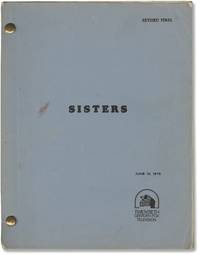
ref. 170959Los Angeles: Twentieth Century-Fox Television 1978. Draft script for the 1982 television movie seen here under the working title "Sisters" Originally aired on June 7 1982 on NBC. Rare. One of only two original feature-length original screenplays written by Maya Angelou the other being the 1972 television movie "Georgia Georgia". In a small town in North Carolina a young schoolteacher's life is upended with the arrival of her younger sisters who challenge her straitlaced ultra-moral attitude towards life. Filmed in 1979 but not aired until 1982. Set in North Carolina and shot on location in Montgomery and Opelika Alabama. Blue titled wrappers dated June 12 1978 and noted as REVISED FINAL on the front wrapper. Title page present dated June 12 1978 noted as REVISED FINAL with credit for screenwriter Maya Angelou. 122 leaves with last page of text numbered 116. Mimeograph duplication on eye-rest green stock rectos only. Pages Near Fine wrapper Very Good plus bound with two gold brads. Twentieth Century-Fox Television unknown
1963ref. 167069N.p.: N.p. 1963. First Draft script for the 1964 film. Based on Harry Kurnitz's 1961 American stage adaptation of Marcel Achard's 1960 French play "L'Idiote." One of the funniest films of the 1960s and the defining installment in the well-loved Pink Panther series. While "A Shot in the Dark" was ably preceded by "The Pink Panther" in 1963 it was the first film to feature the series' underrated maestro: Herbert Lom as Chief Inspector Dreyfus foil to Peter Sellers' Inspector Clouseau and the first to truly define the style of the side-splitting installments that would follow. The only script for this film we have ever handled. Fuchsia wrappers with a die-cut title window in the British style. Title page present dated 14th October 1963 noted as First Draft with credit for director Blake Edwards. 173 leaves with last page of text numbered 170. Mimeograph duplication on eye-rest green stock rectos only with several pink revision pages dated October 17 1963. Pages about Fine wrapper Near Fine bound internally with two silver brads with a worn title label affixed to the binding. N.p. unknown
1959ref. 149872Tokyo: Shochiku 1959. Draft script for the 1959 Japanese film. Text and titles in Japanese. Angered by their parents' refusal to buy them a television set two young brothers decide to go on a silence strike against all adults leading to a number of comic misunderstandings in their tight-knit community. Set in a suburb of Tokyo. White titled wrappers. 16 leaves with last page of text numbered 31. Mimeograph duplication printed on rectos and versos. Pages Very Good plus wrapper Very Good lightly foxed with some wear to the binding with perfect binding. Rosenbaum 1000. Criterion Collection 84. Vogel Film as a Subversive Art. Shochiku unknown
1948ref. 152186N.p.: N.p. 1948. Draft script for the 1948 British film. Copy belonging to production manager Mickey Delamar with his name in holograph pencil to the title page and his holograph annotations throughout. With revision pages laid in throughout the script along with a distribution receipt signed by Delamar and with a reference photograph from the film showing actors Vivien Leigh and Ralph Richardson. Delamar worked as a producer production manager and assistant director on over 30 films and was active in the film industry for four decades. His credits include Charlie Chaplin's "A King in New York" 1957 Francois Truffaut's "Fahrenheit 451" 1966 and Terence Young's "Mayerling" 1968. Based on the classic 1877 novel by Leo Tolstoy about a young woman whose loveless marriage leads her to begin an affair with a dashing Czarist officer. Set in St. Petersburg. Black titled wrappers. Title page present with credits for novelist Tolstoy and screenwriters Jean Anouilh Julien Duvivier and Guy Morgan. 190 leaves with last page of text numbered 165. Mimeograph duplication rectos only with pink and white undated revision pages throughout. Housed in a navy spring binder as originally used. Pages supple but Very Good only overall with curling at the edges. Photograph about Very Good with moderate soil and toning. Binder Good with soil overall. N.p. unknown books
1974ref. 148727Tokyo: Toei 1974. Draft script for the 1974 Japanese film. Text and titles in Japanese. Based on a series of magazine articles written by journalist Koichi Iiboshi which were in turn based on memoirs written by yakuza crime boss Kozo Mino. The fifth and final film in director Kinji Fukasaku's yakuza pentalogy following feuding gangs in post-war Hiroshima. Set in Hiroshima. Tan titled wrappers. 67 leaves with last page of text numbered D27. Mimeograph duplication printed on rectos and versos. Pages Very Good plus wrapper Very Good slightly wavy with light dampstains to the extremities bound perfectly. Toei unknown books
1966ref. 140604Los Angeles: Expanding Cinema 1966. Shooting final for the 1966 film. Copy belonging to actor Peter Haskell with his holograph annotations throughout and his shooting schedule laid in. Mary Ellen Bute's final film and one of the only cinematic adaptations of James Joyce's masterfully complex work of fiction "Finnegans Wake." Shot over a two year period Bute was tasked with transforming Joyce's impenetrable prose without losing any of the work's surreal lyrical essence. The subsequent film maintains the original novel's oneiric style. Bute and her husband Ted Nemeth were longtime collaborators and Nemeth worked as both cinematographer and producer of the film. In 1965 it was honored at the Cannes Film Festival as Best Debut and remains Bute's sole feature length film. Shot on location in New York City and Dublin. Brown untitled wrappers. Title page present dated March 4 1963 and December 3 1962 noted as Shooting Final with credits for screenwriters Mary Ellen Bute Romana Javitz and T. J. Nemeth Jr and editor A.I.M.S. Street. 148 leaves with last page of text numbered 139. Mimeograph duplication with onionskin revision pages throughout. Pages Very Good plus wrapper Very Good plus. Some pages detaching and wrapper slightly cracked. Bound internally with prong binding. Expanding Cinema unknown books
1929ref. 137372Budapest: Hunnia Filmstudio 1929. Presentation copy of an Early Draft script for the Hungarian film released in Hungry in 1932 as "Tavaszi zapor" in Frace in 1933 as "Marie Legende Hongroise" and in the United States in 1935 as "Spring Shower." Housed in a likely hand-sewn floral cloth-covered portfolio the script is INSCRIBED by the Hungarian-American feminist and radical socialist screenwriter Ilona Fulop on the title page: "To Mac: / Because You still trust me! / Ilona / Christmas 1929 / Hollywood Cal." A unique and attractive item and probably the only surviving copy of the script. The story of a poor girl driven out of her village when she becomes pregnant by her employer's wealthy fiance finding refuge working as a maid in a brothel. After her daughter is taken from her however she falls into alcoholism and dies. A maid in Heaven as she was on earth she saves her daughter from befalling a similar fate by "emptying her mop bucket" on her daughter's head via a rain shower at a pivotal moment. A multinational production in which a Hungarian screenwriter and Hungarian director both with experience in Hollywood shot a film starring a French actress using frozen assets from a French producer that had been mandated for exclusively Hungarian use. Though not a box office success at the time it is now regarded as one of the all-time great films originating from the country. In a 1919 article entitled "What is 'Revolution' Doing to Love" screenwriter Fulop describes herself as a socialist radical as opposed to a revolutionary or a Bolshevik and her desire to further equal rights for women strongly defines her as a modern-day feminist as well. "Spring Showers" with its women- and proletarian-friendly plot thus comes as little surprise. Housed in floral cloth-covered portfolio titled wrappers. Title page present with credits for screenwriter Fulop. 78 leaves with last page of text numbered 77. Carbon typescript. Pages Very Good portfolio Very Good bound with a single line of hand-stitching. Hunnia Filmstudio unknown books
1961ref. 141438Tokyo: Nikkatsu 1961. Treatment script for the 1961 film. Text in Japanese. A 1920s playwright meets a beautiful woman who might be the ghost of his patron's deceased wife. White titled perfect bound wrappers. Title page present. 39 leaves with last page of text numbered 38. Mechanical duplication. Pages Very Good plus wrapper Very Good plus. Nikkatsu unknown books
1955ref. 146249Burbank CA: Walt Disney Productions 1955. Draft script for the 1956 film here under the working title "Children of the Covered Wagon." Walt Disney's working copy with "Walt Disney" in holograph ink on upper left margin of Walt Disney Productions label on the front wrapper not in Disney's hand and annotations in red blue and graphite holograph pencil throughout all clearly in Disney's hand. The most substantive of the annotations denote sequence order and use of stock footage. Our first reaction was to doubt such close involvement by Disney on a 1950s feature but it turns out that this film was special: it was Disney's first Western and only its second live-action CinemaScope feature following on the heels of the wildly successful "20000 Leagues Under the Sea" the year before. Too Disney's first animated CinemaScope feature "Lady and the Tramp" was released just prior to this film in the summer of 1955. All three were major debuts for Disney and Walt Disney's involvement was naturally more hands-on than usual. Based on the 1934 novel "Children of the Covered Wagon" by Mary Jane Carr about a group of pioneers in a wagon train traveling across the West. Staring Disney stalwart Fess Parker of "Davey Crockett" fame as John "Doc" Grayson and featuring four Mouseketeers from the "Mickey Mouse Club" television series: Tommy Cole Doreen Tracey Cubby O'Brian and Karen Pendleton. A one-hour Disneyland telecast on November 14 1956 entitled "Along the Oregon Trail" included a behind-the-scenes look at the filming of "Westward Ho the Wagons!" and on the day of the film's opening the first segment of a four-part series about Native Americans entitled "The First Americans" began on the Disneyland series. Set in the American West shot on location at the Conejo Ranch near Thousand Oaks in California. Red titled wrappers with affixed Walt Disney Productions label as called for with Disney scripts from this era with credits for screenwriter Tom Blackburn and production number 2093. 157 leaves with last page of text numbered 153. Mimeographed rectos only. Pages Near Fine wrapper Near Fine prong binding. Walt Disney Productions unknown books
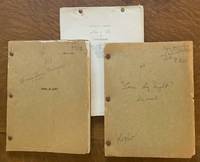
1945ref. 003238Burbank California: Universal Studios 1945. Doyle A. Conan Frank Gruber screenwriter. TERROR BY NIGHT. Burbank: Universal Studios 1945-6. This unique film studio screenplay archive consists of THREE studio scripts: two original writer's draft manuscripts and the final dialogue and continuity script. In short a treasure trove of primary material relating to one of the most endearing and enduring film series of the 1940s. The twelve Sherlock Holmes films produced by Universal Pictures during the years 1942-1946 are legend; they are surely the best known screen-adapted adventures of English Literature's most iconic character and Basil Rathbone and Nigel Bruce are still cherished as the definitive Holmes and Watson. 1. Dated July 2nd 1945 Frank Gruber's complete 113pp original typed carbon copy manuscript labeled "File Copy" accomplished on onion-skin paper brad-bound and housed in original drab brown studio covers production number 7322 with each leaf rubber-stamped "Contract File Copy" in red block letters. The cover is edge-worn but the contents are Very Good indeed. This copy belonged to Tom McKnight penciled signature so stating who served as the Universal Studios Sherlock Holmes technical adviser throughout the entire run of the series. 2. Dated September 29th 1945 Frank Gruber's complete 93pp corrected carbon copy manuscript cover-titled in pencil which includes brad-bound and laid in at the rear two studio-mimeographed sets of extensive screenwriter-corrected white revision pages dated 10/4/1945 and 10/8/1945. Overall Very Good. 3. Dated January 14th 1946 the complete original studio-mimeographed self-wrapper final post-production dialogue continuity script bound with two brads at the top. In Very Good condition. Although this film was inspired by Conan Doyle's "Adventure of the Empty House" in its characterization of Colonel Sebastian Moran and the use of an air gun as a murder weapon screenwriter Frank Gruber created what essentially was an original story and screenplay. Gruber's prior film credits included "Northern Pursuit" 1943 with Errol Flynn and "Johnny Angel" the 1945 Crime Noir starring George Raft. He was also one of the most prolific pulp magazine short story writers of the era. The producer of TERROR BY NIGHT was Howard Benedict from RKO's Saint and Falcon series. The director and executive producer was Roy William Neill who was inarguably the guiding force behind the last nine films in the series. TERROR BY NIGHT unapologetically borrowed from both of Alfred Hitchcock's train-set thrillers "The 39 Steps" 1936 and "The Lady Vanishes" 1938 and Roy William Neill's interpretation of these classics perhaps was the reason TERROR BY NIGHT is one of the best films in the series. TERROR BY NIGHT opened on February 8th 1946 to excellent reviews and the favorable reaction by a thrilled public. A unique archive a unique opportunity for the collector. . Signed. Original Manuscript. Original Wraps. Very Good. Script. Universal Studios Paperback books
1959ref. 145799Hollywood: The Selznick Company 1959. Leatherbound presentation copy of Second Draft script for the 1962 film. Presented to studio executive David O. Selznick with his initials in gilt on front board. Henry King's adaptation of the F. Scott Fitzgerald's classic final novel and his final film as well. King was a prolific director and one of the most commercially successful directors of the 1920s and 1930s seven of his films having been nominated for Academy Award for Best Picture. Lead actress Jennifer Jones cast as Nicole Driver was at the time the wife of film studio executive David O. Selznick. Opposite Jones is Jason Robards as Dr. Dick Diver a once esteemed psychiatrist who marries his patient the emotionally scarred Nicole sacrificing his career for a transient hedonistic life to please her. Nominated for an Academy Award. Set and shot on location in France Italy and Switzerland. Tan leather covered spring binder with Selznick's gilt initials "D.O.S." at the lower right with some wear and tearing on edges and spine binder board interiors lined in silk. Script with orange titled wrappers noted as Second Draft on the front wrapper production No. 00273 dated October 1 1960 with credits for author F. Scott Fitzgerald and screenwriter Ivan Moffat. Title page present with credits for author F. Scott Fitzgerald and screenwriter Ivan Moffat. 176 leaves with last page of text numbered 171. Mimeograph duplication rectos only. Pages Near Fine wrapper Very Good Plus spring binder Very Good or better with wear at the extremities. The Selznick Company unknown books
1959ref. 143374Kanagawa Japan: Daiei Studios 1959. Draft script for the 1959 Japanese film. Based on the 1956 novel by Tanizaki Jun'ichir "Kagi" or "The Key". Winner of the 1960 Jury Prize at the Cannes Film Festival. Shot on location in Japan. All titles and text in Japanese. White titled wrappers with black and gold titles and various rubber stamps to the front wrapper. Title page not present. 122 leaves with last page of text numbered "e-28." Mechanical duplication. Near Fine with light age toning. Daiei Studios unknown books
1968ref. 128776New York: Francis Productions Inc 1968. First Draft script for the 1968 film. Copy belonging to Frank Perry with his name in red holograph ink on the title page. Perry considered making the film but it was ultimately directed by Christian Marquand. This draft is credited solely to Southern though Buck Henry was ultimately given full credit for the adaptation from the novel by Southern and Mason Hoffenberg. In her memoir "Trippin' with Terry Southern: What I Think I Remember" Gail Gerber details at some length the tangle of legal problems over the publication of "Candy" in the US and abroad. Publication was poorly controlled resulting in numerous pirated editions and lawsuits involving Maurice Girodias Olympia Press Putnam and small US paperback publishers such as Lancer Greenleaf and Brandon House. She notes "Despite the popularity of the novel Hollywood was always leery about getting involved with properties that have 'clouded title' so it was no surprise that Frank Perry gave up on the idea of directing the film version of 'Candy' much to Terry's disappointment." Black titled Studio Duplicating Service wrappers. Title page present undated noted as First Draft with credits for screenwriters Southern and Mason Hoffenberg. 136 leaves mimeograph duplication. Pages Near Fine wrapper Very Good plus bound with two gold brads. Francis Productions, Inc unknown books
1973ref. 143674Tokyo: Toho Company / 1973. Draft script for the 1973 Japanese film. Based on the 1972-1973 manga written by Kazuo Koike and Kazuo Kamimura. The story of a woman with a sword in the end of her umbrella who seeks vengeance against the men who murdered her father and raped her mother leaving a trail of blood in her wake. A gorgeously shot cult classic and one of the best films of early 1970s samurai cinema. One of Quentin Tarantino's greatest influences for his "Kill Bill" duology borrowing plot and thematic elements character and set design and even re-creating specific shots. Off white wrappers perfect bound with red and blue titles dated 1973.9.20. 83 leaves with last page of text numbered "e-28." Mechanical duplication. Pages Near Fine wrapper a moderately foxed Very Good plus. Arrow 662. Criterion Collection 790. Toho Company / unknown books
1969ref. 135613N.p.: Alfieri 1969. Vintage oversize double weight color photograph of Dennis Hopper and Jack Nicholson at an outdoor press conference held in front of the Carlton Hotel at the Cannes Film Festival where Hopper was awarded the Cannes First Film Prize. Shot by Marc Alfieri and signed by him in black ink at the lower left margin: "Photo Alfieri / Cannes / FIF 69." Also with Alfier's stamp on the verso and a holograph ink notation: "Festival.69. / 4903." About as close to the very start of the New Hollywood era as can be imagined. "Easy Rider" had its world premiere at Cannes on May 8 1969. It would not debut in the US until July 1969 in a significantly edited form. 9.25 x 12.25 inches. In a museum quality frame. Fine. Alfieri unknown books
1950ref. 168509N.p.: N.p. 1950. Vintage eleven-page ribbon copy typescript short story circa 1940s-1950s subsequently serving as the basis for the 1972 adult film. Rare. An iteration of an explicit short story penned by an anonymous author sometime before or during World War II circulated underground in retyped typescript or carbon typescript copies during the 1940s and after. "Behind the Green Door" is notable as one of of the first American hardcore pictures to receive widespread distribution in the US and one of the first heterosexual pornographic films to feature an interracial sex scene. A breakthrough role for actress Marilyn Chambers who would go on to become one of the first icons in the adult film industry and even worked briefly in mainstream cinema. Eleven leaves last page of text not numbered. Ribbon copy typescript on onionskin stock rectos only. Pages Good or better bound with two staples on the top edges. N.p. unknown
ref. 166556N.p.: N.p. 1982. Draft script for the 1983 British comedy film. Noted as copy No. 58 in manuscript ink on the title page. Bound in with the script are ten pages of Xerographically duplicated storyboards for the short film-within-the-film "The Crimson Permanent Assurance." The final Monty Python film to star actor and writer Graham Chapman before his death in 1989 and a return to the sketch comedy format which characterized the group's earlier television series. Shot on location in Queensway Strathblane and Lancashire England. Red untitled Script Specialists wrappers with a die-cut title window in the British style. Title page present dated March 1982. 115 leaves with last page of text numbered 115. Mimeograph duplication on eye-rest green stock rectos only with five pink revision pages laid in at the rear of the script dated 26/5/82. Pages Very Good plus wrapper Very Good plus with light foxing throughout bound internally with two silver brads. N.p. unknown
ref. 160437N.p.: N.p. 1997. Archive of material relating to the 1998 film. Archive includes four scripts dated variously between 1991 and 1997 and credited variously to screenwriters Christ Zois Zoë Lund and William Gibson as well as approximately ten pages of correspondence and ephemera relating to the film's production and a xerographically duplicated copy of Gibson's source story. One screenplay with the ownership name of Zois on the title page. From the archive of Christ Zois Abel Ferrara's frequent co-screenwriter. Of note are several pieces of correspondence regarding writing credits for the film dated variously between 1997 and 1998. Screenwriters Abel Ferrara and Christ Zois claimed that prior adaptations of Gibson's novel by Gibson Lund and others had no bearing on their own adaptation. Ferrara and Zois would ultimately receive sole screenwriting credit on the completed film. Based on the 1984 short story by William Gibson about two freelance industrial spies in Tokyo who decide to use a call girl to execute their latest mission. Shot on location in New York. November 1991 Draft: Self wrappers. Title page present dated November 1991 noted as Third Draft with credit for author and screenwriter William Gibson. 93 leaves with last page of text numbered 92. Xerographic duplication rectos only. Pages Near Fine partially bound with a binder clip at the top left corner. October 9 1993 Draft: Self wrappers. Title page present dated Oct. 9. 1993 noted as SECOND DRAFT with credit for screenwriter Zoë Lund. 116 leaves with last page of text numbered 109. Xerographic duplication rectos only. Pages Near Fine partially bound with a binder clip at the top left corner. September 28 1997 Draft: Self wrappers. Title page present dated 9/28/97 noted as Draft with credits for screenwriters Christ Zois and Abel Ferrara. 75 leaves with last page of text numbered 74. Xerographic duplication rectos only. Pages Very Good plus partially bound with a binder clip at the top left corner. Undated Draft: Self wrappers. Title page present undated with credit for screenwriter Christ Zois. 99 leaves with last page of text numbered 98. Xerographic duplication rectos only. Pages Very Good plus partially bound with a binder clip on the top edge and housed in a red card folder. N.p. unknown
ref. 148810Tokyo: Toho 1970. Draft script for the 1970 Japanese film. With manuscript ink and pencil annotations to the rear wrapper and throughout the text. Included with the script is a mimeographed shooting schedule. Text and titles in Japanese. Annotations relate to the following: a names of the chosen cast members b set rehearsals and camera rehearsals c times for shooting e.g. Morning Afternoon Evening and Night phone numbers for production personnel d names of potential and/or hired camera assistants e names of potential and/or hired actors f indication of the production company chosen Toho Corporation as well as film stock and lens sizes to be used g additional notes regarding location of some settings h changes to dialogue and action and h some final post-production notes. Director Akira Kurosawa's first color film based on Shugoro Yamamoto's 1962 novel "Kisetsu no nai machi" A City Without Seasons. A series of vignettes about a slum in the suburbs of Tokyo and its impoverished inhabitants. Nominated for an Academy Award for Best Foreign Film. Set and shot on location in Tokyo. Script: White titled wrappers. Title page present. 90 leaves with last page of text numbered d-37. Mimeograph duplication printed on rectos and versos. Pages Very Good plus wrapper Very Good with perfect binding. Schedule: White titled wrappers. 13 leaves with last page numbered 23. Mimeograph duplication printed on rectos and versos. Pages Very Good plus wrapper Very Good with a faintly toned spine and very faint foxing to the fore-edge side-stapled with two staples. Detailed notes with translation of annotations noted above with accompanying images are provided with the script. Toho unknown
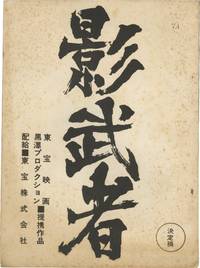
ref. 157439Yokohama Kanagawa: Kurosawa Production Co 1980. Draft script for the 1980 Japanese film. The story of a low-class criminal taught to be the decoy or kagemusha of a dying feudal lord based on the historical daimyo Takeda Shingen and depicting the 1575 Battle of Nagashino in the cinematic climax. When Toho Studios could not afford to complete the film George Lucas and Francis Ford Coppola convinced Twentieth Century Fox to cover the shortfall in exchange for international distribution rights recieving credits as executive producers on the finished film. Nominated for two Academy Awards including Best Foreign Language Film and winner of the Palme d'Or at the 1980 Cannes Film Festival. Set in Sengoku period shot on location in Iga Ueno Castle Himeji Castle Kumamoto Castle Yuhara Plain Hokkaido Japan. White perfect-bound wrappers. Rubber stamped copy No. 74 at the top right corner of the front wrapper. 166 leaves with last page of text numbered "146." Mimeograph duplication. Pages Near Fine with light toning wrapper Very Good with foxing overall and age toning to the page edges. Criterion Collection 267. Kurosawa Production Co unknown