6,014 results
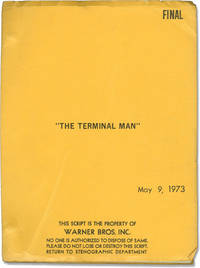
1973ref. 121469Burbank CA: Warner Brothers 1973. Final script for the 1973 film based on the 1972 novel by Michael Crichton. Noted director Mike Hodges' third film and first to be made in the US after "Get Carter" in 1971 and "Pulp" in 1972. An unusual and prescient sci-fi thriller that was poorly distributed in the US but over time counted Stanley Kubrick and Terrence Malick among its admirers. Segal in a serious against-type role is a scientist who agrees to an experimental treatment wherein a tiny computer is implanted in his head to help control violent tendencies. The computer malfunctions probably Windows-based and he becomes a psychotic killer. When Mike Kaplan a Warner Brothers international marketing executive attempted to override Warner Bros' decision not to release the film in Britain he sought Kubrick's help. After explaining the situation and how the film required a different marketing campaign Kubrick interrupted with "I've already seen it and it's terrific." The director Terrence Malick wrote to Hodges expressing how much he loved watching The Terminal Man saying "I have just come from seeing The Terminal Man and want you to know what a magnificent overwhelming picture it is. You achieve moods that I've never experienced in the movies before though it's only in hope of finding them that I keep going. Your images make me understand what an image is not a pretty picture but something that should pierce one through like an arrow and speak in a language all its own." Mustard yellow titled wrappers stamped FINAL on the front wrapper and dated May 9 1973. Distribution page present with receipt intact. Title page present with a credit for screenwriter Hodges. 108 leaves mechanical duplication eye-rest green stock. Pages Near Fine wrapper Very Good plus with a diagonal crease on the front panel internally bound with two gold brads. Warner Brothers unknown books
1967ref. 119761Universal City CA: Universal City Studios 1967. Final script for the 1968 film. Prop master C.S. Chrisman's copy with his trademark manuscript ink initial on the front wrapper and profuse manuscript annotations throughout the text regarding scenes that will require props. Based on the 1966 novel "The Wrong Venus" by Charles Williams. An author on a European cruise is slacking on finishing her newest novel when her publisher sends someone to check in on her progress. The first of two screenplays Williams wrote in Hollywood. Williams was one of the most popular hard-boiled authors in the Gold Medal stable. Beginning in the early 1960s he found work as a screenwriter adapting his novel "All the Way" first adapted in 1960 in the US as an obscure late film noir "The 3rd Voice" as a comedy for French director Marcel Ophuls. Set in Europe. Red titled wrappers noted as Final draft on the front wrapper production No. 02000 dated February 6 1967. Title page present noted as Final draft with credits for author and screenwriter Charles Williams. 132 leaves with last page of text numbered 131. Mimeograph duplication rectos only. Pages Near Fine wrapper Near Fine bound with three gold brads. Universal City Studios unknown books
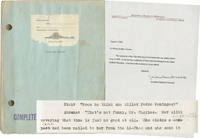
1935ref. 124528Beverly Hills CA: Metro-Goldwyn-Mayer MGM 1935. Dashiell Hammett's original submitted Treatment script for the first sequel to "The Thin Man" here referred to only as "Thin Man Sequel" and ultimately titled "After the Thin Man." With a single manuscript correction by Hammett and letter of provenance from Hammett's daughter Josephine Hammett Marshall regarding the discovery of the treatment in the family's estate. The first "Thin Man" film released in 1934 and based on Hammett's novel was a smash hit and is today a key film in the American screwball comedy cycle. Five sequels were made between 1936 and 1947 all starring the original acting team of William Powell and Myrna Loy and this previously unknown attempt at a sequel by Hammett was clearly commissioned by MGM but never produced making this script an entire unpublished Hammett work. The story is a completely original one never reworked for the other films very much written in Hammett's trademark style and reading a bit more like a story treatment i.e. a novel than a final screenplay which is likely as far as the story got on the road to production. The piece is dated Sept. 17 1935 at the lower right corner of the front panel along with Hammett's name and Hammett's name is noted in pencil next to the title label though not in Hammett's hand. There is only one single-word correction to the entire text at page 83 in Hammett's hand where the word "compact" is replaced with "cigarette case." Accompanying the screenplay is a typed letter signed from Hammett's daughter who edited a recently published collection of Hammett's letters on her personal stationery stating that the screenplay was discovered by Hammett's wife in 1980 and that it had been a part of the family's estate until that time. Probably one of only 2-3 copies that could have been produced and very possibly the only copy extant. To our knowledge no other copy of this story in any form has ever been recorded at auction or sold on the market. Light blue titled wrappers with the white MGM studio label present manuscript pencil notation of Hammett's name secretarial rubber-stamped COMPLETE dated September 17 1935 with a single credit for Hammett. 115 leaves mimeograph duplication. Pages and wrapper Very Good plus bound with two gold brads. In a custom clamshell box. Full pagination available upon request. Metro-Goldwyn-Mayer [MGM] unknown books
1983ref. 118803Universal City CA: Universal City Studios 1983. Revised First Draft for the 1985 film. Costume designer Norman Salling's copy with his name in manuscript ink at the top of the front wrapper. SIGNED by novelist-screenwriter Elmore Leonard on the title page. An ex-car thief trying to turn his life around ends up witness to his friend's murder. While he wants to find love and spend more time with his daughter the men who killed his friend kidnap his daughter sending him on a mission to save his daughter and avenge his friend. One of only a few screenplays adapted by Leonard from one of his own novels made memorable in that it layers a surprisingly complex plot onto what by 1985 had become a pretty standard sub-genre: the Burt Reynolds revenge thriller. Shot on location in California and Florida. Green titled wrappers noted as Revised First Draft on the front wrapper production No. 02162 dated August 5 1983. Title page present dated August 5 1983 noted as Revised First Draft with credits for author and screenwriter Elmore Leonard. 109 leaves with last page of text numbered 106. Xerographic duplication on blue stock rectos only with blue revision pages throughout dated 9/15/1983. Pages Near Fine wrapper Very Good plus with some wear to the corners bound with three gold brads. Universal City Studios unknown books
1986ref. 115890N.p.: N.p. 1986. Revised Draft script for the 1986 film. Production assistant Cynthia Jessen's copy with her name in manuscript ink on the title page numerous lines throughout the script circled and several dog-eared pages. Not to be confused with the 1994 film directed by Robert Benton and starring Paul Newman. A young woman who is tired of her life falls for a man in a traveling Shakespeare troupe. Shot on location in Prescott and Sedona AZ. Blue untitled wrappers. Title page present dated February 19 1986 noted as Revised Draft with credits for screenwriter Beth Henley. 109 leaves with last page of text numbered 104. Xerographic duplication rectos only with blue revision pages throughout dated March 3 1986. Pages Near Fine wrapper Near Fine bound with two gold brads. N.p. unknown books
1969ref. 110611Studio City CA: Major Pictures Corporation 1969. Final Shooting script for the 1970 neo-noir film. Boldly SIGNED by lead actor Rod Taylor on the front wrapper. Based on the 1966 novel by John D. MacDonald featuring his series character Travis McGee. Notable as the only feature film adaptation of MacDonald's wildly popular Travis McGee series long unavailable on any kind of viewing format. Red titled wrappers noted as Final on the front wrapper dated 28 January 1969 with credits for screenwriter Ed Waters and novelist John D. MacDonald. 114 leaves with last page of text numbered 114. Mimeograph duplication rectos only. Pages Fine wrapper Fine bound with two gold brads. In a custom quarter-leather clamshell box. Grant US. Larson Warped and Faded. Major Pictures Corporation unknown books
1950ref. 107868London: Apex 1950. Draft script for the 1951 British film. Editor Peter Hunt's copy with his manuscript annotations throughout. Peter Hunt began his career in the UK film industry as an editor working on several of the best-known early James Bond films "Dr. No" "From Russia With Love" "Goldfinger" as well as "The Ipcress File." He debuted as a director with "On Her Majesty's Secret Service" in 1969. Blue untitled wrappers. Title page present dated April 1950 noted as shooting script with credits for Kenneth Hume. 87 leaves with last page of text numbered 86. Mimeograph duplication rectos only. Pages Near Fine wrapper Very Good plus bound with two staples. Apex unknown books
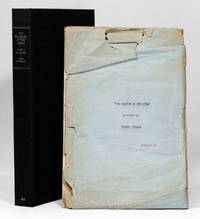
1955ref. 107862N.p.: N.p. 1955. Treatment script for an unproduced film. From the collection of British film director and editor Peter Hunt presumably one of only a handful of copies made. The only other copy located is in the Harry Ransom Center film library at the University of Texas and the notes from that collection read: "'The Speaker's Corner' is a screenplay based on three stories by Robin Maugham including 'Broken Cellophane' 'The Prodigal Son' and 'The Man Who Could Hypnotize Racehorses.' Maugham worked with Rodney Ackland on the adaptation." Mauve titled wrapper noted as a short story on the front wrapper copy No. 20 with credits for screenwriter Robin Maugham. Title page present with credits for Maugham. 13 leaves with last page of text numbered 12. Mimeograph duplication rectos only. Pages Near Fine wrapper Very Good with a string binding. N.p. unknown books
1980ref. 103795Beverly Hills CA: United Artists 1980. Vintage US one sheet film poster for the classic 1980 war film. A low budget epic based primarily on director and screenwriter Samuel Fuller's own experiences in the 1st Infantry Division. 27 x 41 inches folded as issued. Fine. United Artists unknown books
1973ref. 62975Los Angeles and New York 1973. Postcard and note paper 4 x 5 inches total of approximately 100 words both signed "Terrence." Accompanied by a simple illustrated program for "Whisky" and a snapshot of one of the friends dated 1969. Among McNally's many awards are an Emmy and four Tonys. All very good. 9740. unknown books
1925ref. 3105California: Universal Pictures 1925. First edition. original wrappers. Good. AN EARLY WORKING DRAFT OF THE 1925 PHANTOM OF THE OPERA PRESERVING THE DARKER SCENARIO UNIVERSAL WROTE BEFORE ITS FRONT OFFICE ORDERED THE TERROR TONED DOWN AND INCLUDING AN ORIGIN STORY FOR THE PHANTOM THAT NEVER REACHED THE SCREEN. Lon Chaney's unmasking in The Phantom of the Opera remains one of the most famous moments in film history. The picture that audiences finally saw in 1925 though came out of a long and difficult production shaped by poorly received previews reshoots and repeated re-editing. Its story begins with Universal staff writer Elliott J. Clawson's adaptation of Gaston Leroux's 1910 novel. The present typescript records his scenario at an early stage before the studio's successive revisions reshaped it. THE PHANTOM'S LOST ORIGIN STORY: The most striking feature of the draft is a lengthy origin episode absent from every filmed version of the story. In it a Sultan condemns the Phantom to die on an anthill and the Persian who becomes his lifelong associate rescues him. Leroux's novel only alludes to its Phantom's past in Persia where a police official spared him from the Shah's death sentence. Clawson turned that background into a full dramatic sequence. The episode though was abandoned before filming began. Philip J. Riley mentions it in his narrative account of the production The Making of the Phantom of the Opera 1999 but the present manuscript preserves it as Clawson actually wrote it. Riley records that by the fifth revised shooting script most of the genuinely frightening scenes like the anthill death scene had been removed because the front office feared the original material would drive audiences out of the theater. RELATIONSHIP TO THE KNOWN RECORD: Riley's study draws on two principal script documents: an early Clawson draft which he quotes in places and the fifth revised shooting script which he reproduces in full. The present manuscript shares the general scope and character of the early draft yet it differs in both scene numbering and the wording of specific directions. At the bedchamber scene Riley's source is numbered 286; here the same scene is numbered 289. The three-scene offset indicates that this manuscript contains material Riley's source lacks at that point suggesting either an earlier compositional layer or a fuller parallel version. Riley does not say where his early draft is held so the relationship between the two documents remains open. Our comparison is limited to the passages Riley chose to quote and a full collation may well reveal further differences. THE ANNOTATIONS: Pencil annotations appear intermittently throughout. They are pointed and analytical raising questions of continuity pacing and plot logic. One asks how Christine could communicate with Raoul while held captive and another asks why certain developments do not occur earlier in a sequence. They suggest close review by a reader with editorial authority over the script. Note: Although the draft breaks off during the climactic rescue attempt by Raoul and Ledoux and does not include the full text as we've come to know the story the draft appears complete as it originally existed. There is no sign of removed pages - in fact the last page with type seems to be on a different stock and serves also as the rear wrapper - which is consistent with an unfinished working draft rather than later loss. RARITY: Universal silent-era screenplays rarely survive. Scripts were typed in small numbers on unstable pulp paper and much of the studio's early paper record was later discarded. This draft documents The Phantom of the Opera before commercial pressure and successive rewrites displaced Clawson's original conception. It preserves a version of the film that Universal chose not to make. Typescript working draft. Universal City California: Universal Pictures ca. 1925. More than 200 pages typed on 8.5 x 13 inch legal-size pulp stock; original blue wrapper; pale toned rear wrapper. Pencil annotations throughout. Front wrapper present but detached; leaves brittle with edge chipping creases foxing marginal staining and small losses as is typical of Universal scripts of the period. Housed in custom archival presentation box. Universal Pictures unknown books
1940ref. 1355Los Angeles: 20th Century Fox Film Corporation 1940. Letter 295 x 230mm pp. Title 1 2-186 mimeographed duplication rectos only. First draft continuity script for the 1941 film. Orange titled continuous card wrapper rubber stamped internal three brass brad binding. Noted as FIRST DRAFT CONTINUITY on the front wrapper production number 559 copy number 29 dated October 7 1940. Title page present also dated October 7 1940 and noted as 1st Draft Continuity. Pages very good but for a bit of toning and worming to the upper left corner of the final 15 pages cover soiled worn and with some splits to the extremities good. Ex-Howard Barnes; Richard Manney; Gene Hackman. Custom cloth box. Inscribed on the title page by screenwriter Dudley Nichols to film critic Howard Barnes; "Critic par excellence in memory of our old days on The World when neither of us dreamed of working in this fascinating medium of the film Affectionately Dudley Nichols July 15 1941". Referencing the time they both spent as journalists for the New York World. There is a postscript that reads: "This was my first draft done in three weeks. Many things happened to it afterwards as your keen eye will note. D.N". A British big-game hunter is captured after stalking Hitler as a sporting challenge then escapes to England only to be relentlessly pursued by Nazi agents whose campaign of terror claims the life of the young woman who sheltered him. After a harrowing confrontation with his nemesis he acknowledges his true intent and parachutes back into Germany now committed to carrying out the assassination he once denied contemplating. Set in 1939 Bavaria and London shot on set at 20th Century Fox studios in Los Angeles. 20th Century Fox Film Corporation unknown books
1947ref. 003375Universal City: Universal-International 1947. First Edition. Very good. Continuity and dialogue script here under the working title "Destiny of a Woman;" 11 x 8 1/2; textured yellow wraps bound at the top edge with two large brads; "Continuity and Dialogue / Master Copy / Prod. # 115125 / Charge # 563" to front wrap; several light penciled-in annotations throughout; mimeographed text to rectos only; a few minor spots to upper margin of front wrap; several leaves with creases to bottom corners; in very good condition. Based on playwright screenwriter and political activist Lillian Hellman's 1905 - 1984 1946 Broadway play of the same name and prequel to her "The Little Foxes" the drama took place in post-Civil War Alabama and centered around the wealthy ruthless racist Hubbard family. Vladimir Pozner 1905 - 1992 who would adapt Hellman's play for the future film was a French author of Russian-Jewish descent. His "Les etats desunis. Reportage" The Disunited States. A Reportage in essence - a leftist travelogue and one of his most famous works would document racism inequality everyday life and its characters the gangsters the starlets and the poor workers in the United States in the early 20th century. Universal-International paperback books
1934ref. 302814New York Charles Scribner's Sons 1934. 1934. First American edition from English sheets. 8vo. Translated by Ann Gretton. Dust jacket unclipped. Very good. 286 pages. Screenwriter Dudley Nichols' copy signed by him on the front free endpaper. 1st Edition. Hardcover. Very Good/Very Good. New York, Charles Scribner's Sons, 1934. hardcover books