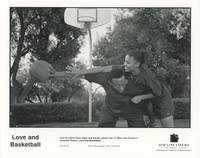
1990ref. 173097N.p.: New Line Cinema 1990. Collection of thirteen vintage studio still photographs from the 2000 film. Childhood friends fall in love and then separate as they both pursue professional careers in basketball. Shot on location in Southern California. 8 x 10 inches. Fine. Criterion 1097. New Line Cinema unknown
1954ref. 150655Santa Monica CA: RKO Radio Pictures 1954. Seven vintage studio still photographs from the 1954 film. Seduction and betrayal erupts among the American employees of a traveling carnival in Munich. Set and shot on location in Munich. 10 x 8 inches. Near Fine. RKO Radio Pictures unknown books
1956ref. 140205Los Angeles: Twentieth Century-Fox 1956. Draft script for the 1956 film here under the working title "The Outlaws are in Town." Copy belonging to Robert Arthur who played Lonny Kesh with his name on the front wrapper in manuscript pencil and his manuscript pencil and ink annotations throughout. Lonny Kesh Arthur works his family's farm in Georgia but has big dreams of going west. His dreams are realized one day as he heads to Texas and ends up running with a gang of outlaws. He eventually returns to the family farm to find his parents have passed on. All goes smoothly until his former gang shows up. Set in Georgia and Texas. Green titled wrappers rubber-stamped copy No. 27 dated June 18 1956. Title page present dated June 18 1956 with credits for screenwriters Earle Snell and Kurt Neumann and author Bennett Foster. 106 leaves with last page of text numbered 106. Multilith duplication with blue revision pages throughout dated July 2 1956. Pages Very Good wrapper Very Good bound with two gold brads. Twentieth Century-Fox unknown books
1954ref. 156130N.p.: N.p. 1954. Vintage program for the 1954 German film. Text and titles in German. Based on the 1932 novel by Ernst Wiechert. A widowed woman falls in love with a piano player and spends the night with him out of wedlock only for him to die shortly thereafter in a car accident. She discovers that she is pregnant to the shame of her family members and is forced to leave town in disgrace. 7.25 x 10.5 inches. Bi-fold. Near Fine. N.p. unknown books
1932ref. 165745Universal City: Universal Pictures 1932. Vintage double weight publicity photograph of Tom Brown and Arletta Duncan by photographer Ray Jones from the 1932 film. On the verso is Jones' photographer stamp a 1932 date stamp and a mimeo snipe here under the working title "Information Kid." From the archive of noted Hollywood still photographer Ray Jones. Born in Wisconsin on January 1 1901 Jones worked for Paramount Pictures in the early 1930s and went on to be the head of the still photography department at Universal Pictures in 1935 where he worked well into the 1950s. Tom Brown stars as Marty Black a crooked jockey who tries to mend his ways after becoming attached to Midge a young orphan boy in need of love and guidance played by Mickey Rooney. 8 x 10 inches. Near Fine. Universal Pictures unknown books
1932ref. 165745Universal City: Universal Pictures 1932. Vintage double weight publicity photograph of Tom Brown and Arletta Duncan by photographer Ray Jones from the 1932 film. On the verso is Jones' photographer stamp a 1932 date stamp and a mimeo snipe here under the working title "Information Kid." From the archive of noted Hollywood still photographer Ray Jones. Born in Wisconsin on January 1 1901 Jones worked for Paramount Pictures in the early 1930s and went on to be the head of the still photography department at Universal Pictures in 1935 where he worked well into the 1950s. Tom Brown stars as Marty Black a crooked jockey who tries to mend his ways after becoming attached to Midge a young orphan boy in need of love and guidance played by Mickey Rooney. 8 x 10 inches. Near Fine. Universal Pictures unknown
1954ref. 156130N.p.: N.p. 1954. Vintage program for the 1954 German film. Text and titles in German. Based on the 1932 novel by Ernst Wiechert. A widowed woman falls in love with a piano player and spends the night with him out of wedlock only for him to die shortly thereafter in a car accident. She discovers that she is pregnant to the shame of her family members and is forced to leave town in disgrace. 7.25 x 10.5 inches. Bi-fold. Near Fine. N.p. unknown
1956ref. 140205Los Angeles: Twentieth Century-Fox 1956. Draft script for the 1956 film here under the working title "The Outlaws are in Town." Copy belonging to Robert Arthur who played Lonny Kesh with his name on the front wrapper in manuscript pencil and his manuscript pencil and ink annotations throughout. Lonny Kesh Arthur works his family's farm in Georgia but has big dreams of going west. His dreams are realized one day as he heads to Texas and ends up running with a gang of outlaws. He eventually returns to the family farm to find his parents have passed on. All goes smoothly until his former gang shows up. Set in Georgia and Texas. Green titled wrappers rubber-stamped copy No. 27 dated June 18 1956. Title page present dated June 18 1956 with credits for screenwriters Earle Snell and Kurt Neumann and author Bennett Foster. 106 leaves with last page of text numbered 106. Multilith duplication with blue revision pages throughout dated July 2 1956. Pages Very Good wrapper Very Good bound with two gold brads. Twentieth Century-Fox unknown
1930ref. 36669Circa 1930. 1930. Very good. - A sheet of cream colored note paper 8-3/8 inches high by 5-1/8 inches wide is signed near the top edge "Frederic Arnold Kummer". The bottom edge of the paper is darkened with slight darkening to the other edges and the bottom right corner is lightly creased. There is a very light vertical crease to the left side. Very good. Author playwright and screenwriter Frederic Arnold Kummer 1873-1943 began his career as a civil engineer before turning to writing full-time in 1907. For much of his writing life he devoted himself to detective fiction beginning with "The Green God" in 1911. He also wrote fantasies including "The Second Coming: A Vision" with Henry P. James 1916 a World War I fantasy in which Christ appeals for peace to the Kaiser and -- probably his most popular work-- an afterlife fantasy "Ladies in Hades: A story of Hell's Smart Set" 1928. Circa [1930]. unknown
1985ref. 159869N.p.: N.p. 1985. Vintage borderless reference photograph from the 1985 Polish film showing director Krzysztof Kie lowski and actress Gra yna Szapo owska on the set. Provenance stamp and annotations in manuscript ink on the verso. A translator tries to come to terms with the death of her husband a lawyer while trying to help her husband's last client with his pending imprisonment. Kie lowski's first writing collaboration with screenwriter Krzysztof Piesiewicz. Shot on location in Warsaw. 7 x 5.25 inches. About Fine. N.p. unknown books
1987ref. 163715N.p.: N.p. 1987. Two vintage borderless reference photographs from the 1987 Polish film one showing actors Bogus awa Pawelec and Tadeusz omnicki the other showing actors Monika Gozdzik and Bogus aw Linda. Dutch distributor labels and annotations in manuscript pencil on the versos. A predecessor to "Sliding Doors" 1998 and "Run Lola Run" 1998 about a young man presented with three choices which lead his life in three separate political directions. Although completed in 1981 the film's release was suppressed in Poland for several years and finally released in 1987 albeit in a censored format. Shot on location in ódzkie and Warsaw Poland. 9.5 x 7 inches. One Near Fine one Very Good plus. Criterion Collection 772. N.p. unknown books
1987ref. 163715N.p.: N.p. 1987. Two vintage borderless reference photographs from the 1987 Polish film one showing actors Bogus awa Pawelec and Tadeusz omnicki the other showing actors Monika Gozdzik and Bogus aw Linda. Dutch distributor labels and annotations in manuscript pencil on the versos. A predecessor to "Sliding Doors" 1998 and "Run Lola Run" 1998 about a young man presented with three choices which lead his life in three separate political directions. Although completed in 1981 the film's release was suppressed in Poland for several years and finally released in 1987 albeit in a censored format. Shot on location in ódzkie and Warsaw Poland. 9.5 x 7 inches. One Near Fine one Very Good plus. Criterion Collection 772. N.p. unknown
1985ref. 159869N.p.: N.p. 1985. Vintage borderless reference photograph from the 1985 Polish film showing director Krzysztof Kie lowski and actress Gra yna Szapo owska on the set. Provenance stamp and annotations in manuscript ink on the verso. A translator tries to come to terms with the death of her husband a lawyer while trying to help her husband's last client with his pending imprisonment. Kie lowski's first writing collaboration with screenwriter Krzysztof Piesiewicz. Shot on location in Warsaw. 7 x 5.25 inches. About Fine. N.p. unknown
1977ref. 150004N.p.: N.p. 1977. Vintage borderless reference photograph of Sylvia Kristel from the 1977 film. The last film in the original "Emmanuelle" trilogy following "Emmanuelle" 1974 directed by Just Jaeckin and starring Kristel and Alain Cuny and "Emmanuelle: The Joys of a Woman" "Emmanuelle II" 1975 directed by Francis Giacobetti and starring Kristel and Umberto Orsini. Miramax film founders Bob and Harvey Weinstein acquired the rights to the film at the 1977 Cannes Film Festival capitalizing on the popularity of what had become an international franchise broadcasting a unique appeal as an erotic film series with feminist leanings. 7 x 4.75 inches. Near Fine. N.p. unknown books
1977ref. 150004N.p.: N.p. 1977. Vintage borderless reference photograph of Sylvia Kristel from the 1977 film. The last film in the original "Emmanuelle" trilogy following "Emmanuelle" 1974 directed by Just Jaeckin and starring Kristel and Alain Cuny and "Emmanuelle: The Joys of a Woman" "Emmanuelle II" 1975 directed by Francis Giacobetti and starring Kristel and Umberto Orsini. Miramax film founders Bob and Harvey Weinstein acquired the rights to the film at the 1977 Cannes Film Festival capitalizing on the popularity of what had become an international franchise broadcasting a unique appeal as an erotic film series with feminist leanings. 7 x 4.75 inches. Near Fine. N.p. unknown
1976ref. 100704Blonay Switzerland. April 28 1976. 1976. Fine. - Over 160 words typed on his personal 11-5/8 inch high by 8-1/4 inch wide stationery with his Swiss address centered at the top. Not having heard from his friend New York City Center producer Jean Dalrymple about producing his play Norman Krasna writes "I have a letter from Jose Ferrer who informs me between barbs of witty abuse that he has had some communications with Sylvia Miles." . "I would suspect at this moment the prospect of getting her are fifty-fifty. She hasn't said yes she hasn't said no which is practically a lyric from a famous Jerome Kern show." He goes on to write that he understands if she hasn't been able to get any backing "we are in a most peculiar business at a difficult time and it is perfectly all right if you pass us by. Sad but all right." Signed "Norman". Folded for mailing with a pencil line indicating that Jean has read the letter else fine. Together with a retained copy of Jean Dalrymple's reply dated June 19 1976. Having been away Jean replies "I have been in Russia for a while making a film on ballet. and so I am terribly late in replying to your very very nice letter." She goes on to say that "Unfortunately Sylvia Miles after first saying she was VERY interested turned us down." "At the moment I can't think of anyone who is 'just right' and the play MUST have that 'just right' actress! Ah. Judy couldn't you return for a bit" She concludes with wam regards ". and maybe you have a new play easier to cast" The American screenwriter playwright producer and film director Norman Krasna 1909-1984 was known for his screwball comedies based on a case of mistaken identity. He wrote several successful Broadway plays including "Dear Ruth" and "John Loves Mary" and directed 3 films "The Ambassador's Daughter" "The Big Hangover" and "Princess O'Rourke" all of which he also wrote and was nominated 4 times for screenwriting Academy Awards winning once for "Princess O'Rourke". The recipient Jean Dalrymple 1902-1998 was the dynamic producer and director of theater and light-opera at Manhattan's City Center. Dalrymple began her career in Vaudeville appearing with James Cagney and Carey Grant in the early 1930s. She was a founding member of the American Theatre Wing the theatre service organization. She worked over the years as a personal manager for the likes of Leopold Stokowski Mary Martin Jos Iturbi Andre Kostalanetz Nathan Milstein and Lily Pons. She began her work at City Center with its founding in 1943 serving as a board member and publicist. Her productions there from the 1940s through the 1960s were a revitalizing influence on the whole New York theatre scene. In 1951 Jean Dalrymple married Major-General Philip deWitt Ginder commander of the Thunderbirds in Korea. She was a friend to Presidents and entertainment personalities throughout the world. Blonay, Switzerland. April 28, 1976.
1976ref. 99595Switzerland July 5th 1976. 1976. Fine. - Over 275 words typed on his personal 11-1/2 inch high by 8-1/4 inch wide stationery with his Swiss address centered at the top. Norman Krasna writes to Jean Dalrymple about his latest play "Hold the presses." he says having rethought the ending. "I had a long searching session with the muse and also a critique from a friend and the three of us have come to the conclusion that the ending is not right." Feeling that his original ending seemed to imply that the girl settled for marriage "as she hasn't got the ability to be a star". "People don't go to the theatre to accept resignation. I prefer the girl on her way to be a star and have the marriage too." Signed "Norman". An apparent phone number is penned at top left of the letter and another spelled out in French at top right. The letter is further briefly annotated on the verso. The top edge of the page is slightly creased and the letter is folded for mailing. Near fine. The American screenwriter playwirth producer and film director Norman Krasna 1909-1984 was known for his screwball comedies based on a case of mistaken identity. He wrote several successful Broadway plays including "Dear Ruth" and "John Loves Mary" and directed 3 films "The Ambassador's Daughter" "The Big Hangover" and "Princess O'Rourke" all of which he also wrote and was nominated 4 times for screenwriting Academy Awards winning once for "Princess O'Rourke". The recipient Jean Dalrymple 1902-1998 was the dynamic producer and director of theater and light-opera at Manhattan's City Center. Dalrymple began her career in Vaudeville appearing with James Cagney and Carey Grant in the early 1930s. She was a founding member of the American Theatre Wing the theatre service organization. She worked over the years as a personal manager for the likes of Leopold Stokowski Mary Martin Jos Iturbi Andre Kostalanetz Nathan Milstein and Lily Pons. She began her work at City Center with its founding in 1943 serving as a board member and publicist. Her productions there from the 1940s through the 1960s were a revitalizing influence on the whole New York theatre scene. In 1951 Jean Dalrymple married Major-General Philip deWitt Ginder commander of the Thunderbirds in Korea. She was a friend to Presidents and entertainment personalities throughout the world. Switzerland, July 5th, 1976.
1957ref. 143197Kyoto: Daiei Studios 1957. Draft script for the 1958 Japanese film. Based on the 1956 novel "Kinkakuji" "Temple of the Golden Pavilion" by Yukio Mishima which is loosely based on the actual event of the burning of the Reliquary or Golden Pavilion of Kinkaku-ji in Kyoto by a young Buddhist acolyte in 1950. The book was one of three Mishima novels adapted by Paul Schrader for episodes in his film "Mishima: A Life in Four Chapters" 1985. Daiei released "Conflagration" "Enj " an adaptation of the same novel directed by Ichikawa Kon in 1958. The title and name of the temple in the film was changed from Kinkakuji after Buddhist opposition threatened problems with filming in Kyoto. This is a script from that film before the name change. Set and shot on location in Kyoto. White titled wrappers rubber-stamped copy No. 12. Title page present. 70 leaves with last page of text numbered e-27. Mechanical duplication. Toning due to aging throughout mildew water damage wrapper split at spine with mild foxing non archival tape to spine and title page overall about Good condition. Daiei Studios unknown books
1959ref. 157643Burbank CA: Warner Brothers 1959. Vintage studio still photograph from the US release of the 1959 Japanese film showing director Kon Ichikawa talking with actors Junko Kano and Tatsuya Nakadai on the set. Printed mimeo snipe and Warner Brothers stamp on the verso. Based on Jun'ichir Tanizaki's 1956 novel "The Key" about an aging voyeuristic antique collector who manipulates his wife into having an affair with his daughter's fiancé as a means of curing his impotence. Nominated for the Palme d'Or. 10 x 8 inches. Near Fine. Warner Brothers unknown books
1959ref. 144308Kanagawa Japan: Daiei Studios 1959. Collection of 6 vintage US publicity photographs from the 1959 Japanese pink film. The first of several films based on the Junichiro Tanizaki. Released in Japan as "Kagi" and with the alternate English language title "The Key." An elderly antique dealer struggles with his aging body and looming impotence. To grapple with his anxiety he introduces his daughter's boyfriend a handsome doctor to his younger wife. The jealousy and voyeurism that follow invigorates his dying spirit but the chaos he has introduced eventually takes a horrific toll. Winner of the 1960 Jury Prize at the Cannes Film Festival. 8 x 10 inches. Near Fine. Weisser and Weisser Japanese Cinema Encyclopedia: The Sex Films pp. 219-220. Sharp Behind the Pink Curtain p. 372. Daiei Studios unknown books
1961ref. 162042N.p.: Edward Harrison 1961. Vintage studio still photograph from the US release of the 1959 Japanese film. Provenance stamp on the verso. Based on the 1956 Japanese novel "Kagi" "The Key" by Jun'ichirô Tanizaki. Aging Kenjji married to a younger woman and concerned with his waning virility introduces his daughter's lover to his wife. Winner of the Prix du Jury at the Cannes Film Festival and nominated for the Palme d'Or. 8 x 10 inches. Near Fine. Edward Harrison unknown books
1959ref. 155776N.p.: N.p. 1959. Three vintage borderless reference photographs from the 1959 Japanese film. One photograph with a stamp noting the film's French title "L'Etrange obsession" on the verso and all three photographs with manuscript ink annotations on the verso. Based on Jun'ichir Tanizaki's 1956 novel "The Key" about an aging voyeuristic antique collector who manipulates his wife into having an affair with his daughter's fiancé as a means of curing his impotence. Nominated for the Palme d'Or. Photos 6 x 4.5 inches. Very Good plus. N.p. unknown books
1955ref. 159872N.p.: N.p. 1955. Vintage reference photograph of director Kon Ichigawa on the set of the 1955 film. Annotations in manuscript pencil on the verso relating to cropping as well as a provenance label. 5 x 6.5 inches. Near Fine. N.p. unknown books
1959ref. 143374Kanagawa Japan: Daiei Studios 1959. Treatment script for the 1959 Japanese film. Based on the 1956 novel by Tanizaki Jun'ichir "Kagi" or "The Key". Annotations and stamps throughout noting a date of March 28 1959 mention of a presentation and "Script Research Library Holding." Winner of the 1960 Jury Prize at the Cannes Film Festival. Adapted from the 1956 novel "The Key" by Jun'ichir Tanizaki and remade Tinto Brass Koji Wakamatsu and others. A satirical late-noir treatise on the decay of human physical ability mental health and sexual desire told in a seemingly reserved family context with stunning cinematography by Kazuo Miyagawa "Yojimbo" "Rashomon" "Floating Weeds" and cinematic style that masterfully blends Ozu and Hitchcock. Restored in 2024 by the Kadokawa Corporation for screening at the 82nd Venice Film Festival and subsequent international screenings through 2026. Shot on location in Japan. Titles and text in Japanese. White titled wrappers with black and gold titles and various rubber stamps on the front wrapper. Title page not present. 122 leaves with last page of text numbered "e-28." Mechanical duplication. Near Fine with light age toning. Daiei Studios unknown books
1956ref. 143240Tokyo: Nikkatsu 1956. First Draft script for the 1956 film. Title in English on rear wrapper. Based on a 1946 children's novel by Michio Takeyama about a conscience-driven Japanese soldier who adopts the lifestyle of a Buddhist monk after he fails to get his countrymen to surrender to an overwhelming force. Nominated for a Best Foreign Language Film Academy Award. Set in Burma during WWll shot on location in Burma and near the Izu Peninsula in Japan. White titled wrappers. Title page present. 70 leaves with last page of text numbered e-25. Mechanical duplication. Pages Near Fine with some toning due to age wrapper Very Good with mild foxing and light water damage near spine. Criterion Collection 379. Eureka Masters of Cinema 12. Nikkatsu unknown books


