Elliott Humphrey, Lucien WarnerBiblio.com

9.342 Ergebnisse
1973Best.-Nr. P2641Used; Very Good. 54-E-06 The Johns Hopkins Press 1973 Hardcover. No dust jacket. End pages have some yellowing. Text is clean and unmarked. Covers have light wear. Book Condition: Very Good . 1973. HARDCOVER. hardcover
1878Best.-Nr. 46954Red Cloud: Argus Steam Print n. d. ca 1878. 1878. First edition. First edition. 8vo. 13 1/2" x 12" illustrated map on one side plus pictures of the Farmers and Merchants Bank and the home of J. L. Miner Red Cloud and front and rear cover panels. The other side promotes Webster County and Red Cloud plus views of homes of prominent residents as well as businesses. A promotional booklet with plat map produced by the real estate firm of Warner & Warren of Republican Valley. Touted here are both Webster County and the city of Red Cloud including the businesses public schools street-car lines factories creamery real estate railroads and more. Advertisements for the Burlington & Missouri River Railway as well as the Chicago Burlington and Quincy R. R. both of which ran from Chicago to Red Cloud are included as well. The map of Webster County Nebraska shows the town of Red Cloud and sixteen of its neighboring counties as well as railroad lines rivers and property divisions. This map was produced by Fort Abstract Co. of Red Cloud said here to keep a complete set of books and plats of all towns and sub-divisions. Illustrations depict buildings in Red Cloud various residences of town citizens and appealing views of the town. Red Cloud was founded on homestead land in 1871 by a group of men including Silas Garber 1833-1905 who would go on to serve as Nebraska's Governor from 1875 to 1879. The town was named by Garber and local businessmen in honor of the chief of the Olgalala tribe of the Teton-Lakota Sioux. When Webster County was organized Red Cloud was designated as the county seat. In 1879 the Burlington & Missouri River Railway reached Red Cloud -- stimulating immigration from America's eastern seaboard and bringing a variety of cultural heritages to town including those of Germany Scandinavia Great Britain and Canada Austro-Hungary aka Bohemians and so forth. The town's cultural melting pot was marvelously depicted in the literary works of Willa Cather who lived in Red Cloud for several years with her family beginning in 1883 at the age of nine. Cather would use the town as the basis for such fictional towns as "Black Hawk" in My Antonia 1918. We could find no copies recorded in OCLC. A few small old water stains to the rear cover short separations and small punctures along old folds. Argus Steam Print, n. d. (ca 1878). unknown
Best.-Nr. 0070066957.Gpaperback. Good. Access codes and supplements are not guaranteed with used items. May be an ex-library book. paperback
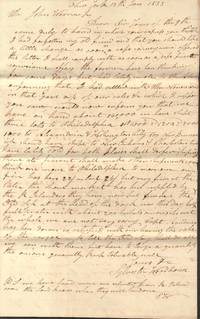
Best.-Nr. 022664Good. Autograph Letters Signed. Small collection of documents from the estate of John Warner a farmer and merchant of Wethersfield Connecticut. Collection consists of 10 separate papers including business letters and accounting sheets. Papers are all folded and exhibit foxing and toning. Many have tears and chipping along the folds. The script on most of the documents is fairly challenging to read though all are still legible. The documents mostly concern the sale and shipping of onions. Collection includes 5 business letters and 5 sheets of accounts. The account sheets have dates ranging from 1815 to 1840 and contain lists of names and figures with arithmetic done on the margins. The letters also contain a range of dates with one from 1818 two from 1819 one from 1823 and another from 1833. The letters appear to be from business partners and largely discuss the transportation of onions and prices in various cities in the eastern United States. This collection of 10 documents gives a glimpse into an agricultural business operating in the first half of the 19th century. . unknown
1811Best.-Nr. H22984London: J. Dodsley / G. Wilkie & J. Robinson / James Cawthorn 1811. Hardcover. Very Good. In mid-19th century half light brown calf and marbled boards gilt titled on spine very good light rubbing and wear to binding. Bookplate of Thomas Fuller and his signature on the Anstey title page -- he was an architect native of Bath. With frontispiece. The Anstey is the 13th edition; the Bath Characters by Warner is a second edition from 1808 light foxing small clipped porttion from title page probably a previous owner's name; The Wonders of a Week at Bath appears to be a first edition from 1811 and has occasional pencil marginalia by a helpful old reader. Nice compilation of three works on Bath all of which are satirical. J. Dodsley / G. Wilkie & J. Robinson / James Cawthorn hardcover
2007Best.-Nr. H13434New York: Gagosian 2007. First printing. Hardcover. Fine/near fine. Quarto white linen with printed glassine dust jacket with accordion style 11-plate foldout 28 pp illustrated. Jacket with faint soil. Gagosian hardcover
2005Best.-Nr. 2928102University Of Michigan Press 2005. This is an ex-library book and may have the usual library/used-book markings inside.This book has hardback covers. In good all round condition. No dust jacket. Please note the Image in this listing is a stock photo and may not match the covers of the actual item600grams ISBN:9780472115181 University Of Michigan Press hardcover
1947Best.-Nr. 031357Boston: Pilgrim Press 1947. Book. Illus. by Winifred Bromhall. Near Fine. Hardcover. 1st Edition. 16mo - over 5¾ - 6¾" tall. First printing no additional printings listed. 64 pp. Worn at the spine head. Otherwise fine. The dust jacket is frayed at the spine ends and corners. The spine is a bit darkened. The price $1.25 is present on the front flap. In Brodart archival dust jacket protector. Pilgrim Press Hardcover
1958Best.-Nr. 66262US: The Grandon Company 1958. First Edition. Hardcover. Very Good /Very Good. Textured red paper-covered boards with gilt-stamped titling to spine. Signed by author at first free endpaper and limited to 350 copies. Pages are clean and unmarked. Light soiling from glue residue at pastedowns but endpages are otherwise clean and unmarked. Text block is clean and unmarked. Boards are clean and bright with light bumping and rubbing to corners and ends of spine. Binding is tight spine is slightly cocked. Dust jacket has light foxing and soiling along spine light scuffing around title at front cover and light soiling and scuffing to edge of spine at rear cover; creasing to edges corners and ends of spine. Dust jacket is covered in a protective mylar jacket. The Grandon Company hardcover
Best.-Nr. 086355377X.Ghardcover. Good. Access codes and supplements are not guaranteed with used items. May be an ex-library book. hardcover
Best.-Nr. 090732505X.Ghardcover. Good. Access codes and supplements are not guaranteed with used items. May be an ex-library book. hardcover
1995Best.-Nr. 9780806516387Used; Very Good. 20-C-12 Carol Pub. Corp. 1995 paperback. Text is clean and unmarked. Covers have some sunning . Spine is tight. Book Condition; Very Good . 1995. TRADE PAPERBACK. paperback
Best.-Nr. 20111178like new. unknown
Best.-Nr. 32801386like new. unknown
1904Best.-Nr. 355737Baltimore: Johns Hopkins Press. Good. 1904. First Edition. Hardcover. The Eckenrode prior to binding was ex-library. It has a perforation stamp on the title page ink stamps on the title page and the contents page. ; Two titles bound together. The Eckenrode is Howes E-38. It is Johns Hopkins University Studies in Historical and Political Science Series XXII Nos. 6-7-8. The Warner is Notes Supplementary to the Johns Hopkins University Studies in Historical and Political Science. . Johns Hopkins Press hardcover
1907Best.-Nr. 5212bx113Inscribed and signed by the author: "For a dear little unknown but not always to stay so friend Laura W. Backus with the best wishes for her future from Anne Warner French. Thanksgiving 1907". VG- in Brown cloth gilt. Outer wear and spotting old dampstains in the gutter affecting margins only. 4 glossy b/w plates. 2p publisher's ads. 8" tall; 323 pages; Signed by Author . Little, Brown hardcover
1930Best.-Nr. 1100288The Cresset Press 1930. Book. Illus. by I.R.Hodkins. Very Good. Dec Board with Board Spine. Signed by Authors. Limited/Numbered. 4to - over 9¾" - 12" tall. Number 235 of 350 copies signed by author internally in fine condition - this copy seldom if ever read - binding firm - cover bright subject to slight scuffing to edge of boards. The slipcase is somewhat shelfworn but sound. The Cresset Press hardcover
1961Best.-Nr. 81186Richmond VA: Garrett and Massie 1961. Presumed First Edition First printing. Hardcover. Good/Good. xiii 1 171 1 pages. Frontis illustration. Illustrations. Footnotes. Bibliography. Index. Endpaper discoloration. DJ has some wear soiling and small edge tears/chips. Mr. Warner's research appeared in Virginia newspapers historical magazines and bulletins -- some of which he edited -- and led to the dedication of historical markers and portraits of historical figures. Mr. Warner was best known for spearheading the designation of 14 buildings as the Tappahannock Historic District in Tappahannock. The buildings which collectively cover more than 300 years of history in interpreting the history of the town were placed on the Virginia Landmarks Register in 1972 and the National Register of Historic Places in 1973. He wrote two books: "Road to Revolutions: Virginia's Rebels from Bacon to Jefferson 1676-1776" and "Hoskins of Virginia and Related Families: Hundley Ware Roy Barnett Waring Bird Buckner Dunbar Trible Booker Aylett." The Virginia Magazine of History said the former "contains what may be the most balanced view" of the pre-Revolutionary debate. The Genealogical Quarterly of London England referred to the Hoskins account as "a major contribution to American genealogy." Mr. Warner a political-science major who earned a bachelor's degree at the College of William and Mary and a master's degree at George Washington University. He later served as an historian with the National Park Service at Jamestown Yorktown the Roosevelt-Vanderbilt National Historic Sites in New York state and the Sitka National Monument in Alaska before returning to Virginia. Road to Revolution is an analysis of popular political thought of leading intellectuals in Virginia during the period from 1676 to 1776. It also attempts to show that Virginia's leaders in the founding of the nation had a significant native political philosophy of their own. Tis philosophy had essentially its own motivations and impulses. the influence of John Locke European thinking and Puritanism played a part but as a background and never the main current of Virginia's political idealism. Garrett and Massie hardcover
1990Best.-Nr. 79879Northbrook Illinois: DBI Books Inc 1990. Twelfth Edition. Trade paperback. Very good. 384 pages. Illustrations. Oversized book measuring 11 inches by 8 inches. This book includes the latest developments in major equipment and techniques. Contributors include many of the world's experts at the turn of the last century. Rifles handguns shotguns and wildcats are covered in a broad range of articles. Also includes an expanded catalog of tools accessories and components including prices and specifications--all extensively indexed for fast reference. In addition to being a world renown expert on firearms Ken Warner was the visionary behind and original editor of the acclaimed KNIVES annual book series. BLADE has a feature article about this titan of knives. The turn of a phrase the flow of the narrative and simply getting the story straight are hallmarks of the writing craft. BLADE Magazine Cutlery Hall-Of-Famer® Ken Warner brought the ability to perform each of these along with an unmatched eloquence to the knife industry. Universally knife authorities acknowledge him as the individual who lifted custom knives out of the shadows. He helped to accomplish this with a straightforward crisp and clean writing style that captured the imagination of readers for nearly half a century. Educating the general public about knives evolved into something of a mission for Warner. In 1976 he wrote The Practical Book Of Knives a primer of information on the mechanics components function and terminology associated with knives. Through editorial contributions to a number of publications he has managed to spread the word. Handloading or reloading is the process of making firearm cartridges or shells by manually assembling the individual components case primer propellant and projectile such as bullet slug or shots rather than purchasing mass-assembled factory-loaded ammunition. The term handloading is the more generic term as it refers to manual assembly of ammunition using components from any source. Reloading refers more specifically to the handloading of ammunition by re-using cases or shells from previously fired ammunition. The terms are often used interchangeably as the techniques are largely the same whether using new or recycled components. The differences lie in the preparation of the cases or shells; new components are generally ready to load while previously fired components often need cleaning removal of expended primers and possibly other reshaping/resizing preparations to make them ready to load again. Economy increased accuracy performance commercial ammunition shortages and hobby interests are all common motivations for handloading both cartridges and shotshells. Handloading ammunition waives the user off the labor cost of commercial production line workers reducing the expenditure to only the cost of purchasing components and equipments. Reloading used cartridge cases can save the shooter money or provides the shooter with more and higher quality ammunition within a given budget. Reloading may not be cost effective for occasional shooters as it takes time to recoup the cost of the required equipment but those who shoot a lot will see cost-savings over time as the brass cartridge case or shotgun shell hull the most expensive components can be reused many times with proper maintenance before needing to be replaced. The bullets/shots and primers can also enjoy discounted prices when purchased in bulks. Besides economy the ability to customize the performance of ammunition is a common goal. Hunters may desire cartridges with specialized bullets with specific terminal performance. Target shooters seek the best achievable accuracy as well as the most consistent trajectories i.e. best precision. Shotgun enthusiasts can make specialty rounds not available in commercial inventories at any price. Many handloaders also customize their cartridges and shells to their specific firearms usually in pursuit of accuracy: they can assemble precision ammunition using cartridge cases that have been fire formed to best fit the chamber of a specific firearm. Handloaders have the flexibility to make reduced-power rounds for hunting rifles such as handloading to an equivalent of a milder-recoiling round to encourage recoil-averse hunters to become proficient with a full-power one. It is also a not infrequent practice for handloaders to make increased-power ammunition i.e. "hot loads" if flatter trajectories are desired. Rather than purchasing a special purpose rifle which many novice hunters would outgrow within a few hunting seasons a single rifle can be used with special handloaded rounds until such time more powerful rounds are desired and become appropriate. This use of specialized handloading techniques often provides significant cost savings especially when a hunter in a family already has a full-power rifle and a new hunter in the family wishes to learn the sport. This technique also enables hunters to use the same rifle and caliber to hunt a wider variety of game. Collectors of obsolete firearms who want to shoot those guns often must handload because appropriate cartridges or shotshells are no longer commercially produced. Handloaders can also create cartridges for which no commercial equivalent exists - wildcat cartridges. As with any hobby the pure enjoyment of the reloading process may be the most important benefit. Recurring shortages of commercial ammunition are also reasons to reload cartridges and shotshells. When commercial supplies dry up and store-bought ammunition is not available at any price having the ability to reload one's own cartridges and shotshells economically provides an ability to continue shooting despite shortages. There are three aspects to ballistics: internal ballistics external ballistics and terminal ballistics. Internal ballistics refers to things that happen inside the firearm during and after firing but before the bullet leaves the muzzle. The handloading process can realize increased accuracy and precision through improved consistency of manufacture by selecting the optimal bullet weight and design and tailoring bullet velocity to the purpose. Each cartridge reloaded can have each component carefully matched to the rest of the cartridges in the batch. Brass cases can be matched by volume weight and concentricity bullets by weight and design powder charges by weight type case filling amount of total usable case capacity filled by charge and packing scheme characteristics of granule packing. DBI Books, Inc paperback
1968Best.-Nr. 80074New York N.Y.: Da Capo Press 1968. Reprint Edition Unabridged Republication of the First Edition Published in Philadelphia in 1855. Hardcover. Very good. xxvi 454 4 pages. Name in ink on fep not of author. New Introduction by Lloyd G. Stevenson M.D. a preeminent medical historian. Charles Caldwell May 14 1772 - July 9 1853 Louisville Kentucky was a noted 19th-century U.S. physician who is best known for starting what would become the University of Louisville School of Medicine. Charles Caldwell was born on May 14 1772. Caldwell earned an M.D. from the University of Pennsylvania School of Medicine in 1796 while studying under Benjamin Rush. Caldwell practiced medicine in Philadelphia and was a lecturer at his alma mater the University of Pennsylvania. He also edited the "Port Folio" one of the day's primary medical magazines and published over 200 medical publications. A significant number of copies of Caldwell's 18th and 19th century publications including copies of the Port folio survive in the collections of the AAS. In 1819 Caldwell left Philadelphia to join the fledgling medical school at Lexington Kentucky's Transylvania University where he quickly turned the school into the region's strongest. In 1821 he convinced the Kentucky General Assembly to purchase $10000 worth of science and medical books from France many of which are still held at the university. The school dismissed him in 1837 and he then traveled with several colleagues to Louisville where they created the Louisville Medical Institute. He made the new school an instant success with its rapid growth into one of the region's best medical schools. However he was forced out in 1849 due to a personal rivalry with Lunsford Yandell. The Autobiography of Dr. Caldwell was composed during the last seven or eight years of his life. It was also revised corrected and prepared for the press by Harriot W. Warner. The book contains an introduction information about his family his experiences in Medical school the yellow fever epidemic in Philadelphia the Whiskey campaign in Western Pennsylvania the military campaign with Washington and Hamilton and the War of 1812. Dr. Caldwell also included a catalogue of his 215 published medical writings and translations published between 1795 and 1851. Da Capo Press hardcover
1963Best.-Nr. 67035New York: The Macmillan Company 1963. Presumed first edition/first printing. Hardcover. Good in good dust jacket. DJ has some wear and soiling. 303 p. illus. part col. ports. part col. maps part col. 33 cm. The most dramatic and significant moments in naval conflicts from Lepanto to the Second World War. All the main naval powers are here represented in victory or defeat-Venice Turkey England Spain France Holland Germany Russia Japan and the United States. Illustrated in color and b/w by some of the finest naval artists the world has known. From Wikipedia: "Oliver Martin Wilson Warner 1903-14 August 1976 was a well-known British naval historian and writer.Warner was born in 1903 and educated at Denstone College and Caius College Cambridge. In 1926 he succeeded Frank Swinnerton as staff reader at the publishing house of Chatto and Windus. In addition to his work as staff reader he also wored on the company's advertising material. As a young man he made contributions to magazines such as The Spectator and Time and Tide some of which were later reproduced in his 1947 book Captains and Kings. In 1939 he published an account of his visit to an "unworldly" relative in Canada entitled Uncle Lawrence. 1 During the Second World War he joined the Admiralty secretariat initially serving in the Commission and Warrant C.W. branchcitation needed before serving on the war artists advisory committee. He later served as secretary to the naval honours and awards committee. After the war he became deputy director of publications of the British Council where he remained until his retirement in 1963. he worked thereafter at Chatto and Windus for another year before concentrating on writing. By the time of his death he had more than twenty books in print. He married twice first to Dorothea Blanchard who died in 1937 by whom he had one daughter. He was married secondly to Elizabeth Strahan with whom he had one son and one daughter. Warner died at his home Old Manor Cottage Haslemere on 14 August 1976. A memorial service was held on 21 October Trafalgar Day at St. Lawrence Jewry-next-Guildhall church. As well as family members the naval historians Professor Christopher Lloyd and Captain Stephen Roskill were in attendance among others. The Macmillan Company hardcover
1996Best.-Nr. 56636Washington DC: Central Intelligence Agency 1996. Presumed First Edition First printing. Wraps. good. Quarto. xliv 450 2 pages. Wraps. Documents. Footnotes. Chronology. Stain on top edge some wear to cover edges. Mr. Robert Louis Benson served with the Office of Security of the National Security Agency. A former US Air Force Officer Me. Benson earned his B.A. in history at the University of Wisconsin. He had written and lectured extensively on Venona. Dr. Michael Warner was Deputy Chief of the Central Intelligence Agency History Staff. He received his Ph.D. in history from the University of Chicago and served as an analyst in CIA's Directorate of Intelligence before join the Center for the Study of Intelligence in 1992. The Venona project was a United States counterintelligence program initiated during World War II by the United States Army's Signal Intelligence Service later absorbed by the National Security Agency which ran from February 1 1943 until October 1 1980. It was intended to decrypt messages transmitted by the intelligence agencies of the Soviet Union e.g. the NKVD the KGB and the GRU. Initiated when the Soviet Union was an ally of the US the program continued during the Cold War when it was considered an enemy. During the 37-year duration of the Venona project the Signal Intelligence Service decrypted and translated approximately 3000 messages. The signals intelligence yield included discovery of the Cambridge Five espionage ring in the United Kingdom and Soviet espionage of the Manhattan Project in the U.S. known as project Enormous. The espionage was undertaken to support the Soviet atomic bomb project. The Venona project remained secret for more than 15 years after it concluded. Some of the decoded Soviet messages were not declassified and published by the United States until 1995. The Venona Project analyzed and translated encrypted Soviet diplomatic and trade communications which turned out to include Soviet KGB and GRU spy messages in addition to diplomatic and trade messages. This collection of documents conveys the flavor of internal U.S. Government discussions and concerns over Soviet espionage in America. This sensational book edited by NSA and CIA officers reveals U.S. "code-breaking" successes in reading KGB and GRU messages during the Cold War. The cryptanalytic efforts of NSA termed the Venona project succeeded in dramatically tearing away the veil of secrecy surrounding Soviet intelligence and espionage. Venona breakthroughs -- described in detail -- played a significant role in exposing and confirming the espionage activities of Soviet agents such as the Rosenbergs Guy Burgess Kim Philby Donald Maclean and others. Aegean Park Press has added a lengthy index to the text as well as additional monographs with pictures concerning the great significance of the Venona. Central Intelligence Agency paperback
1983Best.-Nr. 43532New York: McGraw-Hill Book Company 1983. First Edition. First Printing. Hardcover. Very good/good. 186 pages. Illus. index some wear and soiling to DJ. Signed by the author. Fascinating account of a controversial sportscaster who has made major impacts on the Washington DC media market the New York City media market and national networks. McGraw-Hill Book Company hardcover
2004Best.-Nr. 55309New York: Simon & Schuster 2004. First Printing Stated. Hardcover. Very good/very good. Format is approximately 5.25 inches by 7.25 inches. 12 195 pages. Notes. Signed by the author Howard Dean on the title page. Howard Brush Dean III born November 17 1948 is an American physician author and retired politician who served as Governor of Vermont from 1991 to 2003 and Chair of the Democratic National Committee DNC from 2005 to 2009 and works as a political consultant and commentator. Dean was a candidate for the Democratic nomination in the 2004 presidential election. His implementation of the fifty-state strategy as head of the DNC is credited with the Democratic victories in the 2006 and 2008 elections. Afterward he became a political commentator and consultant to McKenna Long & Aldridge a law and lobbying firm. Dean was named chairman emeritus of the DNC upon his retirement. Dean endorsed Clinton over her competitor Senator Bernie Sanders in spite of the fact that Sanders represented the state of Vermont where Dean had been governor. Howard Dean's rational approach to reforming politics in America is based on his experiences as Governor of Vermont and his Presidential bid in 2004. The Vermont governor and former presidential candidate calls for an end to the right-wing and special-interest agenda that has dominated America and calls for each American citizen to stand up for what he or she believes and demand a system-wide change. Simon & Schuster hardcover
1967Best.-Nr. 21249London: Weidenfeld and Nicolson 1967. very good fair to good. 232 illus. map chronology index plastic coating on DJ is peeling DJ somewhat soiled and foxed. Weidenfeld and Nicolson unknown