6097 risultati
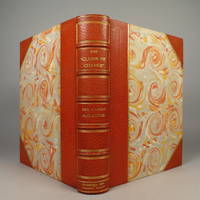
1876rif. 5071First edition in English of the I-Ching the ancient Chinese book of divination sometimes attributed to Confucius but actually much earlier possibly with origins in the second millennium and so the most ancient text of Chinese Civilization. OCLC lists but eight copies worldwide. In McClatchie's view Qian and Kun represented the "God of Heathendom. Qian or his Male portion… and Kun or his Female portion …. These two he goes on to say "are enclosed in the circle or ring… known as the Supreme Ultimate or Great One from which all things are generated." His contemporaries "ridiculed this decidedly sexual view Shchutskii described it as the product of "pseudoscientific delirium" but recent work by other scholars suggests its essential validity. Richard J. Smith "How the Book of Changes arrived in the West". This copy very handsomely bound by Bennett of New York about seventy years ago in grained sienna morocco with title & author in double gilt ruled spine compartments; tooled hubs; top edge gilt. "Shanghai 1876" and owner's name to foot of spine. Preliminaries slightly foxed. xiii vii -xiii of which are platesixvii455 i errata. Chinese and English on opposite pages. "Shanghai Nov. 1876" in light pencil to front fly. Slight loss of paper to front board. Please see images. American Presbyterian Mission Press, Trubner & Co. hardcover books
In-folio (mm 298 195). Carte [250], con la prima bianca; [52]. Collazione: a-G8 H10 i-U8 x10 A8 B12 C-I8; AA-DD8 EE FF10. Spazio delle iniziali vuoto con suggerimento di lettere. Carattero romani (R 94) su 55 righe. Copia con ampie ma leggere macchie di umidità alle pagine iniziali, alcune più marginali alla fine. Legatura in pelle coeva su tavole di legno, con motivi arabeschi impressi sui piatti, dorso con titolo manoscritto su carta; con difetti. Ex-dono del XVI secolo sulla pagina del titolo, alcune glosse dalla stessa mano nel testo.
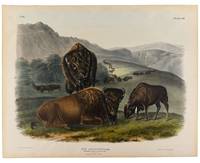
1849rif. 42915New York: John James Audubon 1849. First edition hand-colored lithograph by John T. Bowen of Philadelphia after John James Audubon. An iconic image of Western Americana from the folio first edition of Audubon's "Quadrupeds of North America" the greatest work of natural history illustration produced in America during the nineteenth century: "As long as our civilization lasts America will be in debt to this genius." Peterson This fine plate is from the folio edition of Audubon's The Viviparous Quadrupeds of North America which was produced entirely in the United States. The work was Audubon's last and by 1846 he had to hand over the drawing of the final fifty plates to his sons John Woodhouse and Victor Audubon. The production of the Quadrupeds was begun by Audubon and his sons at about the same time as the commercially-successful octavo edition of The Birds of America. Unlike the double-elephant folio the Quadrupeds was produced entirely in the United States. Reese notes that "By 1843 the Audubon family business was a well-oiled machine involving John James his two sons and various in-laws and friends. The octavo Birds was still in production when Bowen began to produce the plates for the folio edition of the Quadrupeds the largest successful color-plate book project of 19th-century America. It took the family five years to publish 150 plates in thirty parts. The massive project was a commercial success thanks to the close management of Victor. There were about three hundred subscribers." Reese Like Birds of America the Viviparous Quadrupeds was intended to be a comprehensive visual catalog of North America animalia with Audubon's focus here shifting from birds to four-legged land mammals. Accompanying each image was correlating didactic text written primarily by Bachman that informed the reader of the animal's habits diet habitat and gestational period. Totaling 150 prints the project was rushed to completion as Audubon's health declined. Emerging in the shadow of its acclaimed predecessor Birds of America the Viviparous Quadrupeds has not received the adequate attention nor recognition it so richly deserves. This image is of a family of American buffalo the most iconic animal indigenous to North America whose presence was integral for Native American life and whose near-extinction spurred on the conservation movement in the US. The buffalo is today the state animal of Kansas Oklahoma and Wyoming. Bennett p.5. Peterson Birds of America passim. Reese Stamped with a National Character 36. Sabin 2367. Wood p.209. John James Audubon unknown
1686rif. 28626Padoua: Cadorino 1686. Quarto. 32 298 10 Indexpp. including a portrait of the author. Half title. Contemporary vellum manuscript spine title First issue of Terra Rossa's famous account detailing discoveries in the New World as denoted by the 1686 date and the privilege below the imprint reading "Et Privilegio del Serenissimo Principe." Includes much information on Venetian explorers going so far as to credit Marco Polo with discovering Australia and attempts to rename Terra Australis as Terra Australe Magallanica to honor Magellan. In this work Terra Rossa "attempted to prove that Venetians had discovered all lands unknown to the ancients including America and Terra Australis." Hiatt p. 261. He also defends the claims of the Zeno brothers to have made a northern discovery of America prior to Columbus. A rare and surprisingly little-known work focused on early exploration of the Southern Hemisphere. Sabin 94858; European Americana 686/157. Cadorino unknown books
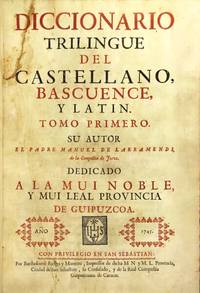
1745rif. 42910San Sebastian: por Bartholome Riesgo y Montero impressor de dicha M N y M.L. Provincia 1745. First edition 2 volumes folio pp. 18 ccxxix 1 436; 2 392 12; titles printed in red and black lexicon in double column engraved amorial headpiece errata leaf at the back of vol. II; full 19th-century speckled calf red edges double gilt-ruled borders on covers gilt-decorated spine in 6 compartments red and black morocco labels in 2; a few minor imperfections hinges tender else a very good sound set. Bookplate of "Milton / Peterborough." This is the first dictionary of Basque preceeded only by Oihenartus' Notitia utriusque Vasconiae tum Ibericae tum Aquitanicae Paris 1638 to which was appended a Basque word list. Larramendi also compiled a Basque grammar 1729. Entry words are in Castilian with Basque and Latin equivalents. The 230-page introduction is an extensive history and grammar of the Basque language the only non-Aryan language of western Europe and a language unaffilliated with any other. Not in NUC. Not in Collison Dictionaries of Foreign Languages; Trubner Catalogue of Dictionaries and Grammars cites only the 1853 revision. Zaunmuller col. 28. por Bartholome Riesgo y Montero, impressor de dicha M N y M.L. Provincia unknown books
1865rif. 219705Shanghae sic & London.: London Mission Press and Trubner & Co. 1865. Two volumes in one: Volume I. ii Title i-x Advertisement Preface 762 pp including Index of Chinese characters pp 1-99 pagination duplicated for pp 224 & 239. Volume II. ii Title 724pp iv List of the Radicals of the Chinese Language. 22 x 15 cm contemporary half calf spine gilt between raised bands expertly rebacked mounting the original spine numerous annotations and underlinings in pencil a handful in ink at the head the final blanks with notes and translation age-toned and worn boards rubbed but a good complete copy of the scarce reprint. Provenance: With the early inked signature of "Hugh Wadell Newchwang 1869" the pioneering missionary whose work laid the foundation for the Irish Presbyterian Church's long-term presence in East Asia. In 1869 Waddell 1839–1901 landed at Newchwang now Yingkou where he established a mission station that included a church school and dispensary. His daughter was Helen Waddell poet scholar and theological novelist. Recent signature of A. Allan Shearer Wellington. Scarce reprint of the second part of Morrison's Dictionary first published between 1815 and 1823 with a notable provenance. The 1865 reprint was issued as a single volume combining the second part of the dictionary with an index of characters arranged according to the Kangxi radicals. "The Second Part of Morrison's Dictionary has been generally commended by experienced Sinologues as the most perfect and useful of the whole. The present is merely a reprint of it with such slight modifications as are mentioned at the close of the original preface." Preface Löwendahl 1334 . London Mission Press [and] Trubner & Co. hardcover
1745rif. 42910San Sebastian: por Bartholome Riesgo y Montero impressor de dicha M N y M.L. Provincia 1745. First edition 2 volumes folio pp. 18 ccxxix 1 436; 2 392 12; titles printed in red and black lexicon in double column engraved amorial headpiece errata leaf at the back of vol. II; full 19th-century speckled calf red edges double gilt-ruled borders on covers gilt-decorated spine in 6 compartments red and black morocco labels in 2; a few minor imperfections hinges tender else a very good sound set. Bookplate of "Milton / Peterborough." This is the first dictionary of Basque preceded only by Oihenartus' Notitia utriusque Vasconiae tum Ibericae tum Aquitanicae Paris 1638 to which was appended a Basque word list. Larramendi also compiled a Basque grammar 1729. Entry words are in Castilian with Basque and Latin equivalents. The 230-page introduction is an extensive history and grammar of the Basque language the only non-Aryan language of western Europe and a language unaffilliated with any other. Not in NUC. Not in Collison Dictionaries of Foreign Languages; Trübner's Catalogue of Dictionaries and Grammars cites only the 1853 revision. Palau 132048; Zaunmuller col. 28. por Bartholome Riesgo y Montero, impressor de dicha M N y M.L. Provincia unknown
In-4to piccolo, (36), 121, (1) pp., 10 tavole. Completo delle 56 silografie nel testo (molte delle quali a piena pagina) e delle 10 tavole incise in rame fuori testo, una delle quali (cuore) con volvelle. Vitello coevo, dorso ben restaurato.
1809rif. 120049NY: E. Sargeant Printed by Opposite Trinity Church.by D&G.Bruce. Good. 1809. First Edition. Hardcover. 5x8". GOOD CONDITION. Front endpapers gone missing.Opens to title page.Otherwise quite nice.lite foxing to pages. Name in pencil inner back cover "Arthur Smith" ; .bright fully readable Gold spine titles on smooth brown leather spine strip. Marbled brown paper covered hard boards. smooth brown leather tips.showing minor rubs to oints & spine ends. not worn. Hinges showing at inner gutters. Text block is solidly bound.Text paper has pliable feel cleanly inked type and not at all brittle. Clean foredges. ; 387xvi pages pages; This might make a nice gift for a member of the CHARLESTON SOUTH CAROLINA FIRST SCOTS PRESBYTERIAN CHURCH IN THE LOW COUNTRY .WHICH STILL IS A THRIVING INSTITUTION.; Signed by Author . E. Sargeant Printed by Opposite Trinity Church.by D&G.Bruce hardcover
1874rif. ABE-1727052845992C. O. Beauchemin & Valois Montreal 1874 A first edition of this important work signed by the author to another missionary worker in the "Nord-Ouest d'Amerique" as he inscribes. A true rarity signed by the author with databases showing no other copies in archived auction results. Book is preserved quite well with a period quarter leather binding with recipient's name stamped at bottom of spine. Unfortunately the map at p. 708 is not present but the fold out verb chart at page 136 of the Grammaire is. A wonderful copy fit a collector or an institution. Satisfaction guaranteed. Additional photos always available on request. Shipped in a fitted padded box. Inscribed by Authors. 1st Edition. Hardcover. Very Good. C. O. Beauchemin & Valois, Montreal hardcover
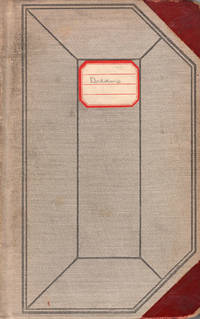
1908rif. 0001530CINCINNATI OHIO OH. Good. 1908. On offer is an interesting very detailed archive of 18 original manuscript diaries handwritten by Cincinnati Ohio Reverend Charles G. Reade a man who is consumed by his visits with the poor the grieving the orphaned and needy. Educated prolific and meticulous he rarely misses a day right up until the end of his life. The 18 volumes are dated between 1908 and 1940 with 1915-1918 conspicuously absent and perhaps due to chaplain service in the military. Very detailed there are accounts of visits to the homes of those who've died from influenza and scarlet fever every visit records names and addresses and every restaurant visited. There are also travels recorded including Toronto and Detroit. The Reverend also records weather for every day but most importantly we learn of this pious dedicated man's every good deed every sermon and collector's and historians of the Cincinnati area is a detailed picture of Depression era and pre-World War II Ohio. It is apparent right from the early years that this man is unbelievably tireless in his devotion to the church and community. After the first years there is scarcely a day that passes in which he does not record going out into the community to lead sermons and teachings attend or preside at funerals marriages births and baptisms. When he writes "in office" or "at desk" one almost gets the feeling that there's a lot of guilt in it. Here are some snippets: January 31 1910: "Read Morning Prayer at 9. Taught 4th & 5th grades. Gave help to __ __. He has a job. Unpacked 100p. books & 100 hymnals belonging to city Mission Society. After lunch had funeral of Mrs Clara Hall at Central & 7th & Wesleyan Cemetery. She was probably murdered. Called on Kountz a patient from City Hospital at 3563 Colerain Ave. Paralyzed. Has wife &2 children." Excerpt from Tuesday October 22 1929: "President Hoover's visit to city. At desk in a.m. Wrote several letters. had burial services for Augeust Miller aged 53 died Sunday oct 20. Had been in Longview Hospital a long time." Finally on December 23 1940 Reverend Reade wrote his last entry: "Went to Dr Stewart Hagan's in taxi with Mrs Schreiber. Mr Henry G Mather took me -- taxi $15. Mr & Mrs Gentry & Robert called on us. They are going to Atlanta Ga. Gave $1 to colored clergyman. Talked to Lewis at Marietta O." Then on December 24 1940 Christmas Eve there is a single entry noting Eternal Rest and signed by his son Lewis Reade. Each book is a standard dated yearbook and were in different formats by years; the smallest format is about 3.5 by 6 inches and the largest is about 4.25 by 7 inches. Overall G. BIOGRAPHICAL NOTES: One learns from one annual: "Rev. Chas. G. Reade" he was born September 18 1865 and he "took charge" of St. Stephen's Episcopal Church in Cincinnati in 1921. His family originated from the UK he was married to a woman named Nora who returned to England in her last years and had at least two younger brothers who were also reverends in England. He lived to the ripe old age of 75 and kept his journals faithfully right up to the day he passed away. EDITOR'S NOTE: We have an earlier group of four diaries of Reade's time in Dayton listed seperately Seller Id# 0001304.; 16mo - over 5¾" - 6¾" tall; KEYWORDS: CINCINNATI OHIO EPISCOPAL CHURCH LEWIS READE CHRISTIANITY CHRISTIAN OUTREACH COMMUNITY SERVICE SOCIAL STUDIES DEPRESSION ERA MIDWEST PRE WORLD WAR II WORLD WAR 2 WWII WW2 RELIGION ECCLESIASTICAL ECUMENICAL EPISCOPALIAN WORLD WAR I WWI BAPTIST EPHEMERA HANDWRITTEN MANUSCRIPT DOCUMENT LETTER AUTOGRAPH DIARY JOURNAL LOG KEEPSAKE WRITER HAND WRITTEN DOCUMENTS SIGNED LETTERS MANUSCRIPTS HISTORICAL HOLOGRAPH WRITERS DIARIES JOURNALS LOGS AUTOGRAPHS PERSONAL MEMOIR MEMORIAL PERSONAL HISTORY TRAVEL antiquité contrat vélin document manuscrit papier Antike Brief Pergament Dokument Manuskript Papier oggetto d'antiquariato atto velina documento manoscritto carta antigüedad hecho vitela documento manuscrito Papel . unknown
In-folio; (54)-356-(1)-(1)-303-168 pp.; occhietto, antiporta allegorica riccamente incisa che illustra la rifrazione della luce attraverso le lenti e l'insegnamento del disegno con il compasso, grande marca tipografica dell'editore incisa sul frontespizio, titolo in rosso e nero, numerose illustrazioni e figure su 87 tavole incise; legatura coeva in pelle con filetti in oro, medaglione centrale con stemma rimosso, tagli spruzzati rossi.
rif. 226396Paris, Au Bureau de l'Annuaire de la Noblesse et Champion, 1894 (1909) 12 vol. in-4 et 1 album in-4, demi-percaline rouge à coins à la Bradel, dos orné, premier plat de couv. cons. (reliure légt post.). Dos légt passé. Ex-libris J. de Lazerme. Bon exemplaire.
1929rif. 35573Darmstadt: Alexander Koch 1929-1944. Disponibili le 16 annate pubblicate dal 1929 anno XL fino al 1944 anno LV e fine della pubblicazione. Le annate 1929-1935 solidamente legate in volumi di cm. 32 mezza pergamena dell'epoca con titoli in oro su tasselli ai dorsi il 1929 in tela editoriale decorata. Le successive annate 1936-1944 in fascicoli sciolti con brossure orig. ill. Complessivamente eccellente stato di conservazione. Ca. 8.000 pagine con migliaia di illustrazioni e tavole fuori testo anche a colori. Si segnala che i fascicoli 7 e 8 del 1940 sono due numeri speciali sulla Germania alla VII triennale di Milano gli anni 1943 e 1944 inoltre sono composti da meno fascicoli in quanto il periodo bellico impose il passaggio della rivista da mensile a trimestrale per poi decretarne la fine nell'aprile 1944. Ampia ed interessante documentazione sull'arte decorativa per la casa in cui vengono raffigurate tutte le avanguardie del design del tempo prevalentemente riguardante il mobilio l'arredamento le stoffe e l'illuminazione. Alexander Koch hardcover
1824rif. 0009038MANCHESTER UK ROTTERDAM HAGUE NETHERLANDS HOLLAND. Good. 1824. On offer is a short but fascinating travel book of one wealthy young Englishmans journey to Rotterdam and The Hague Holland in 1824. It is a unique and rare look at the travel of English aristocracy in the first half of the 19th century the last great age of the English landed gentry. The book is 30 pages in length of which writing is on every single page. Every page is filled with excursions observations and examples of lavish living for William Money his father and his cousin as they travel first to Rotterdam and then spend over a month in The Hague living at quite a fancy hotel exploring the city itself and taking day trips to landmarks around the country. The little book also includes descriptions of lavish dinners and days being waited on driven and doted on by servants and friends. It begins in the Summer 1824: June 25 1824. To commence my narrative I will give a short account of the two last days before our embarkation to Holland. I went to bed rather late on Sunday and was very tired. I had been running about Town the whole day had my teeth filed By the abominable dentist which is one of the Miserries of human life. My head was distracted in short I was a picture of misery.; June 26. The servants awoke me rather early this morning about five OClock however I was much refreshed and went to work like one who had done nothing but I forgot to state that I went to dine at a Gentlemans house on Friday and after all when I came home I had to prepare my things for Holland. Well to go on with my story we get off from No. 9 Manchester Street Manchester Square at 6 oclock this was Saturday morning June 26th 1824 our Party consisted of three my precious Father my cousin and myself. We had a gentleman's carriage to take us about town and a hackney coach to carry our luggage to the Tower that place which has executed French of the greatest and has been destroyed with Royal blood by the hoards of unnatural rebellion. The next day they are on a sailboat going from the East Coast of England and then landing in the Netherlands the next day: June 27th. Went on deck. I was expecting to see nothing but blue skies and the watery ocean but was pleasantly astonished at seeing land all around. This was lacey land I Know it by that name because the Dutch gobble so. We soon got into the river Maas after a fine voyage. We then eat our hearty breakfast.We here took up a pistol and tacked along at a fine rate saw plenty of Tony-legged bison which they called Storks. We got to Rotterdam at 12. From the instant of arrival Money is taken aback by how clean and orderly the Dutch cities are and how kind and lovely the Dutch people are as well. The layout of the cities with the canals and bridges also is commented on quite frequently. June 28th1824. We took Breakfast at Home. we went out with with and enjoyed the town. It is an elegant clean looking place. Trees shaded the walk from the burning sun and canals divide the Principal Streets. However we saw nothing no hous as they call it but came home to dinner at 4. Here we had a bottle of Mousel for dinner we went out again so that I was very tired we then came home and had tea at Mr. Mackplats where we had another Prayer and a delightful conversation. He accompanied us home where I soon got to bed and fast asleep.; After two days in Rotterdam it is off to the Hague where Money and his father and cousin will spend the rest of their time in Holland. Drove off to the Hague with which Place we are most highly delighted. I the beauty of it. It far surpassed my places that I have seen. We walked everywhere the People the PLace and all are so clean. We came to the Hotel de Belle where we have so very nice rooms that had attendance the man who drove us here cheated as that. We were not long here before . Of the gentleman who got these rooms for Papa he took us out to Table d`ote d`hotewhere we dined . This was 4 oclock and had an excellent dinner and a bottle of vin ordinaire called Bordeau.after dinner we went to Mr. Ls house to get him to show us the Place. He showed us everything in the wood.` The `wood` is most probably the Haagse Bos a rectangular neighbourhood and forest in the Haagse Hout district of The Hague Netherlands. This was simply called Die Hout The Woods Mr. L.made a capital bargain with the man only one Golden to go to that sweet Ducking Place the old man of the Place has fishing boats to go over to England for something or other. We came back after a good bathe.We then came home and prepared for dinner and went to Table Doht d`hote and after that we came back and then went to the Wood where we had tea.; After early June there are no entries until late July. July 23 1824. We got up at seven and had breakfast. We set off at 8 in a caravan with Mr. London and Mr. Tosc. We reached Leyden at 9 very much interested.We first went to the University where we saw all of plenty Indians what from all parts of the globe. We saw there a tree which was brought from Egypt in 1573 just about the time when Leyden was besieged. It was made a present by William the first and planted there We then went to the museum and saw curious specimens of all types. Mr. London went to the Anatomy Hall to gut us to see a Head. He came back saying we could only see one which was most beautiful all the views of the Head Neck and parts of the body it was very interesting.; Money also has a deep regard for the engineering works of the day and has a special fascination for the canals and waterways of Holland. We had dinner and then went to to see the sluis the most Beautiful work I ever saw. It was begun in 1784 and finished in 1787. The whole country was inundated by the overflowing of the Bacchus of the Nile. It was like a sea but now these are houses where there was formerly nothing but water. This formed so when the sea is very boisterous there's a good deal of sand connected to the side of the gate so that it is had to clear away as it is on the sea side. The way they do it is the precipe overflows then they lift the gates all of a sudden which goes with such force that it forces the sand away.`` This is accompanied by a page-length drawing of the canal with it`s locks and steps and houses on each sides. The drawing is amateur but well done. The book is in very good shape structurally. The writing is clear and concise script done in black ink. A few pages have some smudging and one page in particular has a good bit of ink fading but which impedes legibility but does not make it impossible. The front cover of the journal states: `Short account of a holiday spent in The Hague by William Money later Rev. William in the summer of 1824 when he was 22 years old.` This is not in Money`s handwriting and was added later by an unknown person.; Manuscript; 8vo - over 7¾" - 9¾" tall; KEYWORDS: HISTORY OF REVEREND WILLIAM MONEY ENGLISH GENTLEMAN LANDED GENTRY 19TH CENTURY ROTTERDAM MANCHESTER ENGLAND UNITED KINGDOM THE HAGUE DEN HAAG DIE HOUT LEYDEN LEIDEN THE NETHERLANDS HOLLAND CANALS IN THE NETHERLANDS FLOOD CONTROL EXTRAVAGANT TRAVEL TABLE DHOTE SLUICE GATE AGE OF BRITISH NOBILITY COLONIAL ERA ENGLAND BRITANNICA HANDWRITTEN MANUSCRIPT DOCUMENT LETTER AUTOGRAPH WRITER HAND WRITTEN DOCUMENTS SIGNED LETTERS MANUSCRIPTS HISTORICAL HOLOGRAPH WRITERS AUTOGRAPHS PERSONAL MEMOIR MEMORIAL ANTIQUITÉ CONTRAT VÉLIN DOCUMENT MANUSCRIT PAPIER ANTIKE BRIEF PERGAMENT DOKUMENT MANUSKRIPT PAPIER OGGETTO DANTIQUARIATO ATTO VELINA DOCUMENTO MANOSCRITTO CARTA ANTIGÜEDAD HECHO VITELA DOCUMENTO MANUSCRITO PAPEL . unknown
1919rif. 45031N. P. Most Likely Cleveland: Written by Reverend Orville Ernest Watson 1919-1941. 1919-1941. First & only edition. 8vo. Decorated cloth with leather corners two leather spine labels and raised bands 300 pp. with every entry dated and printed in ink. All 300 pages are full to completion as Reverend Watson recounts his dreams. The 300 page diary covers the years 1919 to 1941 and provides a unique and sometimes disturbing glimpse into his thoughts and mind. The dreams as described range from typical dreams that any person may have although a number are about his brother and others are horrific nightmares and the surrealistic. On July 4 1919 he vividly describes a nightmare; on July 23 1919 he recounts a horrible dream about a jealous husband; on March 29 1921 a political dream; on March 21 1923 a sea dream; on Feb. 4 1924 he visits his old home town in his dream; on January 22 1927 a dream that with his brother they visit a cemetery in Cincinnati; and much much more. Orville Ernest Watson was born in Westfield Center Ohio on December 1 1857 the son of Joseph Watson a physician and his wife Eliza or Ella Jane Mills. Orville's three siblings were Clarence Minnie and Jessie. The Watson family moved to Cardington Ohio before 1870 and Orville Watson graduated from Ohio Wesleyan University in 1882. After working as a businessman in Cardington he entered Kenyon College in Gambier Ohio as a theology student in 1889. Following his graduation in 1892 he moved to Cleveland Ohio where he was assistant rector for Trinity Episcopal Church. He eventually returned to Gambier Ohio where he died on May 17 1951. Bookplate of Orville Ernest Watson on front pastedown sheet leather corners lightly rubbed and covers lightly soiled else interior clean neat and solid. Overall a very good tight copy. Written by Reverend Orville Ernest Watson, 1919-1941. hardcover
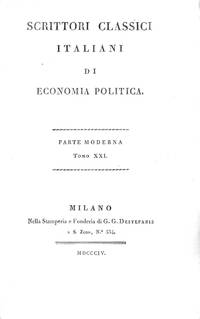
1803rif. 23804Milano: De Stefanis 1803-1805. In-8 p. mm. 221x146 brossura originale 50 volumi. Importante collana di economia curata da Pietro Custodi e composta di due serie: "Parte Antica" tomi I-VII - "Parte Moderna" tomi I-XLI 1 volume di Supplimento n. IL 1 volume di Indici generali n. L. E' questa la prima raccolta completa di notizie e studi sull'economia l'agricoltura i tributi e la moneta nonchè appendici legislative del Sette e Ottocento.La "Parte antica" raccoglie i seguenti autori: Serra Turbolo 1 volume - Davanzati Scaruffi 1 volume - Montanari 1 volume - Broggia 2 volumi - Neri 2 volumi.La "Parte moderna": Bandini Algarotti 1 volume - Belloni Pagnini 1 volume - Galiani 4 volumi - Genovesi 4 volumi - Beccaria 2 volumi - Carli 2 volumi - Verri 3 volumi - Zanon 2 volumi - Paoletti 1 volume - Ortes 7 volumi - Briganti 2 volumi - D'Arco 2 volumi - Filangeri 1 volume - Vasco 3 volumi - Mengotti 1 volume - Palmieri 2 volumi - Delfico Coriani Solera 1 volume - Cantalupo Caracciolo Scrofani 1 volume - Ricci 1 volume.Cfr. "Catalogo della Biblioteca Einaudi"5193.Nel ns. esemplare una ventina di brossure con piccoli strappi o piccole mancanze un volume ingiallito e con aloni sulle ultime 18 carte altrimenti tutti i testi con barbe sono ben conservati. De Stefanis, unknown
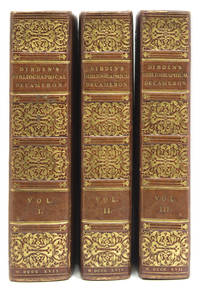
1817rif. 306787London: Printed for the author by W. Bulmer and Co. Shakespeare Press 1817. First edition with half-titles and errata. Hundreds of engravings and examples of type etc. some tinted in red and blue. 3 vols. Imperial 8vo. Contemporary straight-grained red morocco by Charles Smith covers gilt ruled with gilt side-pieces along central panel spines in six compartments with elaborate gilt scrollwork gilt turn-ins blue silk doublures with gilt cornerpieces duplicated on silk free endpapers a.e.g. Foxed minor rubbing to boards an attractive copy. First edition with half-titles and errata. Hundreds of engravings and examples of type etc. some tinted in red and blue. 3 vols. Imperial 8vo. Bound by Charles Smith. Dibdin's lavish work in an ornate binding by Charles Smith one of the more active and competent binders in London of the 1810s-'30s with his "13 Church St Soho" ticket in volume 1. Windle & Pippin A28; Jackson no.40; Hart no.186; Bigmore and Wyman pp. 169-70. Provenance: R.P. Hooper bookplate Printed for the author by W. Bulmer and Co. Shakespeare Press unknown books
1862rif. 353071862. First Edition. STERN Reverend Henry A. Wanderings Among the Falashas in Abyssinia; Together with a Description of the Country and its Various Inhabitants. London: Wertheim Macintosh and Hunt 1862. Octavo original blue cloth rebacked with original spine laid down marbled endpapers. $2800.First edition of this fascinating look at Ethiopian Jews one of the earliest obtainable works in English on the Falashas with eight tinted lithographed plates in-text engravings and one folding map.Henry Aaron Stern was born a Jew in Germany in 1820. Upon converting to Christianity in 1840 Stern joined the Hebrew College of the London Jews Society with the intention of becoming a missionary. He traveled widely working as a missionary to Jewish communities in Baghdad Jerusalem and Constantinople among other places. The London Jews Society became particularly interested in the fate of Ethiopias Jews and requested that Stern travel there. In 1863 he became a captive in Ethiopia where he was subjected to especially cruel tortures and indignities for he was charged by the king with having reflected in his book entitled Wanderings among the Falashas on the kings ferocity and with having stated that his mother was a vendor of Kosso DNB a common medicinal plant. Interior fine. Rebacked original cloth quite clean with original spine laid down. An excellent copy. hardcover
1797rif. 31165A Paris: de l'Imprimerie de Crapelet 1797-1805. Cinque volumi di cm. 135 uniformemente legati in mezza pelle rossa dorsi lisci con filetti fregi e titoli in oro piatti inquadrati da triplice filetto dorato. Esemplare fresco ed in ottimo stato di conservazione. Si tratta della collezione completa di questa serie di volumi che raccolgono relazioni di viaggio in Oriente. I tre viaggi sono così suddivisi: Volume primo: A'BDOUL-KERYM. Voyage de l'Inde a La Mekke. Pp. xxxii 246. Con 2 tavole a colori f.t. Volume secondo e terzo: A'BD-OULRIZAQ e FRANKLIN W. Voyages de la Perse dans l'Inde et du Bengal en Perse. Pp. cxxxi 1 142; 4 270. Con 4 tavole a colori f.t. di cui due a doppia pagina. Volume quarto e quinto: HODGES WILLIAM. Voyage pittoresque de l'Inde fait dans les années 1780-1783. Pp. 4 xxvii 1 222; 4 252. Con 14 tavole a colori f.t. ripiegate o a doppia pagina. Langles 1763-1824 fu scelto come curatore e traduttore di queste relazioni di viaggio per la sua profonda conoscenza della cultura e delle lingue orientali principalmente indiane. Il suo entusiastico interesse contribuì grandemente all'introduzione ed all'estensione degli studi orientali in Francia. Molto interessante e raro sprattutto quando completo ben legato ed in ottimo stato come il presente esemplare. de l'Imprimerie de Crapelet unknown
1775rif. 4402888London: F. Newberry 1775. Twelve duodecimo volumes with 117 engraved plates of 118 lacking plate XXVII 'Black tiger male panther and lynx'; preliminaries thumbed title of one volume perforated and another significantly browned one leaf of text ink-stained general foxing and offsetting; original sheep leather binding scuffed with split hinges; worn as is often the case with juvenile literature of this period but a charming set. A comprehensive natural history encyclopaedia for young people based on Pennant's system of classification. Animals are arranged according to quadrupeds fish birds and insects and each of these classifications is separately indexed. Besides the more usual natural history descriptions of animals vegetables and minerals this work is the first to describe for children Australia's most famous marsupial -- the kangaroo. The entry under the Jerboa vol. III p. 172 reads "Mr. Banks brought home the skin of an animal which he calls the kanguroo sic which from its general outline and the most striking peculiarity of its figure greatly remembers the jerboa yet it entirely differs in size and in many of those minute distinctions which point out the general ranks of nature. The kanguroo is often known to weigh above fifty pounds." The kangaroo was first seen by both Banks and Cook on 24 June 1770 and the first description of it appeared in Hawkesworth's Account of the Voyages published in 1773: "I should have taken it for a wild dog if instead of running it had not leapt like a hare or a deer. Mr. Banks also had an imperfect view of this animal and was of opinion that its species was hitherto unknown." During the remainder of the exploration of the east coast of Australia Cook records that both he and Banks shot and ate kangaroo on several occasions. He records two in particular that weighed eighty pounds and fifty-four pounds the skins of which Joseph Banks took back to England with him. Illustrations of over four hundred animals finely engraved in copper complete this charming eighteenth-century work intended solely to be used by children. . F. Newberry unknown
rif. 223838Paris, Au Bureau de l'Annuaire de la Noblesse-Picard, Paris, Champion, 1894-1911 4 vol. pet in-4 et 1 album petit in-folio, 128 planches de blasons en couleurs, bradel toile verte pour les 4 volumes, demi-toile verte à coins de l'éditeur pour l'album (reliure de l'époque). Dos passé, quelques feuilles détachées dans les volumes de texte, partiellement débrochés. Ex-libris Jacques Jourquin.
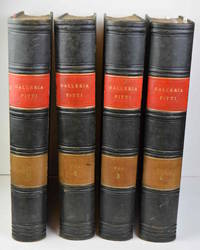
1837rif. 154574Firenze: coi tipi della Galileiana 1837-42. Quattro volumi in-folio cm. 45. Solida legatura del tempo in mezza con titoli in oro su doppi tasselli ai dorsi. L'opera comprende un totale di 499 di 501 tavole f.t. incise in rame ciascuna accompagnata da 2/6 pagine di descrizione e protetta da velina. Mancano due tavole al primo volume. Una gora alle prime 20/25 carte del primo volume peraltro esemplare marginoso pulito ed in ottimo stato di conservazione. Celebre opera munita di un apparato iconografico di grande qualità. coi tipi della Galileiana unknown
1797rif. 51574London: printed for T. Cadell 1797. Cm. 285 pp. xv 1 530 2. Antiporta illustrata e 6 carte geografiche incise e ripiegate f.t. Legatura coeva in piena pelle. dorso a piccoli nervi con ricchi fregi e titoli su tassello. Piatti inquadrati da decorazioni in oro. Qualche minimo segno d'uso alle cerniere e lievi fioriture limitate a poche pagine esemplare peraltro genuino ed in ottimo stato di conservazione. Prima edizione della versione inglese dell'opera in cui Arriano narra la spedizione intrapresa da Nearco da Creta alcuni secoli prima di Cristo. Quest'ultimo viene considerato come il viaggio che fece conoscere il territorio dell'attuale Arabia. printed for T. Cadell unknown
[Ippologia-.Giolito] (cm.20,4) Buona piena pergamena dell'epoca, semirigida. cc.34nn., pp.969 + 1 p. con il registro + 1c. con al recto la marca tipografica del Giolito con la fenice. Elegante corsivo, vari capolettera figurati e ornati. E' questo uno dei più completi e importanti trattati di ippologia che mai sia stato stampato, una specie di enciclopedia ippica. I primi due libri sono dedicati alla storia del cavallo nella letteratura e nell'arte, gli altri trattano della natura del cavallo, allevamento, maneggio, equitazione igiene, malattie, e relative cure. Cicognara 4596 la definisce: "opera la più vasta che conosciamo in questa materia". e Bongi: "vi si trova raccolto tutto ciò che era già stato scritto sul cavallo dagli storici, poeti, naturalisti, maniscalchi e cavallerizzi di ogni età e nazione". la prima edizione apparve nel 1566, questa nostra ricorretta e ampliata, è assolutamente rarissima, manca a molti repertori consultati, compreso Adams, Bm.Stc, Choix, Graesse, Brunet, nonchè ad Huth "bibliog.of Hippology" e a Mennesier De La Lance "Bibliogr. hippique". Lievissima traccia di alone al margine di qualche carta altrimenti esemplare molto bello, nitido e genuino. Il Census nazionale Iccu registra solo 9 copie nelle biblioteche italiane. Unica citazione bibliografica: *Bongi II p. 395 in nota. Libro