2662 resultados
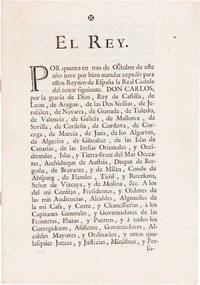
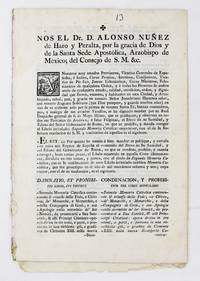
1789ref. 6490Mexico City 1789. Still very good. 9pp. Disbound. Folio. Lacking plain front wrappers. Light wear at lower edge. Scattered faint foxing and light tanning. A fascinating trilingual decree to the Spanish colonial territories of America and the Philippines featuring Latin Italian and Spanish in dual columns. The document focuses solely on the prohibition of one book which was considered particularly heinous to the Catholic Church and the Spanish Crown entitled Segunda Memoria Catolica written in 1784 by the Jesuit missionary Carlo Borgo and published by Andres Febres. The work unsurprisingly caused controversy because within the author harshly criticizes the persecution of the Jesuits accuses the crown and the church of plotting against the order and proposes that those involved be sentenced to death for treason. He further theorizes that the expulsion of the Jesuits of America together with the independence of the United States would cause the loss of the Spanish dominions in America which turned out to be prophetic or highly coincidental depending on your point of view. The present document itself contains several parts. First is the preamble by the Archbishop of Mexico in Spanish that states the authority from which the decree is issued and its subject. Second is proclamation of the Spanish king Carlos IV ordering that the work be proscribed and all copies confiscated. What follows in two columns is the brief but complete and official condemnation by the church in Latin and Italian. Then the document continuing in two columns prints the longer prohibition by Pope Pius VI "Ad Perpetuam Rei Memoriam" and an edict in Latin and Spanish from the Reverenda Camara Apostolica giving its administrative approval. The final part contains the approval of the text as it was received in New Spain by the Archbishop of Mexico and his signature. In all a very interesting look at the administration and process of the Index for Prohibited Books in a very unusual trilingual format. We locate two likely copies at Yale and the BNE. unknown books
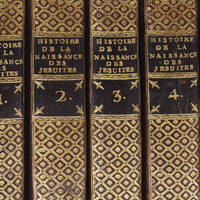
1764ref. 316736Rouen; Paris: s.n. 1764. viii. 499 6; vi 516 4; vi 447 3; vi 509 5; viii 4 311; 4 309-688 pp. 12mo. First four volumes in decorative brown paste-paper boards and sheep backs and corners other 2 volumes in full stained sheep with paste-paper endpapers backs of all six volumes uniform and richly gilt. A fine set in attractive dress. viii. 499 6; vi 516 4; vi 447 3; vi 509 5; viii 4 311; 4 309-688 pp. 12mo. Volumes I-III contain the history of the Society of Jesus from its origin until the end of the eighteenth century and the first analysis of its constitutions and privileges. Volume IV continues that analysis and has an index of the four-volume set. Barbier assigns the analysis chapters to Lois-Adrien Le Paige. Christophe Coudrette 1701-1774 was a Jansenist and the author of several anti-Jesuit works. Cioranesco 21317. Provenance: Fürstlich-Starhemberg'sche Familien Bibliothek Schloss Eferding ink stamp on front endpapers off all volumes; Loyola Reference Library stamp on lower edges call numbers in pencil on title-pages s.n. unknown books
1731ref. 58647Paris: Nicolas Le Clerc 1731. First edition 12mo pp. xlviii 449 17; contemporary full calf gilt-decorated spine in 6 compartments red stained edges; spine label perished boards rubbed and lower board starting ex-St. Stanislaus Novitiate House Library Guelph Ont. closed in 1971 with labels and a bookplate on upper pastedown and shelf label on spine text clean good and sound. Volume XX contains letters from: Dominique Parennin on missionary work in the Chinese court; Maturin le Petit on the religion lifestyle medicine government etc. of the Natchez people around New Orleans; Lombard and Fauque on their work in French New Guinea; Dentrecolles on art and flower arrangement of China; Margat on guineafowl and turkey and converting slaves and native people of St. Dominique. One volume of the 34-volume collection of Jesuit Relations and Allied Documents 1703-1776. "These volumes issued regularly by the Society of Jesus presented selections from correspondence and reports written by Jesuit missionaries then scattered around the globe" and reflected "the continued interest in France in the progress of the Jesuit missions in various parts of the world. The termination of the series reflects the suppression of the Society of Jesus by papal decree" James Ford Bell Catalogue L-368. Collectively they provided some of the most thorough reporting on China in particular to Western audiences of the period as well as early and first-hand accounts of Native American life. Howes L 299; James Ford Bell Catalogue L-368. Nicolas Le Clerc unknown books
1749ref. 58649Paris: Nicolas Le Clerc 1749. First edition 12mo pp. xliii 5 480; folding plate of chayaver plant; contemporary full calf gilt-ruled spine in 6 compartments red stained edges; spine worn upper joint starting lower flyleaf loose large tear to plate neatly mended on verso; ex-St. Stanislaus Novitiate House Library Guelph Ont. closed in 1971 with labels and a bookplate on upper pastedown and shelf label on spine text clean good and sound. Volume XXVII contains letters from: Margat on missionary activity in St. Domingue and Fauque in French Guiana plus an account of persecution in China. One volume of the 34-volume collection of Jesuit Relations and Allied Documents 1703-1776. "These volumes issued regularly by the Society of Jesus presented selections from correspondence and reports written by Jesuit missionaries then scattered around the globe" and reflected "the continued interest in France in the progress of the Jesuit missions in various parts of the world. The termination of the series reflects the suppression of the Society of Jesus by papal decree" James Ford Bell Catalogue L-368. Collectively they provided some of the most thorough reporting on China in particular as well as early and first-hand accounts of Native American life. Howes L 299; James Ford Bell Catalogue L-368. Nicolas Le Clerc unknown books
1722ref. 58648Paris: Nicolas Le Clerc 1722. First edition 12mo pp. xl 418 10; folding map of the southern coast of India; contemporary full calf gilt-decorated spine in 6 compartments red stained edges; small split on lower joint; ex-St. Stanislaus Novitiate House Library Guelph Ont. closed in 1971 with labels and a bookplate on upper pastedown and shelf label on spine text clean good and sound. Volume XV contains letters from: Jean Venance Bouchet on Bisnagar Ganga Madras Goa Visapour etc.; d'Entrecolles on Chinese medicine and industry; Ippolito Desideri on his voyage to and description of Tibet; Turpin on the Indian production of cotton etc. One volume of the 34-volume collection of Jesuit Relations and Allied Documents 1703-1776. "These volumes issued regularly by the Society of Jesus presented selections from correspondence and reports written by Jesuit missionaries then scattered around the globe" and reflected "the continued interest in France in the progress of the Jesuit missions in various parts of the world. The termination of the series reflects the suppression of the Society of Jesus by papal decree" James Ford Bell Catalogue L-368. Collectively they provided some of the most thorough reporting on China in particular to Western audiences of the period as well as early and first-hand accounts of Native American life. Howes L 299; James Ford Bell Catalogue L-368. Nicolas Le Clerc unknown books
1711ref. 58188Paris: Nicolas Le Clerc 1711. First edition 12mo pp. 24 431 11; contemporary full calf gilt-decorated spine in 6 compartments red stained edges; spine label perished boards rubbed and upper board starting upper pastedown lifting ex-St. Stanislaus Novitiate House Library Guelph Ont. closed in 1971 with labels and a bookplate on upper pastedown and shelf label on spine text clean good and sound. Volume IX contains letters on: "Oracles of the demons of the Indies"; missions to Madure; The death of Father Broissia in China; observations on the English in Peking; etc. One volume of the 34-volume collection of Jesuit Relations and Allied Documents 1703-1776. "These volumes issued regularly by the Society of Jesus presented selections from correspondence and reports written by Jesuit missionaries then scattered around the globe" and reflected "the continued interest in France in the progress of the Jesuit missions in various parts of the world. The termination of the series reflects the suppression of the Society of Jesus by papal decree" James Ford Bell Catalogue L-368. Collectively they provided some of the most thorough reporting on China in particular to Western audiences of the period. Howes L 299; James Ford Bell Catalogue L-368. Nicolas Le Clerc unknown books
1741ref. 58184Paris: Le Mercier & Boudet 1741. First edition 12mo pp. xxxii 8 486 2; contemporary full calf gilt-decorated spine in 6 compartments morocco labels in 2 red speckled edges; ex-St. Stanislaus Novitiate House Library Guelph Ont. closed in 1971 with labels and a bookplate on upper pastedown and shelf label on spine light wear to boards very good. Volume XXV contains letters on: Missions to Paraguay including comment on the language of the Chiquites; Nicobar and Carnate India; Vietnam; trials of the Missionaries to China; and the revolutions of Thamas Koulikan Nadir Shah of Iran. One volume of the 34-volume collection of Jesuit Relations and Allied Documents 1703-1776. "These volumes issued regularly by the Society of Jesus presented selections from correspondence and reports written by Jesuit missionaries then scattered around the globe" and reflected "the continued interest in France in the progress of the Jesuit missions in various parts of the world. The termination of the series reflects the suppression of the Society of Jesus by papal decree" James Ford Bell Catalogue L-368. Howes L 299; James Ford Bell Catalogue L-368. Le Mercier & Boudet unknown books
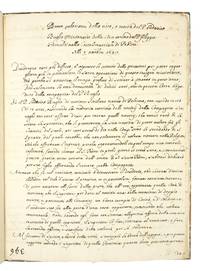
1760ref. 5489Genoa: 29 July 1760. Hardcover. Fine. Manuscript in Italian written in a neat cursive in brown/black ink on laid paper. With some minor foxing some folding lines the creases slightly flattened the bottom edge of the leaves is slightly frayed. Otherwise in very good condition. A harrowing eye-witness account by a Jesuit Father of the Province of Brazil describing the forced expulsion of the Jesuits from Brazil in 1760 the hardships they endured during their capture and the perilous journey from Brazil to Genoa via Lisbon. The author begins his narrative with the persecution suffered by the Jesuits in Brazil following the official suppression of the Order. The Jesuit colleges were thoroughly plundered property seized precious silver taken and church furnishings stripped away. They were ordered not to open the church doors or ring the bells although on three occasions the Blessed Sacrament was brought to the sick an act which deeply moved the local people. The Jesuits endured many sufferings during their captivity. They were confined under harsh conditions; guarded constantly by soldiers. Their living quarters were cramped and filthy so small that they could neither sit nor lie down comfortably. Many suffered from hunger thirst and illness and several lost their lives during this ordeal. On 16 March the journey by sea began. The voyage was nothing short of a cruel martyrdom: extreme hunger and sickness afflicted the Jesuit Fathers. One elderly and saintly Father Francesco Paolo died shortly after the journey began not from disease but from severe distress caused by lack of food and medicine. Another Father Giovanni de Matha suffered a dangerous hemorrhage and narrowly survived while many others fell ill. They arrived at the mouth of the Tagus River in Portugal on 6 June after which they were transferred under guard to a Genoese ship effectively imprisoned once again. They were forbidden from going ashore or even signaling their arrival. More Jesuit Fathers from Brazil joined them later in June many weakened and sick from the hardships endured. Tragically some who had been sent ahead to Portugal suffered such extreme famine and thirst that they resorted to drinking their own urine and several died without the comfort of the last rites which were denied by the ship's captain. The captains and executioners of the royal orders showed little compassion even as they witnessed the Jesuits' pale and dying condition. Throughout this entire ordeal a royal minister constantly monitored the Jesuits offering false hopes that they might remain in the kingdom if they renounced their order and left the Jesuit habit behind. Some succumbed to these pressures but most remained steadfast. The Jesuits also faced opposition from the Bishop of Rio de Janeiro who initially used them for missions but later prohibited their confessions and sermons accusing them falsely of heretical teachings. He even excommunicated those who encouraged perseverance in the Jesuit order. Despite all these hardships the siege imprisonment brutal sea voyage hunger disease and ecclesiastical persecution the Jesuits maintained their faith and dignity praying for peace and the restoration of their Society. In a long postscript the writer gives further news that he has received from Brazil. He describes the devotion despite the Suppression of the Brazilian indigenous novices and the bravery of the students many of whom accompanied other Jesuit fathers in a cramped ship for the long voyage to Europe. A number of students held back -reluctantly- realizing that their presence on the ship would only lead to further overcrowding and privation for the Jesuit fathers in particular those who were old and frail. With sorrow they wept on the shore as the ship weighed anchor and departed for the miserable voyage. The account closes on 29 July 1760 expressing a solemn hope that after so many disasters peace will return to the Jesuit order. 29 July hardcover books
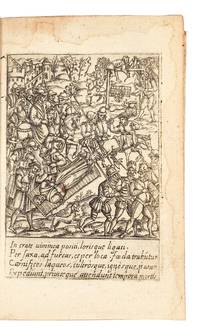
1583ref. 5484Macerata: Appresso Sebastiano Martellini con licenza de' superiori 1583. FIRST ITALIAN EDITION the second edition overall and the FIRST ILLUSTRATED EDITION. Hardcover. Fine. Bound in 19th c. ivory vellum hinges repaired at head and foot light soiling spine label fragmentary the boards ruled in gold the spine gold-tooled with repeating floral tools. Illustrated with six engraved plates of Catholic priests being abused apprehended tortured and executed described in detail below. With a woodcut title vignette of the Crucifixion a woodcut of the Pietà on leaf D7 verso printer's ornaments and woodcut initials. The text is type-ruled throughout. The text is in very good condition aside from damp-staining in gathering B and the six plates; the title page is soiled and has a small area of restoration at the upper corner as well as a clean tear mended and a little staining in the gutter. There is a light oil stain on leaf H6 and a marginal paper flaw on leaf N5. A translation with additional material of Allen's "A briefe historie of the glorious martyrdom of XII. reuerend priests executed vvithin these tvveluemonethes for confession and defence of the Catholike faith." Rheims: J. Foigny 1582. The English edition exists in only 2 copies British Library and Westminster Cathedral Library. This edition the first edition to include the six engraved illustrations is also rare. OCLC locates copies of the Macerata edition at 7 institutions in North America. see notes below for holdings. The central figure of Allen's martyrology is the Jesuit Edmund Campion 1540-1581 who at Allen's request and along with Robert Parsons led the first Mission to England. Campion and his companions were arrested on 17 July 1581. The present work recounts the arrest trial and eventual execution of Campion as well as the priests Ralph Sherwin Alexander Briant Thomas Ford John Shert Robert Johnson William Filby Luke Kirby Lawrence Richardson John Payne and Everard Hanse; as well as the Jesuit Thomas Cottam. Included in these accounts are the transcripts of Campion's final letter to the Jesuit General Claudio Aquaviva Ralph Sherwin's letter from the Tower and Alexander Briant's letter written while imprisoned to the Jesuit fathers in England requesting admission to the Society which was granted. Allen who continued to receive material up to the time of publication appended the martyrdoms of Cuthbert Maine John Nelson and Thomas Sherwood all of whom died in 1577 and 1578 to his account of the martyrs of 1581 and 1582. The translator of the present edition added an additional account not found in the English edition of the martyrdom of 4 English priests in 1583. The Engravings: The six engravings in this work first appeared in the first edition of Robert Parson's "De Persecutione Anglicana Libellus" published by the Jesuit College at Rome in 1582. Each of the six images is accompanied by a four-line explanation in hexameter verse. "The first plate depicts priests being apprehended in private houses and marched off to prison; the second in amplification shows various priests some still in their vestments being led away either on horseback or on foot but always securely bound two gentlewomen who had sheltered them being led to the same destination. In the third a priest is being scourged while tied to the back of a cart and below in the foreground an examination is in progress as preparations are made for torture. The fourth picture illustrates a racking with three other victims lined up to await their turn. In the fifth the priests are being dragged to execution on hurdles while the instruments of death are prepared; and the final plate represents the different stages of martyrdom from the hanging to the drawing quartering and burning of entrails."Anthony G. Petti in Recusant History April 1966 pp. 288-91 Edmund Campion: "Campion was arrested with his companions on 17 July 1581. Amid scenes of violent excitement Campion was derisively paraded through the streets of his native city bound hand and foot riding backwards with a paper stuck in his hat to denote the 'seditious Jesuit'. First thrown into Little Ease at the Tower he was carried privately to the house of his old patron the Earl of Leicester; there he encountered the queen herself and received earnest proffers of liberty and preferments would he but forsake his papistry. Hopton having tried in vain the same blandishments on Campion's return to the Tower the priest was then examined under torture and was reported to have betrayed those who had harboured him. Several arrests were made on the strength of the lie. He had asked for a public disputation. But when it came off in the Norman chapel of the Tower before the Dean of St. Paul's and other divines Campion had been denied opportunity to prepare his debate and had been severely racked. Thus weakened he stood through the four long conferences without chair table or notes and stood undefeated. Philip Howard Earl of Arundel who was looking on in the flush of worldly pride became thereby inspired to return to God's service. "The privy council at its wits' end over so purely spiritual a 'traitor' hatched a plot to impeach Campion's loyalty and called in the hirelings Eliot and Munday as accusers. A ridiculous trial ensued in Westminster Hall 20 Nov. 1581. Campion pleading not guilty was quite unable to hold up his often-wrenched right arm seeing which a fellow prisoner first kissing it raised it for him. He made a magnificent defence. But the sentence was death by hanging drawing and quartering: a sentence received by the martyrs with a joyful shout of 'Haec dies' and 'Te Deum'."Catholic Encyclopedia Cardinal William Allen: "On the accession of Elizabeth and the re-establishment of Protestantism William Allen was one of those who remained most staunch on the Catholic side and it is chiefly due to his labours that the Catholic religion was not entirely stamped out in England. Having resigned all his preferments he left the country in 1561 and sought a refuge in the university town of Louvain. The following year however we find him back in England devoting himself though not yet in priest's orders to evangelizing his native county. His success was such that it attracted notice and he had to flee for safety. For a while he made himself a missionary centre near Oxford where he had many acquaintances and later for a time he sought protection with the family of the Duke of Norfolk. In 1565 he was again forced to leave England this time as it turned out for good. He was ordained priest at Mechlin shortly afterwards. "Convinced that Protestant domination of England could only be temporary and that the whole future depended on there being a supply of trained clergy and controversialists ready to come into the country whenever Catholicity should be restored Allen founded the College at Douay since identified with his name. Douay was a new university founded by Pope Paul IV under the patronage of King Philip of Spain in whose dominions it then was for the special object of combating the errors of the Reformation; and what is still more to the purpose it was already under Oxford influences. The first chancellor Richard Smith was an Oxford man as were several of the most influential members of the university at the time when Allen began. It was his ambition to perpetuate Oxford influences and traditions and to make his new college practically a continuation of Catholic Oxford. "The means of support included besides Allen's private income and other voluntary donations a yearly pension of 200 ducats from the King of Spain and later on one of 100 gold crowns a month from the Pope. The number of students grew rapidly. Often more were received than the income warranted a course rendered necessary by the urgent state of Catholic affairs which Allen met in the spirit of faith; and in the long run means were never wanting. The names of Thomas Stapleton Richard Bristowe Gregory Martin Morgan Philips and others are still well known to English Catholics and are themselves a sufficient record of the ability of Allen's early companions and of the work done at the college. Allen had the power of instilling his spirit into his followers. They lived together without written rule but in perfect mutual harmony working for the common cause. From the Douay press came forth a constant stream of controversial and other Catholic literature which could not be printed in England on account of the Penal Laws. In this Allen himself took a prominent part. His writings are distinguished by extent of learning and theological acumen. One of the chief works undertaken in the early years of the college was the preparation of the well-known Douay Bible. The New Testament was published in 1582 when the college was at Rheims." "In 1575 Allen made a journey to Rome his second where he helped Pope Gregory XIII to found another college to send missionaries to England. For this purpose possession was obtained of the ancient English hospice in the city which was converted into a seminary. Returning to Douay Allen found a storm gathering against the English and in 1578 they were expelled from the town. The collegians took refuge at the University of Rheims where they were well received and continued their work as before Allen being soon afterwards elected canon of the Cathedral Chapter. In 1579 he paid his third visit to Rome being summoned thither in order that he might use his unique personal influence to adjust the dispute between the English and Welsh students at the new college there. It was during this visit that he was appointed a member of the Pontifical Commission for the revision of the Vulgate. Up to this point the career of Allen had won the universal admiration and gratitude of English Catholics for what he himself termed his 'scholastical attempts' to convert England. Such was not however the case with his political labors to secure the same end which may be said to have begun about this time and were far less successful. The famous Bull 'Regnans in excelsis' was issued by Pius V in 1570 deposing Queen Elizabeth and releasing her subjects from their allegiance but it did not take practical shape till seventeen years later when preparations were made for the invasion of England by the King of Spain. Allen was then once more in Rome whither he had been summoned by the Pope after a dangerous illness two years before. He never left the Eternal City again but he kept in constant communication with his countrymen in England. It had been due to his influence that the Society of Jesus to which he was greatly attached undertook to join in the work of the English mission; and now Allen and Father Parsons became joint leaders of the 'Spanish Party' among the English Catholics. "At the request of King Philip Allen was created cardinal in 1587 and held himself in readiness to go to England immediately should the invasion prove successful. In estimating the number of those who would be adherents to the scheme however Allen and Parsons were both at fault. The large majority of English Catholics generously forgetting the past sided with their own nation against the Spanish and the defeat of the Armada 1588 was a subject of rejoicing to them no less than to their Protestant fellow countrymen. Allen survived the defeat of the Armada six years. To the end of his life he remained fully convinced that the time was not far distant when England would be Catholic again. . He continued to reside at the English College Rome until his death 16 October 1594. He was buried in the chapel of the Holy Trinity adjoining the college." Catholic Encyclopedia. Appresso Sebastiano Martellini, con licenza de' superiori hardcover books
1683ref. 5517Rome: ca 1683. Hardcover. Fine. Bound in modern marbled papered boards with leather title label in gilt to the upper board. 17th c. manuscript in ink in a fine secretarial hand on laid paper with watermark of an anchor within circle. Fine condition leading edge untrimmed. A little light spotting on the first leaf very slim portion of leading edge of fourth leaf a little ragged and dust soiled. A report on the life death and funeral of the Sicilian Jesuit Ludovico Buglio 1606-1682 called Li Leisi Chinese: åˆ©é¡žæ€ a distinguished missionary and scientist at the Chinese imperial court in Peking during the late Ming and early Qing dynasties. It was written by Buglio's fellow Jesuit and friend Filippo Grimaldi Chinese: Min Ming'o 1638-1712 who arrived in China in 1671. Grimaldi was present at his confrère's funeral where he tells us that he partook of Manchu tea and wine offered to the mourners. This account which contains information not reported elsewhere remained in manuscript until the 20th century. In addition to our manuscript three other copies are known one of them in the Jesuit archives Rome: Fondo Gesuitico A.R.S.I. Archivum Romanum Societatis Iesu 722/4; another in the Vatican: A.S.V. Archivio Segreto Vaticano Miscellanei dei Gesuiti arm. VIII 58 ff. 16r-21v; and the third in the State Archives Rome: Archivio di Stato Roma Gesuiti Miscell. Pacco 5. Ludovico Buglio labored in China for forty-seven politically turbulent years. He established the first mission in Szechwan Sichuan Province where he carried out intensive evangelization despite opposition from local Buddhist and Daoist clergy built churches at Baoning Chongqing and Peking served as astronomer for the rebel Zhang Xianzhong who raised Buglio to the rank of mandarin and was instrumental in restoring the Imperial Observatory at Peking to Jesuit control. Buglio was imprisoned twice exiled once and narrowly escaped execution. An arrow wound inflicted by a Manchu warrior in 1647 never fully healed leaving Buglio in intense pain for the rest of his life. The wound ultimately proved fatal. In a letter transcribed in this manuscript addressed to Buglio's fellow Jesuits in Peking the Kangxi Emperor lamented Buglio's prolonged suffering and imminent death and announced that he would assist with the funeral expenses. The Emperor's letter is followed by Grimaldi's eyewitness account of the funeral which was overseen by imperial delegates who also participated in the traditional Chinese funeral honors. Renowned for his mastery of spoken and written Chinese Buglio wrote and published a large number of Chinese-language works a list of which is appended to this manuscript. Among the most important of these were "Yulan Xifang Yaoji" "Imperially Commissioned Essentials of the West" presented to the Kangxi Emperor around May 1669 and a translation of Aquinas' "Summa Theologica" titled "Chaoxing xueyao" "Compendium of the Science of the Supernatural". The author and his account: Grimaldi "was one of the most capable and courageous missionaries; he arrived in China during a time of persecution when with the exception of four Fathers remaining in Beijing the other missionaries had been rounded up and held prisoner in Canton twenty-five in total: fourteen Jesuits ten Dominicans and one Franciscan. Upon arriving in Macau the young Fr. Grimaldi secretly made his way into Canton in December 1669 to take the place of a missionary-Fr. Navarrete the Dominican superior-who had escaped from prison; his absence had it been discovered could have seriously jeopardized all the prisoners. In 1671 when the missionaries in Canton were released Fr. Grimaldi was summoned to Beijing to assist Fr. Verbiest and gave science lessons to Emperor Kangxi himself. In 1685 the Emperor sent him to Russia to negotiate with the Tsar regarding the passage of Chinese merchants and European missionaries through Russian territory; however he was unable to achieve this objective and after an absence of seven years he returned to Beijing where he died in 1712."Barbera Grimaldi was well-positioned to write this account of Buglio's life. He labored alongside Buglio for twelve years and it can be assumed that those things that Grimaldi did not witness personally were communicated to him by Buglio himself and other Jesuits chief among them Buglio's close companion Gabriel Magalhães who was with Buglio from the time of his work in Sichuan province through his time in Peking. This accounts for the level of detail that Grimaldi is able to present in his account such as in the story of the providential removal of the arrow that had become lodged in Buglio's body after he and Magalhães were mistaken for spies and shot by Manchu soldiers: "a piece of arrow so tenaciously lodged in his body that Father Magalhães was never able to draw it out either with his hands or with his teeth. Magalhães though he was gravely wounded in one arm strove to find in the wilderness something with which to draw the arrow out; and behold before his eyes there appeared a pair of pincers which seemed to have been brought by his guardian angel for that very need alone with which full of joy and wonder he gave thanks to divine providence and freed Father Buglio from that affliction." The Emperor's letter & Buglio's Funeral: While Buglio lay on his deathbed the Emperor having heard about Buglio's illness through Zhao Chang a member of the Imperial Bodyguard sent a letter to the Jesuits which Grimaldi gives in full. In appreciation for Buglio's years of service to his father and himself his dedication to Chinese language and culture and "because you are men from beyond the sea and Father Ludovico now lies dying in this city far from his own country without kinsfolk to assist him" the Emperor informs the Jesuits that he will arrange and pay for Buglio's funeral. With the letter comes a gift of "two hundred Foè that is two hundred gold scudi and ten pieces of silk as a token of the regard I have held for the father and of how greatly his loss grieves me." The funeral rites included an impressive procession: "The Emperor in every way wished the funeral conducted according to his own affection and not according to the modesty proper to our institute. Twenty soldiers were sent by the Emperor to clear the streets as far as the burial place. At the head of the procession walked a standard raised aloft on which was written in large characters the Father's name together with the many praises and honors the Emperor bestowed on him and a copy of the Emperor's own letter in praise of the deceased on yellow satin silk a color reserved to His Majesty alone. There followed Father Buglio's image above which were written two very large characters signifying that this imperial decree had been issued in memory of the great esteem in which the deceased had been held. In the place of highest honor was set the Holy Cross with the images of St. Michael and Our Lady amid many censers and incense and choirs of diverse musical instruments." "Then followed more than five hundred Christians clothed in mourning and finally gentlemen without number preceded by the court officials sent by the Emperor for this purpose. This whole procession having at last arrived at the place granted us by the late Emperor for the burial of the fathers the funeral was carried out - with great modesty on the part of the Christians and equal reverence on the part of the gentiles." Grimaldi closes his account explaining that while he would like to write more the letter courier is about to leave for Macau and so he must stop where he is. The list of Buglio's Chinese Works: Grimaldi applauds Buglio's remarkable success in mastering Chinese which allowed him to forge close relationships with the Chinese literati and the mandarins. "He accomplished much by writing.understanding very well how highly letters are prized in China and how gentle and how powerful a means the spreading of books is for instilling the holy law of Christ. From the very beginning of his arrival in China he lost no time in advancing himself in Chinese letters language and books and to this end he had all the walls of his room covered with Chinese characters." The manuscript closes with a list of 23 of Buglio's Chinese works including the aforementioned "Yulan Xifang Yaoji" and "Chaoxing xueyao" as well as translations of the Roman Missal 1670 Breviary 1674 and Ritual 1675. Other works some on scientific matters addressed to the Emperor include "Shizi shuo" "Discourse on Lions" 1678 written when the Portuguese gave the emperor an African lion based largely on Ulisse Aldrovandi's "Book of quadrupeds" Bologna 1645 and "Jincheng ying shuo" "Discourse on Falcons offered to the emperor" 1679 written at the emperor's request after he admired the illustrations in Aldrovandi's "Ornithology". This work was later excerpted with attribution into the imperial encyclopedia "Gujin tushu jicheng" 1728. See Lo Nardo P. Ludovico Buglio S.J. 1606-1682 in Intorcettiana Anno II - N. 3 gennaio-giugno 2020; Pfister Notices biographiques et bibliographiques sue les Jésuites de l'ancienne mission de Chine 1552-1773 tome I Chang-Hai 1932 pp. 372-376. ca hardcover books
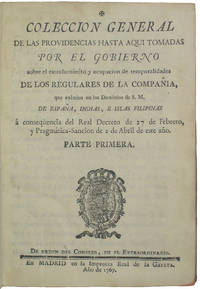
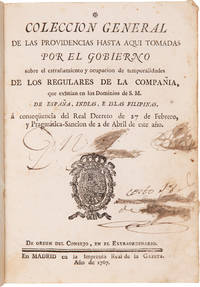
1784ref. 44155Madrid: En la Imprenta Real de la Gazeta 1784. First edition. Contemporary mottled calf compartments decorated in gilt red morocco spine label titled in gilt sewn in green silk ribbon marbled endpapers. A very good copy head band worn with a small chip and a tiny split at the joint owner's bookplate and booksellers engraved plate on front pastedown contents quite bright and clean. 104 91 135 144 4 74 pp. 4to. Five volumes bound in one. Parts 1 2 3 set in condensed type; parts 4 and 5 in expanded type. Royal decrees from Charles III and instructions decisions and regulations issued by the Consejo en el Extraordinario and its president the Conde de Aranda and others--concerning the expulsion of the Jesuits. "These collections contain the documents relative to the expulsion of the Jesuits from the Spanish dominions and the confiscation of their property including the names of the colleges and houses of the order the application of the confiscated property &c. A complete series consists of five parts which are rarely found together. Our collation is of parts I. to III. only" Sabin 14304. Part 4 p. 75-127 contains the papal brief "Dominus ac Redemptor" by Clement XIV in Latin and Spanish. Earlier versions containing parts or all of the first three sections are not all that uncommon but those containing all five parts remain relatively rare. Other than this copy only two others have appeared in the auction records of ABPC and RBH since 1953 the first at the John B. Stetson sale at Parke Bernet and the second at Bonhams in a modern binding and dampstained. Palau 56516. See Sabin 14304. Medina BHA: IV 4228. En la Imprenta Real de la Gazeta unknown books
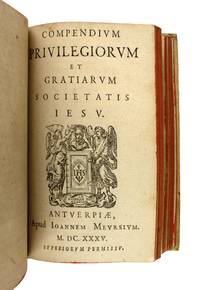
1635ref. 49307Antuerpiae Antwerp: Apud Ioannem Meursium Joannes Meursius 1635. Very Good. Antuerpiae Antwerp: Apud Ioannem Meursium Joannes Meursius 1635. Two octavo volumes bound in one; bound in contemporary vellum with manuscript title to spine; edges stained red; 384 20pp.; 164 4pp. with final page blank collated and complete. Light wear and spotting; binding sound; toning to pages; a Very Good copy. Includes regulations favors and exemptions granted the Jesuits from the Pope. Apud Ioannem Meursium [Joannes Meursius] unknown books
1646ref. 81570Romae: Ex Typographia Reu. Camerae Apost 1646. 8p. Softcover pamphlet. 21 cm. Disbound removed from a bound volume. Small Yale library stamp overstamped with "discard" at base of title-page. Minor browning. Good. Latin text. Ex Typographia Reu. Camerae Apost unknown books
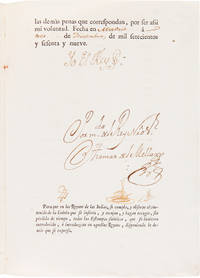
1769ref. 48900Madrid. December 9 1769. The Funds They Left Behind A royal decree discussing the finances of the Jesuit order in the Spanish territories after their expulsion from Spain in 1767 stamp-signed by King Charles III and docketed by his secretary. Gathered signatures stitched. Minor toning some loss to the last leaf affecting the stamped signature of the King and a couple of other words. Good. unknown books
1767ref. 47366Madrid. 1767-1769. Expelling the Jesuits from Spain and Recording Their Activities Around the World The first three in a series of five separately issued parts of the COLECCION GENERAL. In 1767 Charles III convinced they were conspiring against his authority expelled all the Jesuits from within his dominions. In Spain alone 6000 Jesuits were marched to the coast and deported to the Papal States. These volumes contain the orders of expulsion and confiscation of the Society's property and provide a list of the names and locations of all their colleges and religious houses in Spain the New World and the Philippines. Small quarto. First volume in contemporary Spanish calf spine gilt gilt leather label; second volume in antique-style Spanish calf spine gilt with raised bands gilt leather label. Corners bumped on first volume. Minor foxing and soiling a few contemporary notations. Very good. JCB II:1571. MEDINA BHA 4228. PALAU 5616. SABIN 14304. hardcover books
1769ref. 48901Madrid. December 3 1769. Suppressing Satirical Jesuit Works in Barcelona A royal decree attempting to suppress satirical publications of the Jesuit order mentioning "San Ignacio de Loyola" the founder of the Jesuits more than two centuries earlier. Issued after the suppression of the order this is specifically aimed at illicit works printed and circulated in Barcelona. The document is stamp-signed by King Charles III and secretarially docketed. Gathered signatures stitched. Minor worming. Very good. unknown books
1585ref. 4676ENTRY NO. 1 IN BOSCARO THE FIRST REFERENCE TO THE JAPANESE EMBASSY OF 1585 PRINTED ON THE TITLE-PAGE Venice I Gioliti 1585. Small 8vo 15.3 x 10 cm 103 pp. Bound in old vellum. Discrete former ownership stamp on title. Gutter margin of title reinforced; inconsequential toning otherwise excellent. Rare early edition of this Jesuit letter containing news of missions and activity in Japan from the year 1582 the only edition of 5 printed that year to contain a title-page advertising the famous Japanese embassy of 1584-86. Significantly the work also discusses the embassy the participants and their noble lineage and expresses the hope that the embassy will prove a convincing sign of the Jesuit's spectacular success in Japan p. 7. The present imprint of this edition comprises the first entry in Boscaro's bibliography of printed works related to the embassy. It thus stands at the head of nearly 50 works printed in 1585 alone to record and commemmorate an event that-in addition to providing a public relations coup for the Jesuits-became a watershed moment in cross-cultural exchange between the Orient and the West: "no Japanese emissaries to Europe either before or since aroused comparable interest or enthusiasm" Lach. In the annals of international relations between Europe and Japan in the 16th C it is particularly noteworthy "how the physical presence of the Japanese in Europe stimulated an unexpected number of typographical presentations" Boscaro of which this particular Gioliti edition with the titlepage advertising the embassy-Portata de Novo Dal Giapone Dai Signori Ambasciatori-is the very first. Boscaro notes that there were four other editions of Coehho's letter published in Italy in 1585 around the time the embassy arrived in Venice on June 25 including another by Gioliti but none of these uses the embassy as a way to market itself. The report itself is also a significant document of the embassy's genesis: Coelho composed it in February 1582 the month that the embassy of four Japanese Christian converts departed from Nagasaki. In it he describes the ongoing missionary activity across the country: e.g. in Hirado Amasuka Bungo and especially Funai Oita City the home of a thriving Jesuit college. Presumably the contents of this letter as the title suggests were "brought from Japan by the eminent ambassadors" as the latest news on the Jesuits current success in that faraway land. Though the embassy did not reach Lisbon until August 1584 it eventually was as Coelho had hoped a resounding success: from 1584-86 the four young Japanese nobles were the object of intense curiosity wherever they traveled and they were treated to lavish receptions in Lisbon Madrid Florence Rome Venice and other cities throughout Catholic Europe. Provenance: Alfred Hamy 1838-1904 French Jesuit historian and prolific author of books relating to the history of the members of the Company of Jesus. OCLC: Cornell NYPL HU and Newberry. Boscaro 1; Alt-Japan 812; Sommervogel II.1267; Cordier 78; Laures 169; Pagès 22; Lach I.2.690. Boscaro 1; Alt-Japan 812; Sommervogel II.1267; Cordier 78; Laures 169; Pagès 22; Lach I.2.690. I Gioliti books
1945ref. List2748Philippines 1945. Single letter; five 8.5 x 11” pages. Pinhole at top of first page missing final pages overall fine. The unknown author of this letter was an American Jesuit missionary in the Philippines who before the war was a novice living in Novaliches just outside Manila. He apparently had not written a significant letter home for a long time: in this letter written in April of what is likely 1945 he recounts his experiences from between December 8 1941 and early January of 1945 shortly before the civilian POW camp in which he was interned was liberated. After the “Nips” bomb Pearl Harbor “A feverish month ensued”: “We proceeded to put the Community on ‘war-time alert’ with all hands occupied in digging air-raid trenches camouflaging our fortress-like house with a garlanded roof and mud-daubed walls; grain supplies were rushed in against the hour of need. We felt that all it might take Uncle Sam all of six months to put an end to the efforts of the pretender.” Around Christmas they evacuated to the Jesuit Ateneo Grade School then in Intramuros as the Japanese were advancing quickly towards Novaliches. Of course this did not prove to be much safer: “When darkness came the Japs began their bombing of the Port Area. The bombs began to bounce off the pavement; bombers just skimming our roof-top on their way. We spent the night on our tummies and how we prayed. We thought that each decade of the beads would be our last this side of Purgatory. . When the church sto Domingo was hit the floor beneath us did some tricks and we were lifted up a bit and let down amidst the dust and smoke that poured in from above.” The missionaries try to “salvage important papers and other valuables from the Mission House prior to abandoning it to the fire which threatened the entire Walled City.” During this time they and “a thousand refugees” live in the Ateneo while “Dawn and night raids were supplied by the Japs with nary an American plane to say to them no” – American forces had taken a serious hit and withdrawn outside Manila. It was declared an open city before “the little scrawny but arrogant Japs came into the city and took over” in January of 1942. The missionaries persuade the Japanese to let them stay in the Ateneo: “We convinced them that it was impossible for us to give up the building because it belonged to the Pope and the Vatican State would hold us responsible. This argument with many ingenious trimmings enabled us to hold on to the Ateneo until June ‘43 when the main building was taken for a military hospital”. The author describes how despite what he calls his “partial internment” in Manila he is able to get around checkpoints by pretending to be Belgian. He finishes his studies and begins work at a Belgian convent in Paranaque in February of 1943 living between there and Manila: “Incidentally none of this would have been possible if the Japs had gumption enough to find out that I was one of the hated Americans. . All vehicles were obliged to stop here a checkpoint at Baclaran and all passengers get down and file between a Jap sentry and a Filipino constabulary soldier to be searched for hidden arms etc. Since several Belgian Fathers not considered enemy aliens frequently passed this way I was able to walk through unmolested as an unoffending Belgian. . I carefully kept my helmet covering the tell-tale red arm-band which was worn on the arm furtherest away from the Jap. The Filipino would do no more than give me a knowing grin.” On July 10 1944 all of the American civilian POWs are taken to internment camps in Santo Tomas and then Los Baños. In Los Baños the POWs cut wood repair roads and farm. Los Baños would be liberated in February of 1945; the author paints a slightly confusing picture of the leadup to this: “Conditions generally ‘worsened’ when on Jan. 8th about the time that the American troops landed at Mindero an island just across from Batangas the Japs got jittery believing that the Yanks were going to do the obvious and cross over the bay to Batangas and they the Japs at Batanga decamped! ‘You are free but remain in camp until the Americans come. Outside your camp Japanese troops will shoot any who leave.’ Great was the joy in Mudville. From nowhere came flag poles on which we quickly unfurled American and British flags .; a short-wave radio was set up and we enjoyed daily Frisco broadcasts .” It sounds as if the missionary was reporting contrary to the usual narrative of the Los Baños raid that the Japanese had essentially given up control of the camp and were like the prisoners simply waiting for the Americans to come get their people. Perhaps something further happened in the nearly two intervening months; however the remainder of the letter is missing. Of interest to scholars of modern Jesuit history and of the civilian POW experience during the Second World War. unknown books
1764ref. 19180France: n.p. 1764. FIRST EDITION. Stabbed and uncut in contemporary wrappers. First edition of this response to anti-Jesuit literature published anonymously. The Compte rendu has been attributed to the Jesuits Henri-Michel Sauvage 1704-1791 and Jean Nicolas Grou 1731-1803; it takes aim at the 1762 publication of Extraits des assertions dangereuses by Claude-Pierre Roussel de la Tour 1710-1798 in which he chronicles the faith violations of the Jesuits in their publications including their writings against doctrine sin blasphemy magic astrology fornication perjury the occult parricide and homicide suicide and regicide among other topics. Here the authors systematically list the inaccuracies omissions and misinterpretations in both the Latin and French editions of Roussel de la Tour’s book with page numbers for reference. OCLC records only 3 copies in America Boston College Penn Texas A&M; Carayon Bib. Hist. de la compagnie de Jesus 3673; Sommervogel-de Backer 1871. n.p. unknown books
1688ref. 32092Lutetiae Parisiorum Lutetia Paris: Apud Viduam Simonis Benard via Jacobea e regione Collegii Soc. Jesu 1688. Very Good. Lutetiae Parisiorum Paris: Apud Viduam Simonis Benard a.k.a. Marie Benard via Jacobea e regione Collegii Soc. Jesu. 1688. Fifth Edition. 12mo; contemporary calf gilt spine in five compartments; 2331pp.; head and tail pieces; twenty-four 24 engraved emblems. Light wear to edges with shallow loss at spine ends. Binding sound. Bookplate of "C.T. Noel du Payrat" to front pastedown; interior else unmarked; a Very Good and sound copy of a scarce title originally published in 1680 and including "Lysimachis" "Panygyrici" "Symbola Heroica" with many emblems referring to persons associated with the Court of of Louis XIV. Published by Parisian printer Marie Benard the widow of Simon Benard. She went on to publish works for nearly twenty-five years through 1712 though we find little biographical information about her beyond her house's publications. . Apud Viduam Simonis Benard, via Jacobea e regione Collegii Soc. Jesu unknown books
1760ref. 31129Lugano CH: A Spese di Giuseppe Bettinelli di Venezia / Nella Stamperia Privilegiata della Suprema Superiorita' Elvetica nelle Prefetture Italiane 1760. Near Fine. Lugano CH: A Spese di Giuseppe Bettinelli di Venezia / Nella Stamperia Privilegiata della Suprema Superiorita' Elvetica nelle Prefetture Italiane 1760. First Edition. Two octavo volumes bound together. 44; 94pp. 20th-century binding with patterned paper-covered boards and red leather spine label; top edge stained red; new endpapers. Touch of edgewear with toning to spine. Binding sound and interior unmarked. A Near fine copy of two uncommon Swiss Jesuit-related tracts the former appearing more densely theological and the latter discussing the work and thoughts of Plato Seneca and Lucretius among other ancients. A Spese di Giuseppe Bettinelli di Venezia / Nella Stamperia Privilegiata della Suprema Superiorita' Elvetica nelle Prefetture It unknown books
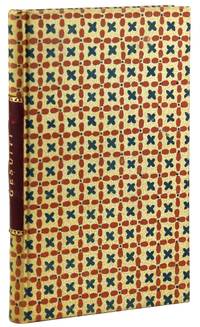
1718ref. 4988Turin ie Paris: Jacques Daniel 1718. Soft cover. Very Good. Small 8vo. 2 ff 66 pp 1 ff. Title page printed in red and black. Bound in contemporary marbled wrappers. Slightly dog-eared otherwise a very good copy. Rare compilation of anti-Jesuit apocrypha: the famous 'Monita secreta' is found here alongside a purported condemnation of the Jesuits by the Faculty of Theology in Paris in 1554 as well as a translation of a prophecy of Saint Hildegaarde commonly seen as fortelling the fall of the Order. The present work bears a transparently false imprint "chez Jacques Daniel a good subject of the Prince at the Sign of Truth"; we have been unable to trace any other record of the publisher Daniel in Turin. While the place of printing was almost certainly Paris the foreign imprint corroborates the polemicist's allegation that France had become such a Jesuit stronghold that the work could not be published there. The Monita Secreta was a guide allegedly written by the Jesuits explaining how to gain riches and make influential friends; bibliographers often attribute it to a Pole Jerome Zaorowsky exiled from the Society in 1611. The work was first printed in 1614 and enjoyed numerous printing couched under various suggestive titles - 'Jesuit intrigues' 'the cabinet of the Jesuits secrets opened' etc. As a forged work of slander for both its widespread dissemination and influence it may be compared to the anti-Semitic Protocols of the Elders of Zion. The editor of the present edition again introduces the work as a clandestine publication - "I do not know by what means it fell into the hands of Printers". The work is written in a straightforward and factual way and instructs members of the Order to court wealthy widows gain promotions and discredit members of other orders. Alexandre Brou for example attributes the printings of the late 17th century to the Jansenists in their ongoing political struggle against the Order; whether the present 'Turin' printing falls into that category remains to be determined. 1708 saw the forced dissolution of the Jansenist stronghold Port-Royal; in the years which followed many Jansenists were excommunicated by Papal bulls for their beliefs. The remarkable rise of the Jesuit Order from its founding in 1540 provoked both suspicion and envy in the religious world: as the editor of the present edition states "the rise of the Jesuits is the object of admiration of the entire world. One cannot understand precisely how in less than two centuries these clerics have managed to become so powerful making themselves formidable to all other Orders and wielding influence in both the Old and New Worlds. It is a mystery for many people." OCLC shows no US copies of this title which appeared again in 1729 without an imprint. OCLC 459214162. Cf De Backer-Sommervogel V: 491-5 p 493 for this edition on the Monita secreta. Cf also Brou Les Jesuites de la Legende I: 290 1906. Jacques Daniel paperback books
1761ref. 2102010040xbvkÀ Avignon, Chez J. Chambeau (Jean-Louis Chambeau), Imprimeur-Libraire;; près les Frères Prêcheurs, Ce premier Septembre (Vol. 1) / Ce premier Novembre (Vol. 2), 1761. 1 blank sheet, 125 pages, 1 bl. sh., 115 pages, 1 blank sheet; titlepages are included in the pagination. - Gilt-titled marbled brown full-leather binding of the period over 5 raised bands; 8vo.(ca. 19,5 x 12,5 x 1,5 cm).
1850ref. 2201030037xbvkParis, A. Franck - Libraire-Éditeur, 1850. Foretitlepage, titlepage, II, (1.295)-1.856 untrimmed and unopened pages with few graphic diagrams (p. 1.256 wrongly numbered 1.258). - Publisher's ornamental and titled blue paper-cover; 8vo.(ca. 22 x 14 x 3,5 cm).
1847ref. 2201030035xbvkParis, A. Franck - Libraire-Éditeur, 1847. Foretitlepage, titlepage, IV, 404 untrimmed and unopened pages, with few graphic diagrams. - Publisher's ornamental and titled blue paper-cover; 8vo.(ca. 22 x 14 x 2 cm).