JESUITES]. LE MOYNE PierreLivre Rare Book

2.550 Ergebnisse
1660Best.-Nr. 39476Paris François Muguet, Jean Guignard 1660 in-4 dérelié, manque de papier dans la marge inférieure du titre
Due tomi uniti in 16° (cm 9,3 x 14,7), legatura mezza pergamena coeva con titoli calligrafati al dorso, pp xix, 180 per il primo tomo, 323, (3) per il secondo. Esemplare in buone condizioni. Libello anonimo con nome dello stampatore fittizio ed assai allusivo ("Le Franc... A l'Image de la Vérité"), voluminoso compendio di nefandezze compiute dall'Ordine della Compagnia di Gesù, fu fondamentale per la loro espulsione dalla Francia. Monclar (m. 1711), giurista che studiò meticolosamente la Costituzione dei Gesuiti, fu chiamato da Voltaire "l'oracle du Parlement de Provence", che aggiunse sull'argomento: "Sils avaient été malheureux, lauteur les aurait assurément respectés. Mais quon se souvienne à jamais quils nont été persécutés que parce quils avaient été persécuteurs; et que leur exemple fasse trembler ceux qui, étant plus intolérants que les jésuites, voudraient opprimer un jour leurs concitoyens qui nembrasseraient pas leurs opinions dures et absurdes". La presente opera è assai rara: fu condannata lo stesso anno con l'"Arrest de la cour de parlement, du 21 mai 1764, : qui condamne au feu deux libelles imprimés, intitulés, l'un: Il est temps de parler... à être lacérés & brûlés... & ordonne qu'il sera enquis contre ceux qui peuvent avoir composé, imprimé ou débité lesdits libelles". Nell'"Avis" ad inizio opera l'editore esulta per questo provvedimento, che afferma chiaramente la verità di quanto denunciato. E' opera che grida: "Brûlez-moi, Messeigneurs, brûlez-moi et ma fortune est faite". Un esemplare censito in COPAC. :
Best.-Nr. 1043111752-1756, 1 volume in-4 de 255x195x58 mm environ, Recueil de Lettres, Remontrances, Requêtes et Mandements, certaines manuscrites contre les Jésuites, Jansénistes, reliure plein veau marbré cognac, dos à nerfs portant titres dorés sur pièce de titre en maroquin bordeaux, orné de caissons à fleurons et motifs dorés, coupes dorées, gardes marbrées, tranches mouchetées de rouge. Une coiffe arasée, manque de cuir sur les coins et coupe inférieure, tampons sur une page de titre, table manuscrite sur les pages de garde, quelques rousseurs et pages brunies, sinon bon état.
Best.-Nr. 195852S.l., 1621 in-8, 23 pp., demi-veau Bradel havane, dos orné de filets dorés, tranches rouges (reliure moderne). Bon exemplaire.
Best.-Nr. 209661Toulouse, Bernard Pijon [puis :] veuve de Bernard Pijon, 1753-1768 18 pièces en un fort vol. in-12, basane fauve marbrée, dos lisse cloisonné et fleuronné, pièces de titre et de tomaison [VII], chaînette dorée sur les coupes, tranches rouges (reliure de l'époque). Manques aux coiffes et à la pièce de titre, dos et coupes frottés.
Best.-Nr. 213996Amsterdam, s.n., 1721 in-8, LX pp., [4] ff. n. ch. (avertissement, table des chapitres, épître), 407 pp., basane brune écaille, dos à nerfs cloisonné et fleuronné, pièce de titre fauve, tranches rouges (reliure de l'époque).
Best.-Nr. 664999À Nismes, chez Pierre Beaume, 1781 2 vol. in-8, VIII-438 pp. et 408 pp., table, basane brune, dos ornés à nerfs, caissons et fleurons dorés, pièces de titre et de tomaison, simple filet à froid en encadrement des plats, tranches mouchetées (rel. de l'époque). Petits manques aux coiffes inférieures. Dos légt frottés. Coins restaurés. Mouillures.
1631Best.-Nr. 2989Col. Agrippinae (Cologne), Corn. ab Egmond, 1631 ; petit in-12 ; plein veau fauve glacé, dos à nerfs décoré de filets dorés disposés en carrés, pièce de titre bordeaux, double filet doré d'encadrement des plats (reliure de l'époque) ; (5)ff. dont titre gravé, 179 pp., (1) p. d'approbation.
7 ouvrages reliés en un volume in-12, plein veau marbré de l'époque, dos à nerfs orné de caissons fleuronnés et cloisonnés, pièce de titre de veau vert. Recueil de sept pamphlets et essais concernant "l’affaire des Jésuites" et les questions religieuses les plus controversées du temps, à la suite du scandale provoqué par l’exécution du prêtre italien Gabriel Malagrida. Missionnaire au Brésil, celui-ci fut livré au bûcher à Lisbonne le 21 septembre 1761 après un procès inique. "L'affaire des Jésuites" débuta en 1761 au parlement de Paris. Considérée dans toute l'Europe comme le principal soutien de l'Église romaine ultramontaine, la compagnie de Jésus avait de nombreux ennemis au sein du jansénisme parlementaire et gallican français, mais aussi du "parti philosophique". Diderot, d'Alembert et Voltaire se mirent rapidement de la partie, dans la marge étroite qui leur était allouée dans le combat contre les Jésuites, sans pour autant adhérer aux thèses des parlementaires ni, encore moins, accorder leur sympathie envers les jansénistes. Par l'édit du novembre 1764, Louis XV supprima la Compagnie du royaume. Petit accroc à la coiffe inférieure. Très bon exemplaire, frais, bien relié à l’époque.
1661Best.-Nr. 39477Paris François Muguet, Jean Guignard 1661 in-4 dérelié
Best.-Nr. 195910S.l., s.d. (1621) in-8, 16 pp., demi-veau Bradel havane, dos orné de filets dorés, tranches rouges (reliure moderne). Exemplaire rogné court en marge inférieure, avec perte de quelques lettres.
In-4, plein vélin souple de l'époque, (2), 95, (5) p., prem. et dern. f. bl., armoiries royales au titre, bandeaux et lettrines gravés sur bois. Rare édition originale in-4° imprimée à Paris, de cette pièce capitale dans l'histoire tourmentée des relations entre la compagnie de Jésus et l'Université de Paris. Par lettres patentes du 12 octobre 1609, Henri IV avait accordé aux jésuites le droit d'enseigner dans leur collège parisien, provoquant l'hostilité de la Sorbonne. A la suite de l'assassinat du roi et de la mise en cause de la Compagnie dans le régicide, la Faculté prit la décision de s'opposer à leur arrivée et déposait un recours dans ce sens devant le Parlement de Paris. Le 15 décembre 1611 une citation à comparaître était notifiée aux jésuites. Pierre de La Martelière plaide pour l'Université, Jacques de Montholon pour les jésuites. A l'issue des audiences, l'avocat général Servin somme les Jésuites de se conformer aux positions de la Sorbonne quant aux libertés de l'Église gallicane. Le Parlement de Paris entérine les conclusions de Servin et, par arrêt du 22 décembre, interdit aux jésuites d'enseigner à Paris. L'arrêt figure en fin de ce volume avec la permission d'imprimer datée du 18 janvier 1612. Les hostilités entre l'Université de Paris et les jésuites ne prirent vraiment fin, faute de combattants, qu'à la suppression de la Compagnie en 1762. ("Bibliothèque historique de la France", 44650). Quelques rousseurs. Bel exemplaire, dans sa première reliure de vélin souple.
Best.-Nr. 199692Liège, chez Le Curieux, au temple de la vérité, 1733 in-12, [9] ff. n. ch. (titre, préface, description de la planche, avis de l'éditeur, table), 95 pp., manque la planche dépliante comme presque toujours, demi-basane fauve, dos à nerfs cloisonné et fleuronné, pièce de titre cerise, tranches mouchetées de rouge (reliure de l'époque). Bon exemplaire.
1726In-8°, legatura semplice, pp.19, buono stato di conservazione. Secondo Aguilar Piñal, P. Justo Palero è uno pseudonimo di Pedro de Aquenza, secondo Palau i Rogers i Lapuente, il citato al testo P. Anselmo [Canillejas] chirurgo latino, è uno pseudonimo del gesuita José Francisco de Isla. In-8°, simple binding, pp.19, good conservation status. According to Aguilar piñal, P. Justo Palero is a pseudonym of Pedro de Aquenza, according to Palau i Rogers Y Lapuente, the quoted text P. Anselmo [Canillejas] Latin surgeon, is a pseudonym of the Jesuit José Francisco de Isla.
1767Volledig in 2 delen, ingebonden in 1 volume: [8],268 + [4],382 pp., met kopergravure buiten tekst in volume 1 (portret van Ignatius biddend voor beeld van Maria), "Nu voor de tweedenmaal in het licht gegeven, om de waereld, op eene onpartydige wyze, den waren oorsprong en aanwas dezer listige en valsche Societeit van Dweepers en Bedriegers onder het oog te brengen", 16cm., lichtgecart. band, tekst helder met slechts enkele vage vlekken op laatste pagina's, tekst in het Nederlands, goede staat, [zeldzame Nederlandse vertaling van Quesnel's oorspronkelijke Franse werk "Histoire de l'admirable Dom Inigo de Guipuscoa, chevalier de la Vierge et fondateur de la monarchie des Inighistes" (1636)], R96563
1767Best.-Nr. R96563Amsterdam, by de Kruyf, Baalde, Bom, [e.a.] 1767 Volledig in 2 delen, ingebonden in 1 volume: [8],268 + [4],382 pp., met kopergravure buiten tekst in volume 1 (portret van Ignatius biddend voor beeld van Maria), "Nu voor de tweedenmaal in het licht gegeven, om de waereld, op eene onpartydige wyze, den waren oorsprong en aanwas dezer listige en valsche Societeit van Dweepers en Bedriegers onder het oog te brengen", 16cm., lichtgecart. band, tekst helder met slechts enkele vage vlekken op laatste pagina's, tekst in het Nederlands, goede staat, [zeldzame Nederlandse vertaling van Quesnel's oorspronkelijke Franse werk "Histoire de l'admirable Dom Inigo de Guipuscoa, chevalier de la Vierge et fondateur de la monarchie des Inighistes" (1636)], R96563
Best.-Nr. 240768Anvers, Jean Moretus, 1598 in-4, [4] ff. n. ch. (titre, prières liminaires, dédicace, notice introductive), 548 pp., [2] ff. n. ch. (privilège, colophon, marque de Plantin), texte sur deux colonnes, typographie en petit corps, des surcharges manuscrites de l'époque à l'encre dans la partie consacrée au Nouveau Testament, demi-basane fauve à coins, dos lisse orné de guirlandes dorées, pièce de titre cerise, tranches mouchetées de rouge (reliure du XIXe). Dos un peu frotté, coins abîmés.
Best.-Nr. 149911Anvers, Hendrik & Cornelissen Verdussen, 1700 fort vol. in-folio, [20]-848-[72] pp., texte sur deux colonnes, vélin souple à rabats et lacets (reliure de l'époque). Bon exemplaire.
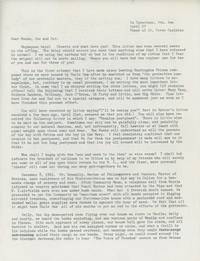
1945Best.-Nr. List2748Philippines 1945. Single letter; five 8.5 x 11” pages. Pinhole at top of first page missing final pages overall fine. The unknown author of this letter was an American Jesuit missionary in the Philippines who before the war was a novice living in Novaliches just outside Manila. He apparently had not written a significant letter home for a long time: in this letter written in April of what is likely 1945 he recounts his experiences from between December 8 1941 and early January of 1945 shortly before the civilian POW camp in which he was interned was liberated. After the “Nips” bomb Pearl Harbor “A feverish month ensued”: “We proceeded to put the Community on ‘war-time alert’ with all hands occupied in digging air-raid trenches camouflaging our fortress-like house with a garlanded roof and mud-daubed walls; grain supplies were rushed in against the hour of need. We felt that all it might take Uncle Sam all of six months to put an end to the efforts of the pretender.” Around Christmas they evacuated to the Jesuit Ateneo Grade School then in Intramuros as the Japanese were advancing quickly towards Novaliches. Of course this did not prove to be much safer: “When darkness came the Japs began their bombing of the Port Area. The bombs began to bounce off the pavement; bombers just skimming our roof-top on their way. We spent the night on our tummies and how we prayed. We thought that each decade of the beads would be our last this side of Purgatory. . When the church sto Domingo was hit the floor beneath us did some tricks and we were lifted up a bit and let down amidst the dust and smoke that poured in from above.” The missionaries try to “salvage important papers and other valuables from the Mission House prior to abandoning it to the fire which threatened the entire Walled City.” During this time they and “a thousand refugees” live in the Ateneo while “Dawn and night raids were supplied by the Japs with nary an American plane to say to them no” – American forces had taken a serious hit and withdrawn outside Manila. It was declared an open city before “the little scrawny but arrogant Japs came into the city and took over” in January of 1942. The missionaries persuade the Japanese to let them stay in the Ateneo: “We convinced them that it was impossible for us to give up the building because it belonged to the Pope and the Vatican State would hold us responsible. This argument with many ingenious trimmings enabled us to hold on to the Ateneo until June ‘43 when the main building was taken for a military hospital”. The author describes how despite what he calls his “partial internment” in Manila he is able to get around checkpoints by pretending to be Belgian. He finishes his studies and begins work at a Belgian convent in Paranaque in February of 1943 living between there and Manila: “Incidentally none of this would have been possible if the Japs had gumption enough to find out that I was one of the hated Americans. . All vehicles were obliged to stop here a checkpoint at Baclaran and all passengers get down and file between a Jap sentry and a Filipino constabulary soldier to be searched for hidden arms etc. Since several Belgian Fathers not considered enemy aliens frequently passed this way I was able to walk through unmolested as an unoffending Belgian. . I carefully kept my helmet covering the tell-tale red arm-band which was worn on the arm furtherest away from the Jap. The Filipino would do no more than give me a knowing grin.” On July 10 1944 all of the American civilian POWs are taken to internment camps in Santo Tomas and then Los Baños. In Los Baños the POWs cut wood repair roads and farm. Los Baños would be liberated in February of 1945; the author paints a slightly confusing picture of the leadup to this: “Conditions generally ‘worsened’ when on Jan. 8th about the time that the American troops landed at Mindero an island just across from Batangas the Japs got jittery believing that the Yanks were going to do the obvious and cross over the bay to Batangas and they the Japs at Batanga decamped! ‘You are free but remain in camp until the Americans come. Outside your camp Japanese troops will shoot any who leave.’ Great was the joy in Mudville. From nowhere came flag poles on which we quickly unfurled American and British flags .; a short-wave radio was set up and we enjoyed daily Frisco broadcasts .” It sounds as if the missionary was reporting contrary to the usual narrative of the Los Baños raid that the Japanese had essentially given up control of the camp and were like the prisoners simply waiting for the Americans to come get their people. Perhaps something further happened in the nearly two intervening months; however the remainder of the letter is missing. Of interest to scholars of modern Jesuit history and of the civilian POW experience during the Second World War. unknown
1945Best.-Nr. List2748Philippines 1945. Single letter; five 8.5 x 11” pages. Pinhole at top of first page missing final pages overall fine. The unknown author of this letter was an American Jesuit missionary in the Philippines who before the war was a novice living in Novaliches just outside Manila. He apparently had not written a significant letter home for a long time: in this letter written in April of what is likely 1945 he recounts his experiences from between December 8 1941 and early January of 1945 shortly before the civilian POW camp in which he was interned was liberated. After the “Nips” bomb Pearl Harbor “A feverish month ensued”: “We proceeded to put the Community on ‘war-time alert’ with all hands occupied in digging air-raid trenches camouflaging our fortress-like house with a garlanded roof and mud-daubed walls; grain supplies were rushed in against the hour of need. We felt that all it might take Uncle Sam all of six months to put an end to the efforts of the pretender.” Around Christmas they evacuated to the Jesuit Ateneo Grade School then in Intramuros as the Japanese were advancing quickly towards Novaliches. Of course this did not prove to be much safer: “When darkness came the Japs began their bombing of the Port Area. The bombs began to bounce off the pavement; bombers just skimming our roof-top on their way. We spent the night on our tummies and how we prayed. We thought that each decade of the beads would be our last this side of Purgatory. . When the church sto Domingo was hit the floor beneath us did some tricks and we were lifted up a bit and let down amidst the dust and smoke that poured in from above.” The missionaries try to “salvage important papers and other valuables from the Mission House prior to abandoning it to the fire which threatened the entire Walled City.” During this time they and “a thousand refugees” live in the Ateneo while “Dawn and night raids were supplied by the Japs with nary an American plane to say to them no” – American forces had taken a serious hit and withdrawn outside Manila. It was declared an open city before “the little scrawny but arrogant Japs came into the city and took over” in January of 1942. The missionaries persuade the Japanese to let them stay in the Ateneo: “We convinced them that it was impossible for us to give up the building because it belonged to the Pope and the Vatican State would hold us responsible. This argument with many ingenious trimmings enabled us to hold on to the Ateneo until June ‘43 when the main building was taken for a military hospital”. The author describes how despite what he calls his “partial internment” in Manila he is able to get around checkpoints by pretending to be Belgian. He finishes his studies and begins work at a Belgian convent in Paranaque in February of 1943 living between there and Manila: “Incidentally none of this would have been possible if the Japs had gumption enough to find out that I was one of the hated Americans. . All vehicles were obliged to stop here a checkpoint at Baclaran and all passengers get down and file between a Jap sentry and a Filipino constabulary soldier to be searched for hidden arms etc. Since several Belgian Fathers not considered enemy aliens frequently passed this way I was able to walk through unmolested as an unoffending Belgian. . I carefully kept my helmet covering the tell-tale red arm-band which was worn on the arm furtherest away from the Jap. The Filipino would do no more than give me a knowing grin.” On July 10 1944 all of the American civilian POWs are taken to internment camps in Santo Tomas and then Los Baños. In Los Baños the POWs cut wood repair roads and farm. Los Baños would be liberated in February of 1945; the author paints a slightly confusing picture of the leadup to this: “Conditions generally ‘worsened’ when on Jan. 8th about the time that the American troops landed at Mindero an island just across from Batangas the Japs got jittery believing that the Yanks were going to do the obvious and cross over the bay to Batangas and they the Japs at Batanga decamped! ‘You are free but remain in camp until the Americans come. Outside your camp Japanese troops will shoot any who leave.’ Great was the joy in Mudville. From nowhere came flag poles on which we quickly unfurled American and British flags .; a short-wave radio was set up and we enjoyed daily Frisco broadcasts .” It sounds as if the missionary was reporting contrary to the usual narrative of the Los Baños raid that the Japanese had essentially given up control of the camp and were like the prisoners simply waiting for the Americans to come get their people. Perhaps something further happened in the nearly two intervening months; however the remainder of the letter is missing. Of interest to scholars of modern Jesuit history and of the civilian POW experience during the Second World War. unknown books
1741Best.-Nr. 58184Paris: Le Mercier & Boudet 1741. First edition 12mo pp. xxxii 8 486 2; contemporary full calf gilt-decorated spine in 6 compartments morocco labels in 2 red speckled edges; ex-St. Stanislaus Novitiate House Library Guelph Ont. closed in 1971 with labels and a bookplate on upper pastedown and shelf label on spine light wear to boards very good. Volume XXV contains letters on: Missions to Paraguay including comment on the language of the Chiquites; Nicobar and Carnate India; Vietnam; trials of the Missionaries to China; and the revolutions of Thamas Koulikan Nadir Shah of Iran. One volume of the 34-volume collection of Jesuit Relations and Allied Documents 1703-1776. "These volumes issued regularly by the Society of Jesus presented selections from correspondence and reports written by Jesuit missionaries then scattered around the globe" and reflected "the continued interest in France in the progress of the Jesuit missions in various parts of the world. The termination of the series reflects the suppression of the Society of Jesus by papal decree" James Ford Bell Catalogue L-368. Howes L 299; James Ford Bell Catalogue L-368. Le Mercier & Boudet unknown books
1966Best.-Nr. 68642Typis Polyglottis Vaticanis / Apud Curiam Praepositi Generalis, Rom 1910-1966. je Band ca. 1000 S., Gr.-8°. Bibliotheks-Halbleinen mit Rückenschild, Einbände farblich teils abweichend, bei einem Band ein Außengelenk eingerissen, ansonsten gut erhalten, [Sprache: latein]
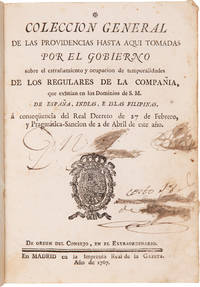
1767Best.-Nr. 47366Madrid. 1767-1769. Expelling the Jesuits from Spain and Recording Their Activities Around the World The first three in a series of five separately issued parts of the COLECCION GENERAL. In 1767 Charles III convinced they were conspiring against his authority expelled all the Jesuits from within his dominions. In Spain alone 6000 Jesuits were marched to the coast and deported to the Papal States. These volumes contain the orders of expulsion and confiscation of the Society's property and provide a list of the names and locations of all their colleges and religious houses in Spain the New World and the Philippines. Small quarto. First volume in contemporary Spanish calf spine gilt gilt leather label; second volume in antique-style Spanish calf spine gilt with raised bands gilt leather label. Corners bumped on first volume. Minor foxing and soiling a few contemporary notations. Very good. JCB II:1571. MEDINA BHA 4228. PALAU 5616. SABIN 14304. hardcover
1767Best.-Nr. 47366Madrid. 1767-1769. Expelling the Jesuits from Spain and Recording Their Activities Around the World The first three in a series of five separately issued parts of the COLECCION GENERAL. In 1767 Charles III convinced they were conspiring against his authority expelled all the Jesuits from within his dominions. In Spain alone 6000 Jesuits were marched to the coast and deported to the Papal States. These volumes contain the orders of expulsion and confiscation of the Society's property and provide a list of the names and locations of all their colleges and religious houses in Spain the New World and the Philippines. Small quarto. First volume in contemporary Spanish calf spine gilt gilt leather label; second volume in antique-style Spanish calf spine gilt with raised bands gilt leather label. Corners bumped on first volume. Minor foxing and soiling a few contemporary notations. Very good. JCB II:1571. MEDINA BHA 4228. PALAU 5616. SABIN 14304. hardcover books
1735Best.-Nr. 110211735 basane mouchetée, dos à n. (petits manques de cuir aux coiffes). in-24, [28] p., p. 3-118, (7ff. blancs), [2]-71 p., A Utrecht au dépens de la Compagnie, 1735