JesuitsBiblio.com
2 480 résultats
réf. DADAX0341393711Wentworth Press 2018-08-09. paperback. New. 6.14x1.91x9.21. Buy with confidence. Excellent Customer Service & Return policy. Wentworth Press paperback
2017réf. x-153261358XWipf & Stock Pub 2017. Paperback. New. 393 pages. 8.25x5.75x1.00 inches. Wipf & Stock Pub paperback
2010réf. DADAX1160935483Kessinger Publishing 2010-03-19. hardcover. New. 6.00x0.81x9.00. Buy with confidence. Excellent Customer Service & Return policy. Kessinger Publishing hardcover
réf. 47005510-nnew. unknown
réf. 1176740830.Gpaperback. Good. Access codes and supplements are not guaranteed with used items. May be an ex-library book. paperback
1731réf. 58647Paris: Nicolas Le Clerc 1731. First edition 12mo pp. xlviii 449 17; contemporary full calf gilt-decorated spine in 6 compartments red stained edges; spine label perished boards rubbed and lower board starting ex-St. Stanislaus Novitiate House Library Guelph Ont. closed in 1971 with labels and a bookplate on upper pastedown and shelf label on spine text clean good and sound. Volume XX contains letters from: Dominique Parennin on missionary work in the Chinese court; Maturin le Petit on the religion lifestyle medicine government etc. of the Natchez people around New Orleans; Lombard and Fauque on their work in French New Guinea; Dentrecolles on art and flower arrangement of China; Margat on guineafowl and turkey and converting slaves and native people of St. Dominique. One volume of the 34-volume collection of Jesuit Relations and Allied Documents 1703-1776. "These volumes issued regularly by the Society of Jesus presented selections from correspondence and reports written by Jesuit missionaries then scattered around the globe" and reflected "the continued interest in France in the progress of the Jesuit missions in various parts of the world. The termination of the series reflects the suppression of the Society of Jesus by papal decree" James Ford Bell Catalogue L-368. Collectively they provided some of the most thorough reporting on China in particular to Western audiences of the period as well as early and first-hand accounts of Native American life. Howes L 299; James Ford Bell Catalogue L-368. Nicolas Le Clerc unknown
1749réf. 58649Paris: Nicolas Le Clerc 1749. First edition 12mo pp. xliii 5 480; folding plate of chayaver plant; contemporary full calf gilt-ruled spine in 6 compartments red stained edges; spine worn upper joint starting lower flyleaf loose large tear to plate neatly mended on verso; ex-St. Stanislaus Novitiate House Library Guelph Ont. closed in 1971 with labels and a bookplate on upper pastedown and shelf label on spine text clean good and sound. Volume XXVII contains letters from: Margat on missionary activity in St. Domingue and Fauque in French Guiana plus an account of persecution in China. One volume of the 34-volume collection of Jesuit Relations and Allied Documents 1703-1776. "These volumes issued regularly by the Society of Jesus presented selections from correspondence and reports written by Jesuit missionaries then scattered around the globe" and reflected "the continued interest in France in the progress of the Jesuit missions in various parts of the world. The termination of the series reflects the suppression of the Society of Jesus by papal decree" James Ford Bell Catalogue L-368. Collectively they provided some of the most thorough reporting on China in particular as well as early and first-hand accounts of Native American life. Howes L 299; James Ford Bell Catalogue L-368. Nicolas Le Clerc unknown
1722réf. 58648Paris: Nicolas Le Clerc 1722. First edition 12mo pp. xl 418 10; folding map of the southern coast of India; contemporary full calf gilt-decorated spine in 6 compartments red stained edges; small split on lower joint; ex-St. Stanislaus Novitiate House Library Guelph Ont. closed in 1971 with labels and a bookplate on upper pastedown and shelf label on spine text clean good and sound. Volume XV contains letters from: Jean Venance Bouchet on Bisnagar Ganga Madras Goa Visapour etc.; d'Entrecolles on Chinese medicine and industry; Ippolito Desideri on his voyage to and description of Tibet; Turpin on the Indian production of cotton etc. One volume of the 34-volume collection of Jesuit Relations and Allied Documents 1703-1776. "These volumes issued regularly by the Society of Jesus presented selections from correspondence and reports written by Jesuit missionaries then scattered around the globe" and reflected "the continued interest in France in the progress of the Jesuit missions in various parts of the world. The termination of the series reflects the suppression of the Society of Jesus by papal decree" James Ford Bell Catalogue L-368. Collectively they provided some of the most thorough reporting on China in particular to Western audiences of the period as well as early and first-hand accounts of Native American life. Howes L 299; James Ford Bell Catalogue L-368. Nicolas Le Clerc unknown
2018réf. G0829447040I4N00Loyola Press 2018. Paperback. Very Good. May have limited writing in cover pages. Pages are unmarked. ~ ThriftBooks: Read More Spend Less.Dust jacket quality is not guaranteed. Loyola Press paperback
1640réf. 21706Antwerp 1640. Folio. Ex Officina Plantiniana Balthasar Moretus Contemporary calf over wooden boards gold-tooled spine blind-tooled boards; rebacked with the original backstrip laid down remnants of clasps 4 small brass corner pieces. With an engraved title page and 126 engraved emblems including the Leo Belgicus map. 8 952 22 pp. First and only edition of the Jubilee masterpiece of the renowned Provincia Flandro-Belgica administrative region of the Society of Jesus and one of the finest books of the Officina Plantiniana under Balthasar Moretus. The Imago primi saeculi was the celebration of the celebration the triumphal arch erected by the Jesuits of the Flemish-Belgian province for the victories of Ignatius of Loyola 1491-1556 and also for the greater glory of God. All the emblems depict scenes of life but also the world map a compass the Leo Belgicus and the printer printing Jesuit propaganda are depicted. The first emblem in this work is the sun shining on the world.With a partially erased manuscript shelfmark label mounted on the front pastedown only "131 A 12" remains legible a manuscript inscriptions at the head of the half-title "Collegii Soc. Jesu Gandaui = Ghent" and "LL. Susanna de Hont" and "T 21". The binding shows signs of wear mainly around the spine and the edges and corners of the boards lacking the clasps some foxing and slight staining throughout. Otherwise in good condition.l De Backer-Sommervogel I col. 1625-6 i.v. Bollandus no. 5; Landwehr Emblem and fable books p. 378; Praz pp. 185-227; STCV 6609299; USTC 1003318. LITERATURE & LINGUISTICS LOW COUNTRIES RELIGION & DEVOTION Belgium Emblems Jesuits Religion 17th Century hardcover
réf. 101668214X.Ghardcover. Good. Access codes and supplements are not guaranteed with used items. May be an ex-library book. hardcover
réf. 1290419035.Gpaperback. Good. Access codes and supplements are not guaranteed with used items. May be an ex-library book. paperback
réf. 46565894-nnew. unknown
1760réf. 5489Genoa: 29 July 1760. Hardcover. Fine. Manuscript in Italian written in a neat cursive in brown/black ink on laid paper. With some minor foxing some folding lines the creases slightly flattened the bottom edge of the leaves is slightly frayed. Otherwise in very good condition. A harrowing eye-witness account by a Jesuit Father of the Province of Brazil describing the forced expulsion of the Jesuits from Brazil in 1760 the hardships they endured during their capture and the perilous journey from Brazil to Genoa via Lisbon. The author begins his narrative with the persecution suffered by the Jesuits in Brazil following the official suppression of the Order. The Jesuit colleges were thoroughly plundered property seized precious silver taken and church furnishings stripped away. They were ordered not to open the church doors or ring the bells although on three occasions the Blessed Sacrament was brought to the sick an act which deeply moved the local people. The Jesuits endured many sufferings during their captivity. They were confined under harsh conditions; guarded constantly by soldiers. Their living quarters were cramped and filthy so small that they could neither sit nor lie down comfortably. Many suffered from hunger thirst and illness and several lost their lives during this ordeal. On 16 March the journey by sea began. The voyage was nothing short of a cruel martyrdom: extreme hunger and sickness afflicted the Jesuit Fathers. One elderly and saintly Father Francesco Paolo died shortly after the journey began not from disease but from severe distress caused by lack of food and medicine. Another Father Giovanni de Matha suffered a dangerous hemorrhage and narrowly survived while many others fell ill. They arrived at the mouth of the Tagus River in Portugal on 6 June after which they were transferred under guard to a Genoese ship effectively imprisoned once again. They were forbidden from going ashore or even signaling their arrival. More Jesuit Fathers from Brazil joined them later in June many weakened and sick from the hardships endured. Tragically some who had been sent ahead to Portugal suffered such extreme famine and thirst that they resorted to drinking their own urine and several died without the comfort of the last rites which were denied by the ship's captain. The captains and executioners of the royal orders showed little compassion even as they witnessed the Jesuits' pale and dying condition. Throughout this entire ordeal a royal minister constantly monitored the Jesuits offering false hopes that they might remain in the kingdom if they renounced their order and left the Jesuit habit behind. Some succumbed to these pressures but most remained steadfast. The Jesuits also faced opposition from the Bishop of Rio de Janeiro who initially used them for missions but later prohibited their confessions and sermons accusing them falsely of heretical teachings. He even excommunicated those who encouraged perseverance in the Jesuit order. Despite all these hardships the siege imprisonment brutal sea voyage hunger disease and ecclesiastical persecution the Jesuits maintained their faith and dignity praying for peace and the restoration of their Society. In a long postscript the writer gives further news that he has received from Brazil. He describes the devotion despite the Suppression of the Brazilian indigenous novices and the bravery of the students many of whom accompanied other Jesuit fathers in a cramped ship for the long voyage to Europe. A number of students held back -reluctantly- realizing that their presence on the ship would only lead to further overcrowding and privation for the Jesuit fathers in particular those who were old and frail. With sorrow they wept on the shore as the ship weighed anchor and departed for the miserable voyage. The account closes on 29 July 1760 expressing a solemn hope that after so many disasters peace will return to the Jesuit order. 29 July hardcover
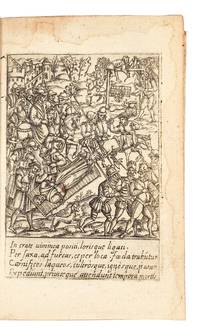
1583réf. 5484Macerata: Appresso Sebastiano Martellini con licenza de' superiori 1583. FIRST ITALIAN EDITION the second edition overall and the FIRST ILLUSTRATED EDITION. Hardcover. Fine. Bound in 19th c. ivory vellum hinges repaired at head and foot light soiling spine label fragmentary the boards ruled in gold the spine gold-tooled with repeating floral tools. Illustrated with six engraved plates of Catholic priests being abused apprehended tortured and executed described in detail below. With a woodcut title vignette of the Crucifixion a woodcut of the Pietà on leaf D7 verso printer's ornaments and woodcut initials. The text is type-ruled throughout. The text is in very good condition aside from damp-staining in gathering B and the six plates; the title page is soiled and has a small area of restoration at the upper corner as well as a clean tear mended and a little staining in the gutter. There is a light oil stain on leaf H6 and a marginal paper flaw on leaf N5. A translation with additional material of Allen's "A briefe historie of the glorious martyrdom of XII. reuerend priests executed vvithin these tvveluemonethes for confession and defence of the Catholike faith." Rheims: J. Foigny 1582. The English edition exists in only 2 copies British Library and Westminster Cathedral Library. This edition the first edition to include the six engraved illustrations is also rare. OCLC locates copies of the Macerata edition at 7 institutions in North America. see notes below for holdings. The central figure of Allen's martyrology is the Jesuit Edmund Campion 1540-1581 who at Allen's request and along with Robert Parsons led the first Mission to England. Campion and his companions were arrested on 17 July 1581. The present work recounts the arrest trial and eventual execution of Campion as well as the priests Ralph Sherwin Alexander Briant Thomas Ford John Shert Robert Johnson William Filby Luke Kirby Lawrence Richardson John Payne and Everard Hanse; as well as the Jesuit Thomas Cottam. Included in these accounts are the transcripts of Campion's final letter to the Jesuit General Claudio Aquaviva Ralph Sherwin's letter from the Tower and Alexander Briant's letter written while imprisoned to the Jesuit fathers in England requesting admission to the Society which was granted. Allen who continued to receive material up to the time of publication appended the martyrdoms of Cuthbert Maine John Nelson and Thomas Sherwood all of whom died in 1577 and 1578 to his account of the martyrs of 1581 and 1582. The translator of the present edition added an additional account not found in the English edition of the martyrdom of 4 English priests in 1583. The Engravings: The six engravings in this work first appeared in the first edition of Robert Parson's "De Persecutione Anglicana Libellus" published by the Jesuit College at Rome in 1582. Each of the six images is accompanied by a four-line explanation in hexameter verse. "The first plate depicts priests being apprehended in private houses and marched off to prison; the second in amplification shows various priests some still in their vestments being led away either on horseback or on foot but always securely bound two gentlewomen who had sheltered them being led to the same destination. In the third a priest is being scourged while tied to the back of a cart and below in the foreground an examination is in progress as preparations are made for torture. The fourth picture illustrates a racking with three other victims lined up to await their turn. In the fifth the priests are being dragged to execution on hurdles while the instruments of death are prepared; and the final plate represents the different stages of martyrdom from the hanging to the drawing quartering and burning of entrails."Anthony G. Petti in Recusant History April 1966 pp. 288-91 Edmund Campion: "Campion was arrested with his companions on 17 July 1581. Amid scenes of violent excitement Campion was derisively paraded through the streets of his native city bound hand and foot riding backwards with a paper stuck in his hat to denote the 'seditious Jesuit'. First thrown into Little Ease at the Tower he was carried privately to the house of his old patron the Earl of Leicester; there he encountered the queen herself and received earnest proffers of liberty and preferments would he but forsake his papistry. Hopton having tried in vain the same blandishments on Campion's return to the Tower the priest was then examined under torture and was reported to have betrayed those who had harboured him. Several arrests were made on the strength of the lie. He had asked for a public disputation. But when it came off in the Norman chapel of the Tower before the Dean of St. Paul's and other divines Campion had been denied opportunity to prepare his debate and had been severely racked. Thus weakened he stood through the four long conferences without chair table or notes and stood undefeated. Philip Howard Earl of Arundel who was looking on in the flush of worldly pride became thereby inspired to return to God's service. "The privy council at its wits' end over so purely spiritual a 'traitor' hatched a plot to impeach Campion's loyalty and called in the hirelings Eliot and Munday as accusers. A ridiculous trial ensued in Westminster Hall 20 Nov. 1581. Campion pleading not guilty was quite unable to hold up his often-wrenched right arm seeing which a fellow prisoner first kissing it raised it for him. He made a magnificent defence. But the sentence was death by hanging drawing and quartering: a sentence received by the martyrs with a joyful shout of 'Haec dies' and 'Te Deum'."Catholic Encyclopedia Cardinal William Allen: "On the accession of Elizabeth and the re-establishment of Protestantism William Allen was one of those who remained most staunch on the Catholic side and it is chiefly due to his labours that the Catholic religion was not entirely stamped out in England. Having resigned all his preferments he left the country in 1561 and sought a refuge in the university town of Louvain. The following year however we find him back in England devoting himself though not yet in priest's orders to evangelizing his native county. His success was such that it attracted notice and he had to flee for safety. For a while he made himself a missionary centre near Oxford where he had many acquaintances and later for a time he sought protection with the family of the Duke of Norfolk. In 1565 he was again forced to leave England this time as it turned out for good. He was ordained priest at Mechlin shortly afterwards. "Convinced that Protestant domination of England could only be temporary and that the whole future depended on there being a supply of trained clergy and controversialists ready to come into the country whenever Catholicity should be restored Allen founded the College at Douay since identified with his name. Douay was a new university founded by Pope Paul IV under the patronage of King Philip of Spain in whose dominions it then was for the special object of combating the errors of the Reformation; and what is still more to the purpose it was already under Oxford influences. The first chancellor Richard Smith was an Oxford man as were several of the most influential members of the university at the time when Allen began. It was his ambition to perpetuate Oxford influences and traditions and to make his new college practically a continuation of Catholic Oxford. "The means of support included besides Allen's private income and other voluntary donations a yearly pension of 200 ducats from the King of Spain and later on one of 100 gold crowns a month from the Pope. The number of students grew rapidly. Often more were received than the income warranted a course rendered necessary by the urgent state of Catholic affairs which Allen met in the spirit of faith; and in the long run means were never wanting. The names of Thomas Stapleton Richard Bristowe Gregory Martin Morgan Philips and others are still well known to English Catholics and are themselves a sufficient record of the ability of Allen's early companions and of the work done at the college. Allen had the power of instilling his spirit into his followers. They lived together without written rule but in perfect mutual harmony working for the common cause. From the Douay press came forth a constant stream of controversial and other Catholic literature which could not be printed in England on account of the Penal Laws. In this Allen himself took a prominent part. His writings are distinguished by extent of learning and theological acumen. One of the chief works undertaken in the early years of the college was the preparation of the well-known Douay Bible. The New Testament was published in 1582 when the college was at Rheims." "In 1575 Allen made a journey to Rome his second where he helped Pope Gregory XIII to found another college to send missionaries to England. For this purpose possession was obtained of the ancient English hospice in the city which was converted into a seminary. Returning to Douay Allen found a storm gathering against the English and in 1578 they were expelled from the town. The collegians took refuge at the University of Rheims where they were well received and continued their work as before Allen being soon afterwards elected canon of the Cathedral Chapter. In 1579 he paid his third visit to Rome being summoned thither in order that he might use his unique personal influence to adjust the dispute between the English and Welsh students at the new college there. It was during this visit that he was appointed a member of the Pontifical Commission for the revision of the Vulgate. Up to this point the career of Allen had won the universal admiration and gratitude of English Catholics for what he himself termed his 'scholastical attempts' to convert England. Such was not however the case with his political labors to secure the same end which may be said to have begun about this time and were far less successful. The famous Bull 'Regnans in excelsis' was issued by Pius V in 1570 deposing Queen Elizabeth and releasing her subjects from their allegiance but it did not take practical shape till seventeen years later when preparations were made for the invasion of England by the King of Spain. Allen was then once more in Rome whither he had been summoned by the Pope after a dangerous illness two years before. He never left the Eternal City again but he kept in constant communication with his countrymen in England. It had been due to his influence that the Society of Jesus to which he was greatly attached undertook to join in the work of the English mission; and now Allen and Father Parsons became joint leaders of the 'Spanish Party' among the English Catholics. "At the request of King Philip Allen was created cardinal in 1587 and held himself in readiness to go to England immediately should the invasion prove successful. In estimating the number of those who would be adherents to the scheme however Allen and Parsons were both at fault. The large majority of English Catholics generously forgetting the past sided with their own nation against the Spanish and the defeat of the Armada 1588 was a subject of rejoicing to them no less than to their Protestant fellow countrymen. Allen survived the defeat of the Armada six years. To the end of his life he remained fully convinced that the time was not far distant when England would be Catholic again. . He continued to reside at the English College Rome until his death 16 October 1594. He was buried in the chapel of the Holy Trinity adjoining the college." Catholic Encyclopedia. Appresso Sebastiano Martellini, con licenza de' superiori hardcover
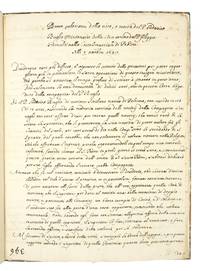
1683réf. 5517Rome: ca 1683. Hardcover. Fine. Bound in modern marbled papered boards with leather title label in gilt to the upper board. 17th c. manuscript in ink in a fine secretarial hand on laid paper with watermark of an anchor within circle. Fine condition leading edge untrimmed. A little light spotting on the first leaf very slim portion of leading edge of fourth leaf a little ragged and dust soiled. A report on the life death and funeral of the Sicilian Jesuit Ludovico Buglio 1606-1682 called Li Leisi Chinese: åˆ©é¡žæ€ a distinguished missionary and scientist at the Chinese imperial court in Peking during the late Ming and early Qing dynasties. It was written by Buglio's fellow Jesuit and friend Filippo Grimaldi Chinese: Min Ming'o 1638-1712 who arrived in China in 1671. Grimaldi was present at his confrère's funeral where he tells us that he partook of Manchu tea and wine offered to the mourners. This account which contains information not reported elsewhere remained in manuscript until the 20th century. In addition to our manuscript three other copies are known one of them in the Jesuit archives Rome: Fondo Gesuitico A.R.S.I. Archivum Romanum Societatis Iesu 722/4; another in the Vatican: A.S.V. Archivio Segreto Vaticano Miscellanei dei Gesuiti arm. VIII 58 ff. 16r-21v; and the third in the State Archives Rome: Archivio di Stato Roma Gesuiti Miscell. Pacco 5. Ludovico Buglio labored in China for forty-seven politically turbulent years. He established the first mission in Szechwan Sichuan Province where he carried out intensive evangelization despite opposition from local Buddhist and Daoist clergy built churches at Baoning Chongqing and Peking served as astronomer for the rebel Zhang Xianzhong who raised Buglio to the rank of mandarin and was instrumental in restoring the Imperial Observatory at Peking to Jesuit control. Buglio was imprisoned twice exiled once and narrowly escaped execution. An arrow wound inflicted by a Manchu warrior in 1647 never fully healed leaving Buglio in intense pain for the rest of his life. The wound ultimately proved fatal. In a letter transcribed in this manuscript addressed to Buglio's fellow Jesuits in Peking the Kangxi Emperor lamented Buglio's prolonged suffering and imminent death and announced that he would assist with the funeral expenses. The Emperor's letter is followed by Grimaldi's eyewitness account of the funeral which was overseen by imperial delegates who also participated in the traditional Chinese funeral honors. Renowned for his mastery of spoken and written Chinese Buglio wrote and published a large number of Chinese-language works a list of which is appended to this manuscript. Among the most important of these were "Yulan Xifang Yaoji" "Imperially Commissioned Essentials of the West" presented to the Kangxi Emperor around May 1669 and a translation of Aquinas' "Summa Theologica" titled "Chaoxing xueyao" "Compendium of the Science of the Supernatural". The author and his account: Grimaldi "was one of the most capable and courageous missionaries; he arrived in China during a time of persecution when with the exception of four Fathers remaining in Beijing the other missionaries had been rounded up and held prisoner in Canton twenty-five in total: fourteen Jesuits ten Dominicans and one Franciscan. Upon arriving in Macau the young Fr. Grimaldi secretly made his way into Canton in December 1669 to take the place of a missionary-Fr. Navarrete the Dominican superior-who had escaped from prison; his absence had it been discovered could have seriously jeopardized all the prisoners. In 1671 when the missionaries in Canton were released Fr. Grimaldi was summoned to Beijing to assist Fr. Verbiest and gave science lessons to Emperor Kangxi himself. In 1685 the Emperor sent him to Russia to negotiate with the Tsar regarding the passage of Chinese merchants and European missionaries through Russian territory; however he was unable to achieve this objective and after an absence of seven years he returned to Beijing where he died in 1712."Barbera Grimaldi was well-positioned to write this account of Buglio's life. He labored alongside Buglio for twelve years and it can be assumed that those things that Grimaldi did not witness personally were communicated to him by Buglio himself and other Jesuits chief among them Buglio's close companion Gabriel Magalhães who was with Buglio from the time of his work in Sichuan province through his time in Peking. This accounts for the level of detail that Grimaldi is able to present in his account such as in the story of the providential removal of the arrow that had become lodged in Buglio's body after he and Magalhães were mistaken for spies and shot by Manchu soldiers: "a piece of arrow so tenaciously lodged in his body that Father Magalhães was never able to draw it out either with his hands or with his teeth. Magalhães though he was gravely wounded in one arm strove to find in the wilderness something with which to draw the arrow out; and behold before his eyes there appeared a pair of pincers which seemed to have been brought by his guardian angel for that very need alone with which full of joy and wonder he gave thanks to divine providence and freed Father Buglio from that affliction." The Emperor's letter & Buglio's Funeral: While Buglio lay on his deathbed the Emperor having heard about Buglio's illness through Zhao Chang a member of the Imperial Bodyguard sent a letter to the Jesuits which Grimaldi gives in full. In appreciation for Buglio's years of service to his father and himself his dedication to Chinese language and culture and "because you are men from beyond the sea and Father Ludovico now lies dying in this city far from his own country without kinsfolk to assist him" the Emperor informs the Jesuits that he will arrange and pay for Buglio's funeral. With the letter comes a gift of "two hundred Foè that is two hundred gold scudi and ten pieces of silk as a token of the regard I have held for the father and of how greatly his loss grieves me." The funeral rites included an impressive procession: "The Emperor in every way wished the funeral conducted according to his own affection and not according to the modesty proper to our institute. Twenty soldiers were sent by the Emperor to clear the streets as far as the burial place. At the head of the procession walked a standard raised aloft on which was written in large characters the Father's name together with the many praises and honors the Emperor bestowed on him and a copy of the Emperor's own letter in praise of the deceased on yellow satin silk a color reserved to His Majesty alone. There followed Father Buglio's image above which were written two very large characters signifying that this imperial decree had been issued in memory of the great esteem in which the deceased had been held. In the place of highest honor was set the Holy Cross with the images of St. Michael and Our Lady amid many censers and incense and choirs of diverse musical instruments." "Then followed more than five hundred Christians clothed in mourning and finally gentlemen without number preceded by the court officials sent by the Emperor for this purpose. This whole procession having at last arrived at the place granted us by the late Emperor for the burial of the fathers the funeral was carried out - with great modesty on the part of the Christians and equal reverence on the part of the gentiles." Grimaldi closes his account explaining that while he would like to write more the letter courier is about to leave for Macau and so he must stop where he is. The list of Buglio's Chinese Works: Grimaldi applauds Buglio's remarkable success in mastering Chinese which allowed him to forge close relationships with the Chinese literati and the mandarins. "He accomplished much by writing.understanding very well how highly letters are prized in China and how gentle and how powerful a means the spreading of books is for instilling the holy law of Christ. From the very beginning of his arrival in China he lost no time in advancing himself in Chinese letters language and books and to this end he had all the walls of his room covered with Chinese characters." The manuscript closes with a list of 23 of Buglio's Chinese works including the aforementioned "Yulan Xifang Yaoji" and "Chaoxing xueyao" as well as translations of the Roman Missal 1670 Breviary 1674 and Ritual 1675. Other works some on scientific matters addressed to the Emperor include "Shizi shuo" "Discourse on Lions" 1678 written when the Portuguese gave the emperor an African lion based largely on Ulisse Aldrovandi's "Book of quadrupeds" Bologna 1645 and "Jincheng ying shuo" "Discourse on Falcons offered to the emperor" 1679 written at the emperor's request after he admired the illustrations in Aldrovandi's "Ornithology". This work was later excerpted with attribution into the imperial encyclopedia "Gujin tushu jicheng" 1728. See Lo Nardo P. Ludovico Buglio S.J. 1606-1682 in Intorcettiana Anno II - N. 3 gennaio-giugno 2020; Pfister Notices biographiques et bibliographiques sue les Jésuites de l'ancienne mission de Chine 1552-1773 tome I Chang-Hai 1932 pp. 372-376. ca hardcover
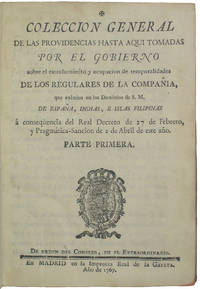
1784réf. 44155Madrid: En la Imprenta Real de la Gazeta 1784. First edition. Contemporary mottled calf compartments decorated in gilt red morocco spine label titled in gilt sewn in green silk ribbon marbled endpapers. A very good copy head band worn with a small chip and a tiny split at the joint owner's bookplate and booksellers engraved plate on front pastedown contents quite bright and clean. 104 91 135 144 4 74 pp. 4to. Five volumes bound in one. Parts 1 2 3 set in condensed type; parts 4 and 5 in expanded type. Royal decrees from Charles III and instructions decisions and regulations issued by the Consejo en el Extraordinario and its president the Conde de Aranda and others--concerning the expulsion of the Jesuits. "These collections contain the documents relative to the expulsion of the Jesuits from the Spanish dominions and the confiscation of their property including the names of the colleges and houses of the order the application of the confiscated property &c. A complete series consists of five parts which are rarely found together. Our collation is of parts I. to III. only" Sabin 14304. Part 4 p. 75-127 contains the papal brief "Dominus ac Redemptor" by Clement XIV in Latin and Spanish. Earlier versions containing parts or all of the first three sections are not all that uncommon but those containing all five parts remain relatively rare. Other than this copy only two others have appeared in the auction records of ABPC and RBH since 1953 the first at the John B. Stetson sale at Parke Bernet and the second at Bonhams in a modern binding and dampstained. Palau 56516. See Sabin 14304. Medina BHA: IV 4228. En la Imprenta Real de la Gazeta unknown
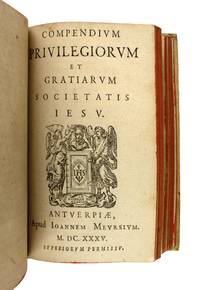
1635réf. 49307Antuerpiae Antwerp: Apud Ioannem Meursium Joannes Meursius 1635. Very Good. Antuerpiae Antwerp: Apud Ioannem Meursium Joannes Meursius 1635. Two octavo volumes bound in one; bound in contemporary vellum with manuscript title to spine; edges stained red; 384 20pp.; 164 4pp. with final page blank collated and complete. Light wear and spotting; binding sound; toning to pages; a Very Good copy. Includes regulations favors and exemptions granted the Jesuits from the Pope. Apud Ioannem Meursium [Joannes Meursius] unknown
réf. 0829447040.Gpaperback. Good. Access codes and supplements are not guaranteed with used items. May be an ex-library book. paperback
réf. 0829443703.Gpaperback. Good. Access codes and supplements are not guaranteed with used items. May be an ex-library book. paperback
réf. B9781018797670Hardback. New. hardcover
réf. ria9783386667104_inpHardcover. New. New Book; Fast Shipping from UK; Not signed; Not First Edition; Réimpression inchangée de l'édition originale de 1876. La maison d'édition Antigonos est spécialisée dans la publication de réimpressions de livres historiques. Nous veillons à ce que ces ouvrages soient mis à la disposition du public d hardcover
réf. ria9783744646796_inpPaperback. New. New Book; Fast Shipping from UK; Not signed; Not First Edition; Menology of the Society of Jesus is an unchanged high-quality reprint of the original edition of 1874. Hansebooks is editor of the literature on different topic areas such as research and science travel and expeditions cooking and nu paperback
réf. ria9781023791083_inpHardcover. New. New Book; Fast Shipping from UK; Not signed; Not First Edition; I am sorry I cannot fulfill the request in the German language as specified but here is an English response. "Lettres Édifiantes Et Curieuses Écrites Des Missions Étrangères Volume 11" presents a compilat hardcover