2 659 résultats
1934236pp.+ 2 cartes dépliantes, dans la série "Museum Lessianum. Section missiologique" no.19, brochure originale, 23cm., pages toujours non coupées, cachet, bon état, R50045
18812 tomes en 1 volume: 364 + 334pp., ("4e édition revue corrigée et augmentée de documents nouveaux"), reliure cart.avec dos en toile (titre doré au dos, plats marbrés), 18cm., bel état
1864viii + 459pp., reliure cart. (dos en cuir avec titre et faux-nerfs dorés), 18cm.
1879462pp., 4e édition revue et corrigée, 18cm., reliure toile (dos en cuir avec titre doré), qqs.rousseurs, bel état
1890150pp. avec illustrations de L. Tobb, 28cm., br.orig., page de titre gravée, pages non coupées, peu de rousseurs, texte imprimé en 2 colonnnes, bon état, R92517
1742v + 386pp., 18cm., br.muet (dos restauré), Nouvelle édition revue corrigée & augmentée, [ce 2e tome (des deux) de la nouvelle édition contient le 3e et 4e volume de l'Edition de Paris, avec quelques additions, e.a. les 2 deniers articles du VIII.Livre]
1696Sans lieu, 1696. In-12 relié plein cuir (reliure d'époque), 108-117-21-11-24-20 pp.. Manque de cuir aux angles et sur les coupes, coiffes arasées, rousseurs. On trouve les textes suivants : - Défense du discours de Monsieur de Gaufridy, avocat général du parlement d'Aix du 221 may dernier, des arrest des Parlemnts de Paris, d'Aix, de Dijon, de Douay, et de la conduite de la Sorbonne ou, Réfutation de la Lettre du prétendu Abbé provençal. Adressée aux RR.PP Jésuites. 1716 -Sentence de Messieurs les vicaires généraux de l'Archeveché de Tours, au sujet d'un sermon prononcé par le P.J. B. Hervieux dans l'Eglise des Jacobins de la dite ville, le 4 aout 1716 -Lettre écrite à M. Ravachet docteur et syndic de Sorbonne 1716 -Réponse à la lettre de Mr l'Eveque de Chalons sur Saone à Monsieur de Cruge avocat général du Parlement de Dijon -Seconde lettre de Mr l'Eveque de Chalons sur Saone à Monsieur de Cruge avocat général du Parlement de Dijon avec la Réponse
1862vii + 643pp., reliure cart. (dos en toile), qqs.rousseurs, bel état
1862vii + 643pp., br.orig. (dos peu restauré), qqs.rousseurs, bon état
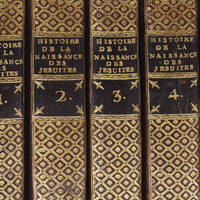
1764réf. 316736Rouen; Paris: s.n. 1764. viii. 499 6; vi 516 4; vi 447 3; vi 509 5; viii 4 311; 4 309-688 pp. 12mo. First four volumes in decorative brown paste-paper boards and sheep backs and corners other 2 volumes in full stained sheep with paste-paper endpapers backs of all six volumes uniform and richly gilt. A fine set in attractive dress. viii. 499 6; vi 516 4; vi 447 3; vi 509 5; viii 4 311; 4 309-688 pp. 12mo. Volumes I-III contain the history of the Society of Jesus from its origin until the end of the eighteenth century and the first analysis of its constitutions and privileges. Volume IV continues that analysis and has an index of the four-volume set. Barbier assigns the analysis chapters to Lois-Adrien Le Paige. Christophe Coudrette 1701-1774 was a Jansenist and the author of several anti-Jesuit works. Cioranesco 21317. Provenance: Fürstlich-Starhemberg'sche Familien Bibliothek Schloss Eferding ink stamp on front endpapers off all volumes; Loyola Reference Library stamp on lower edges call numbers in pencil on title-pages s.n. unknown
1764réf. 316736Rouen; Paris: s.n. 1764. viii. 499 6; vi 516 4; vi 447 3; vi 509 5; viii 4 311; 4 309-688 pp. 12mo. First four volumes in decorative brown paste-paper boards and sheep backs and corners other 2 volumes in full stained sheep with paste-paper endpapers backs of all six volumes uniform and richly gilt. A fine set in attractive dress. viii. 499 6; vi 516 4; vi 447 3; vi 509 5; viii 4 311; 4 309-688 pp. 12mo. Volumes I-III contain the history of the Society of Jesus from its origin until the end of the eighteenth century and the first analysis of its constitutions and privileges. Volume IV continues that analysis and has an index of the four-volume set. Barbier assigns the analysis chapters to Lois-Adrien Le Paige. Christophe Coudrette 1701-1774 was a Jansenist and the author of several anti-Jesuit works. Cioranesco 21317. Provenance: Fürstlich-Starhemberg'sche Familien Bibliothek Schloss Eferding ink stamp on front endpapers off all volumes; Loyola Reference Library stamp on lower edges call numbers in pencil on title-pages s.n. unknown books
18466 volumes: 532 + 570 + 562 + 552 + 592 + 628pp.orné de portraits & lettres in facsimile dépliantes (hors-texte), 19x12cm., 2e édition, reliure cart.avec dos en cuir, cachet de bibl., qqs.rousseurs, bon état, R34742
Paris /Lyon, Poussielgue-Rusand /Pélagaud, 1851, ensemble 2624pp. + 28 ill.hors texte et lettres in facsimile dépliantes, 3e éd. revue augmentée et enrichie d'une table alphabétique des matières, couv.cart. avec dos en cuir, bel état
18456 volumes: 532 + 570 + 562 + 552 + 592 + 628pp.orné de portraits & lettres in facsimile dépliantes (hors-texte), feuilles de garde marbrées, 19cm., 1e édition, reliure cart.avec dos en cuir (plats marbrés, titre et faux-nerfs dorés au dos, qqs.traces d'usage ; petits trous de ver aux qqs.dos), rousseurs, bon état
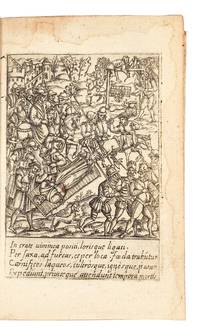
1583réf. 5484Macerata: Appresso Sebastiano Martellini con licenza de' superiori 1583. FIRST ITALIAN EDITION the second edition overall and the FIRST ILLUSTRATED EDITION. Hardcover. Fine. Bound in 19th c. ivory vellum hinges repaired at head and foot light soiling spine label fragmentary the boards ruled in gold the spine gold-tooled with repeating floral tools. Illustrated with six engraved plates of Catholic priests being abused apprehended tortured and executed described in detail below. With a woodcut title vignette of the Crucifixion a woodcut of the Pietà on leaf D7 verso printer's ornaments and woodcut initials. The text is type-ruled throughout. The text is in very good condition aside from damp-staining in gathering B and the six plates; the title page is soiled and has a small area of restoration at the upper corner as well as a clean tear mended and a little staining in the gutter. There is a light oil stain on leaf H6 and a marginal paper flaw on leaf N5. A translation with additional material of Allen's "A briefe historie of the glorious martyrdom of XII. reuerend priests executed vvithin these tvveluemonethes for confession and defence of the Catholike faith." Rheims: J. Foigny 1582. The English edition exists in only 2 copies British Library and Westminster Cathedral Library. This edition the first edition to include the six engraved illustrations is also rare. OCLC locates copies of the Macerata edition at 7 institutions in North America. see notes below for holdings. The central figure of Allen's martyrology is the Jesuit Edmund Campion 1540-1581 who at Allen's request and along with Robert Parsons led the first Mission to England. Campion and his companions were arrested on 17 July 1581. The present work recounts the arrest trial and eventual execution of Campion as well as the priests Ralph Sherwin Alexander Briant Thomas Ford John Shert Robert Johnson William Filby Luke Kirby Lawrence Richardson John Payne and Everard Hanse; as well as the Jesuit Thomas Cottam. Included in these accounts are the transcripts of Campion's final letter to the Jesuit General Claudio Aquaviva Ralph Sherwin's letter from the Tower and Alexander Briant's letter written while imprisoned to the Jesuit fathers in England requesting admission to the Society which was granted. Allen who continued to receive material up to the time of publication appended the martyrdoms of Cuthbert Maine John Nelson and Thomas Sherwood all of whom died in 1577 and 1578 to his account of the martyrs of 1581 and 1582. The translator of the present edition added an additional account not found in the English edition of the martyrdom of 4 English priests in 1583. The Engravings: The six engravings in this work first appeared in the first edition of Robert Parson's "De Persecutione Anglicana Libellus" published by the Jesuit College at Rome in 1582. Each of the six images is accompanied by a four-line explanation in hexameter verse. "The first plate depicts priests being apprehended in private houses and marched off to prison; the second in amplification shows various priests some still in their vestments being led away either on horseback or on foot but always securely bound two gentlewomen who had sheltered them being led to the same destination. In the third a priest is being scourged while tied to the back of a cart and below in the foreground an examination is in progress as preparations are made for torture. The fourth picture illustrates a racking with three other victims lined up to await their turn. In the fifth the priests are being dragged to execution on hurdles while the instruments of death are prepared; and the final plate represents the different stages of martyrdom from the hanging to the drawing quartering and burning of entrails."Anthony G. Petti in Recusant History April 1966 pp. 288-91 Edmund Campion: "Campion was arrested with his companions on 17 July 1581. Amid scenes of violent excitement Campion was derisively paraded through the streets of his native city bound hand and foot riding backwards with a paper stuck in his hat to denote the 'seditious Jesuit'. First thrown into Little Ease at the Tower he was carried privately to the house of his old patron the Earl of Leicester; there he encountered the queen herself and received earnest proffers of liberty and preferments would he but forsake his papistry. Hopton having tried in vain the same blandishments on Campion's return to the Tower the priest was then examined under torture and was reported to have betrayed those who had harboured him. Several arrests were made on the strength of the lie. He had asked for a public disputation. But when it came off in the Norman chapel of the Tower before the Dean of St. Paul's and other divines Campion had been denied opportunity to prepare his debate and had been severely racked. Thus weakened he stood through the four long conferences without chair table or notes and stood undefeated. Philip Howard Earl of Arundel who was looking on in the flush of worldly pride became thereby inspired to return to God's service. "The privy council at its wits' end over so purely spiritual a 'traitor' hatched a plot to impeach Campion's loyalty and called in the hirelings Eliot and Munday as accusers. A ridiculous trial ensued in Westminster Hall 20 Nov. 1581. Campion pleading not guilty was quite unable to hold up his often-wrenched right arm seeing which a fellow prisoner first kissing it raised it for him. He made a magnificent defence. But the sentence was death by hanging drawing and quartering: a sentence received by the martyrs with a joyful shout of 'Haec dies' and 'Te Deum'."Catholic Encyclopedia Cardinal William Allen: "On the accession of Elizabeth and the re-establishment of Protestantism William Allen was one of those who remained most staunch on the Catholic side and it is chiefly due to his labours that the Catholic religion was not entirely stamped out in England. Having resigned all his preferments he left the country in 1561 and sought a refuge in the university town of Louvain. The following year however we find him back in England devoting himself though not yet in priest's orders to evangelizing his native county. His success was such that it attracted notice and he had to flee for safety. For a while he made himself a missionary centre near Oxford where he had many acquaintances and later for a time he sought protection with the family of the Duke of Norfolk. In 1565 he was again forced to leave England this time as it turned out for good. He was ordained priest at Mechlin shortly afterwards. "Convinced that Protestant domination of England could only be temporary and that the whole future depended on there being a supply of trained clergy and controversialists ready to come into the country whenever Catholicity should be restored Allen founded the College at Douay since identified with his name. Douay was a new university founded by Pope Paul IV under the patronage of King Philip of Spain in whose dominions it then was for the special object of combating the errors of the Reformation; and what is still more to the purpose it was already under Oxford influences. The first chancellor Richard Smith was an Oxford man as were several of the most influential members of the university at the time when Allen began. It was his ambition to perpetuate Oxford influences and traditions and to make his new college practically a continuation of Catholic Oxford. "The means of support included besides Allen's private income and other voluntary donations a yearly pension of 200 ducats from the King of Spain and later on one of 100 gold crowns a month from the Pope. The number of students grew rapidly. Often more were received than the income warranted a course rendered necessary by the urgent state of Catholic affairs which Allen met in the spirit of faith; and in the long run means were never wanting. The names of Thomas Stapleton Richard Bristowe Gregory Martin Morgan Philips and others are still well known to English Catholics and are themselves a sufficient record of the ability of Allen's early companions and of the work done at the college. Allen had the power of instilling his spirit into his followers. They lived together without written rule but in perfect mutual harmony working for the common cause. From the Douay press came forth a constant stream of controversial and other Catholic literature which could not be printed in England on account of the Penal Laws. In this Allen himself took a prominent part. His writings are distinguished by extent of learning and theological acumen. One of the chief works undertaken in the early years of the college was the preparation of the well-known Douay Bible. The New Testament was published in 1582 when the college was at Rheims." "In 1575 Allen made a journey to Rome his second where he helped Pope Gregory XIII to found another college to send missionaries to England. For this purpose possession was obtained of the ancient English hospice in the city which was converted into a seminary. Returning to Douay Allen found a storm gathering against the English and in 1578 they were expelled from the town. The collegians took refuge at the University of Rheims where they were well received and continued their work as before Allen being soon afterwards elected canon of the Cathedral Chapter. In 1579 he paid his third visit to Rome being summoned thither in order that he might use his unique personal influence to adjust the dispute between the English and Welsh students at the new college there. It was during this visit that he was appointed a member of the Pontifical Commission for the revision of the Vulgate. Up to this point the career of Allen had won the universal admiration and gratitude of English Catholics for what he himself termed his 'scholastical attempts' to convert England. Such was not however the case with his political labors to secure the same end which may be said to have begun about this time and were far less successful. The famous Bull 'Regnans in excelsis' was issued by Pius V in 1570 deposing Queen Elizabeth and releasing her subjects from their allegiance but it did not take practical shape till seventeen years later when preparations were made for the invasion of England by the King of Spain. Allen was then once more in Rome whither he had been summoned by the Pope after a dangerous illness two years before. He never left the Eternal City again but he kept in constant communication with his countrymen in England. It had been due to his influence that the Society of Jesus to which he was greatly attached undertook to join in the work of the English mission; and now Allen and Father Parsons became joint leaders of the 'Spanish Party' among the English Catholics. "At the request of King Philip Allen was created cardinal in 1587 and held himself in readiness to go to England immediately should the invasion prove successful. In estimating the number of those who would be adherents to the scheme however Allen and Parsons were both at fault. The large majority of English Catholics generously forgetting the past sided with their own nation against the Spanish and the defeat of the Armada 1588 was a subject of rejoicing to them no less than to their Protestant fellow countrymen. Allen survived the defeat of the Armada six years. To the end of his life he remained fully convinced that the time was not far distant when England would be Catholic again. . He continued to reside at the English College Rome until his death 16 October 1594. He was buried in the chapel of the Holy Trinity adjoining the college." Catholic Encyclopedia. Appresso Sebastiano Martellini, con licenza de' superiori hardcover
1909xvii + 744pp., 25cm., original softcover with some minor defects, few annotations in margin of text of p.739, good condition, rare, weight: 1.4kg., R106417
1925xi + 863pp., 25cm., original softcover with some minor defects, most pages are still uncut, some occasional foxing, overall in good condition, rare, weight: 1.4kg., R106561
1583réf. 5484Macerata: Appresso Sebastiano Martellini con licenza de' superiori 1583. FIRST ITALIAN EDITION the second edition overall and the FIRST ILLUSTRATED EDITION. Hardcover. Fine. Bound in 19th c. ivory vellum hinges repaired at head and foot light soiling spine label fragmentary the boards ruled in gold the spine gold-tooled with repeating floral tools. Illustrated with six engraved plates of Catholic priests being abused apprehended tortured and executed described in detail below. With a woodcut title vignette of the Crucifixion a woodcut of the Pietà on leaf D7 verso printer's ornaments and woodcut initials. The text is type-ruled throughout. The text is in very good condition aside from damp-staining in gathering B and the six plates; the title page is soiled and has a small area of restoration at the upper corner as well as a clean tear mended and a little staining in the gutter. There is a light oil stain on leaf H6 and a marginal paper flaw on leaf N5. A translation with additional material of Allen's "A briefe historie of the glorious martyrdom of XII. reuerend priests executed vvithin these tvveluemonethes for confession and defence of the Catholike faith." Rheims: J. Foigny 1582. The English edition exists in only 2 copies British Library and Westminster Cathedral Library. This edition the first edition to include the six engraved illustrations is also rare. OCLC locates copies of the Macerata edition at 7 institutions in North America. see notes below for holdings. The central figure of Allen's martyrology is the Jesuit Edmund Campion 1540-1581 who at Allen's request and along with Robert Parsons led the first Mission to England. Campion and his companions were arrested on 17 July 1581. The present work recounts the arrest trial and eventual execution of Campion as well as the priests Ralph Sherwin Alexander Briant Thomas Ford John Shert Robert Johnson William Filby Luke Kirby Lawrence Richardson John Payne and Everard Hanse; as well as the Jesuit Thomas Cottam. Included in these accounts are the transcripts of Campion's final letter to the Jesuit General Claudio Aquaviva Ralph Sherwin's letter from the Tower and Alexander Briant's letter written while imprisoned to the Jesuit fathers in England requesting admission to the Society which was granted. Allen who continued to receive material up to the time of publication appended the martyrdoms of Cuthbert Maine John Nelson and Thomas Sherwood all of whom died in 1577 and 1578 to his account of the martyrs of 1581 and 1582. The translator of the present edition added an additional account not found in the English edition of the martyrdom of 4 English priests in 1583. The Engravings: The six engravings in this work first appeared in the first edition of Robert Parson's "De Persecutione Anglicana Libellus" published by the Jesuit College at Rome in 1582. Each of the six images is accompanied by a four-line explanation in hexameter verse. "The first plate depicts priests being apprehended in private houses and marched off to prison; the second in amplification shows various priests some still in their vestments being led away either on horseback or on foot but always securely bound two gentlewomen who had sheltered them being led to the same destination. In the third a priest is being scourged while tied to the back of a cart and below in the foreground an examination is in progress as preparations are made for torture. The fourth picture illustrates a racking with three other victims lined up to await their turn. In the fifth the priests are being dragged to execution on hurdles while the instruments of death are prepared; and the final plate represents the different stages of martyrdom from the hanging to the drawing quartering and burning of entrails."Anthony G. Petti in Recusant History April 1966 pp. 288-91 Edmund Campion: "Campion was arrested with his companions on 17 July 1581. Amid scenes of violent excitement Campion was derisively paraded through the streets of his native city bound hand and foot riding backwards with a paper stuck in his hat to denote the 'seditious Jesuit'. First thrown into Little Ease at the Tower he was carried privately to the house of his old patron the Earl of Leicester; there he encountered the queen herself and received earnest proffers of liberty and preferments would he but forsake his papistry. Hopton having tried in vain the same blandishments on Campion's return to the Tower the priest was then examined under torture and was reported to have betrayed those who had harboured him. Several arrests were made on the strength of the lie. He had asked for a public disputation. But when it came off in the Norman chapel of the Tower before the Dean of St. Paul's and other divines Campion had been denied opportunity to prepare his debate and had been severely racked. Thus weakened he stood through the four long conferences without chair table or notes and stood undefeated. Philip Howard Earl of Arundel who was looking on in the flush of worldly pride became thereby inspired to return to God's service. "The privy council at its wits' end over so purely spiritual a 'traitor' hatched a plot to impeach Campion's loyalty and called in the hirelings Eliot and Munday as accusers. A ridiculous trial ensued in Westminster Hall 20 Nov. 1581. Campion pleading not guilty was quite unable to hold up his often-wrenched right arm seeing which a fellow prisoner first kissing it raised it for him. He made a magnificent defence. But the sentence was death by hanging drawing and quartering: a sentence received by the martyrs with a joyful shout of 'Haec dies' and 'Te Deum'."Catholic Encyclopedia Cardinal William Allen: "On the accession of Elizabeth and the re-establishment of Protestantism William Allen was one of those who remained most staunch on the Catholic side and it is chiefly due to his labours that the Catholic religion was not entirely stamped out in England. Having resigned all his preferments he left the country in 1561 and sought a refuge in the university town of Louvain. The following year however we find him back in England devoting himself though not yet in priest's orders to evangelizing his native county. His success was such that it attracted notice and he had to flee for safety. For a while he made himself a missionary centre near Oxford where he had many acquaintances and later for a time he sought protection with the family of the Duke of Norfolk. In 1565 he was again forced to leave England this time as it turned out for good. He was ordained priest at Mechlin shortly afterwards. "Convinced that Protestant domination of England could only be temporary and that the whole future depended on there being a supply of trained clergy and controversialists ready to come into the country whenever Catholicity should be restored Allen founded the College at Douay since identified with his name. Douay was a new university founded by Pope Paul IV under the patronage of King Philip of Spain in whose dominions it then was for the special object of combating the errors of the Reformation; and what is still more to the purpose it was already under Oxford influences. The first chancellor Richard Smith was an Oxford man as were several of the most influential members of the university at the time when Allen began. It was his ambition to perpetuate Oxford influences and traditions and to make his new college practically a continuation of Catholic Oxford. "The means of support included besides Allen's private income and other voluntary donations a yearly pension of 200 ducats from the King of Spain and later on one of 100 gold crowns a month from the Pope. The number of students grew rapidly. Often more were received than the income warranted a course rendered necessary by the urgent state of Catholic affairs which Allen met in the spirit of faith; and in the long run means were never wanting. The names of Thomas Stapleton Richard Bristowe Gregory Martin Morgan Philips and others are still well known to English Catholics and are themselves a sufficient record of the ability of Allen's early companions and of the work done at the college. Allen had the power of instilling his spirit into his followers. They lived together without written rule but in perfect mutual harmony working for the common cause. From the Douay press came forth a constant stream of controversial and other Catholic literature which could not be printed in England on account of the Penal Laws. In this Allen himself took a prominent part. His writings are distinguished by extent of learning and theological acumen. One of the chief works undertaken in the early years of the college was the preparation of the well-known Douay Bible. The New Testament was published in 1582 when the college was at Rheims." "In 1575 Allen made a journey to Rome his second where he helped Pope Gregory XIII to found another college to send missionaries to England. For this purpose possession was obtained of the ancient English hospice in the city which was converted into a seminary. Returning to Douay Allen found a storm gathering against the English and in 1578 they were expelled from the town. The collegians took refuge at the University of Rheims where they were well received and continued their work as before Allen being soon afterwards elected canon of the Cathedral Chapter. In 1579 he paid his third visit to Rome being summoned thither in order that he might use his unique personal influence to adjust the dispute between the English and Welsh students at the new college there. It was during this visit that he was appointed a member of the Pontifical Commission for the revision of the Vulgate. Up to this point the career of Allen had won the universal admiration and gratitude of English Catholics for what he himself termed his 'scholastical attempts' to convert England. Such was not however the case with his political labors to secure the same end which may be said to have begun about this time and were far less successful. The famous Bull 'Regnans in excelsis' was issued by Pius V in 1570 deposing Queen Elizabeth and releasing her subjects from their allegiance but it did not take practical shape till seventeen years later when preparations were made for the invasion of England by the King of Spain. Allen was then once more in Rome whither he had been summoned by the Pope after a dangerous illness two years before. He never left the Eternal City again but he kept in constant communication with his countrymen in England. It had been due to his influence that the Society of Jesus to which he was greatly attached undertook to join in the work of the English mission; and now Allen and Father Parsons became joint leaders of the 'Spanish Party' among the English Catholics. "At the request of King Philip Allen was created cardinal in 1587 and held himself in readiness to go to England immediately should the invasion prove successful. In estimating the number of those who would be adherents to the scheme however Allen and Parsons were both at fault. The large majority of English Catholics generously forgetting the past sided with their own nation against the Spanish and the defeat of the Armada 1588 was a subject of rejoicing to them no less than to their Protestant fellow countrymen. Allen survived the defeat of the Armada six years. To the end of his life he remained fully convinced that the time was not far distant when England would be Catholic again. . He continued to reside at the English College Rome until his death 16 October 1594. He was buried in the chapel of the Holy Trinity adjoining the college." Catholic Encyclopedia. Appresso Sebastiano Martellini, con licenza de' superiori hardcover books
1867102pp.+ 56pp. (Appendices), 34cm., original softcover (some loss of paper at ends of spine), text clean and bright with only few foxing, cfr. De Backer & Sommervogel vol.VIII p.958 no.4, R23336
1673In-8°, 16 cc, pp. 327, più errata, c. di tav. ripiegata (Situs provinciarum imperii Sinici), occhietto, vignetta calcografica sul frontespizio, illustrazioni calcografiche. Rilegatura in pergamena con nervi e titolo al dorso. ROUGEMONT (Franciscus de), b. a Maastricht il 2 aprile 1624, d. a Chang-chu (Cina) il 4 novembre 1676. Nelle scuole dei gesuiti a Bruxelles e Anversa fece i suoi studi inferiori con risultati brillanti e nel1641entrò nella Compagnia di Gesù. All'assedio di Kortrijk nel 1646 si distinse, sebbene non fosse ancora un sacerdote, per il suo zelo nella cura dei soldati feriti. Nel 1654 ricevette la consacrazione del sacerdote e, quando padre Martino Martini, procuratore della missione cinese in Europa, venne a cercare missionari per questo lavoro, riuscì a convincere i suoi genitori a richiedere quella missione a favore del figlio dal Generale dell'Ordine. L'anno seguente partì da Amsterdam per Lisbona con il gesuita di Amsterdam Ignazio Hartoghvelt. Dopo un ritardo a Coimbra, lasciarono Lisbona il 30 marzo 1656 e arrivarono il 6 novembre a Coa. A piedi, continuò il suo viaggio lungo la costa di Malabar, Visschersen Transvancore, e poi attraversò il Siam, dove il suo compagno Hartoghvelt morì a Yoethia nel 1658. Nello stesso anno, de Rougemont raggiunse Macao, e nel 1659, raggiunse la corte imperiale, in Cina. I cristiani da lui formati sono stati riconosciuti per il loro zelo e conoscenza della religione. In seguito a una violenta persecuzione dei cristiani durante la minore età dell'imperatore Kang-hi i missionari furono portati prigionieri a Pechino, poi esiliati nel Canton e imprigionati nella chiesa per 6 anni. R. capì che questa persecuzione aveva la sua ragione principale nella nazionalità straniera dei missionari. Per togliere quest'arma dalle mani degli avversari, pensò di addestrare un clero nativo e pensò che consentire una liturgia della chiesa in lingua cinese avrebbe promosso questo piano. Nel 1667 inviò un dettagliato memorandum al generale dell'ordine Oliva (stampato in Analecta Bollandiana XXXIII (1914), 279-93). Solo nel 1671, quando l'imperatore Kang-hi fu convinto dell'innocenza dei missionari, questi tornarono alle loro congregazioni cristiane. Il Rougemont ha continuò il lavoro interrotto per altri 5 anni. Durante un viaggio verso l'isola di Tsong-ming, si ammalò a Tsang-chu e morì tra le braccia di Padre Couplet. I suoi fedeli cristiani vennero per raccogliere il corpo del loro padre spirituale e dopo due giorni di cammino lo seppellirono solennemente sul Monte Voxan fuori dalla città di Changsho. Egli aveva usato il tempo della sua disoccupazione forzata per compilare la sua Historia Tartaro-Sinica nova (Lovanii 1673), in cui racconta ampiamente la persecuzione subita. Il Rougemont ha dato un ottimo contributo alla conoscenza della letteratura cinese. Con i padri Intorcetta, Herdrich e Couplet, intraprese l'importante lavoro: Confucius Sinarum philosophus, messo in stampa nel 1687 per ordine di Luigi XIV a Parigi. In-8 °, 16 cc, pp. 327, plus errata, folded table (Situs provinciarum imperii Sinici), half-title, woodcut on the title page. ROUGEMONT (Franciscus de), b. in Maastricht on April 2, 1624, d. in Changchu (China) on November 4, 1676. In Jesuit schools in Brussels and Antwerp he made his lower studies with brilliant results and in 1641 he entered the Society of Jesus. At the siege of Kortrijk in 1646 he distinguished himself, even if he was not yet a priest, for his zeal in caring for wounded soldiers. In 1654 he received the priest's consecration and, when Father Martino Martini, procurator of the Chinese mission in Europe, came to look for missionaries for this job, he managed to convince his parents to carry out that mission in favor of his son by the General of the Order. The following year he left Amsterdam for Lisbon with the Jesuit of Amsterdam Ignazio Hartoghvelt. After a delay in Coimbra, they left Lisbon on 30 March 1656 and arrived on 6 November in Coa. On foot, he continued his journey along the coast of Malabar, Visschersen Transvancore, and then he crossed Siam, where his companion Hartoghvelt died in Yoethia in 1658. In the same year, Rougemont reached Macau, and in 1659, he reached the imperial court , in China. The Christians he trained were listed for their zeal and knowledge of religion. Following a violent persecution of Christians during the minor age of Emperor Kang-hi, the missionaries were taken prisoner to Beijing, then exiled to the Canton and imprisoned in the church for 6 years. R. understood that this persecution had its main reason in the foreign nationality of the missionaries. To remove this weapon from the hands of opponents, he thought of training a native clergy and thought that allowing a Chinese-language church liturgy would promote this plan. In 1667 he sent a detailed memorandum to the general of the order Oliva (printed in Analecta Bollandiana XXXIII (1914), 279-93). Only in 1671, when Emperor Kang-hi was convinced of the innocence of the missionaries, did they return to their Christian congregations. Rougemont continued the interrupted work for another 5 years. During a trip to Tsong-ming Island, a Tsang-chu fell ill and died in the arms of Father Couplet. His faithful Christians came to collect the body of their spiritual father and after two days of walking they saw him solemnly on Mount Voxan outside the city of Changsho. He had used the time of his forced unemployment to compile his Historia Tartaro-Sinica nova (Lovanii 1673), in which he widely recounts the persecution he endured. Rougemont made an excellent contribution to the knowledge of Chinese literature. With his fathers Intorcetta, Herdrich and Couplet, he undertook the important work: Confucius Sinarum philosophus, printed in 1687 by order of Louis XIV in Paris.
17342 works (pars 3 & 4) bound in 1 volume; I: [ii bl.] + [iv] 452 [xxxi, index] & II: [iv] 510 [xxi, index] pp., text in latin, cart.cover with leather spine, 32cm., [cfr. De Backer-Sommervogel: III-812-4 & IV-1252-3]
1590In -8°, pp. (88), 763, 5 pp. bb. Legatura in pelle di scrofa coeva con fregi ai piatti e nervi al dorso. Terza edizione, dopo quella di Firenze dell’88 e la prima di Colonia dell’89. Il libro, celebre e ampiamente ristampato, contiene la prima descrizione mai pubblicata della pianta del tè. Fine binding in contemporary pigskin. The third edition, after the Florence’s one and the first, from Cologne. The book, widely reprinted, contains the first description of the tea plant ever published in Europe.
1883211 [1] pp., brochure originale orange, 19cm., pour la plupart non coupé, bon état, R77374
réf. 70493, Brepols, 2026 Paperback, Pages: 535, Size:156 x 234 mm, Illustrations:7 b/w, Language: English. ISBN 9782503601755.
1631réf. 2989Col. Agrippinae (Cologne), Corn. ab Egmond, 1631 ; petit in-12 ; plein veau fauve glacé, dos à nerfs décoré de filets dorés disposés en carrés, pièce de titre bordeaux, double filet doré d'encadrement des plats (reliure de l'époque) ; (5)ff. dont titre gravé, 179 pp., (1) p. d'approbation.