2 550 résultats
1913réf. R59702Matriti [Madrid], Typis Gabrielis Lopez del Horno 1913 xx + 760pp., includes bibliographical references and index, original 1913-edition, (texts in latin, italian & spanish), hardback (marbled plates, spine in cloth), 23cm., VG, in the series "Monumenta Historica Societatis Jesu" volume 46
1929réf. qq764Beauchesne Broché 1929 In-8 (23x14 cm), broché, 504 pages, bibliographie ; pliures sur le dos, plats légèrement jaunis, assez bon état. Livraison a domicile (La Poste) ou en Mondial Relay sur simple demande.
réf. 237134S.l., s.d. (1764) in-8, 23 pp., texte latin et traduction française en regard, en feuilles, cousu.
In 24° (cm 7,5 x 11), piena pergamena rimontata, pp (8), 83, (3), stemma silografico dei Gesuiti al frontespizio, esemplare in buone condizioni, due capilettera acquarellati, . Estratto dal Compendio dei privilegi e grazie dell'Ordine, di concessione papale, a cura del Preposito Generale Claudio Acquaviva (1581-1715), in ordine alfabetico, contenente le voci più importanti: estratto dalla bolla "In Coena Domini"; Apostatae; Excommunicatio; Heretici; Oraculi; Scrupuli; Sede vacante... Minuscola, ma preziosa, testimonianza del periodo di maggior gloria della Compagnia: sotto il Vicario Generale Acquaviva, per trentaquattro anni e sotto otto Pontefici, l'Ordine vive il suo momento più brillante: "Le règne de la Puissance de l'Ordre", come afferma Ribadeau Dumas. Dopo lunghe trattative e controversie, nel 1606 Paolo V approva ufficialmente le "Constitutions": di questo si trova eco nell'introduzione, così come allusioni alla furiosa "bataille d'idées" che si stava svolgendo in quegli anni tra Domenicani e Gesuiti sul principio del libero arbitrio e sulla Grazia. Non abbiamo trovato esemplari di questa edizione censiti nelle biblioteche; solo CCFr segnala opera con lo stesso titolo, Tournon 1603. Ribadeau Dumas, "Grandeur et misère des Jésuites".
187331 + [ii] pp., 25cm., text in Latin, original softcover, few foxing, good condition, R96621
1873réf. R96621Arnhemiae [Arnhem], G.W. Van Der Wiel 1873 31 + [ii] pp., 25cm., text in Latin, original softcover, few foxing, good condition, R96621
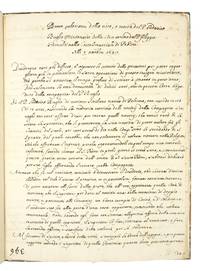
1683réf. 5517Rome: ca 1683. Hardcover. Fine. Bound in modern marbled papered boards with leather title label in gilt to the upper board. 17th c. manuscript in ink in a fine secretarial hand on laid paper with watermark of an anchor within circle. Fine condition leading edge untrimmed. A little light spotting on the first leaf very slim portion of leading edge of fourth leaf a little ragged and dust soiled. A report on the life death and funeral of the Sicilian Jesuit Ludovico Buglio 1606-1682 called Li Leisi Chinese: åˆ©é¡žæ€ a distinguished missionary and scientist at the Chinese imperial court in Peking during the late Ming and early Qing dynasties. It was written by Buglio's fellow Jesuit and friend Filippo Grimaldi Chinese: Min Ming'o 1638-1712 who arrived in China in 1671. Grimaldi was present at his confrère's funeral where he tells us that he partook of Manchu tea and wine offered to the mourners. This account which contains information not reported elsewhere remained in manuscript until the 20th century. In addition to our manuscript three other copies are known one of them in the Jesuit archives Rome: Fondo Gesuitico A.R.S.I. Archivum Romanum Societatis Iesu 722/4; another in the Vatican: A.S.V. Archivio Segreto Vaticano Miscellanei dei Gesuiti arm. VIII 58 ff. 16r-21v; and the third in the State Archives Rome: Archivio di Stato Roma Gesuiti Miscell. Pacco 5. Ludovico Buglio labored in China for forty-seven politically turbulent years. He established the first mission in Szechwan Sichuan Province where he carried out intensive evangelization despite opposition from local Buddhist and Daoist clergy built churches at Baoning Chongqing and Peking served as astronomer for the rebel Zhang Xianzhong who raised Buglio to the rank of mandarin and was instrumental in restoring the Imperial Observatory at Peking to Jesuit control. Buglio was imprisoned twice exiled once and narrowly escaped execution. An arrow wound inflicted by a Manchu warrior in 1647 never fully healed leaving Buglio in intense pain for the rest of his life. The wound ultimately proved fatal. In a letter transcribed in this manuscript addressed to Buglio's fellow Jesuits in Peking the Kangxi Emperor lamented Buglio's prolonged suffering and imminent death and announced that he would assist with the funeral expenses. The Emperor's letter is followed by Grimaldi's eyewitness account of the funeral which was overseen by imperial delegates who also participated in the traditional Chinese funeral honors. Renowned for his mastery of spoken and written Chinese Buglio wrote and published a large number of Chinese-language works a list of which is appended to this manuscript. Among the most important of these were "Yulan Xifang Yaoji" "Imperially Commissioned Essentials of the West" presented to the Kangxi Emperor around May 1669 and a translation of Aquinas' "Summa Theologica" titled "Chaoxing xueyao" "Compendium of the Science of the Supernatural". The author and his account: Grimaldi "was one of the most capable and courageous missionaries; he arrived in China during a time of persecution when with the exception of four Fathers remaining in Beijing the other missionaries had been rounded up and held prisoner in Canton twenty-five in total: fourteen Jesuits ten Dominicans and one Franciscan. Upon arriving in Macau the young Fr. Grimaldi secretly made his way into Canton in December 1669 to take the place of a missionary-Fr. Navarrete the Dominican superior-who had escaped from prison; his absence had it been discovered could have seriously jeopardized all the prisoners. In 1671 when the missionaries in Canton were released Fr. Grimaldi was summoned to Beijing to assist Fr. Verbiest and gave science lessons to Emperor Kangxi himself. In 1685 the Emperor sent him to Russia to negotiate with the Tsar regarding the passage of Chinese merchants and European missionaries through Russian territory; however he was unable to achieve this objective and after an absence of seven years he returned to Beijing where he died in 1712."Barbera Grimaldi was well-positioned to write this account of Buglio's life. He labored alongside Buglio for twelve years and it can be assumed that those things that Grimaldi did not witness personally were communicated to him by Buglio himself and other Jesuits chief among them Buglio's close companion Gabriel Magalhães who was with Buglio from the time of his work in Sichuan province through his time in Peking. This accounts for the level of detail that Grimaldi is able to present in his account such as in the story of the providential removal of the arrow that had become lodged in Buglio's body after he and Magalhães were mistaken for spies and shot by Manchu soldiers: "a piece of arrow so tenaciously lodged in his body that Father Magalhães was never able to draw it out either with his hands or with his teeth. Magalhães though he was gravely wounded in one arm strove to find in the wilderness something with which to draw the arrow out; and behold before his eyes there appeared a pair of pincers which seemed to have been brought by his guardian angel for that very need alone with which full of joy and wonder he gave thanks to divine providence and freed Father Buglio from that affliction." The Emperor's letter & Buglio's Funeral: While Buglio lay on his deathbed the Emperor having heard about Buglio's illness through Zhao Chang a member of the Imperial Bodyguard sent a letter to the Jesuits which Grimaldi gives in full. In appreciation for Buglio's years of service to his father and himself his dedication to Chinese language and culture and "because you are men from beyond the sea and Father Ludovico now lies dying in this city far from his own country without kinsfolk to assist him" the Emperor informs the Jesuits that he will arrange and pay for Buglio's funeral. With the letter comes a gift of "two hundred Foè that is two hundred gold scudi and ten pieces of silk as a token of the regard I have held for the father and of how greatly his loss grieves me." The funeral rites included an impressive procession: "The Emperor in every way wished the funeral conducted according to his own affection and not according to the modesty proper to our institute. Twenty soldiers were sent by the Emperor to clear the streets as far as the burial place. At the head of the procession walked a standard raised aloft on which was written in large characters the Father's name together with the many praises and honors the Emperor bestowed on him and a copy of the Emperor's own letter in praise of the deceased on yellow satin silk a color reserved to His Majesty alone. There followed Father Buglio's image above which were written two very large characters signifying that this imperial decree had been issued in memory of the great esteem in which the deceased had been held. In the place of highest honor was set the Holy Cross with the images of St. Michael and Our Lady amid many censers and incense and choirs of diverse musical instruments." "Then followed more than five hundred Christians clothed in mourning and finally gentlemen without number preceded by the court officials sent by the Emperor for this purpose. This whole procession having at last arrived at the place granted us by the late Emperor for the burial of the fathers the funeral was carried out - with great modesty on the part of the Christians and equal reverence on the part of the gentiles." Grimaldi closes his account explaining that while he would like to write more the letter courier is about to leave for Macau and so he must stop where he is. The list of Buglio's Chinese Works: Grimaldi applauds Buglio's remarkable success in mastering Chinese which allowed him to forge close relationships with the Chinese literati and the mandarins. "He accomplished much by writing.understanding very well how highly letters are prized in China and how gentle and how powerful a means the spreading of books is for instilling the holy law of Christ. From the very beginning of his arrival in China he lost no time in advancing himself in Chinese letters language and books and to this end he had all the walls of his room covered with Chinese characters." The manuscript closes with a list of 23 of Buglio's Chinese works including the aforementioned "Yulan Xifang Yaoji" and "Chaoxing xueyao" as well as translations of the Roman Missal 1670 Breviary 1674 and Ritual 1675. Other works some on scientific matters addressed to the Emperor include "Shizi shuo" "Discourse on Lions" 1678 written when the Portuguese gave the emperor an African lion based largely on Ulisse Aldrovandi's "Book of quadrupeds" Bologna 1645 and "Jincheng ying shuo" "Discourse on Falcons offered to the emperor" 1679 written at the emperor's request after he admired the illustrations in Aldrovandi's "Ornithology". This work was later excerpted with attribution into the imperial encyclopedia "Gujin tushu jicheng" 1728. See Lo Nardo P. Ludovico Buglio S.J. 1606-1682 in Intorcettiana Anno II - N. 3 gennaio-giugno 2020; Pfister Notices biographiques et bibliographiques sue les Jésuites de l'ancienne mission de Chine 1552-1773 tome I Chang-Hai 1932 pp. 372-376. ca hardcover
1683réf. 5517Rome: ca 1683. Hardcover. Fine. Bound in modern marbled papered boards with leather title label in gilt to the upper board. 17th c. manuscript in ink in a fine secretarial hand on laid paper with watermark of an anchor within circle. Fine condition leading edge untrimmed. A little light spotting on the first leaf very slim portion of leading edge of fourth leaf a little ragged and dust soiled. A report on the life death and funeral of the Sicilian Jesuit Ludovico Buglio 1606-1682 called Li Leisi Chinese: åˆ©é¡žæ€ a distinguished missionary and scientist at the Chinese imperial court in Peking during the late Ming and early Qing dynasties. It was written by Buglio's fellow Jesuit and friend Filippo Grimaldi Chinese: Min Ming'o 1638-1712 who arrived in China in 1671. Grimaldi was present at his confrère's funeral where he tells us that he partook of Manchu tea and wine offered to the mourners. This account which contains information not reported elsewhere remained in manuscript until the 20th century. In addition to our manuscript three other copies are known one of them in the Jesuit archives Rome: Fondo Gesuitico A.R.S.I. Archivum Romanum Societatis Iesu 722/4; another in the Vatican: A.S.V. Archivio Segreto Vaticano Miscellanei dei Gesuiti arm. VIII 58 ff. 16r-21v; and the third in the State Archives Rome: Archivio di Stato Roma Gesuiti Miscell. Pacco 5. Ludovico Buglio labored in China for forty-seven politically turbulent years. He established the first mission in Szechwan Sichuan Province where he carried out intensive evangelization despite opposition from local Buddhist and Daoist clergy built churches at Baoning Chongqing and Peking served as astronomer for the rebel Zhang Xianzhong who raised Buglio to the rank of mandarin and was instrumental in restoring the Imperial Observatory at Peking to Jesuit control. Buglio was imprisoned twice exiled once and narrowly escaped execution. An arrow wound inflicted by a Manchu warrior in 1647 never fully healed leaving Buglio in intense pain for the rest of his life. The wound ultimately proved fatal. In a letter transcribed in this manuscript addressed to Buglio's fellow Jesuits in Peking the Kangxi Emperor lamented Buglio's prolonged suffering and imminent death and announced that he would assist with the funeral expenses. The Emperor's letter is followed by Grimaldi's eyewitness account of the funeral which was overseen by imperial delegates who also participated in the traditional Chinese funeral honors. Renowned for his mastery of spoken and written Chinese Buglio wrote and published a large number of Chinese-language works a list of which is appended to this manuscript. Among the most important of these were "Yulan Xifang Yaoji" "Imperially Commissioned Essentials of the West" presented to the Kangxi Emperor around May 1669 and a translation of Aquinas' "Summa Theologica" titled "Chaoxing xueyao" "Compendium of the Science of the Supernatural". The author and his account: Grimaldi "was one of the most capable and courageous missionaries; he arrived in China during a time of persecution when with the exception of four Fathers remaining in Beijing the other missionaries had been rounded up and held prisoner in Canton twenty-five in total: fourteen Jesuits ten Dominicans and one Franciscan. Upon arriving in Macau the young Fr. Grimaldi secretly made his way into Canton in December 1669 to take the place of a missionary-Fr. Navarrete the Dominican superior-who had escaped from prison; his absence had it been discovered could have seriously jeopardized all the prisoners. In 1671 when the missionaries in Canton were released Fr. Grimaldi was summoned to Beijing to assist Fr. Verbiest and gave science lessons to Emperor Kangxi himself. In 1685 the Emperor sent him to Russia to negotiate with the Tsar regarding the passage of Chinese merchants and European missionaries through Russian territory; however he was unable to achieve this objective and after an absence of seven years he returned to Beijing where he died in 1712."Barbera Grimaldi was well-positioned to write this account of Buglio's life. He labored alongside Buglio for twelve years and it can be assumed that those things that Grimaldi did not witness personally were communicated to him by Buglio himself and other Jesuits chief among them Buglio's close companion Gabriel Magalhães who was with Buglio from the time of his work in Sichuan province through his time in Peking. This accounts for the level of detail that Grimaldi is able to present in his account such as in the story of the providential removal of the arrow that had become lodged in Buglio's body after he and Magalhães were mistaken for spies and shot by Manchu soldiers: "a piece of arrow so tenaciously lodged in his body that Father Magalhães was never able to draw it out either with his hands or with his teeth. Magalhães though he was gravely wounded in one arm strove to find in the wilderness something with which to draw the arrow out; and behold before his eyes there appeared a pair of pincers which seemed to have been brought by his guardian angel for that very need alone with which full of joy and wonder he gave thanks to divine providence and freed Father Buglio from that affliction." The Emperor's letter & Buglio's Funeral: While Buglio lay on his deathbed the Emperor having heard about Buglio's illness through Zhao Chang a member of the Imperial Bodyguard sent a letter to the Jesuits which Grimaldi gives in full. In appreciation for Buglio's years of service to his father and himself his dedication to Chinese language and culture and "because you are men from beyond the sea and Father Ludovico now lies dying in this city far from his own country without kinsfolk to assist him" the Emperor informs the Jesuits that he will arrange and pay for Buglio's funeral. With the letter comes a gift of "two hundred Foè that is two hundred gold scudi and ten pieces of silk as a token of the regard I have held for the father and of how greatly his loss grieves me." The funeral rites included an impressive procession: "The Emperor in every way wished the funeral conducted according to his own affection and not according to the modesty proper to our institute. Twenty soldiers were sent by the Emperor to clear the streets as far as the burial place. At the head of the procession walked a standard raised aloft on which was written in large characters the Father's name together with the many praises and honors the Emperor bestowed on him and a copy of the Emperor's own letter in praise of the deceased on yellow satin silk a color reserved to His Majesty alone. There followed Father Buglio's image above which were written two very large characters signifying that this imperial decree had been issued in memory of the great esteem in which the deceased had been held. In the place of highest honor was set the Holy Cross with the images of St. Michael and Our Lady amid many censers and incense and choirs of diverse musical instruments." "Then followed more than five hundred Christians clothed in mourning and finally gentlemen without number preceded by the court officials sent by the Emperor for this purpose. This whole procession having at last arrived at the place granted us by the late Emperor for the burial of the fathers the funeral was carried out - with great modesty on the part of the Christians and equal reverence on the part of the gentiles." Grimaldi closes his account explaining that while he would like to write more the letter courier is about to leave for Macau and so he must stop where he is. The list of Buglio's Chinese Works: Grimaldi applauds Buglio's remarkable success in mastering Chinese which allowed him to forge close relationships with the Chinese literati and the mandarins. "He accomplished much by writing.understanding very well how highly letters are prized in China and how gentle and how powerful a means the spreading of books is for instilling the holy law of Christ. From the very beginning of his arrival in China he lost no time in advancing himself in Chinese letters language and books and to this end he had all the walls of his room covered with Chinese characters." The manuscript closes with a list of 23 of Buglio's Chinese works including the aforementioned "Yulan Xifang Yaoji" and "Chaoxing xueyao" as well as translations of the Roman Missal 1670 Breviary 1674 and Ritual 1675. Other works some on scientific matters addressed to the Emperor include "Shizi shuo" "Discourse on Lions" 1678 written when the Portuguese gave the emperor an African lion based largely on Ulisse Aldrovandi's "Book of quadrupeds" Bologna 1645 and "Jincheng ying shuo" "Discourse on Falcons offered to the emperor" 1679 written at the emperor's request after he admired the illustrations in Aldrovandi's "Ornithology". This work was later excerpted with attribution into the imperial encyclopedia "Gujin tushu jicheng" 1728. See Lo Nardo P. Ludovico Buglio S.J. 1606-1682 in Intorcettiana Anno II - N. 3 gennaio-giugno 2020; Pfister Notices biographiques et bibliographiques sue les Jésuites de l'ancienne mission de Chine 1552-1773 tome I Chang-Hai 1932 pp. 372-376. ca hardcover books
B., s.a. (hacia 1762), 14'5 x 9'5 cm., 128 págs. (Ejemplar corto del margen exterior afectando en unas 3 hojas a una letra. Carece de encuadernación).
1947réf. 20774Poitiers société des antiquaires de L'ouest 1947 2 Fascicules In-8 102 pp 2 fascicules pour 4 trimestres
réf. 53635P. et Bruxelles, Editions Universitaires (Bibliothèque HIstorique), 1951, grand in 8° broché, 455 pages ; quelques rousseurs.
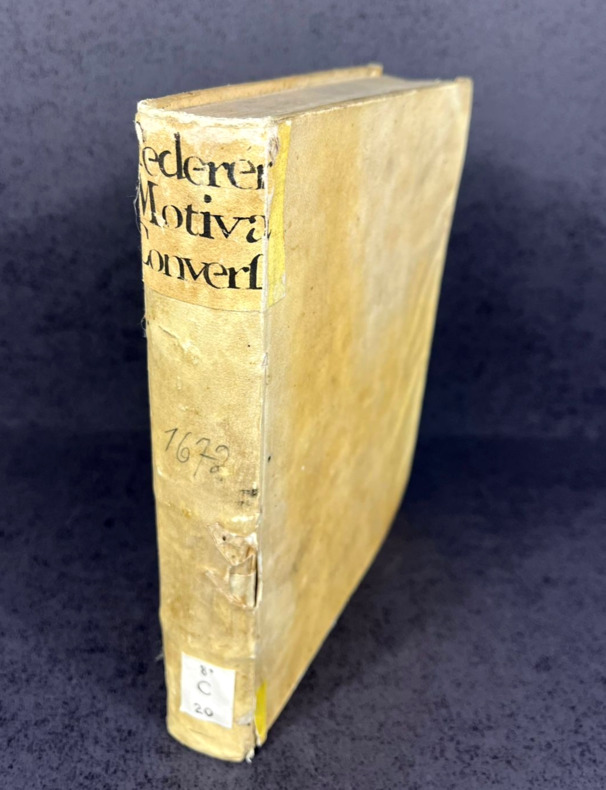
1672réf. 0533Innsbruck, Wagner, 1672. Épais volume in-4 de 160 x 203 mm, 440 (23) pp. Relié plein vélin blanc d'époque. Étiquette d'époque en coiffe, autre étiquette (bibliothèque) plus récente en queue, année d'édition au crayon au milieu du dos. Marque d'ancienne bibliothèque au premier contreplat surmontée d'une référence au crayon. Première garde blanche avec deux inscriptions en latin et allemand. Page de titre principale placée en fin d'ouvrage (!), qui commence par la page signalant la première partie, avec une inscription à la plume en haut de cette page d'ouverture. Rarissime titre polémique anticalviniste. L'auteur, Ioannes ou Johannes Federer (1645-1706), était prêtre jésuite. Professeur et théologien, il s'est fait remarquer en particulier avec "Calvinismus Detectus, & dedoctus", un livre érudit et vigoureux qui condamne le protestantisme calviniste dans les termes les plus fermes. L'auteur y répond à deux lettres calvinistes, l'une du philologue Johann Georg Grævius (1632-1703), converti, l'autre de Johann Jakob Vedrosi (1624-1706). Avec bandeaux, lettrines et culs-de-lampe. Léger manque au dos, petits trous de mite aux toutes premières pages sans aucun autre dégât, deux morceaux de papier vierges collés pour couvrir les tampons du monastère d'origine, sinon intérieur très pur, exempt de rousseurs ou d'annotations. ***************************************************** Innsbruck, Wagner, 1672. Thick in-quarto volume, 160 x 203 mm, 440 (23) pp. Bound in full contemporary white vellum. Contemporary label at the endpaper, another more recent (library) label at the tail, year of publication in pencil in the center of the spine. Old library mark on the front cover surmounted by a pencil reference. First white endpaper with two inscriptions in Latin and German. Main title page placed at the end of the book (!), which begins with the page indicating the first part, with a pen inscription at the top of this opening page. An extremely rare anti-Calvinist polemical title. The author, Ioannes or Johannes Federer (1645-1706), was a Jesuit priest. A professor and theologian, he made a name for himself in particular with "Calvinismus Detectus, & dedoctus," a scholarly and vigorous book that condemns Calvinist Protestantism in the strongest terms. In it, the author responds to two Calvinist letters, one from the philologist Johann Georg Grævius (1632-1703), a convert, and the other from Johann Jakob Vedrosi (1624-1706). With headbands, initials, and tailpieces. Slight loss to the spine, small moth holes in the very first pages with no other damage, two small blank pieces of paper glued to cover the original monastery stamps. Otherwise, the interior is very clean, free of foxing or annotations.
1931réf. 17981931 Grasse, [privately printed], 1931 (imp. de "l'Eclaireur de Nice"). 25, 5 x 17 cm, 8vo, 87 pp., wood engraved ex-libris of James C. Mc Coy on the frontispiece (designed and engraved by Eric Gill for exclusive use in the collection old Jesuit Relation of New France included in this hand-list), original quarter black buckram, spine lettered in gold.
réf. 57871aafFreiburg Schweiz, Heiligen Paulus, 1896, kl. in-8vo, Frontispiz + 134 S., Autographe Emile Ems Stalden 130 à Fribourg Suisse + cachet EMS EMIL étudiant, Original-Leinenband, Tiefprägung, rotschnitt.
1646réf. 81570Romae: Ex Typographia Reu. Camerae Apost 1646. 8p. Softcover pamphlet. 21 cm. Disbound removed from a bound volume. Small Yale library stamp overstamped with "discard" at base of title-page. Minor browning. Good. Latin text. Ex Typographia Reu. Camerae Apost unknown
1646réf. 81570Romae: Ex Typographia Reu. Camerae Apost 1646. 8p. Softcover pamphlet. 21 cm. Disbound removed from a bound volume. Small Yale library stamp overstamped with "discard" at base of title-page. Minor browning. Good. Latin text. Ex Typographia Reu. Camerae Apost unknown books
réf. 213414Collection Selecta patrum Societatis Iesu carminaParis, Jean Boudot, 1705 in-12, [10] ff. n. ch. (faux-titre & titre, dédicace en vers à Louis-Marcel de Coëtlogon, préface, poésie liminaire), 313 pp., [3] pp. n. ch. de privilège, veau fauve, dos à nerfs cloisonné et fleuronné, pièce de titre cerise, tranches mouchetées (reliure de l'époque). Début de fente aux mors, coiffe inférieure usée.
1688réf. 32092Lutetiae Parisiorum Lutetia Paris: Apud Viduam Simonis Benard via Jacobea e regione Collegii Soc. Jesu 1688. Very Good. Lutetiae Parisiorum Paris: Apud Viduam Simonis Benard a.k.a. Marie Benard via Jacobea e regione Collegii Soc. Jesu. 1688. Fifth Edition. 12mo; contemporary calf gilt spine in five compartments; 2331pp.; head and tail pieces; twenty-four 24 engraved emblems. Light wear to edges with shallow loss at spine ends. Binding sound. Bookplate of "C.T. Noel du Payrat" to front pastedown; interior else unmarked; a Very Good and sound copy of a scarce title originally published in 1680 and including "Lysimachis" "Panygyrici" "Symbola Heroica" with many emblems referring to persons associated with the Court of of Louis XIV. Published by Parisian printer Marie Benard the widow of Simon Benard. She went on to publish works for nearly twenty-five years through 1712 though we find little biographical information about her beyond her house's publications. . Apud Viduam Simonis Benard, via Jacobea e regione Collegii Soc. Jesu unknown
1688réf. 32092Lutetiae Parisiorum Lutetia Paris: Apud Viduam Simonis Benard via Jacobea e regione Collegii Soc. Jesu 1688. Very Good. Lutetiae Parisiorum Paris: Apud Viduam Simonis Benard a.k.a. Marie Benard via Jacobea e regione Collegii Soc. Jesu. 1688. Fifth Edition. 12mo; contemporary calf gilt spine in five compartments; 2331pp.; head and tail pieces; twenty-four 24 engraved emblems. Light wear to edges with shallow loss at spine ends. Binding sound. Bookplate of "C.T. Noel du Payrat" to front pastedown; interior else unmarked; a Very Good and sound copy of a scarce title originally published in 1680 and including "Lysimachis" "Panygyrici" "Symbola Heroica" with many emblems referring to persons associated with the Court of of Louis XIV. Published by Parisian printer Marie Benard the widow of Simon Benard. She went on to publish works for nearly twenty-five years through 1712 though we find little biographical information about her beyond her house's publications. . Apud Viduam Simonis Benard, via Jacobea e regione Collegii Soc. Jesu unknown books
1693In-12°, (3cc), 7-233pp, illustrazioni, legatura in pergamena, nervi, buone condizioni, emblema del Re Sole Luigi XIV al frontespizio, 27 emblemi Charles de La Rue (3 agosto 1643, Parigi - 27 maggio 1725, Parigi), noto in latino come Carolus Ruaeus, fu uno dei grandi oratori della Compagnia di Gesù in Francia nel diciassettesimo secolo. Entrò nel noviziato il 7 settembre 1659, ed essendo successivamente professore di lettere e retorica, attirò l'attenzione mentre era ancora giovane da una poesia sulle vittorie di Luigi XIV. Pierre Corneille lo tradusse e lo offrì al re, dicendo che il suo lavoro non eguagliava l'originale del giovane gesuita. Ha scritto diverse tragedie, pubblicato un'edizione di Virgilio e scritto diverse poesie latine. Dopo aver più volte rifiutato di permettergli di andare in Canada, i suoi superiori lo assegnarono alla predicazione; come oratore era molto ammirato dalla corte e dal re. Le sue orazioni funebri sui duchi di Borgogna e del Lussemburgo e quelle su Jacques-Bénigne Bossuet, i suoi sermoni su "Les Calamités publiques" e "The Dying Sinner" sono stati considerati capolavori dai più grandi maestri. Ha predicato missioni tra i protestanti della Linguadoca per tre anni. Era un religioso molto virtuoso e durante i suoi ultimi anni sopportò coraggiosamente grandi infermità. In-12 °, (3cc), 7-233pp, illustrations, vellum binding, bands, good condition, emblem of the Sun King Louis XIV on the title page. 27 emblems. Charles de La Rue (3 August 1643, Paris – 27 May 1725, Paris), known in Latin as Carolus Ruaeus, was one of the great orators of the Society of Jesus in France in the seventeenth century. He entered the novitiate on 7 September 1659, and being afterwards professor of the humanities and rhetoric, he attracted attention while still young by a poem on the victories of Louis XIV. Pierre Corneille translated it and offered it to the king, saying that his work did not equal the original of the young Jesuit. He wrote several tragedies, published an edition of Virgil, and wrote several Latin poems. After having several times refused to permit him to go to Canada, his superiors assigned him to preaching; as an orator he was much admired by the court and the king. His funeral orations on the Dukes of Burgundy and Luxemburg, and that on Jacques-Bénigne Bossuet, his sermons on "Les Calamités publiques" and "The Dying Sinner" have been regarded as masterpieces by the greatest masters. He preached missions among the Protestants of Languedoc for three years. He was a most virtuous religious, and during his last years endured courageously great infirmities.
réf. 1390858677.Gpaperback. Good. Access codes and supplements are not guaranteed with used items. May be an ex-library book. paperback
réf. 139168897X.Ghardcover. Good. Access codes and supplements are not guaranteed with used items. May be an ex-library book. hardcover
réf. 066696341X.Ghardcover. Good. Access codes and supplements are not guaranteed with used items. May be an ex-library book. hardcover
réf. 042833184X.Ghardcover. Good. Access codes and supplements are not guaranteed with used items. May be an ex-library book. hardcover
M., Imp. Nacional, 1865, 23 x 16,5 cm., XV + 632 págs. (Del Memorial Histórico Español. Tomo XIX. Ejemplar con todos sus márgenes, en rústica con sus cubiertas originales).