2 682 résultats
1914réf. R118611Romae [Rome], Typis Polyglottis Vaticanis 1914 xxi + 642pp. + frontispiece (portrait of Pius VII), 26cm., softcover, text in Latin, ex-libris stamp, text is clean and bright, weight: 1.2kg., R118611
1997[xvi] + 626pp., softcover, 23cm., good condition, R78302
1865réf. 947Tournai, Castermann, 1865, in-12, demie-basane aubergine (reliure de l’époque), 338 pages.
1853In -16°, pp. 450 (3). Due volumi legati assieme con numerazione continua, mezza pelle con fregi e titolo al dorso. “Prima edizione napolitana fatta sull’ultima di Ferrara, riveduta nuovamente dall’autore”. Letterato e gesuita, padre Bresciani (1798-1862) viene fieramente stroncato in vita dal De Sanctis (“Il padre Bresciani è un uomo di poco ingegno e di volgare carattere, senza fiele, senza spirito, uno di quegli uomini tagliati così alla grossa, di cui si dice con benevolo compatimento: - gli è un buon uomo !”); negli anni successivi addirittura Antonio Gramsci se ne occuperà, qualificandolo come antesignano del regime fascista e indicando nei suoi Quaderni il “brescianismo” e i “nipotini di padre Bresciani” come portatori di una “letteratura tutta verbale e di nascosti o manifesti spiriti reazionari”.
1929réf. 26063Collège Sainte-Marie Couverture souple Montréal 1929
1917réf. 25960Montréal Collège Sainte-Marie 1917 -in-8 broché un volume, broché marron-clair in-octavo Editeur (paperback in-octavo editor)(23,2 x 15,8 cm), dos et couverture imprimés en noir, toutes tranches non-rognées, 98 pages (augmentées de fac-similés) + 1 page de Tables, 1929 Montréal Collège Sainte-Marie Editeur,
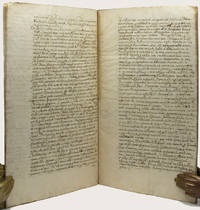
1621réf. 34518Lisbon and Hangzhou China: Manuscripts ca.1623 and 1621. Very Rare A Similar Manuscript Exists in Brussels. We know of no others. The Latin text of both letters is written in a neat uniform cursive hand in brown. Folio leaves 33 x 20.5 cm The transcripts bound in 18th Century stiff blue wrappers the blank paste-downs and endpapers are late 18th century most likely the third quarter between 1745/1753 and 1776 since they contain a clear "lion/vryheit/pro patria" watermark with a crowned GR countermark which resembles Heawood 3148 3149 and 3154. The paper used for the manuscript contains a faint double-headed eagle watermark and it has been reinforced in the gutters. A very pleasing survival very well preserved edges slightly mellowed the wrappers show some signs of wear. VERY RARE MANUSCRIPT TRANSCRIPTS. Chrysostomus Johann Gall 1586-1643 was a German Jesuit and scholar. He left Ingolstadt Germany to teach astronomy mathematics and navigation in Lisbon fro 1620to 1627 before leaving to work in the Jesuit missions in India. The Colégio de Santo Antŕo benefitted from the arrival of many foreign mathematicians and other scholars as Lisbon serves as a gateway for all missionaries departing for Asia. The original letter by Gall was written in Lisbon September 1623 and concerns a newspaper style description of various events including details of the perseution of Christians in Japan particularly the execution of large numbers of the Christian community in Nagasaki in 1622. The second letter in the present work is especially interesting as the original was written by Johannes Terentius also known as Johannes Schreck an Deng Yuhan Hanpo 1576-1630. Terentius was a prominent Jesuit scholar specialized in natural science and mathematics. Before joining the Jesuits as a novice1611 he already enjoyed a grea reputation in Germany as a scholar. In 1621 Terentius left for China to join the Jesuit mission. The original letter by Terentius was written in Hangzhou China on 30 August 1621 to the rector of teh Jesuit College in Munich Jakob Keller 1568-1631. He discusses his journey to China which he started in 1618 his intentions to participate in the planned calendar reform in China and his impressions of the city of Hangzhou which he reached in 1621 Terentius wrote several works on european medicine mathematics and technology in Chinese and together with Johann Adam Schall von Bell and G. Roho introduced European tigonometry and European astronomical instruments to China. In 1629 he began to reform the calendar which J.A. Schall von Bell ocmpleted after Terentius' early death a year later. Backer & Sommervogel VII col. 1929-F Manuscripts unknown
réf. 0484121871.Ghardcover. Good. Access codes and supplements are not guaranteed with used items. May be an ex-library book. hardcover
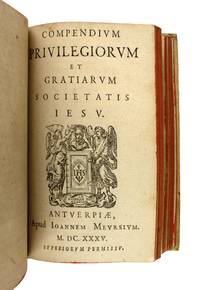
1635réf. 49307Antuerpiae Antwerp: Apud Ioannem Meursium Joannes Meursius 1635. Very Good. Antuerpiae Antwerp: Apud Ioannem Meursium Joannes Meursius 1635. Two octavo volumes bound in one; bound in contemporary vellum with manuscript title to spine; edges stained red; 384 20pp.; 164 4pp. with final page blank collated and complete. Light wear and spotting; binding sound; toning to pages; a Very Good copy. Includes regulations favors and exemptions granted the Jesuits from the Pope. Apud Ioannem Meursium [Joannes Meursius] unknown books
1635réf. 49307Antuerpiae Antwerp: Apud Ioannem Meursium Joannes Meursius 1635. Very Good. Antuerpiae Antwerp: Apud Ioannem Meursium Joannes Meursius 1635. Two octavo volumes bound in one; bound in contemporary vellum with manuscript title to spine; edges stained red; 384 20pp.; 164 4pp. with final page blank collated and complete. Light wear and spotting; binding sound; toning to pages; a Very Good copy. Includes regulations favors and exemptions granted the Jesuits from the Pope. Apud Ioannem Meursium [Joannes Meursius] unknown
réf. R17198, Louvain, Vanlinthout & Vandenzande, 1827, 297pp., reliure cart., dos en cuir (abîmé), qqs.rousseurs, intérieur & texte en bel état, [contient: Destruction des Jésuites en France, anecdote politique et intéressante (pp.2-43), Actes du clergé de France et du pape Clément XIII en faveur des Jésuites de 1761 à 1764 (pp.44-120), Mes doutes sur l'affaire présente des Jésuites 1762 (pp.121-159), De la vérité ou de la supposition de l'édit de bannissement des Jésuites rendu par Henri IV en 1595 (pp.160-294]
Louvain, Vanlinthout & Vandenzande, 1827, 297pp., reliure cart., dos en cuir (abîmé), qqs.rousseurs, intérieur & texte en bel état, [contient: Destruction des Jésuites en France, anecdote politique et intéressante (pp.2-43), Actes du clergé de France et du pape Clément XIII en faveur des Jésuites de 1761 à 1764 (pp.44-120), Mes doutes sur l'affaire présente des Jésuites 1762 (pp.121-159), De la vérité ou de la supposition de l'édit de bannissement des Jésuites rendu par Henri IV en 1595 (pp.160-294]
19408vo., Fifth Impression, page-edges very lightly browning, some light offsetting from fold-ins to free endpapers; red cloth, upper board and backstrip framed and lettered in black, a very good, tight copy in unclipped dustwrapper, the latter browned at backstrip and and chipped with minor loss (affecting lettering) at edges. EXTREMELY SCARCE, ESPECIALLY IN THE DUSTWRAPPER.
réf. 67Paris, David Durand, 1746, 14 ff, (1) ff, 363 pp, (2) ff. In-12 en plein veau marbré de l'époque, dos orné, tranches rougies.
réf. ORD-18937Carcassonne. Polere, Teissié & Chartrand. 1792. In-4 sans couverture, 3 pages. Document exempt de rousseurs, non rogné, tel que paru.
Madrid, La España Editorial, 1896, 18,5 x 12 cm., holandesa piel de época, conserva las cubiertas originales, la anterior desprendida, 203 págs. + 2 hojas. (El autor se llamaba Francisco Teodomiro Moreno, Bachiller de Estepa era su seudónimo).
1933163pp. with some bl/w ills. & some folding maps, 25cm., softcover, 2 library stamps, text clean and bright, good condition, R103805
Cádiz, Viuda de Comes, 1812, 19,5 x 13,5 cm., cubiertas en papel blanco de época, 115 págs. (Solo hemos localizado 4 ejemplares en el Catálogo Colectivo. El autor, que no figura en la portada, está tomado de "L'attribuzione a Luigi Mozzi in C. Sommervogel, Bibliotheque de la Compagnie de Jesus").
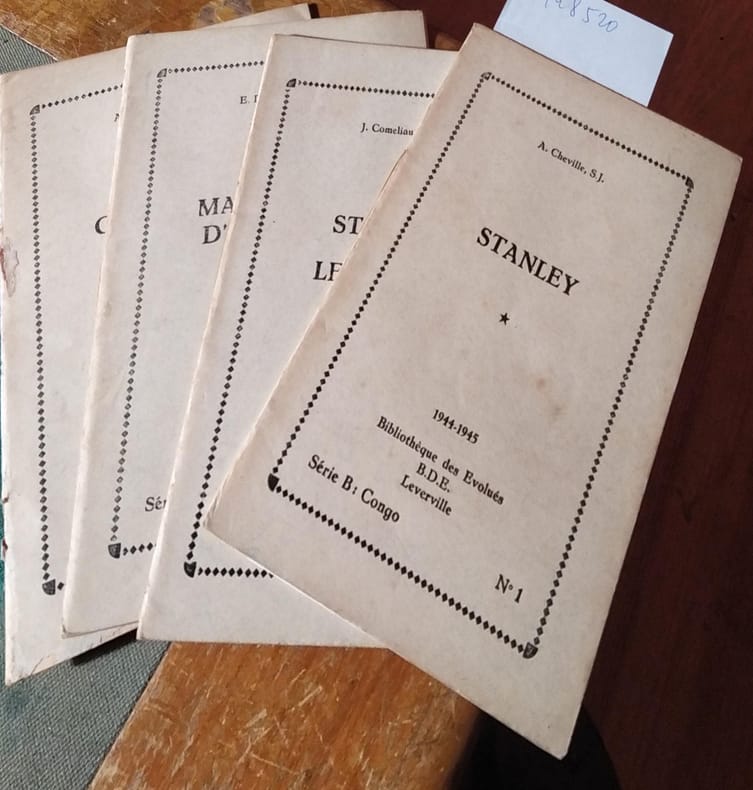
1945réf. 148520Couverture souple. 4 brochures de 32 pages. 12 x 17 cm.
1944réf. 148838Couverture souple. 9 brochures de 32 pages. 12 x 17 cm.
1991réf. 31939Le Grand Livre Du Mois ( Fayard ) 1991 toile éditeur sous jaquette un cahier photographique central
M., La Nave, 1929, 16'5 x 11 cm., tela original, retrato - 251 págs. - 4 láminas. (De la colección Grandes figuras de la Historia).
1651144p. Hardcover Very good condition, in worn calf, backstrip chipped and worn A satire against the Jesuits, ascribed by some to G.C. Scotti and by others to M. Inchofer. With a two-page dedication to Allatius by Timotheus Cursantius, which says that Lucius Cornelius of Europe entrusted him with the manuscript of the work as he was going off to Palestine. The Monarchia describes an imaginary realm in 21 chapters, in a Tacitean style, of a people called solipsi, "only thinking of themselves". - This first edition is listed in NUC once (under the title). BL once (listed under Scotti). BN twice (under Scotti). - Graesse II, 269.
1715Eloge funèbre de Louis XIV par le jésuite et enseignant de rhétorique au Collège Louis-Le-Grand, Charles Porée. Ne faisant pas partie des jésuites mondains aimant briller en société mais se consacrant entièrement à la formation de ses jeunes élèves, il en était très apprécié. Mais il est surtout connu pour avoir été le professeur de Voltaire, qui resté en correspondance avec lui, lui envoyait ses ouvrages. « La laudatio funebris de Louis XIV se présente essentiellement comme une longue et enthousiaste exposition des resgestae du Prince : aux récits des campagnes militaires, nourris de comparaisons avec les exploits des grands capitaines antiques (Alexandre, César, Démétrius) qui occupent la première partie du discours, répond dans la seconde partie la présentation de ses réalisations commandées par ses « virtutes pacificae ». Sont alors énumérées les mesures économiques, commerciales, juridiques, la construction de bâtiments, les réalisations dans le domaine intellectuel et artistique. Les serments solennels prononcés à l’occasion du sacre sont indirectement évoqués : premier engagement de protection de l’Église, promesses de lutter contre les duels, de faire régner la justice et la clémence dans le royaume. L’accent est également mis sur les actions, dans la troisième et dernière partie, lorsqu’il s’agit de « démontrer » la piété du roi : munera offerts à Dieu (construction d’églises, d’un grand hôpital, de Saint-Cyr, des Invalides) ainsi que derniers combats : combat contre les trois hérésies (protestantisme, jansénisme et quiétisme), dans la présentation duquel la mythologie joue son rôle traditionnel d’amplification (comme Henri IV, Louis XIV est l’« Hercule gaulois » affrontant l’hydre35) ; combat ultime contre la mort, celles de ses proches et la sienne, où le Prince se montre encore vainqueur, puisqu’il reste « ferme, inébranlable, immobile »36, plein de constantia. Dernière bataille, où le roi doit vaincre le désir de vie, l’amour du trône, la douleur du corps, les frayeurs de la mort, la désolation de la Cour et accepter de se démunir entièrement. » Cf. Edith Flammarion, Les Orationes panegyricae de Charles Porée (1711-1729) : le Jésuite et le Prince au xviiie siècle, in « «L'éloge du Prince, de l'Antiquité au temps des Lumières. UGA éditions, 2003.
réf. 43118aafFreiburg, Universitätsverlag, 1954, gr. in-8vo, XX + 190 S., tlws. Textpassagen unterstrichen, Original-Broschüre.