JAPAN / JESUITS / COELHO, GasparBiblio.com

2,655 results
1585ref. 4676ENTRY NO. 1 IN BOSCARO THE FIRST REFERENCE TO THE JAPANESE EMBASSY OF 1585 PRINTED ON THE TITLE-PAGE Venice I Gioliti 1585. Small 8vo 15.3 x 10 cm 103 pp. Bound in old vellum. Discrete former ownership stamp on title. Gutter margin of title reinforced; inconsequential toning otherwise excellent. Rare early edition of this Jesuit letter containing news of missions and activity in Japan from the year 1582 the only edition of 5 printed that year to contain a title-page advertising the famous Japanese embassy of 1584-86. Significantly the work also discusses the embassy the participants and their noble lineage and expresses the hope that the embassy will prove a convincing sign of the Jesuit's spectacular success in Japan p. 7. The present imprint of this edition comprises the first entry in Boscaro's bibliography of printed works related to the embassy. It thus stands at the head of nearly 50 works printed in 1585 alone to record and commemmorate an event that-in addition to providing a public relations coup for the Jesuits-became a watershed moment in cross-cultural exchange between the Orient and the West: "no Japanese emissaries to Europe either before or since aroused comparable interest or enthusiasm" Lach. In the annals of international relations between Europe and Japan in the 16th C it is particularly noteworthy "how the physical presence of the Japanese in Europe stimulated an unexpected number of typographical presentations" Boscaro of which this particular Gioliti edition with the titlepage advertising the embassy-Portata de Novo Dal Giapone Dai Signori Ambasciatori-is the very first. Boscaro notes that there were four other editions of Coehho's letter published in Italy in 1585 around the time the embassy arrived in Venice on June 25 including another by Gioliti but none of these uses the embassy as a way to market itself. The report itself is also a significant document of the embassy's genesis: Coelho composed it in February 1582 the month that the embassy of four Japanese Christian converts departed from Nagasaki. In it he describes the ongoing missionary activity across the country: e.g. in Hirado Amasuka Bungo and especially Funai Oita City the home of a thriving Jesuit college. Presumably the contents of this letter as the title suggests were "brought from Japan by the eminent ambassadors" as the latest news on the Jesuits current success in that faraway land. Though the embassy did not reach Lisbon until August 1584 it eventually was as Coelho had hoped a resounding success: from 1584-86 the four young Japanese nobles were the object of intense curiosity wherever they traveled and they were treated to lavish receptions in Lisbon Madrid Florence Rome Venice and other cities throughout Catholic Europe. Provenance: Alfred Hamy 1838-1904 French Jesuit historian and prolific author of books relating to the history of the members of the Company of Jesus. OCLC: Cornell NYPL HU and Newberry. Boscaro 1; Alt-Japan 812; Sommervogel II.1267; Cordier 78; Laures 169; Pagès 22; Lach I.2.690. Boscaro 1; Alt-Japan 812; Sommervogel II.1267; Cordier 78; Laures 169; Pagès 22; Lach I.2.690. I Gioliti
1649"Opera divisa in quattro volumi, rarissima a trovarsi completa: Libro primo, detto la Qualità delle comedie. Per dichiarare, quale sia la lecita a' buoni christiani, e quale la illecita; e per distinguere la modesta dalla oscena, secondo la dottrina di s. Tomaso, e d'altri theologi per sicurezza della coscienza. In-4°, XV, (6cc), 172pp (i.e. 272), legatura in pelle coeva, nervature e titolo al dorso in oro, Firenze, Bonardi 1655; Libro secondo, detto La solutione de' nodi. Per isciogliere molte difficoltà, e per risoluere molti casi di coscienza intorno alle comedie poco modeste; e per mostrare, che non è mai lecita la loro permissione ... Opera di un theologo religioso, stampata ad instanza del sig. Odomenigico Lelonotti da Fanano. Si aggiunge al fine vna Censura d'autori antichi, e moderni intorno a' compositori, compositioni, lettione, e recitamento di poca honestà. Et di più il Giuditio, che si può fare di quelle comedie, che si rappresentano tal'hora con titolo di honesta ricreatione da persone ascritte in vna osseruante congregatione. In-4°, (20cc), 158pp (i.e.258); 135pp+1, legatura in pelle coeva, nervature e titolo in oro al dorso, Firenze, Bonardi, 1649; Libro terzo, detto L’instanza, per supplicare a' signori superiori, che si moderi christianamente il theatro dall'oscenità, e da ogni altro eccesso nel recitare, secondo la dottrina di S. Tomaso, e d'altri theologi antichi e moderni. Opera d'vn religioso theologo, stampata per soddisfattione del sig. Odomenigico Lelonotti da Fanano. ... Vi sono due indici, vno de' capi, e punti, l'altro delle materie. In-4°, (16cc), 377pp, (16cc), legatura in pelle coeva, nervature e titolo in oro al dorso, Firenze Bonardi, 1652; Libro detto L'ammonitioni a' recitanti, per auuisare ogni christiano à moderarsi da gli eccessi nel recitare. Sono diuise in tre breui trattati, cioè il primo intorno à recitanti. Il secondo intorno al comico Beltrame, & al suo libro. Il terzo intorno à ciarlatani. Opera d'vn theologo religioso da Fanano, stampata ad istanza del sig. Odomenigico Lelonotti. Con aggiunta all'vltimo d'vn'Hipomnistico, ouero Discorso ammonitorio, diretto in forma di preghiera a' musici comedianti mercenarij, & ad ogn'altro musico aiutante al theatrale, e poco modesto recitamento. Con due indici, vno dell'ammonitioni, e l'altro delle cose notabili. In-4°, (16cc), 566pp, (2cc), legatura in pergamena con titolo manoscritto al dorso, Firenze, Bonardi 1652. Il gesuita Ottonelli (Odomenigico Lelonotti da Fanano) fu, insieme a Giovanni Paolo Oliva e Paolo Segneri, uno dei critici del teatro più celebri nelle fila della Compagnia di Gesù e in particolare la sua critica è importante per tracciare l’evoluzione del rapporto fra teatro professionale e religione (Zampelli, 2006). Sicuramente sono i libri di teatro, soprattutto Della Christiana moderatione del theatro, a raccontarci molto di Ottonelli. Dagli aneddoti autobiografici sepolti in queste pagine dense possiamo ricostruire l'attività di Ottonelli per i cinque anni cruciali che precedettero il suo arrivo a Firenze nel 1640. Dipingono un quadro sorprendente. Ottonelli si presenta non come un teologo o uno scrittore, ma come un uomo d'azione, un guerrigliero impegnato nella lotta contro il teatro e soprattutto contro il ruolo delle donne in esso. Ottonelli sapeva che in Inghilterra le attrici erano proibite (anche se occasionalmente sul palco apparivano donne di compagnie continentali e la regina e le sue dame si esibivano in maschere di corte). Ottonelli conosceva la pratica inglese e la raccomandava per l'Italia, anche se sapeva che gli attori italiani erano assolutamente contrari. Le donne erano essenziali per l'economia del teatro popolare, e Ottonelli spiega perché. Vendevano i biglietti e permettevano di dare un'occhiata al viso o al petto per qualche soldo. Durante le rappresentazioni vendevano merce: ""mercantie, profumeria, saponetti, moschardini, o simili coserelle"". Cantavano, eseguivano acrobazie e si scambiavano mance, una pratica redditizia. Le brave attrici portavano clienti sia alle commedie che ai giochi d'azzardo. I regali poi venivano inviati dietro le quinte. E’ l’opera di Ottonelli la più attenta cronaca della nascita del teatro italiano, una miniera di notizie e fatti che, anche se narrati con vis polemica, sono l’unico documento di prima mano del periodo d’oro delle compagnie teatrali italiane; addirittura egli si sofferma sulle figure minori dell’intrattenimento, come ciarlatani, musici ambulanti, venditori e imbonitori, vagabondi scaltri e giocolieri. A work which extremely rare to find complete. Jesuit Ottonelli (Odomenigico Lelonotti da Fanano) was, together with Giovanni Paolo Oliva and Paolo Segneri, one of the most famous theater critics in the ranks of the Society of Jesus and in particular his criticism is important for tracing the evolution of the relationship between theater professional and religion (Zampelli, 2006). In fact it is the books on theater, especially Della Christiana moderatione del theatro, that tell us much about Ottonelli. From the autobiographical anecdotes buried in these dense pages we can reconstruct Ottonelli’s activities for the five crucial years preceding his arrival in Florence in 1640. They paint a surprising picture. Ottonelli comes across not as a theologian or writer, but as a man of action, a guerrilla engaged in combat against the theater and especially against the role of women in it. Ottonelli knew that in England actresses were prohibited (though women from continental troupes occasionally appeared on stage and the Queen and her ladies performed in court masques). Ottonelli knew of the English practice and recommended it for Italy, though he knew that Italian actors were dead set against it. Women were essential to the economics of the popular theater, and Ottonelli explains why. They sold the tickets and threw in a glimpse of face or bosom for good measure. They peddled merchandise during performances: “mercantie, profumeria, saponetti, moschardini, o simili coserelle.” They sang, performed acrobatics, and passed a cup for tips, a lucrative practice. Good actresses brought in clients both to the plays and to games of chance. Gifts were sent backstage. Ottonelli's work is the most careful chronicle of the birth of the Italian theater, a mine of news and facts which, even if narrated with a polemic face, are the only first-hand document of the golden period of the Italian theater companies; he even dwells on the minor figures of entertainment, such as charlatans, traveling musicians, vendors and barkers, crafty vagrants and jugglers."
1585ref. 4676Venice: I Gioliti 1585. Hardcover. Very Good. 8vo - over 7¾ - 9¾" tall. 8vo. 103 pp. Bound in old vellum. Discrete former ownership stamp on title. Gutter margin of title reinforced; inconsequential toning otherwise excellent. Rare early edition of this Jesuit letter containing news of missions and activity in Japan from the year 1582 the only edition of 5 printed that year to contain a title-page advertising the famous Japanese embassy of 1584-86. Significantly the work also discusses the embassy the participants and their noble lineage and expresses the hope that the embassy will prove a convincing sign of the Jesuit's spectacular success in Japan p. 7. The present imprint of this edition comprises the first entry in Boscaro's bibliography of printed works related to the embassy. It thus stands at the head of nearly 50 works printed in 1585 alone to record and commemmorate an event that-in addition to providing a public relations coup for the Jesuits-became a watershed moment in cross-cultural exchange between the Orient and the West: "no Japanese emissaries to Europe either before or since aroused comparable interest or enthusiasm" Lach. In the annals of international relations between Europe and Japan in the 16th C it is particularly noteworthy "how the physical presence of the Japanese in Europe stimulated an unexpected number of typographical presentations" Boscaro of which this particular Gioliti edition with the titlepage advertising the embassy-Portata de Novo Dal Giapone Dai Signori Ambasciatori-is the very first. Boscaro notes that there were four other editions of Coehho's letter published in Italy in 1585 around the time the embassy arrived in Venice on June 25 including another by Gioliti but none of these uses the embassy as a way to market itself.The report itself is also a significant document of the embassy's genesis: Coelho composed it in February 1582 the month that the embassy of four Japanese Christian converts departed from Nagasaki. In it he describes the ongoing missionary activity across the country: e.g. in Hirado Amasuka Bungo and especially Funai Oita City the home of a thriving Jesuit college. Presumably the contents of this letter as the title suggests were "brought from Japan by the eminent ambassadors" as the latest news on the Jesuits current success in that faraway land.Though the embassy did not reach Lisbon until August 1584 it eventually was as Coelho had hoped a resounding success: from 1584-86 the four young Japanese nobles were the object of intense curiosity wherever they traveled and they were treated to lavish receptions in Lisbon Madrid Florence Rome Venice and other cities throughout Catholic Europe.OCLC: Cornell NYPL HU and Newberry. Boscaro 1; Alt-Japan 812; Sommervogel II.1267; Cordier 78; Laures 169; Pagès 22; Lach I.2.690. I Gioliti hardcover books
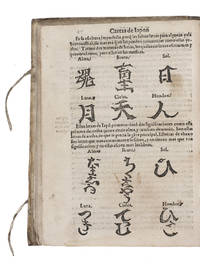
1575ref. 5741Alcalá der Henares Spain: Juan Iniguez de Lequerica 1575. Contemporary limp vellum with ties. 4to in 8s. With woodcut of the Crucifixion on verso of the colophon 2R4v woodcut Japanese characters in the text I8v and woodcut decorated initials throughout. First Spanish edition of 87 Portuguese letters by Jesuit missionaries in Japan very valuable for the history of the Jesuits in Japan India and other parts of Southeast Asia. The work was first published in Portuguese in Coimbra in 1570 and contains 10 additional important Jesuit letters which had never published before. Noteworthy are the woodcut Chinese and Japanese characters included in the text on leaf I8v. Cordier gives a list of these additional letters dating from 1567 to 1571. Other newly added were: the life of Francis Xavier Relacion de las cosas de la India by Manuel Acosta with remarks on in order of appearance Goa Cochin Daman Ceylon Comorin Bassein Ormuz Ethiopia Inambay and Manomotapa Malaca the Moluccas Ambonia Solor Macassar etc. and Breve relacion de la Isla y Reynos del Iapon.Lacking 2 leaves ¶7 and ¶8 from the preliminaries containing the "Indulgencias que nuestro Sancto Padre el Papa Pio. 4 ". With 18th-century manuscript annotations in brown ink on the recto of the first free flyleaf the title-page at the start of the text on fol. 1r the recto of the final leaf and in the margins throughout; the margins show only marks to highlight certain passages the other annotations are variations of the same owner's inscription most elaborate on the front flyleaf: "Ex icDn. Francesco et Paula Caveda Costo 15 . Mad. a 4 . Octobre 1786". The vellum of the binding is somewhat creased and stained water stained throughout the first and last few leaves are frayed and slightly damaged in the margins without affecting the text somewhat browned throughout. Otherwise in good condition.l Alt-Japan-Katalog 298; Cordier Japonica cols. 67-68; Iberian Books 54608; Laures 140; Palau 46311; Porbase 363133 1 copy; Salva 3282; Streit IV 1519 with a full list of all letters; USTC 337147. Juan Iniguez de Lequerica, hardcover
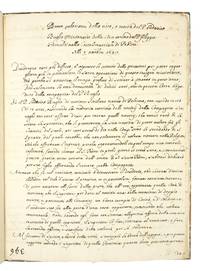
1683ref. 5517Rome: ca 1683. Hardcover. Fine. Bound in modern marbled papered boards with leather title label in gilt to the upper board. 17th c. manuscript in ink in a fine secretarial hand on laid paper with watermark of an anchor within circle. Fine condition leading edge untrimmed. A little light spotting on the first leaf very slim portion of leading edge of fourth leaf a little ragged and dust soiled. A report on the life death and funeral of the Sicilian Jesuit Ludovico Buglio 1606-1682 called Li Leisi Chinese: åˆ©é¡žæ€ a distinguished missionary and scientist at the Chinese imperial court in Peking during the late Ming and early Qing dynasties. It was written by Buglio's fellow Jesuit and friend Filippo Grimaldi Chinese: Min Ming'o 1638-1712 who arrived in China in 1671. Grimaldi was present at his confrère's funeral where he tells us that he partook of Manchu tea and wine offered to the mourners. This account which contains information not reported elsewhere remained in manuscript until the 20th century. In addition to our manuscript three other copies are known one of them in the Jesuit archives Rome: Fondo Gesuitico A.R.S.I. Archivum Romanum Societatis Iesu 722/4; another in the Vatican: A.S.V. Archivio Segreto Vaticano Miscellanei dei Gesuiti arm. VIII 58 ff. 16r-21v; and the third in the State Archives Rome: Archivio di Stato Roma Gesuiti Miscell. Pacco 5. Ludovico Buglio labored in China for forty-seven politically turbulent years. He established the first mission in Szechwan Sichuan Province where he carried out intensive evangelization despite opposition from local Buddhist and Daoist clergy built churches at Baoning Chongqing and Peking served as astronomer for the rebel Zhang Xianzhong who raised Buglio to the rank of mandarin and was instrumental in restoring the Imperial Observatory at Peking to Jesuit control. Buglio was imprisoned twice exiled once and narrowly escaped execution. An arrow wound inflicted by a Manchu warrior in 1647 never fully healed leaving Buglio in intense pain for the rest of his life. The wound ultimately proved fatal. In a letter transcribed in this manuscript addressed to Buglio's fellow Jesuits in Peking the Kangxi Emperor lamented Buglio's prolonged suffering and imminent death and announced that he would assist with the funeral expenses. The Emperor's letter is followed by Grimaldi's eyewitness account of the funeral which was overseen by imperial delegates who also participated in the traditional Chinese funeral honors. Renowned for his mastery of spoken and written Chinese Buglio wrote and published a large number of Chinese-language works a list of which is appended to this manuscript. Among the most important of these were "Yulan Xifang Yaoji" "Imperially Commissioned Essentials of the West" presented to the Kangxi Emperor around May 1669 and a translation of Aquinas' "Summa Theologica" titled "Chaoxing xueyao" "Compendium of the Science of the Supernatural". The author and his account: Grimaldi "was one of the most capable and courageous missionaries; he arrived in China during a time of persecution when with the exception of four Fathers remaining in Beijing the other missionaries had been rounded up and held prisoner in Canton twenty-five in total: fourteen Jesuits ten Dominicans and one Franciscan. Upon arriving in Macau the young Fr. Grimaldi secretly made his way into Canton in December 1669 to take the place of a missionary-Fr. Navarrete the Dominican superior-who had escaped from prison; his absence had it been discovered could have seriously jeopardized all the prisoners. In 1671 when the missionaries in Canton were released Fr. Grimaldi was summoned to Beijing to assist Fr. Verbiest and gave science lessons to Emperor Kangxi himself. In 1685 the Emperor sent him to Russia to negotiate with the Tsar regarding the passage of Chinese merchants and European missionaries through Russian territory; however he was unable to achieve this objective and after an absence of seven years he returned to Beijing where he died in 1712."Barbera Grimaldi was well-positioned to write this account of Buglio's life. He labored alongside Buglio for twelve years and it can be assumed that those things that Grimaldi did not witness personally were communicated to him by Buglio himself and other Jesuits chief among them Buglio's close companion Gabriel Magalhães who was with Buglio from the time of his work in Sichuan province through his time in Peking. This accounts for the level of detail that Grimaldi is able to present in his account such as in the story of the providential removal of the arrow that had become lodged in Buglio's body after he and Magalhães were mistaken for spies and shot by Manchu soldiers: "a piece of arrow so tenaciously lodged in his body that Father Magalhães was never able to draw it out either with his hands or with his teeth. Magalhães though he was gravely wounded in one arm strove to find in the wilderness something with which to draw the arrow out; and behold before his eyes there appeared a pair of pincers which seemed to have been brought by his guardian angel for that very need alone with which full of joy and wonder he gave thanks to divine providence and freed Father Buglio from that affliction." The Emperor's letter & Buglio's Funeral: While Buglio lay on his deathbed the Emperor having heard about Buglio's illness through Zhao Chang a member of the Imperial Bodyguard sent a letter to the Jesuits which Grimaldi gives in full. In appreciation for Buglio's years of service to his father and himself his dedication to Chinese language and culture and "because you are men from beyond the sea and Father Ludovico now lies dying in this city far from his own country without kinsfolk to assist him" the Emperor informs the Jesuits that he will arrange and pay for Buglio's funeral. With the letter comes a gift of "two hundred Foè that is two hundred gold scudi and ten pieces of silk as a token of the regard I have held for the father and of how greatly his loss grieves me." The funeral rites included an impressive procession: "The Emperor in every way wished the funeral conducted according to his own affection and not according to the modesty proper to our institute. Twenty soldiers were sent by the Emperor to clear the streets as far as the burial place. At the head of the procession walked a standard raised aloft on which was written in large characters the Father's name together with the many praises and honors the Emperor bestowed on him and a copy of the Emperor's own letter in praise of the deceased on yellow satin silk a color reserved to His Majesty alone. There followed Father Buglio's image above which were written two very large characters signifying that this imperial decree had been issued in memory of the great esteem in which the deceased had been held. In the place of highest honor was set the Holy Cross with the images of St. Michael and Our Lady amid many censers and incense and choirs of diverse musical instruments." "Then followed more than five hundred Christians clothed in mourning and finally gentlemen without number preceded by the court officials sent by the Emperor for this purpose. This whole procession having at last arrived at the place granted us by the late Emperor for the burial of the fathers the funeral was carried out - with great modesty on the part of the Christians and equal reverence on the part of the gentiles." Grimaldi closes his account explaining that while he would like to write more the letter courier is about to leave for Macau and so he must stop where he is. The list of Buglio's Chinese Works: Grimaldi applauds Buglio's remarkable success in mastering Chinese which allowed him to forge close relationships with the Chinese literati and the mandarins. "He accomplished much by writing.understanding very well how highly letters are prized in China and how gentle and how powerful a means the spreading of books is for instilling the holy law of Christ. From the very beginning of his arrival in China he lost no time in advancing himself in Chinese letters language and books and to this end he had all the walls of his room covered with Chinese characters." The manuscript closes with a list of 23 of Buglio's Chinese works including the aforementioned "Yulan Xifang Yaoji" and "Chaoxing xueyao" as well as translations of the Roman Missal 1670 Breviary 1674 and Ritual 1675. Other works some on scientific matters addressed to the Emperor include "Shizi shuo" "Discourse on Lions" 1678 written when the Portuguese gave the emperor an African lion based largely on Ulisse Aldrovandi's "Book of quadrupeds" Bologna 1645 and "Jincheng ying shuo" "Discourse on Falcons offered to the emperor" 1679 written at the emperor's request after he admired the illustrations in Aldrovandi's "Ornithology". This work was later excerpted with attribution into the imperial encyclopedia "Gujin tushu jicheng" 1728. See Lo Nardo P. Ludovico Buglio S.J. 1606-1682 in Intorcettiana Anno II - N. 3 gennaio-giugno 2020; Pfister Notices biographiques et bibliographiques sue les Jésuites de l'ancienne mission de Chine 1552-1773 tome I Chang-Hai 1932 pp. 372-376. ca hardcover