REVUE DE L'ACTION POPULAIRE 1964Livre Rare Book

2,680 results
1964ref. 129213Couverture souple. 9 revues de 128 pages. 15 x 24 cm.
1964ref. 129212Couverture souple. 9 revues de 128 pages. 15 x 24 cm.
1962ref. 129211Couverture souple. 9 revues de 128 pages. 15 x 24 cm.
1958ref. 129210Couverture souple. 8 revues de 128 pages. 15 x 24 cm. Une revue défraîchie.
1957ref. 109998Couverture souple. 10 revues de 128 pages. 15 x 24 cm. Une revue défraîchie.
2001Au sommaire, articles sur 2 grands thèmes: "Religion et société dans la France moderne" ("Les Réformations catholiques en France: le témoignage des statuts synodaux" par J. Michael HAYDEN et Malcolm R. GREENSHIELDS, ""Sciences et Arts" dans les "Mémoires de Trévoux" (1701-1762)" par Marie-Hélène FROESCHLE-CHOPARD et Michel FROESCHLE, "Les jésuites chassés de la cité. Violences pour un retour: Mauriac, 6-7 septembre 1762" par Joël FOUILLERON, "La difficulté d'être libre: les droits de l'homme, l'Eglise catholique et l'Assemblée constituante, 1789-1791" par Yann FAUCHOIS); "France / Etats-Unis: les enjeux politiques de la culture" ("Diplomatie culturelle et propagande françaises aux Etats-Unis pendant le dernier vingtième siècle" par Alain DUBOSCLARD, "De l'anti-américanisme en France vers 1930: la réception des "Scènes de la vie future"" par Anne-Marie DURANTON-CRABOL, "La débâcle, les universitaires et la Fondation Rockefeller: France/Etats-Unis, 1940-1941" par Emmanuelle LOYER); comptes-rendus d'ouvrages. Français
2001ref. 14895Paris, Belin, 2001 1 volume 16 x 24cm Broché 222p., 1 feuillet; cartes et schémas in texte. Bon état.
ref. 1402paris 1966 in 8 broché
ref. 1369paris 1955 in 8 broché
ref. 1362paris 1951 in 8 broché
ref. 28990Lyon Chez André Molin, Imprimeur-Libraire 1721 in 12 (15,5x9,5) 1 volume reliure plein veau lisse marron de l'époque, dos à nerfs orné, piéce de titre de maroquin rouge, page de titre imprimée en rouge et noir, [10] et 456 pages. Edition revue corrigée, et augmentée de plusieurs lectures. Mention manuscrite de l'époque à la plume; ce livre est du monastère dela Visitation Ste Marie de Montpellier. Bel exemplaire ( Photographies sur demande / We can send pictures of this book on simple request )
1727ref. PHO-2088Paris, chez Louis Guérin, 1727. In-12 (17x10cm), 12ff.-428 pp., basane époque, dos à nerfs avec pièce de titre, frottements, coins usés, coupés usées, traces de feu en pied sans gravité, 1er feuillet blanc détaché. Tampons anciens du collège jésuite de Reims au titre.
ref. 5055P. Hérissant, 1749. In-12, XII-422 pages. Basane marron, dos à nerfs orné. Reliure de l'époque.
1971ref. LFA-126731150Un ouvrage de 392 pages, format 140 x 205 mm, broché, publié en 1971, Editions du Seuil, bon état
ref. 191017S.l. [Grenoble], s.d. (1664) in-4, 35 pp., broché sous couverture d'attente de papier gris.
ref. 243853Mildebourg [= En France], s.n., 1609 in-12, 104 pp., broché sous couverture d'attente de papier crème. Mouillures sur la seconde couverture, couverture défraîchie.
ref. ORD-54021622. Sans mention de lieu ni d'éditeur. Petit in-8 sans couverture, tiré d'un recueil, 8pp. Ex.un peu court de marges en bas de ff. et lgt abîmé, papier affaibli.
1643ref. 1781643 Paris, 1643. Un volume petit in-8 plein vélin blanc d'époque, [blanc], [titre], 242 pages, [blanc]. Notes manuscrites en page de titre, bel état malgré un léger manque au dos et une mouillure claire au haut des pages.
ref. 240643Villefranche, Guillaume Grenier, 1599 petit in-8, [4] ff. n. ch., pp. 9-238, vélin rigide granité et rubriqué, dos à nerfs, pièce de titre cerise (reliure de l'époque). Rousseurs.
ref. 0483728292.Ghardcover. Good. Access codes and supplements are not guaranteed with used items. May be an ex-library book. hardcover
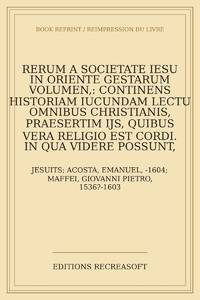
2026ref. LRB12001411Paris: Editions Recreasoft 2026 Langue : Latin. Environ 514 pages. Français : Réimpression à la demande. Édition originale : 1574. Recueil latin consacré aux missions de la Compagnie de Jésus en Orient réunissant des relations sur les Indes et le Japon avec des lettres des notices sur la diffusion de la foi catholique et un spécimen de caractères japonais. L'ensemble présente un vif intérêt pour l'histoire des missions jésuites des premiers témoignages européens sur l'Asie et de l'imprimerie missionnaire au XVIe siècle. Images du livre non contractuelles English : Print-on-demand reprint. Original edition : 1574. Latin collection devoted to Jesuit missions in the East bringing together accounts of India and Japan letters notices on the spread of the Catholic faith and a specimen of Japanese characters. The work is of strong interest for the history of Jesuit missions early European testimony on Asia and missionary printing in the sixteenth century. Book images are non-contractual. Editions Recreasoft. Softcover. New. Editions Recreasoft paperback
ref. 144640S.l., S.l.n.d. (1762) in-8, 175 pp., broché sous couverture d'attente un peu défrâichie.
ref. 95636aaf31x25 cm, 1) kl. ovales Reliquienmedaillon aus Silber mit Glasfenster und Beschriftung „Ex Oss: S. Franc: Bor:“, mit Zeugnis auf Papier, vorgedrucktes Formular mit gestochenem Bischofswappen, handschriftlich ausgefüllt u. unterschrieben, Medaillon und Zeugnis unter Glas mit ornamentaler Textilrahmung mit Stütze zum Aufstellen auf Rückseite, dazu zwei Klosterarbeiten in ähnlicher Textilrahmung: 2) Gouache-Miniatur von Johannes d. Täufer mit Stickerei, Goldborten sowie polychromen Glasperlen, Stoffblumen, Draht und Pailletten. 3) ovales Stoffmedaillon mit Glasperlen u. goldfarbenem Draht u. Pailletten auf Purpurgrund mit Goldbrokatverzierungen, guter Zustand, an den Ecken Textilrahmen teilw. etwas ausgefranst, es liegt auch ein Dossier mit einer kurzen Dokumentation zum Heiligen u. den Jesuiten bei (Ausdrucke u. Fotokopien),
1760ref. 5489Genoa: 29 July 1760. Hardcover. Fine. Manuscript in Italian written in a neat cursive in brown/black ink on laid paper. With some minor foxing some folding lines the creases slightly flattened the bottom edge of the leaves is slightly frayed. Otherwise in very good condition. A harrowing eye-witness account by a Jesuit Father of the Province of Brazil describing the forced expulsion of the Jesuits from Brazil in 1760 the hardships they endured during their capture and the perilous journey from Brazil to Genoa via Lisbon. The author begins his narrative with the persecution suffered by the Jesuits in Brazil following the official suppression of the Order. The Jesuit colleges were thoroughly plundered property seized precious silver taken and church furnishings stripped away. They were ordered not to open the church doors or ring the bells although on three occasions the Blessed Sacrament was brought to the sick an act which deeply moved the local people. The Jesuits endured many sufferings during their captivity. They were confined under harsh conditions; guarded constantly by soldiers. Their living quarters were cramped and filthy so small that they could neither sit nor lie down comfortably. Many suffered from hunger thirst and illness and several lost their lives during this ordeal. On 16 March the journey by sea began. The voyage was nothing short of a cruel martyrdom: extreme hunger and sickness afflicted the Jesuit Fathers. One elderly and saintly Father Francesco Paolo died shortly after the journey began not from disease but from severe distress caused by lack of food and medicine. Another Father Giovanni de Matha suffered a dangerous hemorrhage and narrowly survived while many others fell ill. They arrived at the mouth of the Tagus River in Portugal on 6 June after which they were transferred under guard to a Genoese ship effectively imprisoned once again. They were forbidden from going ashore or even signaling their arrival. More Jesuit Fathers from Brazil joined them later in June many weakened and sick from the hardships endured. Tragically some who had been sent ahead to Portugal suffered such extreme famine and thirst that they resorted to drinking their own urine and several died without the comfort of the last rites which were denied by the ship's captain. The captains and executioners of the royal orders showed little compassion even as they witnessed the Jesuits' pale and dying condition. Throughout this entire ordeal a royal minister constantly monitored the Jesuits offering false hopes that they might remain in the kingdom if they renounced their order and left the Jesuit habit behind. Some succumbed to these pressures but most remained steadfast. The Jesuits also faced opposition from the Bishop of Rio de Janeiro who initially used them for missions but later prohibited their confessions and sermons accusing them falsely of heretical teachings. He even excommunicated those who encouraged perseverance in the Jesuit order. Despite all these hardships the siege imprisonment brutal sea voyage hunger disease and ecclesiastical persecution the Jesuits maintained their faith and dignity praying for peace and the restoration of their Society. In a long postscript the writer gives further news that he has received from Brazil. He describes the devotion despite the Suppression of the Brazilian indigenous novices and the bravery of the students many of whom accompanied other Jesuit fathers in a cramped ship for the long voyage to Europe. A number of students held back -reluctantly- realizing that their presence on the ship would only lead to further overcrowding and privation for the Jesuit fathers in particular those who were old and frail. With sorrow they wept on the shore as the ship weighed anchor and departed for the miserable voyage. The account closes on 29 July 1760 expressing a solemn hope that after so many disasters peace will return to the Jesuit order. 29 July hardcover books
1760ref. 5489Genoa: 29 July 1760. Hardcover. Fine. Manuscript in Italian written in a neat cursive in brown/black ink on laid paper. With some minor foxing some folding lines the creases slightly flattened the bottom edge of the leaves is slightly frayed. Otherwise in very good condition. A harrowing eye-witness account by a Jesuit Father of the Province of Brazil describing the forced expulsion of the Jesuits from Brazil in 1760 the hardships they endured during their capture and the perilous journey from Brazil to Genoa via Lisbon. The author begins his narrative with the persecution suffered by the Jesuits in Brazil following the official suppression of the Order. The Jesuit colleges were thoroughly plundered property seized precious silver taken and church furnishings stripped away. They were ordered not to open the church doors or ring the bells although on three occasions the Blessed Sacrament was brought to the sick an act which deeply moved the local people. The Jesuits endured many sufferings during their captivity. They were confined under harsh conditions; guarded constantly by soldiers. Their living quarters were cramped and filthy so small that they could neither sit nor lie down comfortably. Many suffered from hunger thirst and illness and several lost their lives during this ordeal. On 16 March the journey by sea began. The voyage was nothing short of a cruel martyrdom: extreme hunger and sickness afflicted the Jesuit Fathers. One elderly and saintly Father Francesco Paolo died shortly after the journey began not from disease but from severe distress caused by lack of food and medicine. Another Father Giovanni de Matha suffered a dangerous hemorrhage and narrowly survived while many others fell ill. They arrived at the mouth of the Tagus River in Portugal on 6 June after which they were transferred under guard to a Genoese ship effectively imprisoned once again. They were forbidden from going ashore or even signaling their arrival. More Jesuit Fathers from Brazil joined them later in June many weakened and sick from the hardships endured. Tragically some who had been sent ahead to Portugal suffered such extreme famine and thirst that they resorted to drinking their own urine and several died without the comfort of the last rites which were denied by the ship's captain. The captains and executioners of the royal orders showed little compassion even as they witnessed the Jesuits' pale and dying condition. Throughout this entire ordeal a royal minister constantly monitored the Jesuits offering false hopes that they might remain in the kingdom if they renounced their order and left the Jesuit habit behind. Some succumbed to these pressures but most remained steadfast. The Jesuits also faced opposition from the Bishop of Rio de Janeiro who initially used them for missions but later prohibited their confessions and sermons accusing them falsely of heretical teachings. He even excommunicated those who encouraged perseverance in the Jesuit order. Despite all these hardships the siege imprisonment brutal sea voyage hunger disease and ecclesiastical persecution the Jesuits maintained their faith and dignity praying for peace and the restoration of their Society. In a long postscript the writer gives further news that he has received from Brazil. He describes the devotion despite the Suppression of the Brazilian indigenous novices and the bravery of the students many of whom accompanied other Jesuit fathers in a cramped ship for the long voyage to Europe. A number of students held back -reluctantly- realizing that their presence on the ship would only lead to further overcrowding and privation for the Jesuit fathers in particular those who were old and frail. With sorrow they wept on the shore as the ship weighed anchor and departed for the miserable voyage. The account closes on 29 July 1760 expressing a solemn hope that after so many disasters peace will return to the Jesuit order. 29 July hardcover