Roth, David Luther,Biblio.com

11 008 résultats
réf. 46458466like new. unknown
réf. 1019448393.Ghardcover. Good. Access codes and supplements are not guaranteed with used items. May be an ex-library book. hardcover
réf. 1356467679.Ghardcover. Good. Access codes and supplements are not guaranteed with used items. May be an ex-library book. hardcover
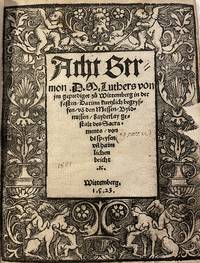
1523réf. 20618CB1523. Augsburg Heinrich Steiner 1523. 4to. 16 Blatt nicht nummeriert. Mit schöner Holzschnitt-Titelbordüre. Neue Broschur. Mit einem kleinen weiss hinterlegten Ausriss der Titelbordüre sowie zwei alten Annotationen in Tinte auf dem Titelblatt. Das Titelblatt ist rechts eng beschnitten. With a small reinforced tear of the title woodcut otherwise fine and two old annotations in ink on the title pages the right part of the title page has small margin otherwise good no stamps. Seltene Augsburger Ausgabe zu Lebzeiten von Martin Luther erschienen. Rare Augsburg print published during the lifetime of Martin Luther. VD16 L 3632 - Benzing 50 - Pegg 1973 1768. - Vgl. Knaake 369. - OCLC: 229905900 Die schöne Titelbordüre wird bei Pflugk-Hartung # 23 erwähnt. Hier in einem kräftigen Druck! With a very decorative woodcut title illustration mentioned in Pflugk-Hartung #23. Im Jahr der Erstausgabe erschienen. / Published in the year of the first edition. Heinrich Steiner hat drei verschiedene Varianten gedruckt u.a. auch mit Acht Sermonnes statt Acht Sermon. The publisher Heinrich Steiner has printed three variations. Der Wittenberger Rat hatte am 24. Januar 1522 eine neue Kirchenordnung beschlossen. Die Altäre und Heiligenbilder sollten abgeschafft werden der Gottesdienst sollte reformiert werden. Soziale Änderungen waren auch geplant. Die kirchlichen Einnahmen sollten Arme direkt oder mit Darlehen fördern das Betteln wurde verboten. Daraufhin gab es einen Bildersturm und die Studenten wanderten aus Wittenberg ab. Diese seltene und bedeutende Werk mit den berühmten Invokavitpredigten führte zum Ende der Wittenberger Unruhen. Ab Sonntag dem 9. März 1522 Invokavit predigte er acht Tage in Folge und nahm zu den Reformen Stellung. Er stellte in diesen acht Predigten die alte gottesdienstliche Form wieder her und setzte sich für ein Predigtverbot für Karlstadt ein. Diese Predigten stellten einen Wendepunkt in der Reformation dar Luther schaffte es kraft seines Wortes seiner Argumentation und damit durch die Gewalt der Kurfürsten die Gewalt zu unterbinden und damit eine Revolution zu verhindern. Luther hielt die Forderungen der Reformer für richtig ja er erkannte sie als Frucht seiner eigenen Gedanken an. Nicht was reformiert worden ist sondern wie reformiert worden ist greift er an. unknown
1523réf. 4923Augsburg: Heinrich Steiner 1523. One of 3 printings by Steiner in the year of the first edition. Hardcover. Fine. A very nice copy stab-stiched in drab 20th c. wrappers. With an attractive woodcut title border Pflugk-Hartung 23. Light maginal fingersoiling to title blank verso of final leaf lightly soiled. . Two early marginal notes in ink in the blank margin of the title. With a duplicate stamp from the Stadtbibliothek Nürnberg on the rear inner cover. The "Eight Sermons by Dr. M. Luther preached by him at Wittenberg in Lent dealing briefly with the masses images both kinds in the sacrament eating of meats and private confession etc." document Luther's efforts to counteract the chaos in Wittenberg that had been caused by Andreas Rudolff-Bodenstein von Karlstadt ca. 1480-1541 who had instituted radical reforms while Luther was in hiding at the Wartburg. During Luther's stay in Wartburg Castle Karlstadt became the head of the reform movement at Wittenberg. Over the course of a year Karlstadt instituted radical changes in all aspects of religious life. As the leader of the Wittenberg movement and the head of the Wittenberg theological faculty Karlstadt was in a unique position to both pronounce and enact changes within the church. He instituted most of his larger reforms with the support of the theologians and the city magistrates. These changes to established forms particularly the institution of the reformed mass displeased the Elector of Saxony however and by March 6th 1522 Luther would return at the Elector's request to take control of the Wittenberg movement. Prior to Luther's return however Wittenberg would see troubling public manifestations of the new reforms as a radicalized populace took to the streets in the infamous "Wittenberg disturbances." "In December 1521 Luther returned secretly to Wittenberg from the Wartburg for a three day conference on how to meet the turbulence and confusion caused by the radical reformers. Soon after his return to the Wartburg Karlstadt put himself at the head of those who favored immediate abolition of Roman practices. At Christmas Karlstadt administered communion "in both kinds"i.e. by giving both the consecrated host and the wine to the laity for the first time in the parish church. This had been done as early as September in the Augustinian monastery where Gabriel Zwilling conducted mass in the vernacular and abolished private masses. Karlstadt also declared that confession before communion was unnecessary that images were not allowable in the church and that rules of fasting were not binding and this led to outbreaks of actual destruction of images and altars. He also taught the doctrine of direct illumination by the Spirit which made scholarship and learning unnecessary for the understanding of the Scriptures. The consequence was that the city schools were closed and the university threatened with collapse. Allied with Karlstadt's followers were the Zwickau prophets Storch Drechsel and Stübner adherents of Thomas Münzer. "Luther who hitherto had relied upon Melanchthon's leadership to keep order returned to Wittenberg on March 6. On March 8 he conferred with Melanchthon Justus Jonas Nicholas Amsdorf and Hieronymus Schurf. On March 9 Invocavit Sunday he mounted the pulpit in the parish church and preached each day from the ninth to the sixteenth. This remarkable series of sermons which are powerful inspired preaching of the gospel had the effect of restoring tranquility and order almost at once. His task was to lead his congregation away from fanatical enthusiasm back to the spirit of the gospel and to answer the questions that were agitating his people in the light of the gospel. Further details may be found in an excellent introduction to the sermons in PE 2 387-390 and in the biographies of Luther and the church histories. The sermons were transcribed by an unknown amanuensis."Doberstein Luther Works Vol. 51. [Heinrich Steiner] hardcover
1523réf. 4923Augsburg: Heinrich Steiner 1523. One of 3 printings by Steiner in the year of the first edition. Hardcover. Fine. A very nice copy stab-stiched in drab 20th c. wrappers. With an attractive woodcut title border Pflugk-Hartung 23. Light maginal fingersoiling to title blank verso of final leaf lightly soiled. . Two early marginal notes in ink in the blank margin of the title. With a duplicate stamp from the Stadtbibliothek Nürnberg on the rear inner cover. The "Eight Sermons by Dr. M. Luther preached by him at Wittenberg in Lent dealing briefly with the masses images both kinds in the sacrament eating of meats and private confession etc." document Luther's efforts to counteract the chaos in Wittenberg that had been caused by Andreas Rudolff-Bodenstein von Karlstadt ca. 1480-1541 who had instituted radical reforms while Luther was in hiding at the Wartburg. During Luther's stay in Wartburg Castle Karlstadt became the head of the reform movement at Wittenberg. Over the course of a year Karlstadt instituted radical changes in all aspects of religious life. As the leader of the Wittenberg movement and the head of the Wittenberg theological faculty Karlstadt was in a unique position to both pronounce and enact changes within the church. He instituted most of his larger reforms with the support of the theologians and the city magistrates. These changes to established forms particularly the institution of the reformed mass displeased the Elector of Saxony however and by March 6th 1522 Luther would return at the Elector's request to take control of the Wittenberg movement. Prior to Luther's return however Wittenberg would see troubling public manifestations of the new reforms as a radicalized populace took to the streets in the infamous "Wittenberg disturbances." "In December 1521 Luther returned secretly to Wittenberg from the Wartburg for a three day conference on how to meet the turbulence and confusion caused by the radical reformers. Soon after his return to the Wartburg Karlstadt put himself at the head of those who favored immediate abolition of Roman practices. At Christmas Karlstadt administered communion "in both kinds"i.e. by giving both the consecrated host and the wine to the laity for the first time in the parish church. This had been done as early as September in the Augustinian monastery where Gabriel Zwilling conducted mass in the vernacular and abolished private masses. Karlstadt also declared that confession before communion was unnecessary that images were not allowable in the church and that rules of fasting were not binding and this led to outbreaks of actual destruction of images and altars. He also taught the doctrine of direct illumination by the Spirit which made scholarship and learning unnecessary for the understanding of the Scriptures. The consequence was that the city schools were closed and the university threatened with collapse. Allied with Karlstadt's followers were the Zwickau prophets Storch Drechsel and Stübner adherents of Thomas Münzer. "Luther who hitherto had relied upon Melanchthon's leadership to keep order returned to Wittenberg on March 6. On March 8 he conferred with Melanchthon Justus Jonas Nicholas Amsdorf and Hieronymus Schurf. On March 9 Invocavit Sunday he mounted the pulpit in the parish church and preached each day from the ninth to the sixteenth. This remarkable series of sermons which are powerful inspired preaching of the gospel had the effect of restoring tranquility and order almost at once. His task was to lead his congregation away from fanatical enthusiasm back to the spirit of the gospel and to answer the questions that were agitating his people in the light of the gospel. Further details may be found in an excellent introduction to the sermons in PE 2 387-390 and in the biographies of Luther and the church histories. The sermons were transcribed by an unknown amanuensis."Doberstein Luther Works Vol. 51. [Heinrich Steiner] hardcover books
1972réf. 150797Beverly Hills CA: United Artists 1972. Seven vintage color studio still photographs from the 1972 film including five mounted as issued by the distributor on a presentation card. Based on the 1970 novel by Wally Ferris about two New York City cops who become involved in a bloody struggle between the Italian mob the Harlem mob and a pair of small-time crooks who have stolen thousands of dollars from both groups. Due to its setting in Harlem this underrated crime drama is often lumped with other Blaxploitation pictures of the era when in truth it belongs to the great pantheon of gritty violent police procedurals of the early 1970s-something of a New York City companion to Don Siegel's "Dirty Harry" released the year before. Set in Harlem shot on location in New York City. Cards 10 x 8 inches. Presentation card 14 x 11 inches. Color studio still photographs and presentation cards Very Good plus. Grant US. Parish and Hill 3. Spicer US Neo-Noir. Howard Blaxploitation Cinema p. 68 83-84. United Artists unknown
1972réf. 150797Beverly Hills CA: United Artists 1972. Seven vintage color studio still photographs from the 1972 film including five mounted as issued by the distributor on a presentation card. Based on the 1970 novel by Wally Ferris about two New York City cops who become involved in a bloody struggle between the Italian mob the Harlem mob and a pair of small-time crooks who have stolen thousands of dollars from both groups. Due to its setting in Harlem this underrated crime drama is often lumped with other Blaxploitation pictures of the era when in truth it belongs to the great pantheon of gritty violent police procedurals of the early 1970s-something of a New York City companion to Don Siegel's "Dirty Harry" released the year before. Set in Harlem shot on location in New York City. Cards 10 x 8 inches. Presentation card 14 x 11 inches. Color studio still photographs and presentation cards Very Good plus. Grant US. Parish and Hill 3. Spicer US Neo-Noir. Howard Blaxploitation Cinema p. 68 83-84. United Artists unknown books
réf. 036489069X.Ghardcover. Good. Access codes and supplements are not guaranteed with used items. May be an ex-library book. hardcover
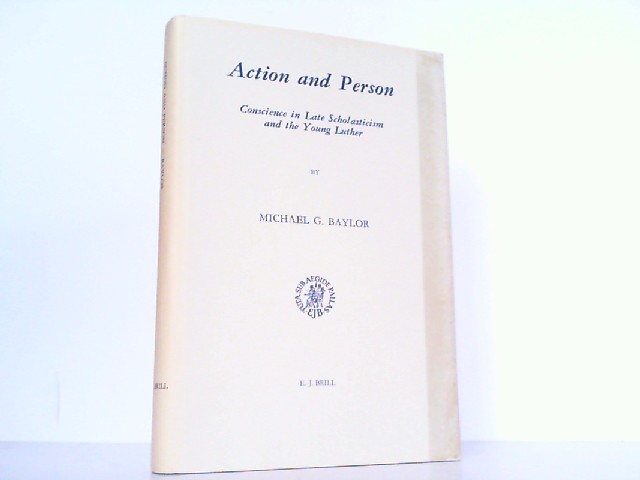
1977réf. 101418Leiden, E.J. Brill, 1977.
réf. 0364470917.Ghardcover. Good. Access codes and supplements are not guaranteed with used items. May be an ex-library book. hardcover
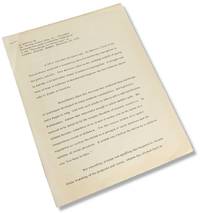
1963réf. 65890Atlanta: np 1963. 8pp. Mimeographed on rectos only bound with single staple. Tanned overall else in very good condition. One of an unknown but no doubt small number printed for colleagues attendees and the press. Provenance upon request. "Dr. King discusses the issues of segregation poverty and discrimination within the City of Atlanta in this 1963 speech at the Pilgrimage for Democracy. He explains that although Atlanta was thought to be a place of "racial harmony" the reality of glaring discrimination in Atlanta's schools restaurants and housing has left the local Negro community "tired" and hungry for change." www.thekingcenter.org. We locate only one other example in the King papers at Stanford University. np unknown
1963réf. 65890Atlanta: np 1963. 8pp. Mimeographed on rectos only bound with single staple. Tanned overall else in very good condition. One of an unknown but no doubt small number printed for colleagues attendees and the press. Provenance upon request. "Dr. King discusses the issues of segregation poverty and discrimination within the City of Atlanta in this 1963 speech at the Pilgrimage for Democracy. He explains that although Atlanta was thought to be a place of "racial harmony" the reality of glaring discrimination in Atlanta's schools restaurants and housing has left the local Negro community "tired" and hungry for change." www.thekingcenter.org. We locate only one other example in the King papers at Stanford University. np unknown books
réf. 1017870551.Ghardcover. Good. Access codes and supplements are not guaranteed with used items. May be an ex-library book. hardcover
réf. 1331266548.Gpaperback. Good. Access codes and supplements are not guaranteed with used items. May be an ex-library book. paperback
réf. 1342139739.Ghardcover. Good. Access codes and supplements are not guaranteed with used items. May be an ex-library book. hardcover
1948réf. blb03864University Alabama: University of Alabama Press 1948. 1st. Hardcover. Near Fine/Near Fine. Blue linen-like cloth with maroon lettering on front and spine. Book is tight square relatively sharp-cornered and free of markings and flaws other than the prior owners name on inside front cover. Book is Near Fine. Unclipped Dust Jacket shows original price of $2.50 and has very little scuffing or shelfwear to speak of. 139 pp. University of Alabama Press hardcover
1948réf. 1048705810University Of Alabama Press 1948. Hardcover. Good. Pages can have notes/highlighting. Spine may show signs of wear. ~ ThriftBooks: Read More Spend Less.Shelf and handling wear to cover and binding with general signs of previous use. Wear commensurate with age and use. Former owner's name in ink on front endpaper otherwise clean and unmarked copy. Boards slightly misaligned. Dust jacket wrapped in protective mylar sleeve. Secure packaging for safe delivery.Dust jacket quality is not guaranteed. University Of Alabama Press hardcover
réf. 3924639744.Gpaperback. Good. Access codes and supplements are not guaranteed with used items. May be an ex-library book. paperback
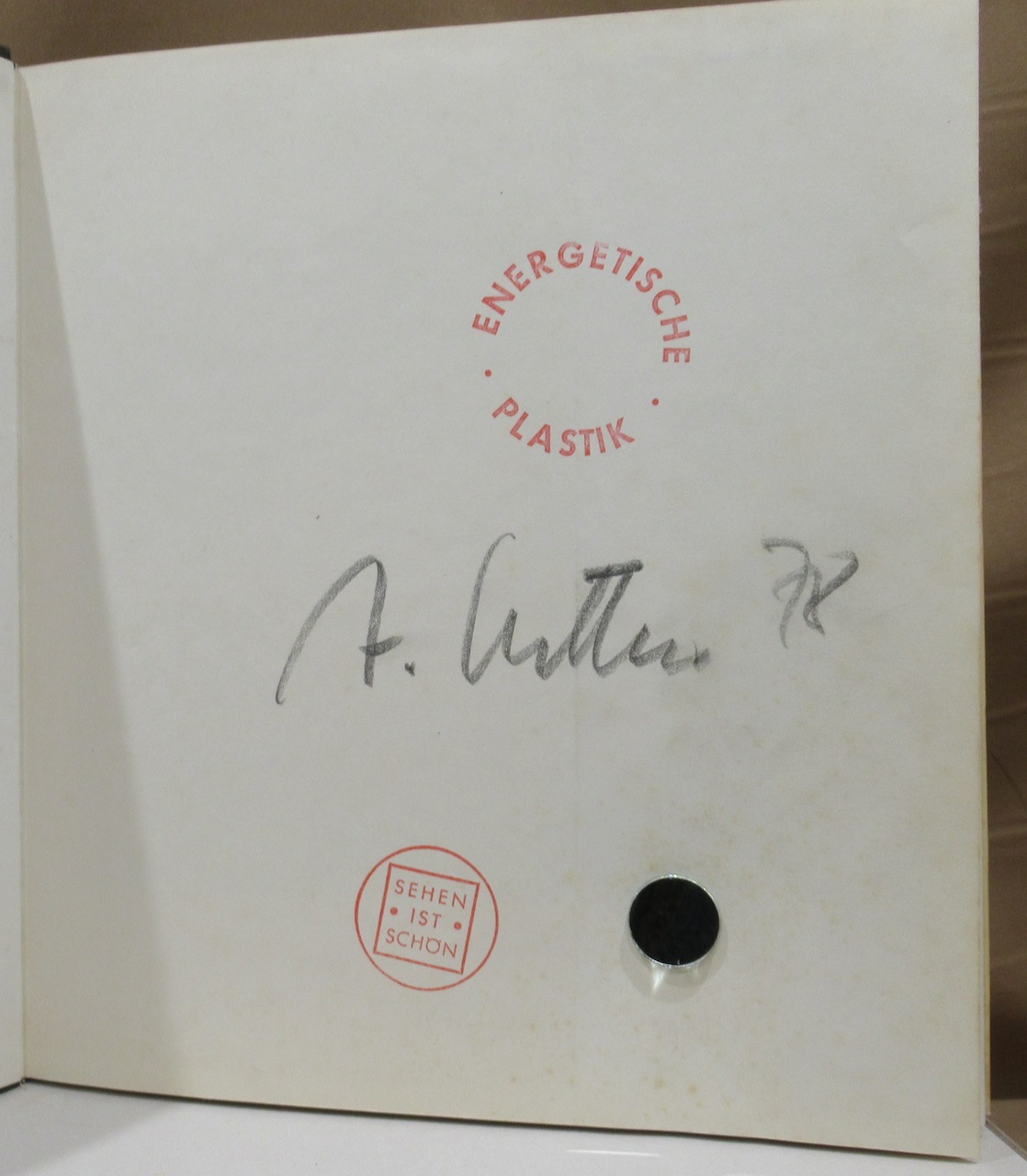
1978réf. 92044Verlag Aurel Bongers. New. Hardcover. FREE UPGRADE to Courier/Priority Shipping Upon Request - IN STOCK AND IMMEDIATELY AVAILABLE FOR SHIPMENT - Flawless copy brand new pristine never opened -- 193 pages. -- with a bonus offer-- . 1978. 3764703040 . Verlag Aurel Bongers hardcover
1977réf. 64642Gallery. As New. Paperback. FREE UPGRADE to Courier/Priority Shipping Upon Request – – IN STOCK AND IMMEDIATELY AVAILABLE FOR SHIPMENT - AS NEW THE TEXT BLOCK IS PRISTINE CLEAN UNMARKED AND IN EXCELLENT CONDITION - - Text in German. 60 pp. With one text ill. And 51 ills. On 45 pls. 26 x 21 cm. -- with a bonus offer-- . 1977. Gallery paperback
1987réf. 35310BBStuttgart, Klett-Cotta, 1987. 30 cm. 365 Seiten, überwiegend Ill. (z.T. farb.) OLwd., mit Schutzumschl. Signiert, Su leicht berieben, wenig Textbräunung.
1978réf. 105151Recklinghausen, Bongers 1978. 1978. 4°, 194 S. mit zahlreichen, teils farbigen Abbildungen, Orig.-Leinen mit Orig.-Umschlag.
1993réf. 51080Lincoln: University of Nebraska Press 1993. Softcover. Fine. Advance Excerpt. Fine in stapled wrappers. University of Nebraska Press unknown books
1520réf. 5195Wittenberg: Melchior Lotter the younger 1520. FIRST EDITION. Hardcover. Fine. Disbound with a slim guard along the spine. A crisp copy the title very lightly soiled contents with some very light scattered marginal foxing and a few light marginal blemishes; blank verso of last leaf lightly soiled. This is the first response by Luther to the papal bull threatening him with excommunication 'Exsurge Domine' issued by Pope Leo X on June 15 1520 and published in Germany in September 1520. In it Luther is defiant. He defends his "heretical" errors amplifies his criticism of indulgences and condemns the pope as an illegitimate tyrant. "The papal bull did not excommunicate Luther but rather condemned forty-one theses taken from Luther's writings as either 'heretical or scandalous or false or offensive to pious ears or dangerous to simple minds or subversive of catholic truth.' Luther was asked to recant these errors within sixty days or face excommunication. Luther proceeded to defend the condemned propositions in two Latin and two German works of which this is the first. "As far as Luther was concerned the pope and his bull did not speak for the true church. Rather the bull made it plain that the men in Rome were 'tyrants' and their condemnation of obvious Christian truth would now reveal their tyranny to everyone. His response to the condemnation of his statement 'Indulgences are a pious fraud practiced upon Christians; they are remissions of good works and belong to the things that are permitted but not necessary' is very significant. He stated his willingness to recant this proposition because he now considered it far too mild. Luther was now prepared to say 'The indulgences are not a pious fraud but an infernal diabolical antichristian fraud larceny and robbery whereby the Roman Nimrod teacher of sin peddles sin and hell to the whole world and sucks and entices away everybody's money as the price of this unspeakable harm.'" "As far as his conflict with Rome was concerned Luther appeared to be utterly sure of himself. In fact the violent opposition from the papacy became for him a vindication of the truth of his cause. And Luther made the source of his confidence very clear. He said 'I am sure the Word of God is with me and not with them for I have the Scriptures on my side and they have only their own doctrine. This gives me courage so that the more they despise and persecute me the less I fear them.' "It was this same complete trust in the power of the Word which he expressed in a letter to his friend Spalatin accompanying his 'Defense and Explanation of All the Articles' the third of Luther's responses to the papal bull. Referring to Ulrich von Hutten's warlike plans to defend the cause of the gospel by force of arms he wrote 'You can see what Hutten has in mind. I do not want the gospel to be contested by force and the shedding of blood.Through the Word the world was overcome through the Word the church was maintained and through the Word she will again be restored.' It was on this power that Luther relied in his struggle with the papacy." George Forell The Concordia edition of Luther's Works Vol. 32 pp. ix-xiv. [Melchior Lotter the younger] hardcover