264 risultati
rif. 53161Genève, Labor et Fides (Collection "Histoire de la Réforme racontée aux Jeunes"), 1963, in 8° broché, 82 pages ; couverture rouge ilustrée.
rif. 53635P. et Bruxelles, Editions Universitaires (Bibliothèque HIstorique), 1951, grand in 8° broché, 455 pages ; quelques rousseurs.
rif. 53728P., Fayard (Collection "Textes pour l'Histoire Sacrée"), 1955, in 12 broché, 253 pages ; en partie non coupé ; rousseurs à la couverture.
rif. 103.556Paris, Editions Seghers, 1964. 13 x 16, 192 pp., quelques illustrations en N/B, broché, très bon état.
rif. 40189Paris : Presses Universitaires de France (Coll. Mythes et religions), 1966 - un volume broché (19x12 cm), 161pages - bon état -
1931rif. G75859Nijmegen / Utrecht, Dekker & Van de Vegt / Van Leeuwen 1931 xii + 314pp., 25cm., stempeltje, onopengesneden, goede staat, G75859
1995rif. 150752J.C. Lattès J.C. Lattès 1995, fort In-8 broché, 452 pages. Très bon état
1951rif. R67210Paris / Bruxelles, Editions Universitaires 1951 455pp., 24cm., dans la série "Bibliothèque historique", br., qqs.cachets, bon état
1836rif. dm572Imprimerie Ch. Gruaz, Genève Relié 1836 In-8 (13.2 x 21.5 cm), relié demi-peau, dos orné de filets et caissons avec titre et auteur doré, gardes marbrées, peu commun ; bords frottés, mors marqués, des marques d'usage sur les plats, rousseurs en début et fin d'ouvrage et sur les tranches, par ailleurs intérieur bien conservé, bel exemplaire. Livraison a domicile (La Poste) ou en Mondial Relay sur simple demande.
rif. 123077aafParis, Imprimerie Nationale, 1909, in-8vo, 16 p., brochure originale.
1955rif. R73462's-Gravenhagen / Groningen, Stichting Geestelijke Liederen uit den Schat van de Kerk der Eeuwen / De Vuurbaak 1955 774pp.geïll., 31cm., linnen band, 2 stempeltjes, goede staat, R73462
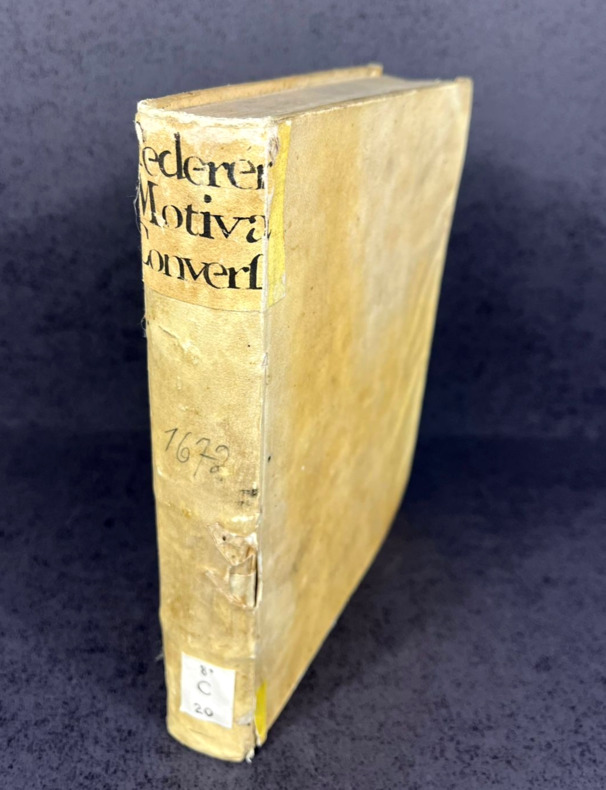
1672rif. 0533Innsbruck, Wagner, 1672. Épais volume in-4 de 160 x 203 mm, 440 (23) pp. Relié plein vélin blanc d'époque. Étiquette d'époque en coiffe, autre étiquette (bibliothèque) plus récente en queue, année d'édition au crayon au milieu du dos. Marque d'ancienne bibliothèque au premier contreplat surmontée d'une référence au crayon. Première garde blanche avec deux inscriptions en latin et allemand. Page de titre principale placée en fin d'ouvrage (!), qui commence par la page signalant la première partie, avec une inscription à la plume en haut de cette page d'ouverture. Rarissime titre polémique anticalviniste. L'auteur, Ioannes ou Johannes Federer (1645-1706), était prêtre jésuite. Professeur et théologien, il s'est fait remarquer en particulier avec "Calvinismus Detectus, & dedoctus", un livre érudit et vigoureux qui condamne le protestantisme calviniste dans les termes les plus fermes. L'auteur y répond à deux lettres calvinistes, l'une du philologue Johann Georg Grævius (1632-1703), converti, l'autre de Johann Jakob Vedrosi (1624-1706). Avec bandeaux, lettrines et culs-de-lampe. Léger manque au dos, petits trous de mite aux toutes premières pages sans aucun autre dégât, deux morceaux de papier vierges collés pour couvrir les tampons du monastère d'origine, sinon intérieur très pur, exempt de rousseurs ou d'annotations. ***************************************************** Innsbruck, Wagner, 1672. Thick in-quarto volume, 160 x 203 mm, 440 (23) pp. Bound in full contemporary white vellum. Contemporary label at the endpaper, another more recent (library) label at the tail, year of publication in pencil in the center of the spine. Old library mark on the front cover surmounted by a pencil reference. First white endpaper with two inscriptions in Latin and German. Main title page placed at the end of the book (!), which begins with the page indicating the first part, with a pen inscription at the top of this opening page. An extremely rare anti-Calvinist polemical title. The author, Ioannes or Johannes Federer (1645-1706), was a Jesuit priest. A professor and theologian, he made a name for himself in particular with "Calvinismus Detectus, & dedoctus," a scholarly and vigorous book that condemns Calvinist Protestantism in the strongest terms. In it, the author responds to two Calvinist letters, one from the philologist Johann Georg Grævius (1632-1703), a convert, and the other from Johann Jakob Vedrosi (1624-1706). With headbands, initials, and tailpieces. Slight loss to the spine, small moth holes in the very first pages with no other damage, two small blank pieces of paper glued to cover the original monastery stamps. Otherwise, the interior is very clean, free of foxing or annotations.
rif. R117535Princeton, Princeton Theological Seminary 196 133pp., signed with handwritten dedication by the author, 23cm., softcover, in the series "Studies in Reformed Theology and History" New Series No.1, good condition, R117535
rif. 43083Paris, Fayard, 1963 14 x 22, 277 pp., broché, bon état.
1950rif. R103688Paris, P.U.F. 1950 292pp., 25cm., brochure originale, dans la série "Etudes d'histoire et de philosophie religieuses publiées par la faculté de théologie protestante de l'Université de Strasbourg", la plupart des pages sont toujours non coupées, bon état, R103688
1950rif. gg1888Presses Universitaires de France Relié 1950 In-4 (17 x 26 cm), reliure demi-toile, dos lisse, 292 pages ; papier bruni, rousseurs sur la couverture conservée, par ailleurs bel état. Livraison a domicile (La Poste) ou en Mondial Relay sur simple demande.
1931xii + 314pp., 25cm., stempeltje, onopengesneden, goede staat, G75859
1955774pp.geïll., 31cm., linnen band, 2 stempeltjes, goede staat, R73462
1950292pp., 25cm., brochure originale, dans la série "Etudes d'histoire et de philosophie religieuses publiées par la faculté de théologie protestante de l'Université de Strasbourg", la plupart des pages sont toujours non coupées, bon état, R103688
1951455pp., 24cm., dans la série "Bibliothèque historique", br., qqs.cachets, bon état
1964Paris, Editions du Cerf, 1964, in-8, br. editoriale, pp. 445. Con bibliografia.
1995J.C. Lattès 1995, fort In-8 broché, 452 pages. Très bon état
GALATINA, CONGEDO, 2001. In 8°: pp. 414. Con alc. fotografie in b.n. f.t. Leg. t. tela edit. sopracop. fig.
2011Calvino non fu originale, l'analisi della sua apostasia ci dice che fu attratto nell'orbita di Lutero, si appoggiò a Lutero, ne seguì i medesimi principii: i suoi dogmi fondamentali sono infine i dogmi del protestantesimo, cioè della dottrina di Lutero; ma il suo ingegno, il suo carattere personale, la sua forma mentis hanno dato a quella dottrina delle particolari caratteristiche: Calvino ha preso il pensiero di Lutero, ma l'ha fatto suo. Sostituire la Chiesa di Calvino a quella del Papa: questo fu il suo scopo. Assolutista nella difesa di questo suo diritto, di sicuro rappresentante ed interprete della verità, della volontà di Dio, cercò, per garantirlo, un sostegno nella forza materiale e perciò per lui lo Stato non era che il servo della Chiesa (la sua) con la missione di farla ad ogni costo trionfare. Egli perciò fu un intransigente nel peggior senso della parola. Autori: Luigi Nigra.
1971In-8° (cm. 24 ca.), pp. 35. Brossura editoriale