CALVIN JeanLivre Rare Book

6 057 résultats
1565réf. 31656Genève François Perrin 1565 fort vol. in-8 vélin ivoire sur ais de bois, dos à nerfs portant le titre manuscrit, décor estampé à froid recouvrant les plats, avec bordures ornées de motifs floraux et de portraits en médaillon des champions de la Réforme et cartouche portant la date de 1577, tranches bleues, traces de lacets [Rel. de l'époque]
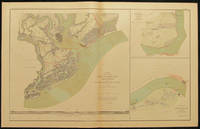
1891réf. 26210Washington: Government Printing Office 1891-1895. In the original 36 parts. FIRST EDITION. With 175 numbered double-page lithographed color maps and plates on 178 sheets by Bien. Large elephant folio presented in the original 36 large folio fascicles with their original printed paper wrappers now housed together in a blue cloth portfolio case with string ties the spine of the case is lettered in gilt. A handsome and impressive set in fully original condition overall very excellent and especially well preserved. The original wrappers show some occasional minor wear along the edges and spines occasional small tears at folds or minor creasing or separation. Sets in the original fascicles with wrappers intact are very rare and very elusive in the open market. This is a very fine example of the most rare state of the first edition. SCARCE IN ORIGINAL FOLIO PARTS AND AN EXTREMELY IMPRESSIVE ATLAS PRODUCED BY THE UNITED STATES GOVERNMENT PRINTING OFFICE TO ILLUSTRATE THE OFFICIAL RECORDS OF THE AMERICAN CIVIL WAR. The first of the 36 fascicles contains the index and preface and also included is the 1902 additions and corrections insert each of the following 35 fascicles contain five of the large double page plates. A beautiful and fascinating accompaniment to the official records of the Civil War. Each massive plate is either an impressively detailed and informative map or contains multiple images providing detailed plans of cities towns and fortresses views panoramas uniforms battlefields bridges engagements lookouts etc. etc. The maps and plans were primarily reproduced from those that had been drawn during the war by engineers draftsmen and sometimes even generals themselves for actual military use. Only a few maps drawn later by cartographers were added for historical purposes. Tactical and strategic maps indicate troop disposition; defense lines redoubts and fortifications of key sites are clearly shown. Terrain maps often contain picket positions signal stations and lines of march. Some were taken from what had been only rough sketches some from cartographic masterpieces. All are informative and reveal the knowledge or lack of knowledge that both sides possessed about the terrain and the strength and the position of opposing troops. The index to the maps refers to campaigns and battles rivers creeks lakes bays islands bridges fords ferries landings roads railroads mountains towns churches forts and much more. An indispensable source of information and imagery from the American Civil War. The atlas was not reprinted until 1958. Government Printing Office hardcover
1576réf. 33142-158Lausanne François Le Preux 1576. 16 380 72 leaves. With coat of armes of the city of Berne in woodcut on title. 8vo. Old calf blind-stamped back with title red edges. Lausanne François Le Preux 1576. First systematical statement of the Reformed Church PMM here present in a re-edition of the authorative Latin text. Taking its final form in 1559 and subsequently much revised enlarged and later re-oublished again from this present edition. The "Institutio Christianae" is certainly one of the most influential books of all time. It was composed in its first form when Jean Calvin 1509-1564 was twenty-six and dedicated his book to Francis I. Highly influential in the Western world and still widely read by theological students today. The book was written as an introductory textbook on the Protestant faith for those with some previous knowledge of theology and covered a broad range of theological topics from the doctrines of church and sacraments to justification by faith alone and Christian liberty. This edition was prepered by: 1 Nicolas Colladon c. 1530 - 1586 a French Calvinist pastor and son of French parents who in 1536 took shelter in Switzerland for religious reasons. He studied theology at Lausanne and Geneva and was a friend of John Calvin and pastor at Vandoevres and Geneva. In 1564 he became chancellor of the Academy where he taught theology until the death of Calvin. With Theodore Beza he worked on a famous monography on the French Reformed Church in France 1560. 2 Augustinus Marlorat du Pasquier 1506 - 1562 a French later a Protestant Reformer after he became indoctrinated with the principles of Protestantism. He left France in 1535 and took refuge in Geneva where he worked as a proof-reader for Greek and Hebrew. The dismissal of Viret in the controversy on excommunication however led Pasquier who approved the rigidly Calvinistic procedure to resign. After a short time in Geneva he went in July to Paris as pastor of the Evangelical congregation there. A nice copy with some contemp. marginalia. _ _ _ - Erichson 34; Adams C 364; Peter/Gilmont 76/3; Index aurel. no. 130.146; Senebier Histoire littéraire de Genevè I. 398; vlg. PMM 65. Lausanne, François Le Preux unknown
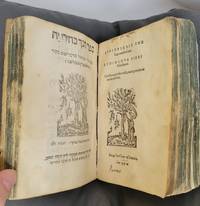
1525réf. 1403641Geneva; Genevae; Argentoriati i.e. Strassburg; Hagenau; Coloniae: Robertus Stephanus; Roberto Stephano; Johann Knobloch d. Ä.; Setzer; Apud Ioan. Gymnicum Johann Gymnich 1554; 1551; 1526; 1525; 1531. Octavo 5 parts. In Very Good condition. Bound in contemporary worn vellum. Ties at front hinge separated. Edges of text block dyed blue/black. Part three with rubrication and red ink marginalia. A sammelband in 5 parts of Calvinistic theology. 1 Calvin John Jean; Tremellius Immanuel translator; SEFER HINUKH BEHIRE YAH; Geneva : Nidpas be-bet Robertus Stephanus 1554. 8 152 8 pages. Translation by Immanuel Tremellius of Jean Calvin's Catéchisme de l'Eglise de Genève. Hebrew title romanized. Primarily in Hebrew; afterword a letter from Tremellius to Duke Christoph of Württemberg dated April 3 1554 in Strasbourg in Latin. First Edition. Tremellius was the first professor of Hebrew at Cambridge University. He converted to Christianity and died in 1580. USTC: 450063. GLN-306. Index Aureliensis; 129.892. Vinograd Geneva 1. 2 Calvin John Jean; STOICHEIOSIS TES CHRISTIANON PISTEOS = RUDIMENTA FIDEI CHRISTIANAE : LIBELLUS APPRIME UTILIS NUNC PRIMUM IN LUCEM AEDITUS; Genevae : Para RÅvertÅ tÅ StephanÅ etei Roberto Stephano Robert Estienne 1551. 126 2 pages. First book printed at Geneva by Robert Estienne. Greek translation by Henri Estienne of Calvin's Catéchisme de l'église de Genève. Greek colophon dated 14 Dec. 1551. USTC: 450041. Renouard: I 80. GLN-222. 3 Bader Johann; Meyer Tobias; AD ILLUSTREM PRINCIPEM D. LUDOVICUM COMITEM PALATINUM RHENI DUCEM BAUARIAE COMITEM VELDENSEM ETC. DE ANSERE QUI SACRAMENTUM EDISSE DICITUR; Argentoriati i.e. Strassburg: Johann Knobloch d. Ä. 1526; 20 leaves. USTC: 608905. VD16 B 106. VD16 B 114 Index Aureliensis; 111.457 4 Bugenhagen Johannes; Georg Spalatin; POSTILLATIO IOAN. BVGENHAGII POMERANI IN EVANGELIA USUI TEMPORUM&SANCTORUM TOTIUS ANNI SERUIENTIA; Hagenau: Setzer ca. 1525; 32 leaves. USTC: 685333. VD16 B 9351. 5 Augustine of Hippo Saint; D. AURELI AUGUSTINI HIPPONENSIS EPISCOPI DE BONO CONJUGALI LIBER UNUS. EIUSDEM DE SANCTA VIRGINITATE LIBER UNUS.; Coloniae : Apud Ioan. Gymnicum Johann Gymnich 1531 56 unnumbered leaves. Title within woodcut border with date 1530. USTC: 625891. VD16 ZV 27243. Shelved case 3. The present sammelband presents a cross-section of sixteenth-century theological writing encapsulating both the intellectual and polemical ferment of the Reformation as well as the enduring theological authority of the patristic tradition. At its heart are two translations of Jean Calvin's Catechism of the Church of Geneva one in Hebrew by Immanuel Tremellius and the other in Greek by Henri Estienne each printed by Robert Estienne at Geneva. The existence of these translations are illustrative of Reformation theologian's claim to return ad fontes back to the languages of Scripture itself. By representing a catechetical summary of Christian doctrine in both Hebrew and Greek the reformers in Geneva sought to demonstrate that their theology was rooted in the sources of revelation and the 'pure' teachings of the early Church in a manner capable of addressing both learned audiences and hoped-for Jewish or Eastern interlocutors. Alongside Calvin's catechisms are two early Lutheran texts: Johann Bader and Tobias Meyer's sacramental tract printed in Strasbourg in 1526 and Johannes Bugenhagen's postils printed at Hagenau ca.1525. These works reflect both the polemical and pastoral concerns of the early Lutheran movement on the one hand grappling with the meaning of the Eucharist and on the other providing sermons for the liturgical year. A close ally of Luther Bugenhagen sought to stabilize the reformation communities through pragmatic instruction. Bader's text by contrast exemplifies the more combative dimension of then current theological controversies. Taken together these two texts are illustrative of how Reformation figures not only produced works of doctrinal innovation but also sought new forms of preaching and pastoral practice. Also present is a Cologne edition of two treatises by St. Augustine of Hippo De bono coniugali and De sancta virginitate. Augustine's authority among the reformers Lutheran and Calvinist with John Calvin and his followers in particular invoking him as a guarantor of continuity with the early church. In this sammelband which includes works by both Lutherans and Reform theologians the presence of these texts demonstrate how Augustine's writings on marriage and virginity provided a moral theology that could be appropriated across these still-porous confessional divisions. By binding Augustine with Calvin Bugenhagen and other reformers the volume exemplifies how early Protestants claimed authority from the Church Fathers attempting to demonstrate that their reforms did not represent a novelty within the Christian but rather a recovery of the authentic early Christian church. The assemblage of these particular and diverse works in this volume suggests that they were likely bound together in the mid-16th century. The presence of Calvinist catechisms Lutheran sermons and polemics and works by Augustine indicates that these texts were brought together during a time in which the boundaries between "Lutheran" and "Reformed" identities were still porous likely before the Lutheran Formula of Concord in 1577 and the Reformed Synod of Dordt in 1618. After these key moments confessional lines between the two traditions became far sharper. In the period between 1540 and 1570 the Reformation was still a popular evangelical movement with significant overlapping sympathies and theological tendencies sharing both a robust humanist disposition and a common appeal to the authority of Scripture and the patristic tradition. A collector of these works during this period would likely have seen these as complementary expressions of the same reforming enterprise. The translations of Calvin's catechism into Greek and Hebrew in particular suggest a distinct cosmopolitanism: a theology that could be directed outward to Jews Eastern Orthodox Christians and the broader "republic of letters". Taken together the works gathered in this sammelband are representative of the emergence of a distinctly Protestant culture one that sought to articulate a developing form of Christianity across languages confessions and centuries. The significance of the present volume lies not only in the rarity and importance of its individual components but in their relation to one another - their diversity and unity consonance and dissonance - and is a fine example of the breadth of Reformation theological and cultural engagement across confessional lines and with both the humanist and patristic traditions. 1403641. Shelved Dupont Bookstore. Robertus Stephanus; [Roberto Stephano]; [Johann Knobloch d. Ä.]; [Setzer]; Apud Ioan. Gymnicum [Johann Gymnich] unknown
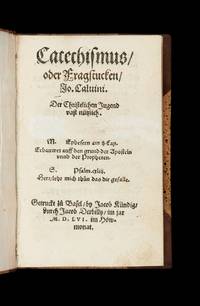
1556réf. 12421Basle: J. Derbilley at the press of J. Kündig 1556. 18th-century half-sheep and speckled pastepaper over thin wooden boards rear board wormed initials P.S. gilt-lettered on the front panel. ONLY EDITION EARLY ISSUE OF THE FIRST CALVINIST CATECHISM IN GERMAN AND THE ONLY LITERAL GERMAN TRANSLATION OF CALVIN'S TEXT. No American library holds a copy. First published in 1537 Calvin's first attempt at rudimentary religious instruction was a complex reduction of his Institutes. Five years later he simplified his approach couched his ideas in catechistic format and created the standard Calvinist manual - the so-called Second Geneva Catechism. Its first printing in French is lost. In 1545 Calvin published his own Latin translation the basis of our anonymous word-for-word German rendering. This is Derbilley's first book. Vagaries and errors in the opening quire suggest he had yet to perfect his new trade many of these idiosyncrasies are reset in digitized copies I examined. In good condition outer margins trimmed with some loss to the shoulder notes repair to the final leaf's outer blank margin from a removed thumb tab. Inexplicably absent from Peter and Gilmont Bibliotheca Calviniana. ¶Neuser "Die Übersetzung des Genfer Katechismus 1542/1545 ins Deutsche durch Zacharias Ursinus im Jahr 1563" in Koers 74 2009 683-700; Erichson Bibliographia Calviniana 16; Bietenholz Basle and France in the Sixteenth Century 226; Brüggemann & Brunken Handbuch zur Kinder- und Jugendliteratur 69 & illus. Sp. 268; VD 16 C 311. J. Derbilley at the press of J. Kündig unknown
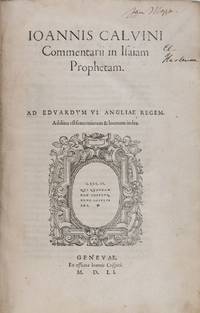
1551réf. 3895Genevae Geneva: Ex officina Ioannis Crispini Jean Crespin 1551. First edition. Contemporary dark brown calf covers with blind fillet border gilt corner tools and a small central gilt ownership stamp bearing the initials "WS"; spine with five raised bands; manuscript title on the fore-edge; traces of two pairs of clasps. Guildford Theological Library label on the front pastedown. Early ownership inscription "Thomas Bl." on the recto of the front free endpaper struck through; two later ownership inscriptions on the title page both illegible. Binding rubbed and worn with losses to the leather at the spine ends and corners; upper joint split and repaired at head exposing part of the first gathering; smaller loss at the foot of the lower joint. Old dampstaining to the lower outer corner and occasional marginal worming; otherwise internally clean and sound. First edition. Contemporary dark brown calf covers with blind fillet border gilt corner tools and a small central gilt ownership stamp bearing the initials "WS"; spine with five raised bands; manuscript title on the fore-edge; traces of two pairs of clasps. 12 637 39 pp. Collation: ⶠA-ZⶠAa-ZzⶠAA-IIⶠKKâ¸. Extremely scarce first edition of Calvin's first Old Testament commentary a unique collaborative work with Nicolas des Gallars and a landmark of Reformed biblical exegesis. Calvin's first published commentary on an Old Testament book the Commentarii in Isaiam inaugurated the series of biblical commentaries that became one of the defining achievements of his literary career and established the pattern of Old Testament exegesis that he would continue to develop throughout the remainder of his life. It occupies a unique place within Calvin's oeuvre as the only commentary whose first edition was not written directly by him. Instead it was compiled by his trusted secretary and close collaborator Nicolas des Gallars c. 1520-1581 from Calvin's sermons on Isaiah preached from 1546 and his lectures of 1549-1550. Des Gallars prepared the Latin text from notes supplemented by memory reading it to Calvin in successive portions for correction and revision before publication. Isaiah remained a recurring focus of Calvin's ministry: he returned to the prophet throughout his career from his Geneva sermons of 1546 to one of his final recorded biblical expositions in January 1564. Dedicated to the young King Edward VI of England the commentary formed part of Calvin's broader effort to encourage and support the English Reformation. In the dedication he presents Isaiah-whom he describes as of royal lineage and a servant of Christ the supreme King-as a model worthy of a Christian ruler expressing the hope that Edward would continue the reform of the English Church. The commentary enjoyed immediate success and circulated rapidly through the international Reformed network. A documented copy belonged to the Scottish reformer David Forrest of Haddington by July 1552 illustrating both the speed of its dissemination and its adoption by leading figures of the Scottish Reformation. Forrest's extensively annotated copy further demonstrates that the work quickly became an active tool of biblical study and theological reflection rather than merely a library book. When the edition sold out Calvin declined a simple reprint. Dissatisfied with the collaborative text he undertook a thorough revision extensively rewriting and enlarging the commentary for subsequent editions beginning with that of 1559. The revised version was substantially expanded and reorganized making the present first edition the sole witness to the original form of one of Calvin's most influential exegetical works. Extremely scarce. RBH records only a single copy appearing at auction during the past century Swann Galleries 1990. The edition is recorded in the USTC no. 450035 where it remains classified as a "lost book". . Ex officina Ioannis Crispini [Jean Crespin] unknown
1560réf. 1560GENPRESENTING FOR YOUR CONSIDERATION EXQUISITE GENUINE 465 YEAR OLD FIRST EDITION OF THE HISTORIC GENEVA BIBLE PRINTED BY ROULAND HALL AT GENEVA SWITZERLAND IN 1560. Quarto 9 3/4" x 7" x 2 1/2" HERBERT #107 D & M #77 STC # 2093. Known as the Breeches Bible for its rendering of Genesis 3:7 " Then the eyes of them both were opened and they knewe that they were naked and they sewed figge tree leaues together and made them selues breeches. " SHORT DESCRIPTION The General title supplied in fine facsimile lacks all three leaves of the preliminaries has all 26 engravings within the text and all 5 maps Old Testament and Apocrypha are complete without facsimiles. New Testament Title page dated 1560 is original and the New Testament is complete without facsimiles both tables at the end are incomplete and defective. COLLATION AND CONDITION GENERAL TITLE PAGE 1 page supplied in fine facsimile on sympathetically aged cotton linen paper. Imprinted at Geneva by Rouland Hall MDLX. Features a wonderful engraving of the scene at the Red Sea surrounded with the passages Exodus 14:14 Psalm 34:19 and Exodus 14:13. Verso is blank. lacking the following three leaves of the preliminaries THE OLD TESTAMENT foliated 1- 385b 63 lines of Roman type to the full page in double columns. Beautiful floriated and historiated initials begin each book along with the arguments. Within the text features the full complement of 26 engravings such as: The situation of the Garden of Eden The flood The crossing of the Red Sea the Tabernacle and the Temple with their furniture Solomon's throne and Ezekiel's vision. Also found here are 3 maps as called for at: Numbers 23 Joshua 15 and the end of Ezekiel. the remaining 2 maps are listed below where they are found in the n.t. Leaves 1 & 2 with repaired blank outer margins resulting in the loss of a few letters of the printed notes only. Leaves 196-202 with quarter sized stains to the blank footer margins. Leaf 217 stained to the upper half most likely from an ancient floral pressing. Top and bottom of the verso of leaf 238 is smudged. Leaf 263 has a stain in the center approx. 1" x 2" Leaf 286 has a stain in the lower left column approx. 1" x 2". The paper is clean crisp and bright with only very minor staining and soiling. There are no loose missing or torn pages. The edges are straight the gutters are clean the corners are strong. The footer and fore edge margins are excellent while the occasional header margins are trimmed touching and also into the running headlines but without obscuring the words. A Very Good example .COMPLETE. THE APOCRYPHA foliated 386-474 63 lines of Roman type to the full page in double columns.Beautiful floriated and historiated initials begin each book. The paper is clean crisp and bright with only very minor staining and soiling. There are no loose missing or torn pages. The edges are straight the gutters are clean the corners are strong. The margins are very good all around. A Very Good example .COMPLETE. THE NEW TESTAMENT TITLE PAGE 1 page folio #1. Imprinted at Geneva by Rouland Hall MDLX. Features a wonderful engraving of the scene at the Red Sea surrounded with the passages Exodus 14:14 Psalm 34:19 and Exodus 14:13. Verso is blank. Lightly stained Good. COMPLETE. THE DESCRIPTION OF THE HOLIE LAND 3 pages The double page map of the places found in the four evangelists. Map #4 of five found in this edition. Clean and crisp verso is blank. Very Good COMPLETE. THE NEW TESTAMENT foliated 2- 122 63 lines of Roman type to the full page in double columns.Beautiful floriated and historiated initials begin each book along with the arguments. Leaf 7 has a somewhat crudely repaired tear without loss of the text Leaves 50-63 have minor chipping to the upper blank corner tips. Map # 5 the description of the countries and places mentioned in Acts bound at the end of the text. Leaf 74 has the lower blank corner repaired with loss to a few letters of the notes. Leaf 91 printed slightly skewed. Leaf 94 misnumbered as 84 without a break in the collation. Leaves 120-122 faintly stained. The paper is clean crisp and bright with only very minor staining and soiling. There are no loose missing or torn pages. The edges are straight the gutters are clean the corners are strong. The footer and fore edge margins are excellent while the occasional header margins are trimmed touching the running headlines. A Very Good example COMPLETE. The following two tables concordances are incomplete. The first table lacks the last page. The second table lacks the first page the next two leaves the final four leaves and all thereafter. Their condition is fair to poor with various faults including tear outs with loss cropped outer margins chipped corners and edges etc. ABOUT THE BINDING This Bible is bound in a full brown leather Victorian binding that has been neatly rebacked featuring a new burgundy morocco label. All joints are unsplit uncracked and holding firmly. The plain end papers appear to be 18th century and features the inscription of Jacob Elton who was possibly a British Naval Captain. The text block is firm square and unshaken with its fore edges dyed red as was the practice of Victorian binders. The custom fitted brown half leather clamshell case was recently made and features a maroon morocco label and is titled directly to the foot "1560 GENEVA". ABOUT THE GENEVA BIBLE The Geneva Bible is one of the most historically significant translations of the Bible into English preceding the King James Version by 51 years. It was the primary Bible of 16th-century English Protestantism and was the Bible used by William Shakespeare Oliver Cromwell John Knox John Donne and John Bunyan author of Pilgrim's Progress 1678. It was one of the Bibles taken to America on the Mayflower Pilgrim Hall Museum and Dr. Jiang have collected several bibles of Mayflower passengers. The Geneva Bible was used by many English Dissenters and it was still respected by Oliver Cromwell's soldiers at the time of the English Civil War in the booklet "Cromwell's Soldiers' Pocket Bible". This version of the Bible is significant because for the very first time a mechanically printed mass-produced Bible was made available directly to the general public which came with a variety of scriptural study guides and aids collectively called an apparatus which included verse citations that allow the reader to cross-reference one verse with numerous relevant verses in the rest of the Bible introductions to each book of the Bible that acted to summarize all of the material that each book would cover maps tables woodcut illustrations and indices. Because the language of the Geneva Bible was more forceful and vigorous most readers strongly preferred this version to the Great Bible. In the words of Cleland Boyd McAfee "it drove the Great Bible off the field by sheer power of excellence". During the reign of Queen Mary I of England 1553–58 a number of Protestant scholars fled from England to Geneva Switzerland which was then ruled as a republic in which John Calvin and later Theodore Beza provided the primary spiritual and theological leadership. Among these scholars was William Whittingham who supervised the translation now known as the Geneva Bible in collaboration with Myles Coverdale Christopher Goodman Anthony Gilby Thomas Sampson and William Cole; several of this group later became prominent figures in the Vestments controversy. Whittingham was directly responsible for the New Testament which was complete and published in 1557 while Gilby oversaw the Old Testament. The first full edition of this Bible with a further revised New Testament appeared in 1560 but it was not printed in England until 1575 New Testament and 1576 complete Bible. Over 150 editions were issued; the last probably in 1644. The very first Bible printed in Scotland was a Geneva Bible which was first issued in 1579. In fact the involvement of Knox and Calvin in the creation of the Geneva Bible made it especially appealing in Scotland where a law was passed in 1579 requiring every household of sufficient means to buy a copy. Some editions from 1576 onwards included Laurence Tomson's revisions of the New Testament. Some editions from 1599 onwards used a new "Junius" version of the Book of Revelation in which the notes were translated from a new Latin commentary by Franciscus Junius. The annotations which are an important part of the Geneva Bible were Calvinist and Puritan in character and as such they were disliked by the ruling pro-government Anglicans of the Church of England as well as King James I who commissioned the "Authorized Version" or King James Bible in order to replace it. The Geneva Bible had also motivated the earlier production of the Bishops' Bible under Elizabeth I for the same reason and the later Rheims-Douai edition by the Catholic community. The Geneva Bible remained popular among Puritans and remained in widespread use until after the English Civil War. The Geneva notes were surprisingly included in a few editions of the King James version even as late as 1715 Rouland Hall