707 resultados
[2] ff., 227-[3] pp., 1 pl. dépl broché, couverture d'attente bleu clair de l'époque, pièce de titre papier au dos an 10 (1801), an 10 (1801), in-8, [2] ff, 227-[3] pp, 1 pl. dépl, broché, couverture d'attente bleu clair de l'époque, pièce de titre papier au dos, « Première édition collective de ces différents rapports concernant des établissements de bienfaisance construits selon le modèle des fameux "Fourneaux" de Rumford » (Oberlé). Très rare. L'ouvrage ouvre sur une instruction générale de Candolle et Delessert, décrivant la construction des fourneaux et donne la recette des soupes. La planche dépliante gravée sur cuivre, en fin d'ouvrage, représente le modèle de fourneau tel que décrit. Suivent : - PARMENTIER, Rapport au ministre de l'Intérieur sur les soupes de légumes. - CANDOLLE, Rapport sur l'état actuel des soupes et des fourneaux. - PARMENTIER, Rapport sur la substitution de l'orge mondé au riz. - CADET DE VAUX, Mémoire sur la substitution du gruau d'orge au riz, dans les hôpitaux civils et militaires. Le chimiste américain Benjamin Thompson, anobli sous le nom de comte de Rumford (1753-1814) fonda ses établissements de charité publique à Munich ; très vite, ils attirèrent l'attention de l'Europe entière. A Paris, le premier fourneau fut installé le 21 pluviôse an 8 (1800), au 16 rue du Mail, et fut placé sous la direction du jeune botaniste Candolle. Une dizaine d'années plus tard, 6 établissements de ce type distribuaient quotidiennement des soupes aux indigents de la capitale. Exemplaire tel que paru, sous couverture d'attente et non rogné. Oberlé n° 163. Vicaire, 732
1868ref. 10706S.l. (Paris), s.n. (gravé par Pouzadou, lithographié par Lanoue), 1868 ; grand in-folio en feuilles sous portefeuille muet ; (6) pp. de Titre, noms des Chemins de fer et table des planches imprimées en rouge et noir, 65 planches doubles, triples ou quadruples, ouvrage entièrement lithographié.
1623ref. 1146161623 M.DC.XXIII (1623), à Genève, par Baltazar L'Abbe (?) - Fort in-12 (11cmx17,5cm) - Reliure parchemin de l'époque, Lettrines - 2 Ouvrages de Scipion Dupleix reliés en un Volume : "Le Livre de la Métaphysique ou science surnaturelle, Volume II", composé des onze livres ; 263p + tables pour les cinq premiers livres (Première partie Livres 1 à 4, deuxième partie Livre 5, pagination reprenant à 1 à partir du sixième livre, soit le début de la troisième partie (Livres 6 à 8) soit 232p. Pagination reprenant à 1 pour la quatrième partie (Livre 9 à 11), soit 184p (Les tables sont au début de chacune des 4 parties). Suivi de "L'Ethique ou Philosophie Morale", composé de 7 livres (Le premier livre de l'Ethique, Le second livre de l'Ethique, etc.) courant sur 352 pages, avec sa table des matières en début d'ouvrage. Ancien Français
1868ref. 10705S.l. (Paris), s.n. (gravé par Pouzadou, lithographié par Lanoue), 1868 ; grand in-folio en feuilles sous portefeuille muet ; (6) pp. de Titre, noms des Chemins de fer et table de planches imprimées en rouge et noir, 118 planches doubles, triples ou quadruples ou plus, certaines en couleurs. Ouvrage entièrement lithographié.
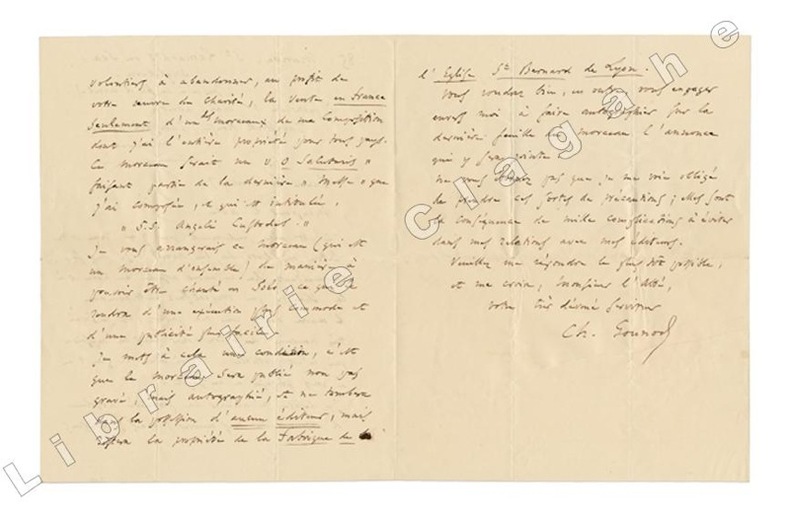
ref. 18307“Monsieur l’abbé, [...] Je vous suis reconnaissant de m’avoir associé au zèle et à la charité qui vous ont fait entreprendre l’oeuvre dont vous me parlez [...] Voici donc ce que j’ai à vous proposer à ce sujet. Je désire n’aliéner la propriété absolue d’aucune de mes oeuvres ; mais je consens volontiers à abandonner, au profit de votre oeuvre de charité, la vente en France seulement d’un des morceaux de ma composition dont j’ai l’entière propriété pour tous pays. Ce morceau serait un “O Salutaris” faisant partie de la dernière “Messe” que j’ai composée, et qui est intitulée “S.S. Angeli Custodes”. Je vous arrangerai ce morceau (qui est un morceau d’ensemble) de manière à pouvoir être chanté en solo, [...]. Je mets à cela une condition, c’est que le morceau sera publié non pas gravé, mais autographié, et ne tombera dans la possession d’aucun éditeur, mais restera la propriété de la fabrique de l’Eglise St-Bernard de Lyon. Vous voudrez bien en outre, vous engager envers moi à faire autographier sur la dernière feuille du morceau l’annonce qui y sera jointe. Ne vous étonnez pas que je me vois obligé de prendre ces sortes de précautions ; elles sont la conséquence de mille complications à éviter dans mes relations avec mes éditeurs. [...] signé : Ch. Gounod.”
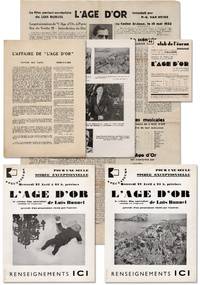
1932ref. 169144N.p.: N.p. 1932. A small archive of five vintage French pamphlets flyers and broadsides announcing 1931 and 1932 screenings of the banned 1930 surrealist film. All items are housed loose in a custom bound volume with a "L'Affaire de L'Age d'Or" label on the spine with each item laid in on separate leaves overlaid with heavy protective tissue housed in a custom slipcase. Rare. The archive includes: "L'Affaire de 'L'Age d'Or'" bi-fold pamphlet printed on rectos and versos with a satin-finish photo illustrated insert also printed on the recto and verso published by Nancy Cunard on the occasion of her January 1931 private screening of the film in London. The bi-fold includes the essay "Exposé des Faits" "Statement of Facts" describing the film's initial riotous reception "Extraits du Programme" "Excerpts from the Program" a "Questionnaire" regarding political and legal actions taken in response to the film and an extensive "Extraits de la Presse" "Excerpts from the Press" followed the names of signatories Maxime Alexandre Aragon André Breton René Char René Crevel Salvador Dali Paul Eluard Georges Malkine Benjamin Péret Man Ray Georges Sadoul Yves Tanguy André Thirion Tristan Tzara Pierre Unik and Albert Valentin. Two satin-finish variants of a flyer printed on rectos only for a screening of the film on April 27 1932 by Les Spectateurs de l'Avant-Garde at La Bellevilloise a workers' cooperative theatre with each flyer featuring a different image from the film. A second screening was later added on April 30 not noted on the flyers. The screenings were decidedly low-key private events with Buñuel insisting "No protests." French director Jean Vigo was reportedly among the participants of the screenings. And two items relating to a screening presented by Le Club de L'Ecran at Cine-Casino in Belgium on May 10 1932: A 4 x 5.5 inch announcement for the screening printed on the recto only noting the film as being presented by P.G. van Hecke Paul-Gustave Van Hecke followed by seating and ticket prices purchase locations and Club de L'Ecran membership prices. A large newsprint broadside printed on the recto and the verso for Le Club de L'Ecran announcing the May 10th screening with articles on the recto regarding the film club's activities and an excerpt from the Surrealist manifesto published upon the film's premiere with the verso dedicated entirely to numerous texts and articles on "L'Age d'Or" featuring two images from the film and a portrait of Buñuel. A key and archetypal work of Surrealist cinema alongside "Un Chien Andalou" 1929 also written by Buñuel and Dali and directed by Buñuel featuring a series of absurdist vignettes scathingly and sardonically rebuking the sexual hypocrisy of bourgeois society the Catholic Church and 20th century European society in general. The violence the uproar "L'Age d'Or" created remains as shocking as the film itself: days into the first screenings at Studio 28 on December 3 1930 the theatre was stormed by fascist youths enraged at the film's perceived anti-patriotic and anti-Christian message. Demonstrators threw ink at the screen shouted anti-Semitic death threats smashed the theatre windows and completely destroyed an exhibition of surrealist books and art in the foyer. In response the Board of Censors re-reviewed the film and on December 10 the film was banned from further public showings in France. The film's producers subsequently withdrew "L'Age d'or" from commercial distribution and public exhibition for more than 40 years although three years later in 1933 the film was privately exhibited at the Museum of Modern Art in New York. "L'Affaire de 'L'Age d'Or':" Bi-fold 7.5 x 10.5 inches. About Near Fine with a Very Good plus 7.5 x 10 inch insert with both items previously folded horizontally. Two Les Spectateurs April 27 Flyers: 8.25 x 10.5 inches. One Near Fine. One Very Good plus with light creasing faint toning and a .25 inch closed tear to the top edge. Le Club de L'Ecran Announcement: 4 x 5.5 inches. Near Fine. Le Club de L'Ecran Broadside: 14.25 x 21.75 inches folded as issued. About Near Fine with an additional lightly toned horizontal fold. Housed in a 9.25 x 12 inch custom bound Near Fine volume with a 9.5 x 12.25 inch Near Fine slipcase. BFI. Rosenbaum 1000. Vogel Film as a Subversive Art. N.p. unknown
1932ref. 169144N.p.: N.p. 1932. A small archive of five vintage French pamphlets flyers and broadsides announcing 1931 and 1932 screenings of the banned 1930 surrealist film. All items are housed loose in a custom bound volume with a "L'Affaire de L'Age d'Or" label on the spine with each item laid in on separate leaves overlaid with heavy protective tissue housed in a custom slipcase. Rare. The archive includes: "L'Affaire de 'L'Age d'Or'" bi-fold pamphlet printed on rectos and versos with a satin-finish photo illustrated insert also printed on the recto and verso published by Nancy Cunard on the occasion of her January 1931 private screening of the film in London. The bi-fold includes the essay "Exposé des Faits" "Statement of Facts" describing the film's initial riotous reception "Extraits du Programme" "Excerpts from the Program" a "Questionnaire" regarding political and legal actions taken in response to the film and an extensive "Extraits de la Presse" "Excerpts from the Press" followed the names of signatories Maxime Alexandre Aragon André Breton René Char René Crevel Salvador Dali Paul Eluard Georges Malkine Benjamin Péret Man Ray Georges Sadoul Yves Tanguy André Thirion Tristan Tzara Pierre Unik and Albert Valentin. Two satin-finish variants of a flyer printed on rectos only for a screening of the film on April 27 1932 by Les Spectateurs de l'Avant-Garde at La Bellevilloise a workers' cooperative theatre with each flyer featuring a different image from the film. A second screening was later added on April 30 not noted on the flyers. The screenings were decidedly low-key private events with Buñuel insisting "No protests." French director Jean Vigo was reportedly among the participants of the screenings. And two items relating to a screening presented by Le Club de L'Ecran at Cine-Casino in Belgium on May 10 1932: A 4 x 5.5 inch announcement for the screening printed on the recto only noting the film as being presented by P.G. van Hecke Paul-Gustave Van Hecke followed by seating and ticket prices purchase locations and Club de L'Ecran membership prices. A large newsprint broadside printed on the recto and the verso for Le Club de L'Ecran announcing the May 10th screening with articles on the recto regarding the film club's activities and an excerpt from the Surrealist manifesto published upon the film's premiere with the verso dedicated entirely to numerous texts and articles on "L'Age d'Or" featuring two images from the film and a portrait of Buñuel. A key and archetypal work of Surrealist cinema alongside "Un Chien Andalou" 1929 also written by Buñuel and Dali and directed by Buñuel featuring a series of absurdist vignettes scathingly and sardonically rebuking the sexual hypocrisy of bourgeois society the Catholic Church and 20th century European society in general. The violence the uproar "L'Age d'Or" created remains as shocking as the film itself: days into the first screenings at Studio 28 on December 3 1930 the theatre was stormed by fascist youths enraged at the film's perceived anti-patriotic and anti-Christian message. Demonstrators threw ink at the screen shouted anti-Semitic death threats smashed the theatre windows and completely destroyed an exhibition of surrealist books and art in the foyer. In response the Board of Censors re-reviewed the film and on December 10 the film was banned from further public showings in France. The film's producers subsequently withdrew "L'Age d'or" from commercial distribution and public exhibition for more than 40 years although three years later in 1933 the film was privately exhibited at the Museum of Modern Art in New York. "L'Affaire de 'L'Age d'Or':" Bi-fold 7.5 x 10.5 inches. About Near Fine with a Very Good plus 7.5 x 10 inch insert with both items previously folded horizontally. Two Les Spectateurs April 27 Flyers: 8.25 x 10.5 inches. One Near Fine. One Very Good plus with light creasing faint toning and a .25 inch closed tear to the top edge. Le Club de L'Ecran Announcement: 4 x 5.5 inches. Near Fine. Le Club de L'Ecran Broadside: 14.25 x 21.75 inches folded as issued. About Near Fine with an additional lightly toned horizontal fold. Housed in a 9.25 x 12 inch custom bound Near Fine volume with a 9.5 x 12.25 inch Near Fine slipcase. BFI. Rosenbaum 1000. Vogel Film as a Subversive Art. N.p. unknown books