BibleLivre Rare Book

7965 risultati
1569rif. 65571569 1569, Antuepia , C. Plantin, 1564. In-12 (105 x 70 mm). Reliure de l’époque aux petits fers, dos à 4 nerfs orné, tranches dorées et tamponnées aux fers.
1995rif. 689BASTEI-LÜBBE 09/1995-07/96. 1. softcover. Scandal/Kendar Deutsche Erstveröffentlichung! 202652027420286 BASTEI-LÜBBE paperback
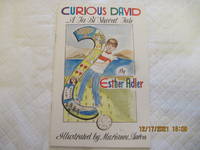
rif. 6323-10122Initials WJCS inscribed inside front wrap else Content appears as new unopened unread & unblemished in fine wraps as shown. Originally just the day when trees were considered a year older relevant in the ancient world for tithing purposes—Tu Bi'Shevat was transformed by the kabbalists of Safed into a celebration of nature its fruits and the Divine "tree" reaching toward us. At Tu Bi'Shevat seders the four cups of wine borrowed loosely from the Passover seder revitalized in modern times and inspired with an environmental consciousness we drink the fruit of the vine and eat many different kinds of fruit from trees—from the tough hard walnut to the luscious pomegranate—evoking different aspects of the Divine and of humanity. Insurance & handling is included free. Extra Charges/Fees apply on Shipments Outside The U.S. and Expedited Shipments. Oversize and/or heavy books may require additional fees. Will advise Written 11.30.2021SK 4 similar copies #6323-10122 Img.7694 Updated 8.16.25 Jewish National Fund, Dept. Of Ed. paperback
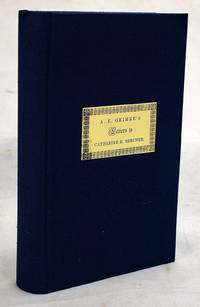
1838rif. 2006080076Boston Printed by Isaac Knapp 1838-12-31. First Edition. Hardcover. Good. Powerful women and dangerous women: Early Abolitionist works Bound in contemporary boards. Yellow printed title label on front board. Rebacked with renewed spine. Housed in custom clam shell case. Library markings. Intermittent water stain generally faint. 130 pp. "First edition of the third work in a series of literary exchanges between Beecher and Grimke that began in 1836 with Grimke's Appeal to Christian Women of the South. This was followed by Beecher's Essay on Slavery and Abolitionism with Reference to the Duty of American Females 1837 in turn followed by the present work by Grimke. Although born into the Southern elite of South Carolina Angelina Grimke 1805-1879 spent most of her life in the North advocating for the abolition of slavery and women's rights. Catherine Beecher was an educator and shared similar views." - Swann Galleries Sale 2377 Lot 59 March 26 2015. Angela Grimke and her sister Sarah Moore were highly unusual women for their era. They converted to Quakerism and advocated not only the emancipation of slaves but also racial and gender equality. Quite radical for a southern woman in the 1830s. Boston, Printed by Isaac Knapp hardcover
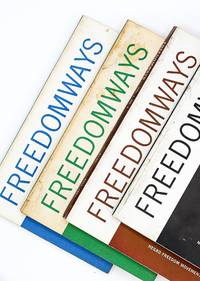
rif. 55410New York: Freedomways Associates 1985. First edition. Very good to near fine overall. Complete 98-issue run of this indispensable document of the Civil Rights and post-Civil Rights eras. FREEDOMWAYS was one of the richest documents of African American and global Black culture politics and thought to emerge from the turbulence of the 1960s. Founded by Louis Burnham and Edward Strong with the help of W.E.B. Du Bois whose wife Shirley Graham Du Bois would serve as the journal's first editor "FREEDOMWAYS was the brainchild of a group of black Marxist activists" McClendon 277 which included Esther Jackson John Henrik Clarke Dorothy Burnham Margaret Burroughs James Jackson and Alphaeus Hunton. The quarterly published articles essays commentary poetry short stories book reviews and artwork from many of the most important international voices in Black intellectual life. Over its 24-year run John Lewis Julian Bond Angela Davis Martin Luther King Jr. James Baldwin Ossie Davis Harry Belafonte Pablo Neruda Derek Walcott Kwame Nkrumah Julius K. Nyerere Agostinho Neto Jomo Kenyatta Cheddi Jagan Alice Childress June Jordan Gwendolyn Brooks Tom Dent Don Lee Jacob Lawrence Alice Walker her first publication and many others all appeared in its pages. In addition to its many enduring influences FREEDOMWAYS also served as "an important but often overlooked 'parent' of modern black feminism" McDuffie 100. A tricky run to assemble especially in collectible condition of one of the most long-lived and important assemblages of 20th-century Black writing. 98 volumes; 9'' x 6'' all. Original printed and photographic wrappers all. Various paginations most 100-200 pages. Minor shelfwear. Some occasional creasing. Touches of soil or foxing here and there. Overall bright and sound. Housed in a series of archival boxes. (Freedomways Associates) unknown
rif. 55410New York: Freedomways Associates 1985. First edition. Very good to near fine overall. Complete 98-issue run of this indispensable document of the Civil Rights and post-Civil Rights eras. FREEDOMWAYS was one of the richest documents of African American and global Black culture politics and thought to emerge from the turbulence of the 1960s. Founded by Louis Burnham and Edward Strong with the help of W.E.B. Du Bois whose wife Shirley Graham Du Bois would serve as the journal's first editor "FREEDOMWAYS was the brainchild of a group of black Marxist activists" McClendon 277 which included Esther Jackson John Henrik Clarke Dorothy Burnham Margaret Burroughs James Jackson and Alphaeus Hunton. The quarterly published articles essays commentary poetry short stories book reviews and artwork from many of the most important international voices in Black intellectual life. Over its 24-year run John Lewis Julian Bond Angela Davis Martin Luther King Jr. James Baldwin Ossie Davis Harry Belafonte Pablo Neruda Derek Walcott Kwame Nkrumah Julius K. Nyerere Agostinho Neto Jomo Kenyatta Cheddi Jagan Alice Childress June Jordan Gwendolyn Brooks Tom Dent Don Lee Jacob Lawrence Alice Walker her first publication and many others all appeared in its pages. In addition to its many enduring influences FREEDOMWAYS also served as "an important but often overlooked 'parent' of modern black feminism" McDuffie 100. A tricky run to assemble especially in collectible condition of one of the most long-lived and important assemblages of 20th-century Black writing. 98 volumes; 9'' x 6'' all. Original printed and photographic wrappers all. Various paginations most 100-200 pages. Minor shelfwear. Some occasional creasing. Touches of soil or foxing here and there. Overall bright and sound. Housed in a series of archival boxes. (Freedomways Associates) unknown books
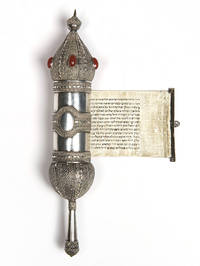
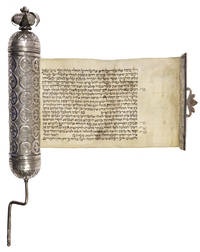
rif. 117059Jerusalem Bezalel Circa 1920. . Original manuscript on vellum text arranged in 14 lines in Hebrew script scroll housed in an elaborately decorated silver filigree case stamped 'Made in Palestine 935' set with five semiprecious stones presumed Carnelian stone; scroll height 600 mm case height 220 mm engraved with 'Jerusalem' signature in Hebrew. A beautiful example of a Bezalel Megillah housed in a silver case with elaborate filigree and semiprecious stones. The Bezalel school was founded in 1906 in Jerusalem by the artist and professor Boris Schatz and was the first art school to be established in the Holy Land in the 20th century. Schatz who discussed his vision of opening an art school in the Land of Israel with Herzl when the two met in Vienna in 1903 chose to call the school Bezalel after the biblical artist Bezalel ben Uri ben Hur mentioned in the book of Exodus as the artist chosen by God to build the Tabernacle HaMishkan in Hebrew. According to the scripture this artist worked in silver gold copper stone and wood. By founding the school Schatz aimed to establish a national style of art blending classical Jewish European and Middle-Eastern traditions. In addition to traditional sculpture and painting training the school ran craft workshops that produced decorative objects in silver leather wood brass and fabric which were sold at exhibitions in Europe and the United States. Schatz's school was closed in 1929 and then reopened in the mid 1930s as the New Bezalel. In 1955 the school received its official academic acclaim and today the Bezalel Academy of Art and Design is Israel's national school of art as well as its oldest higher education institution. The art created by Bezalel's students and professors in the first decades of the 20th century is considered the stepping stone for Israeli visual arts. The Book of Esther is part of Ketuvim Writings the third section of the Hebrew Bible. It tells the story of a Jewish girl named Esther who became queen of Persia and thwarted a plan by Haman to commit genocide against her people. Also called The Megillah the book is the basis and an integral part of the Jewish celebration of Purim. Its full text is read aloud twice during the celebration in the evening and again the following morning. Besides Song of Songs it is the only book in the Bible that does not explicitly mention God. 'Since the Talmudic period it has been customary to write the Book of Esther on parchment in the form of a scroll and the rules governing its production and writing are basically the same as those for a traditional Torah scroll. It is not known when and under what circumstances artistic embellishment of Esther scrolls began. The earliest extant illuminated examples emanate from 16th-century Italy commissioned by well-to-do Italian Jews.' Encyclopaedia Judaica Jerusalem, Bezalel, [Circa 1920]. hardcover
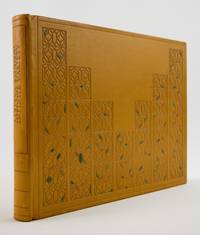
rif. ST21189Seattle and London: University of Washington Press 2002. FIRST EDITION. 220 x 280 mm. 8 3/4 x 11". 222 pp. 1 leaf. LOVELY OCHER GOATSKIN BY JOHN FRANKLIN MOWERY stamp-signed "JFM 2002" on rear turn-in covers with blind-ruled frame surrounding seven columns of increasing height filled with a dense geometric pattern featuring small inlays highlighted in red and green smooth spine ruled and titled in blind. In a black slipcase with matching goatskin lip. Numerous color photographic plates in the text throughout. Bookplate of Werner L. Gundersheimer on front pastedown see below. A VERY FINE COPY--virtually unworn and internally pristine. This beautifully produced celebration of the Folger Shakespeare Library comes from the personal collection of its Emeritus Director and is offered in a fine binding executed by its former Head Conservator. Our binder J. Franklin Mowery studied bookbinding under Professor Kurt Londenberg at the Staatliche Hochschule für bildende Künste Academy of Art in Hamburg and trained as a paper conservator under Otto Wächter in Vienna before returning to the U.S where he served as the head of conservation at the Folger for 37 years. At the same time he continuing to take private binding commissions for which he was highly acclaimed even having a solo show of his work at the Metropolitan Museum of Art in 1982. Produced on the 70th anniversary of the Folger Shakespeare Library "Infinite Variety" aims as the introduction says to fill the "long-felt need" for a "comprehensive survey of the library's collections and activities for the general public" with contributions from many of the library's staff members including Mowery. The binding demonstrates Mowery's skill the buttery goatskin tooled with precision to a design that is elegantly designed complex and yet slightly whimsical not unlike the works of Shakespeare. According to Mowery's article "A Binder's Training" "Guild of Book Workers' Journal" XX 1981-82 the blind-stamping technique seen here was "particularly favored by Professor Londenberg" and often employed by Mowery for the range of design possibilities it offers. The method uses dies to stamp the patterns: "a photographic process can transfer any black and white image onto zinc plates that are deeply etched and mounted onto type-high metal blocks for heated impressions or onto wood for cold embossing." Former owner Werner L. Gundersheimer b. 1937 served as the director of the Folger from 1984-2002 and has served as Director Emeritus since 2004. His tenure was marked by growth in the library's collections as well as increased academic fellowships and public outreach. University of Washington Press unknown
rif. ST21189Seattle and London: University of Washington Press 2002. FIRST EDITION. 220 x 280 mm. 8 3/4 x 11". 222 pp. 1 leaf. LOVELY OCHER GOATSKIN BY JOHN FRANKLIN MOWERY stamp-signed "JFM 2002" on rear turn-in covers with blind-ruled frame surrounding seven columns of increasing height filled with a dense geometric pattern featuring small inlays highlighted in red and green smooth spine ruled and titled in blind. In a black slipcase with matching goatskin lip. Numerous color photographic plates in the text throughout. Bookplate of Werner L. Gundersheimer on front pastedown see below. A VERY FINE COPY--virtually unworn and internally pristine. This beautifully produced celebration of the Folger Shakespeare Library comes from the personal collection of its Emeritus Director and is offered in a fine binding executed by its former Head Conservator. Our binder J. Franklin Mowery studied bookbinding under Professor Kurt Londenberg at the Staatliche Hochschule für bildende Künste Academy of Art in Hamburg and trained as a paper conservator under Otto Wächter in Vienna before returning to the U.S where he served as the head of conservation at the Folger for 37 years. At the same time he continuing to take private binding commissions for which he was highly acclaimed even having a solo show of his work at the Metropolitan Museum of Art in 1982. Produced on the 70th anniversary of the Folger Shakespeare Library "Infinite Variety" aims as the introduction says to fill the "long-felt need" for a "comprehensive survey of the library's collections and activities for the general public" with contributions from many of the library's staff members including Mowery. The binding demonstrates Mowery's skill the buttery goatskin tooled with precision to a design that is elegantly designed complex and yet slightly whimsical not unlike the works of Shakespeare. According to Mowery's article "A Binder's Training" "Guild of Book Workers' Journal" XX 1981-82 the blind-stamping technique seen here was "particularly favored by Professor Londenberg" and often employed by Mowery for the range of design possibilities it offers. The method uses dies to stamp the patterns: "a photographic process can transfer any black and white image onto zinc plates that are deeply etched and mounted onto type-high metal blocks for heated impressions or onto wood for cold embossing." Former owner Werner L. Gundersheimer b. 1937 served as the director of the Folger from 1984-2002 and has served as Director Emeritus since 2004. His tenure was marked by growth in the library's collections as well as increased academic fellowships and public outreach. University of Washington Press unknown books
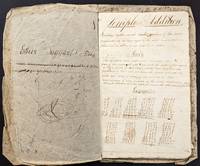
1814rif. 1160Middletown CT. 1814. Folio. 320 x 200 mm. 12 ½ x 8 inches. 424 leaves. Textblock sewn with original drab paper wrappers. Wrappers with a few tears and folds at the edges some staining and a few ink marks; otherwise a remarkably well preserved manuscript work book. Fine example of an early American arithmetic work book filled with examples applicable to the mercantile or dry goods trade. Includes exercises in simple addition addition of Federal Money simple subtraction subtraction of Federal Money simple multiplication and the application and use of multiplication in making out bills determining quantity and finding the value of goods. This part includes examples of establishing the cost of paper pairs of men’s shoes bushels of oats and other grains and food commodities. This is followed by exercises in division compound addition Sterling money weights and measures Troy weight Avoirdupois apothecaries cloth wine and the measurement of land. Of the examples we especially note math problems concerning distances on the East Coast including New York to Philadelphia; a wine merchant’s dwindling quantity of ‘pipe wine’; and a tailor’s bill for materials and making of a silk coat vest and buttons.”   A final question to be solved reads as follows: “The war between England and America commenced April 19 1775 and a general peace took place January 20th 1783 how long did the war continue” Miss Taggart’s calculations break down the problem into years months and days to arrive at the correct answer. The contents of the manuscript suggest that Ms. Taggart may have been training to work in a commercial setting selling goods such as the one listed in the fictional Bill of Parcels. Although it is well known that women especially wives of the owners of general stores managed the business side of a mercantile enterprise it is very rare to have an exercise book penned by a woman that documents the method of learning complex mathematics and business practices. In this case Esther Taggart was very proud of the work she was doing and she signed the book four different time; once on the inside cover; once on p. 9 “Esther Taggart’s Manuscript”; once on p. 45 again signing it “Esther Taggart’s Manuscript” and finally on the inside rear wrapper. Although we are not sure which New England town named Middletown was Esther’s home we think it was Connecticut. On the sample “Bill of Parcel” that appears on the verso of leaf 11 the example cites New London as the origin of the invoice. . unknown
1814rif. 1160Middletown CT. 1814. Folio. 320 x 200 mm. 12 ½ x 8 inches. 424 leaves. Textblock sewn with original drab paper wrappers. Wrappers with a few tears and folds at the edges some staining and a few ink marks; otherwise a remarkably well preserved manuscript work book. Fine example of an early American arithmetic work book filled with examples applicable to the mercantile or dry goods trade. Includes exercises in simple addition addition of Federal Money simple subtraction subtraction of Federal Money simple multiplication and the application and use of multiplication in making out bills determining quantity and finding the value of goods. This part includes examples of establishing the cost of paper pairs of men’s shoes bushels of oats and other grains and food commodities. This is followed by exercises in division compound addition Sterling money weights and measures Troy weight Avoirdupois apothecaries cloth wine and the measurement of land. Of the examples we especially note math problems concerning distances on the East Coast including New York to Philadelphia; a wine merchant’s dwindling quantity of ‘pipe wine’; and a tailor’s bill for materials and making of a silk coat vest and buttons.”   A final question to be solved reads as follows: “The war between England and America commenced April 19 1775 and a general peace took place January 20th 1783 how long did the war continue” Miss Taggart’s calculations break down the problem into years months and days to arrive at the correct answer. The contents of the manuscript suggest that Ms. Taggart may have been training to work in a commercial setting selling goods such as the one listed in the fictional Bill of Parcels. Although it is well known that women especially wives of the owners of general stores managed the business side of a mercantile enterprise it is very rare to have an exercise book penned by a woman that documents the method of learning complex mathematics and business practices. In this case Esther Taggart was very proud of the work she was doing and she signed the book four different time; once on the inside cover; once on p. 9 “Esther Taggart’s Manuscript”; once on p. 45 again signing it “Esther Taggart’s Manuscript” and finally on the inside rear wrapper. Although we are not sure which New England town named Middletown was Esther’s home we think it was Connecticut. On the sample “Bill of Parcel” that appears on the verso of leaf 11 the example cites New London as the origin of the invoice. . unknown books
rif. 97796Balkan early 19th century. . Scroll on parchment housed in a silver case unstamped cast hammered and engraved with floral decorations and geometric patterns. Scroll height 15 cm case height 34.5 cm; some staining to parchment. Megillat Esther in Sephardic Script housed in an elaborately decorated silver case. Esther scroll housed in an elaborately decorated silver case. Manuscript on vellum text arranged in 19 lines in Hebrew Sephardic Script. An ornamentation of an attractive multilayered flower to the top of the case. The Book of Esther is part of the Ketuvim The Writings the third section of the Hebrew Bible. It tells the story of a Jewish girl named Esther who became queen of Persia and thwarted a plan by Haman to commit genocide against her people. Also called The Megillah the book is the basis and an integral part of the Jewish celebration of Purim. Its full text is read aloud twice during the celebration in the evening and again the following morning. Besides Song of Songs it is the only book in the Bible that does not explicitly mention God. 'Since the Talmudic period it has been customary to write the Book of Esther on parchment in the form of a scroll and the rules governing its production and writing are basically the same as those for a traditional Torah scroll. It is not known when and under what circumstances artistic embellishment of Esther scrolls began. The earliest extant illuminated examples emanate from 16th-century Italy commissioned by well-to-do Italian Jews' Encyclopaedia Judaica. Balkan, early 19th century. hardcover
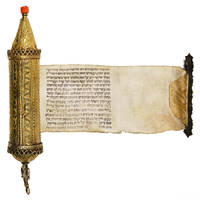
rif. 98168Balkan 19th century. . Scroll on parchment housed in a silver gilt case unstamped; scroll height 7 cm. case height 19 cm. Original manuscript on vellum text arranged in 15 lines in Hebrew Sephardic Script. A red bead decorating the top of the case. The Book of Esther is part of the Ketuvim The Writings the third section of the Hebrew Bible. It tells the story of a Jewish girl named Esther who became queen of Persia and thwarted a plan by Haman to commit genocide against her people. Also called The Megillah the book is the basis and an integral part of the Jewish celebration of Purim. Its full text is read aloud twice during the celebration in the evening and again the following morning. Besides Song of Songs it is the only book in the Bible that does not explicitly mention God. 'Since the Talmudic period it has been customary to write the Book of Esther on parchment in the form of a scroll and the rules governing its production and writing are basically the same as those for a traditional Torah scroll. It is not known when and under what circumstances artistic embellishment of Esther scrolls began. The earliest extant illuminated examples emanate from 16th-century Italy commissioned by well-to-do Italian Jews' Encyclopaedia Judaica. Balkan, 19th century. hardcover
1973rif. 1-2500771973. Couverture souple. Moyen . Astrolabio collection 1973. 1 volume brochés format In-8 acceptable Envoi avec numéro de Suivi - shipping with tracking number. Astrolabio unknown
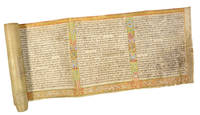
rif. 91530Central Italy early 19th century. . Illuminated scroll on parchment 3 spliced sheets 25.5 x 202.7 cm.; hand-coloured decorations possibly later some wear and loss of colour small tears; repairs to the back of first sheet. Italian Esther scroll beautifully illuminated in colour. Text divided into 11 parshiyot of 28 lines each and a compartment dedicated to the schematic drawing of the hanging of Haman's 10 sons. The decoration is composed of colourful ornamental borders on an ochre-yellow background: upper border with intertwining green branches lower border with a white vine-stem and crowns large flowers and medallions depicting the zodiac signs in the columns that separate the compartments. The Book of Esther is part of the Ketuvim The Writings the third section of the Hebrew Bible. It tells the story of a Jewish girl named Esther who became queen of Persia and thwarted a plan by Haman to commit genocide against her people. Also called The Megillah the book is the basis and an integral part of the Jewish celebration of Purim. Its full text is read aloud twice during the celebration in the evening and again the following morning. Besides Song of Songs it is the only book in the Bible that does not explicitly mention God. 'Since the Talmudic period 70-640 AD it has been customary to write the Book of Esther on parchment in the form of a scroll and the rules governing its production and writing are basically the same as those for a traditional Torah scroll. It is not known when and under what circumstances artistic embellishment of Esther scrolls began. The earliest extant illuminated examples emanate from 16th-century Italy commissioned by well-to-do Italian Jews' Encyclopaedia Judaica. Central Italy, early 19th century. unknown