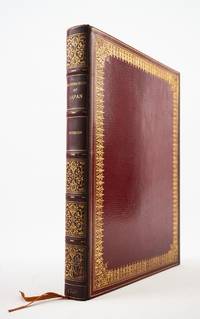
réf. 84308103London 1822 Ackerman. Dark purple tooled leather raised bands 25 hand colored aquatint copper etchings in 13 plates many fold-outs very clean 325p. small folio 24 x 31.5 cm all edge gilt gold stamped. VERY NICE COPY. QUITE RARE ! . . . . ONE OF THE MOST IMPORTANT HAND-COLORED BOOKS . . . ON JAPAN OF THE 19 CENTURY. . SUBTITLE: continued: ".And of the Ceremonies Customary Marriages and Funerals: to Which are Subjoined Observations of the Legal Suicide of the Japanese Remarks on their Poetry an Explanation of their Mode of Reckoning time Particulars Respecting the Dosia Powder the Preface of a Work by Confoutzee Confucius on Filial Piety &c. &c. Translated from the French by Frederic Shoberl." . THE SUPERB COLOR COPPER-ETCHED ENGRAVINGS: . The book contains hand-tinted engravings along with color printed illustrations. . Magnificently copper-engraved color plates showing illustrations of early 19th century Japan which at that time was still closed to Foreigners. Titsingh was chief agent for the Dutch East India Company stationed in Nagasaki. He described feasts & ceremonies of the Japanese court a hand-tinted color foldout plate 98 cm. long ! marriages funerals law poetry chronology furniture earthquakes &c. . TITSINGH'S PRIMARY OBSERVATIONS: He also gave valuable and new first-hand information on Japan based on his personal observations which otherwise were not available elsewhere. The most important book of the time period because Japan was essentially closed to the rest of the world. With lavish hand-colored plates. . A treasure & superb addition to any collection and library. . By and large the most important and most valuable small folio color plate book published on Japan in English of the epoch. . DESHIMA ISLAND: A marvelous primary resource and historic work ! Titsingh was the chief for the Dutch East India Company and was stationed in at Deshima a tiny island reserved for the Dutch in the Nagasaki harbour. Deshima was closed off of to the rest of Japan. . Color photos are posted to our website. . SPECIFIC COPY DETAILS: . COPY 1: The Binding: Bound in full recent red moroccan leather gold-stamped rule lines 5 raised bands marbled endpapers firmly bound and solid. A fine example of excellent workmanship and binding about as good as it can get. . Contents: This copy has a perforated library name on the back side of the color frontispiece and on the right side of the title page barely touching the last 3 letters of "Nagasaki." This is on several other pages and all of the color plates. . There is also a red oval library stamp with "withdrawn" stamped in black on this page. . The title page has the same perforated library name in the right margin partially over the last 3 letters of "Nagasaki.". . There is an identical oval red stamp over the word: "Printed" For R. Ackerman." . The title page has somef eint foxing please see photos posted to our website for details see spine.jpg and images: illus09.jpg through illus14.jpg for this copy details. . Several other pages have occasional feint foxing through out. . Otherwise the contents are bright clean no marks or stains. . The book looks stunningly beautiful in is superb binding. . COPY 2: IN THE ORIGINAL PUBLISHER'S RED CLOTH BINDING: The Binding: . This book is bound in the original 1822 red blind-stamped cloth with gild spine titles and front & back cover embossed & gilt-stamped oval design reading: "THE SOCIETY OF WRITERS TO THE SIGNET." . Below that is the blind-stamped impression of a Chinese man and woman in elaborate robes looks like the publisher didn't know the difference between Japanese & Chinese. . The original cloth spine has been laid over a pebbled red-matching cloth spine. There is some minor loss to the original spine near the head & tail. The top and bottom edges are a bit rubbed and the corners are bent rubbed. There are 2 small lines of what looks like period black writing ink about 1 cm. & 1.5 cm. long by 1-2 mm. wide on the front lower cover. . The Contents: . The title page and hand-colored frontispiece as well as all of the plates and text are bright superbly clean and in fresh condition no transfer or issues. There is a touch of the usual minor bit of 'toning' to the leading edges of the signatures as usual. . See photos on our website illus08.jpg & illus09.jpg. . COPY 3: Binding: Bound in full dark purple morocco leather with elaborate gold-stamped decorations lines blind-stamping five raised bands and marbled endpapers. There is some of the usual cover scuffing scratches and small imperfections. . The inside front cover hinge was reinforced with stiff period marbled paper & a small patch inside the front cover in the left corner. The inside back hinge and marbled papers are completely intact. All edges gilt the book is firmly bound and solid. . The contents: Contents are very bright clean & solid the illustrations are fine with no transfer or issues. There is a tiny bit of the usual minor & feint signature edge 'toning' but not greatly noticible. . This copy has the armoral book plate and Coat-of-Arms of James Garland Albert Jr.1870-1906 an American socialite. . See 3 photos of this binding on our website: illus06.jpg illus07.jpg & illus15.jpg. . REFERENCES: . google: JAMESALBERTGARLANDJR. H. Cordier: JAPONICA Japonica 449 Abbey Travel 557 Tooley 489 . . unknown books
1822réf. ST20877London: Printed for R. Ackermann 1822. First English Edition. 300 x 235 mm. 11 3/4 x 9 1/2". xvi 325 1 pp.Translated by Frederic Shoberl. Imposing contemporary crimson straight-grain morocco gilt covers with filigree frame with densely massed scrolling fleurons raised bands spine gilt in compartments with radiating viny scrolls surrounded by leaves and annular dots marbled endleaves all edges gilt. WITH 13 HAND-COLORED PLATES in etching and aquatint many after Japanese artworks one folding. Bookplate removed from front flyleaf. Bookseller's ticket of J. L. Thompson & Co Kobe Japan on front pastedown. Abbey Travel 557; Tooley 489; Martin Hardie "English Coloured Books" pp. 113-14. See also E. F. Strange "Japanese Illustration" pp. xxiii-xxiv. Spine and fore-edge of upper board slightly darkened a few minute flakes to lowest spine compartment but the binding extremely well preserved with very lustrous boards. Final 10 leaves slightly creased one repaired marginal tear but still A FINE COPY INTERNALLY exceptionally bright smooth and entirely fresh and clean. This generously proportioned production illustrated with 13 vibrant colored plates is a rare European account of Japan during the period in which the country was "closed" to the west offered here in its first English edition. Originally published in French in 1820 "Illustrations of Japan" is comprised of a history and description of the Tokugawa shogunate which Titsingh had translated from the Japanese plus Titsingh's own observations on the language customs and ceremonies of the Japanese people. The present English edition is accompanied by plates in etching and aquatint enhanced with hand coloring. Our author Dutch diplomat Isaac Titsingh 1745-1812 spent 14 years in Nagasaki for the Dutch East India company and between 1779-84 he served as trade director-cum-ambassador travelling to Edo now Tokyo for audiences with the shogun and other high officials in the shogunate. Unlike most of his Western contemporaries Titsingh was open-minded and curious about the people he encountered engaging with their art and culture; in fact art historian and Victoria & Albert Museum keeper Edward F. Strange tells us that Titsingh is the earliest known European collector of Japanese prints of which a number appear in the present volume. Our publisher Rudolph Ackermann 1764-1834 made his living issuing sumptuously illustrated books such as the present volume and was an early adopter of color aquatint and lithography technologies; Hardie writes that he was "the great presiding genius before whose magic wand so many pictorial books sprang into existence." In very attractive period morocco this is a particularly appealing copy of the work free of the foxing and offsetting that often plague copies of this and other large-format color illustrated books. Printed for R. Ackermann unknown books
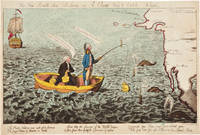
1791réf. 51520London: H. Humphreis sic January 4 1791. The Nootka Crisis Parodied In 1789 and 1790 Nootka Sound in the Pacific Northwest looked to be the spur of a major conflict between the kingdoms of Britain and Spain. The inlet was an important outpost for maritime fur trading and had therefore become the focus of the centuries-old struggle for advantage in the New World. Courtesy of explorer and trader John Meares news of Spanish indiscretions reached Britain in 1790 and intensified the growing anti-Spanish rhetoric and call for war. Meares whose credibility was famously contested in two remarkable pamphlets by George Dixon claimed not only that the Spanish had seized British ships but that they had removed his settlement at Nootka and replaced it with their own. After debate in the House of Commons it was decided the British Navy would be mobilized. While Spain initially sought to go to war they could not attain the essential support of France and thus required a diplomatic solution to the problem. This came in the form of the first Nootka Convention which was signed on Oct. 28 1790. The convention guaranteed Britain the right to have outposts on Nootka Sound and to practice whaling in waters beyond the "Ten-League Line" off the coast. The Convention eventually resulted in the seminal voyage of George Vancouver to survey the Pacific Northwest. This print is a satire on the British Tory government's handling of the crisis. Its central critical point attacks part of the convention concerning fishing rights which Pitt's opposition latched onto as evidence of underhanded dealings. They noted that the original importance of Nootka Sound was not for whaling but rather for fur trading and that the whaling industry had surely redirected political attention toward their interests. Thus the print shows Pitt and Henry Dundas in the Pacific off the west coast of North America hopelessly fishing with millions from the treasury. As Pitt expresses worry over the spending Dundas soothes him with the knowledge that "the Gudgeons we caught in England will pay for it all." In saying so Dundas declares the Britons who supported the war to have been bait for his and Pitt's political maneuvering. The coastline is shown from southern Alaska to Mexico likewise making this an early map of California Alaska and the west coast. In all it is a lively expression of disbelief and anger at the amount expended on preparing for war set against the eventual prize namely the indeterminate profitability of whaling. Cropped within plate borders with no loss to image or text. Remnants of older paper pasted to verso. Color bright and fresh. Near fine. unknown books
réf. 84308102London 1822 Ackermann. Red original cloth very goodsmall folio gold stamped 325p. 25 aquatint illustrations on 13 hand colored copper etched plates many color foldouts 25 x 32.3 cm. THE FIRST & ONLY EDITION. Q U I T E R A R E . . . . ONE OF THE MOST IMPORTANT HAND-COLORED BOOKS . . . ON JAPAN OF THE 19 CENTURY. . SUBTITLE: continued: ".And of the Ceremonies Customary Marriages and Funerals: to Which are Subjoined Observations of the Legal Suicide of the Japanese Remarks on their Poetry an Explanation of their Mode of Reckoning time Particulars Respecting the Dosia Powder the Preface of a Work by Confoutzee Confucius on Filial Piety &c. &c. Translated from the French by Frederic Shoberl." . THE SUPERB COLOR COPPER-ETCHED ENGRAVINGS: . The book contains hand-tinted engravings along with color printed illustrations. . Magnificently copper-engraved color plates showing illustrations of early 19th century Japan which at that time was still closed to Foreigners. Titsingh was chief agent for the Dutch East India Company stationed in Nagasaki. He described feasts & ceremonies of the Japanese court a hand-tinted color foldout plate 98 cm. long ! marriages funerals law poetry chronology furniture earthquakes &c. . TITSINGH'S PRIMARY OBSERVATIONS: He also gave valuable and new first-hand information on Japan based on his personal observations which otherwise were not available elsewhere. The most important book of the time period because Japan was essentially closed to the rest of the world. With lavish hand-colored plates. . A treasure & superb addition to any collection and library. . By and large the most important and most valuable small folio color plate book published on Japan in English of the epoch. . DESHIMA ISLAND: A marvelous primary resource and historic work ! Titsingh was the chief for the Dutch East India Company and was stationed in at Deshima a tiny island reserved for the Dutch in the Nagasaki harbour. Deshima was closed off of to the rest of Japan. . Color photos are posted to our website. . SPECIFIC COPY DETAILS: . COPY 1: The Binding: Bound in full recent red moroccan leather gold-stamped rule lines 5 raised bands marbled endpapers firmly bound and solid. A fine example of excellent workmanship and binding about as good as it can get. . Contents: This copy has a perforated library name on the back side of the color frontispiece and on the right side of the title page barely touching the last 3 letters of "Nagasaki." This is on several other pages and all of the color plates. . There is also a red oval library stamp with "withdrawn" stamped in black on this page. . The title page has the same perforated library name in the right margin partially over the last 3 letters of "Nagasaki.". . There is an identical oval red stamp over the word: "Printed" For R. Ackerman." . The title page has somef eint foxing please see photos posted to our website for details see spine.jpg and images: illus09.jpg through illus14.jpg for this copy details. . Several other pages have occasional feint foxing through out. . Otherwise the contents are bright clean no marks or stains. . The book looks stunningly beautiful in is superb binding. . COPY 2: IN THE ORIGINAL PUBLISHER'S RED CLOTH BINDING: The Binding: . This book is bound in the original 1822 red blind-stamped cloth with gild spine titles and front & back cover embossed & gilt-stamped oval design reading: "THE SOCIETY OF WRITERS TO THE SIGNET." . Below that is the blind-stamped impression of a Chinese man and woman in elaborate robes looks like the publisher didn't know the difference between Japanese & Chinese. . The original cloth spine has been laid over a pebbled red-matching cloth spine. There is some minor loss to the original spine near the head & tail. The top and bottom edges are a bit rubbed and the corners are bent rubbed. There are 2 small lines of what looks like period black writing ink about 1 cm. & 1.5 cm. long by 1-2 mm. wide on the front lower cover. . The Contents: . The title page and hand-colored frontispiece as well as all of the plates and text are bright superbly clean and in fresh condition no transfer or issues. There is a touch of the usual minor bit of 'toning' to the leading edges of the signatures as usual. . See photos on our website illus08.jpg & illus09.jpg. . COPY 3: Binding: Bound in full dark purple morocco leather with elaborate gold-stamped decorations lines blind-stamping five raised bands and marbled endpapers. There is some of the usual cover scuffing scratches and small imperfections. . The inside front cover hinge was reinforced with stiff period marbled paper & a small patch inside the front cover in the left corner. The inside back hinge and marbled papers are completely intact. All edges gilt the book is firmly bound and solid. . The contents: Contents are very bright clean & solid the illustrations are fine with no transfer or issues. There is a tiny bit of the usual minor & feint signature edge 'toning' but not greatly noticible. . This copy has the armoral book plate and Coat-of-Arms of James Garland Albert Jr.1870-1906 an American socialite. . See 3 photos of this binding on our website: illus06.jpg illus07.jpg & illus15.jpg. . REFERENCES: . google: JAMESALBERTGARLANDJR. H. Cordier: JAPONICA Japonica 449 Abbey Travel 557 Tooley 489 . . unknown books
1666réf. 1299Nurnberg 1666. Houzeau & Lancaster 3039; Zimmer 5089 1628 Strasbourg ed.; Poggendorff 1984. Warner The Sky Explored pp. 104-5. Extremely rare German edition a Latin edition was published the same year of Sturms enlargement of Habrechts famous treatise on the making of celestial and terrestrial globes published in 1628. The Habrecht family of clock and instrument makers were famous throughout Europe from the last quarter of the sixteenth century to the end of the seventeenth century. The authors father also called Isaac was responsible for making the monumental second Strasbourg clock which was one of the mechanical wonders of its time on the Continent. Isaac Habrecht 1589-1633 was a Strasbourg physician mathematician and maker of globes. He was much influenced by Blaeu and Hondius and his globes were highly regarded. J. C. Sturm was Habrechts student and a scientist of vision. He organized the first scientific academy in Germany the Collegium Curiosum sive Experimentale at Altdorf in 1672 and introduced the first course in experimental physics in a German university. In 1666 he undertook the task of augmenting Habrechts original text and adding a number of folding plates. The plates include two handsome polar projections of the world two polar stereographic celestial charts of the northern and southern constellations and ten folded engravings showing the various parts of his planiglobiums.The fourteen folded engravings superbly executed by Jacob von der Heyden were probably intended to be mounted and assembled to form several instruments each with a revolving plate measuring 27 cm in diameter and a movable pointer. Each was to be supported on an approximately 12-cm base. The work is one of the most beautiful instrument books published in the seventeenth century and certainly one of the rarest particularly with the full complement of plates. Despite being an obvious Americanum see pp. 205 228 231 and America pictured on one of the maps it is not in Sabin JCB Palmer and other standard bibliographies. Houzeau & Lancaster lists a 1650 edition that is clearly an error as Sturm would have been 15 years old at the time.OCLC lists Yale for the German and Chicago for the Latin editions. unknown books
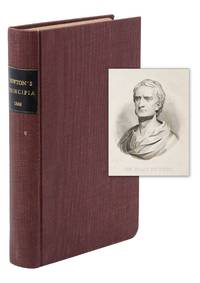
1848réf. 140949208New York: Daniel Adee 1848. First American Edition. Very Good. First American edition first printing with date 1848 on title page and publisher's address listed as 107 Fulton-Street. 4 v-viii 9-581 pp. illustrated with engraved frontispiece protected by tissue guard. Recently bound in maroon buckram title label to spine. Very Good with light wear to covers and slight bumping to lower corners; title label beginning to lift at one corner. Band of paper residue to front free endpaper. Light toning and moderate foxing to textblock edges and contents dampstain to outer textblock edge and outer margin throughout. Cohen pp. 347-352. The first American edition of the foundational physics text first published in Latin in 1687. Andrew Motte's 1729 translation was reprinted in 1803 and 1819 in Britain but subsequent 19th century editions were printed only in the United States and Germany. The New York-based publisher Daniel Adee deposited a copyright for the Principia in 1846 then printed five issues between 1848 and 1850. A contemporary notice in the Scientific American declared: "For a long time the 'Principia' was kept far out of the reach of the mere English Scholar as if Newton had written it exclusively for the classical student and philosopher. It was a scarce book when printed in the Latin language; it is now thanks to the spirit of an American publisher printed in our mother tongue and should find a place in every family library. Daniel Adee unknown books
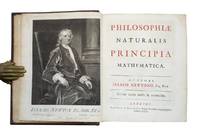
1726réf. 69561London: Apud Guil. & Joh. Innys 1726. Editio tertia aucta & emendata. London: Apud Guil. & Joh. Innys 1726. Full Description: NEWTON Sir Isaac. Philosophiæ naturalis principia mathematica. Editio tertia aucta & emendata. London: Apud Guil. & Joh. Innys 1726. Third edition. One of only 1250 copies printed. Quarto. 34 530 6 index pp. Engraved frontispiece portrait facing title by George Vertue after I. Vanderbank. Bound without the advertisement leaf. Numerous diagrams in the text and one engraving of cometary orbit on p. 506. Title printed in red and black. With the Royal Privilege printed on verso of the first leaf as in Babson copy 2. In full goatskin. Spine ruled and lettered in gilt. Boards paneled in blind. Inner hinges repaired. Some old ink manuscript notes on front flyleaf. Numerous instances of light early pencil marginalia and a few in ink. Some ghost dampstaining throughout. Previous owner's bookplate on front pastedown. Overall a very good copy. "This edition was the last published during the author's lifetime and the basis of all subsequent editions. It was edited by Henry Pemberton M.D. F.R.S. and contains a new preface by Newton and a large number of alterations the most important being the scholium on fluxions in which Leibnitz had been mentioned by name. This had been considered an acknowledgement of Leibnitz's independent discovery of the calculus. In omitting Leibnitz's name in this edition Newton was criticized as taking advantage of an opponent whose death had prevented any reply" Babson p. 12. Third edition of "the greatest work in the history of science" Printing and the Mind of Man. In the Principia Newton formulated the three laws of motion from which he derived the principle of universal gravitation "wherein all bodies of whatever mass attract one another in proportion to their masses and in inverse ratio as the square of the distance between them. This applies to dust particles as to the mightiest celestial bodies" Dibner. "Copernicus Galileo and Kepler had certainly shown the way; but where they described the phenomena they observed Newton explained the underlying universal laws. The Principia provided the great synthesis of the cosmos proving finally its physical unity. Newton showed that the important and dramatic aspects of nature that were subject to the universal law of gravitation could be explained in mathematical terms within a single physical theory.The same laws of gravitation and motion rule everywhere; for the first time a single mathematical law could explain the motion of objects on earth as well as the phenomena of the heavens. The whole cosmos is composed of inter-connecting parts influencing each other according to these laws. It was this grand conception that produced a general revolution in human thought equalled perhaps only by that following Darwin's Origin of Species" Printing and the Mind of Man 161 describing the first edition. Babson 13. Gray 9. Wallis 9. HBS 69561. $22500. Apud Guil. & Joh. Innys unknown books
réf. 39481Philadelphia: Printed by C. Sherman 5605. 8vo 5 volumes. 8 7/8 x 5 1/2 inches. Hebrew and English text on facing pages. Each volume inscribed at the head of the English-language title "To my beloved wife from her affectionate husband" the first volume with a later family annotation. Contemporary purple morocco spine in six compartments with raised bands lettered in gilt in the second and fourth repeating gilt decoration in others marbled edges marbled endpapers. Provenance: Solomon Nunes Carvalho each cover stamped in gilt Rare large-paper association copy of the first Jewish translation of the Pentateuch into English. More than any other person of his time Isaac Leeser 1806-1868 envisioned the development of a major center of Jewish culture and religious activity in the United States. He single-handedly provided American Jews with many of the basic religious texts institutions and conceptual tools they needed to construct the cultural foundation of what would later emerge as the largest Jewish community in the history of the Jewish people. Printed in 1845 this edition of the Pentateuch in five volumes included a vocalized Hebrew text of each of the Five Books of Moses together with an English translation and notes as well as the haftarot prophetic readings. Leeser actually began working on The Law of God in 1838. Among the factors involved in his decision to begin systematically working on a translation was the recent opening of Rebecca Gratz's Sunday School which met for the first time in March 1838 in Philadelphia and was desperately in need of appropriate study material. Students were compelled to use the King James Bible for want of a Jewish alternative. Religiously objectionable passages in other texts provided by Protestant organizations were either pasted over or torn out by Gratz's staff. Leeser who supported the Sunday School and was its chief academic resource person felt compelled to find more suitable texts for the students. The impetus for Leeser throughout was always his desire to provide the Jews of America with an English text of the Bible that was produced by one of their own and was not tainted by conversionist motivations. This copy with provenance to Solomon Nunes Carvalho who was a noted American painter photographer writer and inventor best known for traveling with John C. Fremont on his fifth expedition through Kansas Colorado and Utah. He published an account of that journey titled "Incidents of Travel and Adventure in the Far West; with Colonel Fremont's Last Expedition" 1860 and was considered a pioneer in travel photography. Isaac Leeser the hazzan of Congregation K.K. Mikveh Israel married Carvalho and his wife Sarah Miriam Solis on October 15 1845 in Philadelphia where Carvalho's father had a workshop. Rosenbach 569; Singerman 884; Goldman 7; Lance J. Sussman "Another Look at Isaac Leeser and the First Jewish Translation of the Bible in the United States" Modern Judaism Vol. 5 No. 2 Gershom Scholem Memorial Issue. May 1985 pp. 159-190. Printed by C. Sherman unknown books
1848réf. 1803065Daniel Adee 1848. 1st Edition. Hardcover. Near Fine/No Jacket. Near fine TRUE first American edition 1st issue as stated on the title page. Some water stains on page edges. Previous owner's bookplate on front pastedown. Rubbing on outside spine and corners and at bottom of spine. Tape at endpapers and pastedowns along gutters. Housed in custom-made slip case. Daniel Adee hardcover books
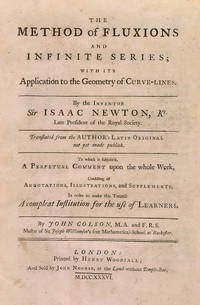
1736réf. 14348London: Henry Woodfall 1736. FIRST EDITION. With engraved frontispiece interpolated leaf 143-144 and leaf containing errata on the recto publisher’s advertisements on the verso. Paneled sprinkled calf in a contemporary style; a large paper copy with very wide margins a few contemporary annotations. First edition of Newton’s treatise on the calculus a work of great importance and rarity. Ready for publication in 1671 Newton circulated the manuscript among his friends who urged him to establish priority by publishing his own work. He steadfastly refused and prior to his death entrusted it to Henry Pemberton who never had it published. It was not until 1736 that Method of fluxions was finally published in the present English translation by John Colson who added a lengthy commentary. The original Latin edition did not appear until 1779 in the Opera omnia. Babson 171; Gray 232; Wallis 232; Smith History of Mathematics I p. 404. Henry Woodfall unknown books
1950réf. 17991ASSOCIATION COPY I ROBOT Gnome Press 1950 first edition some modest age toning to the top and fore edges two small blots of ink to the t.p.e.'s never bleeding through to the upper margin of the text else just about fine in vg/vg color pictorial dust-wrapper. Inscribed by the author to one of his publishers "To -Compliments of Susan Calvin the fictional central character of this title & Myself Isaac Asimov. Gnome Press unknown books
1827réf. 305824Charleston SC: James S. Burges 1827. First and only edition. 18 2 blank pp. 1 vols. 12mo. Modern pale yellow wrappers. Custom chemise and quarter morocco slipcase. Some pale foxing to title otherwise clean. First and only edition. 18 2 blank pp. 1 vols. 12mo. A rare pamphlet issued by the first Jewish Reform movement in the United States the Sephardic Reformed Society of Israelites in Charleston South Carolina recording an address by one of the movement's leaders. The Reformed Society of Israelites formed in 1824 when it split off from the Kahal Kadosh Beth Elohim KKBE synagogue in Charleston seeking to implement a number of reforms it deemed crucial to engaging the rising generation. In the process the Society posited a distinctly American form of practice. Led by Isaac Harby Abraham Moise and David Nunes Carvalho the Reformed Society of Israelites reflected the fact that as Jonathan Sarna has phrased it: "Jews who did not feel at home in synagogue no longer had to compromise their principles for the sake of consensus; they felt free to withdraw and start their own congregations. In free and democratic America congregational autonomy became the rule resulting in a new American Judaism - a Judaism of diversity and pluralism." The present address was delivered on the third anniversary of the Society by Isaac Cardozo 1786-1855 who served as the group's Vice-President from 1828-1832. Cardozo invokes a "spirit of reform in all existing institutions which is abroad" and reminds the group of its origin as "a society that was instituted mainly for effecting the observance of order and decorum in Hebrew worship: for adapting it to the feelings and propensities of the enlightened Israelite of the present day; and for endeavoring to bring about by argument and petition what neither necessity nor persuasion could before accomplish" before he goes on to defend the mission against various critiques. Apart from being a leader within Charleston's Sephardic Jewish community Cardozo was also the patriarch of an important southern African-American family. He had six children with his common-law wife Lydia Weston a free black woman from a prominent Charleston family--one of a number of openly mixed-race households in antebellum Charleston. One of their sons was Francis Cardozo 1836-1903 who became the first African-American to hold statewide office in the United States serving as Secretary of State in South Carolina from 1868 to 1872. Another son Thomas served as State Superintendent of Education from 1873 to 1876. RARE: OCLC reports only four institutional copies and A.S.W. Rosenbach in his American Jewish Bibliography located only one copy in a private collection. Rosenbach 289 locating one copy in a private collection; OCLC Princeton Am. Jewish Hist. Soc. USC Presbyterian College; American Imprints 28385; Singerman 0442 James S. Burges unknown books
réf. 05625London: G. Humphrey 1821. Queen Caroline Sliced And Diced By Satirists' Blade Fifty Devastating Hand-Colored Caricatures Directed Against the British Monarchy CRUIKSHANK George illustrator. CRUIKSHANK I.R. illustrator. LANE Theodore illustrator. The Attorney-General's Charges Against The Late Queen brought forward in the House of Peers on Saturday August 19 1820. Illustrated with Fifty Coloured Engravings. London: G. Humphrey 1821. First edition. Folio 18 13/16 x 13 inches; 478 x 330 mm. 2 title imprint on verso. 20 pp. by Robert Gifford Attorney-General. Hand colored frontispiece and forty-nine hand colored etched plates the majority being by Theodore Lane. Six of the plates are by George Cruikshank; one is after George Cruikshank; three are by Isaac Robert Cruikshank. All plates with interleaves. The text & plates are watermarked "J. Whatman 1821" Handsomely bound by Sangorski & Sutcliffe ca. 1960 in three-quarter dark blue morocco over marbled boards ruled in gilt. Spine with five raised bands elaborately tooled and lettered in gilt in compartments marbled endpapers all edges gilt. A fine well margined copy of this series of devastating caricatures directed against the British monarchy including the republication of the charges brought by the Attorney-General Robert Baron Gifford 1779-1826 against Queen Caroline and in support of the Pains and Penalties Bill of 1820 by which George IV who had only just inherited the throne in 1820 and who hated his wife sought to remove her title and dissolve their marriage. The volume begins with a view of Humphrey's shop-window where 42 of these prints are on view. The focus of these caricatures is Caroline of Brunswick 1768-1821 and her alleged affair with Bartolommeo Bergami. She renamed him Pergami as being more aristocratic and appointed him Grand Master of the Order of St Caroline. Queen Caroline on the whole elicited a great deal of public support and as a result the Bill had to be subsequently abandoned. However the following year in July 1821 Caroline was barred from the coronation fell ill and died three weeks later. After the fall of Napoleon in 1815 George Cruikshank's attention was largely turned towards highlighting the decadence of Britain's Regency monarchy which was epitomised by George IV while still the Prince Regent. In this collection six of the plates are by George or Isaac Robert Cruikshank or both the remainder are by Theodore Lane 1800-1828 a painter and engraver who frequently worked on sporting material especially in partnership with Pierce Egan. It was after this period that George Cruikshank became progressively more sober and serious. This scarce collection of caricatures sharply lampooning Queen Caroline to delightfully deadly effect is not found in the British Museum. Indeed BM Satires refers to the copy at the Bibliothéque National France one of only six copies in institutional holdings worldwide. Theodore Lane 1800-1828 was a political lampoonist and in 1820 created a series of satirical images of Queen Caroline at the time of her return to England to claim her rights as consort to George IV. Lane caricatured the queen as a grotesque overdressed and overweight accompanied by her Italian lover Bartolomeo Pergami and the then Lord Mayor of London Matthew Wood. The Plates: 1. Design for a New Coat of Arms Frontispiece 2. Humphrey Printseller & Publisher. 3. Bergami's Little Darling. 4. A Pas de Deux or Love at First Sight. 5. The Choice of Hercules. 6. An Arm-Full of Love 7. The Como-cal Hobby. 8. Winding up to a pitch the Automaton Scaramouch or Harlequin Courier's Delight 9. The Long & the Short of the Tale - or the whole of the concern. 10. Modesty! 11. The Modern Genius of History at her Toilet. 12. National Love! 13. Dignity! 14. A gentle jog into Jerusalem. 15. The Saint! 16. Tent-ation. 17. Installation of a Knight Companion of the Bath. 18. Travelling Tete à Tete!! 19. A R_Y_L Visit to a Foreign Capital or The Ambassador not at home!! George Cruikshank Cohn 1934 20. R_y_l Condescension - or a Foreign Minister Astonished! George Cruikshank Cohn 1914 21. Bat Cat and Mat. 22. A parting Hug at St. Omer! 23. A Wooden Substitute or Any Port in a Storm. 24. A late Arrival at Mother Wood's. George Cruikshank Cohn 1307 25. Mother Wood the Popular Procuress! Robert Cruikshank Cohn 1763 26. Mother Cole. 27. Grand Entrance to Bamboozl 'Em. 28. Steward's Court of the Manor of Torre Devon. 29. The Time Piece! & Canning Jack o' both sides. Robert Cruikshank 30. The Radical Ladder. After George Cruikshank 31. The C-R-L-E Column. 32. Delicious Dreams! 33. The Effusions of a Troubled Brain. 34. Caroline Fair or Mat Pudding and his Mountebank 35. The Mother Red-Cap Public House in opposition to the King's Head. George Cruikshank Cohn 1761 36. Carrying Coals to Newcastle!! 37. Moments of Pleasure. 38. The Man of the Woods & the Cat-o'-mountain. 39. The Q-n's Ass in a Band-box. 40. An Old Friend with a New Face or the Baron in Disguise. 41. Meditations at Brandyburgh; or an address to the Sun. 42. Dido in Despair. 43. The whole Truth or John Bull with his eyes opened. 44. A Going! A Going! the last time A Going!______Down!!! George Cruikshank Cohn 876 45. Returning Justice lifts aloft her Scale. 46. Lucifera's Procession. Fairy Queen. 47. The Royal Extinguisher or the King of Brobdingnag & the Lilliputians. I.R. & George Cruikshank Cohn 1919 48. The Grand Coronation of Her Most Graceless Majesty C-R-L-E Columbina the first Queen of all the Radicals. 49. A Coronation Stool. 50. The Armorial Bearings of the White Cat. cut and mounted. Bobins IV 1329; BM Satires 14206 note. London: G. Humphrey, [1821] unknown books
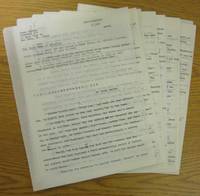
1976réf. 00670THE BICENTENNIAL MAN / ORIGINAL CARBON TYPESCRIPT being 50 pages approximately 15000 words fine in custom tray-case. Accompanied by a 200 word plus TYPED LETTER SIGNED by Asimov dated July 12th 1974 to his long time friend and fellow science fiction personage Forrie Ackerman mentioning that he cannot promise a science fiction story to a deadline but since the proposed anthology title is to be THE BICENTENNIAL MAN there were 4 previously published items in The Saturday Evening Post that might be possibly utilized revolving around Benjamin Franklin which could be had for a small royalty. Along with copies of three other letters to Ackerman which yield yet more information regarding the specifics of this eventual typescript. Which goes like this: Sometime in 1974 a woman by the name of Naomi Gordon approached Forrest Ackerman with an idea for a science fiction anthology for the upcoming Bicentennial of the U.S. Projected writers for this undertaking were to be Ray Bradbury Arthur C. Clarke Fred Pohl Ursula Le Guin Robert Heinlein Philip Jose Farmer Larry Niven A. E. Van Vogt Jack Williamson and of course Isaac Asimov. While this project never fully materialized with some authors agreeing to the project and others not and some producing an actual typescript and again others not Isaac obviously opted in thereby producing this novella. When the anthology finally and officially became a lost cause the story was then immediately published when submitted elsewhere and went on to win not only the prestigious NEBULA award but the highly coveted HUGO award as well. Asimov's typescripts are very rarely offered on the open market or the private market for that matter with most if not all of them going to the Boston University Library and the opportunity to purchase the second of only three of his fictional works to win a HUGO award the final being another short story entitled GOLD published much later in 1991 which was written on a computer and thus never a true and proper typescript and the second to win the NEBULA award not too mention a "ROBOT STORY" to boot and the source work for the film of the same name with Robin Williams in the lead should prove a temptation most difficult to ignore. First option of refusal to purchase the rest of the THE BICENTENNIAL MAN file consisting of all remaining authorial typescripts and correspondence will be tendered to the purchaser of this item. N. p. unknown books
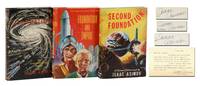
1953réf. 140948512New York: Gnome Press 1953. First Edition. Near Fine/Near Fine. Three volumes all first edition first printings all uniformly signed by Isaac Asimov directly on the title pages. Foundation is in Currey's A binding; Foundation and Empire is in Currey's A binding and A dust jacket state; Second Foundation is in Currey's B binding. Laid in is an additional autographed typed postcard addressed to Golden Atom fanzine founder editor and early sci-fi fan Larry Farsace postmarked 10 May 1983. All volumes are Near Fine with light wear to corners and spine ends. Foundation and Foundation and Empire in Near Fine unclipped jackets. Rear board of Second Foundation faintly stained with a corresponding dampstain to dust jacket more pronounced on the blindside; unclipped dust jacket is Very Good with several short closed tears and associated creasing shallow chipping along the top edge of the rear panel and flap though still presents very well. A handsome set of this epic science-fiction trilogy which was awarded a special Hugo in 1966 for best all-time series. Very scarce with all three volumes directly signed. Gnome Press unknown books
1950réf. 140948961New York: Gnome Press Inc 1950. First Edition. Near Fine/Near Fine. First edition first printing. Presentation copy signed by Isaac Asimov on the front free endpaper the day after publication and inscribed: "For: Alex Osheroff who would have bought it anyway-a true blue guy. 12/3/50." 253 pp. Bound in publisher's red cloth boards stamped in black. Near Fine with short tear and accompanying dent to spine light foxing to textblock edges and light foxing and offsetting to endpapers. In a Near Fine unclipped dust jacket with light rubbing and edgewear several shallow scratches and light foxing to upper and lower edges and verso. A superb copy of Isaac Asimov's short story collection exploring the ethical implications of programming robots. He signed the fresh-off-the-press copy to Alex Osheroff a science fiction fan who published the single issue cardzine Robot in 1937 and co-edited the first issue of the fanzine Helios with Sam Moskowitz that same year. Osheroff retained his interest in speculative fiction after serving in the Second World War and joined the Fantasy Veterans Association which held several conventions in the 1950s. He would have treasured the warm inscription in this book. Gnome Press, Inc unknown books
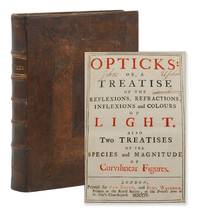
1704réf. 140946960London: Printed for Sam. Smith and Benj. Walford Printers to the Royal Society at the Prince's Arms in St. Paul's Church-Yard 1704. First Edition. Very Good. First edition first issue of this foundational work in the field of optics in which Isaac Newton explores the nature of light and color presenting his experiments and theories on how light behaves. Title printed in red and black within a double-rule border and without author's name. Bound in contemporary paneled calf boards sympathetically rebacked; with 19 engraved folding plates. Very Good. Soiling to textblock and endsheets bookplate of Irish naturalist John Vandeleur Stewart affixed to the front pastedown ownership signature to title page. Amateur repair to gutter at title page. Numerous pencil notations throughout though mostly confined to the margins or blank areas. Plate 5 is torn at the fold plate 6 with corner loss affecting the image several shaved. Second book with page 120 misnumbered as 112. A lovely copy of Newton's second major book on physical science considered one of the Scientific Revolution's three major works on optics. It overturned centuries of thinking attributed to Aristotle or Theophrastus and accepted by scholars in Newton's time that "pure" light such as the light attributed to the Sun is fundamentally white or colorless and is altered into color by mixture with darkness caused by interactions with matter. Here Newton shows the opposite was true: light is composed of different spectral hues he describes seven - red orange yellow green blue indigo and violet and all colors including white are formed by various mixtures of these hues. He demonstrates that color arises from a physical property of light - each hue is refracted at a characteristic angle by a prism or lens - but he clearly states that color is a sensation within the mind and not an inherent property of material objects or of light itself. Unlike his earlier work Philosophiae Naturalis Principia Mathematica which took a more deductive approach Opticks is largely experimental and inductive. Newton's study includes detailed descriptions of his experiments with prisms and lenses leading to the conclusion that white light is composed of a spectrum of colors. The work also delves into the phenomena of diffraction and interference which were crucial to the development of wave theory in later years. The work is notable for containing Newton's first mathematical papers in print and for giving the first full explanation of the rainbow complete with related diagrams. Like Galileo Newton decided to publish this text in his native English rather than Latin the language of scholarship; an enlarged Latin edition would be published two years later. Printed for Sam. Smith and Benj. Walford, Printers to the Royal Society, at the Prince's Arms in St. Paul's Church-Yard unknown books
1704réf. 157612London: Smith & Walford 1704. First. hardcover. very good. 4 parts in 1 volume. Title page printed in red & black within a double-ruled border. Illustrated with 19 folding copperplate engravings.4 144 211 1 pages. In the second sequence p. 120 is marked 112 and there are blank pages between 137-8 and 138-9. Thick 4to contemporary blind-tooled paneled calf well-worn and now expertly re-backed in sympathetic leather; last several pages have marginal dampstains otherwise a remarkably clean crisp copy. London: Smith & Walford Printers to the Royal Society 1704. First edition first issue - with the author not named on title page. "Newton's Opticks expounds his corpuscular theory of light and summarizes his experiments concerning light and colour. It also prints two important mathematical treatises omitted in later editions describing his invention of the fluxional calculus the grounds for his claim of priority over Leibniz. Newton arrived at most of his unconventional ideas on colour by about 1668 and Opticks was largely complete by 1692. However when he first partially expressed his theories in public in 1672 and 1675 they provoked hostile criticism especially on the continent. As a result Newton delayed the publication of Opticks until his most vociferous critics - especially Robert Hooke - were dead. Unusually for Newton and in what was probably a further defensive move the work was first published in English rather than Latin becoming a major contribution to the development of vernacular scientific literature. By about 1715 Opticks established itself as a model for interweaving theory with quantitative experimentation. Newton's aim was not to "explain the properties of light by hypotheses but to propose and prove them by reason and experiments" p. 1. The great achievement of the work was to show that colour was a mathematically definable property." The work contains: The First Book of Opticks The Second Book of Opticks The Thrid Book of Opticks Tertii Ordinis: Enumeratio Linearum Tractatus de Quadratura Curvarum. The main work is in English the 2 treatises pages 138-211 are in Latin. Babson 132; Gray 174; Horblit 79b; PMM 172; Norman 1588; Dibner 148; Wallis 174.Provenance: Signature of Francis Cremer the initial owner & contemporary of Newton's dated 1704 is on the title page with the price he paid of 12 shillings. Another ownership signature "Gul Bryant" also a sudent at Cambridge some decades later is on the rear flyleaf and the library label of Francis E. Nipher 1847- 1926 the American physicist on the front paste-down. Smith & Walford unknown books
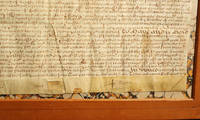
1666réf. 3781520/11/1666. A very rare document from his his miracle year Annus Mirabilis mentioning Woolsthorpe where he made some of his most famous discoveries This is the earliest document from Newton we found reaching the public market in generations and the only from this great and historic year <img class=""alignnone wp-image-37824 size-post-window"" src=""https://cdn.raabcollection.com/wp-content/uploads/20260904221035/Newton-November-20-1666-J-1-1600x711.jpg"" alt="""" width=""1600"" height=""711"" /> Isaac Newton was a pioneering mathematician physicist and astronomer widely regarded as one of the most influential scientists in history. His key contributions were the Laws of Motion that describe how objects move and interact with forces which formed the foundation of classical mechanics; Universal Gravitation proposing that the same force pulling an apple to the ground also governs the motion of planets and moons - the law of universal gravitation; Optics where he showed that white light is made up of a spectrum of colors by passing it through a prism and he built the first practical reflecting telescope; and Principia Mathematica his 1687 book Philosophiæ Naturalis Principia Mathematica laid out his laws of motion and gravitation and is considered one of the most important scientific works ever published. Newton was born at Woolsthorpe Manor on Christmas Day in 1642. In 1665. When the Great Plague closed Cambridge University as a precaution against spreading the illness Newton returned to the manor. During his 18-month retreat there he worked in his bedroom on calculus optics and his early ideas of gravity. Newton later ascribed many of his most important scientific discoveries to these years including gravitation and subsequent accounts have placed the story of his seeing the apple fall from the tree in the garden at Woolsthorpe 1666. Historian and scientist William Stukeley records having dinner with Newton later in his life and afterward — the weather being warm — the two went out into the garden and drank tea under some apple trees. It was there that Newton told him he'd been in that very same situation once before when the idea of gravitation first came to him: watching an apple fall and wondering to himself why it should always descend straight down to the ground rather than sideways or upward — the observation that set him thinking about whether the same force might reach as far as the Moon. The year was 1666. The “marvelous year” Annus Mirabilis of 1666 may surely be taken as symbolic of a decisive turning point in the history of human thought. Document signed an indenture for the lease of a property in Belton-in-Rutland 20 November 1666. It is In English on vellum and signed on the fold-up by Newton his mother Hannah Smith and Thomas Pilkington; signed as witnesses on the verso by Newton's half-sister Hannah Smith his half-brother Benjamin Smith his uncle William Ayscough and others. This is an early property transaction signed by Newton during his ‘1665-1666 stay at Woolsthorpe Manor. The document is an agreement between Thomas Pilkington the fiance of Newton's half-sister Marie Smith Newton's mother Hannah Smith and Newton himself described as 'Isaac Newton of Trinitye Colledge in the university of Cambridge gentleman' for a lease of one year on the house and grounds in Belton-in-Rutland occupied by Pilkington. <img class=""alignnone wp-image-37825 size-post-window"" src=""https://cdn.raabcollection.com/wp-content/uploads/20260904221210/Newton-November-20-1666-F-1-1600x848.jpg"" alt="""" width=""1600"" height=""848"" /> ""This Indenture made the Twentieth day of November Anno Diu 1666 and in the Eighteenth yeare of the Raigne of our Soveraigne Lord Charles the Second etc. Betweene Thomas Pilkington of Belton in the County of Rutland Esq. of the one part Hannah Smyth of Woolestrop alias Woolstrope in the Parish of Coulsterworth in the County of Lincoln Widowe and Isaac Newton of Trinitye Colledge in the University of Cambridge gentleman of the other parte Witnesseth that the said Thomas Pilkington as well for and in consideration of the sume of five shillings of lawfull money of England to him in hand paid by the said Hannah Smyth and Isaac Newton. Hath demised granted leased bargained and sold. unto the said Hannah Smyth and Isaac Newton. all that capitall mesuage or Tenement or house situate and being in Belton aforesaid in the said County or Rutland and now or late in the tenure use or occupation of the said Thomas Pilkington. Together with all houses edifices buildings barnes stables outhouses courtyards foulyards orchards garden yards and backsides to the said Capitall Mesuage or tenement or house."" <img class=""alignnone wp-image-37847 size-post-window"" src=""https://cdn.raabcollection.com/wp-content/uploads/20260905130528/Newton-November-20-1666-C-1-1600x594.jpg"" alt="""" width=""1600"" height=""594"" /> On the verso is an Autograph document signed by Newton in the third person. “Sealed and delivered by the within named Isaac Newton in the presence of us” and then is signed by Hannah Smith Jeffery Adamson and William Cottam. Provenance: The Fairfax Library sold in 1993. Although the present document is ostensibly a lease under the conventions of property transactions at this date the actual undertaking is likely a sale of the freehold by Thomas Pilkington to Newton and his mother: the 'lease' would have been followed by a 'release' the following day which would have completed the transfer of title. Thus this document is signed twice in full by Newton and contains a additional paragraph in his hand. Newton’s autograph or manuscript material is elusive especially anything relating his miracle years at Woolsthorpe Manor. This is our first example. Pilkington married Marie Newton's half sister and Hannah's daughter just two days after this document was signed. So it seems likely that this was part of the marriage agreement with Hannah and Isaac serving in official capacity. <img class=""alignnone wp-image-25018 size-post-window"" src=""https://cdn.raabcollection.com/wp-content/uploads/20231204144051/Folder-site-11-1600x1327.jpg"" alt=""historical memorabilia dealer"" width=""1600"" height=""1327"" /> hardcover books
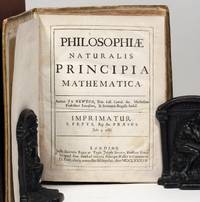
1687réf. 3096London: Joseph Streater for the Royal Society 1687. FIRST EDITION. contemporary vellum. Very Good. EXCEEDINGLY RARE FIRST EDITION OF THE GREATEST WORK IN THE HISTORY OF SCIENCE. "The Principia is generally described as the greatest work in the history of science. Copernicus Galileo and Kepler had certainly shown the way; but where they described the phenomena they observed Newton explained the underlying universal laws. The Principia provided the great synthesis of the cosmos proving finally its physical unity. Newton showed that the important and dramatic aspects of nature that were subject to the universal law of gravitation could be explained in mathematical terms within a single physical theory. With him the separation of natural and supernatural of sublunar and superlunar worlds disappeared. The same laws of gravitation and motion rule everywhere; for the first time a single mathematical law could explain the motion of objects on earth as well as the phenomena of the heavens. The whole cosmos is composed of inter-connecting parts influencing each other according to these laws. It was this grand conception that produced a general revolution in human thought equalled perhaps only by that following Darwin's Origin of Species. It was the final irrevocable break with a medieval conception based on Greek and Roman cosmology and a scholastic system derived from the medieval interpretation of Aristotle. Newton's universe almost independent of the spiritual order ushered in the age of rationalism scientific determinism and the acceptance of a mechanistic view of nature" Printing and the Mind of Man 161. On the history of the first edition: The first edition was financed almost entirely by Newton's friend the astronomer Edmund Halley and it is estimate that only about 300-400 copies were printed. There are two issues of the first edition most easily identified by the state of the title page. The "English issue" for domestic distribution has a two-line publisher's imprint after "Londini". In the "Continental" issue as in this copy printed to be distributed throughout the rest of Europe the title page is a cancel and has a three-line publisher's imprint with the name of the bookseller Samuel Smith added. London: Joseph Streater for the Royal Society at the expense of Edmond Halley to be sold by Samuel Smith and other booksellers 1687. Quarto 243 x 189 mm contemporary vellum tan calf lettering-piece gilt; quarter brown morocco folding case. 252 leaves and folding plate. Title with the three-line imprint cancelled; P4 cancel correcting orientation of the diagram on verso; errata inserted at end /- Ooo4; engraving of cometary orbit inserted before B1. Numerous woodcut diagrams in text. Complete. Title-page with outer margins restored and a portion of rule border in pen facsimile; internal tear or paper flaw crossing text on Ll1; marginal paper flaws on three leaves; 13 leaves with small wormtrack in lower margin; moderate patches of dampstaining most notable towards rear and extending sometimes into text text legible; binding with possible re-sewing or reinforcement and some minor soiling. Provenance: H. Pelham signature on pastedown; Easton family presumably Walter Easton or his family Osborne Road East Fremantle Australia signature on pastedown. Crossed out signature on front free endpaper recto. Joseph Streater for the Royal Society unknown books