Cardozo, Isaac NABAA

31 825 résultats
1827réf. 305824Charleston SC: James S. Burges 1827. First and only edition. 18 2 blank pp. 1 vols. 12mo. Modern pale yellow wrappers. Custom chemise and quarter morocco slipcase. Some pale foxing to title otherwise clean. First and only edition. 18 2 blank pp. 1 vols. 12mo. A rare pamphlet issued by the first Jewish Reform movement in the United States the Sephardic Reformed Society of Israelites in Charleston South Carolina recording an address by one of the movement's leaders. The Reformed Society of Israelites formed in 1824 when it split off from the Kahal Kadosh Beth Elohim KKBE synagogue in Charleston seeking to implement a number of reforms it deemed crucial to engaging the rising generation. In the process the Society posited a distinctly American form of practice. Led by Isaac Harby Abraham Moise and David Nunes Carvalho the Reformed Society of Israelites reflected the fact that as Jonathan Sarna has phrased it: "Jews who did not feel at home in synagogue no longer had to compromise their principles for the sake of consensus; they felt free to withdraw and start their own congregations. In free and democratic America congregational autonomy became the rule resulting in a new American Judaism - a Judaism of diversity and pluralism." The present address was delivered on the third anniversary of the Society by Isaac Cardozo 1786-1855 who served as the group's Vice-President from 1828-1832. Cardozo invokes a "spirit of reform in all existing institutions which is abroad" and reminds the group of its origin as "a society that was instituted mainly for effecting the observance of order and decorum in Hebrew worship: for adapting it to the feelings and propensities of the enlightened Israelite of the present day; and for endeavoring to bring about by argument and petition what neither necessity nor persuasion could before accomplish" before he goes on to defend the mission against various critiques. Apart from being a leader within Charleston's Sephardic Jewish community Cardozo was also the patriarch of an important southern African-American family. He had six children with his common-law wife Lydia Weston a free black woman from a prominent Charleston family--one of a number of openly mixed-race households in antebellum Charleston. One of their sons was Francis Cardozo 1836-1903 who became the first African-American to hold statewide office in the United States serving as Secretary of State in South Carolina from 1868 to 1872. Another son Thomas served as State Superintendent of Education from 1873 to 1876. RARE: OCLC reports only four institutional copies and A.S.W. Rosenbach in his American Jewish Bibliography located only one copy in a private collection. Rosenbach 289 locating one copy in a private collection; OCLC Princeton Am. Jewish Hist. Soc. USC Presbyterian College; American Imprints 28385; Singerman 0442 James S. Burges unknown books
réf. 05625London: G. Humphrey 1821. Queen Caroline Sliced And Diced By Satirists' Blade Fifty Devastating Hand-Colored Caricatures Directed Against the British Monarchy CRUIKSHANK George illustrator. CRUIKSHANK I.R. illustrator. LANE Theodore illustrator. The Attorney-General's Charges Against The Late Queen brought forward in the House of Peers on Saturday August 19 1820. Illustrated with Fifty Coloured Engravings. London: G. Humphrey 1821. First edition. Folio 18 13/16 x 13 inches; 478 x 330 mm. 2 title imprint on verso. 20 pp. by Robert Gifford Attorney-General. Hand colored frontispiece and forty-nine hand colored etched plates the majority being by Theodore Lane. Six of the plates are by George Cruikshank; one is after George Cruikshank; three are by Isaac Robert Cruikshank. All plates with interleaves. The text & plates are watermarked "J. Whatman 1821" Handsomely bound by Sangorski & Sutcliffe ca. 1960 in three-quarter dark blue morocco over marbled boards ruled in gilt. Spine with five raised bands elaborately tooled and lettered in gilt in compartments marbled endpapers all edges gilt. A fine well margined copy of this series of devastating caricatures directed against the British monarchy including the republication of the charges brought by the Attorney-General Robert Baron Gifford 1779-1826 against Queen Caroline and in support of the Pains and Penalties Bill of 1820 by which George IV who had only just inherited the throne in 1820 and who hated his wife sought to remove her title and dissolve their marriage. The volume begins with a view of Humphrey's shop-window where 42 of these prints are on view. The focus of these caricatures is Caroline of Brunswick 1768-1821 and her alleged affair with Bartolommeo Bergami. She renamed him Pergami as being more aristocratic and appointed him Grand Master of the Order of St Caroline. Queen Caroline on the whole elicited a great deal of public support and as a result the Bill had to be subsequently abandoned. However the following year in July 1821 Caroline was barred from the coronation fell ill and died three weeks later. After the fall of Napoleon in 1815 George Cruikshank's attention was largely turned towards highlighting the decadence of Britain's Regency monarchy which was epitomised by George IV while still the Prince Regent. In this collection six of the plates are by George or Isaac Robert Cruikshank or both the remainder are by Theodore Lane 1800-1828 a painter and engraver who frequently worked on sporting material especially in partnership with Pierce Egan. It was after this period that George Cruikshank became progressively more sober and serious. This scarce collection of caricatures sharply lampooning Queen Caroline to delightfully deadly effect is not found in the British Museum. Indeed BM Satires refers to the copy at the Bibliothéque National France one of only six copies in institutional holdings worldwide. Theodore Lane 1800-1828 was a political lampoonist and in 1820 created a series of satirical images of Queen Caroline at the time of her return to England to claim her rights as consort to George IV. Lane caricatured the queen as a grotesque overdressed and overweight accompanied by her Italian lover Bartolomeo Pergami and the then Lord Mayor of London Matthew Wood. The Plates: 1. Design for a New Coat of Arms Frontispiece 2. Humphrey Printseller & Publisher. 3. Bergami's Little Darling. 4. A Pas de Deux or Love at First Sight. 5. The Choice of Hercules. 6. An Arm-Full of Love 7. The Como-cal Hobby. 8. Winding up to a pitch the Automaton Scaramouch or Harlequin Courier's Delight 9. The Long & the Short of the Tale - or the whole of the concern. 10. Modesty! 11. The Modern Genius of History at her Toilet. 12. National Love! 13. Dignity! 14. A gentle jog into Jerusalem. 15. The Saint! 16. Tent-ation. 17. Installation of a Knight Companion of the Bath. 18. Travelling Tete à Tete!! 19. A R_Y_L Visit to a Foreign Capital or The Ambassador not at home!! George Cruikshank Cohn 1934 20. R_y_l Condescension - or a Foreign Minister Astonished! George Cruikshank Cohn 1914 21. Bat Cat and Mat. 22. A parting Hug at St. Omer! 23. A Wooden Substitute or Any Port in a Storm. 24. A late Arrival at Mother Wood's. George Cruikshank Cohn 1307 25. Mother Wood the Popular Procuress! Robert Cruikshank Cohn 1763 26. Mother Cole. 27. Grand Entrance to Bamboozl 'Em. 28. Steward's Court of the Manor of Torre Devon. 29. The Time Piece! & Canning Jack o' both sides. Robert Cruikshank 30. The Radical Ladder. After George Cruikshank 31. The C-R-L-E Column. 32. Delicious Dreams! 33. The Effusions of a Troubled Brain. 34. Caroline Fair or Mat Pudding and his Mountebank 35. The Mother Red-Cap Public House in opposition to the King's Head. George Cruikshank Cohn 1761 36. Carrying Coals to Newcastle!! 37. Moments of Pleasure. 38. The Man of the Woods & the Cat-o'-mountain. 39. The Q-n's Ass in a Band-box. 40. An Old Friend with a New Face or the Baron in Disguise. 41. Meditations at Brandyburgh; or an address to the Sun. 42. Dido in Despair. 43. The whole Truth or John Bull with his eyes opened. 44. A Going! A Going! the last time A Going!______Down!!! George Cruikshank Cohn 876 45. Returning Justice lifts aloft her Scale. 46. Lucifera's Procession. Fairy Queen. 47. The Royal Extinguisher or the King of Brobdingnag & the Lilliputians. I.R. & George Cruikshank Cohn 1919 48. The Grand Coronation of Her Most Graceless Majesty C-R-L-E Columbina the first Queen of all the Radicals. 49. A Coronation Stool. 50. The Armorial Bearings of the White Cat. cut and mounted. Bobins IV 1329; BM Satires 14206 note. London: G. Humphrey, [1821] unknown
réf. 05625London: G. Humphrey 1821. Queen Caroline Sliced And Diced By Satirists' Blade Fifty Devastating Hand-Colored Caricatures Directed Against the British Monarchy CRUIKSHANK George illustrator. CRUIKSHANK I.R. illustrator. LANE Theodore illustrator. The Attorney-General's Charges Against The Late Queen brought forward in the House of Peers on Saturday August 19 1820. Illustrated with Fifty Coloured Engravings. London: G. Humphrey 1821. First edition. Folio 18 13/16 x 13 inches; 478 x 330 mm. 2 title imprint on verso. 20 pp. by Robert Gifford Attorney-General. Hand colored frontispiece and forty-nine hand colored etched plates the majority being by Theodore Lane. Six of the plates are by George Cruikshank; one is after George Cruikshank; three are by Isaac Robert Cruikshank. All plates with interleaves. The text & plates are watermarked "J. Whatman 1821" Handsomely bound by Sangorski & Sutcliffe ca. 1960 in three-quarter dark blue morocco over marbled boards ruled in gilt. Spine with five raised bands elaborately tooled and lettered in gilt in compartments marbled endpapers all edges gilt. A fine well margined copy of this series of devastating caricatures directed against the British monarchy including the republication of the charges brought by the Attorney-General Robert Baron Gifford 1779-1826 against Queen Caroline and in support of the Pains and Penalties Bill of 1820 by which George IV who had only just inherited the throne in 1820 and who hated his wife sought to remove her title and dissolve their marriage. The volume begins with a view of Humphrey's shop-window where 42 of these prints are on view. The focus of these caricatures is Caroline of Brunswick 1768-1821 and her alleged affair with Bartolommeo Bergami. She renamed him Pergami as being more aristocratic and appointed him Grand Master of the Order of St Caroline. Queen Caroline on the whole elicited a great deal of public support and as a result the Bill had to be subsequently abandoned. However the following year in July 1821 Caroline was barred from the coronation fell ill and died three weeks later. After the fall of Napoleon in 1815 George Cruikshank's attention was largely turned towards highlighting the decadence of Britain's Regency monarchy which was epitomised by George IV while still the Prince Regent. In this collection six of the plates are by George or Isaac Robert Cruikshank or both the remainder are by Theodore Lane 1800-1828 a painter and engraver who frequently worked on sporting material especially in partnership with Pierce Egan. It was after this period that George Cruikshank became progressively more sober and serious. This scarce collection of caricatures sharply lampooning Queen Caroline to delightfully deadly effect is not found in the British Museum. Indeed BM Satires refers to the copy at the Bibliothéque National France one of only six copies in institutional holdings worldwide. Theodore Lane 1800-1828 was a political lampoonist and in 1820 created a series of satirical images of Queen Caroline at the time of her return to England to claim her rights as consort to George IV. Lane caricatured the queen as a grotesque overdressed and overweight accompanied by her Italian lover Bartolomeo Pergami and the then Lord Mayor of London Matthew Wood. The Plates: 1. Design for a New Coat of Arms Frontispiece 2. Humphrey Printseller & Publisher. 3. Bergami's Little Darling. 4. A Pas de Deux or Love at First Sight. 5. The Choice of Hercules. 6. An Arm-Full of Love 7. The Como-cal Hobby. 8. Winding up to a pitch the Automaton Scaramouch or Harlequin Courier's Delight 9. The Long & the Short of the Tale - or the whole of the concern. 10. Modesty! 11. The Modern Genius of History at her Toilet. 12. National Love! 13. Dignity! 14. A gentle jog into Jerusalem. 15. The Saint! 16. Tent-ation. 17. Installation of a Knight Companion of the Bath. 18. Travelling Tete à Tete!! 19. A R_Y_L Visit to a Foreign Capital or The Ambassador not at home!! George Cruikshank Cohn 1934 20. R_y_l Condescension - or a Foreign Minister Astonished! George Cruikshank Cohn 1914 21. Bat Cat and Mat. 22. A parting Hug at St. Omer! 23. A Wooden Substitute or Any Port in a Storm. 24. A late Arrival at Mother Wood's. George Cruikshank Cohn 1307 25. Mother Wood the Popular Procuress! Robert Cruikshank Cohn 1763 26. Mother Cole. 27. Grand Entrance to Bamboozl 'Em. 28. Steward's Court of the Manor of Torre Devon. 29. The Time Piece! & Canning Jack o' both sides. Robert Cruikshank 30. The Radical Ladder. After George Cruikshank 31. The C-R-L-E Column. 32. Delicious Dreams! 33. The Effusions of a Troubled Brain. 34. Caroline Fair or Mat Pudding and his Mountebank 35. The Mother Red-Cap Public House in opposition to the King's Head. George Cruikshank Cohn 1761 36. Carrying Coals to Newcastle!! 37. Moments of Pleasure. 38. The Man of the Woods & the Cat-o'-mountain. 39. The Q-n's Ass in a Band-box. 40. An Old Friend with a New Face or the Baron in Disguise. 41. Meditations at Brandyburgh; or an address to the Sun. 42. Dido in Despair. 43. The whole Truth or John Bull with his eyes opened. 44. A Going! A Going! the last time A Going!______Down!!! George Cruikshank Cohn 876 45. Returning Justice lifts aloft her Scale. 46. Lucifera's Procession. Fairy Queen. 47. The Royal Extinguisher or the King of Brobdingnag & the Lilliputians. I.R. & George Cruikshank Cohn 1919 48. The Grand Coronation of Her Most Graceless Majesty C-R-L-E Columbina the first Queen of all the Radicals. 49. A Coronation Stool. 50. The Armorial Bearings of the White Cat. cut and mounted. Bobins IV 1329; BM Satires 14206 note. London: G. Humphrey, [1821] unknown books
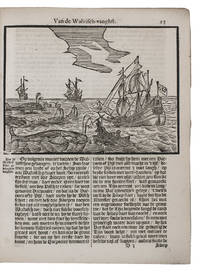
1665réf. 98MCBSHUHD3NAmsterdam 1665. 4to. Gillis Joosten Saeghman Late 19th-century vellum with the title stamped on the spine with black foil a black single fillet border on both boards. With a woodcut vignette of ships on the title page 16 further woodcuts on integral leaves 1 full-page signed by Christoffel van Sichem IV and 9 half-page and smaller with his monogram and a woodcut ship in a cartouche plus 1 repeat woodcut decorated initials and decorative bands built up from cast fleurons. Set in textura types with incidental roman and italic. 32 pp. First Dutch translation of the accounts of three voyages to Greenland by Jens Munk John Monck Martin Frobisher and Godske Lindenau searching for a passage to the East Indies through the Hudson Strait. Also containing a description of Greenland and an account of whaling including an unsigned illustration of a beached sperm whale with new illustrations by Christoffel van Sichem IV 1642-1693. It is a Dutch translation of La Peyrère's 1647 Relation du Groenland 1647 via the somewhat abbreviated German translation published in Hulsius's 1650 collection which contains the additional description of Spitsbergen and a discourse on whaling. La Peyrère included revised versions of Jens Munk's account of his voyage to Hudson Bay originally published in Navigatio septentrionalis 1624 and the accounts of voyages by Martin Frobisher and Godske Lindenau. Red armorial library stamp of the Forschungsstelle Volk und Raum on the title page: this was a research institute active at The Hague during the occupation of The Netherlands by Nazi Germany. Good copy.l Alden & Landis 663/79; Gosch Danish Arctic expeditions II pp. lxii-lxiii; JCB III pp. 98-99; Tiele Mém. 256; Sabin 28641 & 51334; STCN 4 copies; cf. Howgego to 1800 F80-F81 L128 and M180. ABE CAT Alaska Canada & Greenland hardcover
1789réf. 184162Mostly at sea: 8 June 1786 - 31 March 1789. The last surviving crew member of Cook's Endeavour A window onto the later career of Isaac Manley 1755-1837 mourned on his death as the last remaining participant in Cook's historic first voyage. Manley joined Cook's crew aged only 13 and was promoted to midshipman on 5 February 1771 during the journey home. He rose to the rank of admiral of the red becoming one of the fifteen most senior officers in the Royal Navy. On the Endeavour Manley acted as servant to the master Robert Molineux. The ravages of disease in the later part of the voyage offered opportunities for advancement. Molineux died off Cape Town in April 1771 and Manley was promoted a day either side of the deaths of midshipmen John Bootie and Jonathan Monkhouse. "The Muster Rolls show Isaac being charged £3.13.2 for slops at this time and £15.18.6 for dead men's clothes presumably he was buying the dead middies' uniforms. And his tobacco charge which began at 19/- in September 1769 also increased to £1.8.6" Hill. Writing to the First Secretary of the Admiralty on his return to England Cook gave Manley his endorsement in typically reserved fashion: "Midshipmen Mr Isaac Smith and Mr Isaac Manly both too young for the preferment yet their behaviour merits the best recommendation" quoted by Hill. Manley signed up for Cook's second voyage but was discharged for still unknown reasons in April 1772 before the Resolution sailed. He was commissioned lieutenant in May 1777 serving with the Channel Fleet and in North America and the West Indies and fought in the Battle of the Saintes. In 1786 at the rank of commander he was appointed to HMS Fairy - the service covered by this log - and ended his active duties in 1790. While living the life of a landed gentleman he continued to earn promotion reaching flag rank in 1809. He was promoted to admiral of the red a few months before his death. The daily log commences on 8 June 1786: "Came on board and took the command of Her Majesty's Sloop Fairy by virtue of a commission dated the 17th May 1786." The ship is tasked with patrolling the Channel and cracking down on smugglers seizing spirits tobacco and other contraband. There are also references to punishing sailors for drunkenness and mutinous behaviour. In late 1787 Manley was also occupied with naval impressment and was ruthlessly effective recording ships stopped and men pressed-ganged. In 1788 the ship is ordered to Africa the log ending in media res on 31 March 1789 near the equator. a By family descent; b Sold at Sotheby's London "Atlases Maps Topographical Prints and Travel Books" 2 May 1985 Lot 220 buyer: Quaritch; c Sold by Quaritch c.1987 to Cecil George Whitmont 1912-1991 Australian collector with his bookplate and a selection of paperwork formerly in an improvised acetate rear pocket. Quarto 245 x 195 mm. With 182 leaves all but 3 pages filled in neat manuscript. Original quarter calf parchment sides. Housed in custom green cloth solander box green spine label. Wear from shipboard use contents clean: very good. Anthony Hill "Isaac Manley - Servant on Endeavour to Admiral" Captain Cook Society. hardcover
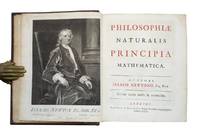
1726réf. H-142Philosophiae Naturalis Principia Mathematica third edition half-title engraved portrait frontispiece title in red and black woodcut illustrations and diagrams some foxing and soiling contemporary calf joints and corners worn 4to William & John Innys 1726. This edition was edited by Henry Pemberton and Sir Isaac Newton wrote a preface with new edits just one year before he passed away in 1727. This third edition printed in London is the very basis of all subsequent printings of the Principia and a true history existing through time. One out of 1250 copies Demy 1000 regular issue see below printed and with complete pagination this copy is a remarkable and rare book in the history of science. The 1726 edition was comprised of 1250 copies evidenced by William Bowyer's paper stock ledger which records the following: Superfine 50 largest paper; Royal 200 large paper; Demy 1000 regular issue. Royal copies can be identified by their size and CC watermark. See: Henry P. Macomber and Gerald G. Grubb "A census of the owners of copies of the 1687 first edition of Newton's Principia" PBSA 47 1953 269-304 p.293. Babson 11-12 Wallis 9. Guil. & Joh. Innys, Regiae Societatis typographos hardcover
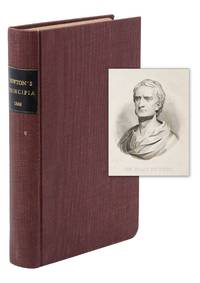
1726réf. vBC4008RARE 1726 THIRD EDITION OF NEWTON'S PRINCIPIA THE LAST EDITION PUBLISHED IN HIS LIFETIME EDITED BY NEWTON HIMSELF THE BASIS FOR ALL SUBSEQUENT EDITIONS. ONE OF ONLY 1250 COPIES PRINTED. AT 300 FAR FEWER REMAIN! London: Guil. & Joh. Innys Regiae Societatis typographos 1726. Quarto 240 x 192 mm. Lauded by Albert Einstein as "perhaps the greatest intellectual stride that has ever been granted to any man to make" Newton's Principia is arguably the most influential book in history. Grounded on the premise that virtually everything in the universe is amenable to scientific understanding this transformative milestone abounding with interdisciplinary impact "is generally described as the greatest work in the history of science. Copernicus Galileo and Kepler had certainly shown the way; but where they described the phenomena they observed Newton explained the underlying universal laws. The Principia provided the greatest synthesis of the cosmos proving finally its physical unity. Newton showed that the important and dramatic aspects of nature that were subject to the universal law of gravitation could be explained in mathematical terms with a single physical theory. With him the separation of the natural and supernatural of sublunar and superlunar worlds disappeared. The same laws of gravitation and motion rule everywhere; for the first time a single mathematical law could explain the motion of objects on earth as well as the phenomena of the heavens. The whole cosmos is composed of inter-connecting parts influencing each other according to these laws. It was this grand conception that produced a general revolution in human thought equaled perhaps only by that following Darwin's Origin of Species… Newton is generally regarded as one of the greatest mathematicians of all time and the founder of mathematical physics. It was the final irrevocable break with a medieval conception based on Greek and Roman cosmology and a scholastic system derived from the medieval interpretation of Aristotle. Newton's universe almost independent of the spiritual order ushered in the age of rationalism scientific determinism and the acceptance of a mechanistic view of nature" PMM 161. Dissatisfied with the first two editions of his own masterpiece London 1687; Amsterdam 1723 Newton towards the end of his life "gave one last effort to the Principia. It is clear that he regarded the Principia rather than the Opticks as his masterwork. He worked over the Principia without end to hone its language to a perfect expression of his ideas… . Perhaps a serious illness in 1722 reminded him that he could not delay forever. We know only that the printing of an edition more sumptuous than either of the others began in the fall of 1723." Westfall The Life of Isaac Newton. With portrait engraving by Vertue bound before first text leaf and numerous illustrations in text. Complete with the privilege leaf half-title dedication leaf index and ad leaf. 240 x 192 mm. 18th-century paneled calf gilt-lettered spine rebacked hinges cracked but holding. Frontispiece caption trimmed with some loss to artists' signatures minor foxing and toning but a very good crisp copy. Engraved armorial bookplate of the Earl of Hopetoun. Third edition revised and expanded edited by Henry Pemberton M.D. F.R.S. contains a new preface by Newton and many alterations and clarifications the scholium on fluxions chief among them. Sir Isaac Newton died on March 31 1727 at the age of 84 one year after his treasured edition was published. This Third Edition of his Principia is the final definitive statement of the man who invented calculus determined the composition of light and discovered the laws of gravity and motion which govern the universe the founder of modern science Sir Isaac Newton. Book #vBC4008. $26000. We specialize in rare Ayn Rand and other legends and landmarks. Guil. & Joh. Innys hardcover
1950réf. 17991ASSOCIATION COPY I ROBOT Gnome Press 1950 first edition some modest age toning to the top and fore edges two small blots of ink to the t.p.e.'s never bleeding through to the upper margin of the text else just about fine in vg/vg color pictorial dust-wrapper. Inscribed by the author to one of his publishers "To -Compliments of Susan Calvin the fictional central character of this title & Myself Isaac Asimov. Gnome Press unknown
1950réf. 17991ASSOCIATION COPY I ROBOT Gnome Press 1950 first edition some modest age toning to the top and fore edges two small blots of ink to the t.p.e.'s never bleeding through to the upper margin of the text else just about fine in vg/vg color pictorial dust-wrapper. Inscribed by the author to one of his publishers "To -Compliments of Susan Calvin the fictional central character of this title & Myself Isaac Asimov. Gnome Press unknown books
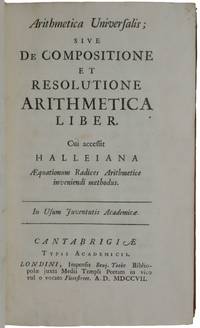
1707réf. 4639Cambridge; London: Typis Academicus; Benjamin Tooke 1707. First edition. First edition of Newton's treatise on algebra or 'universal arithmetic' his "most often read and republished mathematical work" Whiteside. Included are 'Newton's identities' providing expressions for the sums of the powers of the roots of any polynomial equation plus a rule providing an upper bound for the positive roots of a polynomial and a generalization to imaginary roots of René Descartes' 'Rule of Signs.' . Hardcover. NEWTON'S TREATISE ON ALGEBRA. First edition of Newton's treatise on algebra or 'universal arithmetic' his "most often read and republished mathematical work" Whiteside. "Included are 'Newton's identities' providing expressions for the sums of the ith powers of the roots of any polynomial equation for any integer i pp. 251-2 plus a rule providing an upper bound for the positive roots of a polynomial and a generalization to imaginary roots of René Descartes' Rule of Signs pp. 242-5" Parkinson p. 138. About this last rule for determining the number of imaginary roots of a polynomial which Newton offered without proof Gjertsen p. 35 notes: "Some idea of its originality . can be gathered from the fact that it was not until 1865 that the rule was derived in a rigorous manner by James Sylvester." Provenance: Jesuit College at Ghent ink inscription 'Bibliotheca Collegii Gandavensis Societatis Jesu.' and shelfmark on title; extensive marginal annotations by a well-informed contemporary reader. This reader was possibly the English Jesuit Christopher Maier 1697-1767. Born in Durham England Maier entered the Society of Jesus in 1715. He taught at Liège where he became interested in astronomy. In 1750 Maire was commissioned by Pope Benedict XIV to measure two degrees of the meridian from Rome to Rimini with fellow Jesuit Roger Boscovich with a view to mapping the Papal States; in turn they proved that the earth is an oblate spheroid as Newton had proposed in Principia publishing their results in Litteraria Expeditione 1755. Maier spent his final years at the English Jesuit College in Ghent. "In fulfillment of his obligations as Lucasian Professor Newton first lectured on algebra in 1672 and seems to have continued until 1683. Although the manuscript of the lectures in Cambridge University Library carries marginal dates from October 1673 to 1683 it should not be assumed that the lectures were ever delivered. There are no contemporary accounts of them and apart from Cotes who made a transcript of them in 1702 they seem to have been totally ignored. Whiteside Papers V p. 5 believes that they were composed 'over a period of but a few months' during the winter of 1683-4" Gjertsen pp. 33-4. The course of lectures stemmed from a project on which Newton had embarked in the autumn of 1669 thanks to the enthusiasm of John Collins: the revision of Mercator's Latin translation of Gerard Kinckhuysen's Dutch textbook on algebra Algebra ofte stel-konst 1661. Newton composed a manuscript 'Observations on Kinckhuysen' in 1670 see Whiteside Papers II and used it in the preparation of his lectures. He took the opportunity not only to extend Cartesian algebraic methods but also to restore the geometrical analysis of the ancients giving his lectures on algebra a strongly geometric flavor. "When Newton resigned his Lucasian professorship to his deputy William Whiston in December 1701 it was natural that the latter should wish to familiarize himself with the deposited lectures of his predecessor" Whiteside Papers V p. 8. Whiston later claimed in his Memoirs London: 1749 that Newton gave him his reluctant permission to publish the lectures. Whiston arranged with the London stationer to underwrite the expense of printing the deposited manuscript and then subsequently between September 1705 and the following June corrected both specimen and proof sheets as they emerged from the University Press. The completed editio princeps finally appeared in May 1707 priced at 4s. 6d. without Newton's name on the title page although references inside the work made no attempt to hide the author's identity. It included an appended tract by Halley on 'A new accurate and easy method for finding the roots of any equations generally without prior reduction' pp. 327-343. Publication of the work had been delayed by Newton who complained that the titles and headings were not his and that it contained numerous mistakes. Yet when he prepared a second edition in 1722 the changes he introduced were "primarily reorderings of his own manuscript not corrections of Whiston's additions" Westfall p. 649. In reality Newton's misgivings probably derived more from his reluctance to place before the public a relatively immature and poorly organized work and one that did not take into account the developments in the subject that had taken place in the quarter century since the manuscript was composed. For a book that was to become Newton's most often republished mathematical work the Arithmetica initially made little impact in Britain and was not even graced by a review in the Philosophical Transactions. On the Continent the reception accorded the lectures was more positive. "Leibniz unhesitatingly divining their author beneath the cloak of anonymity gave them a long review in the Acta Eruditorum of Leipzig in 1708. Written thirty years before he noted and now deservingly printed by William Whiston he assured the reader that 'you will find in this little book certain particularities that you will seek in vain in great tomes on analysis.' His close associate Johann Bernoulli despite some adverse remarks paid Newton the compliment in 1728 of basing his own course on the elements of algebra upon Newton's text. Perhaps partly in consequence of Newton's recent death in Britain too the book began about this time to arouse greater interest than when it was first issued in 1707" Hall p. 174. Despite the impressive contributions of the work to the theory of equations mentioned earlier it is difficult to pigeonhole the work as being either algebraic or geometric. From one point of view the Arithmetica can be seen as a fulfillment of the programme outlined by Descartes in the Géométrie because it teaches how geometrical problems and also arithmetical and mechanical ones can be translated into the language of algebra. Paradoxically however Newton criticized Descartes maintaining that at least in some cases Apollonian geometry is to be preferred to Cartesian algebra in the analysis of indeterminate problems. Modern analysts he complained had confused algebra and geometry: "The Ancients so assiduously distinguished them one from the other that they never introduced arithmetical terms into geometry. recent people by confusing both have lost the simplicity in which all elegance in geometry consists" Whiteside Papers V p. 429. The last section of the work 'The linear construction of equations' pp. 279-326 is particularly anti-Cartesian the term 'linear' in this context does not refer to straight lines but derives from Pappus. Newton here deals with the problem of constructing cubics third-degree equations that Descartes solved via the intersection of a circle and a parabola. Newton proposed instead to use a curve of degree higher than the conics as a means of construction namely the conchoid a fourth-degree curve. Newton regarded the conchoid as preferable because it has a mechanical construction and leads to a more elegant solution of the problem. William Whiston 1667-1752 was "a member of the first generation of Cambridge students to emulate Newton's method and principles. He went up to Cambridge in 1686 claimed to have attended one or two incomprehensible lectures by Newton on his Principia and was elected a Fellow of Clare Hall in 1691. After taking orders he left Cambridge for a while returning in 1700 when chosen by Newton to be his deputy as Lucasian Professor. About a year later upon Newton's resignation and commendation Whiston succeeded him. Aberrant theology was to be his downfall. While Newton and their common friend Dr Samuel Clarke kept private their doubts about Trinitarianism the Creed and the Thirty-nine Articles Whiston sought publicly to amend the errors of the Anglican faith; for this he was summoned before the heads of houses in the university and dismissed from his post in 1710" Hall p. 175. Babson 199; Wallis 277; D. Gjertsen Newton Handbook 1986; A. R. Hall Isaac Newton 1992; R. S. Westfall Never at Rest 1983. 8vo pp. viii 343. Woodcut diagrams throughout. Former owner's signature F. Percy White Feb. 1920 on half-title partially erased. Contemporary mottled calf covers with floral border and corner fleurons in blind. / Hardcover. Typis Academicus; Benjamin Tooke unknown
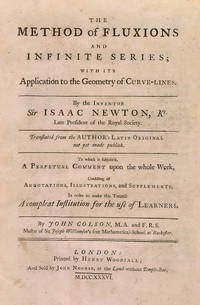
1736réf. 14348London: Henry Woodfall 1736. FIRST EDITION. With engraved frontispiece interpolated leaf 143-144 and leaf containing errata on the recto publisher’s advertisements on the verso. Paneled sprinkled calf in a contemporary style; a large paper copy with very wide margins a few contemporary annotations. First edition of Newton’s treatise on the calculus a work of great importance and rarity. Ready for publication in 1671 Newton circulated the manuscript among his friends who urged him to establish priority by publishing his own work. He steadfastly refused and prior to his death entrusted it to Henry Pemberton who never had it published. It was not until 1736 that Method of fluxions was finally published in the present English translation by John Colson who added a lengthy commentary. The original Latin edition did not appear until 1779 in the Opera omnia. Babson 171; Gray 232; Wallis 232; Smith History of Mathematics I p. 404. Henry Woodfall unknown
1736réf. 14348London: Henry Woodfall 1736. FIRST EDITION. With engraved frontispiece interpolated leaf 143-144 and leaf containing errata on the recto publisher’s advertisements on the verso. Paneled sprinkled calf in a contemporary style; a large paper copy with very wide margins a few contemporary annotations. First edition of Newton’s treatise on the calculus a work of great importance and rarity. Ready for publication in 1671 Newton circulated the manuscript among his friends who urged him to establish priority by publishing his own work. He steadfastly refused and prior to his death entrusted it to Henry Pemberton who never had it published. It was not until 1736 that Method of fluxions was finally published in the present English translation by John Colson who added a lengthy commentary. The original Latin edition did not appear until 1779 in the Opera omnia. Babson 171; Gray 232; Wallis 232; Smith History of Mathematics I p. 404. Henry Woodfall unknown books
réf. 39481Philadelphia: Printed by C. Sherman 5605. 8vo 5 volumes. 8 7/8 x 5 1/2 inches. Hebrew and English text on facing pages. Each volume inscribed at the head of the English-language title "To my beloved wife from her affectionate husband" the first volume with a later family annotation. Contemporary purple morocco spine in six compartments with raised bands lettered in gilt in the second and fourth repeating gilt decoration in others marbled edges marbled endpapers. Provenance: Solomon Nunes Carvalho each cover stamped in gilt Rare large-paper association copy of the first Jewish translation of the Pentateuch into English. More than any other person of his time Isaac Leeser 1806-1868 envisioned the development of a major center of Jewish culture and religious activity in the United States. He single-handedly provided American Jews with many of the basic religious texts institutions and conceptual tools they needed to construct the cultural foundation of what would later emerge as the largest Jewish community in the history of the Jewish people. Printed in 1845 this edition of the Pentateuch in five volumes included a vocalized Hebrew text of each of the Five Books of Moses together with an English translation and notes as well as the haftarot prophetic readings. Leeser actually began working on The Law of God in 1838. Among the factors involved in his decision to begin systematically working on a translation was the recent opening of Rebecca Gratz's Sunday School which met for the first time in March 1838 in Philadelphia and was desperately in need of appropriate study material. Students were compelled to use the King James Bible for want of a Jewish alternative. Religiously objectionable passages in other texts provided by Protestant organizations were either pasted over or torn out by Gratz's staff. Leeser who supported the Sunday School and was its chief academic resource person felt compelled to find more suitable texts for the students. The impetus for Leeser throughout was always his desire to provide the Jews of America with an English text of the Bible that was produced by one of their own and was not tainted by conversionist motivations. This copy with provenance to Solomon Nunes Carvalho who was a noted American painter photographer writer and inventor best known for traveling with John C. Fremont on his fifth expedition through Kansas Colorado and Utah. He published an account of that journey titled "Incidents of Travel and Adventure in the Far West; with Colonel Fremont's Last Expedition" 1860 and was considered a pioneer in travel photography. Isaac Leeser the hazzan of Congregation K.K. Mikveh Israel married Carvalho and his wife Sarah Miriam Solis on October 15 1845 in Philadelphia where Carvalho's father had a workshop. Rosenbach 569; Singerman 884; Goldman 7; Lance J. Sussman "Another Look at Isaac Leeser and the First Jewish Translation of the Bible in the United States" Modern Judaism Vol. 5 No. 2 Gershom Scholem Memorial Issue. May 1985 pp. 159-190. Printed by C. Sherman unknown
réf. 39481Philadelphia: Printed by C. Sherman 5605. 8vo 5 volumes. 8 7/8 x 5 1/2 inches. Hebrew and English text on facing pages. Each volume inscribed at the head of the English-language title "To my beloved wife from her affectionate husband" the first volume with a later family annotation. Contemporary purple morocco spine in six compartments with raised bands lettered in gilt in the second and fourth repeating gilt decoration in others marbled edges marbled endpapers. Provenance: Solomon Nunes Carvalho each cover stamped in gilt Rare large-paper association copy of the first Jewish translation of the Pentateuch into English. More than any other person of his time Isaac Leeser 1806-1868 envisioned the development of a major center of Jewish culture and religious activity in the United States. He single-handedly provided American Jews with many of the basic religious texts institutions and conceptual tools they needed to construct the cultural foundation of what would later emerge as the largest Jewish community in the history of the Jewish people. Printed in 1845 this edition of the Pentateuch in five volumes included a vocalized Hebrew text of each of the Five Books of Moses together with an English translation and notes as well as the haftarot prophetic readings. Leeser actually began working on The Law of God in 1838. Among the factors involved in his decision to begin systematically working on a translation was the recent opening of Rebecca Gratz's Sunday School which met for the first time in March 1838 in Philadelphia and was desperately in need of appropriate study material. Students were compelled to use the King James Bible for want of a Jewish alternative. Religiously objectionable passages in other texts provided by Protestant organizations were either pasted over or torn out by Gratz's staff. Leeser who supported the Sunday School and was its chief academic resource person felt compelled to find more suitable texts for the students. The impetus for Leeser throughout was always his desire to provide the Jews of America with an English text of the Bible that was produced by one of their own and was not tainted by conversionist motivations. This copy with provenance to Solomon Nunes Carvalho who was a noted American painter photographer writer and inventor best known for traveling with John C. Fremont on his fifth expedition through Kansas Colorado and Utah. He published an account of that journey titled "Incidents of Travel and Adventure in the Far West; with Colonel Fremont's Last Expedition" 1860 and was considered a pioneer in travel photography. Isaac Leeser the hazzan of Congregation K.K. Mikveh Israel married Carvalho and his wife Sarah Miriam Solis on October 15 1845 in Philadelphia where Carvalho's father had a workshop. Rosenbach 569; Singerman 884; Goldman 7; Lance J. Sussman "Another Look at Isaac Leeser and the First Jewish Translation of the Bible in the United States" Modern Judaism Vol. 5 No. 2 Gershom Scholem Memorial Issue. May 1985 pp. 159-190. Printed by C. Sherman unknown books
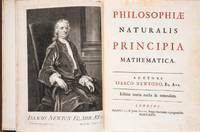
1726réf. 69561London: Apud Guil. & Joh. Innys 1726. Editio tertia aucta & emendata. London: Apud Guil. & Joh. Innys 1726. Full Description: NEWTON Sir Isaac. Philosophiæ naturalis principia mathematica. Editio tertia aucta & emendata. London: Apud Guil. & Joh. Innys 1726. Third edition. One of only 1250 copies printed. Quarto. 34 530 6 index pp. Engraved frontispiece portrait facing title by George Vertue after I. Vanderbank. Bound without the advertisement leaf. Numerous diagrams in the text and one engraving of cometary orbit on p. 506. Title printed in red and black. With the Royal Privilege printed on verso of the first leaf as in Babson copy 2. In full goatskin. Spine ruled and lettered in gilt. Boards paneled in blind. Inner hinges repaired. Some old ink manuscript notes on front flyleaf. Numerous instances of light early pencil marginalia and a few in ink. Some ghost dampstaining throughout. Previous owner's bookplate on front pastedown. Overall a very good copy. "This edition was the last published during the author's lifetime and the basis of all subsequent editions. It was edited by Henry Pemberton M.D. F.R.S. and contains a new preface by Newton and a large number of alterations the most important being the scholium on fluxions in which Leibnitz had been mentioned by name. This had been considered an acknowledgement of Leibnitz's independent discovery of the calculus. In omitting Leibnitz's name in this edition Newton was criticized as taking advantage of an opponent whose death had prevented any reply" Babson p. 12. Third edition of "the greatest work in the history of science" Printing and the Mind of Man. In the Principia Newton formulated the three laws of motion from which he derived the principle of universal gravitation "wherein all bodies of whatever mass attract one another in proportion to their masses and in inverse ratio as the square of the distance between them. This applies to dust particles as to the mightiest celestial bodies" Dibner. "Copernicus Galileo and Kepler had certainly shown the way; but where they described the phenomena they observed Newton explained the underlying universal laws. The Principia provided the great synthesis of the cosmos proving finally its physical unity. Newton showed that the important and dramatic aspects of nature that were subject to the universal law of gravitation could be explained in mathematical terms within a single physical theory.The same laws of gravitation and motion rule everywhere; for the first time a single mathematical law could explain the motion of objects on earth as well as the phenomena of the heavens. The whole cosmos is composed of inter-connecting parts influencing each other according to these laws. It was this grand conception that produced a general revolution in human thought equalled perhaps only by that following Darwin's Origin of Species" Printing and the Mind of Man 161 describing the first edition. Babson 13. Gray 9. Wallis 9. HBS 69561. $22500. Apud Guil. & Joh. Innys unknown
1726réf. 69561London: Apud Guil. & Joh. Innys 1726. Editio tertia aucta & emendata. London: Apud Guil. & Joh. Innys 1726. Full Description: NEWTON Sir Isaac. Philosophiæ naturalis principia mathematica. Editio tertia aucta & emendata. London: Apud Guil. & Joh. Innys 1726. Third edition. One of only 1250 copies printed. Quarto. 34 530 6 index pp. Engraved frontispiece portrait facing title by George Vertue after I. Vanderbank. Bound without the advertisement leaf. Numerous diagrams in the text and one engraving of cometary orbit on p. 506. Title printed in red and black. With the Royal Privilege printed on verso of the first leaf as in Babson copy 2. In full goatskin. Spine ruled and lettered in gilt. Boards paneled in blind. Inner hinges repaired. Some old ink manuscript notes on front flyleaf. Numerous instances of light early pencil marginalia and a few in ink. Some ghost dampstaining throughout. Previous owner's bookplate on front pastedown. Overall a very good copy. "This edition was the last published during the author's lifetime and the basis of all subsequent editions. It was edited by Henry Pemberton M.D. F.R.S. and contains a new preface by Newton and a large number of alterations the most important being the scholium on fluxions in which Leibnitz had been mentioned by name. This had been considered an acknowledgement of Leibnitz's independent discovery of the calculus. In omitting Leibnitz's name in this edition Newton was criticized as taking advantage of an opponent whose death had prevented any reply" Babson p. 12. Third edition of "the greatest work in the history of science" Printing and the Mind of Man. In the Principia Newton formulated the three laws of motion from which he derived the principle of universal gravitation "wherein all bodies of whatever mass attract one another in proportion to their masses and in inverse ratio as the square of the distance between them. This applies to dust particles as to the mightiest celestial bodies" Dibner. "Copernicus Galileo and Kepler had certainly shown the way; but where they described the phenomena they observed Newton explained the underlying universal laws. The Principia provided the great synthesis of the cosmos proving finally its physical unity. Newton showed that the important and dramatic aspects of nature that were subject to the universal law of gravitation could be explained in mathematical terms within a single physical theory.The same laws of gravitation and motion rule everywhere; for the first time a single mathematical law could explain the motion of objects on earth as well as the phenomena of the heavens. The whole cosmos is composed of inter-connecting parts influencing each other according to these laws. It was this grand conception that produced a general revolution in human thought equalled perhaps only by that following Darwin's Origin of Species" Printing and the Mind of Man 161 describing the first edition. Babson 13. Gray 9. Wallis 9. HBS 69561. $22500. Apud Guil. & Joh. Innys unknown books
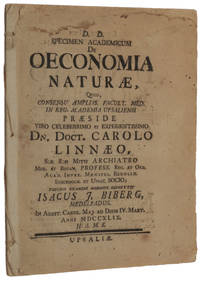
1749réf. 5245Uppsala: np 1749. First edition. First edition extremely rare. "This essay was the first sketch of a science of ecology. Linnaeus used his economy-of-nature concept as an organising principle to unify an important but previously amorphous part of natural history. In so doing he was also attempting to transform an important background concept into the central theory of a new science" Egerton. "In regard to Linnaeus' concepts of an economy of nature Darwin used these ideas as major explanations of the workings of natural selection. So Linnaeus supplied major assistance for Darwin's arriving at his theory of evolution" Stauffer. . THE BIRTH OF THE SCIENCE OF ECOLOGY. First edition extremely rare of Linnaeus' pioneer dissertation which created the science of ecology. "This essay was the first sketch of a science of ecology. Linnaeus used his economy-of-nature concept as an organising principle to unify an important but previously amorphous part of natural history. In so doing he was also attempting to transform an important background concept into the central theory of a new science . The term 'economy of nature' bore an obvious similarity to the contemporary term for animal physiology 'animal economy' which involved studying how the parts contributed to the functioning of the whole. Linnaeus may indeed have had in mind an analogy between the organs in an animal and the species in a habitat because his analysis of the interrelations between the plants and animals in nature implied a close and well-defined interaction for the good of the whole: 'To perpetuate the established course of nature in a continued series the divine wisdom has thought fit that all living creatures should constantly be employed in producing individuals that all natural things should contribute and lend a helping hand towards preserving every species and lastly that the death and destruction of one thing should always be subservient to the restitution of another' . The Oeconomia naturae begins with the above-quoted definition and then explains how that concept can be used to interpret phenomena in inanimate nature and in the plant and animal kingdoms. For both the plant and animal kingdoms Linnaeus considered propagation preservation and destruction as the phenomena which maintained the economy of nature" Egerton p. 335. "The phrase 'Oeconomy of Nature' "should be familiar to readers of Darwin for he claims in the Origin p. 102 that 'all organic beings are striving it may be said to seize on each place in the economy of nature.' When the word 'economy' appears in Darwin's texts there is a tendency to look to political economy for precursors . but concepts like the animal economy and the economy of nature debatably belonged to intellectual lineages that were relatively independent of their social and political context . I will argue that Darwin's idea of a place in the economy of nature stems from the work of previous naturalists like Carl Linnaeus and Charles Lyell and that it played a key role in the development of his evolutionary ideas. . Darwin read translations of Linnaeus' dissertations Oeconomia naturae 1749 and Politia naturae 1760 in May 1841. Although the phrase 'economy of nature' appears only once in Darwin's notebooks of the late 1830s it can be found throughout his first sketches on transmutation in 1842 and 1844. Given this chronology it is likely that the idea came to play a greater role in Darwin's work because of his encounter with these Linnaean texts" Pearce pp. 494-6. The dissertation was dictated by Linnaeus in Swedish to Isaac Biberg a doctoral candidate who translated it into Latin and defended it according to the academic custom of the eighteenth century. ABPC/RBH lists no copy in the last 80 years. OCLC lists 5 copies in US Madison Wisconsin; Kansas; Harry Ransom Texas; Minnesota; Huntington. "Like most naturalists of his time Linnaeus was trained in medicine and thus would have been familiar with the term 'oeconomia animalis' as employed by Charleton Hermann Boerhaave and others. However Linnaeus set his sights higher - what he wanted to describe was not the animal economy but the economy of nature as a whole. Of course others had used the term 'economy of nature' e.g. Sir Kenelm Digby in a variety of works but only as a brief metaphor. For example Digby writes in 1644 that natural motion 'hath its birth from the universall oeconomy of nature here among us.' What Linnaeus did instead was extend the physiological idea of the animal economy to nature in its entirety. In his eyes the economy of nature deserved a description just as detailed and rational as that of the animal economy. "In the dissertation 'Oeconomia Naturae' defended by his student Isaac Biberg in 1749 Linnaeus defines his title as follows: 'By the oeconomy of nature we understand the all-wise disposition of the creator in relation to natural things by which they are fitted to produce general ends and reciprocal uses.' The 'reciprocal uses' are the key to the whole idea for 'the death and destruction of one thing should always be subservient to the restitution of another;' thus mould spurs the decay of dead plants to nourish the soil and the earth then 'offers again to plants from its bosom what it has received from them.' Linnaeus points out that natural processes always follow a certain order with each stage dependent on the previous. A fallen tree for instance does not go to waste but is colonized and eliminated by an ordered series of creatures: liverworts mushrooms beetles caterpillars and woodpeckers. Just as the respiratory cardiovascular lymphatic and digestive systems play different functional roles in the economy of the human body different species play different functional roles in the economy of nature as a whole. For example each kind of insect lays its eggs on a particular kind of plant: '. every different tribe chooses its own species of plant. Nay there is scarce any plant which does not afford nourishment to some insect; and still more there is scarcely any part of a plant which is not preferred by some of them. Thus one insect feeds upon the flower; another upon the trunk another upon the root; and another upon the leaves.' "Each type of organism therefore according to Linnaeus has its special function in nature's economy. Just as the animal economy ensures the health and well-being of the animal body the economy of nature ensures the health and well-being of the natural world. Linnaeus discusses the many creatures that help cleanse and purify nature's body without which the 'whole earth would be overwhelmed with carcases and stinking bodies.' Thus if a horse dies near a roadway its body will 'be filled with innumerable grubs of carniverous flies by which he is entirely consumed and removed out of the way that he may not become a nuisance to passengers by his poisonous stench.' Likewise specialized aquatic predators like the thornback the hound fish or the conger eel consume fish carcasses near the shore. Linnaeus even suggests an experiment to prove the purifying potential of insects: '. knats lay their eggs in stagnant putrid and stinking waters and the grubs that arise from these eggs clear away all the putrefaction; and this will easily appear if any one will make the experiment by filling two vessels with putrid water leaving the grubs in one and taking them all out of the other. For then he will soon find the water that is full of grubs pure and without any stench while the water that has no grubs will continue stinking.' "Thus for Linnaeus even scavengers and grubs the lowest of all species play an essential role in the economy of nature" Pearce pp. 497-8. "Oeconomia Naturae is both the culmination of a great tradition - that of Christian natural theology and the starting point of a new science the one that Ernst Haeckel named 'ecology' in 1866. In accordance with the natural theology and the 'age of optimism' celebrated in the works of William Derham John Ray Bernhard Nieuwentyt Gottfried von Leibniz and Christian von Wolff Linnaeus defines 'the economy of nature' as the Creator's wise arrangement and deposition of all things according to which they fulfil their purpose for the glory of God and the happiness of Man. "And although individuals perish their roles persist . The roles in Linnaean nature are what today's ecologists call 'niches': a multidimensional 'space' defined by the abilities of the species and their interactions with the environment - their physiology and habitat preferences position in food chains and ecosystem structure. Although the Oeconomia Naturae reads like an ecology textbook it also sparkles with the eroticism of the Baroque. Like a voluptuous painter Linnaeus revels in the splendour of life in its beautiful 'costumes' its sensual appeal and showy extravagance the delightful colours forms and adaptations the impressive devices for preservation survival defence attack sex and propagation mating and pollination the means of dispersal and child-rearing . "Between 1743 and 1776 Linnaeus wrote more than 180 such academic theses. But few achieved the instant success of the Oeconomia Naturae. A Swedish translation was produced within a year. English and German versions soon appeared. It was also reprinted in Latin in the many editions of Linnaeus's Amoenitates academicae published in Amsterdam Leyden Erlangen and Graz through the second half of the eighteenth century. New translations continue to appear today" Hestmark. "Darwin's influence on the history of ecology resulted in the very christening of the science itself by Ernst Haeckel who once explained that 'By ecology we mean the body of knowledge concerning the economy of nature' and who concluded 'in a word ecology is the study of all those complex interrelationships referred to by Darwin as the conditions of the struggle for existence' . "When we come to consider the sources of Darwin's ecological insight the importance of his personal experience is obvious . Besides the influence of Darwin's field observations there was the influence of his reading . The importance for Darwin of Lyell's discussion of the economy of nature and allied topics in his Principles of Geology is very clear . Lyell's references in regard to the economy of nature point directly back to the major earlier source: the writings of Carl Linnaeus. The importance of Linnaeus in the evolution of ecology is very great and it is striking that among the naturalists writing after Linneaus and before Darwin it is the geologist Charles Lyell who shows the clearest grasp of Linnaeus' ideas on the economy of nature and who makes the fullest use of them in his own work . After coming to know in the pages of Lyell's Principles ideas and facts from a number of these Linnaean essays Darwin encountered Linnaeus himself in English translation in May of 1841 . From this year of 1841 on Darwin made increasing use of the phrases 'economy of nature' and 'polity of nature' . "The conventional wisdom is that Darwin overthrew the work of Linnaeus in so far as he replaced the orthodox dogma of fixity of species by his theory of evolution. But in regard to Linnaeus' concepts of an economy of nature Darwin used these ideas as major explanations of the workings of natural selection. So Linnaeus supplied major assistance for Darwin's arriving at his theory of evolution" Stauffer. "In German and Swedish universities in the eighteenth century the serious test of the student was the skill with which he conducted his oral defence of the thesis he presented. His major professor who presided at the disputation was often the author of the thesis to be defended. At Uppsala Linnaeus generally dictated the essays which his students published and paid the printer's bill for. He quite naturally regarded these dissertations as his own work. In a letter to his friend the English naturalist John Ellis he wrote: 'The fourth volume of my Amoenitates Academicae is very nearly printed . Among the dissertations I am about to publish are Genera morborum Aer habitabilis Flora Jamaicensis Sus porcus Anthropomorpha & Generatio ambigens. In the last of these I shall show that the brain and spinal marrow only proceed from the mother and the rest of the body from the father.' "Nowadays unless there is direct evidence to the contrary it is customary to regard Linnaeus as the author of all these dissertations" ibid. Soulsby Catalogue of the works of Linnaeus 2nd ed. 1933 1514. Egerton 'Changing concepts of the balance of nature' The Quarterly Review of Biology 48 1973 pp. 322-50. Hestmark 'Oeconomia Naturae L' Nature 405 2000 p. 19. Pearce 'A great complication of circumstances - Darwin and the Economy of Nature' Journal of the History of Biology 43 2010 pp. 493-528. Stauffer 'Ecology in the long manuscript version of Darwin's 'Origin of Species' and Linnaeus' 'Oeconomy of Nature'' Proceedings of the American Philosophical Society 104 1960 pp. 235-41. 4to pp. viii 48 woodcut initials head- and tail-pieces first and last pages tanned spotted water stain to upper edge of the first two leaves. String bound. A very good copy in original state of this extremely rare dissertation. np unknown
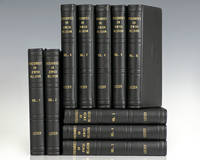
1866réf. 107732Philadelphia: Sherman & Co 1866-68. Rare first editions of one of the 'major builders of American Judaism' Isaac Leeser's Discourses on the Jewish Religion. Octavo 10 volumes bound in full leather gilt titles to the spine raised bands. In near fine condition. Complete sets are of the utmost rarity. American Jewish lay minister author translator and publisher Issac Leeser’s “contributions to every area of Jewish culture and religion made him a major builder of American Judaism." In addition to his influence on the Jewish pulpit in the United States Leeser became the first American Jewish publisher and produced the first Jewish translation of the bible into English. “The translation of the Bible was Leeser’s great literary achievement and represented many years of patient labor and devotion to a task which he considered sacred…until the new Jewish Publication Society version was issued in 1917 it was the only source from which many Jews not conversant with Hebrew derived their knowledge of the Bible in accordance with Jewish tradition” Waxman 1090. Sherman & Co hardcover
1845réf. 78547Philadelphia: C. Sherman 5605 1845-46. First edition of the “first English translation of the Pentateuch in America” the 1845 Hebrew-English Bible by one of the most prominent and influential figures in American Jewish history. Octavo 5 volumes. Translated by Isaac Leeser. Bound in full contemporary calf gilt titles and tooling to the spine. In near fine condition. A nice example rare in contemporary binding. Previous editions published by Jews in England had simply utilized the King James translation. The translator was Isaac Leeser 1806-1868 who worked without assistance. In his preface he apologizes for any errors: "How can it be expected that I should escape when I have no Jewish compositors and have necessarily to be often away when the work goes to press" Despite these obstacles Leeser doubted that "the precious word of God ever appeared among us in a more beautiful form than the volumes in which I am now engaged." Leeser avoided reliance on earlier English translations though he made some use of German translations and noted that "the arrangement is strictly Jewish. My intention was to furnish a book for the service of the Synagogue both German and Portuguese." Leeser’s “contributions to every area of Jewish culture and religion made him a major builder of American Judaism.” The publication of his Pentateuch was the first time that any portion of the Bible was published in America under Jewish auspices. “The translation of the Bible was Leeser’s great literary achievement and represented many years of patient labor and devotion to a task which he considered sacred… He made good use of the various German translations by Jews of the collective commentary known as the Biur and of other Jewish exegetic works. As a result his translation though based in style upon the King James version can be considered an independent work for the changes he produced are numerous and great… until the new Jewish Publication Society version was issued in 1917 it was the only source from which many Jews not conversant with Hebrew derived their knowledge of the Bible in accordance with Jewish tradition” Waxman 1090. C. Sherman, 5605 unknown
1666réf. 1299Nurnberg 1666. Houzeau & Lancaster 3039; Zimmer 5089 1628 Strasbourg ed.; Poggendorff 1984. Warner The Sky Explored pp. 104-5. Extremely rare German edition a Latin edition was published the same year of Sturms enlargement of Habrechts famous treatise on the making of celestial and terrestrial globes published in 1628. The Habrecht family of clock and instrument makers were famous throughout Europe from the last quarter of the sixteenth century to the end of the seventeenth century. The authors father also called Isaac was responsible for making the monumental second Strasbourg clock which was one of the mechanical wonders of its time on the Continent. Isaac Habrecht 1589-1633 was a Strasbourg physician mathematician and maker of globes. He was much influenced by Blaeu and Hondius and his globes were highly regarded. J. C. Sturm was Habrechts student and a scientist of vision. He organized the first scientific academy in Germany the Collegium Curiosum sive Experimentale at Altdorf in 1672 and introduced the first course in experimental physics in a German university. In 1666 he undertook the task of augmenting Habrechts original text and adding a number of folding plates. The plates include two handsome polar projections of the world two polar stereographic celestial charts of the northern and southern constellations and ten folded engravings showing the various parts of his planiglobiums.The fourteen folded engravings superbly executed by Jacob von der Heyden were probably intended to be mounted and assembled to form several instruments each with a revolving plate measuring 27 cm in diameter and a movable pointer. Each was to be supported on an approximately 12-cm base. The work is one of the most beautiful instrument books published in the seventeenth century and certainly one of the rarest particularly with the full complement of plates. Despite being an obvious Americanum see pp. 205 228 231 and America pictured on one of the maps it is not in Sabin JCB Palmer and other standard bibliographies. Houzeau & Lancaster lists a 1650 edition that is clearly an error as Sturm would have been 15 years old at the time.OCLC lists Yale for the German and Chicago for the Latin editions. unknown
1666réf. 1299Nurnberg 1666. Houzeau & Lancaster 3039; Zimmer 5089 1628 Strasbourg ed.; Poggendorff 1984. Warner The Sky Explored pp. 104-5. Extremely rare German edition a Latin edition was published the same year of Sturms enlargement of Habrechts famous treatise on the making of celestial and terrestrial globes published in 1628. The Habrecht family of clock and instrument makers were famous throughout Europe from the last quarter of the sixteenth century to the end of the seventeenth century. The authors father also called Isaac was responsible for making the monumental second Strasbourg clock which was one of the mechanical wonders of its time on the Continent. Isaac Habrecht 1589-1633 was a Strasbourg physician mathematician and maker of globes. He was much influenced by Blaeu and Hondius and his globes were highly regarded. J. C. Sturm was Habrechts student and a scientist of vision. He organized the first scientific academy in Germany the Collegium Curiosum sive Experimentale at Altdorf in 1672 and introduced the first course in experimental physics in a German university. In 1666 he undertook the task of augmenting Habrechts original text and adding a number of folding plates. The plates include two handsome polar projections of the world two polar stereographic celestial charts of the northern and southern constellations and ten folded engravings showing the various parts of his planiglobiums.The fourteen folded engravings superbly executed by Jacob von der Heyden were probably intended to be mounted and assembled to form several instruments each with a revolving plate measuring 27 cm in diameter and a movable pointer. Each was to be supported on an approximately 12-cm base. The work is one of the most beautiful instrument books published in the seventeenth century and certainly one of the rarest particularly with the full complement of plates. Despite being an obvious Americanum see pp. 205 228 231 and America pictured on one of the maps it is not in Sabin JCB Palmer and other standard bibliographies. Houzeau & Lancaster lists a 1650 edition that is clearly an error as Sturm would have been 15 years old at the time.OCLC lists Yale for the German and Chicago for the Latin editions. unknown books
1848réf. 140949208New York: Daniel Adee 1848. First American Edition. Very Good. First American edition first printing with date 1848 on title page and publisher's address listed as 107 Fulton-Street. 4 v-viii 9-581 pp. illustrated with engraved frontispiece protected by tissue guard. Recently bound in maroon buckram title label to spine. Very Good with light wear to covers and slight bumping to lower corners; title label beginning to lift at one corner. Band of paper residue to front free endpaper. Light toning and moderate foxing to textblock edges and contents dampstain to outer textblock edge and outer margin throughout. Cohen pp. 347-352. The first American edition of the foundational physics text first published in Latin in 1687. Andrew Motte's 1729 translation was reprinted in 1803 and 1819 in Britain but subsequent 19th century editions were printed only in the United States and Germany. The New York-based publisher Daniel Adee deposited a copyright for the Principia in 1846 then printed five issues between 1848 and 1850. A contemporary notice in the Scientific American declared: "For a long time the 'Principia' was kept far out of the reach of the mere English Scholar as if Newton had written it exclusively for the classical student and philosopher. It was a scarce book when printed in the Latin language; it is now thanks to the spirit of an American publisher printed in our mother tongue and should find a place in every family library. Daniel Adee unknown
1848réf. 140949208New York: Daniel Adee 1848. First American Edition. Very Good. First American edition first printing with date 1848 on title page and publisher's address listed as 107 Fulton-Street. 4 v-viii 9-581 pp. illustrated with engraved frontispiece protected by tissue guard. Recently bound in maroon buckram title label to spine. Very Good with light wear to covers and slight bumping to lower corners; title label beginning to lift at one corner. Band of paper residue to front free endpaper. Light toning and moderate foxing to textblock edges and contents dampstain to outer textblock edge and outer margin throughout. Cohen pp. 347-352. The first American edition of the foundational physics text first published in Latin in 1687. Andrew Motte's 1729 translation was reprinted in 1803 and 1819 in Britain but subsequent 19th century editions were printed only in the United States and Germany. The New York-based publisher Daniel Adee deposited a copyright for the Principia in 1846 then printed five issues between 1848 and 1850. A contemporary notice in the Scientific American declared: "For a long time the 'Principia' was kept far out of the reach of the mere English Scholar as if Newton had written it exclusively for the classical student and philosopher. It was a scarce book when printed in the Latin language; it is now thanks to the spirit of an American publisher printed in our mother tongue and should find a place in every family library. Daniel Adee unknown books
réf. 84308102London 1822 Ackermann. Red original cloth very goodsmall folio gold stamped 325p. 25 aquatint illustrations on 13 hand colored copper etched plates many color foldouts 25 x 32.3 cm. THE FIRST & ONLY EDITION. Q U I T E R A R E . . . . ONE OF THE MOST IMPORTANT HAND-COLORED BOOKS . . . ON JAPAN OF THE 19 CENTURY. . SUBTITLE: continued: ".And of the Ceremonies Customary Marriages and Funerals: to Which are Subjoined Observations of the Legal Suicide of the Japanese Remarks on their Poetry an Explanation of their Mode of Reckoning time Particulars Respecting the Dosia Powder the Preface of a Work by Confoutzee Confucius on Filial Piety &c. &c. Translated from the French by Frederic Shoberl." . THE SUPERB COLOR COPPER-ETCHED ENGRAVINGS: . The book contains hand-tinted engravings along with color printed illustrations. . Magnificently copper-engraved color plates showing illustrations of early 19th century Japan which at that time was still closed to Foreigners. Titsingh was chief agent for the Dutch East India Company stationed in Nagasaki. He described feasts & ceremonies of the Japanese court a hand-tinted color foldout plate 98 cm. long ! marriages funerals law poetry chronology furniture earthquakes &c. . TITSINGH'S PRIMARY OBSERVATIONS: He also gave valuable and new first-hand information on Japan based on his personal observations which otherwise were not available elsewhere. The most important book of the time period because Japan was essentially closed to the rest of the world. With lavish hand-colored plates. . A treasure & superb addition to any collection and library. . By and large the most important and most valuable small folio color plate book published on Japan in English of the epoch. . DESHIMA ISLAND: A marvelous primary resource and historic work ! Titsingh was the chief for the Dutch East India Company and was stationed in at Deshima a tiny island reserved for the Dutch in the Nagasaki harbour. Deshima was closed off of to the rest of Japan. . Color photos are posted to our website. . SPECIFIC COPY DETAILS: . COPY 1: The Binding: Bound in full recent red moroccan leather gold-stamped rule lines 5 raised bands marbled endpapers firmly bound and solid. A fine example of excellent workmanship and binding about as good as it can get. . Contents: This copy has a perforated library name on the back side of the color frontispiece and on the right side of the title page barely touching the last 3 letters of "Nagasaki." This is on several other pages and all of the color plates. . There is also a red oval library stamp with "withdrawn" stamped in black on this page. . The title page has the same perforated library name in the right margin partially over the last 3 letters of "Nagasaki.". . There is an identical oval red stamp over the word: "Printed" For R. Ackerman." . The title page has somef eint foxing please see photos posted to our website for details see spine.jpg and images: illus09.jpg through illus14.jpg for this copy details. . Several other pages have occasional feint foxing through out. . Otherwise the contents are bright clean no marks or stains. . The book looks stunningly beautiful in is superb binding. . COPY 2: IN THE ORIGINAL PUBLISHER'S RED CLOTH BINDING: The Binding: . This book is bound in the original 1822 red blind-stamped cloth with gild spine titles and front & back cover embossed & gilt-stamped oval design reading: "THE SOCIETY OF WRITERS TO THE SIGNET." . Below that is the blind-stamped impression of a Chinese man and woman in elaborate robes looks like the publisher didn't know the difference between Japanese & Chinese. . The original cloth spine has been laid over a pebbled red-matching cloth spine. There is some minor loss to the original spine near the head & tail. The top and bottom edges are a bit rubbed and the corners are bent rubbed. There are 2 small lines of what looks like period black writing ink about 1 cm. & 1.5 cm. long by 1-2 mm. wide on the front lower cover. . The Contents: . The title page and hand-colored frontispiece as well as all of the plates and text are bright superbly clean and in fresh condition no transfer or issues. There is a touch of the usual minor bit of 'toning' to the leading edges of the signatures as usual. . See photos on our website illus08.jpg & illus09.jpg. . COPY 3: Binding: Bound in full dark purple morocco leather with elaborate gold-stamped decorations lines blind-stamping five raised bands and marbled endpapers. There is some of the usual cover scuffing scratches and small imperfections. . The inside front cover hinge was reinforced with stiff period marbled paper & a small patch inside the front cover in the left corner. The inside back hinge and marbled papers are completely intact. All edges gilt the book is firmly bound and solid. . The contents: Contents are very bright clean & solid the illustrations are fine with no transfer or issues. There is a tiny bit of the usual minor & feint signature edge 'toning' but not greatly noticible. . This copy has the armoral book plate and Coat-of-Arms of James Garland Albert Jr.1870-1906 an American socialite. . See 3 photos of this binding on our website: illus06.jpg illus07.jpg & illus15.jpg. . REFERENCES: . google: JAMESALBERTGARLANDJR. H. Cordier: JAPONICA Japonica 449 Abbey Travel 557 Tooley 489 . . unknown
réf. 84308102London 1822 Ackermann. Red original cloth very goodsmall folio gold stamped 325p. 25 aquatint illustrations on 13 hand colored copper etched plates many color foldouts 25 x 32.3 cm. THE FIRST & ONLY EDITION. Q U I T E R A R E . . . . ONE OF THE MOST IMPORTANT HAND-COLORED BOOKS . . . ON JAPAN OF THE 19 CENTURY. . SUBTITLE: continued: ".And of the Ceremonies Customary Marriages and Funerals: to Which are Subjoined Observations of the Legal Suicide of the Japanese Remarks on their Poetry an Explanation of their Mode of Reckoning time Particulars Respecting the Dosia Powder the Preface of a Work by Confoutzee Confucius on Filial Piety &c. &c. Translated from the French by Frederic Shoberl." . THE SUPERB COLOR COPPER-ETCHED ENGRAVINGS: . The book contains hand-tinted engravings along with color printed illustrations. . Magnificently copper-engraved color plates showing illustrations of early 19th century Japan which at that time was still closed to Foreigners. Titsingh was chief agent for the Dutch East India Company stationed in Nagasaki. He described feasts & ceremonies of the Japanese court a hand-tinted color foldout plate 98 cm. long ! marriages funerals law poetry chronology furniture earthquakes &c. . TITSINGH'S PRIMARY OBSERVATIONS: He also gave valuable and new first-hand information on Japan based on his personal observations which otherwise were not available elsewhere. The most important book of the time period because Japan was essentially closed to the rest of the world. With lavish hand-colored plates. . A treasure & superb addition to any collection and library. . By and large the most important and most valuable small folio color plate book published on Japan in English of the epoch. . DESHIMA ISLAND: A marvelous primary resource and historic work ! Titsingh was the chief for the Dutch East India Company and was stationed in at Deshima a tiny island reserved for the Dutch in the Nagasaki harbour. Deshima was closed off of to the rest of Japan. . Color photos are posted to our website. . SPECIFIC COPY DETAILS: . COPY 1: The Binding: Bound in full recent red moroccan leather gold-stamped rule lines 5 raised bands marbled endpapers firmly bound and solid. A fine example of excellent workmanship and binding about as good as it can get. . Contents: This copy has a perforated library name on the back side of the color frontispiece and on the right side of the title page barely touching the last 3 letters of "Nagasaki." This is on several other pages and all of the color plates. . There is also a red oval library stamp with "withdrawn" stamped in black on this page. . The title page has the same perforated library name in the right margin partially over the last 3 letters of "Nagasaki.". . There is an identical oval red stamp over the word: "Printed" For R. Ackerman." . The title page has somef eint foxing please see photos posted to our website for details see spine.jpg and images: illus09.jpg through illus14.jpg for this copy details. . Several other pages have occasional feint foxing through out. . Otherwise the contents are bright clean no marks or stains. . The book looks stunningly beautiful in is superb binding. . COPY 2: IN THE ORIGINAL PUBLISHER'S RED CLOTH BINDING: The Binding: . This book is bound in the original 1822 red blind-stamped cloth with gild spine titles and front & back cover embossed & gilt-stamped oval design reading: "THE SOCIETY OF WRITERS TO THE SIGNET." . Below that is the blind-stamped impression of a Chinese man and woman in elaborate robes looks like the publisher didn't know the difference between Japanese & Chinese. . The original cloth spine has been laid over a pebbled red-matching cloth spine. There is some minor loss to the original spine near the head & tail. The top and bottom edges are a bit rubbed and the corners are bent rubbed. There are 2 small lines of what looks like period black writing ink about 1 cm. & 1.5 cm. long by 1-2 mm. wide on the front lower cover. . The Contents: . The title page and hand-colored frontispiece as well as all of the plates and text are bright superbly clean and in fresh condition no transfer or issues. There is a touch of the usual minor bit of 'toning' to the leading edges of the signatures as usual. . See photos on our website illus08.jpg & illus09.jpg. . COPY 3: Binding: Bound in full dark purple morocco leather with elaborate gold-stamped decorations lines blind-stamping five raised bands and marbled endpapers. There is some of the usual cover scuffing scratches and small imperfections. . The inside front cover hinge was reinforced with stiff period marbled paper & a small patch inside the front cover in the left corner. The inside back hinge and marbled papers are completely intact. All edges gilt the book is firmly bound and solid. . The contents: Contents are very bright clean & solid the illustrations are fine with no transfer or issues. There is a tiny bit of the usual minor & feint signature edge 'toning' but not greatly noticible. . This copy has the armoral book plate and Coat-of-Arms of James Garland Albert Jr.1870-1906 an American socialite. . See 3 photos of this binding on our website: illus06.jpg illus07.jpg & illus15.jpg. . REFERENCES: . google: JAMESALBERTGARLANDJR. H. Cordier: JAPONICA Japonica 449 Abbey Travel 557 Tooley 489 . . unknown books