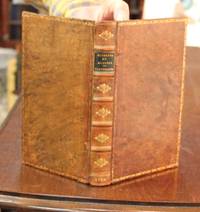
1748réf. 7795Martin / Coignard et Boudet / Mariette / Guérin Paris 1748 Quatorze volumes in-4, 1748-1750, reliure plein veau raciné de l'époque, dos à cinq nerfs fleuronnés, pièces de titre de maroquin rouge, pièce de tomaison havane, titres et tomaisons dorés, double filet doré sur les coupes, tranches rouges. Ouvrage enrichi de cartes géographiques et de figures. 41 planches collationnées, la plupart dépliantes. Tome I : X- 957 p., 7 pl. Tome II : [2]-II-781p., 8 pl. Tome III : [4]-184-592 p., 3 pl. Tome IV : [4]-789, 14 pl. Tome V : [2]-V-753 p., 4 pl. Tome VI : [4]-680 p., 1 pl. Tome VII : [4]-924 p. Tome VIII : [2]-II-841 p. Tome IX : [2]-929 p., 1 pl. Tome X : [6]-110-653 p., 2 pl. Tome XI : [4]-192-614 p. Tome XII : IV-248-448 p., 1 pl. Tome XIII : VIII-927 p. Tome XIV : XXIV-232-187 p. (table des matières). Première édition de la "Sainte Bible" par Laurent-Etienne Rondet (1715-1785), dans la traduction de Port-Royal due pour l'essentiel à Isaac Lemaistre de Sacy. Ont été insérées les notes de Louis de Carrières en italiques et celles de Laurent-Étienne Rondet. En marge figure la Vulgate sixto-clémentine en latin. Les "notes littérales, les préfaces et les dissertations" sont tirées du "Commentaire" paru entre 1707 et 1716, du bénédictin Augustin Calmet (1672-1757). Dom Calmet, par sa rigueur d'analyse et ses commentaires nouveaux littéraux en français, a révolutionné la critique biblique. Son texte devint un texte de référence et servit de base à de nombreuses "Sainte Bible" qui parurent à partir de 1748 jusqu'à la fin XIXe, même si dès 1748 ses commentaires furent transformés et retravaillés. Cette édition originale de 1748 est recherchée également pour ses planches et ses cartes géographiques gravées. Coiffes usagées notamment des vol. I, II, III, IV, XI et XIII, galeries de vers en queue pour les vol. I, III, IV, VII, XI, XIII, intérieur frais dans l'ensemble. Bon exemplaire. PHOTOS NUMERIQUES DISPONIBLES PAR EMAIL SUR SIMPLE DEMANDE-DIGITAL PHOTOGRAPS MAY BE AVAILABLE ON REQUEST
1848réf. 026108Boston: Little Brown 1848. First . Hardcover. Near Fine. Folio - over 12 - 15" tall. Complete with alll 16 plates 2 of which are attributed to Godfrey N. Frankenstein 1820-1873. Original dark brown cloth binding with original decorative gilt titles on the front cover. This particular example also boasts the ownership signature Fully investigated & referenced of Hiester Henry Muhlenberg 1812-1886 He was a member of the distinguished Muhlenberg family of Pennsylvania. And the bookplate where he/his family apparently donated the volume many decades ago 'The Reading Public Museum and Art Gallery' both on the inside of the front cover. Inside the rear cover is a small trapazoidal piece of manilla card where assumed an inventory card was kept. Book was clearly NOT for public viewing. Plates are in lovely near fine to fine condition with none of the usual foxing as seen in most examples. All are perfect for framing or to keep whole for propserity. The corners & spine ends a bit worn. A very nice example of this cornerstone to any White Mountains Book Collection. Oakes was drowned in the same year of this publication 1848 somewhere between East Boston & Boston. One wonders what he would have done to top this masterpiece had he lived. Bents page 1 Second listing of 'The Classics'. The plates are as follows: 1 "The White Mountains" 2 "Mount Crawford" 3 "The Notch of the White Mountains" 4 "The Lower Cascade of the Notch" 5 "The Gate of the Notch" 6 "The Falls of the Amonoosuck" 7 "The Granite Cliffs of the Falls" two views 8 "The Franconia Notch" 9 "Profile Mountain at Franconia" 10 "The Profile Rock" 11 "The Basin in Lincoln N.H." 12 "The Flume in Lincoln N.H." 13 "Nancy`s Bridge" 14 "Mt. Crawford from the Notch" two views 15 "Mount Washington" two views and 16 "Mt. Washington over Tuckerman`s Ravine." Come by for a look! Little Brown, hardcover
1986réf. 51364BASTEI-LÜBBE 1986. 1. softcover. BASTEI-LÜBBE paperback
2008réf. x-0521739535Cambridge University Press 2008. 7 Paperback books. New. 1st edition. 3834 pages. 11.00x8.25x8.00 inches. Cambridge University Press paperback
1697réf. 45644Leipzig, Grosse & Gleditsch, 1697. 4to. No wrappers. In: ""Acta Eruditorum Anno MDCXCVII"", No V, May-issue. Pp. 193-240 (entire issue offered). With titlepage to the volume 1697. Leibniz: pp. 201-205. Johann Bernoulli: pp. 206-211. Jacob Bernoulli: pp. 211-214. Newton: pp. 223-224. As usual, some leaves with browning.
1697réf. 45644Leipzig Grosse & Gleditsch 1697. 4to. No wrappers. In: "Acta Eruditorum Anno MDCXCVII" No V May-issue. Pp. 193-240 entire issue offered. With titlepage to the volume 1697. Leibniz: pp. 201-205. Johann Bernoulli: pp. 206-211. Jacob Bernoulli: pp. 211-214. Newton: pp. 223-224. As usual some leaves with browning. First appearance of the famous issue of Acta Eruditorum in which the 4 solutions by the 4 most eminent mathematicians at the time were printed together. There were in all 5 solutions to the posed problem and Newton's solution was first printed in the Philosophical Transactions January 1697 and reprinted here. The solution proposed by L'Hopital not printed here was not published until 1988.The brachistochrone problem was posed by Johann Bernoulli in Acta Eruditorum in June 1696. He introduced the problem as follows: "I Johann Bernoulli address the most brilliant mathematicians in the world. Nothing is more attractive to intelligent people than an honest challenging problem whose possible solution will bestow fame and remain as a lasting monument. Following the example set by Pascal Fermat etc. I hope to gain the gratitude of the whole scientific community by placing before the finest mathematicians of our time a problem which will test their methods and the strength of their intellect. If someone communicates to me the solution of the proposed problem I shall publicly declare him worthy of praise." Johann Bernoulli and Leibniz deliberately tempted Newton with this problem. It is not surprising given the dispute over the calculus that Johann Bernoulli had included these words in his challenge:- ."there are fewer who are likely to solve our excellent problems aye fewer even among the very mathematicians who boast that they. have wonderfully extended its bounds by means of the golden theorems which they thought were known to no one but which in fact had long previously been published by others."According to Newton's biographer Conduitt he solved the problem in an evening after returning home from the Royal Mint. Newton: . "in the midst of the hurry of the great recoinage did not come home till four in the afternoon from the Tower very much tired but did not sleep till he had solved it which was by four in the morning."Newton send his solution to his friend Charles Montague and Montague published anonymously in the Transactions. Newton's solution presented here in the Acta is also anonymous. The episode did not please Newton as he later wrote: "I do not love to be dunned pestered and teased by foreigners about mathematical things ." After the competition Johann Bernoulli said ". my elder brother made up the fourth of these after Leibniz himself and Newton that the three great nations Germany England and France each one of their own to unite with myself in such a beautiful search all finding the same truth."Struik Edt. "A Source Book in Mathematics 1200-1800 pp. 391 ff. unknown
réf. 84308002London 1834 Parbury. Full calf raised bands gilt stamped spine decorations text in French 460p. index chronology a bright copy Japanese text characters ca. 22 x 28 cm. FIRST & ONLY EDITION R A R E Translation of the "Nippon O-dai Ichiran" Chronology of Japanese Rulers by Hayashi Shunsai which was originally published in 1663. . According to the preface the translation was made with the help of three Japanese interpreters at Nagasaki who gave Titsingh an oral Dutch translation. Klaproth subsequently checked Titsingh's manuscript against the original Japanese text revised it and produced a supplement for the period covering 1611-1834. . A very important Dutch Deshima study & translation of an important study on Japan's early Imperial history. With notes and preface by M.J. Klaproth: "D'un Apercu de L'Histoire Mythologique du Japon." . REFERENCE: H. Cordier: JAPONICA: 450. . . unknown
1998réf. 50621BASTEI-LÜBBE 05/1998. 1. softcover. Lucky Starr: Weltraum-Ranger 211382114121143211452114721149 BASTEI-LÜBBE paperback
1985réf. 47836SCHERZ 1985. 1. hardcover. SCHERZ hardcover
1983réf. 39846HEYNE WILHELM 1983. 12.ND. softcover. Roboter-Foundation Glata Kovrajo! HEYNE, WILHELM paperback
1954réf. 00633THE FUN THEY HAD" ORIGINAL CARBON TYPESCRIPT being 5 pages plus cover sheet about 1100 words light wear to the final leaf else vg/near fine with two typed corrections. This short story was first published in a syndicated newspaper in 1951 then in the February 1954 issue of Fantasy and Science Fiction. It was first printed in book format in 1955 by Perma Books in the anthology OPERATION FUTURE and collected later in the authors own collection of short stories published by Doubleday in 1957 entitled EARTH IS ROOM ENOUGH. Perhaps your best opportunity to purchase a manuscript by one of the most important authors in the genre. Housed in a most attractive pictorial and gold-gilt lettered tray-case. Fantasy and Science Fiction unknown
1954réf. 00633THE FUN THEY HAD" ORIGINAL CARBON TYPESCRIPT being 5 pages plus cover sheet about 1100 words light wear to the final leaf else vg/near fine with two typed corrections. This short story was first published in a syndicated newspaper in 1951 then in the February 1954 issue of Fantasy and Science Fiction. It was first printed in book format in 1955 by Perma Books in the anthology OPERATION FUTURE and collected later in the authors own collection of short stories published by Doubleday in 1957 entitled EARTH IS ROOM ENOUGH. Perhaps your best opportunity to purchase a manuscript by one of the most important authors in the genre. Housed in a most attractive pictorial and gold-gilt lettered tray-case. Fantasy and Science Fiction unknown books
1733réf. 184646Rotterdam: Michel Bohm & Compagnie 1733. Text in French. Nine volumes footballing over 4500 pages title page ornaments a few small decorative initials decorative tailpieces the title pages printed in red & black; cr. 12mo; contemporary red morocco spines lettered and decorated in gilt compartments between raised bands featuring fleurs de lys and the royal monogram of Louis XVinterlaced double L with crown boards with triple gilt rule border and royal coat of arms at centre gilt edges; dentelles decorated in gilt; all edges sprinkled red; endpapers browned a couple of small edge tears some marginal damp stains and occasional slight soiling a little light foxing; Michel Bohm & Compagnie Rotterdam 1733. New edition. Loosely inserted is a folded sheet of a previous owner's handwritten notes in French with purchase date of 1924 about the significance of Larrey's work and the binding of the present set which is in the style of the royal library of Louis XV. Isaac de Larrey c. 1638-1719 was a French Huguenot who fled to the Netherlands after the revocation of the Edict of Nantes in 1685 made Protestantism illegal in France. The volumes of his history of the reign of Louis XIV were issued in Rotterdam from 1718 to 1722. Larrey later entered the service of the Elector of Brandenburg in Berlin. Perhaps because it was written in exile his depiction of the Sun King's reign is regarded as more impartial than some other contemporary accounts. Michel Bohm, & Compagnie unknown
réf. 325487New York: Doubleday & Company 1971. First Edition; First Printing. Hardcover. Very Good in a Very Good dust jacket. Small owner nameplate on FEP. 1 inch closed tear on bottom front panel.; Half title page inscribed by Isaac Asimov.; Signed by Author. Doubleday & Company hardcover
1953réf. 003497Doubleday 1953. 1st Edition 1st Printing. Hardcover. Very Good Minus/Good Plus. Richard Powers. First edition/printing. Book is in Very Good Minus condition predominantly with moderate shelf wear and spine aging. The dust jacket in a protector is in Good Plus condition with much wear but yet nicely intact for this very scarce title with jacket not price clipped. Inscribed by Asimov as himself AND Paul French on FFE! Another sharp Richard Powers cover which is repeated upside down on the title page. Second book in the Starr Young Adult SF series by the inimitable Asimov. Doubleday hardcover
1752réf. B4844London : Samuel Peterson c.1752. . A near fine copy. Plates and text are clean and crisp. . Edition: Second Edition. Binding: Contemporary calf boards with gilt decorative borderings. Rebacked skillfully. Spine in six compartments of raised bands with gilt decorative devices and rulings. Gilt title on green calf label on 2. Notes: This is one of the most important works introducing Newtonian physics to continental Europe. Wilhelm Jacob Gravesande 1688-1742 was a Dutch lawyer and natural philosopher chiefly remembered for developing experimental demonstrations of the laws of classical mechanics. As professor of mathematics astronomy and philosophy at Leiden University he helped to propagate Isaac Newton’s ideas in Continental Europe. Size: 8vo. 184x127mm. Illustration: Illustrated with a multitude of in text equations as well as 4 fold out plates depicting mathematical relationships. Pages: P. Title Blank Preface iii-iv 1-187 Category: Book Science & Technology; Samuel Peterson hardcover
1726réf. 9030959London: John Clark and Richard Hett et al. 1726. 2nd. Hardcover. Very good. Signed on front free endpaper by previous owner Ronald Salmon Crane former member of University of Chicago faculty and the "Chicago School of Literary Criticism." Rebound in half black leather and pebbled cloth boards with spine stamped in gilt. Minor wear to extremities one corner through cloth head and heel of spine chipped. Text block is in remarkable fine condition; tight clean and bright. Each page is separated from the next by a page of tissue. A few small neat notes on front endpapers. 4 1/2 x 7 inches. 326 pages plus tissue-pages. John Clark and Richard Hett, et al. hardcover
1726réf. 9030959London: John Clark and Richard Hett et al. 1726. 2nd. Hardcover. Very good. Signed on front free endpaper by previous owner Ronald Salmon Crane former member of University of Chicago faculty and the "Chicago School of Literary Criticism." Rebound in half black leather and pebbled cloth boards with spine stamped in gilt. Minor wear to extremities one corner through cloth head and heel of spine chipped. Text block is in remarkable fine condition; tight clean and bright. Each page is separated from the next by a page of tissue. A few small neat notes on front endpapers. 4 1/2 x 7 inches. 326 pages plus tissue-pages. John Clark and Richard Hett, et al. hardcover books
réf. 9159524Short description: In Russian. Sivers, Evstafiy Evstafievich. General Accounting. You are welcome to reach out to us for a detailed description of the copies currently available. Delivery of this book may take longer than usual including extended processing and pre-shipping time, no expedited shipping is available. Please advise us if you have a set date or a deadline to receive your order.SKU9159524
réf. 818171838. ca. 26 x 205 cm gerahmt Handschriftlicher 13-zeiliger Brief in Tinte datiert «Lucerne le 26 Mars 1838» in dem Guillaume-Henri Dufour einem «Wolfsberger» wohl Isaac Christian Wolfsberger dessen Beförderung zum «Second Lieutenant dans le Corps du Génie fédérale» ankündigt gezeichnet «votre dévoué / G. H. Dufour». «Isaac Christian Wolfsberger Wolfschberger geboren 6.12.1801 Genf gestorben 27.2.1876 Genf ref. von Genf. . Architektur- und Ingenieurausbildung in München. Ab 1837 arbeitete W. für Guillaume-Henri Dufour den er 1820 im Militär kennengelernt hatte an der Aufnahme der Genfer Kantonskarte in der damals modernen Technik der Höhenkurven. Als Mitarbeiter an der Dufourkarte führte er vereinfachende und effiziente Methoden für die Geländeaufnahme ein und gilt als einer ihrer gewandtesten Zeichner. 1842 trat W. als Ingenieur ins Genfer Dep. für öffentl. Arbeiten ein und übernahm es 1853 als Staatsrat. Sein Gesamtplan zur Stadterweiterung wurde nur z.T. ausgeführt. Ab 1855 war er Ingenieur der Genfer Gaswerke. 1838-51 Offizier im Quartiermeisterstab»; «Guillaume-Henri Dufour geboren 15.09.1787 Konstanz gestorben 14.7.1875 Les Eaux-Vives heute Gem. Genf ref. von Genf. . D. war zwei Jahre alt als seine Eltern nach Genf zurückkehrten das sie anlässlich der Wirren von 1782 verlassen hatten. Er besuchte das Collège in Genf und studierte dann Geisteswissenschaft und Physik an der Akademie. 1807-09 besuchte er die Ecole polytechnique in Paris 1809-10 die Ecole supérieure d'application du génie in Metz. Ab 1811 leistete D. Dienst in der franz. Armee. Als er auf Korfu in einer Militärgarnison stationiert war - er beteiligte sich dort am Bau von Befestigungsanlagen - wurde er im Juni 1813 auf See bei einer Konfrontation mit den Engländern verletzt. Er wurde zum Hauptmann im Generalstab befördert und nahm 1814 am Frankreichfeldzug teil. Nach seiner Rückkehr nach Genf quittierte er 1817 den Dienst in der franz. Armee. 1817-50 ab 1828 in offizieller Funktion war er Kantonsingenieur in Genf. Ab 1821 gab er an der Genfer Akademie sporadisch Unterricht in Mathematik Geometrie Vermessungskunde und Hydraulik. Ab 1823 baute er in der Stadt mehrere Hängebrücken darunter den Pont des Bergues 1833-34 und gestaltete ab 1827 die Uferpromenade und einen Teil des Seebeckens; 1845-56 überwachte er die Erstellung des kantonalen Katasters. Zwischen 1829 und 1850 reiste er mehrmals nach Frankreich um dort die Realisierung von Industrie- und Eisenbahnprojekten zu verfolgen. Er setzte sich 1851 aktiv für die Errichtung einer Eisenbahnlinie Lyon-Genf ein.1817 wurde D. im Grad eines Hauptmanns in das neu geschaffene Bundesheer integriert; 1820 erfolgte die Ernennung zum Oberstleutnant 1827 zum Oberst. 1819 war er Mitbegründer der Militärschule von Thun. Hier amtierte er bis 1831 als Genie-Instruktor und Lehrer von Louis-Napoleon Bonaparte dem künftigen Napoleon III. mit dem er sein Leben lang befreundet blieb. 1831 wurde er zum Chef der Generalstabsabteilung ernannt. Er hatte somit den Auftrag im Falle eines Krieges in Europa die Verteidigung der Schweiz zu organisieren. Im folgenden Jahr wurde er zum Oberstquartiermeister der Eidgenossenschaft Generalstabschef ernannt. In dieser Eigenschaft nahm er an den Tagsatzungen teil und leitete die Triangulationen für die Erstellung einer Karte der Schweiz im Massstab 1:100'000. Die Arbeiten für die sog. Dufour-Karte begannen 1832 und wurden 1864 beendet Kartografie. 1833 beauftragte ihn die Tagsatzung aufgrund von Unruhen mit einer Division Basel zu besetzen. 1838 versetzte D. Genf in Verteidigungsbereitschaft um in der Affäre um Prinz Louis-Napoleon Bonaparte einen franz. Angriff zu verhindern. 1843 kommandierte er die Truppen die Konfrontationen zwischen Genfer Konservativen und Radikalen unterdrücken sollten. Am 21.10.1847 ernannte ihn die Tagsatzung zum General zum Befehlshaber der eidg. Truppen. Er erhielt einen Auftrag den er trotz gewisser Bedenken annahm: Er sollte den Sonderbund auflösen. Am 4. und 5.11.1847 richtete er zuerst an seine Divisionäre dann an seine Truppen eine Empfehlung und eine Proklamation die Ausschreitungen vermeiden sollte. Nach einem geschickt geführten und fast unblutigen dreiwöchigen Feldzug kapitulierten die abtrünnigen Kantone. D. verpflichtete seine Truppen stets dazu sich an strenge humanitäre Grundsätze zu halten. Als Anerkennung sprach ihm die Tagsatzung eine Ehrengabe von 40'000 Franken zu. Während der Revolution im Grossherzogtum Baden im August 1849 ernannte ihn die Bundesversammlung erneut zum Oberbefehlshaber um allfällige Übergriffe auf die Schweiz zu verhindern. Auch während des Neuenburgerhandels erteilte ihm die Bundesversammlung den Oberbefehl über die Truppen 27.12.1856. 1859 befehligte er erneut die Schweizer Armee als diese anlässlich des sard.-franz. Krieges gegen Österreich mobilisiert wurde.Neben seinen Tätigkeiten als Ingenieur und Offizier war D. sowohl in Genf als auch auf Bundesebene politisch aktiv. In Genf wurde er 1819 in den Repräsentierenden Rat gewählt wo er die Liberalen vertrat. 1830 sprach er sich für eine Bundesflagge aus; ausserdem war er der zweite Vertreter seines Kantons an der ausserordentl. Tagsatzung. Nach der Genfer Revolution vom November 1841 wurde er in den Verfassungsrat und 1842 in den Grossen Rat und in den Gemeinderat Legislative gewählt. Nach der Revolution von 1846 war er ein Gegner der Radikalen und ihres Führers James Fazy. Auf nationaler Ebene vertrat er im Nationalrat 1848-51 das Berner Seeland und 1854-57 Genf; 1862-66 sass er für den Kt. Genf im Ständerat. Hier befasste er sich u.a. mit der Ratifizierung des Abkommens über das Dappental. Im März 1860 intervenierte er im Savoyerhandel vergeblich bei Napoleon III. um die Annexion des Chablais und des Faucigny durch Frankreich zu verhindern. 1863 war er einer der fünf Mitbegünder des Comité international de secours aux militaires blessés dem späteren IKRK dem er im ersten Jahr vorstand. Von 1847 bis 1855 hatte D. auch einen Sitz in der Genfer Synode inne.D. verfasste ein "Lehrbuch der Taktik" 1842 franz. 1840 sowie Arbeiten über Befestigungen und verschiedene militärhistorische Studien. Seine Tätigkeit als Ingenieur und Wissenschaftler war äusserst vielfältig: Er befasste sich u.a. mit den Bereichen Geometrie Kartenprojektion Brückenstatik Widerstand von Festkörpern angewandte Mechanik Vermessungskunde Hydraulik Wasserstandsmessung und gnomonische Projektion. Seine Karte der Schweiz gilt als Pionierwerk. D. spielte ferner eine entscheidende Rolle bei der städteplanerischen und baulichen Gestaltung Genfs und bei der Festlegung der Streckenführung der Eisenbahn in der Schweiz. Der von Natur aus konservative D. war als "Mann der goldenen Mitte" juste milieu stets ein Gegner von Extremen und ein unermüdlicher Vorkämpfer für den nationalen Zusammenhalt. Er war Ritter 1814 Kommandeur 1848 Grossoffizier 1852 und Grosskreuzträger 1866 der Ehrenlegion und erhielt zahlreiche weitere Auszeichnungen aus dem Ausland» HLS. 010 1838 unknown
réf. 84308004Paris 1834 Oriental Translation Fund. Green pebbled cloth spine neatly rebacked in matching green goat leather gold stamped spine titles 458p. index large format 22 x 29.5 cm. small stamp on title page. FIRST & ONLY EDITION Translation of the "Nippon O-dai Ichiran" Chronology of Japanese Rulers by Hayashi Shunsai which was originally published in 1663. . According to the preface the translation was made with the help of three Japanese interpreters at Nagasaki who gave Titsingh an oral Dutch translation. Klaproth subsequently checked Titsingh's manuscript against the original Japanese text revised it and produced a supplement for the period covering 1611-1834. . A very important Dutch Deshima study & translation of an important study on Japan's early Imperial history. With notes and preface by M.J. Klaproth: "D'un Apercu de L'Histoire Mythologique du Japon." . REFERENCE: H. Cordier: JAPONICA: 450. . . unknown
réf. 9275Tel Aviv Israel: Masada Publishing 1975. First Hebrew Edition. Hardcover. Very Good. 5 1/8 X 8 Inches. 208 PP. First Hebrew edition in the original glossy illustrated boards. Translated into Hebrew by Haim Glickstein. Inscribed "To Stan Bercowitch / with thanks / Isaac Asimov / 16 Dec. 75" directly on the title-page. Cover artwork by A. Darian. Scuffing and light wear to board edges and covers. Rubbing to spine ends. A scarce book in commerce to find signed in any language. Masada Publishing hardcover
1861réf. 000012411Cambridge: Macmillan and Co 1861. First edition. Hardcover. Near Fine. 8vo. 5 vi-xii 532 1-24 publisher's advertisements pp. Bound in dark green cloth rectangular borders stamped in blind on the boards gilt lettering on the spine light brown endpapers and pastedowns. Illustrated with numerous in-text equations and a folding plate with 12 diagrams. Presentation copy with "From the Author" this phrase not written by Todhunter written on the half-title page followed by the recipient's name affiliation and the date; all of the latter information in the author's hand. Oxford DNB J. B. Mullinger revised by Adrian Rice "Todhunter Isaac 1820-1884"; Bibliotheca Chemico-Mathematica 249; Dauben 1361. Todhunter was one of the best-known British mathematicians of the nineteenth century. He was a lecturer in mathematics at Cambridge from 1849 until his death in 1884. Although he made some original contributions to mathematics his reputation largely rests upon his work in the history of mathematics; he wrote several influential books on the subject including the present volume. The book was intended to extend the well-known treatment of the history of the calculus by Woodhouse through the middle of the nineteenth century and includes coverage of the work of Lagrange Gauss Poisson Cauchy and others. An exceptional copy of this important work in the history of mathematics with an interesting association and scarce thus. An attractive Near Fine copy with minor wear to the extremities. Macmillan and Co hardcover
1808réf. 33787London: for Samuel Bagster In the Strand 1808. The First Bagster Edition a RARE EXTRA ILLUSTRATED AND LARGE PAPER COPY. Vignette half-title engraved portrait frontispiece 17 illustrations of fish within the text 17 additional full-page hand coloured plates of the fishes depicted15 full page engraved plates in black and white 2 pages of engraved music some additioinal wood cuts in the text. A unique copy EXTRA ILLUSTRATED. Royal 8vo bound in full contemporary calf the covers with double gilt fillet rules at the borders the spine with raised bands gilt stopped and coloured compartments richly tooled in blind lettered in gilt in one compartment marbled endleaves. vi 512 pp. A very good copy with some mild rubbing to the extremities the binding is strong the text-block and illustrations are clean and well preserved. VERY RARE EXTRA ILLUSTRATED COPY OF THE FIRST BAGSTER EDITION. THE ADDITIONAL PLATES ARE OF FISHES AND ARE ALL HAND COLOURED. A beloved classic of the English language and what many call the finest "How-To" book ever written; Walton's ANGLER has been described as "full of wisdom kindly humour and charity; it is one of the most delightful and care-dispelling books in the language." "More than most authors he lives in his writings which are the pure expression of a kind humorous and pious soul in love with nature while the expression itself is unique for apparent simplicity which is really elaborately studied art" DNB. for Samuel Bagster, In the Strand hardcover