[Juan y Santacilia, Jorge]; [Ulloa, Antonio de]; [Torres Villarroel, Diego de]; [Newton, Isaac]Biblio.com
31.744 resultados
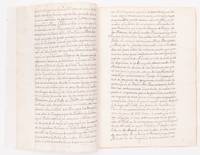
1752ref. 1862Spain 1752. 18th-century manuscript. Text in Spanish. 24 handwritten pages in ink in three different hands. Later binding of blank paper using old material. Tiny wormholes at the lower edge of the pages on the first 7 leaves not affecting the legibility. Occasional foxing ink ghosting. Water stains on the last 2 leaves. Overall in fine condition. 18th-century manuscript. Text in Spanish. 24 handwritten pages in ink in three different hands. ff 12. 18th-Century Spanish manuscript about the Spanish involvement in the French Geodesic Mission of 1735 and the Ellipsoid Model of the Earth. The manuscript is an interesting collection of contemporary reports proving the importance of the Spanish role performed by Jorge Juan y Santacilia and Antonio de Ulloa in the so-called French Geodesic Mission 1735 with a particular focus on the polemic over the shape of the Earth. The quotations are conjugated with connecting texts by an anonymous author. One of the important scientific disputes of the late 17th early 18th century was the debate on the shape of the Earth. The assumption of the spherical shape was dominating until the late 17th century when Sir Isaac Newton determined that the Earth was oblate a spheroid stretched over the Equator however at the same time Giovanni Domenico Cassini and his son Jacques supposed that the Earth was prolate stretched along the poles. Eventually in 1735 two expeditions were sent by Louis XV and the French Academy to the Arctic Circle Lapland and to the Equator Ecuador and Peru to gain certainty by measuring the meridian arcs at polar and equatorial latitudes. The equatorial mission was accompanied by two Spanish geographers Jorge Juan y Santacilia and Antonio de Ulloa thus it became the first major international scientific expedition. The findings of the missions confirmed Newton’s hypothesis that the Earth was oblate a rotational ellipsoid. The first part of the manuscript is a lengthy citation of an early Spanish report on the equatorial mission published in the Mercurio histórico y político February 1745; pp. 99–107 which is followed by further references and quotations related to the geographer’s their work and the figure of the Earth such as Benito Jerónimo Feijóo y Montenegro’s Theatro critico universal 1751 Bernardo’s de Ulloa’s Antonio’s father Restablecimento de las fabricas y comercio español 1749 and articles from the Journal de Trévoux or the Gaceta de Zaragoza. The second part is Diego de Torres Villarroel’s 1693–1770 study Prevenciones in: Libros en que estan reatados. Vol. IV.; 1752 in which de Torres the almanac writer and professor of mathematics of a dubious repute opposes the findings of the missions and Newton’s hypothesis of the oblate Earth. Antonio de Ulloa 1716–1795 was a Spanish scientist and explorer the first Spanish governor of Louisiana who is also credited as the discoverer of the element platinum. De Ulloa was a Fellow of the Royal Society and a foreign member of the Royal Swedish Academy of Sciences. His associate Spanish scientist in the Geodesic Mission to Peru was Jorge Juan y Santacilia 1713–1773 who during the mission also measured the heights of the mountains of the Andes. Jorge Juan was the founder of the Real Observatorio de Madrid Royal Observatory of Madrid and he became a Fellow of the Royal Society too. Their co-written memoirs were published in Spanish from 1748 on and their books were very soon translated into French English and German. Literature: Lafuente A.; Mazuecos A.: Gentlemen of the Fixed Point: Science Politics and Adventure in the Geodesic Expedition to the Viceroyalty of Peru in the XVIII Century. pp. 171–203. Retrieved on July 8 2020 from Mayboudi L. S.: chapter 5.1 In: Geometry Creation and Import With COMSOL Multiphysics. Dulles VA USA: Mercury Learning & Information 2019.; Richardson D.; et al: The International Encyclopedia of Geography People the Earth Environment and Technology: Chichester UK; Hoboken NJ: John Wiley & Sons 2017. . unknown
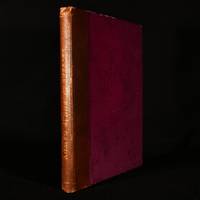
1906ref. 764R34London: J. B. Nichols and Sons 1906 . Cloth. Very Good. 11" by 8.5". None. A lovely collection of the letters of Philip Gawdy a prolific letter writer of the Tudor times. Philip Gawdy 1562-1617 was an English letter writer and landowner from a family of politicians; his letters are held at the British Library. During his lifetime he joined the crew of the 'Revenge' under Sir Richard Grenville's command and was captured and imprisoned in Portugal at the Battle of Flores.Contains a family tree of the Gawdy family.Printed by the Roxburghe Club. In a quarter morocco binding. Externally generally smart with slight rubbing to the head and tail of the spine and extremities. Internally firmly bound. Pages are uncut and bright and clean. Very Good J. B. Nichols and Sons hardcover
1997ref. Q-0300070543Yale University Press 1997-02-27. Paperback. New. New. In shrink wrap. Looks like an interesting title! Yale University Press paperback
1995ref. Q-0300059663Yale University Press 1995-04-26. Hardcover. New. In shrink wrap. Looks like an interesting title! Yale University Press hardcover
2002ref. Q-0300093136Yale University Press 2002-03-01. Paperback. New. In shrink wrap. Looks like an interesting title! Yale University Press paperback
1995ref. 195511New Haven CT: Yale University Press 1995. Second printing. Hardcover. 126 pages. Edited and with an introduction and notes by Carol J. Avins. Tranlated by H.T. Willetts. A clean and tight near fine copy in a very near fine dust jacket. Yale University Press unknown books
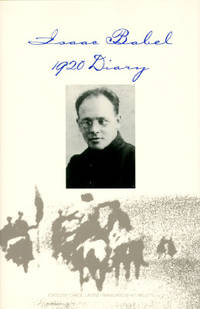
ref. B9780300093131Paperback / softback. New. This diary by Russian writer Isaac Babel recounts his experiences with the Cossack cavalry during the Polish-Soviet war of 1919-20. The basis for "Red Cavalry" Babel's best-known work it records the devastation of the war and the extreme cruelty of the Polish and Red Armies towards the Jews. paperback
1995ref. 004924Yale University Press. DJ in archival cover with a full number line starting with 1. . Fine. Hardcover. 1st Edition. 1995. Yale University Press hardcover
ref. 6511833Yale University Press . Papeback. New. pp. 194 Yale University Press unknown
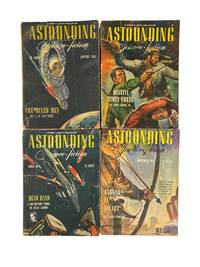
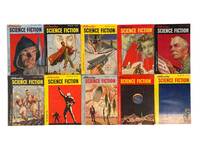
1945ref. 218001945. Magazines and PeriodicalsLiteratureSci-fi Astounding Science Fiction archive of four issues. New York: Street & Smith Publications January-December 1945. Original illustrated wraps. This postwar quartet of Astounding Science Fiction documents a transitional moment in the genre as authors grappled with nuclear anxieties technological utopianism and post-fascist global reordering. Under editor John W. Campbell Jr. the magazine continued its influential "Golden Age" output developing rigorous speculative narratives through hard science and moral philosophy. These issues feature early entries by foundational voices such as Isaac Asimov A.E. van Vogt and Fritz Leiber Jr. and include work under the pseudonym "Lewis Padgett" the collaborative pen name of Henry Kuttner and C.L. Moore-Moore being one of the earliest and most significant women in American science fiction. 1 Astounding Science Fiction Vol. XXXIV No. 5. January 1945. Features "The Mixed Men" by A.E. van Vogt a foundational novelette exploring themes of identity rebellion and human-machine hybridity that presaged cybernetic fiction. Includes short stories "The Canal Builders" by Robert Abernathy and "Enter the Professor" by E. Mayne Hull. Notably "The Waveries" by Fredric Brown uses humor and allegory to imagine a world where non-verbal alien parasites disrupt Earth's electromagnetic functions undermining modern communication. Cover by Timmins. 2 Astounding Science Fiction Vol. XXXV No. 1. March 1945. Contains Part I of "Destiny Times Three" by Fritz Leiber Jr. a parallel-universe thriller that remains one of the earliest science fiction treatments of alternate timelines and totalitarian control. The issue also features "Blind Alley" by Isaac Asimov a quietly profound short story examining the psychological plight of an alien confined by humans reflecting postwar debates on displacement and power. Additional contributions by A. Bertram Chandler and George O. Smith. 3 Astounding Science Fiction Vol. XXXV No. 2. April 1945. Highlights "Dead Hand" an early Foundation story by Isaac Asimov which explores the collapse of empire and the logic of psychohistory-a fictional science blending mathematics sociology and historical determinism. Includes "Correspondence Course" by Raymond F. Jones and "Brains for Bricks" by Malcolm Jameson. The article "Little Enough" by J.J. Coupling offers technical speculation on energy systems during a time of growing public awareness of atomic power. 4 Astounding Science Fiction Vol. XXXVI No. 5. December 1945. Features "Beggars in Velvet" by Lewis Padgett a pseudonym for the husband-wife duo Henry Kuttner and Catherine L. Moore. Moore's significant yet often underacknowledged role as co-author places her among the pioneering women in science fiction's formative years. Also included is the conclusion of Isaac Asimov's Foundation serial "The Mule" a key arc in the saga where a single mutant individual disrupts the predictive stability of psychohistory-Asimov's most memorable antagonist. Contributions by George O. Smith and Malcolm Jameson round out the issue. Cover by Timmins. All issues exhibit moderate wear consistent with age. Light edgewear and expected toning throughout with creasing to spines and minor chipping to extremities. Significant chipping to back wrappers on March and April issues and to bottom spine of January issue. Overall good condition. This archive captures critical voices of speculative fiction's Golden Age and documents contributions by one of the most important female writers in the genre's early history. unknown
1945ref. 218001945. Magazines and PeriodicalsLiteratureSci-fi Astounding Science Fiction archive of four issues. New York: Street & Smith Publications January-December 1945. Original illustrated wraps. This postwar quartet of Astounding Science Fiction documents a transitional moment in the genre as authors grappled with nuclear anxieties technological utopianism and post-fascist global reordering. Under editor John W. Campbell Jr. the magazine continued its influential "Golden Age" output developing rigorous speculative narratives through hard science and moral philosophy. These issues feature early entries by foundational voices such as Isaac Asimov A.E. van Vogt and Fritz Leiber Jr. and include work under the pseudonym "Lewis Padgett" the collaborative pen name of Henry Kuttner and C.L. Moore-Moore being one of the earliest and most significant women in American science fiction. 1 Astounding Science Fiction Vol. XXXIV No. 5. January 1945. Features "The Mixed Men" by A.E. van Vogt a foundational novelette exploring themes of identity rebellion and human-machine hybridity that presaged cybernetic fiction. Includes short stories "The Canal Builders" by Robert Abernathy and "Enter the Professor" by E. Mayne Hull. Notably "The Waveries" by Fredric Brown uses humor and allegory to imagine a world where non-verbal alien parasites disrupt Earth's electromagnetic functions undermining modern communication. Cover by Timmins. 2 Astounding Science Fiction Vol. XXXV No. 1. March 1945. Contains Part I of "Destiny Times Three" by Fritz Leiber Jr. a parallel-universe thriller that remains one of the earliest science fiction treatments of alternate timelines and totalitarian control. The issue also features "Blind Alley" by Isaac Asimov a quietly profound short story examining the psychological plight of an alien confined by humans reflecting postwar debates on displacement and power. Additional contributions by A. Bertram Chandler and George O. Smith. 3 Astounding Science Fiction Vol. XXXV No. 2. April 1945. Highlights "Dead Hand" an early Foundation story by Isaac Asimov which explores the collapse of empire and the logic of psychohistory-a fictional science blending mathematics sociology and historical determinism. Includes "Correspondence Course" by Raymond F. Jones and "Brains for Bricks" by Malcolm Jameson. The article "Little Enough" by J.J. Coupling offers technical speculation on energy systems during a time of growing public awareness of atomic power. 4 Astounding Science Fiction Vol. XXXVI No. 5. December 1945. Features "Beggars in Velvet" by Lewis Padgett a pseudonym for the husband-wife duo Henry Kuttner and Catherine L. Moore. Moore's significant yet often underacknowledged role as co-author places her among the pioneering women in science fiction's formative years. Also included is the conclusion of Isaac Asimov's Foundation serial "The Mule" a key arc in the saga where a single mutant individual disrupts the predictive stability of psychohistory-Asimov's most memorable antagonist. Contributions by George O. Smith and Malcolm Jameson round out the issue. Cover by Timmins. All issues exhibit moderate wear consistent with age. Light edgewear and expected toning throughout with creasing to spines and minor chipping to extremities. Significant chipping to back wrappers on March and April issues and to bottom spine of January issue. Overall good condition. This archive captures critical voices of speculative fiction's Golden Age and documents contributions by one of the most important female writers in the genre's early history. unknown books
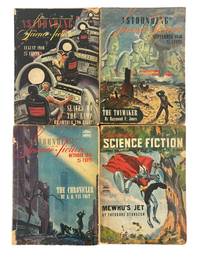
1946ref. 218301946. Magazines and PeriodicalsLiteratureSci-fi Astounding Science Fiction archive of four issues. New York: Street & Smith Publications August-November 1946. Four issues. Original illustrated wrappers. Each issue features wraparound painted covers by William Timmins with internal illustrations by Frank Kelly Freas and Charles Swenson. A consecutive four-issue run of the genre-defining pulp science fiction magazine Astounding edited by John W. Campbell Jr. at a turning point in the post-war sci-fi imagination. Each issue features contributions from leading Golden Age authors including Isaac Asimov Theodore Sturgeon A.E. van Vogt and Arthur Leo Zagat offering critical early treatments of emerging themes such as robotics post-nuclear dystopia and interspecies ethics. Archive includes: 1 Astounding Science Fiction Vol. XXXVII No. 6. August 1946. Includes the first part of Arthur Leo Zagat's two-part serial "Slaves of the Lamp" which explores mass surveillance and mind control via a dystopian industrial setting-Zagat was one of the more prolific Jewish-American authors working in pulp. Also featured are novelettes by Paul Carter "The Last Objective" B. Payne Hull "Bankruptcy Proceedings" and A.E. van Vogt "Child of the Gods" whose speculative narratives often address totalitarianism and psychological identity. Raymond F. Jones contributes the short story "The Cat and the King" while the science article "Radar: The Waves That 'Feel'" highlights technological fascination in the immediate postwar period. 2 Astounding Science Fiction Vol. XXXVIII No. 1. September 1946. Concludes Zagat's "Slaves of the Lamp." Features Raymond F. Jones's novelette "The Toymaker" a notable precursor to AI fiction and widely cited in early discussions of emotional robotics. Also includes Lawrence O'Donnell's "Vintage Season" a chilling time-travel narrative later adapted into the film Timescape-O'Donnell was a pseudonym for husband-wife writing team C.L. Moore and Henry Kuttner. Moore one of the earliest prominent female sci-fi writers was instrumental in shaping speculative fiction's psychological complexity though uncredited individually here. The short stories include "Evidence" by Isaac Asimov one of the most significant early robot stories in his canon wherein a robotic political candidate raises questions about civil rights and identity. 3 Astounding Science Fiction Vol. XXXVIII No. 2. October 1946. Debuts A.E. van Vogt's "The Chronicler" a philosophical serial exploring collective memory and historiography. Includes novelettes by John MacDougal Hal Clement and A. Bertram Chandler. Short stories "Alien" by George O. Smith and "To Still the Drums" by Chan Davis round out the issue-Davis an anti-fascist academic later blacklisted during McCarthyism used sci-fi to critique authoritarian regimes. The science article "The Atomic Pile" reflects ongoing interest in atomic energy. 4 Astounding Science Fiction Vol. XXXVIII No. 3. November 1946. Features the standout novelette "Mewhu's Jet" by Theodore Sturgeon a poignant first-contact narrative emphasizing empathy and nonviolence-an early and enduring example of humane alien fiction. Also includes Clifford D. Simak's "Hobbies" and short stories by Mark Champion and A. Bertram Chandler. Van Vogt's "The Chronicler" concludes in this issue. Notably many of the stories here grapple with the potential and peril of post-human evolution. Spines show wear with moderate edge chipping especially to the October issue which has tearing to staplebinding. November issue marked by inkstain on cover. Interior pages clean and complete. Overall good condition. A cohesive four-issue 1946 run featuring foundational authors of Golden Age science fiction including contributions from Theodore Sturgeon and Isaac Asimov and a collaborative story from pioneering female sci-fi writer C.L. Moore-representing both canonical and marginal voices grappling with technology ethics and identity in postwar America. unknown
1946ref. 218301946. Magazines and PeriodicalsLiteratureSci-fi Astounding Science Fiction archive of four issues. New York: Street & Smith Publications August-November 1946. Four issues. Original illustrated wrappers. Each issue features wraparound painted covers by William Timmins with internal illustrations by Frank Kelly Freas and Charles Swenson. A consecutive four-issue run of the genre-defining pulp science fiction magazine Astounding edited by John W. Campbell Jr. at a turning point in the post-war sci-fi imagination. Each issue features contributions from leading Golden Age authors including Isaac Asimov Theodore Sturgeon A.E. van Vogt and Arthur Leo Zagat offering critical early treatments of emerging themes such as robotics post-nuclear dystopia and interspecies ethics. Archive includes: 1 Astounding Science Fiction Vol. XXXVII No. 6. August 1946. Includes the first part of Arthur Leo Zagat's two-part serial "Slaves of the Lamp" which explores mass surveillance and mind control via a dystopian industrial setting-Zagat was one of the more prolific Jewish-American authors working in pulp. Also featured are novelettes by Paul Carter "The Last Objective" B. Payne Hull "Bankruptcy Proceedings" and A.E. van Vogt "Child of the Gods" whose speculative narratives often address totalitarianism and psychological identity. Raymond F. Jones contributes the short story "The Cat and the King" while the science article "Radar: The Waves That 'Feel'" highlights technological fascination in the immediate postwar period. 2 Astounding Science Fiction Vol. XXXVIII No. 1. September 1946. Concludes Zagat's "Slaves of the Lamp." Features Raymond F. Jones's novelette "The Toymaker" a notable precursor to AI fiction and widely cited in early discussions of emotional robotics. Also includes Lawrence O'Donnell's "Vintage Season" a chilling time-travel narrative later adapted into the film Timescape-O'Donnell was a pseudonym for husband-wife writing team C.L. Moore and Henry Kuttner. Moore one of the earliest prominent female sci-fi writers was instrumental in shaping speculative fiction's psychological complexity though uncredited individually here. The short stories include "Evidence" by Isaac Asimov one of the most significant early robot stories in his canon wherein a robotic political candidate raises questions about civil rights and identity. 3 Astounding Science Fiction Vol. XXXVIII No. 2. October 1946. Debuts A.E. van Vogt's "The Chronicler" a philosophical serial exploring collective memory and historiography. Includes novelettes by John MacDougal Hal Clement and A. Bertram Chandler. Short stories "Alien" by George O. Smith and "To Still the Drums" by Chan Davis round out the issue-Davis an anti-fascist academic later blacklisted during McCarthyism used sci-fi to critique authoritarian regimes. The science article "The Atomic Pile" reflects ongoing interest in atomic energy. 4 Astounding Science Fiction Vol. XXXVIII No. 3. November 1946. Features the standout novelette "Mewhu's Jet" by Theodore Sturgeon a poignant first-contact narrative emphasizing empathy and nonviolence-an early and enduring example of humane alien fiction. Also includes Clifford D. Simak's "Hobbies" and short stories by Mark Champion and A. Bertram Chandler. Van Vogt's "The Chronicler" concludes in this issue. Notably many of the stories here grapple with the potential and peril of post-human evolution. Spines show wear with moderate edge chipping especially to the October issue which has tearing to staplebinding. November issue marked by inkstain on cover. Interior pages clean and complete. Overall good condition. A cohesive four-issue 1946 run featuring foundational authors of Golden Age science fiction including contributions from Theodore Sturgeon and Isaac Asimov and a collaborative story from pioneering female sci-fi writer C.L. Moore-representing both canonical and marginal voices grappling with technology ethics and identity in postwar America. unknown books
1952ref. 217991952. Magazines and PeriodicalsLiteratureSci-fi Astounding Science Fiction archive of ten issues. : Street & Smith Publications January-December 1952. Original illustrated wraps. This full-year run of Astounding Science Fiction captures the magazine under the long-standing editorship of John W. Campbell Jr. who shepherded the Golden Age of science fiction with an emphasis on rationalism engineering ethos and human problem-solving. These 1952 issues feature pivotal contributions by influential genre authors such as Isaac Asimov Walter M. Miller Jr. Jack Vance Gordon R. Dickson and Eric Frank Russell. While Campbell's editorial direction leaned heavily toward hard science narratives this archive also reflects early intersections with Cold War anxiety postwar technocratic idealism and philosophical experimentation that would lay groundwork for New Wave science fiction. The presence of few female writers or authors of color highlights the period's gender and racial homogeneity within major genre magazines. 1 Astounding Science Fiction Vol. XLVIII No. 5. January 1952. Features "Telex" by Jack Vance short novel and "That Share of Glory" by C.M. Kornbluth a tale of cultural diplomacy through a monastic order in space now recognized as a Cold War allegory. 2 Astounding Science Fiction Vol. XLVIII No. 6. February 1952. Includes "Firewater" by William Tenn Philip Klass a social satire featuring alien contact and Cold War power dynamics and early work by Gordon R. Dickson and James Blish. 3 Astounding Science Fiction Vol. XLIX No. 1. March 1952. Debut of Gunner Cade by Cyril Judd C.M. Kornbluth & Judith Merril an unusual pseudonymous collaboration; also includes Jack Williamson's "Man Down" and stories by H.B. Fyfe and Matthew M. Cammen. 4 Astounding Science Fiction Vol. XLIX No. 2. April 1952. Features "Dumb Waiter" by A Canticle for Leibowitz author Walter M. Miller Jr. and stories by Raymond F. Jones and Julian Chain. Serial installment of Gunner Cade continues. 5 Astounding Science Fiction Vol. XLIX No. 3. May 1952. Concludes Gunner Cade and includes "Blood's a Rover" by Chad Oliver an anthropologist whose fiction often tackled cross-cultural and racial themes though under the genre's dominant lens. 6 Astounding Science Fiction Vol. XLIX No. 4. June 1952. Highlights "Blood Bank" by Walter M. Miller Jr. and "The Specter General" by Theodore Cogswell a militarized satire of decaying empires frequently anthologized for its wit and genre-defying tone. 7 Astounding Science Fiction Vol. L No. 1. September 1952. Contains "Frontier of the Dark" by A. Bertram Chandler with commentary on leadership and isolation and "Improbable Profession" by Leonard Lockhard a pen name of F. Orlin Tremaine reflecting on the writing life. 8 Astounding Science Fiction Vol. L No. 2. October 1952. Isaac Asimov's The Currents of Space Part One a planetary romance engaging with themes of colonization and class appears alongside a Walter M. Miller Jr. short story and additional work by Edwin James and Dean McLaughlin. 9 Astounding Science Fiction Vol. L No. 3. November 1952. Asimov's serial continues; Eric Frank Russell contributes "Last Blast" and Algis Budrys's "The High Purpose" explores social stratification and ideological conformity. 10 Astounding Science Fiction Vol. L No. 4. December 1952. Conclusion of The Currents of Space. Features "The Impacted Man" by Robert Sheckley-known for his later surrealism-and work by Mack Reynolds Fredric Brown and Randall Garrett. Light toning and edge wear consistent with age; some issues show minor spine creasing rubbing or corner bumps. Interiors generally clean and legible. Overall very good condition. This complete annual set captures the editorial consolidation of Campbell's vision the emergence of authors who would become luminaries in American science fiction and the subtle cultural shifts that preceded the genre's later expansion into broader more inclusive territory. unknown
1952ref. 217991952. Magazines and PeriodicalsLiteratureSci-fi Astounding Science Fiction archive of ten issues. : Street & Smith Publications January-December 1952. Original illustrated wraps. This full-year run of Astounding Science Fiction captures the magazine under the long-standing editorship of John W. Campbell Jr. who shepherded the Golden Age of science fiction with an emphasis on rationalism engineering ethos and human problem-solving. These 1952 issues feature pivotal contributions by influential genre authors such as Isaac Asimov Walter M. Miller Jr. Jack Vance Gordon R. Dickson and Eric Frank Russell. While Campbell's editorial direction leaned heavily toward hard science narratives this archive also reflects early intersections with Cold War anxiety postwar technocratic idealism and philosophical experimentation that would lay groundwork for New Wave science fiction. The presence of few female writers or authors of color highlights the period's gender and racial homogeneity within major genre magazines. 1 Astounding Science Fiction Vol. XLVIII No. 5. January 1952. Features "Telex" by Jack Vance short novel and "That Share of Glory" by C.M. Kornbluth a tale of cultural diplomacy through a monastic order in space now recognized as a Cold War allegory. 2 Astounding Science Fiction Vol. XLVIII No. 6. February 1952. Includes "Firewater" by William Tenn Philip Klass a social satire featuring alien contact and Cold War power dynamics and early work by Gordon R. Dickson and James Blish. 3 Astounding Science Fiction Vol. XLIX No. 1. March 1952. Debut of Gunner Cade by Cyril Judd C.M. Kornbluth & Judith Merril an unusual pseudonymous collaboration; also includes Jack Williamson's "Man Down" and stories by H.B. Fyfe and Matthew M. Cammen. 4 Astounding Science Fiction Vol. XLIX No. 2. April 1952. Features "Dumb Waiter" by A Canticle for Leibowitz author Walter M. Miller Jr. and stories by Raymond F. Jones and Julian Chain. Serial installment of Gunner Cade continues. 5 Astounding Science Fiction Vol. XLIX No. 3. May 1952. Concludes Gunner Cade and includes "Blood's a Rover" by Chad Oliver an anthropologist whose fiction often tackled cross-cultural and racial themes though under the genre's dominant lens. 6 Astounding Science Fiction Vol. XLIX No. 4. June 1952. Highlights "Blood Bank" by Walter M. Miller Jr. and "The Specter General" by Theodore Cogswell a militarized satire of decaying empires frequently anthologized for its wit and genre-defying tone. 7 Astounding Science Fiction Vol. L No. 1. September 1952. Contains "Frontier of the Dark" by A. Bertram Chandler with commentary on leadership and isolation and "Improbable Profession" by Leonard Lockhard a pen name of F. Orlin Tremaine reflecting on the writing life. 8 Astounding Science Fiction Vol. L No. 2. October 1952. Isaac Asimov's The Currents of Space Part One a planetary romance engaging with themes of colonization and class appears alongside a Walter M. Miller Jr. short story and additional work by Edwin James and Dean McLaughlin. 9 Astounding Science Fiction Vol. L No. 3. November 1952. Asimov's serial continues; Eric Frank Russell contributes "Last Blast" and Algis Budrys's "The High Purpose" explores social stratification and ideological conformity. 10 Astounding Science Fiction Vol. L No. 4. December 1952. Conclusion of The Currents of Space. Features "The Impacted Man" by Robert Sheckley-known for his later surrealism-and work by Mack Reynolds Fredric Brown and Randall Garrett. Light toning and edge wear consistent with age; some issues show minor spine creasing rubbing or corner bumps. Interiors generally clean and legible. Overall very good condition. This complete annual set captures the editorial consolidation of Campbell's vision the emergence of authors who would become luminaries in American science fiction and the subtle cultural shifts that preceded the genre's later expansion into broader more inclusive territory. unknown books
1982ref. 85997Litchfield CT: American Sporting Book Price Guides 1982. Stitched Paperback. As New. #52 of 81 limited edition signed by author on last page with letter laid in also signed Includes Variants Reprints and Eugene V. Connett's Earlier Works 20 pages.; #52/81; 4 x 9 "; Signed by Author. American Sporting Book Price Guides paperback
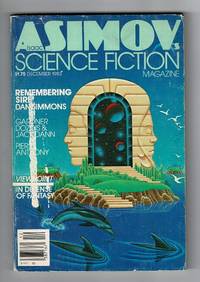
1983ref. 58819New York: Davis Production 1983. 7" x 5" pp. 177 3; pictorial wrappers in the pagination; light wear to edges removal of address label has left slight residue on upper wrapper very good. Signed by both Gardner and Isaac Asimov on table of contents. Asimov has also added a note in his editorial of this issue which is coincidentally on "Autographs." He highlights the paragraph saying "My own feeling is that it is far better to send a stick-on label or a bookplate have the writer sign and return that and then paste it in the book." And at the beginning of the editorial he writes "Read this again! Davis Production unknown
1983ref. 58819New York: Davis Production 1983. 7" x 5" pp. 177 3; pictorial wrappers in the pagination; light wear to edges removal of address label has left slight residue on upper wrapper very good. Signed by both Gardner and Isaac Asimov on table of contents. Asimov has also added a note in his editorial of this issue which is coincidentally on "Autographs." He highlights the paragraph saying "My own feeling is that it is far better to send a stick-on label or a bookplate have the writer sign and return that and then paste it in the book." And at the beginning of the editorial he writes "Read this again! Davis Production unknown books
ref. 0615145787.Gpaperback. Good. Access codes and supplements are not guaranteed with used items. May be an ex-library book. paperback
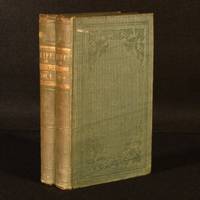
1841ref. 1018H13Philadelphia : Henry Perkins 1841 . Cloth. Very Good. 8" by 5". None. The second edition of the biography of William Wilberforce one of the defining figures of British abolition written by his sons and enlarged for an American readership. In the publisher's original green blind stamped cloth. Second edition. The American edition of this substantial biography of William Wilberforce revised from the London edition by Caspar Morris. Complete in two volumes. Illustrated with an engraved frontispiece portrait to volume I. Collated complete. Written by two of Wilberforce"s sons the work traces his private religious life parliamentary career and central role in the British abolition movement including his long campaign against the slave trade and his wider evangelical and philanthropic reform work. William Wilberforce 1759-1833 was a British statesman evangelical reformer and leading parliamentary voice against the transatlantic slave trade. His long campaign helped secure the abolition of the British slave trade in 1807. In the publisher's original cloth binding. Externally smart. Slight rubbing and bumping to extremities. Minor rubbing to boards. Spines slightly faded. One or two light marks to boards and spines. Light scattered spotting to endpapers. Internally firmly bound. Pages generally bright and clean if slightly age toned with scattered spotting heavier to the odd gathering. Slight cockling to leaves. Very Good Henry Perkins hardcover
1991ref. KNY1093481991. Hardcover. Language: Russian. Condition: good. Defects: signs of age. No illustrations. Original title: 2 toma. The photos show the actual copy offered. Ships from Ukraine by Nova Post with tracking after receipt of payment (bank transfer or PayPal); delivery time 12–28 business days including customs clearance. Shipping for this book (up to 2 kg): Netherlands €26.20, Belgium €31.70, Germany €22.90, France €31.20, Austria €31.20, Switzerland €47.60; other countries on request. The exact amount is confirmed when we accept your order. The parcel is sent from outside the EU/UK/Switzerland. Import VAT on books (e.g. Netherlands 9 %, Germany 7 %, Belgium 6 %, France 5.5 %, Switzerland 2.6 %, UK 0 %) and a customs handling fee of the carrier may be charged to the buyer on delivery; they are not included in the price. Consumers in the EU have the statutory 14-day right of withdrawal (see the seller terms). If the book does not match the description or is damaged in transit, please contact us right after receipt.
2004ref. Q-0060723025Harper Design 2004-09-14. Paperback. New. New. In shrink wrap. Looks like an interesting title! Harper Design paperback
2004ref. USD_9780060723026HarperCollins 2004. 1st. Paperback. Used - Like New/Used - Like New. _ HarperCollins paperback
2004ref. 1-0060723025Harper Design Intl 2004. Paperback. New. 238 pages. 11.25x8.75x0.75 inches. Harper Design Intl paperback
2004ref. AME_9780060723026HarperCollins 2004. 1st. Paperback. New/New. _ HarperCollins paperback