[Rosolenz, Johannes; hier: Jacob von Stainz]Antiquariat.de

214 résultats
1606réf. 62172Graz, Georg Widmanstetter, 1606. 4°. 6 nn., 158 num., 20 nn. Bll., HLdr. d. Zt. a. 3 Bünden.
1657réf. 65965Ohne Ort (Basel), Johann Jacob Genath Wittwe, (1657). 4°. 28 S., Geheftet (ausgebunden; ohne Einband).
1663réf. 65963Ohne Ort (Basel), Jacob Bertsche, (1663). 4°. Titel m. Holzschn.-Bordüre u. -Vignette. 27 S., Geheftet (ausgebunden; ohne Einband).
1666réf. 65960Ohne Ort (Basel), Jacob Bertsche, (1666). 4°. Titel m. Holzschn.-Bordüre u. -Vignette. 24 S., Geheftet (ausgebunden; ohne Einband).
1608réf. 64953Ingolstadt, Andreas Angermeyer, 1608. 4°. Titel in Rot u. Schwarz m. großer Holzschn.-Vignette. Mit einigen Holzschn.-Vignetten u. -Initialen. 1 Bl., 17 (1) S., 375 (1) S., 1 weißes Bl., Geheftet (ausgebunden; ohne Einband).
1666réf. 65959Ohne Ort (Basel), Jacob Bertsche, (1666). 4°. 24 S., Geheftet (ausgebunden; ohne Einband).
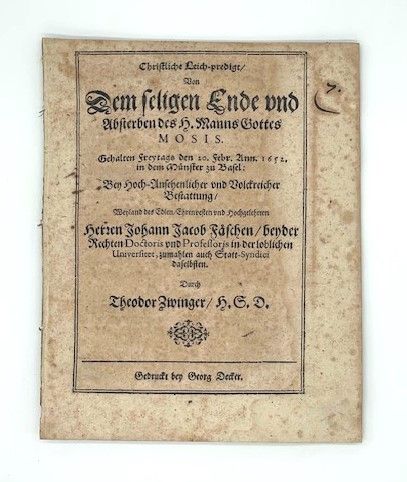
1652réf. 65717Ohne Ort (Basel), Georg Decker, (1652). 4°. 39 (1) S., Geheftet (ausgebunden; ohne Einband).
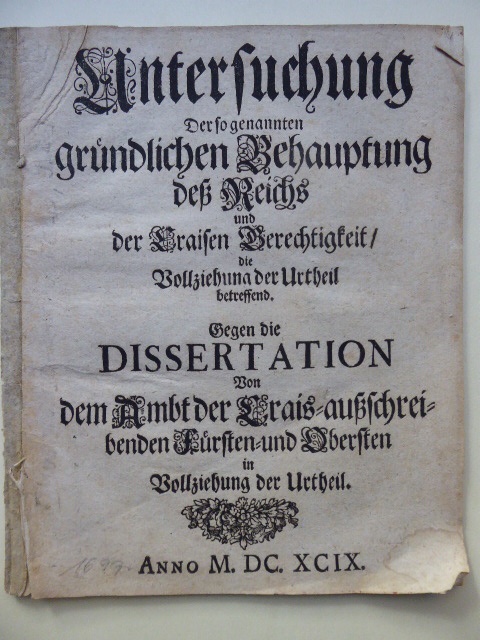
1699réf. 53282(Ohne Ort). Anno M. DC. XCIX (1699). 32 Seiten. Titelbroschur (Geringe Gebrauchsspuren) 19x15 cm
1622réf. 31298Amsterdam: Chez Michel Colin 1622. Folio. 11 x 7 1/4 inches. 6 103 6 107-254pp. Engraved additional title 17 engraved maps 16 double-sheet 1 folding 5 engraved illustrations in the text of the Le Maire narrative. Without the portrait of Le Maire as usual found in only a small number of copies. Early eighteenth century sheep covers ruled in blind spine with raised bands in seven compartments morocco lettering piece in the second the others with a repeat decoration in gilt marbled pastedowns One of the classic descriptions of the Spanish conquests in the New World including the first publication of Jacques Le Maire's journal of one of the greatest early Pacific voyages and circumnavigations: a work of great rarity and importance. This edition of Herrera includes the first publication of Jacques Le Maire's journal of one of the greatest early Pacific voyages and circumnavigations that of Le Maire and Schouten in 1615 and 1616. Le Maire's journal which occupies pp. 107-174 of this book describes the voyage of trade and discovery launched by one of the most aggressive of Netherlands traders in this era of Dutch expansion. The expedition sailed around Cape Horn explored the Pacific coast of South America and pursued the search for Terra Australis. Inspired in part by Quiros and motivated by Dutch trading zeal this was the essential precursor to Tasman's voyage; indeed Tasman made great use of Le Maire's mapping of the ocean. The Le Maire voyage the last of the seventeenth century expeditions to search for the unknown continent from the east was responsible for extensive discoveries in the Pacific recorded in excellent detail on the numerous maps published here. These include maps of Le Maire's Pacific route and of New Guinea the latter definitely establishing it to be an island. There are also five engraved views showing the expedition in Patagonia a Polynesian sailing canoe the anchorage at Cocos Island natives at Cocos and the isle of Hoorn. The first section of this work is the first French and second edition overall of a portion of Antonio de Herrera's Historia General first published in Madrid in 1601. This is one of the classic descriptions of the Spanish conquests in the New World with important maps of the West Indies the Americas the coasts of Central and South America the interior of Mexico Terra Firme and the west coast of South America including some of the most important maps relating to the Pacific made to the time. The third section of this volume consists of brief accounts of other voyages into the Pacific and the account of Pedro de Cevallos of the Spanish possessions in the New World. Two issues of this French translation were printed in Amsterdam in 1622. This copy has the first imprint recorded by Wagner. There were also Latin and Dutch editions in the same year differing slightly in their makeup; Wagner assigns priority to this French edition. A work of great rarity and importance. Borba de Moraes p.400; European Americana 622/68; JCB 3II:166; Sabin 31543; Tiele pp. 56-57 314-316; Tiele-Muller 296; Wagner Spanish Southwest 12a. Chez Michel Colin unknown books
1675réf. 12522Nuremburg: J. von Sandart 1675. Copper engraving with early colour. Printed on laid paper. Title in manuscript ink on verso of sheet. Cleveland Historical Society collection stamp on verso of sheet. Numerous tears and creases in outside margins which have been expertly repaired. Center fold has been strengthened. An early map of Africa by the great mapmaker Jacob von Sandrart engraved by Homann. Sandrart's stunning map of Africa is a close copy of Fredrik de Wit's map 'Nova Africa Descriptio' published in 1660. With the prime meridian running through Ferro Island the map is typical of late seventeenth century maps of Africa. Like other maps of the period Sandrart has included a highly decorative and informative cartouche in the lower left corner of the sheet. Homann's continental cartouches aspired to convey the natural history as well as the costume and manner of life of the human inhabitants. Here while a woman peacefully nurses her baby in a hammock a native chief stares out at the viewer from under the shade of a large umbrella. On the right side of the vignette two riders on horseback one with a cutlass and one with a decaptitated head ride by a river where one man is attacking another with his sword. Among the humans are a lion a snake a reptile of some sort and another fox-like animal. Although the map repeats De Wit's decorations it relies on Ptolemy for its description of the Nile basin. It is to some degree remarkable that seventeenth century maps of the interior of Africa were filled with geographical features and named locations since there had been very little European exploration of the interior at this date. European trade took place at specific locations along the coast and almost nothing was known about the interior of the dark continent except through rumor. This is a fascinating map by Sandrart and one of only two maps engraved by Homann before 1690. Born at Frankfurt-on-Main Jacob von Sandrart was one of the most esteemed mapmakers in Nuremberg at the close of the seventeenth century. He learned his trade from his uncle Joachim von Sandrart and from Cornelius Danckerts. As with this impressive map all of Sandrart's charts are filled with a wealth of decorative details and highly ornate cartouches. J. von Sandart unknown books
1619réf. WRCAM54737Leiden: Nicolaus a Geelkercken 1619. 1751pp. lacking blank leaf P4 which divides the two narratives but was mistakenly included as pp.119-120 in the continuous pagination; including large engraved vignette on title with twenty-five engraved plates five folding double-page and two large folding maps. Oblong quarto. Contemporary Dutch vellum. Old stains and soiling to boards manuscript "33" in ink on spine edges rubbed boards slightly bowed. Modern bookplate on front pastedown. Minor toning and foxing tiny reinforcement at mounting stub on verso of each large folding map some offsetting. Overall very good. In a blue cloth box gilt leather label. Scarce first Latin edition of one of the bestsellers of illustrated 17th-century travel literature which reports Le Maire's critical DISCOVERY OF TIERRA DEL FUEGO an alternate route to the Pacific and also recounts the Pacific pillaging of the veteran East Indies sailor-turned-pirate Joris van Spilbergen. In addition the work includes valuable early information on ports along the Pacific coast of the Americas and is also of interest for the 17th-century Dutch presence in Brazil. Rich in ethnographic detail the numerous illustrations in the SPECULUM ORIENTALIS. include images of oversized penguins llamas and an Andean condor with a nine-foot wing span. Naval battles beleaguered Spanish settlements and newly discovered islands are also depicted in detail making this a valuable compendium of adventure on the high seas during the Age of Discovery. In 1614 the VOC commissioned Spilbergen to sail to the Moluccas with nearly 700 men. Despite the ostensible commercial nature of his expedition Spilbergen's six vessels were heavily armed anticipating encounters with silver-laden Spanish vessels. Spilbergen spent two years calling at various Spanish and Portuguese ports along both coasts of South America failing to capture any great amounts of silver or silk from Manila but burning several settlements and emerging triumphant from a naval skirmish just south of Lima. By contrast Le Maire's less mercenary expedition resulted in important discoveries; his exploration of Tierra del Fuego and the Tuamotou Archipelago called into doubt the existence of a massive southern continent providing a catalyst for Tasman's discovery of New Zealand and Australia. The two expeditions crossed paths in the Dutch East Indies in 1616. Spilbergen's fleet of six ships was fitted out and armed to combat the Spanish colonies attacking Spanish settlements and shipping along their route. They sailed to Brazil then through the Straits of Magellan and north along the coast of America as far as California. After sailing east to the Philippines they went on to Batavia in search of a Spanish fleet reportedly planning to attack Dutch settlements in the Moluccas but they never found a fleet. On his arrival at Batavia Spilbergen encountered Le Maire and Schouten whose voyage for the newly-formed Compagnie Australe had embarked in 1615 a year after Spilbergen's. Le Maire and Schouten traveled via the newly-discovered Le Maire Strait but on their arrival at Batavia they were arrested for breaching the monopoly granted to the Dutch East India Company of the Strait of Magellan. Spilbergen took Le Maire Schouten and their crews on board and escorted them back to the Netherlands virtually as prisoners. Le Maire grew ill and died en route. This work is remarkable as an early document on Dutch navigation to the Brazilian coasts. Its great value lies in Spilbergen's detailed account of their stay in the Ilha Grande from October 1614 to January 1615 and in São Vicente in 1615. Plate 2 depicting the disordered landing of Dutch vessels in São Vicente clearly documents the way of life of the indigenous peoples under Portuguese occupancy. Colonial religious structures appear alongside typical Native American hammocks and traditional Brazilian costumes and methods of animal husbandry are evident. This illustration with its explanatory text is particularly important as 17th-century ethnographic documents about the future São Paulo are very rare. One of the large folding maps remains important for illustrating Le Maire and Schouten's route across the Pacific. Other maps show the Straits of Magellan and Manila the Moluccas and various ports on the Pacific coast of America. The SPECULUM ORIENTALIS. was originally published in Dutch the same year as this Latin edition with identical plates. Translations in other languages followed rapidly: German in 1620 Frankfurt and French in 1621 Amsterdam. The work was not translated into English until the 1906 Hakluyt Society edition with the title THE EAST AND WEST INDIAN MIRROR. LANDWEHR VOC 361 mistaking the first edition of the Dutch: it is 1619 as his excellent collation obviously attests not 1617. BORBA DE MORAES II:276. HOWGEGO S159. W. Klooster THE DUTCH IN THE AMERICAS 1600- 1800 cat. 24 p.12. BLAIR-ROBERTSON XV pp.328-30; illustrated XVIII p.224. LeCLERC 1994. SABIN 2288. RODRIGUEZ 2288. EUROPEAN AMERICANA 619/133. J. de Villiers THE EAST AND WEST INDIAN MIRROR Hakluyt Society 1906. JCB II:143. Lach ASIA IN THE MAKING OF EUROPE III pp.445-48. Schilder AUSTRALIA UNVEILED Ch. V pp.32-37. TIELE 66. Nicolaus a Geelkercken hardcover books
1610réf. WRCAM51636Amsterdam: Cornille Nicolas 1610. Three volumes bound in one. Described in greater detail below. Folio. Contemporary vellum over boards rebacked with original spine preserved. Bookplate on front pastedown. Light soiling and repairs to titlepages; minor soiling otherwise. Very good. Three highly important Dutch voyages all in their second French editions and bound together as issued in 1610. These three voyages represent the initial Dutch exploration and expansion to the East Indies a significant element in a global commercial enterprise which was to develop throughout the 17th century. The foundational accounts in the present volume originally issued together by Amsterdam printer Cornille Nicolas include: 1 Lodewijcksz Willem: PREMIER LIVRE DE L'HISTOIRE DE LA NAVIGATION AUX INDES ORIENTALES PAR LES HOLLANDOIS. Amsterdam: Cornille Nicolas 1609. 53 leaves. Titlepage with engraved map forty-five in-text engravings including three maps seventeen in-text woodcut illustrations and one plate on separate leaf following printed text. Moderate soiling on titlepage slight edge wear to first few leaves. Second French edition following the first French edition of 1598. Lodewijcksz gives an account of the first Dutch expedition to the East Indies under Cornelis Houtman from 1595 to 1597. The information collected by Houtman on the spice trade convinced the Dutch they could compete with Portugal's monopoly in the East Indies and his narrative served to initiate the explosion of Dutch trading at the turn of the century. "Like the English Houtman's men suffered so severely from scurvy that they had to put in at the Cape of Good Hope and at Antongil Bay in Madagascar to recuperate. But they then sailed straight across the Indian Ocean to the Straits of Sunda and dropped anchor at Bantam in Java without the loss of a ship. At this port the center of the Javanese pepper trade a long time was spent. Both natives and Portuguese showed considerable hostility and Houtman and some of his men were imprisoned. However the Dutch succeeded in making a commercial treaty and departed with a good cargo. They proceeded eastward to Bali and then returned along the south coast of Java thereby acquiring a more correct impression of the width of the island than had prevailed and laid the ghost of Java's being the northern part of the Southern Continent.the Dutch skipper had enough to show for his venture to inspire the merchants of Amsterdam with a determination to exploit the trade" - Penrose. 2 Neck Jacob Cornelissoon van: LE SECOND LIVRE IOURNAL OU COMPTOIR CONTENANT LE VRAY DISCOURS ET NARRATION HISTORIQUE. Amsterdam: Cornille Nicolas 1609. Two parts. 224 leaves. Titlepages with engraved illustrations twenty-two in-text engravings including one map two in-text woodcuts. Leaves D2 and D3 lacking provided in facsimile. Second French edition following the first French edition of 1601. Van Neck who represented the Verre Company commanded three ships which were part of the first successful Dutch trading voyage to the region. The other two ships were commanded by Wybrand Van Warwijck and Jacob Van Heemskerk. Van Neck's vessel became separated from the other two after rounding the Cape of Good Hope and the three did not reunite again until his arrival in Java in late December 1598. Unlike his Dutch predecessor Cornelis Houtman who three years earlier had seized the port of Bantam Van Neck dealt diplomatically with the natives. "Rather than rejecting the inflated prices asked by the local ruler he offered to pay over the odds in order to cement a lasting relationship.Van Neck's was the most profitable of the pre-VOC Dutch East India Company voyages. Despite the apparently high price paid for spices he netted a profit of 300 per cent on his overall costs. In 1601 fourteen fleets comprising sixty-five ships sailed for the East Indies but by that time competition between rival Dutch operators as well as with the Portuguese had inflated prices and none were as successful as Van Neck's first enterprise" - Howgego. While focused on activity in the East Indies EUROPEAN AMERICANA notes the text includes references to Brazil and tobacco from the West Indies. The second part of this 1609 French edition an eight-page appendix of words spoken in Java and Malay includes word lists in French printed in roman type Malay in italic type and Javanese in civilité. 3 Noort Olivier van: DESCRIPTION DU PENIBLE VOYAGE FAIT ENTOUR DE L'UNIVERS OV GLOBE TERRESTRE. PAR SR. OLIVIER DU NORT D'UTRECHT GENERAL DE QUATRE NAVIRES ASSAVOIR. Amsterdam: Widow of Cornille Nicolas 1610. 2611pp. Engraved titlepage vignette. Twenty-five in-text engravings including three maps. Second French edition following the first French printing of 1602. Van Noort a former innkeeper in Rotterdam sponsored by a group of Dutch merchants accomplished the fourth circumnavigation of the globe after Magellan Drake and Cavendish. He was the first Dutch explorer to do so making the trip from 1598 to 1601. The voyage was particularly arduous. Half the crew mutinied his ships were constantly harassed and most of those that didn't mutiny perished from disease. He returned to Holland "with only one battered ship and eight crew left although some accounts suggest that forty-five crew survived. His voyage contributed little to the geographical knowledge of the time but had some effect in opening the way to the establishment of the Dutch in the East Indies.Van Noort's achievement however captured the imagination of his countrymen and the published accounts sold well the first appearing only eighteen days after his return. A more complete edition appeared later that year followed by two amended editions in 1602" Howgego. Three of the most important pioneering French voyages to the Far East bound together as issued. Lodewijcksz: EUROPEAN AMERICANA 609/71. TIELE-MULLER 115. JCB 3II:63. HOWGEGO H105 Houtman. Penrose TRAVEL AND DISCOVERY IN THE RENAISSANCE 1952 p.204. Neck: EUROPEAN AMERICANA 609/93. TIELE 786. TIELE-MULLER 129. HOWGEGO N13. Noort: EUROPEAN AMERICANA 610/79. SABIN 55438. BORBA DE MORAES p.617. W. Klooster THE DUTCH IN THE AMERICAS 1600- 1800 p.12. TIELE 806. JCB 3II:71. HOWGEGO N37. Cornille Nicolas hardcover books
1601réf. WRCAM38446London: Simon Stafford and Felix Kingston for Cuthbert Burby & John Flasket 1601. 1584 leaves. Woodcut vignette of sailing ship on titlepage. Extra-illustrated with 19 engravings numbered 1-3 19 4-18 from Van Neck's HISTORIALE BESCHRIJVINGHE Amsterdam 1619. Text and plates "inlaid to size" remargined to 9 1/4 x 6 3/4 inches. Quarto. 19th-century mottled calf gilt spine gilt gilt leather label. Boards and spine slightly worn. Titlepage and plates mounted to larger sheets; printed pages of text inlaid in larger sheets. Engraved plates annotated in ink with corresponding "page" leaf recto or verso of text. Lacking the dedication leaf paraph 2 and leaf Q4 blank pages shaved with occasional slight loss of text in lower margin rust hole in leaf P3 affecting a few letters on recto tear in leaf Q3 repaired not affecting text. Overall a very good copy with the 1860 engraved bookplate of the Library of the Earls of Macclesfield on front pastedown shelf marks inscribed on verso of front free endpaper. Embossed stamp of the Earls of Macclesfield in upper extended margins of titlepage leaf and following two leaves of text. The first English edition of Van Neck's account of his 1598 voyage to the East Indies translated from the 1601 Amsterdam edition of the author's HET TWEEDE BOECKE. The Dutch navigator who represented the Verre Company commanded three ships which were part of the first successful Dutch trading voyage to the region. The other two ships were commanded by Wybrand Van Warwijck and Jacob Van Heemskerk. Van Neck's vessel became separated from the other two after rounding the Cape of Good Hope and the three did not reunite again until his arrival in Java in late December 1598. Unlike his Dutch predecessor Cornelis Houtman who three years earlier had seized the port of Bantam Van Neck dealt diplomatically with the natives. "Rather than rejecting the inflated prices asked by the local ruler he offered to pay over the odds in order to cement a lasting relationship.Van Neck's was the most profitable of the pre-VOC Dutch East India Company voyages. Despite the apparently high price paid for spices he netted a profit of 300 per cent on his overall costs. In 1601 fourteen fleets comprising sixty-five ships sailed for the East Indies but by that time competition between rival Dutch operators as well as with the Portuguese had inflated prices and none were as successful as Van Neck's first enterprise" - Howgego. While focused on activity in the East Indies EUROPEAN AMERICANA notes that the text includes references to Brazil and tobacco from the West Indies. Van Neck's account was popular throughout the first half of the 17th century and was reprinted and translated into German and French as well as English. It also appeared in collections of voyages such as those by De Bry Hulsius and Colijn. This extra- illustrated copy includes nineteen engraved plates from the Amsterdam 1619 edition of Van Neck's HISTORIALE BESCHRIJVINGHE published by Michiel Colijn. The images are mounted on separate sheets and bound in the book at the appropriate portion of the text. The engravings are annotated in ink indicating the appropriate page i.e. recto or verso of a specific leaf related to the image. A rare book on the market. Prior to this copy from the Macclesfield sale in March 2007 the last copy previously available was sold at the Boise Penrose sale in 1971. Both EUROPEAN AMERICANA and STC record only two copies in the U.S. at the Huntington and NYPL the latter noted as imperfect. EUROPEAN AMERICANA 601/66. STC 18417 noting quires A-G printed by Stafford paraph 2 and quires H-Q printed by Kingston. TIELE-MULLER p.144. HOWGEGO N13. [Simon Stafford and Felix Kingston] for Cuthbert Burby & John Flasket hardcover books
1609réf. WRCAM46859Amsterdam: Cornille Nicolas 1609. Two volumes bound in one. Described in greater detail below. Folio. Contemporary boards rebacked in calf spine gilt leather label. Very good. From the Library of the Earls of Macclesfield with engraved 1860 bookplate on front pastedown and blind pressure stamp on first two printed leaves of first title. Two highly important Dutch voyages both in their second French editions and bound together as issued in 1609. These two voyages represent the initial Dutch exploration and expansion to the East Indies a significant element in a global commercial enterprise which was to develop throughout the 17th century. The two foundation accounts in the present volume originally issued together by Amsterdam printer Cornille Nicolas include: 1 Lodewijcksz Willem: PREMIER LIVRE DE L'HISTOIRE DE LA NAVIGATION AUX INDES ORIENTALES PAR LES HOLLANDOIS. Amsterdam: Cornille Nicolas 1609. 53 leaves. Titlepage with engraved map forty-five in-text engravings including three maps seventeen in-text woodcut illustrations and one plate on separate leaf following printed text. Moderate soiling on titlepage slight edge wear to first few leaves. Second French edition following the first French edition of 1598. Lodewijcksz gives an account of the first Dutch expedition to the East Indies under Cornelis Houtman from 1595 to 1597. The information collected by Houtman on the spice trade convinced the Dutch they could compete with Portugal's monopoly in the East Indies and his narrative served to initiate the explosion of Dutch trading at the turn of the century. "Like the English Houtman's men suffered so severely from scurvy that they had to put in at the Cape of Good Hope and at Antongil Bay in Madagascar to recuperate. But they then sailed straight across the Indian Ocean to the Straits of Sunda and dropped anchor at Bantam in Java without the loss of a ship. At this port the center of the Javanese pepper trade a long time was spent. Both natives and Portuguese showed considerable hostility and Houtman and some of his men were imprisoned. However the Dutch succeeded in making a commercial treaty and departed with a good cargo. They proceeded eastward to Bali and then returned along the south coast of Java thereby acquiring a more correct impression of the width of the island than had prevailed and laid the ghost of Java's being the northern part of the Southern Continent.the Dutch skipper had enough to show for his venture to inspire the merchants of Amsterdam with a determination to exploit the trade" - Penrose. 2 Neck Jacob Cornelissoon van: LE SECOND LIVRE IOURNAL OU COMPTOIR CONTENANT LE VRAY DISCOURS ET NARRATION HISTORIQUE. Amsterdam: Cornille Nicolas 1609. Two parts. 228 leaves. Titlepages with engraved illustrations twenty-two in-text engravings including one map two in-text woodcuts. Second French edition following the first French edition of 1601. Van Neck who represented the Verre Company commanded three ships which were part of the first successful Dutch trading voyage to the region. The other two ships were commanded by Wybrand Van Warwijck and Jacob Van Heemskerk. Van Neck's vessel became separated from the other two after rounding the Cape of Good Hope and the three did not reunite again until his arrival in Java in late December 1598. Unlike his Dutch predecessor Cornelis Houtman who three years earlier had seized the port of Bantam Van Neck dealt diplomatically with the natives. "Rather than rejecting the inflated prices asked by the local ruler he offered to pay over the odds in order to cement a lasting relationship.Van Neck's was the most profitable of the pre-VOC Dutch East India Company voyages. Despite the apparently high price paid for spices he netted a profit of 300 per cent on his overall costs. In 1601 fourteen fleets comprising sixty-five ships sailed for the East Indies but by that time competition between rival Dutch operators as well as with the Portuguese had inflated prices and none were as successful as Van Neck's first enterprise" - Howgego. While focused on activity in the East Indies EUROPEAN AMERICANA notes the text includes references to Brazil and tobacco from the West Indies. The second part of this 1609 French edition an eight-page appendix of words spoken in Java and Malay includes word lists in French printed in roman type Malay in italic type and Javanese in civilité. Two of the most important of the pioneering French voyages to the Far East bound together as probably issued in this edition. Lodewijcksz: EUROPEAN AMERICANA 609/71. TIELE-MULLER 115. JCB 3II:63. HOWGEGO H105 Houtman. Penrose TRAVEL AND DISCOVERY IN THE RENAISSANCE 1952 p.204. Neck: EUROPEAN AMERICANA 609/93. TIELE 786. TIELE-MULLER 129. HOWGEGO N13. Cornille Nicolas hardcover books
1609réf. WRCAM38891Amsterdam: Cornille Nicolas 1609. Two parts. 228 leaves second part with its own titlepage. Folio. Modern three-quarter morocco and marbled boards spine gilt. A few leaves with worm tracks expertly repaired. Very good. Second French edition following the first French edition of 1601 of this important voyages narrative describing the initial Dutch exploration and expansion to the East Indies a significant element in a global commercial enterprise which was to develop throughout the 17th century. Van Neck who represented the Verre Company commanded three ships which were part of the first successful Dutch trading voyage to the region. The other two ships were commanded by Wybrand Van Warwijck and Jacob Van Heemskerk. Van Neck's vessel became separated from the other two after rounding the Cape of Good Hope and the three did not reunite again until his arrival in Java in late December 1598. Unlike his Dutch predecessor Cornelis Houtman who three years earlier had seized the port of Bantam Van Neck dealt diplomatically with the natives. "Rather than rejecting the inflated prices asked by the local ruler he offered to pay over the odds in order to cement a lasting relationship.Van Neck's was the most profitable of the pre-VOC Dutch East India Company voyages. Despite the apparently high price paid for spices he netted a profit of 300 per cent on his overall costs. In 1601 fourteen fleets comprising sixty-five ships sailed for the East Indies but by that time competition between rival Dutch operators as well as with the Portuguese had inflated prices and none were as successful as Van Neck's first enterprise" - Howgego. While focused on activity in the East Indies EUROPEAN AMERICANA notes that the text includes references to Brazil and tobacco from the West Indies. The second part of this 1609 French edition which has its own titlepage is an eight-page appendix of words spoken in Java and Malay including word lists in French printed in roman type Malay in italic type and Javanese in civilité. EUROPEAN AMERICANA 609/93. TIELE 786. TIELE-MULLER 129. HOWGEGO N13. JCB 3II:64. Cornille Nicolas hardcover books
1672réf. 19314Nuremburg: Johann Daniel Tauber 1672. Enlarged edition. Hardcover. Later quarter vellum and boards. Very good. 30.5 x 21 cm. 312 22 a-d6 B-P6Q4. Full page engraving of ship at sea by Boner frontispiece portrait of Saar title page in black and red one leaf with two engravings 12 engravings in the text floriated chapter head designs. First published 1662 this an enlarged edition. Saar was employed as a mercenary for the East India Company spending 15 years in South East Asia including Indonesia and Ceylon. He died at age 38 in the battle of Mogersdorf. Most of Saar's descriptions relate to Ceylon. The publisher also added other contemporary accounts to help authenticate Saar's accounts. Scattered text toning ex-library stamp effaced from head of title page title page slightly chipped fore-edge and foot dampstain lower corners M-M4. Johann Daniel Tauber hardcover books
1603réf. 100584Innsbruck: Daniel Baur 1603. First edition in German after the Latin edition published in 1601. With frontispiece engraved portrait of Archduke Ferdinand II privilege on verso title page two preliminary leaves and 121 of 125 elaborate engraved portraits each with facing biographical notice printed within woodcut border. Lacking 4 leaves portraits 3 24 64 71. Two preliminary leaves printed for William Sterling Maxwell his extensive bibliographical note and index of portraits; a facsimile folding view of Innsbruck inserted after title. Full dark brown morocco spine titled in gilt upper board with Sterling Maxwell arms in gilt a.e.g. by XXXX. Sterling Maxwell's largest bookplate on front pastedown. A few portraits possibly in old facsimile or restrike. 11 leaves loose or slightly sprung a few marginal paper flaws one portrait poorly inked. First edition in German after the Latin edition published in 1601. With frontispiece engraved portrait of Archduke Ferdinand II privilege on verso title page two preliminary leaves and 121 of 125 elaborate engraved portraits each with facing biographical notice printed within woodcut border. Lacking 4 leaves portraits 3 24 64 71. Two preliminary leaves printed for William Sterling Maxwell his extensive bibliographical note and index of portraits; a facsimile folding view of Innsbruck inserted after title. The celebrated portrait gallery of the Archduke Ferdinand II of Austria with portraits of emperors kings nobles and war heroes in historic suits of armor in the Archduke's collection at Schloß Ambras. Compiled by the Archduke's secretary Schrenck von Notzing and translated into German by J.E. Noyse van Campenhouten. With an interesting full page printed bibliographical notice by Sterling Maxwell dated 1870 printed within facimile borders matching the text pages of the portraits. Colas 2691; Brunet V 224; Vinet 2046; Grässe VI 317; Lipperheide 499 Daniel Baur unknown books
1684réf. 53168Altenburg: Gottfried Richter 1684. Small thick 8vo pp. 38 958 42; engraved frontispiece woodcut initials and ornaments; and early owner has supplied 7 vellum tabs affixed to the fore-edge; OCLC locates only 3 copies two in Germany and one in Sweden. Bound with an imperfect copy of: M. Jacob Daniel Ernsts Anweisung / Wie Dessen so genantes Historisches Bilder-Hauß/ neben denen dreyen Theilen der Historischen Confect-Taffel same imprint 1688 pp. 10 880 of 1298; Together 2 titles in contemporary full vellum manuscript title on spine; interesting yellow floral pastedown likely 18th century; very good and sound. Gottfried Richter hardcover books
1647réf. 24501London: Printed by M. S. for H. Blunden at the Castle in Corne-hill 1647. 1st Edition variant issue Wing B-3408A. Another issue of the same year has the printer's name "Matth. Simmons. in the yeare 1647". Period full leather with modern rebacking to style. Red morocco title label in second spine compartment. Modern eps. An overall VG copy text paper beginning to brown at edges with some associated chipping/repaired hole to lower right quarter of E2 affects last few words of two lines on p 25 and first few words of four lines on page 26/occasional po marginal pencil annotation a/o check mark. 18 155 7 28 4 pp. Separate t.p. for "Clavis". Last 4 pp: 2 pp 'Catalogue of Bookes' viz. bibliographical list by Behmen 1 pp of "Faults Escaped in Printing" & a blank. Inserted table & plate imperfect lacking 'folded' left side approx. 1 - 1.5". 4to: ¢4 -¢1 a half-title a2 a3 B1 A4 -A1 C - 2B4 2C2. Bohme a German philosophical mystic who had a profound influence on such later intellectual movements as idealism and Romanticism. Born of poor parents in Goerlitz Germany as a boy he tended cattle later becoming a shoemaker marrying & fathering 4 children. Boehme at the robust age of 37 in 1612 wrote his first treatise Aurora oder Die Morgenroete in Aufgang. In 1613 an unauthorized copy of the manuscript was copied and circulated by Karl von Ender. Its reception "raised him out of his homely sphere and made him the centre of a local circle of liberal thinkers considerably above him in station and culture." However the local pastor primarius of Gorlitz Gregorius Richter leveled a charge of heresy. The local muncipal council administered an admonishment to no further "meddle in such matters." This charge Boehme publicly followed for 5 years. In 1618 Boehme again started writing expository & polemical treatises. The majority of his works were written though not formally published from 1619 - 1624. A second major work Der Weg zu Christo was published in 1624 and signaled a renewal of clerical hostility. Boehem however was destined to suffer but a short period of this second persecution; he died of an illness on 17 November 1624. Boehme has been said to have a "fertility of ideas" and a "trasncendent greatness of religious insight." Boehme was studied by Sir Isaac Newton and influenced the work Henry More as well as and especially William Law 1686 - 1761. Xl Questions concerning the Soule was translated by the English mystic John Sparrow in collaboration with John Ellstone & financed by Humphrey Blunden. This the first of several works by Boehme that Sparrow & Ellstone were to translate into English between 1644 - 1662. Boehme proved to be highly popular in England where there were regular societies of Behmenists at the time. This work XL Questions went into a second edition in 1648 and a third edition in 1665. 11th EB. A scarce title in the Boehme canon. We find no copies currently offered via the major on-line databases OCLC records but 4 institional cc and the work has only appeared at auction 3 times in the last 25 years the last in 1989. Printed by M. S. for H. Blunden, at the Castle in Corne-hill hardcover books
1646réf. 046444Hoorn: Arent Jansz Chalon 1646. First Edition. Hardcover Vellum. Very Good Condition. Contemporary overlapping vellum modest discoloration and soiling but sound. Spine darkened remains of labels bookplate on pastedown and endpaper. Two works in one the second unpaginated and dated 1647 on the separate title; printed in a mix of black letter and Roman type faces. 8 252 60pp. The first edition of a popular and much reprinted book of moral tales about violence. 15 engravings in the first work 3 in the second and a vignette on the title and an extra engraved title to Gulden-Spiegel. As here it was often paired with Mayvogel's life of Amnon apparently present here in the second edition first published in 1646. No other copies of the first edition located in OCLC or auction records. Size: Octavo 8vo. Quantity Available: 1. Shipped Weight: Under 1 kilo. Category: Philosophy; Antiquarian & Rare. Inventory No: 046444. Arent Jansz Chalon hardcover books
1698réf. 75048Bruxelles: Typis ludoci Stryckwant 1698. Hardcover. Good. Editio altera longe auctior et elegantior. 15 16-651 5 71p. 19th century black leather. 14 cm. Binding sound but rather heavily scuffed. Almost entire front endpaper covered with a printed label urging unsuccessfully it appears the See of Portsmouth not to sell this or any other book coming from the Virtue and Cahill Library. Cross-hatched pencil markings on a few pages. Most of the rather small text leaves are double-columned. Some sections of text browned while other are bright and white. Latin text. Originally published in German in 1644. Typis ludoci Stryckwant hardcover books
1658réf. 046557Rotterdam: Arnold Leers 1658. Early Edition. Hardcover Full Leather. Very Good Condition. Contemporary full sheep spine rubbed hinges cracked but binding sound title in red and black with old ownership signature very clean internally. First published in 1638 it criticizes a wide variety of popular medical beliefs and takes issue with some current scientific theories e.g. Harvey's circulation of the blood. It was translated into French and English and remained influential for some time. 20 2 blanks 561pp. Osleriana 3735 Size: duodecimo 12mo. Quantity Available: 1. Shipped Weight: Under 1 kilo. Inventory No: 046557. Arnold Leers hardcover books
1691réf. 504341691. London: Printed for Tho. Salusbury 1691. London: Printed for Tho. Salusbury 1691. An Early English Anthology of Bohme's "Theosophick" Writings Bohme Jakob 1575-1624. Taylor Edward c.1642-17290 Editor. Jacob Behmen's Theosophick Philosophy Unfolded; In Divers Considerations and Demonstrations Shewing the Verity and Utility of the Several Doctrines or Propositions Contained in the Writings of that Divinely Instructed Author. Also the Principal Treatises of the Said Author Abridged. And Answers Given to the Remainder of the 177 Theosophick Questions Propounded by the Said Jacob Behmen Which were Left Unanswered by Him at the Time of His Death. As a Help Towards the Better Understanding the Old and New Testament. Also What Man is With Respect to Time and Eternity. Being an Open Gate to the Greatest Mysteries. With a Short Account of the Life of Jacob Behmen. London: Printed for Tho. Salusbury 1691. vi 434 8 pp. Second and third signatures bound in reverse order. Portrait frontispiece lacking. Quarto 8" x 6". Contemporary paneled sheep raised bands to spine. Moderate rubbing to extremities a few small scuffs to boards chipping to spine ends front board partially detached but secure rear joint just starting at ends corners lightly bumped. Armorial bookplate of the Earl of Macclesfield to front pastedown. Offsetting to margins light foxing in a few places. A sound copy of a scarce treatise. $750. Only edition. This edition of Boehm's writings in translation marks an important chapter in the English reception of Boehm's writings. A German mystic and self-taught theologian he believed that humanity had fallen from a state of divine grace to its present state of sin and suffering that the forces of evil included fallen angels who had rebelled against God. On these points he is consistent with Lutheran Theology. Boehme believed however that the fall from grace was a necessary stage in the evolution of the universe. It was necessary for humanity to depart from God in order initiate an evolution toward a new state of redeemed harmony that would be more perfect than the original state of innocence. God would thus achieve a new self-awareness by interacting with a creation that was both part of and distinct from Himself. English Short-Title Catalogue R21858. unknown books
1603réf. 046923Basel: Conrad Waldkirch 1603. Early Edition. Hardcover Vellum. Very Good Condition. Two volumes in full contemporary vellum - the first work with no place or publisher 1603 the second Waldkirch Basel 1603. Modest browning throughout heavier in a few spots scattered minor dampstains in the second book; clean and very good overall. 32 416 24 ; 14 334 12 pp with a folding table in Hotman. Early editions first editions were 1585 and 1565 respectively - the Acontius is rare in commerce and not much more common in libraries. Acontius fled to Basel as the counter reformation began to find an increasingly wide variety if ideas heretical. Stratagematum satanae became central to later ideas of religious toleration and what constitutes dogma. Size: Octavo 8vo. Quantity Available: 1. Shipped Weight: Under 1 kilo. Category: Religion & Theology; Antiquarian & Rare. Inventory No: 046923. Conrad Waldkirch hardcover books
1666réf. JC14675Arnheim: Johann Fridericus Hagius 1666. Hardcover. Very Good. 12mo 135 x 70mm. Pagination: 1 398pp. 26 index. Signatures: 1; A-R12; S7 of 8 lacking final blank one leaf of index unopened. Full-page engraved architectural frontispiece of sacred muses holding holy attributes and 176 plates with 350 devices engravings by Aegidus Sadeler of Prague 1568-1629 laid out in ovals and medallions. 19th-century morocco with gilt monogram cipher of interlocking Cs as cornerpieces and to spine marbled endpapers all edges gilt; rubbing to extremities especially the head of the spine otherwise a good copy with rich impressions. Early monogram bookplate and another later of Bibliotheque I.G. Schorsch on front pastedown. A monogram and motto Nunc nox mox lux are stamped in green on the flyleaf. Another stamp to lower margin of title with French surname Bourcier. Later Arnheim edition of Jacobus Typotiuss influential collection of emblems detailing parts of sacred ritual in the Latin West church. Typotiuss Symbola Divina et Humana was first published in Prague in three volumes from 1601 to 1603. An extant manuscript of the Symbola Divina et Humana dates to about 1590 and it is known that several copies were made and circulated through the court of Prague. Typotius a Flemish humanist scholar was court historian to Emperor Rudolf II. While his name takes precedence on the title page Typotius was possibly just one of four men responsible for this work. The designs were compiled by Ottavio Strada antiquarian to Emperor Rudolf III and were reproduced by the engraver Aegidius Sadeler. Typotius wrote the Latin commentaries on the impresa except in the fourth book which was the work of Anselm Boethius de Boodt physician to the same emperor. The imprese in Typotiuss work covers a vast array of subjects including the Santa Eucharista Holy Eucharist the Santa Crucis Holy Cross popes kings emperors and rulers of various nations princes clergy and cardinals. Some notable figures represented in imprese include French kings Philip I and Louis VII Henry VIII of England and his queens Anne Boleyn and Anne of Cleves James VI of Scotland Philip II of Spain and unsurprisingly Rudolf II of Bohemia. The work was highly popular in its time and was frequently reprinted in both Germany and in the Netherlands. Praz p. 518; Landwehr 799; Cicognara 1964. Johann Fridericus Hagius hardcover books