(Mérimée, Hugo, Max Jacob, Vigny, George Sand, Saint-Exupéry, Hansi, Loti, Carco, Baudelaire, Valéry) -Livre Rare Book

55.923 risultati
rif. 40955Catalogue de la vente aux enchères réalisée à l'Hôtel Drout le 2 juillet 2002 - un volume 21x27cm broché sous couverture illustrée, de 70 pages illustrées en noir et en couleurs comprenant 304 notices - bon état -
1725rif. 227524Uppsala: Werner 1725. Collation π1 A-C8; Pp. i title-ii verso blank 1-48. 1 vols. 16mo. Stitched. Ink signature at foot of title minor paper flaw in top margin of first two leaves three manuscript corrections in text else fine. Collation π1 A-C8; Pp. i title-ii verso blank 1-48. 1 vols. 16mo. Early work on the Norse voyages to Greenland Vinland Helluland Skraelingaland and discussion of the textual record of the exploration of North America. Celsius the uncle of Anders of the temperaturs scale fame was an early mentor of Carl Linneaus. Howes W15; Sabin 100960; Alden 725/208 Werner unknown
1725rif. 227524Uppsala: Werner 1725. Collation π1 A-C8; Pp. i title-ii verso blank 1-48. 1 vols. 16mo. Stitched. Ink signature at foot of title minor paper flaw in top margin of first two leaves three manuscript corrections in text else fine. Collation π1 A-C8; Pp. i title-ii verso blank 1-48. 1 vols. 16mo. Early work on the Norse voyages to Greenland Vinland Helluland Skraelingaland and discussion of the textual record of the exploration of North America. Celsius the uncle of Anders of the temperaturs scale fame was an early mentor of Carl Linneaus. Howes W15; Sabin 100960; Alden 725/208 Werner unknown books
rif. a591191870 1871. First two and likely only issues of history and genealogical journal for Lima Delaware County Pennsylvania. Number 1 is dated 1870 ; Number 2 is dated 1871. Issues are bound together as one. Issue 1 describes places and buildings of Lima Issue 2 gives some local genealogy. Some of the people discussed: Thomas and Frances Taylor; John Worrall Rachel and Philip Taylor John and Joshua Minshall Anthony Shaw Miller Family Daniel Hoopes. Sm.4to. 16pp. 12pp. original printed stringbound wraps. Author's preface indicates that some photographs taken by J. J. Tyler will accompany the printed material no photographs are included. Good light soiling some wear at edges the top corners of the pages in Issue 2 are chipped not affecting text except for a few letters on final two pages. Scarce. paperback
1810rif. 215799Philadelphia 1810. 1-1/2 pp. on verso and recto of first leaf; second leaf docketed on veso "Bond - I Whelen & Jacob Downing to S.-P. Bridge ccmp.". 1 vols. 4to. Witnessed by John J. Downing and Robert Clinton with their signature. 1-1/2 pp. on verso and recto of first leaf; second leaf docketed on veso "Bond - I Whelen & Jacob Downing to S.-P. Bridge ccmp.". 1 vols. 4to. "Know All Men by these present that M. Israel Whelen and Jacob Downing of the City of Philadelphia are held and firmly bound unto the President Directors and Company for erecting a Permanent Bridge over the river Schuylkill at or near the City of Philadelphia in the sum of Ten Thousand dollars - Money of the United States of North America to be paid to the said President Directors and Company . unknown
1810rif. 215799Philadelphia 1810. 1-1/2 pp. on verso and recto of first leaf; second leaf docketed on veso "Bond - I Whelen & Jacob Downing to S.-P. Bridge ccmp.". 1 vols. 4to. Witnessed by John J. Downing and Robert Clinton with their signature. 1-1/2 pp. on verso and recto of first leaf; second leaf docketed on veso "Bond - I Whelen & Jacob Downing to S.-P. Bridge ccmp.". 1 vols. 4to. "Know All Men by these present that M. Israel Whelen and Jacob Downing of the City of Philadelphia are held and firmly bound unto the President Directors and Company for erecting a Permanent Bridge over the river Schuylkill at or near the City of Philadelphia in the sum of Ten Thousand dollars - Money of the United States of North America to be paid to the said President Directors and Company . unknown books
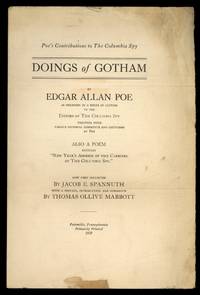
1929rif. 616082Pottstown Pennsylvania: Privately Printed by Jacob E. Spannuth 1929. Unbound. Very Good. Publisher's prospectus. Quarto sheet folded to make four pages printed on three. Measuring 6" x9" closed. Old folds into thirds some staining at the edges and small chips and tears near very good. The book edited by Spannuth and with an introduction and notes by Thomas Ollive Mabbott was published in a trade edition of 713 copies $10 and 36 large paper copies $25. Privately Printed by Jacob E. Spannuth unknown books
rif. 1016627270.Ghardcover. Good. Access codes and supplements are not guaranteed with used items. May be an ex-library book. hardcover
rif. 5621Monté-Carlo, Regain, 1949. In-12 broché, 635 pp. (couverture défraichie). Le Bible - Le religion juive - Isarël à travers l'histoire - Le rôle d'Esraël dans le monde - L'antisémitisme.
1875rif. 51479Paris: Auguste Fontaine 1875. First edition. No. 8 of 50 copies on Whatman Paper. Frontispiece portrait in two states. 4 xv xvi blank 510 2 table 8 Extrait du Catalogue Auguste Fontaine. 1 vols. 8vo. Original printed wrappers all edges uncut. Some browning to wrappers partial split at spine of front wrapper two small chips from margins of front wrapper else very fine unopened copy. First edition. No. 8 of 50 copies on Whatman Paper. Frontispiece portrait in two states. 4 xv xvi blank 510 2 table 8 Extrait du Catalogue Auguste Fontaine. 1 vols. 8vo. Printer's apprentice turned prolific author Restif de la Bretonne 1734-1806 was one of the distinctive literary voices of late eighteenth-century France whose works chronicle the excesses of the ancien régime and the tumults of the Revolution. Exceedingly scarce édition de tête of this bibliography which remains important and has been reprinted on several occasions. Auguste Fontaine unknown
1875rif. 8344Paris: Auguste Fontaine Libraire 1875. 1875. Very good. - Octavo original printed gray wraps rebound in reddish brown cloth; gilt-lettered label on spine; deckle-edged. The covers are bumped rubbed & soiled & the label is chipped. The original wraps are soiled with the corners creased; the front wrap is detached with a small stain & pencil notations. xv & 510 pp. B&W frontispiece. The contents are bright and very good. Limited edition of 500 numbered copies on Holland paper. The rare first edition. Paris: Auguste Fontaine, Libraire, 1875. paperback
rif. 16501Auguste Fontaine (1875) - Fort in 8 de 510 pages - Demi-chagrin marron, dos à nerfs avec titre doré - Couvertures imprimées conservées - Préface de P.L. Jacob - 40 pages de table analytique - Bibliographie raisonnée - Portrait-frontispice de Restif de La Bretonne dessiné par Binet et gravé par E. Loiselet d'après l'original de L. Berthet - Edition originale tirée à 500 ex. sur papier de Hollande (n° 117) - Exemplaire en très bon état
1875rif. 51479Paris: Auguste Fontaine 1875. First edition. No. 8 of 50 copies on Whatman Paper. Frontispiece portrait in two states. 4 xv xvi blank 510 2 table 8 Extrait du Catalogue Auguste Fontaine. 1 vols. 8vo. Original printed wrappers all edges uncut. Some browning to wrappers partial split at spine of front wrapper two small chips from margins of front wrapper else very fine unopened copy. First edition. No. 8 of 50 copies on Whatman Paper. Frontispiece portrait in two states. 4 xv xvi blank 510 2 table 8 Extrait du Catalogue Auguste Fontaine. 1 vols. 8vo. Printer's apprentice turned prolific author Restif de la Bretonne 1734-1806 was one of the distinctive literary voices of late eighteenth-century France whose works chronicle the excesses of the ancien régime and the tumults of the Revolution. Exceedingly scarce édition de tête of this bibliography which remains important and has been reprinted on several occasions. Auguste Fontaine unknown books
1898rif. 455013New York: Century Co 1898. Unbound. Fine. Illustrated broadside printed in orange and black on white paper. Measuring 13½" x 20". One barely visible tear repaired on the verso else about fine. Poster for a magazine issue. Image along the left margin displays an illustration by Jay Hambidge of a fireman scaling a house to reach a man in dire need of rescue. The right side of the broadside provides a long list of the other articles in the issue. Century Co unknown
1898rif. 455013New York: Century Co 1898. Unbound. Fine. Illustrated broadside printed in orange and black on white paper. Measuring 13½" x 20". One barely visible tear repaired on the verso else about fine. Poster for a magazine issue. Image along the left margin displays an illustration by Jay Hambidge of a fireman scaling a house to reach a man in dire need of rescue. The right side of the broadside provides a long list of the other articles in the issue. Century Co unknown books
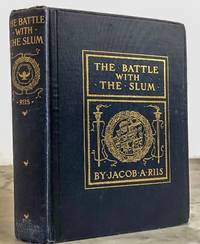
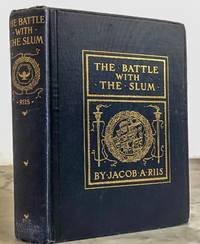
1902rif. 021995New York: The Macmillan Company 1902. First Edition. Hardcover. Minor wear to covers. Near Fine. Second Printing in publisher's original decorated blue cloth. Illustrated. This copy is SIGNED "with the best wishes of/Theodore Roosevelt/Dec 1906." Jacob Riis a significant contributor to the cause of urban reform in the United States of America at the turn of the twentieth century was among the most dedicated advocates for America's oppressed and downtrodden. He arrived in New York from his native Denmark at the age of 21 in 1870. A pioneer in photojournalism Riis photographed and wrote about the slums and tenements of a New York in the dawn of a new century. Riis came to Roosevelt's attention through his 1890 book HOW THE OTHER HALF LIVES. As Commissioner of the New York City Police Department Roosevelt accompanied Riis on his evening travels through the slums and witnessed firsthand the inhumane conditions endured by many of New York's inhabitants. In his 1901 book MAKING OF AN AMERICAN Riis wrote of Roosevelt: "It could not have been long after I wrote HOW THE OTHER HALF LIVES that he came to the Evening Sun office one day looking for me. I was out and he left his card merely writing on the back of it that he had read my book and had 'come to help.' That was all and it tells the whole story of the man. I loved him from the day I first saw him; nor ever in all the years that have passed has he failed of the promise made then. No one ever helped as he did. For two years we were brothers on Mulberry Street." Roosevelt in turn wrote of Riis after his death: "It is difficult for me to write of Jacob Riis only from the public standpoint. He was one of my truest and closest friends. I have ever prized the fact that once in speaking of me he said 'since I met him he has been my brother.' I have not only admired and respected him beyond measure but I have loved him dearly . and I mourn him as if he were one of my own family." The Macmillan Company hardcover
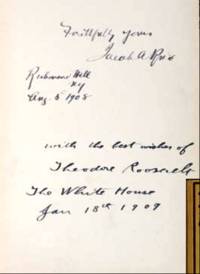
1904rif. 014375New York: The Outlook Company 1904. First Edition. Hardcover. Hinges cracked and neatly repaired. Still Near Fine. Second Printing in publisher's original decorated cloth. Illustrated with plates. This copy virtually unique as it is INSCRIBED and SIGNED by both the author and the subject as President. Riis's inscription is dated 5 August 1908. Roosevelt writes: "with the best wishes of/Theodore Roosevelt/The White House/Jan. 18th 1909." The addition of "The White House" by Roosevelt is notable as prior to his administration the residence was known as the "President's Palace" the "President's House" and the "Executive Mansion." It was Roosevelt who officially named it "The White House" in 1901. Of the many books signed by Roosevelt we have both handled and seen we have never before encountered one in which he has noted his official residence along with his signature. Jacob Riis among the most dedicated advocates for America's oppressed and downtrodden arrived in New York from his native Denmark at the age of 21 in 1870. A pioneer in photojournalism Riis photographed and wrote about the slums and tenements of a New York in the dawn of a new century. Riis came to Roosevelt's attention through his 1890 book HOW THE OTHER HALF LIVES. As Commissioner of the New York City Police Department Roosevelt accompanied Riis on his evening travels through the slums and witnessed firsthand the inhumane conditions endured by many of New York's inhabitants. In his 1901 book MAKING OF AN AMERICAN Riis wrote of Roosevelt: "It could not have been long after I wrote HOW THE OTHER HALF LIVES that he came to the Evening Sun office one day looking for me. I was out and he left his card merely writing on the back of it that he had read my book and had 'come to help.' That was all and it tells the whole story of the man. I loved him from the day I first saw him; nor ever in all the years that have passed has he failed of the promise made then. No one ever helped as he did. For two years we were brothers on Mulberry Street." Roosevelt in turn wrote of Riis after his death: "It is difficult for me to write of Jacob Riis only from the public standpoint. He was one of my truest and closest friends. I have ever prized the fact that once in speaking of me he said 'since I met him he has been my brother.' I have not only admired and respected him beyond measure but I have loved him dearly . and I mourn him as if he were one of my own family." The Outlook Company hardcover
1902rif. 021995New York: The Macmillan Company 1902. First Edition. Hardcover. Minor wear to covers. Near Fine. Second Printing in publisher's original decorated blue cloth. Illustrated. This copy is SIGNED "with the best wishes of/Theodore Roosevelt/Dec 1906." Jacob Riis a significant contributor to the cause of urban reform in the United States of America at the turn of the twentieth century was among the most dedicated advocates for America's oppressed and downtrodden. He arrived in New York from his native Denmark at the age of 21 in 1870. A pioneer in photojournalism Riis photographed and wrote about the slums and tenements of a New York in the dawn of a new century. Riis came to Roosevelt's attention through his 1890 book HOW THE OTHER HALF LIVES. As Commissioner of the New York City Police Department Roosevelt accompanied Riis on his evening travels through the slums and witnessed firsthand the inhumane conditions endured by many of New York's inhabitants. In his 1901 book MAKING OF AN AMERICAN Riis wrote of Roosevelt: "It could not have been long after I wrote HOW THE OTHER HALF LIVES that he came to the Evening Sun office one day looking for me. I was out and he left his card merely writing on the back of it that he had read my book and had 'come to help.' That was all and it tells the whole story of the man. I loved him from the day I first saw him; nor ever in all the years that have passed has he failed of the promise made then. No one ever helped as he did. For two years we were brothers on Mulberry Street." Roosevelt in turn wrote of Riis after his death: "It is difficult for me to write of Jacob Riis only from the public standpoint. He was one of my truest and closest friends. I have ever prized the fact that once in speaking of me he said 'since I met him he has been my brother.' I have not only admired and respected him beyond measure but I have loved him dearly . and I mourn him as if he were one of my own family." The Macmillan Company hardcover books
1904rif. 014375New York: The Outlook Company 1904. First Edition. Hardcover. Hinges cracked and neatly repaired. Still Near Fine. Second Printing in publisher's original decorated cloth. Illustrated with plates. This copy virtually unique as it is INSCRIBED and SIGNED by both the author and the subject as President. Riis's inscription is dated 5 August 1908. Roosevelt writes: "with the best wishes of/Theodore Roosevelt/The White House/Jan. 18th 1909." The addition of "The White House" by Roosevelt is notable as prior to his administration the residence was known as the "President's Palace" the "President's House" and the "Executive Mansion." It was Roosevelt who officially named it "The White House" in 1901. Of the many books signed by Roosevelt we have both handled and seen we have never before encountered one in which he has noted his official residence along with his signature. Jacob Riis among the most dedicated advocates for America's oppressed and downtrodden arrived in New York from his native Denmark at the age of 21 in 1870. A pioneer in photojournalism Riis photographed and wrote about the slums and tenements of a New York in the dawn of a new century. Riis came to Roosevelt's attention through his 1890 book HOW THE OTHER HALF LIVES. As Commissioner of the New York City Police Department Roosevelt accompanied Riis on his evening travels through the slums and witnessed firsthand the inhumane conditions endured by many of New York's inhabitants. In his 1901 book MAKING OF AN AMERICAN Riis wrote of Roosevelt: "It could not have been long after I wrote HOW THE OTHER HALF LIVES that he came to the Evening Sun office one day looking for me. I was out and he left his card merely writing on the back of it that he had read my book and had 'come to help.' That was all and it tells the whole story of the man. I loved him from the day I first saw him; nor ever in all the years that have passed has he failed of the promise made then. No one ever helped as he did. For two years we were brothers on Mulberry Street." Roosevelt in turn wrote of Riis after his death: "It is difficult for me to write of Jacob Riis only from the public standpoint. He was one of my truest and closest friends. I have ever prized the fact that once in speaking of me he said 'since I met him he has been my brother.' I have not only admired and respected him beyond measure but I have loved him dearly . and I mourn him as if he were one of my own family." The Outlook Company hardcover books
rif. 10878vo. 200 x 180 mm. 8 x 6 ¾ inches. 302 pp. Manuscript text in neat hand. Bound in half-leather and marbled boards gilt rules on spine. Some rubbing to spine ends a later ownership name stamp on front pastedown. Manuscript lecture notes from Prof. Leonard Woods' class in theology taught at the Seminary in Andover. The student introduces the lectures in the first two pages: "West Chester Society Colchester Conn. -- In view of an examination preparatory to my ordination I presented to the Council the following confession of faith." He follows this information with a nine page table of contents for the lectures which begins with "On the inspiration of the Scriptures." In clear prose he recounts what he was taught by Prof. Woods while he was a student at Andover for those several years. Although unsigned these lecture notes most likely belong to Jacob Scales 1788-1873. Scales was born in Freeport Maine graduated from Dartmouth in 1817 and went on to Andover Theological Seminary finishing his degree there in 1820. In December of that year he was ordained pastor of the Congregational Church at Colchester Connecticut. In 1827 Scales became a pastor in Henniker NH; then Cornwall Vermont in 1839. Here he ran afoul of the local anti-slavery society according to Lyman Matthews' "History of the Town of Cornwall Vermont" Cornwall VT: 1862 pp. 182-6. A remonstrance by ten members of the church felt strongly he should not be installed. An ecclesiastical council was convened: "The remonstrants acknowledge that upon the subject of slavery Mr. Scales in sentiment is correct; but they allege that as a practical abolitionist he does not come up to the standard of the American Anti-Slavery Society. Of this however no proof was adduced. This Council can recognize no other standard than the Word of God." and therefore the church proceeded to install him. His tenure was not always smooth and he was dismissed in 1842. He became an acting pastor at Plainfield from 1842-1861. see his brief biography in the New England Historical and Genealogical Register v. 66 p. 50 Scales published several sermons and other works in his lifetime and Dartmouth College has a collection of his papers. Leonard Woods 1774-1854 was a professor of theology at Andover from 1808 until his retirement in 1846. He was a member of the Congregational Church and an orthodox Calvinist. He continued to write and prepare his works for publication. A five volume set of his lectures sermons letters and essays was published in Andover between 1849-1851. see: McClintock and Strong Biblical Cyclopedia Harper & Bros.: 1880 for more information on Woods. . Item #67599 JT/DSC 1087 . unknown
rif. 10878vo. 200 x 180 mm. 8 x 6 ¾ inches. 302 pp. Manuscript text in neat hand. Bound in half-leather and marbled boards gilt rules on spine. Some rubbing to spine ends a later ownership name stamp on front pastedown. Manuscript lecture notes from Prof. Leonard Woods' class in theology taught at the Seminary in Andover. The student introduces the lectures in the first two pages: "West Chester Society Colchester Conn. -- In view of an examination preparatory to my ordination I presented to the Council the following confession of faith." He follows this information with a nine page table of contents for the lectures which begins with "On the inspiration of the Scriptures." In clear prose he recounts what he was taught by Prof. Woods while he was a student at Andover for those several years. Although unsigned these lecture notes most likely belong to Jacob Scales 1788-1873. Scales was born in Freeport Maine graduated from Dartmouth in 1817 and went on to Andover Theological Seminary finishing his degree there in 1820. In December of that year he was ordained pastor of the Congregational Church at Colchester Connecticut. In 1827 Scales became a pastor in Henniker NH; then Cornwall Vermont in 1839. Here he ran afoul of the local anti-slavery society according to Lyman Matthews' "History of the Town of Cornwall Vermont" Cornwall VT: 1862 pp. 182-6. A remonstrance by ten members of the church felt strongly he should not be installed. An ecclesiastical council was convened: "The remonstrants acknowledge that upon the subject of slavery Mr. Scales in sentiment is correct; but they allege that as a practical abolitionist he does not come up to the standard of the American Anti-Slavery Society. Of this however no proof was adduced. This Council can recognize no other standard than the Word of God." and therefore the church proceeded to install him. His tenure was not always smooth and he was dismissed in 1842. He became an acting pastor at Plainfield from 1842-1861. see his brief biography in the New England Historical and Genealogical Register v. 66 p. 50 Scales published several sermons and other works in his lifetime and Dartmouth College has a collection of his papers. Leonard Woods 1774-1854 was a professor of theology at Andover from 1808 until his retirement in 1846. He was a member of the Congregational Church and an orthodox Calvinist. He continued to write and prepare his works for publication. A five volume set of his lectures sermons letters and essays was published in Andover between 1849-1851. see: McClintock and Strong Biblical Cyclopedia Harper & Bros.: 1880 for more information on Woods. . Item #67599 JT/DSC 1087 . unknown books
1951rif. 112603Philadelphia: Jefferson Medical College 1951. Softcover. Very Good. Small quarto. vi 119pp. Comb-bound wrappers. Owner's name penned on title front cover detached from a few prongs very good. Containing Course I: The Upper Extremity Course II: The Head and Neck Course III: The Thorax Course IV: The Abdomen and Pelvis Course V: The Lower Extremity Course VI: The Articulations. Scarce OCLC locates only 2 copies. Jefferson Medical College unknown
1951rif. 112603Philadelphia: Jefferson Medical College 1951. Softcover. Very Good. Small quarto. vi 119pp. Comb-bound wrappers. Owner's name penned on title front cover detached from a few prongs very good. Containing Course I: The Upper Extremity Course II: The Head and Neck Course III: The Thorax Course IV: The Abdomen and Pelvis Course V: The Lower Extremity Course VI: The Articulations. Scarce OCLC locates only 2 copies. Jefferson Medical College unknown books
1890rif. 6184821890. Unbound. Very Good. Sepia-toned gelatin silver boudoir photograph. Image approximately 7.5" x 4.5". on a slightly larger card mount. Light fading at the upper extremities very good or better. Contemporary ink caption on verso noting "Headquarters of the Beekmanites 6 miles from Rockford Ill." with a few later and erasable pencil notes. The Beekmanites were and still are to some degree an obscure religious cult. In the 1880s Dorinda Beekman declared herself Jesus and began her own religion on Weldon Farms in Winnebago Illinois outside of Rockford and declared the farm as Heaven. When Beekman suddenly died and didn't return from the dead three days later one of her disciples a red-headed man named George Jacob Schweinfurth declared that her spirit had taken over his body and he continued the religion and where he lived in luxury enjoying the company of the female "Angels" who worshipped him and who soon began to give birth to red-headed children causing the patriarch to be driven from the property and move to Chicago where he took up Christian Science. His story attracted some attention including a visit by and published article in The New York Times. A nice artifact of an obscure byway in American home-cooked religions. unknown
1890rif. 6184821890. Unbound. Very Good. Sepia-toned gelatin silver boudoir photograph. Image approximately 7.5" x 4.5". on a slightly larger card mount. Light fading at the upper extremities very good or better. Contemporary ink caption on verso noting "Headquarters of the Beekmanites 6 miles from Rockford Ill." with a few later and erasable pencil notes. The Beekmanites were and still are to some degree an obscure religious cult. In the 1880s Dorinda Beekman declared herself Jesus and began her own religion on Weldon Farms in Winnebago Illinois outside of Rockford and declared the farm as Heaven. When Beekman suddenly died and didn't return from the dead three days later one of her disciples a red-headed man named George Jacob Schweinfurth declared that her spirit had taken over his body and he continued the religion and where he lived in luxury enjoying the company of the female "Angels" who worshipped him and who soon began to give birth to red-headed children causing the patriarch to be driven from the property and move to Chicago where he took up Christian Science. His story attracted some attention including a visit by and published article in The New York Times. A nice artifact of an obscure byway in American home-cooked religions. unknown books