43 656 résultats
réf. 10801La Parisienne, n° 2-39 [sauf 19 et 21], février 1953 - décembre 1956. 36 fascicules in-8, brochés.
réf. 16767Caractères, n° 7-8-9, c. 1969. Un volume in-8°, broché.
réf. 12698La nouvelle revue française, n°91, 4/1921. In-8, broché.
réf. 12741La nouvelle revue française, n°175, 4/1928. In-8, broché.
réf. 16773Caractères, n° 30-31, c. 1983. Un volume in-8°, broché.
réf. 8040LA NOUVELLE CRITIQUE, revue du marxisme militant, N° 24, mars 1951. In-12, broché.
1985réf. 84149ABO.O., Vlg. u. Jahr (ca. 1985). 21 x 20 cm. (40 S.) mit 18 (teils farb.) Tafeln, OKt. EA. OKt. EA.
réf. 20012Poésie présente, cahiers trimestriels de poésie, N° 77, Mortemart, Rougerie, 1990. Un fascicule in-8°, broché.
réf. L13961Editions de La Sirène, 1919. In-12 br. Couverture et page de titre ornés de la Sirène dessinée par Raoul Dufy. Préface de Max Jacob. Un des exemplaires réservés à l'auteur. E.O. ex. sur beau papier bouffant avec une sorte de monogramme de Moricand. Très bel envoi autographe de Conrad Moricand à Max Jacob, préfacier du livre.
1938réf. 84077Ile de Bréhat Île de Bréhat: S. n. 1938. Fine. S. n. Ile de Bréhat Île de Bréhat s. d. 1938 14 x 9 cm une carte Autograph postcard signed by Max Jacob 12 lines in black ink written from the hotel du port on the island of Bréhat to his friend the writer Nino Frank. The postcard depicts a boat leaving Paimpol to sail towards Iceland. Max Jacob thanks his friend who favorably received his recent work revealing to him the confidential nature of the latter: "". tes bonnes paroles sur mon livre me vont droit au coeur. il est écrit pour très peu de gens dont tu es."" ""your kind words about my book go straight to my heart. it is written for very few people of whom you are one."" He also extols to him the virtues and expiatory merits of labor: "". travaille cher ami : c'est tout dans la vie. "" ""work dear friend: it is everything in life."" while castigating the vegetative state of the vacationer: "". je mène l'horrible vie de plage."" ""I lead the horrible beach life."" Nino Frank fleeing fascism settled in Paris in 1923. He became friends with Max Jacob Pierre Mac Orlan Léon-Paul Fargue André Malraux Blaise Cendrars and Georges Ribemont-Dessaignes with whom he founded the review Bifur in 1929. Translator journalist but also filmmaker and radio personality Nino Frank met Blaise Cendrars in 1928 who would become his great friend and with whom he collaborated Rhum Film sans images. He created the expression film noir to designate the Hollywood detective genre which refers to dramatic suspense cinema produced in the United States in the 1940s and 1950s. S. n. unknown
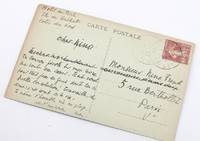
1938réf. 84077S. n. | Ile de Bréhat s. d. [1938] | 14 x 9 cm | une carte
1935réf. 80598Paris 22 Janvier 1935 | 21 x 27 cm | une feuille
1914réf. S5961Offprint from:: Monthly Notices of the Royal Astronomical Society Vol. LXXIV No. 7 May 1914. 1914. 8vo. i 600-622 pp. 20 tables 1 fig. Original printed wrappers. Very good. FIRST SEPARATE EDITION. Jacob Halm was chief assistant at the Cape Observatory Cape Town where he performed intensive work to create good standard sequences to be used for photographic photometry in the southern sky. DSB VI pp. 74-75. Monthly Notices of the Royal Astronomical Society, Vol. LXXIV, No. 7, May 1914. unknown books
1847réf. M12984Philadelphia:: American Medical Association 1847/8. 1847. Offprint. Series: Transactions of the American Medical Association. Sm. 8vo. 18 pp. Contemporary plain brown wrappers probably as issued; extracted from a bound volume thus a remnant residue affecting spine. Front cover library withdrawal rubber stamp possibly: "Concord Free Public Library". Very good. First SEPARATE OF BIGELOW ON ANESTHESIA the journal form has an entirely different pagination being pages 197-214 in the 1847 issue. We believe this is the original offprint form of this paper by Bigelow. There are several clear differences between this offprint form and the journal issue is 1 the pagination for the offprint is 1-18 for the journal it is 197-214 and 2 the journal issue has "C.-1. at the head of the paper and foot of the page has no page number – whereas the offprint form adds the line "Extracted. . . raises the title text higher on the page and includes a page number "1" at the bottom left margin. There is no known textual difference. "The committee considered in detail the various anesthetic agents. According to the report some surgeons were afraid to use anesthesia in their surgical operations feeling that the advantages afforded by the relief of pain might be offset by the risks involved. However even at this early date authors of this report felt that a large group of surgeons were wholly in favor of anesthesia. The authors did however admit that some surgeons would restrict the use of these agents to severe operations after the introduction of ether anesthesia in Boston it was not until several months later that the method became generally popular in other communities in the United States. The favorable reports of its use in Boston and in Europe made for the more extensive use in American communities in 1847 and 1848. The dangers of etherization were also considered. In some cases it was thought that convulsions prolonged stupor intense cerebral excitement alarming depression of the vital powers and asphyxia apparently were caused by the inhalation of ether and chloroform. Secondary effects attributed to inhalation in a few cases were bronchitis pneumonia and inflammation of the brain. Interestingly enough according to this report p. 190 ether was considered to be a safer drug than chloroform" Keys pp. 36-47. "Dr. Bigelow was the unflinching advocate of sulphuric ether as the only safe anesthetic: and his unshaken opinion had a very wide and lasting influence. Bigelow instituted important and productive experiments in anesthesia. He inhaled new and untried anesthetic agents. He made practical and original studies of asphyxia and thoroughly established the fact that insensibility from the inhalation of nitrous oxide gas is largely due to asphyxia. He was also the first to show that anesthesia by nitrous oxide could be accomplished with certainty only by the use of a large volume of gas; and thus made the way plain to Colton and others for its successful adoption in tooth-pulling and in brief surgical operations" Mayo p. 603. Bigelow 1818–1890 born in Boston studied at Harvard from 1833 and became a prominent surgeon and Professor of Surgery at Harvard University. "His 1846 article 'Insensibility during Surgical Operations Produced by Inhalation' detailed the discovery of ether anesthesia and was selected by readers of the New England Journal of Medicine as the 'most important article in NEJM history' in commemoration of the journal's 200th anniversary." "He was a vocal opponent of vivisection and was best known for his description of the hip joint and for a technique for treating patients with kidney stones." – Wikip. REFERENCES: Keys Thomas The History of Surgical Anesthesia Park Ridge IL: Wood Library Museum of Anesthesiology 1996; Fulton & Stanton Anesthesia VII p. 191; Mayo William J. "In the Time of Henry Jacob Bigelow." JAMA Vol. 77 No. 8. 1921. 597-603 pp. American Medical Association, [1847/8]. unknown
1847réf. M12984Philadelphia:: American Medical Association 1847/8. 1847. Offprint. Series: Transactions of the American Medical Association. Sm. 8vo. 18 pp. Contemporary plain brown wrappers probably as issued; extracted from a bound volume thus a remnant residue affecting spine. Front cover library withdrawal rubber stamp possibly: "Concord Free Public Library". Very good. First SEPARATE OF BIGELOW ON ANESTHESIA the journal form has an entirely different pagination being pages 197-214 in the 1847 issue. We believe this is the original offprint form of this paper by Bigelow. There are several clear differences between this offprint form and the journal issue is 1 the pagination for the offprint is 1-18 for the journal it is 197-214 and 2 the journal issue has "C.-1. at the head of the paper and foot of the page has no page number – whereas the offprint form adds the line "Extracted. . . raises the title text higher on the page and includes a page number "1" at the bottom left margin. There is no known textual difference. "The committee considered in detail the various anesthetic agents. According to the report some surgeons were afraid to use anesthesia in their surgical operations feeling that the advantages afforded by the relief of pain might be offset by the risks involved. However even at this early date authors of this report felt that a large group of surgeons were wholly in favor of anesthesia. The authors did however admit that some surgeons would restrict the use of these agents to severe operations after the introduction of ether anesthesia in Boston it was not until several months later that the method became generally popular in other communities in the United States. The favorable reports of its use in Boston and in Europe made for the more extensive use in American communities in 1847 and 1848. The dangers of etherization were also considered. In some cases it was thought that convulsions prolonged stupor intense cerebral excitement alarming depression of the vital powers and asphyxia apparently were caused by the inhalation of ether and chloroform. Secondary effects attributed to inhalation in a few cases were bronchitis pneumonia and inflammation of the brain. Interestingly enough according to this report p. 190 ether was considered to be a safer drug than chloroform" Keys pp. 36-47. "Dr. Bigelow was the unflinching advocate of sulphuric ether as the only safe anesthetic: and his unshaken opinion had a very wide and lasting influence. Bigelow instituted important and productive experiments in anesthesia. He inhaled new and untried anesthetic agents. He made practical and original studies of asphyxia and thoroughly established the fact that insensibility from the inhalation of nitrous oxide gas is largely due to asphyxia. He was also the first to show that anesthesia by nitrous oxide could be accomplished with certainty only by the use of a large volume of gas; and thus made the way plain to Colton and others for its successful adoption in tooth-pulling and in brief surgical operations" Mayo p. 603. Bigelow 1818–1890 born in Boston studied at Harvard from 1833 and became a prominent surgeon and Professor of Surgery at Harvard University. "His 1846 article 'Insensibility during Surgical Operations Produced by Inhalation' detailed the discovery of ether anesthesia and was selected by readers of the New England Journal of Medicine as the 'most important article in NEJM history' in commemoration of the journal's 200th anniversary." "He was a vocal opponent of vivisection and was best known for his description of the hip joint and for a technique for treating patients with kidney stones." – Wikip. REFERENCES: Keys Thomas The History of Surgical Anesthesia Park Ridge IL: Wood Library Museum of Anesthesiology 1996; Fulton & Stanton Anesthesia VII p. 191; Mayo William J. "In the Time of Henry Jacob Bigelow." JAMA Vol. 77 No. 8. 1921. 597-603 pp. American Medical Association, [1847/8]. unknown books
réf. 63369Dijon, Centre d'Etudes Bourguignonnes, 1954. 17 x 25, 63 + 16 pp., broché, bon état.
réf. 99440Paris, Octave Doin et Fils, 1909-1907. 13 x 18 , x-436 + 489-xii pages, 233 + 229 figures, reliure d'édition pleine percaline orange, tête rougie, très bon état.
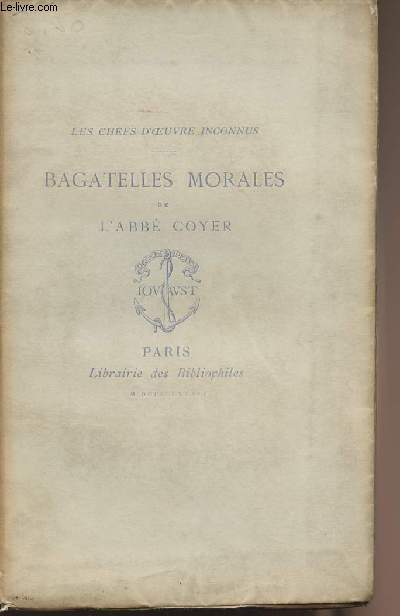
1884réf. R240150279Librairie des Bibliophiles. 1884. In-12. Broché. Etat d'usage, Couv. légèrement passée, Dos plié, Intérieur acceptable. 99 pages. Gravure sous serpente en frontispice. Bandeaux, culs-de-lampe. Dos bruni.. . . . Classification Dewey : 840.08-XIX ème siècle
1986réf. RO80214192Gallery Pierre Matisse N.Y. 1986. In-4. Broché. Bon état, Couv. convenable, Dos satisfaisant, Intérieur frais. Environ 20 pages. Nombreuses illustrations en couleurs hors texte dont frontispice. Texte en langue anglaise.. . . . Classification Dewey : 708-Galeries, musées, collections d'art
1949réf. 7092Paris Paul Morihien 1949 1 Paul Morihien, Paris, 1949, in-12, broché, couverture bleue, 158 pp.
1963réf. S8610No place:: Journal of Molecular Biology 1963. 1963. 8vo. 23-42 pp. Figs. tables. Self-wraps. Ownership signature of Norman Horowitz. Fine. RARE. Jacob was one of the most important geneticists of the 20th century. He shared the 1965 Nobel Prize for Physiology or Medicine with Andre Lwoff and Jacques Monod for their discoveries concerning genetic control of enzyme and virus synthesis. Journal of Molecular Biology, 1963. paperback
1963réf. S8610No place:: Journal of Molecular Biology 1963. 1963. 8vo. 23-42 pp. Figs. tables. Self-wraps. Ownership signature of Norman Horowitz. Fine. RARE. Jacob was one of the most important geneticists of the 20th century. He shared the 1965 Nobel Prize for Physiology or Medicine with Andre Lwoff and Jacques Monod for their discoveries concerning genetic control of enzyme and virus synthesis. Journal of Molecular Biology, 1963. paperback books
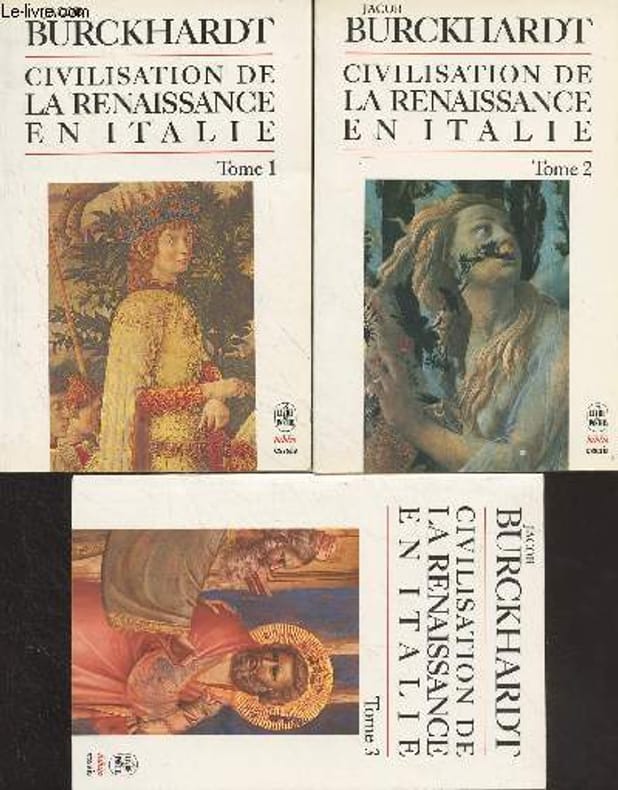
1988réf. R300321091Le livre de poche. 1988. In-12. Broché. Etat d'usage, Couv. convenable, Dos satisfaisant, Quelques rousseurs. 276 + 443 +299 pages - nombreuses illustrations en noir et blanc dans et hors texte.. . . . Classification Dewey : 945-Italie
1973réf. R300306602Fayard. 1973. In-8. Broché. Etat d'usage, Couv. convenable, Dos satisfaisant, Papier jauni. XXVI + 304 pages.. . . . Classification Dewey : 100-PHILOSOPHIE ET DISCIPLINES CONNEXES
1973réf. RO80117795FAYARD. 17 avril 1973. In-8. Broché. Bon état, Couv. convenable, Dos satisfaisant, Intérieur frais. XXV + 304 pages. Envoi de l'auteur, A. KLIMOV. Couverture rempliée.. . . . Classification Dewey : 97.2-Dédicace, envoi