WECKERUS Johann JacobLivre Rare Book
56.074 resultados
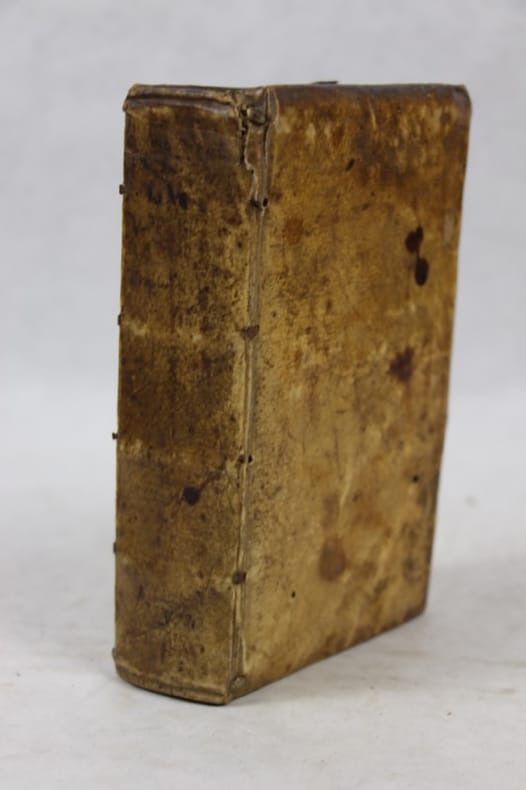
1598ref. 54399[Basilae, Typis Conradi Waldkirchii, sumptibus Episcopianorum] 1598 Fort in-8, plein vélin de l’ép., dos lisse, 14- 667- 27 pp. Figures dans le texte. Sans le titre. Reliure ternie, fendillée en tête, lég. hum. marginale in fine.
1953ref. RO40173950Centrale Drukkerij N.V.. 1953. In-8. Broché. Bon état, Couv. convenable, Dos satisfaisant, Intérieur frais. 233 pages. Etiquette de code sur le dos. Tampons et annotations de bibliothèque sur le 1er plat et en page de titre.. . . . Classification Dewey : 490-Autres langues
1913ref. V95365Leiden, Sijthoff s.d. [ca. 1913] xiii + 445,[2] pp. met 100 tekstafbeeldingen en talrijke tabellen, 25cm., linnen uitgeversband met titel in goudopdruk (wat sleets aan randen), tekst en binnenwerk in zeer goede staat, [Vervolg van titel: "zoowel als de bewerking van tabak tot sigaren, sigaretten, rooktabak, pruim, tabak en snuif"], V95365
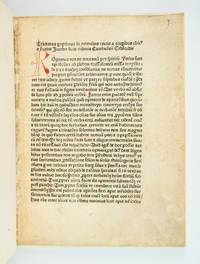
1477ref. ST21103Blaubeuren: Conrad Mancz ca. 1477. Second Edition in Latin. 278 x 205 mm. 11 x 8". 20 leaves. COMPLETE. Single column 32 lines in gothic type. Modern stiff vellum flat spine. Capitals struck in red nine hand-drawn two- to four-line initials in red. Front pastedown with engraved armorial bookplate of Boies Penrose II and with armorial morocco bookplate and paper library label of Eric Hyde Lord Sexton FSA. Goff J-22; BMC II 565; ISTC ij00022000. See Wetzer und Welte's Kirchenlexikon VI 1168. Rear cover with minor soiling first leaf tipped onto tab and with repairs along gutter first two leaves a bit soiled and foxed last two leaves with neat old repairs to lower fore-edge corner the text as a whole with slight softening because of exposure to damp. Not without obvious defects but still an incunable appealing for its content rarity and provenance as well as for its generous margins and unworn binding. One of just three copies in North America located by ISTC this is the extremely rare Blaubeuren edition of a work that offers guidance on dealing with ghostly apparitions a topic not often dealt with in incunabular printing. "On Souls Stripped of their Bodies or On the Apparitions and Receptacles of Souls" was written in the late 1450s in response to a plea for advice from a Franciscan monastery in Leipzig that was experiencing what appeared to be supernatural disturbances instigated by a ghost or demon. A Carthusian prior who also served as rector and professor of canon law at the University of Erfurt Jacobus de Clusa also known as Jacob of Jüterbogk or Jacob of Paradiso 1381-1465 was known for his numerous writings on moral theology. First issued in 1475 in German and in Latin the present response to the concerned Franciscans became the most widely read of his works. According to Wetzer & Welte Jacobus considers in the book "such apparitions to be quite possible particularly in places where the deceased had sinned as they may hope to be released from Purgatory sooner through the intercession of surviving relatives or friends. Consequently he offers advice to the latter on this matter. 'If souls ask for intercession' he says 'it should be granted but one must not give way to idle fantasies.' He identifies the most effective means of aid as: Masses almsgiving prayers fasting and good works. In this context he discusses the state of the soul after death in a clear and illuminating manner. 'Immediately after death' he states 'the particular judgment takes place at the very spot where death occurred; for God is everywhere.' He designates four places to which departed souls may go: a. the Empyrean Heaven; b. the underworld "infernus sub terra"; c. Limbo of the Infants "limbus puerorum"; d. Purgatory. In his view escaping Purgatory entirely is very difficult." This open discussion of what happens to the soul after death and the possibility of the existence of ghosts was unsurprisingly appealing to a wide audience particularly as it came from a respected theologian. ISTC indicates that ours is the second incunabular edition following the first printing in Esslingen ca. 1474--all early printings are now uncommon in commerce. This is one of 24 works issued between 1473 and 1478 by Conrad Mancz the only 15th century printer in Blaubeuren a small city near Ulm. Jacobus de Clusa was the author of three of these publications the other two being books of sermons. Our copy was owned by Philadelphia bibliophile Boies Penrose II 1902-76 before its acquisition by Eric Hyde Lord Sexton 1902-80 an avid collector of early printing who amassed a library of incunabula from 114 different printing locations. This volume sold at his 1981 sale at Christie's for $2200. ISTC identifies the Sexton copy as one of three in North America the others being at the Huntington and the Beinecke. Searches of RBH and ABSA find just one other copy of the Blaubeuren edition at auction since 1928 that one appearing at Doerling in 1981 where it fetched 6500 Deutsche marks $2879. Conrad Mancz unknown
1477ref. ST21103Blaubeuren: Conrad Mancz ca. 1477. Second Edition in Latin. 278 x 205 mm. 11 x 8". 20 leaves. COMPLETE. Single column 32 lines in gothic type. Modern stiff vellum flat spine. Capitals struck in red nine hand-drawn two- to four-line initials in red. Front pastedown with engraved armorial bookplate of Boies Penrose II and with armorial morocco bookplate and paper library label of Eric Hyde Lord Sexton FSA. Goff J-22; BMC II 565; ISTC ij00022000. See Wetzer und Welte's Kirchenlexikon VI 1168. Rear cover with minor soiling first leaf tipped onto tab and with repairs along gutter first two leaves a bit soiled and foxed last two leaves with neat old repairs to lower fore-edge corner the text as a whole with slight softening because of exposure to damp. Not without obvious defects but still an incunable appealing for its content rarity and provenance as well as for its generous margins and unworn binding. One of just three copies in North America located by ISTC this is the extremely rare Blaubeuren edition of a work that offers guidance on dealing with ghostly apparitions a topic not often dealt with in incunabular printing. "On Souls Stripped of their Bodies or On the Apparitions and Receptacles of Souls" was written in the late 1450s in response to a plea for advice from a Franciscan monastery in Leipzig that was experiencing what appeared to be supernatural disturbances instigated by a ghost or demon. A Carthusian prior who also served as rector and professor of canon law at the University of Erfurt Jacobus de Clusa also known as Jacob of Jüterbogk or Jacob of Paradiso 1381-1465 was known for his numerous writings on moral theology. First issued in 1475 in German and in Latin the present response to the concerned Franciscans became the most widely read of his works. According to Wetzer & Welte Jacobus considers in the book "such apparitions to be quite possible particularly in places where the deceased had sinned as they may hope to be released from Purgatory sooner through the intercession of surviving relatives or friends. Consequently he offers advice to the latter on this matter. 'If souls ask for intercession' he says 'it should be granted but one must not give way to idle fantasies.' He identifies the most effective means of aid as: Masses almsgiving prayers fasting and good works. In this context he discusses the state of the soul after death in a clear and illuminating manner. 'Immediately after death' he states 'the particular judgment takes place at the very spot where death occurred; for God is everywhere.' He designates four places to which departed souls may go: a. the Empyrean Heaven; b. the underworld "infernus sub terra"; c. Limbo of the Infants "limbus puerorum"; d. Purgatory. In his view escaping Purgatory entirely is very difficult." This open discussion of what happens to the soul after death and the possibility of the existence of ghosts was unsurprisingly appealing to a wide audience particularly as it came from a respected theologian. ISTC indicates that ours is the second incunabular edition following the first printing in Esslingen ca. 1474--all early printings are now uncommon in commerce. This is one of 24 works issued between 1473 and 1478 by Conrad Mancz the only 15th century printer in Blaubeuren a small city near Ulm. Jacobus de Clusa was the author of three of these publications the other two being books of sermons. Our copy was owned by Philadelphia bibliophile Boies Penrose II 1902-76 before its acquisition by Eric Hyde Lord Sexton 1902-80 an avid collector of early printing who amassed a library of incunabula from 114 different printing locations. This volume sold at his 1981 sale at Christie's for $2200. ISTC identifies the Sexton copy as one of three in North America the others being at the Huntington and the Beinecke. Searches of RBH and ABSA find just one other copy of the Blaubeuren edition at auction since 1928 that one appearing at Doerling in 1981 where it fetched 6500 Deutsche marks $2879. Conrad Mancz unknown books
1694ref. 9453DB1694. Jena Nisius 1694. 28 S. Geheftet. Mit Holzschnitt-Vignette und floraler Initiale. Ränder etwas schräg beschnitten einzelner Buchstabenverlust auf Titel. Sonst ein sehr gut erhaltenes Exemplar. unknown
ref. 006138Amsterdam Netherlands: J. Brandt & Zoon An excllent clean and tighlty bound book published around 1949. Lightly inked message from a giver of a book to the recipient dated 1949. 288 pages. J.. Brandt & Zoon hardcover
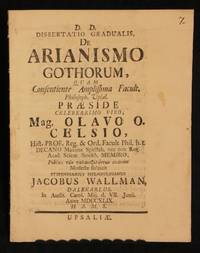
ref. 26650Uppsala 1749. 4:o. 4 29 1 s. Tagen ur band. Lidén I: 106. Warmholtz 1341: “Författaren är af den mening at Götherne som tågat utur Scandien ej förr än vid slutet af III eller i början af IV Sec. blifvit til Christna Läran omvände . Han tilstår likväl at de icke bekänt sig til den grofva Arianismus utan fast mera varit semi-Ariani.” unknown
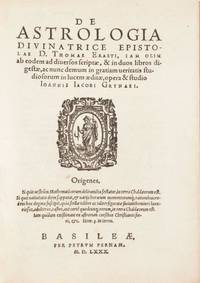
1580ref. LLV2606Basle:: Peter Perna 1580 1572. 1580. Two volumes bound as one. Quarto. Pagination: 8 236 12; 16 267 20 pp. including blanks. Two printer's devices on title pages full-page portrait of Paracelsus on N3r of second work decorated initials; minor stains. Contemporary limp vellum yapp fore-edge covers lightly curled one tie of four. Title in old hand on bottom edge old owner's seven-line ink note on front free end paper on "Diogenes" minor marginal dampstain on two leaves otherwise a fresh clean crisp copy. WRITTEN ON THE BOTTOM EDGE OF THE VOLUME: "De astrolog: divinatrice. Erasti.Disputation. / De medicina Paracelsi.Pars I." VERY RARE. First edition. THOMAS ERASTUS' DISTPUTATIONS CONCERNING ASTROLOGY AND THE NEW MEDICINE OF PARACELSUS. First Editions. bound with: DISPUTATIONUM DE MEDICINA NOVA PHILIPPI PARACELSI PARS PRIMA: IN QUA QUAE DE REMEDIIS SUPERSTITIOSIS & MAGICIS CURATIONIBUS ILLE PRODIDIT PRAECIPUE EXAMINANTUR. . . This is one of two books written by Erastus concerning divining astrology especially directed to certain persons named in the letter of Erastus in this case the primary being Christopher Stathmion whose last letter is dated from 1559. A second part was issued for the DE MEDICINA not present here. Thomas Erastus 1524-1583 Swiss Protestant theologian a physician whose original name was Luber Lieber or Liebler. As a follower of Huldreich Zwingli he supported the Swiss leader's view of the Lord's Supper at the conferences of Heidelberg 1560 and Maulbronn 1564 and in a book 1565. In spite of his vigorous opposition to the Calvinist doctrine Presbyterian Church discipline and government were introduced in Heidelberg in 1570. In 1574 Erastus was excommunicated by the Heidelberg consistory but a year later the edict was removed. . .The term Erastianism has come to represent approval of the dominance of civil authority in all punitive measures and by extension complete dominance of the state over the church though Erastus himself never held such an extreme view. Erastianism achieved its definitive expression in the Leviathan of Thomas Hobbes. / ". . .On his return from Italy to Germany Erastus was shocked at the extent to which men were addicted to vain predictions of astrologers and at the astrological restrictions under which medical practice labored. . .as an antidote to the superstition poisoning Germany he had made a translation from the Italian into German of the book of Savonarola against astrologers. This aroused some opposition among German astrologers and the aforesaid physician of Coburg Chrsitopher Stathmion had contended that Savonarola's work did not apply to divination or astrology which was based on natural causes. . .He adopts the usual theological position that divination is the work of demons. He joins Pico and Savonarola in their wholesale onslaught upon astrology to which he would appear to leave almost no field of activity. . .In the first volume of his Disputations Concerning the New Medicine of Paracelsus . . . Erastus has more to say against astrology. It holds first place in magic of which he utterly disapproves and is the offscouring of all impious arts. . .Erastus denied the possibility of natural magic. Nor would he admit that the Magi of ancient Persia had been priests or sages. Their magic too he regarded as diabolical. He showed himself even more incensed at Pomponnazzi for his favorable attitude toward magic in De incantationibus than at Paracelsus. . . Astrology he condemned as the foundation of all other magic arts. He censured Paracelsus for speaking approvingly of augury prodigies geomancy pyromancy and necromancy and for condoning the receiving from demons' remedies to be employed for good ends." Thorndike V5 pp. 652-660 FURTHER: Regarding the second tract the Disputations "concerning and against the new Paracelsan medicine composed by Erastus illustrate on the one hand his opposition to the medical views of Paracelsus and his followers and on the other hand his opposition to various occult arts and sciences most of which he accuses Paracelsus of countenancing." "Erastus commends Paracelsus for one thing namely his careful preparation of medicines and revival of distillation." p. 657. REFERENCES: Astrologiae: VD 16 E3669; Adams E905 & E910; Cantamessa I1401; DSB IV388; Durling/NLM 1383; Antoine Faivre & Jacob Needleman Modern esoteric spirituality London 1992 p. 181; Houzeau/Lancaster 4932; Herbert Jaumann Bio-bibliographisches Repertorium p.253; Rosenthal Magica 3397; Medicina: VD 16 E3679; Sudhoff 247; Wellcome I 2057; Waller 2778. Peter Perna, 1580, 1572. hardcover
1580ref. LLV2606Basle:: Peter Perna 1580 1572. 1580. Two volumes bound as one. Quarto. Pagination: 8 236 12; 16 267 20 pp. including blanks. Two printer's devices on title pages full-page portrait of Paracelsus on N3r of second work decorated initials; minor stains. Contemporary limp vellum yapp fore-edge covers lightly curled one tie of four. Title in old hand on bottom edge old owner's seven-line ink note on front free end paper on "Diogenes" minor marginal dampstain on two leaves otherwise a fresh clean crisp copy. WRITTEN ON THE BOTTOM EDGE OF THE VOLUME: "De astrolog: divinatrice. Erasti.Disputation. / De medicina Paracelsi.Pars I." VERY RARE. First edition. THOMAS ERASTUS' DISTPUTATIONS CONCERNING ASTROLOGY AND THE NEW MEDICINE OF PARACELSUS. First Editions. bound with: DISPUTATIONUM DE MEDICINA NOVA PHILIPPI PARACELSI PARS PRIMA: IN QUA QUAE DE REMEDIIS SUPERSTITIOSIS & MAGICIS CURATIONIBUS ILLE PRODIDIT PRAECIPUE EXAMINANTUR. . . This is one of two books written by Erastus concerning divining astrology especially directed to certain persons named in the letter of Erastus in this case the primary being Christopher Stathmion whose last letter is dated from 1559. A second part was issued for the DE MEDICINA not present here. Thomas Erastus 1524-1583 Swiss Protestant theologian a physician whose original name was Luber Lieber or Liebler. As a follower of Huldreich Zwingli he supported the Swiss leader's view of the Lord's Supper at the conferences of Heidelberg 1560 and Maulbronn 1564 and in a book 1565. In spite of his vigorous opposition to the Calvinist doctrine Presbyterian Church discipline and government were introduced in Heidelberg in 1570. In 1574 Erastus was excommunicated by the Heidelberg consistory but a year later the edict was removed. . .The term Erastianism has come to represent approval of the dominance of civil authority in all punitive measures and by extension complete dominance of the state over the church though Erastus himself never held such an extreme view. Erastianism achieved its definitive expression in the Leviathan of Thomas Hobbes. / ". . .On his return from Italy to Germany Erastus was shocked at the extent to which men were addicted to vain predictions of astrologers and at the astrological restrictions under which medical practice labored. . .as an antidote to the superstition poisoning Germany he had made a translation from the Italian into German of the book of Savonarola against astrologers. This aroused some opposition among German astrologers and the aforesaid physician of Coburg Chrsitopher Stathmion had contended that Savonarola's work did not apply to divination or astrology which was based on natural causes. . .He adopts the usual theological position that divination is the work of demons. He joins Pico and Savonarola in their wholesale onslaught upon astrology to which he would appear to leave almost no field of activity. . .In the first volume of his Disputations Concerning the New Medicine of Paracelsus . . . Erastus has more to say against astrology. It holds first place in magic of which he utterly disapproves and is the offscouring of all impious arts. . .Erastus denied the possibility of natural magic. Nor would he admit that the Magi of ancient Persia had been priests or sages. Their magic too he regarded as diabolical. He showed himself even more incensed at Pomponnazzi for his favorable attitude toward magic in De incantationibus than at Paracelsus. . . Astrology he condemned as the foundation of all other magic arts. He censured Paracelsus for speaking approvingly of augury prodigies geomancy pyromancy and necromancy and for condoning the receiving from demons' remedies to be employed for good ends." Thorndike V5 pp. 652-660 FURTHER: Regarding the second tract the Disputations "concerning and against the new Paracelsan medicine composed by Erastus illustrate on the one hand his opposition to the medical views of Paracelsus and his followers and on the other hand his opposition to various occult arts and sciences most of which he accuses Paracelsus of countenancing." "Erastus commends Paracelsus for one thing namely his careful preparation of medicines and revival of distillation." p. 657. REFERENCES: Astrologiae: VD 16 E3669; Adams E905 & E910; Cantamessa I1401; DSB IV388; Durling/NLM 1383; Antoine Faivre & Jacob Needleman Modern esoteric spirituality London 1992 p. 181; Houzeau/Lancaster 4932; Herbert Jaumann Bio-bibliographisches Repertorium p.253; Rosenthal Magica 3397; Medicina: VD 16 E3679; Sudhoff 247; Wellcome I 2057; Waller 2778. Peter Perna, 1580, 1572. hardcover books
ref. 47038029like new. unknown
ref. 1020224355.Ghardcover. Good. Access codes and supplements are not guaranteed with used items. May be an ex-library book. hardcover
ref. #[18124]8º: 8 A-2D 8 -2D8 blanco gepag.: 16 430 pp.; 8 A-2A 8 gepag.: 16 383 1 pp. Twee titelpagina's in zwart en rood gedrukt. Contemperain perkament. Muller 429 tweede deel Biographisch-Bibliographisches Kirchenlexikon Band IX 1995 l Satirische beschouwingen over zeden en actuele gebeurtenissen van de Duitse theoloog hoogleraar en schrijver Schupp of Schuppius 1610-1661. Het tweede deel van 'De bedorvene werelt' dat vertaler Schoolhouder heeft opgedragen aan de verzamelaar van mun unknown
ref. 1168042712.Gpaperback. Good. Access codes and supplements are not guaranteed with used items. May be an ex-library book. paperback
1775ref. 52507100002Martinus De Bruyn 1775. Hardcover. Good. Hardcovers. SCARCE ORIGINAL 1775-76 PRINTING. 2 VOLUME SET. Pages are clean and unmarked. Covers marbled paper covered boards with leather on spines show edge wear with rubbing/scuffing. Some tears on marbled paper. Bindings tight hinges strong. Hardcovers. ZELDZAME ORIGINELE DRUK UIT 1775-76. SET VAN 2 DELIGE ARTIKELEN. Pagina's zijn schoon en onbeschadigd. De omslagen met gemarmerd papier beklede platten met leer op de ruggen vertonen slijtage aan de randen door wrijving/slijtage. Enkele scheuren in het gemarmerde papier. Stevige banden scharnieren sterk.; 100% Satisfaction Guaranteed! Ships same or next business day! Martinus De Bruyn hardcover
ref. #[9188]Amsterdam G.J.A. Beijerinck 1837 8º: 2 6 141 1 pp. Gegraveerde titelpagina met vignet door J.P. Lange naar Coutteau en 5 gravures in de tekst door dezelfden en door J.W. Kaiser. Half linnen. l Uit het voorwoord blijkt dat Van Oosterwijk Bruijn zijn versjes "ter verpoozing en vervrolijking" placht voor te dragen in letterkundige genootschappen als het serieuze gedeelte achter de rug was. unknown
ref. 1166757870.Gpaperback. Good. Access codes and supplements are not guaranteed with used items. May be an ex-library book. paperback
ref. 1120473276.Gpaperback. Good. Access codes and supplements are not guaranteed with used items. May be an ex-library book. paperback
ref. B9781166757878New. unknown
ref. 1166767353.Gpaperback. Good. Access codes and supplements are not guaranteed with used items. May be an ex-library book. paperback
ref. 1120482755.Gpaperback. Good. Access codes and supplements are not guaranteed with used items. May be an ex-library book. paperback
ref. B9781166767358New. unknown
2015ref. 140725Moordrecht: Target Press 2015. goed / good. ISBN: 9789080747371. . Target Press unknown
1769ref. 52507100004Martinus De Bruyn 1769. Hardcover. Good. Hardcover. SCARCE ORIGINAL 1769 PRINTING. I & II in one book. Pages are unmarked. Covers marbled paper covered boards with leather on spine show edge wear with rubbing/scuffing. Some tears on marbled paper. Spine edge wear. Binding tight hinges strong. Hardcover. ZELDZAME ORIGINELE DRUK UIT 1769. I & II in één boek. Pagina's zijn onbeschreven. De omslagen met gemarmerd papier beklede platten met leer op de rug vertonen slijtage aan de randen door wrijving/slijtage. Enkele scheuren in het gemarmerde papier. Slijtage aan de rugrand. Stevige binding scharnieren sterk.; 100% Satisfaction Guaranteed! Ships same or next business day! Martinus De Bruyn hardcover
ref. B9781166467609New. unknown