Baldwin, MosesABAA
500 risultati
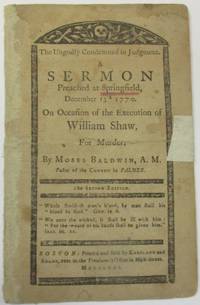
1771rif. 39601Boston: Printed and Sold by Kneeland and Adams next to the Treasurer's Office in Milk-Street 1771. 24pp but lacking the half title. Death's Head ornamentation on title page. Disbound and uniformly toned. Closed tear to title leaf no loss repaired; evidence of repair at outer margin. Inner margin of title page and page 24 with old wrapper remnants. Good. Shaw bludgeoned Edward East to death while both were inmates of the Springfield prison. This is the second of three editions of this title all issuing in 1771; AAS does not own our edition. Reverend Baldwin scolds Mr. Shaw "for the sin of intemperance. Have you not hereby dishonoured God and abused his bounty and goodness; wronged your own soul and body; wasted your substance; brought your self and family to poverty and distress. . . You are verily guilty of the crying sin of MURDER." Evans 11974. ESTC W1508.5- Yale NYHS Boston Public Williams Peabody-Essex. Not in McDade or Cohen. Printed and Sold by Kneeland and Adams, next to the Treasurer's Office in Milk-Street unknown books
rif. X03OS-00049Z. Tehinka. Collectible - Acceptable. New York: Z. Tehinka 1943. Reprint of 1680 edition. Volume 1. Folio. 28pp. Maps. Fair book. Spine cover missing. Board covers considerably chipped though without text loss. Front board detached. Preface through p. 26 detached. Poland maps history travel Inquire if you need further information. Z. Tehinka unknown books
rif. X03OS-00050Z. Tehinka. Collectible - Acceptable. New York: Z. Tehinka 1943. Reprint of 1680 edition. Volume 1. Folio. 28pp. Maps. Fair book. Bottom 6" of both boards dampstained. Poland maps history travel Inquire if you need further information. Z. Tehinka hardcover books
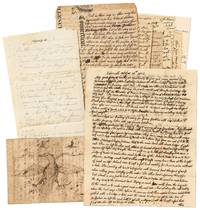
1834rif. 436962Connecticut New York Ohio 1834. Very Good. A small archive consisting of one two-page narrative letter and 10 loose sheets about 20 holograph pages of miscellaneous writings by Moses Kimball including one page with pen and ink illustrations. Modest toning and a few tiny tears three manuscript sheets are partially split at the folds including one with a neat Japanese paper tape repair about very good overall. Born in Connecticut in 1741 Moses Kimball served in the Revolutionary War as a soldier under Brigadier General Samuel McClellan 1781-82. A devout Universalist he taught navigation and civil engineering and was a prosperous land owner in Norwich Connecticut. The letter and miscellaneous writings of poetry and short sermons retained here date from the last two years of his life when he left Connecticut to live with a grandson in Norwalk Ohio. In the letter written to a friend in Connecticut Kimball describes in detail his 15-day journey undertaken in May 1835 from Poquetanuck to Norwalk: He left via sloop for Albany then traveled along the Erie Canal and completed the last leg of the trip by steamer on Lake Erie. In his verse and short sermons he lays out his strong Universalist beliefs and philosophy of life. He died happy at the age of 93 in December 1835 just a few weeks after his arrival in Norwalk. A few extracts from the letter together with a sample of his verse follows: 1. ALS. 2pp. Small quarto. Norwalk October 14th 1835. Addressed to John Harkness at Preston Connecticut: "My good friend having an opportunity to give you some account of my journey to this place I gladly embrace it. It is a beautiful country suitable for farming a rich soil . We have an academy of learning for young gentlemen with 108 scholars and another for young ladies with 98 female scholars . We left Poquetanuck the 11 day of May & arrived at my Grandson Moses Kimball's the 25 of May. We went in a sloop . to Albany there I saw great improvements . They have made an Island in the river half a mile long . forming a basin between that & the main land with draw bridges at each end. There we left the sloop and entered on board a canal boat and past on our way drawn by horses day and night. Thus we past on up to Little Falls . and so on to Fort Stanwix . there at the height of land we left the Mohawk River and past a flat level country for 60 or 70 miles without a lock. The country all low and intersected with drowned land . and all along this wet country where the land rose a little . there would be some inhabitants settled with a bridge or two over the canal . when we got to Lake Erie at Buffalo we left the canal boat and got into a steam boat the largest vessel that I ever saw . this boat that cost thirty-five thousand dollars my grandson Moses owns one-tenth part . When we came over the lake . there were seven hundred passengers in her . So you see it is no wonder she earns money . ." 2. Miscellaneous Verses and Short Sermons 1834-35: 10 octavo sheets/about 20 holograph pages including one page with pen and ink illustrations. The following is quoted from a poem written by Kimball on his ninety-third birthday "May 17 A.D. 1834": This day my years are Ninety-three The time is past & gone from me Brought into being here to stay To wait for time to pass away . And when my earthly body dies To God my spirit will arise And live with him and there remain Till Souls to bodies join again . A compelling and historically important small archive of writings that also serve as a testament to Kimball's remarkable physical health and mental acuity. unknown books
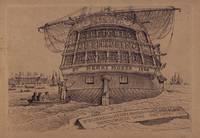
1824rif. 55402London: Henry Moses 1824. First edition. Hardcover. Very good to fine condition. Oblong Octavo. 20 etchings plus original illustrated wrappers. Bound in Royal blue leather retaining original wraps; gilt lettering and ruling on leather label mounted to spine. Cream endpapers. Tan wrappers with etching and brown lettering on front back cover plain. Our collection of "Sketches of Shipping" on the River Thames appears to be the earliest state published by Henry Moses with front wrappers dated Dec. 1 1824 and all twenty etchings dated in plates Oct. 1 1824. An 1826 advertisement in the Quarterly Review indicated that six parts of the Sketches with five engravings each had been published up to that time and announces the publication of two additional issues. The front wrapper stating publication date as Dec. 1 1824 as in our copy appears to have been used in various editions including some containing eleven plates dated March 1 1825 in plates or lettered in ink "Nos. 5 & 6" corresponding to the 1826 Quarterly Review advertisement. The irregularities and/or contradictions in tracing the publication of these Moses etchings suggest that due to the constrictions of the medium these popular etchings were published in limited numbers in variant editions as identified by the dates in these plates to satisfy the public demand of the time. In our copy all 20 etchings are dated in plates Oct. 1 1824 with two of the plates containing additional dates etched into the plates as indicated below: 1. Sailing Match Aug. 16 1824 2. An Indianian in Barnard's Yard Deptford 3. Trafalgar 120 G 125 4. Midway 5. Midway Aug. 9 1824 6. Blackwall. Dutches of M. 7. Blackwall Basin 8. Trafalgar P - 120 Guns 9. Sheerness Yard from a Window of the Fountain Inn 10. Sheerness 11. Sheerness Yard from a window of the Fountain Inn variant motif 12. Trafalgar 120 Guns 13. Trafalgar in the Basin Sheerness 14. Hulks at Sheerness 15. Blackwall 16. Untitled 17. City Canal 18. Basin at Blackwall 19. Blackwall - Wellington Indiaman 20. Surat Castle All etchings but plate 12 with H. Moses printed to plate. Plate twelve with Henry Moses. Printed by Chatfield and Coleman. Inked name and date on front free endpaper. "12/." inked to upper foredge corner of cover; this with a few small damp stains on front and back covers. OCLC lists an 1837 copy with 57 plates incl. 2 engraved title pages published in London by Ackermann a 1824 copy with nineteen plates 1825 and 1837 copies with thirty plates the latter published by Ackermann an 1837 copy titled "The Marine Sketch Book" with twenty-eight plates an 1826 copy with nine plates titled Sketches of Shipping: View in Portsmouth Harbour" and an 1827 copy with thirty plates titled "Shipping at Portsmouth and Spithead" publisher W. B. Cooke. Henry Moses hardcover books
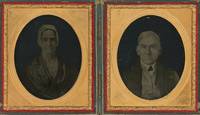
1854rif. List1708Philadelphia 1854. Ninth plate ambrotypes in a union case measuring 2 ½ x 2 ⅛ inches visible in larger case. With the identification of Isaac Rehn with his imprint and "Patented July 4 & 11 1854" imprinted on the case. A fine pair. A striking pair of ambrotypes of Mary and Moses Pennock who were members of the Kennett Square Underground Railroad network as well as active members of the Kennett Square abolitionist and Quaker community. Moses was one of the founders of the Longwood Progressive Meeting. In R.C. Smedley's History of the Underground Railroad in Chester and Neighboring Counties of Pennsylvania Lancaster Office of the Journal 1883 the Pennocks are mentioned on p. 301 as working as part of the network surrounding Isaac and Thamazine Meredity. Their son Samuel who would go on to secure important agricultural patents is also mentioned twice. The images are notable from a photographic history perspective as well as being early examples of the ambrotype process that had been patented in part by fellow Quaker and spiritualist Isaac Rehn. Rehn held a partial patent on ambrotypes along with James Ambrose Cutting of Boston and became unpopular among other photographers for his efforts to extend his patent. He later practiced spiritual photography and was a Professor of Chemistry at Pennsylvania Medical University in Philadelphia. Rehn was also involved in radical politics as a founder and leader of the Philadelphia section of the International Workingmen's Association which was later disenfranchised by Karl Marx along with several other American sections. Examples of Rehn's work are held at the National Gallery of Art the Library Company of Philadelphia and Yale's Sterling Memorial Library. Overall a very fine and significant pair of images. unknown books
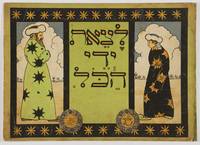
1920rif. 52940Moscow/Odessa: Omanut 1920. First edition. Softcover. g- to g. Oblong octavo. Unpaginated 8 double-sided leaves front and back wrappers printed on both sides. Stiff tan paper wrappers with beautiful chromolithographic illustrations in hues of green blue black and brown. Issued by the pioneering Hebrew-language published house Omanut. This lavishly illustrated work is a version of the Aesop's fable often known as "The Miller His Son and the Donkey" in a version said to have been adapted by Leo Tolstoy with Hebrew translation attributed to the acclaimed Hebrew-language writer and essayist Ahad Ha-Am Asher Zvi Ginsberg 1856-1957 although the work is completely uncredited. Here the work's title has been humorously translated into Hebrew as "To Please Everyone". The text is accompanied throughout by 8 large and vibrant chromolithographic images including the front and back wrappers. The illustrations are credited collectively to "Havurat Tsayarim" The Group of Painters a group of four young artists from the Odessa Art Academy who illustrated works for Omanut during the period comprised of Yakov Apter 1899-1941 Moses Mutselmakher 1900-1961 Aaron Keravatsov 1896-1942 and Efim Khiger 1899-1955. This work is part of the Gamliel Library series of beautiful picture books for children introduced by Omanut co-founder Shoshana Zlatopolsky Persitz and named after her son Gamliel. Persitz took inspiration from the rich tradition of Russian children's literature lavishly illustrated in chromolithographs produced by the likes of Ivan Bilibin and the publishing house of Iosif Knebel to create some of the earliest examples of comparable works in Hebrew. No publication date is given but the fact that this is one of a smaller number of earlier titles issued before the move of the publisher Omanut to Frankfurt points to the fact it could not have been published after 1921. Text throughout in Hebrew. Wrappers with some foxing and staining. Some rubbing and creasing to extremities. Back cover lightly soiled with a light vertical crease in the center. The binding has been re-cased with a sting-binding along the spine to secure the book block. Water staining and light foxing to pages throughout predominantly in the margins. Images still vibrant. Wrappers in good- interior in good condition overall. Quite scarce. Hebrew title: ‌לצ×ת ידי הכל Author/contributors: חבורת-×¦×™×¨×™× ×פטר מוצלמכר קרבצוב חגר ×יזופוס לב טולסטוי ×חד ×”×¢× Publication: מוסקבה-×ודיסה הוצ×ת ××ž× ×•×ª Series title: ספריה גמלי×ל Alternate transliteration: La'tset Yede Ha'kol. Omanut unknown books
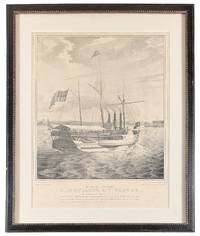
1828rif. 42606Boston: Pendleton's Lithography 1828. Uncoloured lithograph. Framed size: 19 1/4 x 15 5/8 inches. An early American marine lithograph depicting the steam packet Chancellor Livingston entering Newport Harbor issued at the outset of steam navigation on the New England coast. Published in Boston by Pendleton's Lithography after a design by Moses Swett this print presents the Chancellor Livingston under way as it enters Newport Harbor with passengers visible along the decks and flags flying from the rigging. The composition combines a detailed vessel portrait with a wider harbour view situating the steamer within a recognizable coastal setting and emphasizing both its scale and activity. The vessel itself held a prominent place in early American steam navigation. Originally associated with Robert Fulton's Hudson River operations the Chancellor Livingston was rebuilt in 1827 for service between New York and Providence. The lithograph records this later phase of its career when coastal steam travel was expanding rapidly and such vessels were becoming a familiar presence along the northeastern seaboard. The printed text beneath the image reinforces the promotional aspect of the print listing the vessel's dimensions horsepower boilers and fittings as well as its passenger capacity and accommodations. This combination of technical specification and visual representation places the image at the intersection of ship portraiture and commercial advertisement reflecting the contemporary interest in steam technology and its practical advantages. As a product of Pendleton's Lithography the print also belongs to the earliest phase of lithographic production in the United States. Established in Boston in the 1820s the firm was among the first to adopt the medium on a sustained basis and works such as this illustrate both the technical possibilities of lithography and its application to subjects of current interest. The present impression reflects that early moment when lithography was emerging as a flexible and effective means of producing images of modern life and technology. Pendleton's Lithography unknown books
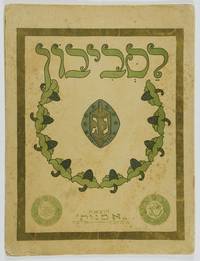
1920rif. 52932Moscow/Odessa: Omanut 1920. First edition. Softcover. g- to vg. Large quarto. Unpaginated 8 double-sided leaves front and back wrappers printed on both sides. Stiff tan paper wrappers with beautiful chromolithographic illustrations in hues of green blue red and gold. Issued by the pioneering Hebrew-language published house Omanut. This lavishly illustrated work contains the Hanukkah poem "For the Dreidel" written by acclaimed Hebrew-language poet Zalman Shneour 1887-1959 although the author is uncredited here. The text is accompanied throughout by 8 large and vibrant chromolithographic images including the front and back wrappers many with over-painting in lustrous metallic hues of silver and gold. Whenever the Dreidel appears it is in silver. The illustrations are credited collectively to "Havurat Tsayarim" The Group of Painters a group of four young artists from the Odessa Art Academy who illustrated works for Omanut during the period comprised of Yakov Apter 1899-1941 Moses Mutselmakher 1900-1961 Aaron Keravatsov 1896-1942 and Efim Khiger 1899-1955. This work is part of the Gamliel Library series of beautiful picture books for children introduced by Omanut co-founder Shoshana Zlatopolsky Persitz and named after her son Gamliel. Persitz took inspiration from the rich tradition of Russian children's literature lavishly illustrated in chromolithographs produced by the likes of Ivan Bilibin and the publishing house of Iosif Knebel to create some of the earliest examples of comparable works in Hebrew. No publication date is given but the fact that this is one of a smaller number of earlier titles issued before the move of the publisher Omanut to Frankfurt points to the fact it could not have been published after 1921. Text throughout in Hebrew. Front wrapper foxed and lightly water-stained with some additional minor staining to the back wrappers. Light rubbing chipping and/or creasing to extremities. Leaves disbound. Interior images and text overall still quite clean and vibrant with a few minor to light stains and/or smudges along the bottom margins of a few leaves. Ex-library ink stamps at the bottom of the first and last text pages as well as the back wrapper. Wrappers in good- interior in very good condition overall. Hebrew title: לסביבון Author/contributors: חבורת-×¦×™×¨×™× ×פטר מוצלמכר קרבצוב חגר זלמן ×©× ×™×ור Publication: מוסקבה-×ודיסה הוצ×ת ××ž× ×•×ª Series title: ספריה גמלי×ל Alternate transliteration: L'Sevivon This first edition is quite scarce with OCLC listing only two holdings worldwide. A slightly more common second edition of the work was published in 1922 after Omanut had moved to Frankfurt. Bibliographic reference: Ayala Gordon Hebrew Illustrations 2005 p.89-116. Omanut unknown books
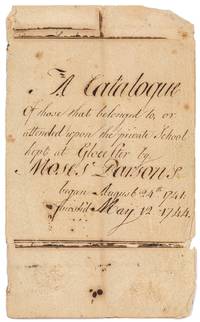
1741rif. 560322Gloucester Massachusetts 1741. Softcover. Very Good. Manuscript. 24mo. Three quarter leaves pinned inside two outer full leaves measuring about 3 ½" x 6". One quarter leaf is loose laid-in. The full front cover leaf titled in manuscript is trimmed above the title and has one horizontal cut below the title very good. The three-quarter leaves list the names of students 75 boys and 13 girls in ink on the rectos and versos. Born in Gloucester Massachusetts in 1716 Moses Parsons graduated from Harvard in 1736 and while pursuing his theological studies he taught a private school in his native town as noted in the catalogue from 1741-44. In 1744 he accepted a call to Byfield Parish where he was distinguished as a preacher until his death in 1783 having seen the Church through the Great Awakening led by George Whitefield and through the Revolutionary War. At his school Parsons taught a veritable Who's Who of early Gloucester residents - individual and family names such as Winthrop Sargent whose son was a prominent patriot and Governor of the Mississippi Territory William Ellery Nathaniel Haraden whose son served as the Sailing Master of the U.S.S. Constitution and many others. In addition to his pastoral responsibilities at Byfield Parsons was instrumental in founding Governor Dummer Academy now known as The Governor's Academy. During his tenure at his private school Parson's calculates that he taught 75 boys and 28 girls quite a few of whom would go on to be immortalized by Gloucester historians John Babson and James Pringle. An important early manuscript documenting an overlooked piece of Gloucester's local history. Reference: William Cutter. Genealogical and Personal Memoirs Relating to the Families of the State of Massachusetts. unknown books
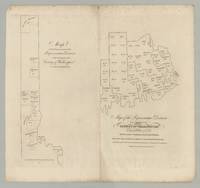
rif. 6460Portland ca 1832. Engraving 13.5” x 14.5” sheet size. Previously unrecorded map by Moses Greenleaf of Washington County Maine intended for a never-realized second volume of his Survey of the State of Maine. The map is stripped to its essentials showing Washington County and its state-representative districts in outline presumably based on reapportionment following the Census of 1830. The voting population for each town and unincorporated “plantation” is given though only in the northern part of the county at left are their boundaries delineated. Given the map’s purely political purpose Greenleaf has entirely eschewed the topographical detail of his earlier maps of the state. The map’s unfinished appearance suggests it might be an early proof particularly when it is compared with a companion map of York County also produced by Greenleaf at the time and presently known in a single example discussed below. Moses Greenleaf Greenleaf was a towering figure in the mapping of the state of Maine devoting his life to ever-improved mapping of the region. The pinnacle of his career came in 1829 when he published his new and substantially updated wall map of Maine. This was complemented by a text volume A Survey of the State of Maine and accompanying atlas the first atlas of the state and the third of any state of the Union. The map is a remarkable achievement widely heralded but the Survey of the State of Maine is also of the first importance a wide-ranging summation of the present state of Maine particularly valuable for commercial and economic data. Greenleaf however ever the perfectionist acknowledged the deficiencies of the work and announced his intention of issuing a second volume: “…it was intended to devote some portion of the work to a distinct consideration of the absolute and relative wealth of the State and its different component parts – value and importance of its lands – facilities for – kinds extent and expediency of internal improvements and its general resources; but the time when the publication must be completed was limited and an important part of the materials for these subjects could not be obtained until after this time. It was thought better therefore to omit their introduction altogether for the present; in the hope that circumstances will permit at a future time a more extended notice of them and under greater advantages for useful results than was possible at present.” Preface to A Survey of the State of Maine The largest single handicap to Greenleaf’s career was simply that the market for high-quality maps of Maine was too small for his projects to be commercially viable. Consider for example the 1829 wall map text volume and atlas which had cost him six years of his time and more than $12000 out of pocket for surveys engraving printing &c. He had 565 sets printed and offered by advance subscription at $16 a set but by early 1830 barely 100 of these had been sold. At this point though only after much debate the State rescued him by stepping in and purchased 400 sets at the full subscription price. Seemingly undeterred by the parlous financial prospects of the project and by the number of sets still in circulation Greenleaf continued to work on improving his materials. In 1832 he republished the wall-map of Maine but very few examples of that printing can be traced. In parallel our map and the companion map of York County mentioned earlier are the only known evidence that Greenleaf started work on his projected second volume of the Survey of the State of Maine Although there might be reference amongst the papers in the Moses Greenleaf archive in the Maine State Archives. Unfortunately the volume was never completed – and it may not even have advanced very far – possibly due to Greenleaf’s financial struggles but certainly ending with Greenleaf’s death on March 20 1834 aged fifty-six. Rarity and references We are aware of an example recently acquired by the Osher Map Library but the map is absolutely unrecorded in the general bibliographic literature the specialized biographical and bibliographical literature on Greenleaf and the mapping of Maine and the standard databases for the antiquarian market. It must be noted however that we acquired five examples in a large lot of Greenleaf material purchased by a third party at a Vermont auction in 2020. Not in OCLC; Phillips Maps of America; Walter Macdougall Settling the Maine Wilderness Wilderness – Moses Greenleaf His Maps and His Household of Faith 1777-1834 2006; Edgar Crosby Smith Moses Greenleaf Maine’s first map-maker a biography … also a bibliography of the maps of Maine 1903; Edward Thompson Important Maine Maps Books Prints and Ephemera 2003; or Thompson Printed Maps of the District and State of Maine 1793-1860 2010. Neither Antique Map Price Record nor Rare Book Hub show any record of the map having appeared on the antiquarian market. Macdougall Smith and Thompson all provided useful background on Greenleaf and his work. It is also worth noting that Greenleaf’s companion map of the representative districts of York County see Thompson Printed Maps of the District and State of Maine p.96 is recorded in but a single example in the Benton L. Hatch Collection in the University of Maine’s Fogler Library Special Collections See Thompson Printed Maps of the District and State of Maine pp. 96-97. Hatch was Associate Librarian for Special Collections at the University of Massachusetts who built a substantial collection of material on the history of Maine and Massachusetts. In view of his lifetime interest it seems likely that given the opportunity he would have acquired any others of the series he encountered. Appendix: An accounting of Greenleaf’s 1829 project A rough balance sheet for the 1829 publications can be reconstructed from contemporary documents. The wall-map and text volume with atlas were offered by advance subscription at $16 a set. A report of proceedings in the state legislature recorded that “It appears that Mr. G. was induced by encouragement from the Legislature to extend his original plan and incur great additional expense in order to present a work more valuable to the state. The engraving printing &c. cost $8351 81 surveys &c. about 4000 and Mr. G has devoted more than 6 years of his time to the work. The Legislature of 1828 granted $1000 to aid him in his labors. 565 copies were printed of which 458 remain unsold.” Hallowell American Advocate February 27 1830. A second report estimated that Greenleaf’s personal contribution be valued at $9000 Portland Christian Monitor February 25 1830. This gives as a rough guide income of $2700 against an actual cost of $12350 or a notional cost of $21350. In view of the scale of the loss Greenleaf made an appeal for relief submitting a lengthy memorial in January 1830 Maine State Archives. After much debate in the legislature it was agreed that the state would purchase 400 sets at the subscription price of $16 and the state would give Greenleaf a “a notice for $2000 redeemable in no longer time than 15 years and to be paid out of the proceeds of the Public Lands” Portland Eastern Argus February 26 1830. While the Maine government acted partly out of realization of a debt of honor to Greenleaf there was also a general feeling that the success of Greenleaf’s mapping project would bring all manner of benefits not least in driving land sales by the state. However the state also ended up with more copies than it could use so there was a heavy drive to sell sets to the school districts in particular and offices and officers of state at Washington Hallowell American Advocate January 21 1832 but also to gift sets to to Maine’s representatives in Congress to all the other states and so on. CONDITION: Very good light foxing and creasing small hole in maring at top of vertical fold. Offered in partnership with Boston Rare Maps. [Portland, ca 1832] unknown books
1795rif. 53585Erlangen: Printed by Christian Karl Gottlieb Kunstmann 1795. First edition. Hardcover. Very good condition. Elephant Folio. Unpaginated 10pp. Bound in dark half leather over light brown leather with gilt lettering and ruling on spine. Title page with engraved vignette. Engraved headpieces for both first pages in Hebrew and German. Engraved endpieces as above. Text printed in Hebrew and German throughout on facing pages. The hymn praises peace and the treaty alongwith the prudence of King Friedrich Wilhelm was sung by Moses Hochheimer Rabbi in Ansbach. It was printed by Christian Karl Gottlieb in Erlangen. This peace treaty between France and Prussia was rectified on April 5 1795 in Basel and was the first of three treaties that established France as the dominant power in Europe in effect breaking up the First Coalition. France was represented by François de Barthélemy Prussia by Karl August von Hardenberg. Minor wear to binding. Pages somewhat age-toned with some creasing small chips along edges and some light foxing. Printed by Christian Karl Gottlieb Kunstmann hardcover books
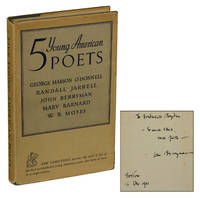
1940rif. 180216005New York: New Directions 1940. First Edition. Hardcover. Very Good. First edition. Signed by John Berryman on front paste down and inscribed to novelist Frederick Boyden "so much skill much faith - signed John Berryman Boston 16 Dec 1941." 221 pp. Blue cloth with gilt lettering. Near Fine in Very Good price-clipped dust jacket that is rubbed along edges slightly chipped at head and tail closed tear along front flap fold a few faint stains. The very first book appearance of John Berryman and quite rare signed by him as well as poet/ novelist/essayist Randall Jarrell and poet/translator of Sappho Mary Barnard. New Directions hardcover books
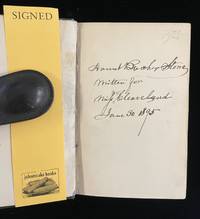
1894rif. 013411Boston: Houghton Mifflin 1894. Later Edition. Hardcover. Very Good. A later printing 1894 of "A New Edition with Illustrations and a Bibliography of the Work by George Bullen" 1878. 8vo publishers plain green cloth black-endpapers with evidence of past reinforcement of hinges front and rear. Hartford bookstore ticket rear pastedown. Inscribed: "Harriet Beecher Stowe/ written for/ Miss Cleaveland/ June 30 1895" PROVENANCE: Heirs of the Cleaveland family whose genealogy goes back to colonial Connecticut. Penciled in the inscription before "Miss Cleaveland" are the letters "EW" which identifies the inscribee as Elizabeth Whittlesey Cleaveland one of Elisha Whittlesey Cleaveland's daughters and great great granddaughter of Moses Cleaveland 1754 - 1806 Connecticut lawyer politician soldier and surveyor who founded the city of Cleveland Ohio while surveying the Connecticut Western Reserve in 1796. During the American Revolution he served as the brigadier general of the Connecticut militia. Both Stowe and the inscribee were born in Connecticut where they both died Stowe's inscription here is in a shaky hand and dated a year and a day before her death on July 1 1896 at the age of 85. Houghton, Mifflin hardcover books
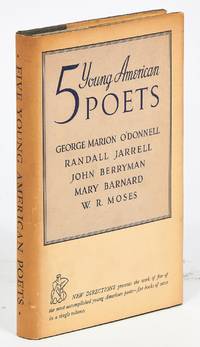
1940rif. 417914Norfolk Connecticut: New Directions 1940. Hardcover. Fine/Very Good. First edition. Fine in modestly age-toned very good or better dust jacket. The first commercial book appearance of these five poets preceding Berryman's and Jarrell's own separate first books by two years. Inscribed by John Berryman to a philosophy professor at Columbia University: "To Irwin Edman: On page 45 a paper on aesthetics long overdue. with sincere regard John Berryman. Boston 18 Oct 1941." Laid in is the front of the original mailing parcel hand-addressed by Berryman to Edman with his name repeated in the return address. Page 45 contains Berryman’s introduction to the selection of his poems entitled “A Note on Poetry.” Both Edman and Berryman both belonged to the Boar’s Head Society at Columbia a social group devoted to poetry. Berryman graduated from Columbia in 1936 so indeed his paper whatever it was was long overdue. New Directions hardcover books
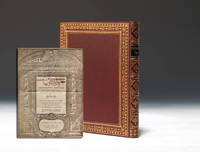
1695rif. 871351695. JUDAICA ALSHEKH Moses. Romemot El. Amsterdam: Printed in the house of David de Castro Tartas published by Eliezer ben Haninah 1695. Small quarto period-style full red morocco gilt elaborately gilt-decorated spine and covers raised bands black morocco spine label; ff. 94. $3500.Second edition the first Amsterdam edition of AlshekhÕs esteemed commentary on the Psalms beautifully bound.Alshekh d. after 1593 rabbi and Bible commentator was born in Adrianople studied in Salonika and then emigrated to Erez Israel settling in Safed where he gained prominence as an halakhic authority a teacher in two talmudic academies and a preacher. He was active in communal affairs and was a member of the rabbinical court of Joseph Caro who ordained him. This is the text that Hayyim Alshekh published in Venice in 1605 claiming that it was his fatherÕs authoritative text and not merely a preliminary draft which had been published a decade earlier in Constantinople under the title Tappuhei Zahav. AlshekhÕs Biblical commentaries which are permeated with religious-ethical and religious-philosophical ideas supported by ample quotations from talmudic and midrashic sources became quite popular and have often been reprinted.With an introduction by the publisher citing Ephraim Luntschitz on the importance of the work and quoting the authorÕs intentions in originally presenting this book to the public. Approbation on last leaf by Moses Judah ben Kalonymus Kohen known as Leib Harif the Ashkenazic Rabbi of Amsterdam. In addition the publisher adds after the first approbation: ÒAlso by the authority and with the permission of the great sage the head of the rabbinical court of the Sephardim our master and teacher Jacob Sasportas who has not however added his signature to the approbation due to a lack of time.Ó The importance of receiving even without an actual signed approbation the blessing or perceived blessing of both the Ashkenazic and Sephardic authorities suggests the sharp divide between the two Amsterdam Jewish communities. With three leaves of text ff. 10-12 replaced in neat facsimile. Vinograd Amsterdam 637. Steinschneider 6431:13. A few early ink marginalia.Tiny repair to corner of title page not affecting border and first two leaves. A splendidly bound volume. hardcover books
1650rif. 68492London: Printed by T.N. for Robert Bostock 1650. First and only edition. Small quarto 7 1/8 x 5 1/2 inches; 180 x 139 mm. 8 100 2 pp. Bound without final blank. With engraved initials head and tail pieces. Newer half calf over contemporary speckled paper boards. Spine stamped in gilt. Red morocco spine label lettered in gilt. Some minor toning and foxing throughout. Top margin trimmed close occasionally affecting running headline. Previous owner's morocco bookplate on front pastedown. Overall a very good copy. "In early modern marriage conduct books wives are advised to submit to their husbands and husbands are advised as the 'lords of the house' to keep order by rebuking and controlling their wives. Most marriage books however do not condone wife beating. Moses a Vauts was one of the few who supported wife beating. In The Husband's Authority Unvail'd. wherein it is moderately discussed whether it be fit or lawfull for a good Man to beat his bad Wife he states 'If Wives will invent strange new Fashions and frisking strains of Disobedience. why should not their Husbands suit them with new Forms of Discipline" Vauts also declares 'It were well and better the wife could not deserve Blows; but if they be due or needful or best for her why should they be denied her'" Custome is an Idiot: Jacobean Pamphlet Literature on Women. Edited by Susan Gushee O'Malley ESTC R205920. HBS 68492. $3500. Printed by T.N. for Robert Bostock unknown books
1852rif. 266899Boston 1852. unbound. Partial unsigned manuscript consisting of four pages 9.75 x 7.75 inches labeled "2" through "5" of a more extensive document all in the hand of Moses G. Farmer from 1852-1853 discussing the earliest trial-runs of the first ever Electric Fire Alarm System implemented in Boston. Though placed into service on April 28th 1852 Farmer's notes in diary form start on June 21st assessing the system while constantly citing ways to improve his new invention in very small part: ".Wednesday June 23 an alarm at 2:15.could not be easily read and caused a delay of 8 or 10 minutes.Saturday July 9th the circuit wheel of the key board needed repairs - the connector melted off by strong battery. July 10th Great Fire in Fort Hill. Alarm first came from Lower Boston plain. They tried to give it from Fort Hill & Persshar St. but both turned together turned too fast while ringing for So. Boston alarm came from Broad St. a delay in the time alarm of about 7 minutes.Friday Aug 6th Wanted! A Battery! Easy of manipulation. Constant & enduring in its operation. Powerful & certain in its effects & of small.cost! Sunday Aug 8th An alarm from D-7 at 12M. The operator did not understand it being the first one from that box & did not strike till the alarm came from I-4 at 12:15 P.M.Says he will recognize it next time. Oct 17th tried to raise an alarm from D-3 - S-3 4 & 5 but could not the lightning assertors were the cause of the difficulty.Friday Oct. 29th Put my newly invented battery on the South Boston signal circuit first time. Nov. 22nd Proceeded to try experiments on the velocity of sound for Captain C Wilkes.put my new battery on all signal circuit. Monday Dec. 20th Bad luck within two days at Three alarms. At one alarm the operator forgot to connect the South circuit. At Another the South end bells struck all sorts of ways on account of the key board running too fast. Atmospheric electricity probably had something to do with raising a false alarm at South End yesterday. Note: this is possibly the earliest recorded false alarm! Jan 11th 1853 Patent for my battery granted today. Sat. Jan. 15th 1853 Key board out of order. Made a substitute & had I repaired. Monday Jan. 17th Found wire broken at So. Williams St. did not intercept the circuit." This item has natural folds but is still in near fine condition. American electrical engineer and inventor of the Electric Fire Alarm System and several forms of the Incandescent Electric Light. He also patented an early light bulb which was later bought by Thomas Edison. Though a true pioneer of many aspects of 19th century electrical invention he and his wife were Spiritualists and felt that their talents were God-given and that they shouldn't take credit for any of his inventions. As a result he failed to carry his ideas to commercial success. unknown books
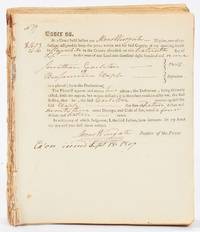
1810rif. 413795Haverhill Massachusetts 1810. Softcover. Near Fine. Partially printed letterpress documents. 154 documents p. 5 28-177 all but the first five documents are hand-numbered by Wingate. Each document is filled out in the hand of Moses Wingate in his capacity as Justice of the Peace of Haverhill. Formerly bound with sewing and glue marks along the spine otherwise the documents themselves are mostly near fine or better with a few of them exhibiting small chips or tears. Each document contains the names of the adversaries and usually the decision by default which is filled out and Signed by Moses Wingate. A few have extensive notes on the verso but most are straightforward defaults. We suspect most of the plaintiffs were businessmen or shopkeepers and most of the defendants were defaulters on small accounts. Wingate born in 1769 was a distinguished resident of Haverhill in Essex County near the New Hampshire border who lived to more than 100 dying in 1870 and who cast a vote in every presidential election from Washington to Grant. He was at various times a member of the Massachusetts State House of Representatives and Senate and Justice of the Peace of Haverhill for nearly half a century. Among the plaintiffs here represented is publisher and printer Daniel Appleton founder of the important publisher D. Appleton and Company; as well as members of the locally prominent Carlton Minot Emerson Ingersoll and Whittier families John Greenleaf Whittier was born in Haverhill in 1807; at least three different Whittiers are named here presumably relatives. An interesting historical insight into business and justice in the early days of the Republic. unknown books
rif. 52511New York City 1808. Fine. Folio 16 by 10 in. - lightly folded once horizontally and twice vertically. 4pp; approx. 1000 words of text on first three pages with address at final page; ruled in light brown ink. A few oxidation spots small tear along central fold at final page above dress no loss of text else clean and fine written in a strong neat hand. Dated November 2 1808 New York City: Moses Gomez 1744/45-1826 son of Rebecca Gomez née De Lucena; the second wife of Mordecai Gomez and a manufacturer of chocolate here acknowledges receipt of $1852.17 from the executors of his mother's estate thereby releasing any additional claim on the estate. This payment was prompted by the death two months earlier of Moses' brother Abraham the eldest living son of Rebecca. The proceeds from the sale of her Nassau property are to be equally divided with Moses' half-sister Rachel Waage the daughter of Mordecai Gomez by his first wife. Moses Gomez refers to the death of his widowed mother Rebecca who in her lifetime had published a last will and testament dated July 21 1798 and died in 1801. In her will she appointed her grandsons Abraham Gomez Jr. and Herman Henricks and friend attorney Henry Kermit executors. Her property on Nassau Street was to be divided among her heirs. Moses Gomez states that according to Rebecca's will during the lifetime of her eldest son Abraham the Nassau property should be leased out from year to year with the monies going to his support and ultimately to pay his funeral expenses. Upon his death the house was be sold. One of the executors of Rebecca's estate Herman Harmon Henricks 1771-1838 was Moses' nephew the son of his sister Eve and was a prominent member of the Henricks copper mining family. Signatures: Moses Gomez twice the second after a brief addendum; Witnesses: John Severidge jun.; Daniel Mack jun. for the addendum. J.R. Rosenbloom A Biographical Dictionary of Early American Jews Univ. Kentucky 1960 p.46; cf. L. Hershkowitz Wills of Early New York Jews pp. 84-91 the will of Mordecai Gomez. unknown books
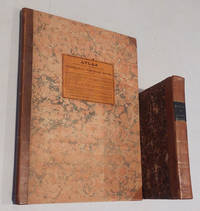
1829rif. 49267Portland: Shirley and Hyde 1829. First edition. The title page of Greenleaf's 1829 . Portland: Shirley and Hyde 1829. First edition. The title page of Greenleaf's 1829 "Survey" says it is "Illustrated by Maps." In fact these maps are in a separate atlas published without a title page. "Atlas Accompanying Greenleaf's Map and Statistical Survey of Maine." Contents as follows:1. Orthographic projection of the situation of the mountain and highland ranges particularly in the northern part of the State.2. 10 Vertical projections of the elevation of the northern and eastern boundary line with those of sections across the State from the Atlantic to the St. Lawrence; and the comparative declivities of the principal rivers.3. Sketch of the British map got up during the late war with a view to raise pretence for a claim to a new boundary.4. Maps of the British surveyors under the treaty of Ghent shewing their pretended ranges of highlands across the State. The 4 preceding Maps are designed to exhibit the true merits of the question of the disputed boundary as far as it is affected by the direction and elevation of the highlands.5. Map of the original grants and sales of land under which the titles are now holden -- from the earliest dates to the latest divisions of land between Maine and Massachusetts.6. Map exhibiting the progress present density and distribution of population and wealth; and the present representative districts.7. A comparative view of the climate of Maine and others of the United States and of England exhibited in a series of diagrams of the monthly means and extremes of temperature."Greenleaf was as in many of his endeavors ahead of his time in publishing an atlas devoted to an individual state. This atlas was preceded only by Robert Mill's 1825 Atlas of the State of South Carolina and David Burr's 1829 Atlas of the State of New York and it was not until many years later that another such state atlas appeared." - Ed Thompson "Important Maine Maps." "Atlas" and The book "Survey of the State of Maine" and its accompanying atlas brought $7475 and $546 respectively in Thompson's 2003 auction. The two items offered here are in superior condition to Thompson's copies. "Survey" is bound in contemporary half calf over marbled boards and has a black spine label with gold lettering. Minor rubbing to covers and foxing in text but a very good condition of a rare book. The atlas also bound in half calf over marbled boards has a printed paper cover label. The maps show some old repairs along folds but are in very good condition. Laid into the atlas is a two-sheet manuscript "Map of Township B. Surveyed by D. Parker Esq." Done in sepia ink and pencil. 40 x 32 cm. 21.5 cm. viii 468 pp. and 33.5 cm. Seven folding hand colored maps. . Shirley and Hyde hardcover books
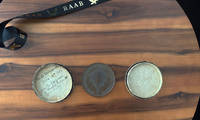
1509rif. 3366415/09/1866. Acquired from the direct descendants of the commander of the vessel that received the medal in Russia it was not known to have survived and has never before been offered for sale Emperor Alexander II issued the Emancipation Manifesto on March 3 1861 which granted freedom to over 23 million serfs. This reform is known as the Emancipation Edict. The Emancipation Proclamation was issued by President Abraham Lincoln on January 1 1863. It declared that all persons held as slaves within the rebellious Confederate states ""are and henceforward shall be free."" The Union victory in the Civil War finalized in 1865 ensured this would become the law of the land. Lincoln and Alexander had something else in common. Lincoln was assassinated in April 1865 by John Wilkes Booth in an act of political violence. The attempted assassination of Alexander II in 1866 was a failed act of political violence by Dmitry Karakozov a young revolutionary. Karakozov's aim was to kill the Tsar and spark a revolution believing the Emperor had betrayed the people's expectations after his emancipation of serfs in 1861. Another attempt around 20 years later would be successful. In 1866 President Andrew Johnson sent Assistant Secretary of the Navy Gustavus Vasa Fox who had played a leading role in the expedition to relieve Fort Sumter in April 1861 on a mission to Russia primarily to deliver a resolution from Congress congratulating Emperor Alexander II on his survival of the assassination attempt. The mission also aimed to gather information on European naval capabilities and explore potential trade opportunities including the sale of the ironclad monitor USS Miantonomoh. The mission was a major event marking a high point in Russian-American friendship and was met with grand receptions in St. Petersburg and Moscow. In the process Johnson sent the ironclad Miantonomoh itself on a world tour with the destination of Russia - first across the Atlantic and through the North Sea the Baltic and then through the Mediterranean in 1866 and 1867. The commander of this vessel was Moses Stuyvesant graduate of the Naval Academy and hero of the Civil War. He had been on two sunk vessels including one taken down by a Confederate Ironclad. But the mission had two messages: to congratulate Russia on the freeing of the serfs and the Tsar on surviving the assassination attempt. The resolution read: “JOINT RESOLUTION relative to the attempted assassination of the Emperor of Russia. “Be it resolved by the Senate and House of Representatives of the United States of America in Congress assembled That the Congress of the United States of America has learned with deep regret of the attempt made upon the life of the Emperor of Russia by an enemy of emancipation. The Congress sends greeting to his Imperial Majesty and to the Russian nation and congratulates the twenty millions of serfs upon the providential escape from danger of the sovereign to whose head and heart they owe the blessings of their freedom. “Sec. 2. And be it further resolved That the President of the United States be requested to forward a copy of this resolution to the Emperor of Russia. “Approved May 16 1866.” In mid Summer the Miantonomoh arrived in the harbor of Cronstadt on the 17th of August and the Tsar sent an address acknowledging the visit of Mr Fox. On Saturday September 15 the fleet went to push off from Russia. Mr. Fox left Petersburg after a farewell breakfast given on Russian yacht Rurik at which the Russian Lieutenant Greig presented the Americans with a symbol of their newly instituted freedoms from slavery in both countries: a medal struck in memory of the enfranchisement of the serfs in Russia. Grieg said ""The friendship of the two nations. among the causes to which is due this mutual spirit is the great event emancipation which has been accomplished almost simultaneously in the two countries - there by a sanguinary struggle here by the path of peace."" He then presents the ""medal struck in memory of the enfranchisement of the peasants.He will see on it the likeness of our sovereign and the effigy of a nobleman and of peasant."" This is that very medal given by the Russians to the Americans to commemorate the freedom of their former slaves presented to the Americans depicting the scene of Alexander II on one side as Grieg says in a case on the inside of which Stuyvesant as commander of the expedition has signed his name and dated it September 15 1866 the day of the presentation of the medal and Grieg's speech and written ""From the Emperor of Russia Alex III"" instead of II. The bronze medal reads: ""FEBRUARY 19 1861 Cut to N. Kozin from the model of count F. Tolstoy. Engraver: Nikolai Kozin"" It is not known how many were made. A small number have reached the market but none akin to this: with the important symbolism of a state gift congratulating a nation on emancipation. This was a gift of one slave-freeing nation to another in the immediate aftermath of those actions. This medal was not known to have survived and comes from the direct descendants of Stuyvesant who received it September 5 1866. <img class=""alignnone wp-image-25018 size-post-window"" src=""https://cdn.raabcollection.com/wp-content/uploads/20231204144051/Folder-site-11-1600x1327.jpg"" alt="""" width=""1600"" height=""1327"" /> unknown books
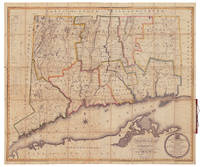
rif. 3387Hartford: Published under the Authority of The General Assembly By Hudson & Goodwin 1812 or 1813. Engraved By Abner Reed E. Windsor. Hand-colored engraving 36.5" x 44.25" plus margins dissected and mounted on linen folding into original 8vo covers half red leather and marbled paper boards gilt title "Connecticut" and gilt rules at spine. CONDITION: Good spotting mainly in the lower left quadrant which seems to be endemic to case map examples as evident in copies at Harvard and the Library of Congress which can be viewed online. The first state of this scarce important and very fine map of Connecticut offered here in desirable case map form with beautiful original color. This large and impressive map depicts the entire state of Connecticut as well as narrow portions of adjacent states the whole of Long Island Sound and part of Long Island. A circular cartouche incorporating the Connecticut coat-of-arms appears in the lower right corner along with a fine calligraphic dedication to Governor Roger Griswold. A handsome compass rose with a fleur-de-lis directional is situated in Long Island Sound near New Haven. A key in the upper left margin identifies some thirty-five points of interest including churches academies court houses gun & pistol factories paper mills distilleries glass works ore beds light houses etc. The last item listed is "Humphrysville - The first extensive successful woolen mill in the country." According to Thompson there is an apparently later state of the map in which this note had been transferred to the site of present day Seymour. Also noted by Thompson are the turnpike roads a recent development and apparently the first to appear on an American map. Warren & Gillett undertook the first survey of the state since William Blodget's map of 1792 carrying out much of the field work themselves but also as Ristow points out likely incorporating manuscript maps from local surveyors as well as other locally provided data. "Though the publication of this map was a private venture the survey had an official sanction. At the May session 1811 of the Connecticut legislature a resolution was passed authorizing Hudson & Goodwin 'at their own expense to prepare and publish from actual survey a map of this state and for that purpose the petitioners are authorised.to pass over the land of individuals in the state.and empowered to examine the records of the state'" Thompson. As the authoritative map of the state the Warren & Gillet map served as the prototype for other maps of Connecticut into the 1840s. Although cataloged by Thompson and others as 1812 the date of publication of this map is somewhat unclear. The inscription to Governor Griswold reads in part "Respectfully Inscribed By the Publishers. Hartford February 1812" but the copyright date is 1813. Also the last governor listed is John Cotton Smith who succeeded Griswold in 1813. Moses Warren 1762-1835 was born in Hopkinton Rhode Island but soon moved with his family to East Lyme Connecticut. He served as a sergeant in the Revolutionary War and surveyed the Western Reserve in 1796. Warren's partner George Gillet 1771-1853 was born in Hebron Connecticut. He was appointed surveyor general of Connecticut following publication of this map. A splendid early map of Connecticut. REFERENCES: Thompson Maps of Connecticut 52; Ristow American Maps & Mapmakers pp. 96-98. Hartford: Published under the Authority of The General Assembly, By Hudson & Goodwin, 1812 [or 1813]. Engraved By Abner Reed, E. unknown books
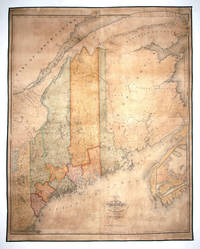
1829rif. 8887Portland 1829. No Binding. Very Good. 50 ¾ x 40 ¼ inches. Steel engraving. Original wash color refreshed; expertly conserved re-mounted on new linen; a few cracks & marginal mends but fine for this kind. The very rare three copies cited in OCLC first edition of this excellent map of Maine by the state's first mapmaker. An exceptionally well-preserved example. Unlike many early American state maps that struggled to get completed Greenleaf's received a warm commendation from the state legislature even before it was published and the mapmaker was granted $1000 to aid him in finishing the map. Greenleaf later received $640 from the legislature for 40 copies of the map that were obtained for state use a remarkable $16 per copy. Perhaps the large number of copies sold for official rather than private use helps account for the map's present rarity. The map was originally intended to accompany an atlas and survey of the state that Greenleaf published the same year but very few complete sets of the three items are known to have survived. Greenleaf appears to have taken special care in the production of this map. Although published in Portland Maine Greenleaf employed as engravers for this work the estimable J. H. Young and F. Dankworth both of whom produced major works for the firms of S. A. Mitchell and others. This precisely detailed map which shows ten counties in different colors provides state county town and township boundary lines. The state's many rivers lakes ponds and even falls are shown as are roads and elevations. The map was re-published in 1844 by Greenleaf's son and namesake from the same plates but with emendations and several times thereafter. Greenleaf published two earlier maps of the state in 1815 and 1820 but the present work was by far his finest. Ristow W. American Maps and Mapmakers pp. 95-96; Catalogue Raisonne Important Maine Maps. Auction Catalogue for Thompson Collection Auction Robert E. Croul 2003 lot 119. unknown books
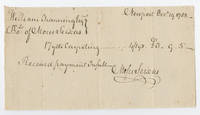
1788rif. 25418Seixas' 1790 letter of welcome elicited the first president's most compelling statement on religious liberty "to bigotry no sanction." In this 1788 receipt Seixas signs a receipt documenting payment for carpet by William Channing the state's new attorney general. MOSES SEIXAS. Manuscript Document Signed to William Channing December 18 1788. Receipt for carpeting. 1 p. 7¼ x 4 in. Complete Transcript Newport Decr 19 1788 William Channing Esq Bot Bought of Moses Seixas / 17 yds Carpeting . . . . . . . . . . .4/1 yd. £3.9. 5. Received payment In full / Moses Seixas Docketing on verso in another hand: Moses Seixas Moses Mendes Seixas 1744-1809 was born in New York into a Jewish family. His father immigrated from Portugal to New York about 1730 and became a merchant. The family moved to Newport Rhode Island in 1765. Moses Seixas married Jochebed Levy in 1770 and they had eight children. He was one of the organizers and first cashier of the Bank of Rhode Island which conducted business in his house until 1818. After the British occupied Newport during the Revolutionary War Seixas remained in Newport but was among the signers of a document supporting the patriot cause. In 1790 he was the president of the Congregation Yeshuat Israel later Touro Synagogue in Newport. He was also a charter member and first grand master of St. John's Lodge of Free and Accepted Masons in Newport. William Channing 1751-1793 was born in Newport Rhode Island and graduated from the College of New Jersey Princeton in 1769. In 1773 he married Lucy Ellery daughter of William Ellery a Newport lawyer who signed the Declaration of Independence and they had nine children. Channing was elected Attorney General of Rhode Island in 1777 and when Rhode Island ratified the U.S. Constitution in 1790 Channing became the first federal District Attorney. One of his sons was the famous Unitarian preacher William Ellery Channing 1780-1742. Historical Background From 15 Sephardic families who arrived in 1658 Newport Rhode Island's Jewish community grew to be the largest in the colonies. Many Jews left during the Revolutionary War when Newport was occupied by the British. A significant number returned when the British left in 1779. By the time Rhode Island became a state there were approximately 300 Jews in the thriving Newport community. Starting while on his way to New York to assume the presidency in April of 1789 George Washington received many messages from civic fraternal and religious organizations offering congratulations praise of his deeds in war peace and politics prayers on behalf of congregations or constituents. Washington's replies justly count among his most famous pronouncements setting a boldly inclusive tone that helped our new nation survive and expand. After the first session of the first Congress Washington set out on a tour of the New England states except for Rhode Island which had yet to ratify the Constitution. It finally did so in May of 1790 and three days after the second session of Congress adjourned Washington Jefferson and others set out to visit Newport. On August 18 Washington and his entourage were greeted with four addresses written as open letters and read in a public ceremony. First the town then from all the Christian clergy then the Masonic order and finally from the Hebrew Congregation. Moses Seixas on behalf of the Congregation Kahal Kadosh Yeshuat Israel congratulated Washington on his ascendancy to the Presidency. He invoked the language of the Revolution in arguing that Jews should be entitled to the same privileges as an American of any other religious denomination. Having been previously "deprived…of the invaluable rights of free Citizens" Seixas expressed his hopes for the success of the new "government erected by the majesty of the people a government which to bigotry gives no sanction—to persecution no assistance; but generously affording to all liberty of conscience." Seixas' letter moved President Washington who echoed Seixas' words and built on them to make his most celebrated statement on religious freedom. He responded as soon as he returned to the capital New York assuring the Hebrew congregation that "happily the Government of the United States which gives to bigotry no sanction to persecution no assistance requires only that they who live under its protection should demean themselves as good citizens in giving it on all occasions their effectual support. It would be inconsistent with the frankness of my character not to avow that I am pleased with your favorable opinion of my Administration and fervent wishes for my felicity. May the Children of the Stock of Abraham who dwell in this land continue to merit and enjoy the good will of the other Inhabitants; while every one shall sit in safety under his own vine and fig tree and there shall be none to make him afraid." Washington's addresses responding to religious congregations included those of Baptist Congregational Dutch Reformed Episcopalian German Lutheran German Reformed Jewish Protestant Presbyterian Quaker Roman Catholic and other denominations. Today we understand that Washington and his fellow Founding Fathers were oblivious to the realities of other kinds of oppression. Knowing what we know now how can we still value these slave-owners' declamations on freedom While acknowledging Washington's ownership of his full share of the universal biases of his age we can and should still treasure his "to bigotry no sanction" letter as a powerful testament to the promise of America. In the 218 years since Washington responded to Seixas' address has anyone come up with a better definition of the benefits and responsibilities of American citizenship Washington's original letter was acquired by the Morris Morgenstern Foundation in 1948 and is on long-term loan to the National Museum of American Jewish History in Philadelphia. Seixas' letter to Washington is in the Library of Congress and Seixas' retained copy was acquired by the Morgenstern Foundation in 1949 and is with Washington's letter. Condition Fine condition with intersecting folds and slight bit of foxing. books