503 résultats
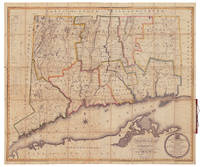
réf. 3387Hartford: Published under the Authority of The General Assembly By Hudson & Goodwin 1812 or 1813. Engraved By Abner Reed E. Windsor. Hand-colored engraving 36.5" x 44.25" plus margins dissected and mounted on linen folding into original 8vo covers half red leather and marbled paper boards gilt title "Connecticut" and gilt rules at spine. CONDITION: Good spotting mainly in the lower left quadrant which seems to be endemic to case map examples as evident in copies at Harvard and the Library of Congress which can be viewed online. The first state of this scarce important and very fine map of Connecticut offered here in desirable case map form with beautiful original color. This large and impressive map depicts the entire state of Connecticut as well as narrow portions of adjacent states the whole of Long Island Sound and part of Long Island. A circular cartouche incorporating the Connecticut coat-of-arms appears in the lower right corner along with a fine calligraphic dedication to Governor Roger Griswold. A handsome compass rose with a fleur-de-lis directional is situated in Long Island Sound near New Haven. A key in the upper left margin identifies some thirty-five points of interest including churches academies court houses gun & pistol factories paper mills distilleries glass works ore beds light houses etc. The last item listed is "Humphrysville - The first extensive successful woolen mill in the country." According to Thompson there is an apparently later state of the map in which this note had been transferred to the site of present day Seymour. Also noted by Thompson are the turnpike roads a recent development and apparently the first to appear on an American map. Warren & Gillett undertook the first survey of the state since William Blodget's map of 1792 carrying out much of the field work themselves but also as Ristow points out likely incorporating manuscript maps from local surveyors as well as other locally provided data. "Though the publication of this map was a private venture the survey had an official sanction. At the May session 1811 of the Connecticut legislature a resolution was passed authorizing Hudson & Goodwin 'at their own expense to prepare and publish from actual survey a map of this state and for that purpose the petitioners are authorised.to pass over the land of individuals in the state.and empowered to examine the records of the state'" Thompson. As the authoritative map of the state the Warren & Gillet map served as the prototype for other maps of Connecticut into the 1840s. Although cataloged by Thompson and others as 1812 the date of publication of this map is somewhat unclear. The inscription to Governor Griswold reads in part "Respectfully Inscribed By the Publishers. Hartford February 1812" but the copyright date is 1813. Also the last governor listed is John Cotton Smith who succeeded Griswold in 1813. Moses Warren 1762-1835 was born in Hopkinton Rhode Island but soon moved with his family to East Lyme Connecticut. He served as a sergeant in the Revolutionary War and surveyed the Western Reserve in 1796. Warren's partner George Gillet 1771-1853 was born in Hebron Connecticut. He was appointed surveyor general of Connecticut following publication of this map. A splendid early map of Connecticut. REFERENCES: Thompson Maps of Connecticut 52; Ristow American Maps & Mapmakers pp. 96-98. Hartford: Published under the Authority of The General Assembly, By Hudson & Goodwin, 1812 [or 1813]. Engraved By Abner Reed, E. unknown books
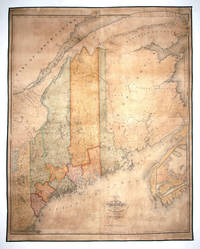
1829réf. 8887Portland 1829. No Binding. Very Good. 50 ¾ x 40 ¼ inches. Steel engraving. Original wash color refreshed; expertly conserved re-mounted on new linen; a few cracks & marginal mends but fine for this kind. The very rare three copies cited in OCLC first edition of this excellent map of Maine by the state's first mapmaker. An exceptionally well-preserved example. Unlike many early American state maps that struggled to get completed Greenleaf's received a warm commendation from the state legislature even before it was published and the mapmaker was granted $1000 to aid him in finishing the map. Greenleaf later received $640 from the legislature for 40 copies of the map that were obtained for state use a remarkable $16 per copy. Perhaps the large number of copies sold for official rather than private use helps account for the map's present rarity. The map was originally intended to accompany an atlas and survey of the state that Greenleaf published the same year but very few complete sets of the three items are known to have survived. Greenleaf appears to have taken special care in the production of this map. Although published in Portland Maine Greenleaf employed as engravers for this work the estimable J. H. Young and F. Dankworth both of whom produced major works for the firms of S. A. Mitchell and others. This precisely detailed map which shows ten counties in different colors provides state county town and township boundary lines. The state's many rivers lakes ponds and even falls are shown as are roads and elevations. The map was re-published in 1844 by Greenleaf's son and namesake from the same plates but with emendations and several times thereafter. Greenleaf published two earlier maps of the state in 1815 and 1820 but the present work was by far his finest. Ristow W. American Maps and Mapmakers pp. 95-96; Catalogue Raisonne Important Maine Maps. Auction Catalogue for Thompson Collection Auction Robert E. Croul 2003 lot 119. unknown books
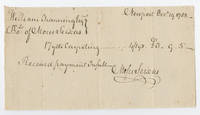
1788réf. 25418Seixas' 1790 letter of welcome elicited the first president's most compelling statement on religious liberty "to bigotry no sanction." In this 1788 receipt Seixas signs a receipt documenting payment for carpet by William Channing the state's new attorney general. MOSES SEIXAS. Manuscript Document Signed to William Channing December 18 1788. Receipt for carpeting. 1 p. 7¼ x 4 in. Complete Transcript Newport Decr 19 1788 William Channing Esq Bot Bought of Moses Seixas / 17 yds Carpeting . . . . . . . . . . .4/1 yd. £3.9. 5. Received payment In full / Moses Seixas Docketing on verso in another hand: Moses Seixas Moses Mendes Seixas 1744-1809 was born in New York into a Jewish family. His father immigrated from Portugal to New York about 1730 and became a merchant. The family moved to Newport Rhode Island in 1765. Moses Seixas married Jochebed Levy in 1770 and they had eight children. He was one of the organizers and first cashier of the Bank of Rhode Island which conducted business in his house until 1818. After the British occupied Newport during the Revolutionary War Seixas remained in Newport but was among the signers of a document supporting the patriot cause. In 1790 he was the president of the Congregation Yeshuat Israel later Touro Synagogue in Newport. He was also a charter member and first grand master of St. John's Lodge of Free and Accepted Masons in Newport. William Channing 1751-1793 was born in Newport Rhode Island and graduated from the College of New Jersey Princeton in 1769. In 1773 he married Lucy Ellery daughter of William Ellery a Newport lawyer who signed the Declaration of Independence and they had nine children. Channing was elected Attorney General of Rhode Island in 1777 and when Rhode Island ratified the U.S. Constitution in 1790 Channing became the first federal District Attorney. One of his sons was the famous Unitarian preacher William Ellery Channing 1780-1742. Historical Background From 15 Sephardic families who arrived in 1658 Newport Rhode Island's Jewish community grew to be the largest in the colonies. Many Jews left during the Revolutionary War when Newport was occupied by the British. A significant number returned when the British left in 1779. By the time Rhode Island became a state there were approximately 300 Jews in the thriving Newport community. Starting while on his way to New York to assume the presidency in April of 1789 George Washington received many messages from civic fraternal and religious organizations offering congratulations praise of his deeds in war peace and politics prayers on behalf of congregations or constituents. Washington's replies justly count among his most famous pronouncements setting a boldly inclusive tone that helped our new nation survive and expand. After the first session of the first Congress Washington set out on a tour of the New England states except for Rhode Island which had yet to ratify the Constitution. It finally did so in May of 1790 and three days after the second session of Congress adjourned Washington Jefferson and others set out to visit Newport. On August 18 Washington and his entourage were greeted with four addresses written as open letters and read in a public ceremony. First the town then from all the Christian clergy then the Masonic order and finally from the Hebrew Congregation. Moses Seixas on behalf of the Congregation Kahal Kadosh Yeshuat Israel congratulated Washington on his ascendancy to the Presidency. He invoked the language of the Revolution in arguing that Jews should be entitled to the same privileges as an American of any other religious denomination. Having been previously "deprived…of the invaluable rights of free Citizens" Seixas expressed his hopes for the success of the new "government erected by the majesty of the people a government which to bigotry gives no sanction—to persecution no assistance; but generously affording to all liberty of conscience." Seixas' letter moved President Washington who echoed Seixas' words and built on them to make his most celebrated statement on religious freedom. He responded as soon as he returned to the capital New York assuring the Hebrew congregation that "happily the Government of the United States which gives to bigotry no sanction to persecution no assistance requires only that they who live under its protection should demean themselves as good citizens in giving it on all occasions their effectual support. It would be inconsistent with the frankness of my character not to avow that I am pleased with your favorable opinion of my Administration and fervent wishes for my felicity. May the Children of the Stock of Abraham who dwell in this land continue to merit and enjoy the good will of the other Inhabitants; while every one shall sit in safety under his own vine and fig tree and there shall be none to make him afraid." Washington's addresses responding to religious congregations included those of Baptist Congregational Dutch Reformed Episcopalian German Lutheran German Reformed Jewish Protestant Presbyterian Quaker Roman Catholic and other denominations. Today we understand that Washington and his fellow Founding Fathers were oblivious to the realities of other kinds of oppression. Knowing what we know now how can we still value these slave-owners' declamations on freedom While acknowledging Washington's ownership of his full share of the universal biases of his age we can and should still treasure his "to bigotry no sanction" letter as a powerful testament to the promise of America. In the 218 years since Washington responded to Seixas' address has anyone come up with a better definition of the benefits and responsibilities of American citizenship Washington's original letter was acquired by the Morris Morgenstern Foundation in 1948 and is on long-term loan to the National Museum of American Jewish History in Philadelphia. Seixas' letter to Washington is in the Library of Congress and Seixas' retained copy was acquired by the Morgenstern Foundation in 1949 and is with Washington's letter. Condition Fine condition with intersecting folds and slight bit of foxing. books