489 resultados
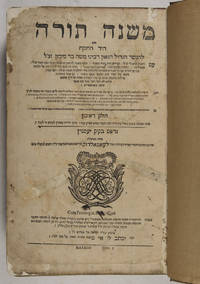
1802ref. 55778Saloniki Thessaloniki: Mordekhai Nahman and David Yisraeliga 1802. Second edition. Modern cloth. Very good-. Quarto 25 by 16.5 cm. 2 136 leaves. Hebrew text in rabbinic font arranged in two columns. Title within elaborate letterpress borders with textual quotations; woodcut printer's device verso title approbations page; publication date in chronogram. Recent royal blue cloth; text block with speckled edges. Title leaf reinforced with tissue along fore-edge; title with tear along gutter 7 cm and small mostly marginal worm traces; worming vanishes by the sixth leaf with very minimal text loss; slightest marginal worm tracing at final 20 leaves; entry at bottom margins of the title and four other pages excised in black marker not affecting text; several leaves lightly toned else a very good copy with crisp clean text. Very scarce second edition of this collection of rabbinic responsa issued by Moses ben Isaac Segal Mintz 15th century. First published at Krakow in 1617 this is the author's only published work. Born in Mainz between 1420 and 1430 Moses Mintz studied with Jacob Weil and Israel Isserlein and while still quite young was appointed rabbi of Würzburg. Mintz led a peripatetic life which allowed him to investigate Jewish customs and communal regulations in many towns. After the 1453 expulsion of the Jews from Würzburg he returned to Mainz until the expulsion of 1462. He subsequently went to Landau and Ulm. In 1469 he was appointed rabbi of Bamberg. Four years later he was in Nürnberg and the following year in Posen. There he made preparations to emigrate to Palestine but for unknown reasons decided to remain in Posen until the end of his life. "Mintz's prominence and recognized authority resulted in may other rabbis turning to him with halakhic queries on such issues as issur ve-heter dietary laws and communal customs" Heller. His circle of correspondents included Israel Isserlein Joseph Colon Eliezer Treves and his cousin Judah Mintz. As the present collection notably deals with practical issues of contemporary importance especially civil and matrimonial law -- including customs and the enactments of Rabbenu Gershom -- they provide insight into Jewish life in fifteenth-century Germany. Issues of some notable responsa include taxes placed on Jews by local rulers; obligations of a wealthy man to his wife's poor relatives; a woman who committed adultery repented and swears the child is from her husband; if a person blind in one eye can be a judge in a case of halitzah when a man is released from the general obligation to marry his deceased brother's widow; and if one should mourn for a murderer. "Of special value are three responsa in manuscript entitled 'The Three Branches' which are an important source for the history of the yeshivot rabbinic schools of Germany in the 15th century. They depict the woeful condition of pupil-teacher relations which had broken down as a result of the arrogance of the teachers and their exaggerated concern for their dignity as well as because of the pupils' desire for greater freedom of activity and the acquisition of social status" EJ. Approbations of Istanbul rabbis: Ezekiel Refael Chaim Alfandari; Michael Ashkenazi; Moshe Frishko Provenance: Ink stamps of the Yeshiva Ha-Metivta ha-Gedolah Jerusalem at approbation page and bottom margin of one text page. References: Enc. Jud. 1st ed. 12: 65-66; M. J. Heller The Seventeenth Century Hebrew Book pp. 346-347 first ed. 1617; Vinograd Salonica 515; Cf. Steinschneider 6529.1 ed. Krakow 1617 - but not noting the present edition! Title and imprint Hebrew: תשובות ×ž×”×¨×³×³× מינץ נדפס פה ש××œ×•× ×™×§×™ ×™×¢×³×³× בדפוס מרדכי נחמן וחברו דוד ישר×ליג׳ה Date chronogram: 5562 = ×•×™×¨× משה Yeshiva stamp: ×”×ž×ª×™×‘×ª× ×”×’×“×•×œ× בית הר×ש׳׳ל ישיבה תיכון. Mordekhai Nahman and David Yisraeliga unknown books
ref. 14102New York: McGraw-Hill 1970. First Edition First Printing. Cloth. Very good/very good. First edition of Public Works: A Dangerous Trade by Robert Moses inscribed to journalist and historian Theodore H. White. Octavo xxxvi 952pp. Beige cloth title stamped in blue and red. The first printing with a full number line on the copyright page and no additional printings. Solid text block light sunning along top edge light dampstain to rear cover. In the publisher's dust jacket retail price on front flap archival tissue repair to verso a few closed tears bright illustrations. Signed by the author "To Ted White / with high regard / Robert Moses" on the second free endpaper. Robert Moses 1888-1981 was an urban planner in New York City and served as the 49th Secretary of State of New York from 1927-1929. Throughout his forty-year career Moses oversaw construction and function of Jones Beach State Park and the New York State Parkway System and was acting head of the Triborough Bridge Authority. Despite his accomplishments in public affairs Moses's reputation was diminished with the publication of Robert Caro's biography The Power Broker which described Moses as a racist official who cut corners on budgeting and restricted access to city parks for lower-class families. McGraw-Hill unknown books
ref. 140942510New York: McGraw-Hill Book Company 1970. First Edition. Fine. First edition first printing. Signed by Robert Moses as Bob and inscribed to a former owner on the half-title page. Bound in publisher's original dark blue leather stamped in gilt with gilt spine titles blocked in pinkish-red top edge gilt. Fine in acetate wrapper. Books signed by Moses are scarce. McGraw-Hill Book Company unknown books
1695ref. 48869Amsterdam: Hendrick Boom and the Widow of Dirk Boom 1695. First edition. Hardcover. Very good. Two parts quarto. 8 154 2 errata; 171 2 variantes lectiones 1 corrigenda 2 blankpp. Title in red and black with woodcut vignette; half-title for the second part; woodcut lettrines. A dedication to the Burgemeisters of Amsterdam appears following the title. In the second part the Hebrew text is printed on the left side of the rectos and the right side of the versos so as to appear in the center with the Latin translation against the margins when the book is fully opened. Contemporary vellum letterpress title in black at spine. Hebrew square unvocalized and Latin text in facing columns; full-page Latin commentary in first part. Covers lightly soiled. Clean corner tear at q2 just extending into catchword. A very good copy with clean crisp text. Collation: dagger4 A-T4 V2; a-y4 = 170 leaves; blank y4. Hebrew texts of the Babylonian Talmud mishnah treatise Rosh Hashanah The New Year; accompanied by Maimonides' treatise Hilkhot Sanhedrin The Rules of the Sanhedrin from his Mishneh Torah with Latin translation and notes by Hendrik Houting fl. 1695 who often includes copious quotations from the gemara; Maimonides; Obadiah Bertinoro; the Tzemah David of David Ganz and other Jewish sources. Little is known of the editor's life apart from his association with the better-known Dutch Hebraist Willem Surenhuys 1666-1729 now chiefly remembered for his monumental Latin translation of the Mishnah 1698-1703. It is worth noting in this context that Surenhuys "was able to make use of earlier published versions for twenty-five of the sixty-one tractates" van Rooden "Hendrik Boom 1644-1709 was an important Amsterdam bookseller and publisher. He worked together with the widow of his brother Dirk since 1680. It is uncertain whether he had a printing-house of his own" Fuks. References: Dienstag "Christian Translators of the Mishneh Torah" 16. Fuks/Fuks-Mansfeld 609. Heller 17th Century pp.1286-1287. P. T. van Rooden Theology Biblical Scholarhsip and Rabbinical Studies in the Sevententh Century Leiden: Brill 1989 p. 110. Steinschneider 5252. Provenance: Presentation bookplate of Edward Hayes Plumptre Dean of Wells Theological College 1881-1891. מסכת ר×ש השנה משנה תורה הלכות סנהדרין. Hendrick Boom and the Widow of Dirk Boom hardcover books
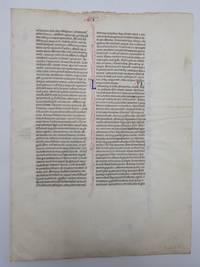
ref. 290159circa 1250. Very good; light wrinkling and marginal foxing to pages. Folio 30.5x22.5 cm. One sheet fine vellum folded with text from the book of Numbers in two columns. weight: 0.2 lb. Unknown scribe. hardcover books
1739ref. 27896Jessnitz Saxony-Anhalt: Bi-defus Yisrael bar Avraham 1739. Hardcover. Good. Four volumes folio published between 1739 and 1742. Woodcut printer's device at titles; woodcut endpieces in first volume. Hebrew text opens from right to left; leaf numbers in Hebrew characters. Hebrew chronograms yield Jewish dates of publication 5499-5502. Brown library buckram scuffed at extremities spines lettered in gilt. Endleaves renewed. A good set. See foliation and condition notes for each volume below. Scarce eighteenth-century edition of this seminal compendium of Jewish law halakhah. Compiled between 1170 and 1180 while Maimonides was living in Egypt the Mishneh Torah is regarded as the author's magnum opus. It is the only Medieval-era work that surveys the full panoply of Jewish observance including those laws that are only applicable when the Jerusalem Temple is in existence. The present edition is the first to contain Judah Rosanes' commentary Mishneh le-melekh. "Mishneh Torah" The Repetition of the Law is an appellation originally applied to the biblical book of Deuteronomy; the subtitle "ha-Yad ha-Hazakah" The Book of the Strong Hand plays on its subdivision into fourteen books: the numerical value fourteen is represented in Hebrew letters as Yud 10 Dalet 4 which forms the word "yad" hand. Maimonides sought to provide a complete statement of the Oral Law so that a person who mastered first the Written Torah and then the Mishneh Torah would be in no need of any other book. Contemporary reaction was mixed with strong and immediate opposition focusing on the absence of sources and the belief that the work appeared to be intended to supersede study of the Talmud itself. Maimonides responded to these criticisms and the Mishneh Torah endures as an influential work in Jewish religious thought. According to several authorities a decision may not be rendered in opposition to a view of Maimonides even where he apparently militated against the sense of a Talmudic passage for in such cases the presumption was that the words of the Talmud were incorrectly interpreted. Likewise: One must follow Maimonides even when the latter opposed his teachers since he surely knew their views and if he decided against them he must have disapproved their interpretation. Vol. 1: 1 title 8 234 102 3 ff. Repairs at title page with very slight loss of text at verso following leaf and the final leaf. Text embrowned often heavily in first half with some light marginal dampstains throughout. Old manuscript entries in Hebrew at title in at least three hands. Vol. 2: 1 title 148 112 2 ff. Marginal repairs to first and last two leaves no loss of text. Moderately dampstained throughout with some mild embrowning. Old manuscript entries in Hebrew at title in at least two hands; three old stamps at title including at least one censor's approbation. Vol. 3: 1 title 221 169 ff. Repairs at bottom margin to title with loss of some text below imprint and at final lines of rabbinic approbations at verso and at bottom margin following leaf with some text loss and obscuration by translucent paper tape. Small marginal repair at final leaf. Light dampstaining in first half; remaining text with mild embrowning. Old manuscript entries in Hebrew at title in at least two hands; two old stamps at title including at least one censor's approbation. Vol. 4: 1 title 135 138-154 157 1 ff. Marginal repairs to title and final leaf no loss of text. Sporadic light embrowning and marginal stains. Old manuscript entry in Hebrew at title. A complete set with only minimal text loss in a few places -- a very usable scholar's copy. References: Vinograd Jessnitz 46; Fürst 2: p. 295; Zenker p. 583 Title in Hebrew: משנה תורה ×”×•× היד החזקה להנשר הגדול ×”×’×ון רבינו משה בר מימון זצ׳׳ל ×¢× השגת הר×ב׳׳ד זצ׳׳ל ופירוש הרב מגיד משנה וכסף משנה להג×ון המשביר רבינו יוסף ×§×רו זצ׳׳ל ומגדל עוז והגהות מימונייות ופירוש רבינו עובדי והרב המוסמך מדר׳׳ל ן׳ חביב על הלכות קידוש החדש ×¢× כל הצורות השייכות להלכות ×לו ולהלכות שבת וסוכה ×•×¢× מורה ×ž×§×•× על דברי הרב המגיד וכסף משנה ×’× שתי מפתחות גדולות ורחבות ×חת על סדר ×”×¤×¨×§×™× ×•×חת על דרך ××œ×¤× ביתה ×œ× חסר דבר מכל כפי ×שר נדפס ב××ž×©×˜×¨×“× Rabbi Moses Maimonides the Rambam was a 12th century Jewish philosopher and halachic legal scholar. A highly controversial figure both during his lifetime and after his death he is generally acknowledged as the preeminent Jewish thinker of the Middle Ages. He was born in Córdoba Spain but fled as a child from the Almohad persecution. He eventually settled in Egypt where he served as a rabbi physician and philosopher. His fourteen-volume Mishneh Torah his only work not in Arabic still carries canonical authority particularly within the Yemenite Jewish community as the codification of Talmudic law. His other works include "Kitab al-Siraj" a commentary on the Mishnah "Kitab al-Fara'I" a book on precepts and the celebrated philosophical work "Dalalat al-Ha'irin" known in Hebrew as the "Moreh Nevukhim" The Guide to the Perplexed. In this latter work Maimonides attempted a philosophical/theological reconciliation of the Hebrew Bible and Greek knowledge. This work came to play a central role in all subsequent major controversies over philosophy within the Jewish community during the Middle Ages. Bi-defus Yisrael bar Avraham hardcover books
1786ref. 55770Providence 1786. Folio sheet approx. 15" x 12" docketed on the verso; previous folds with splits no loss; overall toning; good. Brigadier General James Angell 1723-1785 descendant of one of the first settlers of Providence died February 2 1785. This inventory was taken by Moses Brown 1736-1838 executor of the will and both a friend and relative. The Angell's daughter Abigail married a Goddard relatives of the Brown family. Among assets listed are Angell's Johnston farm lot 160 acres of Vermont land a third of an acre lot in North Providence; "we to give James and Jacob a Deed of the Whole of remd of Johnston farm & North Providence lott." James Angell was town clerk of Providence until 1775 and Theodore Foster said of him "I became intimately acquainted with the said James Angell and many of his Family Connexions among whom was the Honorable Stephen Hopkins Esq. whose Sister married the said James Angell." Documentary History of R.I. Angell was also appointed chairman of the committee to revise laws of the state. unknown books
1786ref. 969Berkeley & Jefferson Counties Virginia now West Virginia: not published 1786 - 1842. Group of ten folio manuscript documents and one partially printed document completed in manuscript involving the real estate transactions of Charles & John Yates in the upper Shenandoah Valley. Approximately 29 pp. in total all docketed. Each exhibits expected wear including original folds with associated splits and separations one document with a small area of archival tissue repair creasing tears small losses occasionally briefly affecting text soiling toning and foxing. Charles Yates 1728 - 1809 emigrated from England in 1748 first to New York and then in 1752 to Fredericksburg Virginia. A prosperous merchant and importer he was also deeply involved in real estate speculation in Berkeley and Jefferson Counties now West Virginia. Advancing in years unmarried and childless he solicited his brother John Orfeur Yates of Liverpool to send one of his sons as heir apparent. Young John Yates 1779 - 1851 then 13 years old arrived in 1792. Educated at the College of New Jersey and William and Mary John with wife Julia took up residence about 1807 at Walnut Grove his uncle's hunting lodge on some 912 acres near Charlestown in Berkeley County. Yates remained in the vicinity until his death. Quoting from Memorials of a Family in England and Virginia AE Terrill 1887 page 337 "As a citizen in his adopted country Mr Yates was active and liberal using his means and his influence in the encouragement of public improvements; more especially the making a better roads the starting of manufactories and establishing the system of free schools." Most if not all of the documents revolve around 2071 acres of land originally granted in 1751 by Thomas Lord Fairfax to Thomas Rutherford. Encompassing what became known as the Flowing Springs tract the collection sheds light on a complicated history beginning with the acquisition in 1786 of 755 acres by Charles Yates via William Orr a proxy from Robert Rutherford who apparently defaulted on a loan. Particularly interesting is a survey with large plat map accomplished in December 1812 involving a division of the lands of John Peyton 1729 - 1804 Peyton a son in law of Robert Rutherford apparently acquired the land in 1795. Additionally the documents contain the signatures of several significant participants in the French and Indian War the American Revolution or the War of 1812 including Thomas Rutherford Philip Pendleton Moses Hunter James Singleton Henry St George Tucker and George Hite. Includes: Berkeley County December 1 1786 Indenture 4 pp Charles Yates & William Orr in which Yates conveys 755 acres to Orr part of a tract of 2071 acres which was the subject of a decree issued at County Court of Frederick "May sessions last" regarding default of Robert Rutherford. Orr purchased the the land at auction for "three thousand two hundred & sixty five pounds." Signed by Charles Yates Thomas Rutherford brother of Robert Rutherford Philip Pendleton Moses Hunter and William Simpson. Berkeley County December 2 1786 Indenture 3 pp Charles Yates & William Orr in which Yates buys back the 755 acres purchased the day before at auction by Orr "which said tract of land is part of the 2071 acres late the property of a certain Robert Rutherford and which was sold by him the said Charles Yates on the fourth day of August last part to the said William Orr by virtue of a decree of the County Court of Frederick in Chancery on a certain matter of controversy then and there depending between the said Charles Yates complainant and the said Robert Rutherford defendant and which now conveyed by him the said Charles Yates onto the said William Orr by deed …" Signed by Orr Philip Pendleton Thomas Rutherford Thomas Simpson and William Sovell. Jefferson County February 12 1811 Agreement 3 pp between John Yates and Jesse Stall in which "the true course of a dividing line between the lands of the subscribers" is established Signed by Yates Stall and George Hite. Jefferson County December 17 1812 Survey with large plat map 3pp Folio 32" x 26" two sheets joined "The above plat represents a survey and division of the lands of John Peyton commonly known by the name of Flowing Spring tract executed pursuant to a decree of the Chancery District Court holden at Staunton the whole containing one thousand five hundred & thirty-five acres …" Adjacent to the plat is a list of 8 beneficiaries to the division all Peytons. Signed by surveyor William Castleman John Yates James Singleton Joseph W Davis and Rich Baylor. Jefferson County 1813 Survey with plat map 2 pp "At the request of John Yates Esq a tract of land in Jefferson County …" The docket describes this as the "Washington tract" Signed by surveyor William M. McPherson. McPherson was the first surveyor of Jefferson County after the split from Berkeley Jefferson County December 11 1813 Survey with plat map 2pp reflecting the sale of 130 acres to Adam Gather by John Yates Signed by surveyor Mark Hornsey. Jefferson County December 11 1813 Survey with plat map 2pp reflecting the remainder of land 77 acres after sale of 130 acres to Adam Gather. "This tract of land of timber land purchased by John Yates from George S. Washington remaining after sale of the other part to Adam Gather …" George Steptoe Washington was the nephew of President Washington. Signed by surveyor Mark Hornsey. Jefferson County November 4 1814 Indenture partially printed completed in manuscript 2pp in which John Yates purchases 118 acres from Robert O. Grayson and wife Marguerite Susan Grayson. Signed by both Graysons George Hite Edward McGuire and Lewis Hoff Jefferson County January 23 1837 Indenture 4 pp in which John Yates purchases from Abraham Snyder wife Susannah and daughter Elisha "a certain tract or parcel of land lying and being in the said County of Jefferson which is part of a larger tract of land called the Flowing Spring tract formerly belonging to John Peyton deceased …" An interesting addendum suggests some controversy: "We Richard Williams and William F Lock Justices of the Peace in the county aforesaid in the State of Virginia do hereby certified Susanna Snyder the wife of Abraham Snyder partner to a certain deed bearing date on the 23rd day of January 1837 and hereto annexed personally appeared before us in our county aforesaid and being examined privately and apart from her husband and having the deed fully explained to her she the said Susannah Snyder acknowledged the same to her act and deed and declared she had willingly signed sealed and delivered the same and wished not to retract it …" Signed by the Snyders Rich Williams and William F Lock. Jefferson County April 1842 Survey with plat map 2 pp "Yates to Alexander Beginning at a point in the center of the Winchester and Potomac Rail Road …" Signed by surveyor James M Brown. Jefferson County May 5 1842 Indenture Deed of Release 4 pp Henry St. George Tucker trustee Ann T. Hite John S Davison and Philip Williams to John Yates regarding "certain lots of land in Jefferson County Virginia - being part of the "Flowing Spring Mill" tract late the property of John Peyton … containing three hundred and fifty acres …" Signed by Tucker Hite Davison and Williams and Justices of the Peace George Spooner and John K Jones Jefferson County and John Magill and Jas Neill Frederick County. not published books
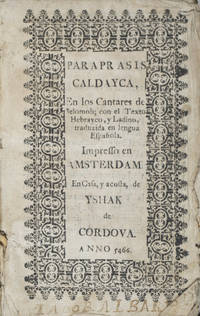
ref. 44043Amsterdam: Yshak de Cordova 5466. Fifth printing. Hardcover. poor to g-. 16mo. 3.5x6". 167pp. missing final page. Original brown calf boards. The book is a complete Spanish-language translation of the biblical book Song of Songs Song of Solomon and Perkei Avot Ethics of the Fathers the famed collection Jewish ethical sayings taken from the Talmud. Both of these works feature Moses Belmonte's translations which had been printed in Amsterdam since 1644. The translations are interlinear with each passage printed in Hebrew followed by the Spanish and in the case of Song of Songs the translation is followed by Spanish-language commentary. These works are related in their connection to the Jewish observance of Passover. Song of Songs is read on the Sabbath during Passover and chapters from Perkei Avot are traditionally read one each week between Passover and Shavuot. Pages 1-91 contain Song of Songs and 92-167 contain the text of Perkei Avot. As stated in the preface this is the "Quinta Imprension" Fifith printing of the work based on Belmonte's translation and that it was printed for the congregation of Rabbi Jacob de Mesa in Amsterdam. Title page bordered with a decorative woodblock motif. Decorative head and endpeices at the beginning and end of sections. Some of the translated text of Perkei Avot contains numerous in-text hand-corrections and Hebrew marginal notes in ink from the period. Text in Spanish with passages in Hebrew and some Ladino. Binding with spine missing rubbing and light chipping to extremities. Covers with some creasing scratches and abrasions. Starting at interior covers and some other pages throughout. Some sporadic water stains foxing and smudges throughout. The final section of Pirkei Avot is wormed in the upper corner with minimal loss of text overall. Page 103-104 with a vertical closed tear. A few pages have notes in ink. The final page p.167 containing the final passage of Perkei Avot verse 14 in Hebrew and Spanish is missing. Interior back cover is partially torn away from the board. Name of the previous owner in ink on the interior covers and the bottom of the title page. Binding fairly tight overall. Binding in poor interior good- condition overall. Moses Belmonte 1619 - 1647 Amsterdam was a poet and translator of Portuguese Jewish origin. Alternative titles: "Paraphrasis Caldayca en los Cantares de Selomoh con el Texto Hebrayco y Ladino traduzida en lengua Española" "Paraphrasis Caldaica en los cantares de Selomoh: con el Texto Hebrayco y Ladino traduzida en lengua Española" This copy belonged to Jacob Alvarez-Pereira 1684-1754 who was a prominent Sephardic Jewish merchant. References: Kayserling p.181 under bible; Silva-Rosa 18. Yshak de Cordova hardcover books
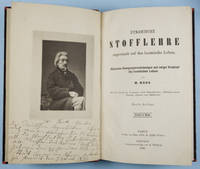
1880ref. 15524Paris: Privately Printed Sybille Hess 1880. Second edition. Hardcover. g. Scarce Only two libraries worldwide own this book according to OCLC. 8vo. 182 1 pp. Half maroon leather over marbled paper covered boards with gilt lettering to spine. Raised bands. Modern endpapers. Inscribed by Sybille Hess post mortem to original free front endpaper. Gravure frontispiece. Lithographic illustrated throughout. Fold-out map. Rare second edition of of this scientific work by the "father of modern socialist Zionism" Moses Hess 1812-1875. A philosophic work on science the cosmos and mankind. It draws upon scientific and philosophical ideas with influence from Hegel and Feuerbach. Hess had worked in this field most of his life and it was posthumously published by his devoted wife in 1877 as a pious monument to his memory. He is best known as the Zionist author of "Rome and Jerusalem." Head of spine corners worn. Minor scuffing and rubbing to boards. In German. In overall good condition. Privately Printed [Sybille Hess] hardcover books
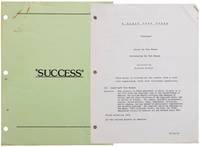
ref. 8128N.P.: N.P. 1982. Very good. 11” x 8½”. Thin card wrappers/loose leaves three-hold and punched printed rectos only. pp. 61. Very good: front wrap with staining from paperclip otherwise bright and clean throughout. This is a screenplay for an African American soap opera which never aired Success. The title page mentions that “this story is created by the author from a true life experience with some fictional creativity.” The author's name is too common to successfully research and we'll note that IMDB has a listing for a Tom Moses who was a Black actor who appeared on McCloud and Columbo in the early 1970s. This script predates television's first Black soap opera Generations which premiered March 27 1989 and ran through January 1991. The plot of this pilot begins with flashbacks initially in Washington D.C. where we meet Angela Saunders a ten year old girl who overheard her parents arguing and learned that her father was not her biological father. The next scene took place in 1974 and Angela asked her mother about her birth father wanting to know who he was and it was revealed that he was “in Hollywood” and that his name was Tom Phillips. The action then cuts to 1983 with Tom reading a letter from Angela asking if he was her real father and we learn that Tom was an actor and also ran a performing arts school. Later Angela goes to California to meet Tom and stay with his family; on arrival she asks if her mother could visit as well. Tom's wife agrees setting up one of the story's major conflicts. Interspersed throughout is standard soap opera fare including sexual trysts a philandering producer familial misunderstandings searing hatreds blackmail and other juicy bits. OCLC locates no copies. N.P. unknown books
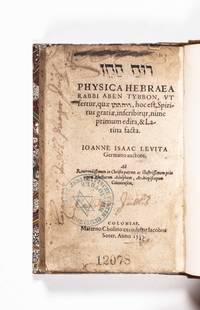
1555ref. 48871Köln Cologne: Maternus Cholinus and Jakob Soter 1555. First Latin diglot edition. Hardcover. Good. Small octavo. A-L16 = 88 leaves signed on each side e.g. A8 verso is signed A16; H9 missigned G9. 16 157 2 epigram 1 blankpp. Pagination and register run from right to left. Modern quarter sheep over marbled boards gauffered edges endleaves renewed. Library stamps and old owner entries at title; early marginal annotation and underlinings in the "Epistola"; text toned with dampstain affecting bottom quarter of text throughout not impairing legibility; marginal tear at C7. A good complete copy with ample margins. Third edition per Steinschneider and the first Latin diglot version of this anonymous introductory work. First published at Venice in 1544 it is notable that a Latin translation appears so soon after a sixteenth-century editio princeps of a Hebrew work. It comprises a commentary on and explanation of difficult terms in Maimonides' Moreh Nevukhim Guide for the Perplexed with an elucidation of terminology in the translations of Arabic to Hebrew as well as the jargon of medieval philosophical literature in general. As the editor of the present edition notes at the title "Ru'ah Hen has been attributed to the renowned translator R. Judah ben Saul ibn Tibbon c. 1120-c. 1190 and to R. Jacob ben Abba Mari ben Samson Anatoli 13th century also a translator of note. Ibn Tibbon known as the 'father of translators' was born in Granada Spain but relocated to Lunel in Provence France to escape the persecution of the Jews in the former location. He supported himself as a physician coming into contact with many sages one of whom R. Meshullam ben Jacob requested that ibn tibbon translate R. Bahya ibn Paquda's Hovot ha-Levavot into Hebrew. In addition to translating that work from Arabic ibn Tibbon also translated several other books into Hebrew among them R. Judah Halevi's Kuzari R. Saadiah Gaon's Emunot ve-De'ot and R. Solomon ibn Gabirol's Middot ha-Nefesh and Mivhar Peninim" Heller. While this is the fourth known printing of the work it is the first to include vowel points and the translation of the formerly Jewish convert to Christianity Johann Isaac Levita 1515-1577 a descendant of Elias Levita the most famous in his time of those Jews who sought scholarly contact with Christians and taught Christians Hebrew. As an added bonus the present edition includes Maimonides' De astrologia epistola elegans. The celebrated English jurist and Hebrew scholar John Selden is known to have had a copy of Ruah ha-Hen in his library Oxford Library note. Adams J-403. Cf. Heller The Sixteenth Century Hebrew Book 815 noting the present ed. Steinschneider 1 col. 639; no. 4038. VD 16 I1. Hebrew title: רוח החן. Maternus Cholinus and Jakob Soter hardcover books
1904ref. 266665New York: Moses King 1904. First. paperback. good. 325 photo Illus. 72pp. Folio original printed wrappers spine ends worn small area of wear to middle of spine wrappers lightly soiled corners of wrappers chipped front wrapper lightly dampstained near edges. New York: Moses King 1904. First Edition Views include multi-story commercial buildings bridges banks municipal buildings private residences schools churches and hospitals. Internally a very good copy with bright illustrations. Moses King unknown books
1679ref. 42560London: Peter Parker 1679. 4to. 7 1/2 x 6 inches. Reissue of the 1676 first edition with cancel title. xvi 204 4 pp. Illustrated with 4 engraved plates. Bound with: Gabriel PLATTES c.1600-1644. A Discovery of Subterranean Treasure: viz. Of all manner of Mines and Minerals at end. London: Peter Parker 1679. iv 24 pp. Period quarter calf and marbled paper boards An important early English treatise on forestry and designed woodland here in the 1679 issue with the rare addition of Plattes's tract on mines and minerals. Cook was gardener to the Earl of Essex at Cassiobury Park near Watford and laid out many woodland walks and avenues including reputedly an avenue of 296 lime trees. Cook wrote from practical experience as gardener to Arthur Capell first Earl of Essex at Cassiobury Park near Watford one of the notable Restoration landscapes outside London. His treatise treats trees both as productive estate assets and as elements of design giving directions for raising transplanting pruning grafting and ordering forest and fruit trees as well as for planting. The engraved plates and accompanying rules for measuring land and timber show the book's practical range joining arboriculture surveying estate management and landscape design. The work reflects a moment when English country-house landscapes were increasingly shaped through ordered planting axial walks avenues and managed woodland. Cook's association with Cassiobury gives the book particular interest: he is traditionally credited with laying out woodland walks and avenues there including a celebrated avenue of lime trees. His manual preserves the working knowledge behind such improvements before the broader eighteenth-century shift toward more naturalistic landscape gardening. The appended Plattes tract broadens the volume from woodland and estate improvement to the useful exploitation of natural resources. A Discovery of Subterranean Treasure gives practical directions for locating mines and minerals and for melting refining and assaying ores from gold to coal. Plattes an experimental writer on agriculture and practical science wrote for readers interested in applicable knowledge rather than scholastic theory. Bound with Cook's forestry manual the two works form a compact volume on improvement above and below ground: the ordering of trees woods and avenues followed by the discovery and testing of mineral wealth. Fussell pp.39-40; Henrey 39; Kress 1483; Wing C6033; Hoover 232. Peter Parker unknown books
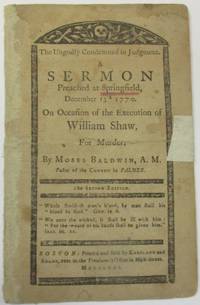
1771ref. 39601Boston: Printed and Sold by Kneeland and Adams next to the Treasurer's Office in Milk-Street 1771. 24pp but lacking the half title. Death's Head ornamentation on title page. Disbound and uniformly toned. Closed tear to title leaf no loss repaired; evidence of repair at outer margin. Inner margin of title page and page 24 with old wrapper remnants. Good. Shaw bludgeoned Edward East to death while both were inmates of the Springfield prison. This is the second of three editions of this title all issuing in 1771; AAS does not own our edition. Reverend Baldwin scolds Mr. Shaw "for the sin of intemperance. Have you not hereby dishonoured God and abused his bounty and goodness; wronged your own soul and body; wasted your substance; brought your self and family to poverty and distress. . . You are verily guilty of the crying sin of MURDER." Evans 11974. ESTC W1508.5- Yale NYHS Boston Public Williams Peabody-Essex. Not in McDade or Cohen. Printed and Sold by Kneeland and Adams, next to the Treasurer's Office in Milk-Street unknown books
ref. X03OS-00049Z. Tehinka. Collectible - Acceptable. New York: Z. Tehinka 1943. Reprint of 1680 edition. Volume 1. Folio. 28pp. Maps. Fair book. Spine cover missing. Board covers considerably chipped though without text loss. Front board detached. Preface through p. 26 detached. Poland maps history travel Inquire if you need further information. Z. Tehinka unknown books
ref. X03OS-00050Z. Tehinka. Collectible - Acceptable. New York: Z. Tehinka 1943. Reprint of 1680 edition. Volume 1. Folio. 28pp. Maps. Fair book. Bottom 6" of both boards dampstained. Poland maps history travel Inquire if you need further information. Z. Tehinka hardcover books
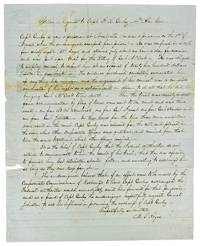
1864ref. 49788N.p. 1864. Very Good. N.p.: 1864. Manuscript letter written in ink signed by Royce at the end and on the verso. Single leaf 26.5x21cm; chips and rubbing; a few closed tears with archival tape repairs; Very Good. An unusual insightful document highlighting the laws of war and murder during the Civil War. Royce's petition seeks justice for Confederate Captain Frank R. Gurley sent to the Confederate Commission of Exchange. Its author Confederate Captain Moses Strong Royce was captured in Tennessee and imprisoned at Nashville. Gurley Royce's cell-mate had killed Union General Robert McCook of Ohio near Huntsville Alabama in August 1862. In October 1863 Union forces captured Gurley and charged him with murdering McCook. Gurley Union officials claimed was a guerrilla who shot McCook while the General was lying in an ambulance. Southerners claimed that Gurley was not a guerrilla but a regular soldier in the Confederacy's 4th Alabama Cavalry and that he killed McCook according to the laws of war. Harper's Weekly and Frank Leslie's Illustrated Newspaper fanned the flames claiming that lawless Confederate guerrillas murdered the general; feelings ran high. "US General Grant wrote CS General Hardee in December of 1863 and said that although Gurley was a member of the Confederate army that did not preclude him from being tried for having committed a foul murder" online Huntsville-Madison County Public Library essay 'Frank B. Gurley's 1866 Diary'. Having escaped from prison in March 1864 Royce plead Gurley's case. "He was confined in a cell for sixty-eight days and allowed only about one hour a day for exercise and was put upon trial for the killing of Genl. McCook. He was obliged to employ counsel to defend himself at an expense of 2500 dollars in greenbacks. The evidence produced completely exonerated him of anything like murder and the argument of his counsel was a complete vindication of his right as a soldier and an officer to do all that he did in bringing Genl. McCook to his death. "When the trial was nearly ended four communications by flag of truce were sent to the court and were there read - one from Lt. Col. Hambrick one from Genl. Forrest one from Genl. Hardee and one from Genl. Johnston" assuring that Gurley was not a guerrilla but a duly enrolled member of the Confederate military forces. Nevertheless Gurley was found guilty and sentenced to death. "The undersigned believes that if an effort were to be made by the Confederate Commission of Exchange to have Capt. Gurley exchanged the Federal authorities would immediately send him forward for that purpose and as a friend of Capt. Gurley the undersigned respectfully requests General Johnston to use his influence in procuring the exchange of Capt. Gurley. Respectfully submitted M. S. Royce." Even after War's end the dispute continued. Gurley having been released from prison in an administrative snafu was re-arrested charged but finally released and placed on parole in April 1866. . unknown books
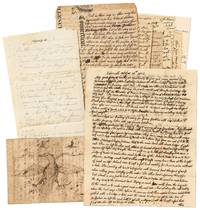
1834ref. 436962Connecticut New York Ohio 1834. Very Good. A small archive consisting of one two-page narrative letter and 10 loose sheets about 20 holograph pages of miscellaneous writings by Moses Kimball including one page with pen and ink illustrations. Modest toning and a few tiny tears three manuscript sheets are partially split at the folds including one with a neat Japanese paper tape repair about very good overall. Born in Connecticut in 1741 Moses Kimball served in the Revolutionary War as a soldier under Brigadier General Samuel McClellan 1781-82. A devout Universalist he taught navigation and civil engineering and was a prosperous land owner in Norwich Connecticut. The letter and miscellaneous writings of poetry and short sermons retained here date from the last two years of his life when he left Connecticut to live with a grandson in Norwalk Ohio. In the letter written to a friend in Connecticut Kimball describes in detail his 15-day journey undertaken in May 1835 from Poquetanuck to Norwalk: He left via sloop for Albany then traveled along the Erie Canal and completed the last leg of the trip by steamer on Lake Erie. In his verse and short sermons he lays out his strong Universalist beliefs and philosophy of life. He died happy at the age of 93 in December 1835 just a few weeks after his arrival in Norwalk. A few extracts from the letter together with a sample of his verse follows: 1. ALS. 2pp. Small quarto. Norwalk October 14th 1835. Addressed to John Harkness at Preston Connecticut: "My good friend having an opportunity to give you some account of my journey to this place I gladly embrace it. It is a beautiful country suitable for farming a rich soil . We have an academy of learning for young gentlemen with 108 scholars and another for young ladies with 98 female scholars . We left Poquetanuck the 11 day of May & arrived at my Grandson Moses Kimball's the 25 of May. We went in a sloop . to Albany there I saw great improvements . They have made an Island in the river half a mile long . forming a basin between that & the main land with draw bridges at each end. There we left the sloop and entered on board a canal boat and past on our way drawn by horses day and night. Thus we past on up to Little Falls . and so on to Fort Stanwix . there at the height of land we left the Mohawk River and past a flat level country for 60 or 70 miles without a lock. The country all low and intersected with drowned land . and all along this wet country where the land rose a little . there would be some inhabitants settled with a bridge or two over the canal . when we got to Lake Erie at Buffalo we left the canal boat and got into a steam boat the largest vessel that I ever saw . this boat that cost thirty-five thousand dollars my grandson Moses owns one-tenth part . When we came over the lake . there were seven hundred passengers in her . So you see it is no wonder she earns money . ." 2. Miscellaneous Verses and Short Sermons 1834-35: 10 octavo sheets/about 20 holograph pages including one page with pen and ink illustrations. The following is quoted from a poem written by Kimball on his ninety-third birthday "May 17 A.D. 1834": This day my years are Ninety-three The time is past & gone from me Brought into being here to stay To wait for time to pass away . And when my earthly body dies To God my spirit will arise And live with him and there remain Till Souls to bodies join again . A compelling and historically important small archive of writings that also serve as a testament to Kimball's remarkable physical health and mental acuity. unknown books
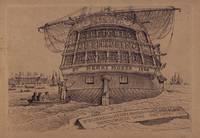
1824ref. 55402London: Henry Moses 1824. First edition. Hardcover. Very good to fine condition. Oblong Octavo. 20 etchings plus original illustrated wrappers. Bound in Royal blue leather retaining original wraps; gilt lettering and ruling on leather label mounted to spine. Cream endpapers. Tan wrappers with etching and brown lettering on front back cover plain. Our collection of "Sketches of Shipping" on the River Thames appears to be the earliest state published by Henry Moses with front wrappers dated Dec. 1 1824 and all twenty etchings dated in plates Oct. 1 1824. An 1826 advertisement in the Quarterly Review indicated that six parts of the Sketches with five engravings each had been published up to that time and announces the publication of two additional issues. The front wrapper stating publication date as Dec. 1 1824 as in our copy appears to have been used in various editions including some containing eleven plates dated March 1 1825 in plates or lettered in ink "Nos. 5 & 6" corresponding to the 1826 Quarterly Review advertisement. The irregularities and/or contradictions in tracing the publication of these Moses etchings suggest that due to the constrictions of the medium these popular etchings were published in limited numbers in variant editions as identified by the dates in these plates to satisfy the public demand of the time. In our copy all 20 etchings are dated in plates Oct. 1 1824 with two of the plates containing additional dates etched into the plates as indicated below: 1. Sailing Match Aug. 16 1824 2. An Indianian in Barnard's Yard Deptford 3. Trafalgar 120 G 125 4. Midway 5. Midway Aug. 9 1824 6. Blackwall. Dutches of M. 7. Blackwall Basin 8. Trafalgar P - 120 Guns 9. Sheerness Yard from a Window of the Fountain Inn 10. Sheerness 11. Sheerness Yard from a window of the Fountain Inn variant motif 12. Trafalgar 120 Guns 13. Trafalgar in the Basin Sheerness 14. Hulks at Sheerness 15. Blackwall 16. Untitled 17. City Canal 18. Basin at Blackwall 19. Blackwall - Wellington Indiaman 20. Surat Castle All etchings but plate 12 with H. Moses printed to plate. Plate twelve with Henry Moses. Printed by Chatfield and Coleman. Inked name and date on front free endpaper. "12/." inked to upper foredge corner of cover; this with a few small damp stains on front and back covers. OCLC lists an 1837 copy with 57 plates incl. 2 engraved title pages published in London by Ackermann a 1824 copy with nineteen plates 1825 and 1837 copies with thirty plates the latter published by Ackermann an 1837 copy titled "The Marine Sketch Book" with twenty-eight plates an 1826 copy with nine plates titled Sketches of Shipping: View in Portsmouth Harbour" and an 1827 copy with thirty plates titled "Shipping at Portsmouth and Spithead" publisher W. B. Cooke. Henry Moses hardcover books
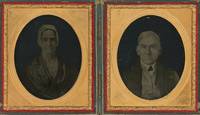
1854ref. List1708Philadelphia 1854. Ninth plate ambrotypes in a union case measuring 2 ½ x 2 ⅛ inches visible in larger case. With the identification of Isaac Rehn with his imprint and "Patented July 4 & 11 1854" imprinted on the case. A fine pair. A striking pair of ambrotypes of Mary and Moses Pennock who were members of the Kennett Square Underground Railroad network as well as active members of the Kennett Square abolitionist and Quaker community. Moses was one of the founders of the Longwood Progressive Meeting. In R.C. Smedley's History of the Underground Railroad in Chester and Neighboring Counties of Pennsylvania Lancaster Office of the Journal 1883 the Pennocks are mentioned on p. 301 as working as part of the network surrounding Isaac and Thamazine Meredity. Their son Samuel who would go on to secure important agricultural patents is also mentioned twice. The images are notable from a photographic history perspective as well as being early examples of the ambrotype process that had been patented in part by fellow Quaker and spiritualist Isaac Rehn. Rehn held a partial patent on ambrotypes along with James Ambrose Cutting of Boston and became unpopular among other photographers for his efforts to extend his patent. He later practiced spiritual photography and was a Professor of Chemistry at Pennsylvania Medical University in Philadelphia. Rehn was also involved in radical politics as a founder and leader of the Philadelphia section of the International Workingmen's Association which was later disenfranchised by Karl Marx along with several other American sections. Examples of Rehn's work are held at the National Gallery of Art the Library Company of Philadelphia and Yale's Sterling Memorial Library. Overall a very fine and significant pair of images. unknown books
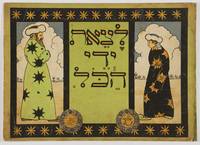
1920ref. 52940Moscow/Odessa: Omanut 1920. First edition. Softcover. g- to g. Oblong octavo. Unpaginated 8 double-sided leaves front and back wrappers printed on both sides. Stiff tan paper wrappers with beautiful chromolithographic illustrations in hues of green blue black and brown. Issued by the pioneering Hebrew-language published house Omanut. This lavishly illustrated work is a version of the Aesop's fable often known as "The Miller His Son and the Donkey" in a version said to have been adapted by Leo Tolstoy with Hebrew translation attributed to the acclaimed Hebrew-language writer and essayist Ahad Ha-Am Asher Zvi Ginsberg 1856-1957 although the work is completely uncredited. Here the work's title has been humorously translated into Hebrew as "To Please Everyone". The text is accompanied throughout by 8 large and vibrant chromolithographic images including the front and back wrappers. The illustrations are credited collectively to "Havurat Tsayarim" The Group of Painters a group of four young artists from the Odessa Art Academy who illustrated works for Omanut during the period comprised of Yakov Apter 1899-1941 Moses Mutselmakher 1900-1961 Aaron Keravatsov 1896-1942 and Efim Khiger 1899-1955. This work is part of the Gamliel Library series of beautiful picture books for children introduced by Omanut co-founder Shoshana Zlatopolsky Persitz and named after her son Gamliel. Persitz took inspiration from the rich tradition of Russian children's literature lavishly illustrated in chromolithographs produced by the likes of Ivan Bilibin and the publishing house of Iosif Knebel to create some of the earliest examples of comparable works in Hebrew. No publication date is given but the fact that this is one of a smaller number of earlier titles issued before the move of the publisher Omanut to Frankfurt points to the fact it could not have been published after 1921. Text throughout in Hebrew. Wrappers with some foxing and staining. Some rubbing and creasing to extremities. Back cover lightly soiled with a light vertical crease in the center. The binding has been re-cased with a sting-binding along the spine to secure the book block. Water staining and light foxing to pages throughout predominantly in the margins. Images still vibrant. Wrappers in good- interior in good condition overall. Quite scarce. Hebrew title: ‌לצ×ת ידי הכל Author/contributors: חבורת-×¦×™×¨×™× ×פטר מוצלמכר קרבצוב חגר ×יזופוס לב טולסטוי ×חד ×”×¢× Publication: מוסקבה-×ודיסה הוצ×ת ××ž× ×•×ª Series title: ספריה גמלי×ל Alternate transliteration: La'tset Yede Ha'kol. Omanut unknown books
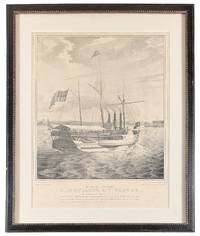
1828ref. 42606Boston: Pendleton's Lithography 1828. Uncoloured lithograph. Framed size: 19 1/4 x 15 5/8 inches. An early American marine lithograph depicting the steam packet Chancellor Livingston entering Newport Harbor issued at the outset of steam navigation on the New England coast. Published in Boston by Pendleton's Lithography after a design by Moses Swett this print presents the Chancellor Livingston under way as it enters Newport Harbor with passengers visible along the decks and flags flying from the rigging. The composition combines a detailed vessel portrait with a wider harbour view situating the steamer within a recognizable coastal setting and emphasizing both its scale and activity. The vessel itself held a prominent place in early American steam navigation. Originally associated with Robert Fulton's Hudson River operations the Chancellor Livingston was rebuilt in 1827 for service between New York and Providence. The lithograph records this later phase of its career when coastal steam travel was expanding rapidly and such vessels were becoming a familiar presence along the northeastern seaboard. The printed text beneath the image reinforces the promotional aspect of the print listing the vessel's dimensions horsepower boilers and fittings as well as its passenger capacity and accommodations. This combination of technical specification and visual representation places the image at the intersection of ship portraiture and commercial advertisement reflecting the contemporary interest in steam technology and its practical advantages. As a product of Pendleton's Lithography the print also belongs to the earliest phase of lithographic production in the United States. Established in Boston in the 1820s the firm was among the first to adopt the medium on a sustained basis and works such as this illustrate both the technical possibilities of lithography and its application to subjects of current interest. The present impression reflects that early moment when lithography was emerging as a flexible and effective means of producing images of modern life and technology. Pendleton's Lithography unknown books
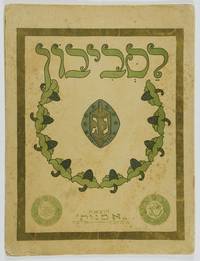
1920ref. 52932Moscow/Odessa: Omanut 1920. First edition. Softcover. g- to vg. Large quarto. Unpaginated 8 double-sided leaves front and back wrappers printed on both sides. Stiff tan paper wrappers with beautiful chromolithographic illustrations in hues of green blue red and gold. Issued by the pioneering Hebrew-language published house Omanut. This lavishly illustrated work contains the Hanukkah poem "For the Dreidel" written by acclaimed Hebrew-language poet Zalman Shneour 1887-1959 although the author is uncredited here. The text is accompanied throughout by 8 large and vibrant chromolithographic images including the front and back wrappers many with over-painting in lustrous metallic hues of silver and gold. Whenever the Dreidel appears it is in silver. The illustrations are credited collectively to "Havurat Tsayarim" The Group of Painters a group of four young artists from the Odessa Art Academy who illustrated works for Omanut during the period comprised of Yakov Apter 1899-1941 Moses Mutselmakher 1900-1961 Aaron Keravatsov 1896-1942 and Efim Khiger 1899-1955. This work is part of the Gamliel Library series of beautiful picture books for children introduced by Omanut co-founder Shoshana Zlatopolsky Persitz and named after her son Gamliel. Persitz took inspiration from the rich tradition of Russian children's literature lavishly illustrated in chromolithographs produced by the likes of Ivan Bilibin and the publishing house of Iosif Knebel to create some of the earliest examples of comparable works in Hebrew. No publication date is given but the fact that this is one of a smaller number of earlier titles issued before the move of the publisher Omanut to Frankfurt points to the fact it could not have been published after 1921. Text throughout in Hebrew. Front wrapper foxed and lightly water-stained with some additional minor staining to the back wrappers. Light rubbing chipping and/or creasing to extremities. Leaves disbound. Interior images and text overall still quite clean and vibrant with a few minor to light stains and/or smudges along the bottom margins of a few leaves. Ex-library ink stamps at the bottom of the first and last text pages as well as the back wrapper. Wrappers in good- interior in very good condition overall. Hebrew title: לסביבון Author/contributors: חבורת-×¦×™×¨×™× ×פטר מוצלמכר קרבצוב חגר זלמן ×©× ×™×ור Publication: מוסקבה-×ודיסה הוצ×ת ××ž× ×•×ª Series title: ספריה גמלי×ל Alternate transliteration: L'Sevivon This first edition is quite scarce with OCLC listing only two holdings worldwide. A slightly more common second edition of the work was published in 1922 after Omanut had moved to Frankfurt. Bibliographic reference: Ayala Gordon Hebrew Illustrations 2005 p.89-116. Omanut unknown books
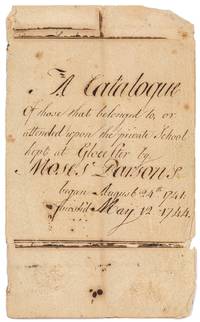
1741ref. 560322Gloucester Massachusetts 1741. Softcover. Very Good. Manuscript. 24mo. Three quarter leaves pinned inside two outer full leaves measuring about 3 ½" x 6". One quarter leaf is loose laid-in. The full front cover leaf titled in manuscript is trimmed above the title and has one horizontal cut below the title very good. The three-quarter leaves list the names of students 75 boys and 13 girls in ink on the rectos and versos. Born in Gloucester Massachusetts in 1716 Moses Parsons graduated from Harvard in 1736 and while pursuing his theological studies he taught a private school in his native town as noted in the catalogue from 1741-44. In 1744 he accepted a call to Byfield Parish where he was distinguished as a preacher until his death in 1783 having seen the Church through the Great Awakening led by George Whitefield and through the Revolutionary War. At his school Parsons taught a veritable Who's Who of early Gloucester residents - individual and family names such as Winthrop Sargent whose son was a prominent patriot and Governor of the Mississippi Territory William Ellery Nathaniel Haraden whose son served as the Sailing Master of the U.S.S. Constitution and many others. In addition to his pastoral responsibilities at Byfield Parsons was instrumental in founding Governor Dummer Academy now known as The Governor's Academy. During his tenure at his private school Parson's calculates that he taught 75 boys and 28 girls quite a few of whom would go on to be immortalized by Gloucester historians John Babson and James Pringle. An important early manuscript documenting an overlooked piece of Gloucester's local history. Reference: William Cutter. Genealogical and Personal Memoirs Relating to the Families of the State of Massachusetts. unknown books