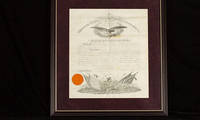
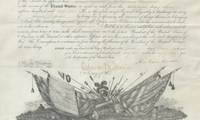
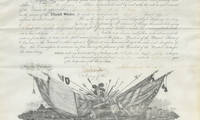
LINCOLN, ABRAHAMABAA
943 risultati
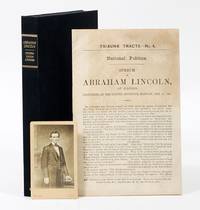
1860rif. 3104New York: New York Tribune 1860. FIRST EDITION. Original wrappers. Very Good. FIRST EDITION of Lincoln's historic Cooper Union Address delivered on February 27 1860 at the Cooper Institute in New York. The speech is largely credited to having launched Lincoln's Presidential bid. With silver print carte-de-visite of the Brady "Cooper Union" photograph. In the fall of 1859 James A. Briggs who served on the lecture committee of the Plymouth Church in Brooklyn invited presidential candidate hopeful Abraham Lincoln to speak to a New York audience on any subject of his choosing. Lincoln accepted the invitation choosing to speak of the current political climate in America. William O. Stoddard an Illinois journalist who worked for President Lincoln during his administration noted that "No previous effort of his life cost him so much hard work as did that Cooper Institute speech" and that the resulting speech "was a masterly review of the history of the slavery question from the foundation of the government with a clear bold statesmanlike presentation of the then present attitude of parties and of sections. It exhibited a careful research a thorough knowledge and understanding of political movements and developments that staggered even the most laborious and painstaking students. It showed a grasp a breadth a mental training and a depth of penetration which compelled the admiration of critical scholars" Stoddard Abraham Lincoln: The True Story of a Great Life. "Horace Greeley had rushed out the speech in pamphlet form as 'Tribune Tract' Number 4 under the headline: National Politics. Speech of Abraham Lincoln of Illinois Delivered at the Cooper Institute Monday Feb. 27 1860. The pamphlet was ready March 6 while Lincoln was still traveling through Connecticut. When he returned to New York he found it already available to the public. "Greeley marketed the eleven-page Tribune edition aggressively. As a bonus the publication included Wisconsin Republican senator James Doolittle's February 24 speech attaching 'the new doctrine of judicial infallibility' as did Lincoln's address at Cooper Union just three days later and also like Cooper Union railing agains 'the headstrong zeal pursued by the other party to force slavery into Territories'. "It was as if Republicans were now speaking with one voice: identifying with the founders attacking the Dred Scott decision rebuking John Brown and drawing their own 'dividing line' on slavery extension. Lincoln did not say it alone; but he said it best. 'Mr. Lincoln's is probably the most systematic and complete defense yet made of the Republican position with regard to Slavery' the Tribune declared in its initial advertisement for the reprints. 'We believe no speech has yet been made better calculated to win the intelligent minds over to our standard. Will the friends of the Cause everywhere aid us to circulate it' "The answer was yes. The Tribune Tract edition proved enormously popular going through at least five additional editions. Lincoln's New York oration was enjoying a new and sustained life in pamphlet form and was being purchased individually and in bulk alike by admirers and groups across the North. "The Cooper Union address tested whether Lincoln's appeal could extend from the podium to the page and from the rollicking campaigns of the rural West to the urban East. Cooper Union held the promise of transforming Lincoln from a regional phenomenon to a national figure. Lincoln knew it and rose to the occasion. "As if to illustrate his metamorphosis the Cooper Union appearance also inspired the most important single visual record on Lincoln's or perhaps any American presidential campaign: an image-transfiguring Mathew Brady photograph. Its later proliferation and reproduction in prints medallions broadsides and banners perhaps did as much to create a 'new' Abraham Lincoln as did the Cooper Union address itself. "Supposedly Lincoln volunteered when he encountered the famous photographer again a few months later: 'Brady and the Cooper Institute made me President'. Make him president they undoubtedly did" Harold Holzer Lincoln at the Copper Union: The Speech That Made Abraham Lincoln President. Note: Although it is difficult to date the carte-de-visite appears to be a late-nineteenth century production. Provenance for the speech: From the collection of George Hambrecht first president of the Wisconsin Lincoln Fellowship and renown Lincoln scholar/collector with his signature in pencil on rear wrapper. New York: New York Tribune Tribune Tracts No. 4 1860. Octavo original wrappers; custom box. Light uniform toning. Lincoln's speech comprises pages 1-11 out of a total of 16 pages. With New York Tribune ads and subscription terms on rear wrapper. RARE. New York Tribune unknown books
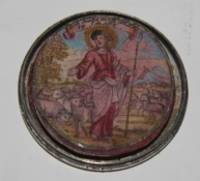
1733rif. 004823Amsterdam 1733. The panorama or concertina was made we believe in 1732 or 1733 or close to that date. The silver "shraubthaler" or outer casing we assume was made separately at a later date but not long afterward. unknown books
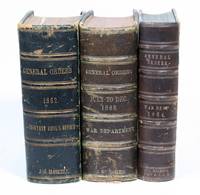
1862rif. 2923Washington D.C.: War Department 1862. Calf marbled boards. Very Good. FIRST OBTAINABLE PRINTING OF THE PRELIMINARY EMANCIPATION PROCLAMATION setting a date for the freedom of more than three million enslaved in the United States and reframing the Civil War as a fight against slavery. Issued by the War Department to regimental commanders in the field during the Civil War in the week after the completion of President Lincoln’s official manuscript version. Contained is a set of three volumes of General Orders covering the full year 1862 July-Dec 1863 and the full year 1864. History of the Emancipation Proclamation: “The proclamation has been called by responsible persons one of the three great documents of world history ranking with Magna Carta and the Declaration of Independence” – Eberstadt “From the first days of the Civil War slaves had acted to secure their own liberty. The Emancipation Proclamation confirmed their insistence that the war for the Union must become a war for freedom. It added moral force to the Union cause and strengthened the Union both militarily and politically. As a milestone along the road to slavery’s final destruction the Emancipation Proclamation has assumed a place among the great documents of human freedom” – National Archives Following the Seven Days Battle and General McClellan’s retreat from the Peninsula at the end of June 1862 President Lincoln realized that there would be no early end to the war and found himself “as inconsolable as it was possible for a human to be and yet live.” Anxious for news from the army and needing to escape the constant interruptions at the White House he frequently visited the telegraph office in the War Department building to await dispatches. It was during one such visit early in July that he asked the chief of the telegraph staff Major Thomas Thompson Eckert for some paper to “write something special” and began the first draft of the Emancipation Proclamation completing it in a few weeks. Lincoln had long hoped to resolve the slavery issue through a congressional act of emancipation compensating slave owners for their loss of “property” but that approach was roundly rejected by representatives from the border states leaving the President who had decided upon the necessity of emancipation with a presidential proclamation as the only option. The extraordinary document he conceived would announce the liberation on January 1 1863 of all slaves in those states still in rebellion against the Union and promised compensation to slave owners in those states that returned to the fold before that time if they adopted “immediate or gradual abolishment of slavery.” This proclamation would be followed by a final proclamation issued on the 1st of January identifying those states still in rebellion and confirming the liberation of all slaves therein. On Tuesday July 22 Lincoln presented his draft to the Cabinet telling them that he had resolved firmly upon the course of action it specified and asking them not for advice but suggestions. The only observation he had not anticipated came from Secretary of State Seward who proposed that it might be best to wait for a military victory before issuing the Proclamation as it could otherwise seem like “the last measure of an exhausted government.” Immediately recognizing the wisdom of the suggestion Lincoln held back. On September 17 after an anxious wait of nearly two months he received the victory he needed at the bloody Battle of Antietam. Completing his final draft Lincoln presented it to his cabinet for refinement on September 22. Following the meeting Seward took the amended draft with him to the State Department where a formal manuscript copy was made then signed by Lincoln and Seward. The formal official “Emancipation Proclamation” was of course issued on January 1 1863 the day it became the law of the land. Printing History: This printing in the War Department’s official “General Orders” is the fourth printing overall but realistically the first obtainable printing. It is preceded by: -The first printing Eberstadt #1 a small three-page circular intended for distribution within the government and to the local press likely printed on September 22. At the time that Charles Eberstadt published his study of the Proclamation 1950 he was able to locate only one copy which he himself owned and as nearly as we have been able to determine no other copies have come to light since then. -The second printing Eberstadt #2 may be a phantom printing. Charles Eberstadt was not able to locate a copy but he inferred its existence from the standard State Department practice of printing a folio edition consisting solely of the text of the proclamation followed by another printing consisting of the text of a letter of transmittal from the Secretary of State as well as the text of the proclamation. While there may be a copy of Eberstadt #2 in the National Archives as he speculated it is not recorded in their online catalogue nor have we been able to find a copy in any other online catalogue including OCLC the Library of Congress and the Abraham Lincoln Library. -Eberstadt’s third printing is of legendary rarity. It consists of Secretary of State Seward’s one-page letter of transmittal addressed “To the Diplomatic and Consular Officers of the United States in foreign countries” and the text of the proclamation. Eberstadt located a total of only five copies in institutions at the Library of Congress the National Archives Yale the Clements Library and Brown. OCLC does not record any additional copies nor is it recorded in Monaghan. There has been one copy at auction $400000 in 2021 and that was described as the only copy in private hands. -The present copy General Orders No. 139 is Eberstadt’s fourth printing of the Preliminary Emancipation Proclamation dated in print on September 24. Eberstadt surmises that this field order printing could have been accomplished as late as September 29 or 30. Although it may have been printed in as many as 15000 copies it is very rare in commerce likely due to the ephemeral nature of the printing and distribution. Additional General Orders and Provenance: The three volumes once belonged to John G. Haskell A.Q.M. Chief Quartermaster and contain the General Orders for the year 1862 July-December only for the year 1863 and for the full year 1864. John Gideon Haskell 1832-1907 was a resident of Kansas and joined the Union Army when the war broke out. He enlisted with the 14th Kansas Volunteer Cavalry Regiment and later served as Assistant Quartermaster General of Kansas as quartermaster of the Third Kansas and the Tenth Kansas Volunteers as Captain and Assistant Quartermaster on the staff of General James G. Blunt and as Chief Quartermaster of the Army of the Frontier. After the war Haskell was named official state architect and worked on the state house the capitol the State University and more. In addition to the preliminary Emancipation Proclamation the three volumes also contain the Acts of Congress on many other subjects including pay discharge recruitment handling of troops etc. Washington D.C.: War Department Adjutant General’s Office 1862-64. Three volumes. Small octavo contemporary three-quarter brown morocco two volumes with cloth boards one with marbled boards. Some rubbing and wear to bindings pencil notations on endpapers with collation and highlighting certain orders and some internal pages. Dampstaining to general title of 1862 volume; internal text and Emancipation Proclamation generally fine. RARE AND IMPORTANT. References: Charles Eberstadt. “Lincoln’s Emancipation Proclamation.” New York: 1950. War Department unknown books
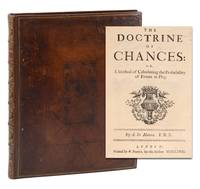
1718rif. 140950005London: Printed by W. Pearson for the Author 1718. First Edition. Near Fine. First edition of the first comprehensive textbook on probability theory. Folio in quarto format π2 A2 a-b2 c1 B-Z2 Aa-Yy2. 4 xiv 175 pp. printed on laid paper and decorated with engraved head- and tail-pieces. Skillfully rebound in period-style calf original paneled calf laid on elaborate gilt tooling and morocco title label to spine all edges speckled red. Original endpapers preserved. Near Fine with light spotting to textblock edges; binding tight. Light soiling to endpapers and widely scattered foxing and occasional smudging to contents. Bookplate to front pastedown effaced gift inscription in old hand to title page ownership signature of O. G. Gregory at upper right infill to upper right corner from removal of third ownership inscription. Dedication leaf creased and edgeworn errata list neatly crossed out in old ink. ESTC T33065. Abraham Moivre added the aristocratic de to his name when he moved from France to England as a young man one of thousands of Huguenot refugees seeking religious freedom. He taught math and within a few years met Isaac Newton who promoted his career and to whom this book is dedicated. De Moivre published several books and papers but it is The Doctrine of Chances which appealed to denizens of ivory towers and gambling dens alike for which the mathematician is most remembered. This copy was owned by the writer mathematician and astronomer Olinthus Gilbert Gregory a protege of Charles Hutton whose own major work was A Treatise of Mechanics 1806. Printed by W. Pearson, for the Author unknown books
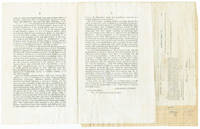
1863rif. 55254N.p. perhaps Virginia. Late 1863 or early 1864. Lincoln's Amnesty Proclamation: A Most Uncommon and Interesting Printing An exceedingly rare separate printing - perhaps by a military field press - of President Abraham Lincoln's December 1863 presidential proclamation offering amnesty to citizens of the Confederacy providing they take an oath that they "will abide by and faithfully support all proclamations of the President made during the existing rebellion having reference to slaves" i.e. the Emancipation Proclamation. When the number of persons in any state taking the oath reached ten percent of the number of voters in 1860 this group of loyal voters could form a state government that could be recognized by the President. The Amnesty Proclamation was issued with President Lincoln's third Annual Message to Congress i.e. State of the Union Address on December 8 1863. It was appended per the language in the title here to the official printing of that address but also printed separately. The present printing almost certainly executed in the weeks after Lincoln's State of the Union was likely hastily composed from the text of the official printing of the proclamation. The work carries no imprint information of any kind and bears the hallmarks of a military field press printing. Toward the close of 1863 with the Confederate Army in full retreat discussions in Congress centered on how to restore the Southern states to the Union. "The crisis which threatened to divide the friends of the Union is past" announced Lincoln. Now it was the duty of Congress to ensure that all citizens in the South regardless of race were guaranteed the equal protection of the law. A number of competing proposals emerged from deliberations but in the end during his message to Congress on December 8 1863 Lincoln declared reconstruction of the South a wholly executive responsibility and "offered 'full pardon.with restoration of all rights of property except as to slaves' to all rebels who would take an oath of future loyalty to the Constitution and pledge to obey acts of Congress and presidential proclamations relating to slavery" Donald p.471. Those excluded from taking the oath were the highest ranking members of the Confederacy - government officials judges military and naval officers above the rank of army colonel or navy lieutenant former congressmen and "all who have engaged in treating colored persons or white persons otherwise than lawfully as prisoners of war." Lincoln further encouraged the Southern states to make provisions "in relation to the freed people of such State which shall recognize and declare their permanent freedom provide for their education and which may yet be consistent as a temporary arrangement with their present condition as a laboring landless and homeless class." "Lincoln indicated that this was only one plan for reconstructing the rebel South and while it was the best he could think of for now he would gladly consider others and possibly adopt them. He might even modify his own classes of pardons if that seemed warrantable.Afterward almost everybody but die-hard Democrats seemed happy with the plan" Oates p.371. The proclamation is accompanied by a partially-printed Oath of Allegiance dated 1864 and datelined Harper's Ferry Virginia. The oath requires the taker to "solemnly swear that I will support protect and defend the Constitution and Government of the United States against all enemies." It is signed in type by Henry A. Urban Lieutenant and A.D.C. Aide-de-Camp. The oath is printed with a blank space for the name of the person taking the oath and the date. There is also a space for people who know the oath-taker and "certify on honor that we know Mr. blank to be a true and loyal man to the Federal Government." The Oath is affixed to a partial manuscript ledger report recording lost military stores for an unidentified unit in 1863 This printing of the Amnesty Proclamation is just as interesting as the government broadside printing or the first pamphlet printing as this edition would have also been used in the field by Union troops encountering Confederate rebels. The composition of the beginning of the seventh paragraph is consistent with the first pamphlet printing of the Amnesty Proclamation Monaghan 191 and not the broadside printing. The text here begins "Therefore I Abraham Lincoln."; in the broadside printing "Therefore" is present at the end of the preceding paragraph. The simple and somewhat loose execution of the composition seen here is consistent with field press printings as is the lack of an imprint of any kind. Perhaps this simple production was intended for Union troops to literally hand to Confederate soldiers to read. The presence of the portion of the ledger and the Oath of Allegiance lends credence to the notion that this edition of the Amnesty Proclamation was produced for use by the military. This printing of the Amnesty Proclamation is not in Monaghan OCLC or in any reference work we could find. In fact we could find no other three-page editions of the Amnesty Proclamation at all. Surely printed in small numbers to begin with it is perhaps a unique surviving example. The OATH affixed to a partial manuscript ledger report recording lost military stores for an unidentified unit in 1863 which is itself glued to the verso of the last blank page of the Amnesty Proclamation. Minor toning light foxing some wrinkling. Overall very good. In a cloth chemise and green half morocco and cloth slipcase spine gilt. MONAGHAN 191 ref. SABIN 41162 note. David Herbert Donald Lincoln New York 1995 p.471. Stephen B. Oates With Malice Toward None: A Life of Abraham Lincoln New York 1977 p.371. hardcover books
1737rif. 41768London: Chez Jean Brindley Libraire de S. A. R. Monseigeur le Prince de Galles dans New Bond-street 1737. Folio. 20 3/4 x 14 1/4 inches. Second edition deluxe large paper issue with wide margins. 43 double-page engravings after Abraham van Diepenbeke including 42 numbered 1-42 and the unnumbered 1658 title with Anvers imprint. Engraved head-piece to first dedication. Numerous woodcut illustrations throughout the text and woodcut historiated and inhabited initials head- and tail-pieces and printer's ornaments. 12 1-236. 248 pp. Letterpress title with London imprint and four dedications to Henriette Cavendishe-Holles the King of Grande-Bretagne Charles Vicomte de Mansfield and to Cavaliers. Avertissement avant-propos four livres plus an Abbrege de la Cavalerie conclusion additions table des chapitres. With incisive manuscript commentary pencilled in the margins in both French and English. Text in French. Bound to style in eighteenth-century half leather over eighteenth-century comb marbled paper-covered boards and marbled endpapers Deluxe large paper issue of Cavendish's classic 1737 treatise on equestrianism with 43 splendid double-page engravings: "The illustrations are among the most beautiful to ever grace equestrian literature." Ramsay Though considered a country of horse lovers England only produced one early master of classical riding: William Cavendish Duke of Newcastle who was a Royalist living in exile until the restoration of King Charles II. During his exile Cavendish opened a riding school in Belgium and wrote the present work La Méthode et Invention Nouvelle de Dresser les Chevaux. This text was the first of Cavendish's two important books on breeding and training horses and was translated into French from his English manuscript and published in Antwerp in two issues: 1657 and 1658 though many of the 1657 title-pages have been altered by hand to read 1658. The first printing was largely incinerated by a fire in the bookseller's shop and is all but impossible to acquire. Brunet Offered here is the deluxe large paper issue of the second edition of Cavendish's first book a work long cherished by bibliophiles for its typographical excellence and the masterful quality of its illustrations. It is a work that has been esteemed by countless generations of horsemen and revered by such master riders as La Guérinière Comte d'Aure and Steinbrecht. It is a landmark of equestrianism. Steinkraus Cavendish's book has been called the only really outstanding work on the subject written by an Englishman. Toole-Stott In it Cavendish discusses a wide variety of equine subjects including the recognition of the age and disposition of a horse; the characteristics of various types of horses such as the Spanish the Barb the English horse and the Arabian; methods of maintenance; and instructions on proper riding: "You must in all Airs follow the strength spirit and disposition of the horse and do nothing against nature; for art is but to set nature in order and nothing else." Of the 43 wonderful double-page engraved plates after Abraham van Diepenbeke 24 depict the multiple stages Cavendish and his assistant Captain Mazin employed in training horses in complicated maneuvers. The quality of the impressions in the present 1737 edition surpasses even those of the original edition. Steinkraus This was the first edition of La Méthode et Invention Nouvelle de Dresser les Chevaux to be published in England with engravings pulled from the original 1658 copperplates which were acquired by the publisher Jean Brindley. Brunet I 1700. Graesse II 93. Huth 23. Lowndes 1663. Mennessier de la Lance II p. 250. Nissen ZBI 848. Podeschi Mellon Books on the Horse and Horsemanship pp. 26 49. Ramsay "Early Dressage Literature to 1800" IOBA 6.9.03. Steinkraus Introduction to A General System of Horsemanship 2000. Toole-Stott Circus and the Allied Arts: A World Bibliography 84. Wing N884-87. Chez Jean Brindley, Libraire de S. A. R. Monseigeur le Prince de Galles, dans New Bond-street unknown books
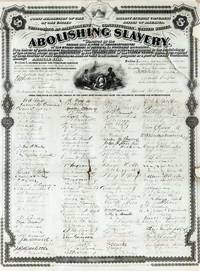
1868rif. 019219Chicago: Western Bank Note & Engraving Co. 1868. First Edition. Document. Recently backed with thin paper with several professional repairs of chips and tears. Very Good . Large folio 16-1/4" x 21-3/4" finely engraved and printed on good quality paper with elaborate decorative borders with a "US" monogram to upper corners a bold calligraphic heading with "ABOLISHING SLAVERY" in prominent decorated letters; at top center is a small vignette of the pyramid and all-seeing eye above an oval vignette of a slave family with child mourning over a cameo portrait of Lincoln. This is followed by the engraved signatures of President Lincoln Vice President Hamlin Schuyler Colfax and J. W. Forney Speaker and Secretary of the Senate and 164 Senators and Congressmen. An exceedingly rare and beautiful printing of the Thirteenth Amendment abolishing slavery: "Neither slavery nor involuntary servitude . Shall exist within the United States." This elaborately engraved Reconstruction-era broadside is based on the special "souvenir" copies on parchment signed by Lincoln and the others of which only a handful are known to have been made. The Thirteenth Amendment represents the first substantive change to how America interpreted those liberties guaranteed by the Bill of Rights since its ratification in 1791. The Emancipation Proclamation only freed the slaves in the openly rebellious states. The Amendment effectively put an end to slavery once and for all upon its passage on 1 February 1865. Western Bank Note & Engraving Co. unknown books
1863rif. 1272681863. Washington D.C. March 12 1863 effective September 9 1862. Engraved document on vellum 352 x 450 mm completed in manuscript signed by Abraham Lincoln and countersigned by Secretary of War Edwin Stanton and with blue War Department seal intact. Docketed by Lorenzo Thomas "L Thomas" in top right corner. Lightly age-toned folding creases some extra toning in lower margin. Very good. § A well-preserved Lincoln-signed commission for William Rufus Terrill 1834-1862 a Virginia-born West Pointer who stayed with the Union and his Northerner wife while his family went with the Confederacy. Terrill won notice commanding artillery at Shiloh and was appointed brigadier general of volunteers on September 9 1862 taking command of the 33rd Brigade Army of the Ohio. A month later on October 8 1862 at the Battle of Perryville he was mortally wounded by an artillery shell while trying to hold his brigade's line. He was 28. This commission is dated more than five months after his death suggesting it was issued as a formality with the appointment dated back to his original date of promotion. His younger brother James a colonel in the 13th Virginia Infantry was killed at the Battle of Bethesda Church on May 30 1864 serving the Confederacy. He too had been nominated for brigadier general; the Confederate Senate confirmed the appointment the day after his death. Another brother Philip also died in Confederate service. Civil War folklore long maintained that their grieving father William Henry Terrill erected a memorial stone for his sons bearing the inscription: "This monument erected by their father. God alone knows which was right." In God Alone Knows Which Was Right: The Blue and Gray Terrill Family of Virginia in the Civil War McFarland 2010 historian Richard Armstrong disproves the folklore but records a fitting chronicle of the tragically divided Virginia family and the high cost of their Civil War service. unknown books
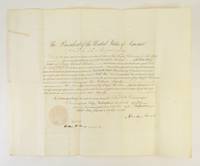
1718rif. ST16605bWashington D.C.: U. S. Government 17 July 1862. 445 x 565 mm. 17 3/4 x 22 1/2". 17 lines of engraved text in copperplate script with names and dates completed in a fine secretarial hand. Loose as issued in an archival mylar sleeve. ◆Neatly mended two-and-three-quarters-inch tear to one edge well away from text half inch slit to end of one fold three very short separations along two folds only one touching text otherwise A FINE FRESH SPECIMEN clean and bright the signature dark and clear the wax-and-white-paper seal intact. This is an excellent example of a presidential document with Lincoln's full signature and with that of his Secretary of State William Henry Seward 1801-72 remembered for negotiating the purchase of Alaska from Russia. The consul appointed in this document Jay Haziel Sherman of Vermont served in Charlottetown Prince Edward Island from 1861 to 1865. It is likely this appointee was Jahaziel Blossom Sherman 1801-65 son of pioneering steamship captain Jahaziel Sherman 1770-1844 and that his unusual Old Testament name was misspelled by the scribe who filled in the appointment form. The younger Sherman died in Nova Scotia in 1865. U. S. Government unknown books
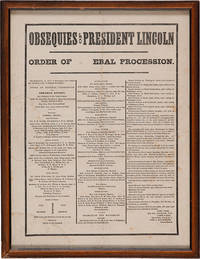
1865rif. 55213N.p. but almost certainly Springfield Il. ca. May 3 1865. The Program for Lincoln's Official Funeral Procession in Springfield on May 4 1865: The Saddest Day in American History Likely a proof copy of the exceedingly rare broadside announcing the funeral procession for President Abraham Lincoln in Springfield in early May 1865. Struck down by assassin John Wilkes Booth on April 15 1865 Lincoln's body lay in state in the White House on April 18 and a ceremonial funeral service took place in Washington D.C. around noon on April 19. Two days later President Lincoln's casket was loaded on a funeral train headed for Springfield Illinois stopping at Baltimore Harrisburg Philadelphia New York City Albany Buffalo Cleveland Columbus Indianapolis Michigan City and Chicago before arriving in Lincoln's adopted hometown early on the morning of May 3. At this time Springfield's population numbered around 15000 but Lincoln's funeral train pulled into a town swollen with over 100000 visiting mourners. Immediately upon arrival Lincoln's coffin was transferred by hearse to Representatives' Hall inside the Illinois Old State Capitol. For the next twenty-four hours from about ten o'clock in the morning on May 3 to the same time the next day about 75000 mourners were allowed to pass by the open coffin of the slain president to pay last respects. According to the present broadside President Lincoln's funeral procession left the Old State Capitol "on Thursday the 4th Inst. at 10 o'clock a.m. precisely." The funeral party of over 10000 people then turned right on 7th Street to pass by the Lincoln family home and then right up Cook Street to proceed past the Governor's Mansion before heading north to Oak Ridge Cemetery. This broadside printing of the order of the procession for Lincoln's Springfield funeral was probably printed the afternoon of May 3 or possibly even the morning of May 4 the day of the funeral. Surrounded by a heavy black band the broadside lists all the persons and units involved in the procession along with their places and the rules for the day. The entire procession was divided into eight divisions with Gen. Joseph Hooker acting as Marshal in Chief. The first three divisions of the military escort represented all the elements of the Army and Navy. After them came the attending clergy and Lincoln's attending physicians. Next was the casket itself the only wheeled vehicle in the procession with the pall bearers to each side followed by Lincoln's horse and then the immediate family. Three more military divisions followed interspersed with government officials ambassadors and state officials followed by delegations from Springfield and other Illinois towns. Next were representatives of various organizations delegations from colleges lawyers doctors and the press Masons Odd Fellows and firemen all interspersed with two more military divisions. The final segment of the funeral procession was designated for "Citizens at large" and "Colored Persons." The broadside gives directions for locations for the forming up of each group. Only marshals were allowed to be on horseback; all others walked. Bands were under the direction of the Committee on Music. Other particular directions follow including regulations for the colors of the various scarves worn by the marshals. The text of the document ends with directions to keep the streets through which the procession passes "clear from sidewalk to sidewalk." This broadside must have been widely distributed to assist the mourners in Springfield but like all such ephemeral pieces few copies have survived. OCLC locates only six at Indiana University the Abraham Lincoln Memorial Library the Boston Athenaeum the Chapin Library at Williams College the John Hay Library at Brown University and the Library Company of Philadelphia. The latter location also attributes the place of printing to Springfield. There is also a copy at the Library of Congress and a copy formerly owned by noted collector James Copley and previously sold by this firm. The present copy is likely an early printer's proof of the broadside as it lacks the first three letters of the word "FUNERAL" in the title. The Library of Congress copy is also likely a proof with its variant title omitting the words "ORDER OF." Both copies also lack the letter "e" in "Order" in the first sentence of text. These errors speak to the haste and stress under which this broadside was surely produced perhaps the day before or the very morning of the day when America's greatest president the Savior of the Union and Illinois' favorite son was laid to rest in a city teeming with seven times its own population in attendance. A remarkable and moving document reflecting a moment of national grief perhaps only approached by the John F. Kennedy funeral and memorializing the day when America's first assassinated president was solemnly committed to the earth. Broadside 12 x 9 inches. Printed in three columns edged with a printed black border. Old folds center vertical fold with some separation. Moderate staining. Still very good. Framed. OCLC 5023077 79462381. unknown books
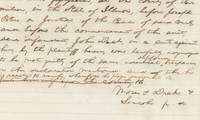
1857rif. 3563230/10/1857. John V. Drake and John C. Moses practiced law in Danville Illinois. They worked on cases appearing before the Vermilion County Circuit Court. When Abraham Lincoln had a case appearing in that court he would sometimes affiliate himself with Drake and Moses. Lincoln was before that court in October and November 1857. Hezekiah Ballah sued John Deck and Zachariah Deck in a case heard in the Vermilion County Circuit Court. This was an action of trespass for castrating seventeen buck sheep and cutting up eight other ewes wethers and lambs. The Decks retained Lincoln who worked together with Drake and Moses in the case in October 1857. The Decks pleaded not guilty. Moreover John Deck also pleaded that he had been acquitted of the charge in Justice of the Peace court. The jury found the Decks not guilty. Hearing the case was Judge David Davis who Lincoln would one day name to the U.S. Supreme Court. Autograph document signed a draft pleading completely in Lincoln’s hand Vermilion County Circuit Court October 1857 being the pleading informing the Court that Deck had previously been acquitted of the same offense. The name of the case was John Deck impleaded with Zachariah Deck ads vs Hezekiah Ballah and it was filed In Trespass. “And the said defendant John Deck comes and defends the force and injury…and says plaintiff actio non fails to act when there is a duty to act because he defendant says he is not guilty in manner and form as is in the declaration alleged; and of this he puts himself upon the country etc. citizens in a court or jury. Moses & Drake & Lincoln p.d.” Lincoln adds below: “And for further plea in this behalf defendant John Deck says plaintiff actio non because he says that heretofore to wit on the __ day of __ in the year of our Lord one thousand eight hundred and fifty seven at the county of Vermillion in the state of Illinois before Joseph Peters a Justice of the Peace of said county and before commencement of this suit said defendant John Deck in a suit against him by the plaintiff herein was lawfully judged to be not guilty of the same identical supposed trespass in this declaration mentioned and this he is ready to verify therefore he prays judgment etc. Moses & Drake & Lincoln p.d.” The case is listed at lawofficeofabrahamlincoln.org. An interesting pleading where Lincoln’s client has already been acquitted of the same offense. <img class=""alignnone wp-image-25018 size-post-window"" src=""https://cdn.raabcollection.com/wp-content/uploads/20231204144051/Folder-site-11-1600x1327.jpg"" alt="""" width=""1600"" height=""1327"" /> unknown books
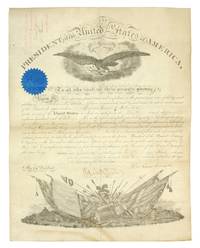
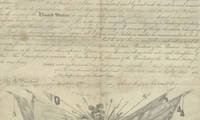
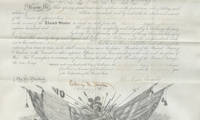
1861rif. 3768907/08/1861. He names G.A. Pierce an assistant quartermaster with the rank of Captain who would serve under General Ulysses S. Grant at Fort Donelson Shiloh and Vicksburg Gilbert Ashville Pierce was a Union Army officer during the Civil War who later became a U.S. Senator and Governor of the Dakota Territory. He served as a captain assistant quartermaster and eventually lieutenant colonel and inspector in the Quartermaster's Department. Pierce entered the service as a second lieutenant in Company H 9th Indiana Volunteer Infantry on April 23 1861. He was promoted by President Abraham Lincoln to captain and assistant quartermaster on August 7 1861. Pierce served under General Ulysses S. Grant at Paducah Fort Donelson Shiloh Grand Gulf and Vicksburg. He was advanced to lieutenant colonel in the Quartermaster's Department on September 12 1863 and later served as a colonel and inspector until mustering out in October 1865. After the war he was admitted to the bar in 1865 and then served in the Indiana House of Representatives starting in 1869. He was appointed Governor of the Dakota Territory by President Chester A. Arthur in 1884 serving until 1886. Pierce was elected as a Republican senator from North Dakota serving from 1889 to 1891. He died in 1901 at age 62. This is the document that launched Pierce’s remarkable career. Document signed by President Lincoln with engravings of flags cannons and an imposing eagle Washington August 7 1861 being Pierce’s original commission as “Assistant Quartermaster with the rank of Captain.” <img class=""alignnone wp-image-25018 size-post-window"" src=""https://cdn.raabcollection.com/wp-content/uploads/20231204144051/Folder-site-11-1600x1327.jpg"" alt=""historical memorabilia dealer"" width=""1600"" height=""1327"" /> unknown books
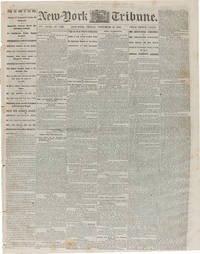
1863rif. 56893New York. November 20 1863. The Gettysburg Address Published in New York the Day After the Event The complete issue of the New-York Tribune printing the Gettysburg Address on the morning of November 20 1863 the first possible date of the speech's printing. The previous day Lincoln delivered his great address at the dedication of a cemetery on the Gettysburg battlefield four months after the bloody and pivotal conflict that turned the tide of the Civil War in favor of the Union. Lincoln's speech was preceded by an address from Edward Everett the most famous orator of his day. Everett's speech took between ninety minutes and two hours to deliver and today is largely forgotten. Lincoln's speech delivered in only a few minutes stands as a supreme distillation of American values and of the sacrifices necessary for the survival of liberty and freedom. Much controversy surrounds the circumstances and content of the address as it was actually delivered at Gettysburg. The words spoken in the speech differ in the versions appearing in newspapers and the text which appeared in Washington several days later published as The Gettysburg Solemnities and known in only four copies which is now taken as the closest version to Lincoln's final intent because of its correspondence to the known manuscript versions. Interestingly and according to Carbonell the text of the first appearance of the speech in book form published a few days later as An Oration Delivered on the Battlefield of Gettysburg Monaghan 193 is taken largely from this New-York Tribune printing. As it appears here the address corresponds closely to the transcription printed in the same day's edition of the New York Times with slight variations in punctuation and capitalization e.g. "Four score and seven years ago our fathers brought forth on this continent a new Nation." in the Tribune versus "Fourscore and seven years ago our Fathers brought forth on this Continent a new nation." in the Times. The address is printed on the first page at the bottom of the fifth column running to the top of the sixth. Significantly it notes the five places during Lincoln's speech where applause broke out thereby providing an important historical record of the reception of the speech as it was delivered by Lincoln. It is noted that the conclusion of the speech was met with "long continued applause" and that "three cheers were here given for the President and the Governors of the States." Lincoln's speech is preceded by the opening prayer of the Rev. Thomas H. Stockton and followed by Everett's speech which occupies the rest of the sixth column and the vast majority of space on page two. War news occupies the other column space on the front page. Together with examples from other newspapers of November 20 1863 this issue of the New-York Tribune represents the first appearance of any version of the Gettysburg Address in print although at some variance with the version Lincoln eventually disseminated. The exact order in which the morning editions of November 20 were printed is practically impossible to determine at this point and as Carbonell states "will almost certainly never be known." Rightfully so Carbonell includes all November 20 morning newspaper printings of the Gettysburg Address as his first entry with no priority. Suffice to say this is as early a printing of one of the foundational documents of American life as one can ever encounter. "Lincoln's speech composed on the train on the way to Gettysburg and written down according to tradition on scratch-paper and the backs of envelopes comprised ten sentences and took only a few minutes to deliver. From the first words—'Four score and seven years ago'—to the last—'that government of the people by the people and for the people shall not perish from the earth'—it is immortal one of the supreme utterances of the principles of democratic freedom" - PRINTING AND THE MIND OF MAN. A handsome copy of this rare and important document. Large folio newspaper. Disbound from a volume. Minor chipping along spine edge. Trimmed closely along top and bottom edges likely when previously bound in a run of the newspaper. One soft horizontal center fold. Withal very good. A perfect candidate for display. CARBONELL 1. GROLIER AMERICAN 100 72 ref. STREETER SALE 1748 ref. PRINTING AND THE MIND OF MAN 351 ref. HOWES E233 ref. MONAGHAN 192 ref. Paul M. Angle "Four Lincoln Firsts" in Papers of the Bibliographical Society of America Vol. 36 no. 1 First Quarter 1942 pp.13-17. For an outstanding analysis of the structure and importance of the Gettysburg Address see Garry Wills Lincoln at Gettysburg New York 1992. unknown books
rif. 600008"Abraham Lincoln" in black ink Washington February 10 1862. Folio. Partially printed document on vellum accomplished in a secretarial hand. Blue wafer seal intact. Lincoln's signature is dark. Appointment of Ethan Allen Hitchcock to the rank of Major General of Volunteers. Boldly co-signed by Edwin Stanton Secretary of War and Adjutant General L. Thomas a few small holes at the folds else fine fresh and dark. Lincoln 1809-65 16th President of the United States 1861-65 and one of the most important figures in American history. Hitchcock 1798-1870 Graduated West Point in 1817; served in Florida war; later with Winfield Scott in Mexico. He was commissioned Major-General of Volunteers as per this document in 1862 and rendered many valuable services to Lincoln's administration and the Union Army see Basler's Lincoln for numerous references to him. Signed by Authors. F. Soft cover. hardcover books
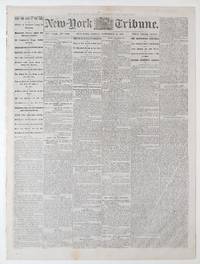
1863rif. 372898New York 1863. 8pp. printed in six columns on a single folded sheet. Large folio. Disbound. Natural paper flaw to first leaf not affecting text of the Gettysburg Address. Cloth portfolio. 8pp. printed in six columns on a single folded sheet. Large folio. The complete issue of the New-York Tribune printing the Gettysburg Address on the morning of Nov. 20 1863 the first possible date of the speech's printing. The previous day Lincoln delivered his great address at the dedication of a cemetery on the Gettysburg battlefield four months after the bloody and pivotal battle that turned the tide of the Civil War in favor of the Union. Lincoln's speech was preceded by an address from Edward Everett the most famous orator of his day. Everett's speech took between ninety minutes and two hours to deliver and today is largely forgotten. Lincoln's speech delivered in only a few minutes stands as a supreme distillation of American values and of the sacrifices necessary for the survival of liberty and freedom. Much controversy surrounds the circumstances and content of the address as it was actually delivered at Gettysburg. The words spoken in the speech differ in the versions appearing in newspapers and the text which appeared in Washington several days later published as The Gettysburg Solemnities and known in only four copies which is now taken as the closest version to Lincoln's final intent because of its correspondence to the known manuscript versions. Interestingly and according to Carbonell the text of the first appearance of the speech in book form published a few days later as An Oration Delivered on the Battlefield of Gettysburg is taken largely from this New York Tribune printing. As it appears here the address corresponds closely to the transcription printed in the same day's edition of the New York Times with slight variations in punctuation and capitalization "Four score and seven years ago our fathers brought forth on this continent a new Nation." in the Tribune versus "Fourscore and seven years ago our Fathers brought forth on this Continent a new nation." in the Times e.g. The address is printed on the first page at the bottom of the fifth column running to the top of the sixth. Significantly it notes the five places during Lincoln's speech where applause broke out thereby providing an important historical record of the reception of the speech as it was delivered by Lincoln. It is noted that the conclusion of the speech was met with "long continued applause" and that "three cheers were here given for the President and the Governors of the States." Lincoln's speech is preceded by the opening prayer of the Rev. Thomas H. Stockton and followed by Everett's speech which occupies the rest of the sixth column and the vast majority of space on page two. War news occupies the other column space on the front page. Together with examples from other newspapers of Nov. 20 1863 this issue of the New-York Tribune represents the first appearance of any version of the Gettysburg Address in print although at some variance with the version Lincoln eventually disseminated. The exact order in which the morning editions of November 20 were printed is practically impossible to determine at this point and as Carbonell states "will almost certainly never be known." Rightfully so Carbonell includes all November 20 morning newspaper printings of the Gettysburg Address as his first entry with no priority. Suffice to say this is as early a printing of one of the foundational documents of American life as one can ever encounter. "Lincoln's speech composed on the train on the way to Gettysburg and written down according to tradition on scratch-paper and the backs of envelopes comprised ten sentences and took only a few minutes to deliver. From the first words - 'Four score and seven years ago' - to the last - 'that government of the people by the people and for the people shall not perish from the earth' - it is immortal one of the supreme utterances of the principles of democratic freedom" PMM. Carbonell 1. Grolier American 100 72 ref. Streeter Sale 1748 ref. PMM 351 ref. Howes E233 ref. Monaghan 192 ref. Paul M. Angle "Four Lincoln Firsts" in Papers of the Bibliographical Society 36 Spring 1942 pp.13-17 unknown books
1861rif. 69112Washington. March 19 1861. A Fine Commission on Vellum Signed in Full by Lincoln Less Than a Month Before Ft. Sumter A very fine military commission printed on vellum and signed by Lincoln in the tense weeks leading to the outbreak of hostilities at Fort Sumter in April. After South Carolina officially adopted the Ordinance of Secession on December 20 hopes for a peaceful cure to the nation's ills were slim. Small skirmishes and strategic maneuvers punctuated by more and more states joining the Confederacy made the imminent need for an empowered military and more military officers abundantly clear by March. This document appoints Thomas G. Baylor as a Second Lieutenant in the Ordnance Department on March 19 and is evidence of that need. Baylor 1837–1890 born in Virginia graduated from West Point in 1857 and was positioned at the Fort Monroe Arsenal from 1858–1861. Baylor took command of that Union stronghold behind Confederate lines on August 15 and remained its leader until October 20 1863. He was then appointed Chief Ordnance Officer of the Army of the Cumberland and was acting Chief Ordnance Officer of the Military Division of the Mississippi until August 1864. During this time he fought at Missionary Ridge and was on Sherman's staff throughout the Carolina and Georgia campaigns. He was Brevetted Major for his services at Atlanta then Lieutenant-Colonel for "gallant services in the capture of Savannah" eventually reaching the rank of Brevet Colonel. After Savannah he returned to command of the Fort Monroe Arsenal which he retained until 1876. From his West Point eulogy: "Colonel Baylor's record of thirty-three years' service in the Army is an exceptional one. A Southerner by birth and lineage he continued loyal to the flag throughout the Civil War in which he bore a conspicuous part although against influences that would have tested the firmness of most men but the lack of sympathy if not hostility from friends and relatives never made him falter in his faith and he went to the grave a gallant soldier and a loyal gentleman." Strong old folds light soiling. Near fine. Twenty-Second Annual Reunion of the Association Graduates of the Untied States Military Academy at West Point New York June 12th 1891 Saginaw MI: Seemann & Peters 1891 pp.18-19. hardcover books
1696rif. 40906Leiden and Utrecht: Pieter vander Aa and François Halma 1696. Two volumes folio. 15 5/16 x 10 1/4 inches. Half title title printed in red and black with engraved vignette. Engraved additional title and 243 engraved plates. Contemporary Dutch blindstamped vellum with arabesque design. Provenance: Karl Magnussun bookplate – John David Drummond 8th Earl of Perth Viscount Strathallan First expanded edition of one of the most attractive Dutch florilegia of the seventeenth century. Munting was professor of botany at the University of Groningen and took over and enlarged the botanic garden founded by his father Henricus. The present work depicts some of the exotic and remarkable plants growing in the garden. It is one of the earliest and most important documents concerning Japanese flora and its importation into the West predating Thunbergs works by almost one hundred years. "Munting wrote a number of works on medical-botanical topics but his posthumously published opus magnum the Naauwkeurige enjoyed particular success at least in part due to the novelty of the plates which in a radical departure from the iconography of the traditional florilegium presented its plant species against a charming series of landscape backgrounds . The illustrations are remarkable for their elegance and originality" Oak Spring Flora. The initial botanical line drawings are now known to have been by about ten different but unidentified artists. Some time after Munting's death and in preparation for their publication these line drawings had tone and the pictorial back- and fore-grounds added by Jan Goeree 1670-1731 under the supervision of the publishers. The engraving and etching was then carried out by Jacob Gole and Joseph Mulder engraver of many of plates in Maria Sibylla Merians work on the insects of Surinam. Hunt 396; Nissen BBI 1428; Tomasi Oak Spring Flora 45 latin edition; Pritzel 6556; Brunet 1947. Pieter vander Aa and François Halma unknown books
1862rif. 3568928/02/1862. He was later promoted to Lt. Colonel for gallantry in action at the Battle of Groveton Document signed with fine engravings of an eagle flags and cannons Washington February 28 1862 naming Percy B. Spear a Commissary of Subsistence of Volunteers with the rank of Captain effective November 30 1861. The document is countersigned by Secretary of War Edwin M. Stanton. The appointment is listed in the U.S. Army Register. The Civil War Commissary Department was responsible for procuring storing and distributing food to soldiers. The rations managed by the department included such things as pork beef bread coffee and soap. But Spear did not serve solely as a Commissary for the entire war. He would soon serve an aide-de-camp in the Fifth Corps in the Gettysburg campaign with Gen. James Barnes mentioning him with distinction in dispatches. Spear ended the war as a Brevet Major. In July 1865 he was appointed Lt. Colonel of Volunteers for meritorious service and for gallantry in action at the Battle of Groveton in 1862. After the war he was again named Commissary of Subsistence this time at the recommendation of Gen. George G. Meade. <img class=""alignnone wp-image-25018 size-post-window"" src=""https://cdn.raabcollection.com/wp-content/uploads/20231204144051/Folder-site-11-1600x1327.jpg"" alt="""" width=""1600"" height=""1327"" /> unknown books
1737rif. 40577London: Chez Jean Brindley Libraire de S. A. R. Monseigeur le Prince de Galles dans New Bond-street 1737. Folio. 17 7/8 x 11 1/4 inches. Complete second edition. 43 double-page engravings after Abraham van Diepenbeke including 42 numbered 1-42 and the unnumbered 1658 title with Anvers imprint. Engraved head-piece to first dedication. Numerous woodcut illustrations throughout the text and woodcut historiated and inhabited initials head- and tail-pieces and printer's ornaments. 12 1-236. 248 pp. Letterpress title with London imprint and four dedications to Henriette Cavendishe-Holles the King of Grande-Bretagne Charles Vicomte de Mansfield and to Cavaliers. Avertissement avant-propos four livres plus an Abbrege de la Cavalerie conclusion additions table des chapitres. Text in French. Contemporary brown full morocco paneled blind with gilt filets on board edges and gilt dentelles seven raised bands forming eight compartments on a richly gilt spine with gilt-lettered red morocco titling-pieces in second and third compartments and gilt foliate tooling in rest marbled endpapers on laid paper all edges gilt Cavendish's classic 1737 treatise on equestrianism with 43 splendid double-page engravings: "The illustrations are among the most beautiful to ever grace equestrian literature." Ramsay Though considered a country of horse lovers England only produced one early master of classical riding: William Cavendish Duke of Newcastle who was a Royalist living in exile until the restoration of King Charles II. During his exile Cavendish opened a riding school in Belgium and wrote the present work La Méthode et Invention Nouvelle de Dresser les Chevaux. This text was the first of Cavendish's two important books on breeding and training horses and was translated into French from his English manuscript and published in Antwerp in two issues: 1657 and 1658 though many of the 1657 title-pages have been altered by hand to read 1658. The first printing was largely incinerated by a fire in the bookseller's shop and is all but impossible to acquire. Brunet Offered here is the second edition of Cavendish's first book a work long cherished by bibliophiles for its typographical excellence and the masterful quality of its illustrations. It is a work that has been esteemed by countless generations of horsemen and revered by such master riders as La Guérinière Comte d'Aure and Steinbrecht. It is a landmark of equestrianism. Steinkraus Cavendish's book has been called the only really outstanding work on the subject written by an Englishman. Toole-Stott In it Cavendish discusses a wide variety of equine subjects including the recognition of the age and disposition of a horse; the characteristics of various types of horses such as the Spanish the Barb the English horse and the Arabian; methods of maintenance; and instructions on proper riding: "You must in all Airs follow the strength spirit and disposition of the horse and do nothing against nature; for art is but to set nature in order and nothing else." Of the 43 wonderful double-page engraved plates after Abraham van Diepenbeke 24 depict the multiple stages Cavendish and his assistant Captain Mazin employed in training horses in complicated maneuvers. The quality of the impressions in the present 1737 edition surpasses even those of the original edition. Steinkraus This was the first edition of La Méthode et Invention Nouvelle de Dresser les Chevaux to be published in England with engravings pulled from the original 1658 copperplates which were acquired by the publisher Jean Brindley. Brunet I 1700. Graesse II 93. Huth 23. Lowndes 1663. Mennessier de la Lance II p. 250. Nissen ZBI 848. Podeschi Mellon Books on the Horse and Horsemanship pp. 26 49. Ramsay "Early Dressage Literature to 1800" IOBA 6.9.03. Steinkraus Introduction to A General System of Horsemanship 2000. Wing N884-87. Chez Jean Brindley, Libraire de S. A. R. Monseigeur le Prince de Galles, dans New Bond-street unknown books
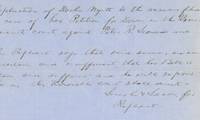
1853rif. 3514603/11/1853. The case is well known and illustrates Lincoln’s penchant for aiding women who had been unjustly treated ""Said answers are untrue uncertain and insufficient that her Bill is true certain and sufficient and he Lincoln will so prove it to be"" During his 25-year legal career in Illinois Abraham Lincoln was involved in a substantial number of cases involving women as litigants. He was known for seeking to represent women and working to get justice for them in an era when women’s cases were often shunned by lawyers or not taken seriously. Lincoln handled some 147 divorce cases about 40% of all divorce cases in his home county of Sangamon. Importantly more than half of the litigants he represented were women. He handled these cases with ""tender consideration"" learning from experience that the law could be a dangerous place for women who had few rights under the legal doctrines of the time. Lincoln also represented women in cases involving land disputes and in slander lawsuits which often involved accusations of adultery and were important for maintaining a woman's community reputation. Lincoln was known for taking cases for women where he felt justice was on his client's side. Notable examples include: Nance Legins-Costley - In 1841 Lincoln successfully represented this African American woman to prevent her from being sold into slavery arguing that slavery was illegal in Illinois; Melissa Goings - He defended Mrs. Goings an elderly woman charged with her abusive husband's murder in a case based on self-defense; Doshia Wyatt - In 1853 Lincoln took on the case of Mrs. Wyatt a widow whose claim was that she was being cheated out of her inheritance. A petition for dower is a legal request filed by a surviving spouse typically a widow to claim a portion of their deceased spouse's estate such as in real property based on common law dower rights. This is a formal process that requires the surviving spouse to file a petition in court describing the property and naming the heir or person with the next immediate estate of inheritance. The court then holds a hearing to determine the rights to dower and the property. Doshia Wyatt widow of Robert Wyatt retained Lincoln and sued for her dower. Thomas Wyatt died in 1847 and left all of his property to his son Robert. Robert Wyatt lost part of the land the Mill Farm to satisfy a judgment against him in the U.S. District Court of Illinois. Robert Wyatt sold another property the Prue Farm to George Brewner. After Robert Wyatt's death in 1852 Doshia Wyatt sued Leonard and Brewner's heirs. Leonard contested the petition claiming that he did not believe Doshia and Robert Wyatt had been legally married. Leonard also claimed that Robert Wyatt had already left Doshia Wyatt land in his will which Leonard claimed was recorded. Hearing the case was Judge David Davis a friend of Lincoln whom as President he would appoint to the U.S. Supreme Court. Ward Hill Lamon Lincoln’s co-attorney on the case began his professional association with Lincoln in 1852 when they became law partners. Though they had different styles they remained close personal and professional friends. After the partnership dissolved in 1857 their friendship continued and Lamon would later become Lincoln's bodyguard and U.S. Marshal for the District of Columbia during Lincoln's presidency. As the bodyguard Lamon was not in Washington on the night of Lincoln’s assassination being on assignment in Richmond at Lincoln’s request. In his Recollections of Abraham Lincoln Lamon reveals that before he left for Richmond he implored the President not to ""go out at night after he was gone particularly to the theatre."" This document relates to the case of Doshia Wyatt. In a petition to the Court filed by Lincoln Wyatt stated her case: “Your petitioner would further represent to your honor that she your petitioner is the widow of the said Robert Wyatt — that she has never relinquished her dower to the said aforesaid land or any part thereof - nor has her dower ever been set off - or assigned her in said premises - that said Robert Wyatt on or about the 28th of July AD 1852 departed this life leaving her the said Doshia widow as aforesaid…Your petitioner would further pray that this honorable court appoints commissioners to assign her dower in & to all of the above described tracts or parcels of land according to the statue in such cases made and approved. And your petitioner would pray for such & gather relief as may be according to equity and good conscience and as in duly abound your petitioner will ever pray.” This is a pleading in Lincoln’s hand which contains the answer of Wyatt to the defendants’ responses to her allegations. Autograph document signed Vermillion County Illinois Circuit Court November 3 1853. “The replication response of Doshia Wyatt to the defendants’ answers filed in the case for her Petition for Dower in the Vermillion Circuit Court against Peter R. Leonard and others. This repliant respondent says that said answers are untrue uncertain and insufficient that her Bill is true certain and sufficient and he Lincoln will so prove it to be as this Honorable Court shall direct. Lincoln & Lamon for Repliant respondent.” On the verso Lincoln has docketed the document “Dosha Wyatt vs Peter R. Leonard Replication.” The clerk of court Samuel Craig then notes that the plea was filed on November 3 1853. An uncommon document in Lincoln’s hand concerning his representation of women. As for the case the parties likely reached a settlement as Wyatt ended up dismissing the case while Leonard paid the costs. <img class=""alignnone wp-image-25018 size-post-window"" src=""https://cdn.raabcollection.com/wp-content/uploads/20231204144051/Folder-site-11-1600x1327.jpg"" alt="""" width=""1600"" height=""1327"" /> unknown books
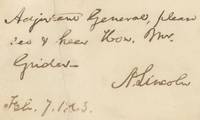
1863rif. 3619207/02/1863. This document has been in a private collection for a generation Kentucky Unionists were important to Lincoln a Kentucky native as he famously said ""I hope to have God on my side but I must have Kentucky.” The Congressman Henry Grider apparently needed to see Thomas to discuss the Act its impact on Kentucky and the details of how the recruitment would be handled Kentuckian Henry Grider was a Whig who served in Congress from 1843-1847 and then as a Unionist from March 4 1861 until 1865. For the Thirty-ninth Congress 1865–1867 Grider shifted to the Democratic Party but retained his commitment to the Union serving from March 4 1865 until his death in office on September 7 1866. Grider represented a Kentucky pro-slavery but Union-loyal constituency and he retained that point of view throughout the Civil War. Kentucky Unionists like Grider were particularly important to Abraham Lincoln a Kentucky native who had famously said ""I hope to have God on my side but I must have Kentucky.” Lincoln is known to have consulted with Grider about Kentucky affairs and relied on his support and that of the Kentucky delegation to Congress. On February 7 1863 Congress passed an Act providing that “the Governor of the State of Kentucky by the consent and under the direction of the President of the United States shall have power to raise and organize into regiments a volunteer force not exceeding twenty thousand rank and file to be raised within the State of Kentucky to serve for the term of twelve months to be employed within the limits of Kentucky in repelling invasion suppressing insurrection and guarding and protecting the public property: Provided That at any time it may be necessary in the discretion of the President of the United States these troops may be employed out of the limits of Kentucky against the enemies of the United States.” Thus the Governor of Kentucky would raise a force of 20000 volunteers to serve in Kentucky but President Lincoln had the authority to order them used outside the state. This Act was received with mixed reviews in Kentucky and on the very day it was enacted Grider’s son Benjamin C. Grider a slave-holding Unionist resigned from the Union Army. From the timing of his resignation one can surmise that he disapproved of the Act. He had commanded the 9th Kentucky Volunteers. Lorenzo Thomas was the Adjutant General of the U.S. Army at that time and his job was to maximize operational effectiveness of the army by manning recruiting for and sustaining military operations. Autograph note signed Washington February 7 1863 the day of the Act to Lorenzo Thomas expediting Grider’s ability to see Thomas. “Adjutant General Please see and hear Hon. Mr. Grider. A. Lincoln.” It seems clear that Grider needed to see Thomas to discuss the Act its impact on Kentucky and the details of how the recruitment would be handled and managed. Not in Basler. A separation running vertically archivally mended. This is a very scarce communication involving Lincoln aiding a Kentucky Unionist. <img class=""alignnone wp-image-25018 size-post-window"" src=""https://cdn.raabcollection.com/wp-content/uploads/20231204144051/Folder-site-11-1600x1327.jpg"" alt=""historical memorabilia dealer"" width=""1600"" height=""1327"" /> unknown books
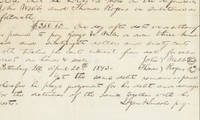
1843rif. 3570010/1843. Miles who was also a prominent Whig politico and part of Lincoln’s political circle used Lincoln’s legal services a number of times Abraham Lincoln and Stephen T. Logan formed a prominent Illinois law partnership called Logan & Lincoln from 1841 to 1844 during which Logan an experienced attorney mentored Lincoln and introduced him to complex areas of the law. During his partnership with Logan Lincoln also increased his caseload before the Illinois Supreme Court and handled appeals from all areas of the state. Logan and Lincoln handled many cases together not merely at their Springfield office but around the state. This ls because Lincoln had a circuit law practice that involved riding the Eighth Judicial Circuit in Illinois covering 14-15 counties including Menard County on horseback or buggy. Logan remained in Springfield while Lincoln traveled the Circuit. As a general practitioner Lincoln handled diverse cases including property disputes debts torts. slander and criminal law. The Logan & Lincoln partnership ended amicably in 1844 after which Lincoln partnered with William H. Herndon who was a clerk in the Logan & Lincoln law office and whose father had been a Lincoln friend for many years. George U. Miles was Herndon’s father-in-law. He came to Illinois in 1816 at age 20 settling first in St. Clair County and then in White County where he married Jane McCoy on November 18 1821. They had three children. Miles removed to Logan County and then in 1836 he went to Sangamon County where he lived on a farm six miles north of Springfield. In 1839 he moved to Petersburg in Menard County where he served as public administrator from 1845 to 1849. Miles was a Whig and a Menard County delegate to conventions that chose Whig candidates. Miles and Lincoln knew each other as neighbors and fellow Whigs and also because of Miles’ family relationship to Lincoln’s friend and partner Herndon. In early 1843 Lincoln sought a nomination for Congress and hoped for Miles’ political support. Miles used Lincoln as an attorney a number of times both before and after Herndon became Lincoln’s partner. In late 1843 Miles retained Logan & Lincoln and sued John Webb and Thomas Rogers to collect a $368.60 debt on a promissory note. Autograph document signed all in Lincoln’s hand Menard County Illinois October-November 1843 being a petition in the county court in which Miles asks for judgment for a debt. “George U. Miles plaintiff states that he holds a note on the defendants John Webb and Thomas Rogers in substance as followeth: ‘$368.60. One day after date we or either of us promise to pay George U. Miles or order three hundred and sixty eight dollars and sixty cents with twelve percent interest from date for value received. Our hands & seals: John Webb and Thomas Rogers Petersburg Ill. April 20th 1843.’ Yet the same debt remains unpaid wherefore he prays judgment for his debt and damages for the detention of the same together with his costs. Logan & Lincoln.” Lincoln won the case. The defendants were found to have defaulted and the court awarded Miles $392.67 counting costs. The case was decided November 1 1843. It is listed at lawofficeofabrahamlincoln.org. After Lincoln’s assassination Miles acted as one of Herndon's key investigators. Miles famously interviewed individuals including Ann Rutledge’s aunt to gather information about Lincoln's early life and relationships serving as a vital source for Herndon's research. Herndon would write a famous biography of Lincoln in the 1880s. <img class=""alignnone wp-image-25018 size-post-window"" src=""https://cdn.raabcollection.com/wp-content/uploads/20231204144051/Folder-site-11-1600x1327.jpg"" alt="""" width=""1600"" height=""1327"" /> unknown books
1861rif. 1571129/03/1861. James E. Harrison though born in Virginia served the Union cause during the Civil War. He received his first appointment as a Second Lieutenant to the 2d U. S. Cavalry in June 1856 and was stationed in Texas and various forts in the West until December 1858 when he was assigned to scouting Indians. He returned East and with the Civil War imminent he was promoted to First Lieutenant 2d U.S. Cavalry in March 1861 and then to Captain 5th U.S. Cavalry in May of that year. Harrison was engaged in the Peninsular campaign and commanded a regiment in the Army of the Potomac from September 1862 to June 1863. During that time he served at the battles of Antietem Chancellorsville and Brandy Station among many others. He was Breveted Major U.S. Army for gallant and meritorious services at the battle of Hanover Court House and Brevet Lieutenant Colonel U.S. Army for gallant and meritorious services at the battle of Antietam. In July of 1864 Harrison was assigned to be Inspector-General of Cavalry in the Department of Arkansas and was later appointed as Special Inspector of Cavalry in West Mississippi. Document signed as President Washington March 29 1861 effective retroactively to February 27 1861 an ornate vignetted commission with an eagle cannons and flags appointing Harrison to the rank of “First Lieutenant in the Second Regiment of Cavalry.” The document is countersigned by Secretary of War Simon Cameron. unknown books
1862rif. 3341204/03/1862. As 1862 opened the war was not going well for the Union. In the east Bull Run had been a disaster and led to the shake-up of command with no results yet to show for it. In the west the loss at Wilson’s Creek gave the Confederates the upper hand. The Federal armies in the west then turned their attention to implementation of the Anaconda Plan – to cut the Confederacy in half by securing the Mississippi River from St. Louis all the way to the Gulf of Mexico and clearing a maritime invasion route into the heart of the Confederacy by taking the Tennessee and Cumberland Rivers which lay just to the east of the Mississippi. If successful these maneuvers would cut Texas Arkansas and Louisiana off from the main body of the South hold Kentucky and Missouri firmly in the Union and make it difficult for Tennessee to cooperate with her sister Confederate states. The first moves would be to take and hold commanding locations north on the Tennessee and Cumberland rivers and command of the operation was given to Brig. Gen. Ulysses S. Grant an obscure and largely unproven officer. On February 6 1862 Fort Henry commanding the Tennessee River was captured by Grant’s forces. It had a poor defensive position and was reduced mainly by the bombardment of gunboats on the river. Nonetheless its fall opened the Tennessee River to Union gunboats and shipping past the Alabama border and provided a real victory for Union arms. Grant next focused his attention on Fort Donelson eleven miles away on the more strategically important Cumberland River. This fort had a much stronger physical position and the Confederates had placed some 20000 men and a number of senior commanders on site to engage in its defense. They were not about to concede the fort and they were ready and waiting for Grant. Grant arrived at Fort Donelson late on February 12 and on the 13th established his headquarters near the left side of the front of the line. That day was spent in battle preparation with a few small probing attacks being carried out against the Confederate defenses. Grant's headquarters was at Cairo Ill where the head of Ordnance was Stephen Lyford. Grant arrived at Fort Donelson late on February 12 and on the 13th established his headquarters near the left side of the front of the line. That day was spent in battle preparation with a few small probing attacks being carried out against the Confederate defenses. The battle was severe with nearly 1000 soldiers on both sides killed and about 3000 wounded. When Simon Buckner the Confederate commander asked for surrender terms Grant famously replied “No terms except unconditional and immediate surrender can be accepted“ adding “I propose to move immediately upon your works.” Buckner surrendered his command of about 15000 men; this was the first of three Confederate armies that Grant captured during the war. The capture of Fort Donelson gave the North control of the Cumberland River which provided the road that opened the Deep South to Union invasion. It boosted morale in the North which now saw that the war could result in great victories and not just defeats. It gave President Lincoln the fighting general he was looking for and it made Grant’s career in the process; he was soon promoted to major general of volunteers. Stephen C. Lyford had a long and distinguished career. He served from May to August 1861 in the defenses of Washington D. C. and in the Manassas Campaign participating in the Battle of Bull Run July 21 1861. He was Aide-de_Camp to Brig. General McDowell in the defenses of Washington D. C. August to October 1861 and Asst. Ordnance Officer at St. Louis Arsenal Mo. November 2 1861 to February 1 1862; in command of the Cairo Ordnance Depot Ill. February to May 1862 being detached to the Cumberland River and was present at the Surrender of Ft. Donelson. He was part of Gen. Halleck's Mississippi Campaign May to July 1862 being engaged in the Siege of Corinth May 1862 and was Chief of Ordnance for Department of the Tennessee July 11 1862 to September 6 1863 and fought in the Battle of Corinth. He would go on to teach at West Point and also serve as aide-de-camp for Gen. Halleck and as representative of the US to Japan to bring back information and technology relevant for American ordnance. Document signed with engravings of flags and weapons Washington March 4 1862 Naming Lyford a “Second Lieutenant in the Ordnance Department."" <img class=""alignnone wp-image-25018 size-post-window"" src=""https://cdn.raabcollection.com/wp-content/uploads/20231204144051/Folder-site-11-1600x1327.jpg"" alt="""" width=""1600"" height=""1327"" /> unknown books
1507rif. 3254115/07/1864. A real rarity the first Lincoln appointment to the Signal Corps for an officer active in Sherman’s Georgia Campaign we have seen On March 29 1860 the United States House of Representatives approved the Army appropriations bill for fiscal year 1861 which included the following amendment: ""For the manufacture or purchase of apparatus and equipment for field signals $2000; and that there be added to the staff of the Army one signal officer with the rank pay and allowance of a major of cavalry who shall have charge under the direction of the Secretary of War of all signal duty and all books papers and apparatus connected therewith."" The United States Senate eventually approved the appropriations bill over the objections of Jefferson Davis now Senator from Mississippi and President James Buchanan signed it into law on June 21 1860 the date now celebrated as the birthday of the modern U.S. Army Signal Corps. Now armies on the go could report back to their civilian leadership in real time and those leaders could make decisions without waiting for a messenger on horse. This changed the face of warfare. President Lincoln himself spent significant time in the telegraph office sending and receiving war correspondence. He often walked alone from the White House to the office and chatted with the operators. As Bates later wrote “During the Civil War the President spent more of his waking hours in the War Department telegraph office than in any other place except the White House. While in the Telegraph Office he was comparatively free from official cares and therefore more apt to disclose his natural traits and disposition than elsewhere under other conditions.” John Quincy Adams first enlisted in 1862 with the 38th Ohio Volunteers. On October 15 of that year he was a quartermaster sergeant with the 10th Ohio Cavalry. After a stint as acting lieutenant on July 15 1864 he was appointed by the President Second Lieutenant to date from March 3 1863. Adams was actively involved in the Georgia campaign conducted by Gen. William T. Sherman. He was with left wing of the 16th Army Corps on the march to Chattanooga Tenn. In the Atlanta Campaign he participated in the battles of Resaca Dallas Kenesaw Mountain. and Jonesboro. He manned signal corps stations at Kenesaw Mt. and Allatoona. Adams was in the engagements at Port McAllister and Rice Mill station in the campaign from Savannah through the Carolinas including battles at Columbia Bentonville and Raleigh; and at the surrender of Confederate Gen. Joseph E. Johnston to Sherman on April 26 1865. Adams was breveted 1st lieutenant for gallant and meritorious service in the Signal Corps at the battle of Allatoona; he was breveted captain for gallant and meritorious services in the Signal Corps at the capture of Fort McAllister and Savannah and throughout the war. Adams was mustered out August 22 1865. After the war he was in the 1st U. S. Cavalry and was in the Indian wars and finished his career as captain and aide to Gen. O.O. Howard in October 1884. He is listed on the roster of the U.S. Signal Corps in the Civil War. Adams is also a protagonist in one of the most famous telegraph exchanges of the war during the battle near Allatoona. During this battle legend goes that Sherman signaled to General Corse and his men to ""hold the fort"" a phrase that inspired the later popular religious hymn entitled Hold the Fort by Chicago evangelist Philip P. Bliss which featured the chorus 'Hold the fort for I am coming’ which then became a common expression. We still use ""hold down the fort"" today. Adams was the signal officer who received that message or rather a variant as Sherman did not use that exact phrase though captured the sentiment. This is President Lincoln’s appointment of Adams as Second Lieutenant. Document signed Washington July 15 1864 naming Adams ""Second Lieutenant in the Signal Corps"" dating from the third of March 1863. This document is a real rarity as we have never before seen a Lincoln appointment to the Signal Corps for an officer active in Sherman’s March to the Sea. Moreover Lincoln Signal Corps appointments are themselves uncommon this being our first. It was acquired from the Adams descendants and has never been offered for sale before. <img class=""alignnone wp-image-25018 size-post-window"" src=""https://cdn.raabcollection.com/wp-content/uploads/20231204144051/Folder-site-11-1600x1327.jpg"" alt="""" width=""1600"" height=""1327"" /> unknown books