HERVEY, Thomas KABAA
2.506 Ergebnisse
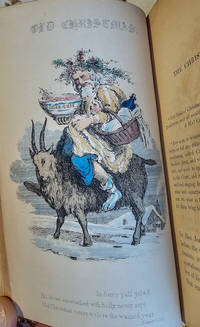
1836Best.-Nr. 021959London: William Spooner 1836. First Edition. Hardcover. Spine darkened a bit so to top of front cover. Near Fine example of a scarce book beautifully bound. Robert Seymour . Small octavo 4" x 6-3/8" beautifully bound by Riviere and Son in full red morocco with triple gilt rules spine with five raised bands and gilt decorations and lettering gilt dentelles all edges gilt; original cloth spine and covers bound in at rear; iv viii 344 pages. Original endpapers and half-title present. Illustrated with numerous hand-colored plates by Robert Seymour. "Thomas Herveys THE BOOK OF CHRISTMAS is remembered today for the wonderful illustrations by Robert Seymour 1798-1836 one of the most successful caricaturists of his time. Herveys text gives an exhaustive historical account of old English Christmas customs: some -- like the feasting on roast beef and turkey plum pudding and mince pies -- still flourishing; others -- like waits carol singing at night and mumming -- almost forgotten. Seymours illustrations completed just a few months before his suicide as he was working on Dickenss PICKWICK PAPERS capture the spirit and joy of the season. From the coach load of Norfolk turkeys to the sleepy waits singers in the light of the street lantern to the merry old gentleman enjoying Christmas by his fire he provides a delightful selection of holiday scenes. THE BOOK OF CHRISTMAS first published in 1836 and reprinted the following year was an early attempt to record and preserve the old customs. As the Victorian revival of the holiday gathered pace during the 1840s many more histories of Christmas festivities and practices were published. They were often bound and illustrated as attractive gift books and so helped to establish a new tradition of the Christmas publishing season BRITISH LIBRARY. William Spooner hardcover books
1930Best.-Nr. 6001881930. Softcover. Very Good. An early treatment script of the film Shanghai Express. Measuring 8½" x 11". 22 mimeographed pages printed rectos only stapled along the spine. Front page detached from staples front page and a bit of the second page with scattered ink markings moderate chipping toning and bumping along the edges thus about very good the text largely clean throughout. An early 22-page treatment script for the famed film Shanghai Express written by Harry Hervey who is generally only credited with writing the short story from which the film was based. The second page includes a list of characters which differs slightly from the film most notably a character named Laura Mason who seems to be the film's character Shanghai Lily played by Marlene Dietrich. Also different is the character Captain Esme Simpson who appears to be the film's character Captain Donald Harvey played by Clive Brook. The film directed by Josef von Sternberg and released in February of 1932 also featured noted Chinese-American actress Anna May Wong as Hui Fei. An interesting piece of Pre-Code Era Hollywood likely printed in very small numbers for a select group of people. unknown
1930Best.-Nr. 6001881930. Softcover. Very Good. An early treatment script of the film Shanghai Express. Measuring 8½" x 11". 22 mimeographed pages printed rectos only stapled along the spine. Front page detached from staples front page and a bit of the second page with scattered ink markings moderate chipping toning and bumping along the edges thus about very good the text largely clean throughout. An early 22-page treatment script for the famed film Shanghai Express written by Harry Hervey who is generally only credited with writing the short story from which the film was based. The second page includes a list of characters which differs slightly from the film most notably a character named Laura Mason who seems to be the film's character Shanghai Lily played by Marlene Dietrich. Also different is the character Captain Esme Simpson who appears to be the film's character Captain Donald Harvey played by Clive Brook. The film directed by Josef von Sternberg and released in February of 1932 also featured noted Chinese-American actress Anna May Wong as Hui Fei. An interesting piece of Pre-Code Era Hollywood likely printed in very small numbers for a select group of people. unknown books
1768Best.-Nr. P5012London: Robert Sayer & Thomas Jefferys c.1768. Very Good. Notes: Rare view of Quebec. This view shows British troops in small boats approaching a French settlement in the Gulf of St. Lawrence. "The items in the Scenographia of greatest interest to Canada are the six prints of the St. Lawrence done after the sketches of Captain Hervey Smyth A.D.C. to General Wolfe. The Six Views of the Most Remarkable Places of the Gulf and River St. Laurence were published in 1760 by Thomas Jefferys London with a dedication to William Pitt Earl of Chatham. The prints are line-engravings of good quality engraved by various well-known engravers of the period."--George Spendlove pg.7 Image Size : 328x511 mm 12.91x20.12 Inches Platemark Size : 365x528 mm 14.37x20.79 Inches Paper Size : 415x582 mm 16.34x22.91 Inches Coloring: Black & White Medium: Copper Engraving Categories: Views Canada Quebec; Robert Sayer & Thomas Jefferys unknown
1836Best.-Nr. 021959London: William Spooner 1836. First Edition. Hardcover. Spine darkened a bit so to top of front cover. Near Fine example of a scarce book beautifully bound. Robert Seymour . Small octavo 4" x 6-3/8" beautifully bound by Riviere and Son in full red morocco with triple gilt rules spine with five raised bands and gilt decorations and lettering gilt dentelles all edges gilt; original cloth spine and covers bound in at rear; iv viii 344 pages. Original endpapers and half-title present. Illustrated with numerous hand-colored plates by Robert Seymour. "Thomas Herveys THE BOOK OF CHRISTMAS is remembered today for the wonderful illustrations by Robert Seymour 1798-1836 one of the most successful caricaturists of his time. Herveys text gives an exhaustive historical account of old English Christmas customs: some -- like the feasting on roast beef and turkey plum pudding and mince pies -- still flourishing; others -- like waits carol singing at night and mumming -- almost forgotten. Seymours illustrations completed just a few months before his suicide as he was working on Dickenss PICKWICK PAPERS capture the spirit and joy of the season. From the coach load of Norfolk turkeys to the sleepy waits singers in the light of the street lantern to the merry old gentleman enjoying Christmas by his fire he provides a delightful selection of holiday scenes. THE BOOK OF CHRISTMAS first published in 1836 and reprinted the following year was an early attempt to record and preserve the old customs. As the Victorian revival of the holiday gathered pace during the 1840s many more histories of Christmas festivities and practices were published. They were often bound and illustrated as attractive gift books and so helped to establish a new tradition of the Christmas publishing season BRITISH LIBRARY. William Spooner hardcover
1871Best.-Nr. NL-02276With an extremely rare depiction of the Kekionga Ball Grounds — the birthplace of professional baseball in America. Harvey C. Lowrie's Fort Wayne Guide Map of 1871 offers a comprehensive and detailed representation of Fort Wayne Indiana at a critical juncture in its history. Created during a period of rapid urbanization and industrial growth the map captures the intricate layout of the city showcasing not only its streets and neighborhoods but also key civic institutions transportation routes and significant landmarks. Most importantly this map has a unique place in sports history. It is one of the few surviving documents to pinpoint the location of the Kekionga Ball Grounds immortalizing the site of the first professional baseball league game the same year this map was published. No photographs or sketches of the ballpark have survived and this map is the only known printed document that clearly references the ballpark's boundaries giving it a special place in the study of early baseball history. The boundaries of the grounds located on the west side of the map on the north side of the St. Mary's River bounded by Mechanics Street west of the St. Marys River are not well known other than as shown on this map. The area may have included additional property leased by the team though no surviving documentation clarifies whether specific lots were part of the legal description. Creation of the Map: Context and Purpose The map was compiled and published by Harvey C. Lowrie and printed by the Chicago Lithographing Company in 1871. Lowrie's motivation for creating the map would have been multifaceted. Fort Wayne was a burgeoning city at the crossroads of major transportation routes and there was a demand for accurate up-to-date maps for planning business and urban management purposes. Additionally the map served as a commercial venture; such maps were often printed with advertising on the reverse. Lowrie's map is no exception containing numerous advertisements for local businesses. The map contains many historical curiosities. It depicts the location of the old Fort Wayne site various public schools early businesses and recreational spaces like the Old Skating Park. It features several prominent railroads which were vital to the city's economic growth. These include the Grand Rapids & Indiana Railroad the Fort Wayne Jackson & Saginaw Railroad and the Pittsburg Fort Wayne & Chicago Railroad. These railroads and proposed and abandoned lines highlight Fort Wayne's importance as a transportation hub in the Midwest during the late 19th century. Other notable details include the Wabash & Erie Canal the canal feeder and a basin between the fifth and ninth wards reflecting the city's connection to water-based trade before railroads took center stage. The First Professional Baseball Game Fort Wayne holds a special place in the history of American sports specifically baseball as the location of the first-ever professional baseball game. On May 4 1871 the Fort Wayne Kekiongas faced the Cleveland Forest Citys in what is widely regarded as the inaugural game of professional baseball under the newly established National Association of Professional Base Ball Players. The Kekiongas won the game 2-0 with pitcher Bobby Mathews throwing a shutout. The game occurred at the Kekionga Ball Grounds a modest facility on the west side of the St. Mary's River. According to Lowrie's map the ballpark was bounded by what is now Huron Street and was situated just north of the city's fairgrounds. The site of the game is of immense historical importance as it marks the formal beginning of professional baseball. This sport would grow to become deeply woven into the American cultural fabric. The ballpark constructed in 1870 on the grounds of Camp Allen — a former Union Army camp — was a simple affair. It included a covered grandstand known as the Grand Dutchess which provided seating for spectators particularly women and their male companions. Unfortunately the grandstand was destroyed by fire later in 1871 and the Kekionga Ball Grounds hosted only eight more professional games before the team disbanded. Despite its brief use the Kekionga Ball Grounds' association with the first professional baseball game gives it an enduring legacy. By marking the location of this early baseball site Lowrie's map constitutes an essential historical document not only for those interested in Fort Wayne's history and development but also for baseball enthusiasts tracing the sport's origins. Census Lowrie's map is very rare and no examples have been identified by the OCLC or on the open market. An article by Bill Griggs and Jim Nitz on the website of the Society For American Baseball Research discusses the importance of Lowrie's map in some detail: https://sabr.org/bioproj/park/kekionga-ball-grounds-fort-wayne/ Cartographers: Harvey C. Lowrie was an American mapmaker and civil engineer active in the mid-19th century. He is best known for his cartographic work on the Midwest particularly his 1871 Fort Wayne Guide Map. While little is documented about his early life Lowrie's contributions to urban cartography became significant during rapid urbanization in the United States. His work focused on creating accurate and functional maps for emerging cities which are crucial for infrastructure planning and development. His work continues to be referenced by historians and collectors for its accuracy and attention to detail. Condition Description Folding map w/ booklet. Minor discoloration/staining along one fold.


