TACHARD (père Guy)Livre Rare Book

2555 risultati
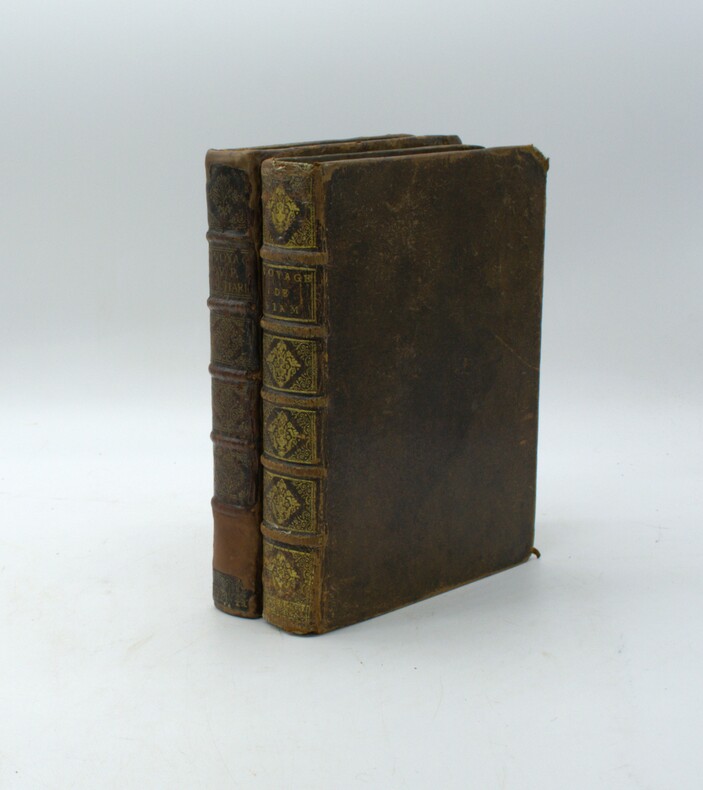
1686rif. PHO-1903Paris, Arnould Seneuze, Daniel Horthemels, 1686-1689, 2 vol. in-4 (25x19cm): 16ff.-424pp. 8ff., 8ff.-416pp.-5ff., illustré de 10 planches (26) dont certaines dépliantes ou à double pages, gravées par Cornelis Vermeulen, d'après les dessins de P. Sevin et 7 vignettes, relié plein veau époque, dos à nerfs, Tome 1, dos frotté, coiffe manquante, épidermure, coins usés, ex-libris raturé au titre, mouillure angulaire sur 10 feuillets, ressaut de cahier. Tome 2, manque au dos, charnières fendues, coins usés, coiffes absentes, petit travail de ver sur 6 feuillets puis pages 300-350, mouillure claire par intermittence, 3 feuillets détachés, quelques feuillets brunis.
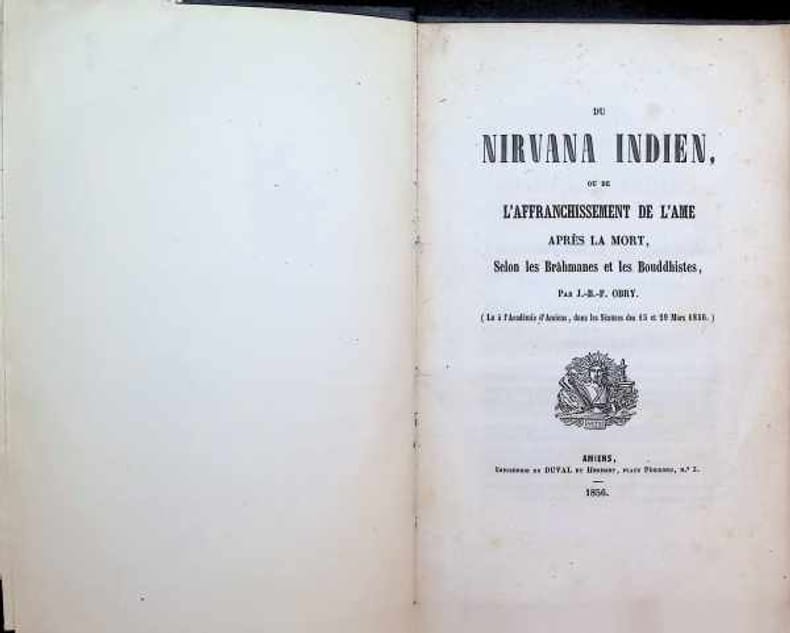
1856rif. 027649Amiens 1856 Imprimerie de Duval Hardcover
1686rif. PHO-2093Paris, Arnould Seneuze, Daniel Horthemels, 1686, in-4 (24,5x19cm): 16ff.-424pp. 8ff., illustré de 20 planches dont certaines à double pages, gravées par Cornelis Vermeulen, d'après les dessins de P. Sevin, relié plein veau chiné, dos à nerfs orné avec titre, frottements, manques en tête et coiffe arasée, 1 coin usé, mouillure en coin sur une quinzaine de feuillets, une planche détachée, quelques brunissures et rousseurs.
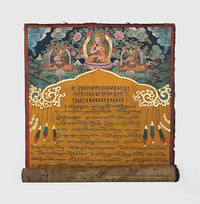
1900rif. 185518Tibet: c. 1900. Finely painted on linen A beautiful devotional manuscript the decoration at the head showing Je Tsongkhapa the founder of the Gelug school of Tibetan Buddhism and his two spiritual sons Gyaltsabje and Khedrupje. The three figures at the foot are dharmapalas "hell protectors" who protect Buddhists and the Dharma. This example was deaccessioned by the Samye monastery to pay for damages sustained during the Cultural Revolution 1966-76. It was purchased by Martin Schøyen b. 1940 the Norwegian collector of rare books and manuscripts from the Rhythm of Tibet Gallery Lhasa in June 2006. His black ink annotation including his pressmark MS 5337/2 is on the verso. Manuscript and hand-painting on linen 135 x 53 mm. Black block and cursive Tibetan manuscript on yellowish brown panel colour illustrations and adornments at head and foot red border. Three characters in red script on reverse. Housed in long grey archival box Recent pencilled label at foot. Some soiling and mild discolouration but an attractive example. unknown
1875rif. 185517Tibet: c. 1875. Finely brushed on linen An attractively executed devotional manuscript decorated with Buddhas an endless knot a Wheel of Dharma shells and other imagery. This example was deaccessioned by the Samye monastery to pay for damages sustained during the Cultural Revolution 1966-76. It was purchased by Martin Schøyen b. 1940 the Norwegian collector of rare books and manuscripts from the Rhythm of Tibet Gallery Lhasa in June 2006. His black ink annotation including his pressmark MS 5337/1 is on the verso. Manuscript and hand-painting on linen 144 x 53 mm. Black block and cursive Tibetan manuscript on yellowish brown background adornments and frames in red and blue red seal. Housed in long grey archival box. Recent pencilled labels at foot. Some soiling and mild discolouration but an attractive example. unknown
1988rif. 1725NICE. EDITIONS D'ART SEFER. LE CHANT DES SPHERES. MONACO. EDITIONS ARTS ET COULEURS. 1988-1990. 2 VOLUMES IN-FOLIO (41 X 32 X 15,5 CENTIMETRES ENVIRON) EN FEUILLES DE 140 + (8) ET 134 + (8) PAGES, SOUS CHEMISE CARTONNEE NOIRE ORNEE D’UN IDEOGRAMME DORE ET EMBOITAGE DE L’EDITEUR RECOUVERT DE VELOURS NOIR, PLAT SUPERIEUR ORNE D’UNE COMPOSITION AVEC IDEOGRAMME DORE DANS UN ENCAFREMENT A FROID, TITRE DORE AU DOS. ILLUSTRE DE NOMBREUSES COMPOSITIONS IN ET HORS-TEXTE, DANS LE STYLE DE L'ENLUMINURE, MISES EN COULEURS A LA MAIN. PREMIER TIRAGE LIMITE A 1280 EXEMPLAIRES NUMEROTES, DONT 30 HORS-COMMERCE. UN DES 750 SUR VELIN D'ARCHES, CELUI-CI PORTANT LE NUMERO 761 ET ACCOMPAGNE DE SON CERTIFICAT D'AUTHENTICITE AU MEME NUMERO SIGNE PAR L'ARTISTE ET L'EDITEUR. TRES BEL EXEMPLAIRE.
1835rif. 89315Arthus Bertrand | Paris s. d. [1835] | 30.5 x 33.7 cm | Relié
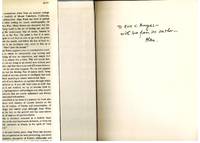
rif. 010568New York : Pantheon Books 1973. Book. Near Fine. Cloth. SIGNED AND INSCRIBED BY AUTHOR. 1st Edition. 8vo - over 7¾ - 9¾" tall. SIGNED AND INSCRIBED BY AUTHOR at front end page -" To Evie and Anyas with love from its author - Alan." A warm and personal inscription suggesting a close personal friendship. First Edition First Printing with Pantheon a division of Random House adopting the Random House First Edition statement with number row running from 2 to 9. Near Fine small scuffs bottom edge of page block sunning at edges of boards in a Near Fine dust jacket narrow 1/2" chip top edge rear panel. Laid in is a single page Bulletin from The Society for Comparative Philosophy Inc. announcing the death of Alan Watts. Watts was the founder and President of the SCP. Coffee cup stain to the bulletin. Alan Watts last book published in his lifetime SCARCE Signed. . Pantheon Books Hardcover
rif. 010568New York : Pantheon Books 1973. Book. Near Fine. Cloth. SIGNED AND INSCRIBED BY AUTHOR. 1st Edition. 8vo - over 7¾ - 9¾" tall. SIGNED AND INSCRIBED BY AUTHOR at front end page -" To Evie and Anyas with love from its author - Alan." A warm and personal inscription suggesting a close personal friendship. First Edition First Printing with Pantheon a division of Random House adopting the Random House First Edition statement with number row running from 2 to 9. Near Fine small scuffs bottom edge of page block sunning at edges of boards in a Near Fine dust jacket narrow 1/2" chip top edge rear panel. Laid in is a single page Bulletin from The Society for Comparative Philosophy Inc. announcing the death of Alan Watts. Watts was the founder and President of the SCP. Coffee cup stain to the bulletin. Alan Watts last book published in his lifetime SCARCE Signed. . Pantheon Books Hardcover books
1690rif. PHO-1696Paris, veuve de J.-B. Coignard, J.-B. Coignard, 1691. 2 volumes in-12, titre, 2 ff. n. c., -555 pp. ; 1 ff. n. c.., 404 pp, 2 ff. de tables in fine, relié plein veau époque, dos à nerfs orné légèrement différent, étiquette de titre au tome 1, coins et coiffes usés, petit travail de ver, 3 planches détachées au tome 1, page de titre courte, cachet. L'illustration comprend 37 planches (41). La première planche donnée dans la table du tome 1 est dans le texte, planches hors texte gravées par Ertinger, certaines dépliantes. Vignette aux armes du marquis de Torcy, à qui l'ouvrage est dédié. Les planches représentent des plantes, des costumes, des habitats, des instruments, de musique, des cartes … etc
2011rif. 87402HARPER, "HarperCollins Publishers India" | New Delhi 2011 | 14.50 x 22.50 cm | reliure de l'éditeur
1688rif. PHO-2582Paris, Claude Barbin, 1688. Un volume in-4°. Reliure de l’époque, plein veau havane, dos à nerfs orné de caissons de double filet doré fleuronnés, pièce de titre en maroquin, roulette dorée sur coupes, tranches mouchetées rouges, début de fente, des frottements, manque en queue, auréole en marge supérieure de quelques feuillets, petites taches au titre.
1982rif. 2090502124900426Rinsen Bookstore 1982. Soft Cover. Fine. The book is in fine condition. Rinsen Bookstore paperback
1985rif. 87407Snow lion publications | Ithaca (New-York) 1985 | 14.50 x 22.50 cm | broché
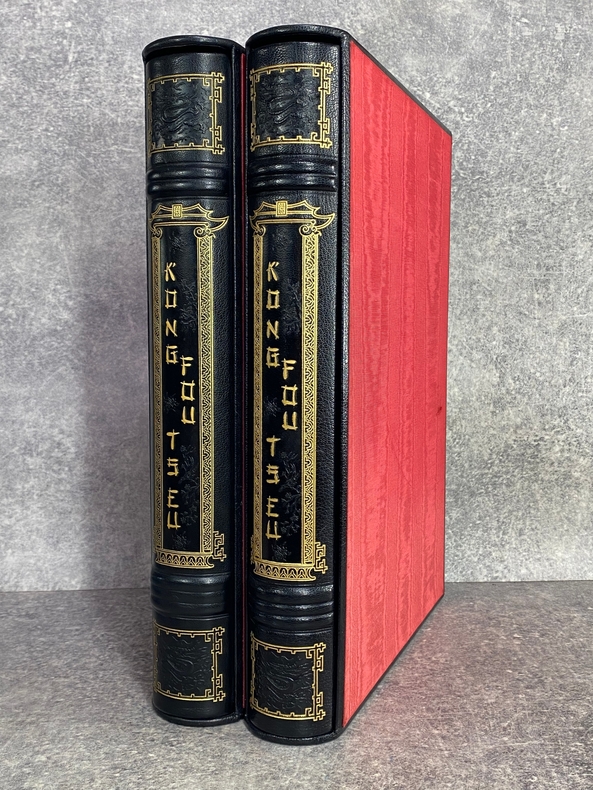
1988rif. 2816MONACO. EDITIONS ARTS ET COULEURS. 1988-1990. 2 VOLUMES IN-FOLIO (30 X 39,5 X 13 CENTIMETRES ENVIRON) DE 140 + (8) ET 134 + (8) PAGES, RELIURE DE L'EDITEUR PLEIN CHAGRIN NOIR, DOS A NERFS ORNE D'UN DECOR A FROID ET EN DORE, TITRE ET TETE DORES, PLATS BISEAUTES ORNES D'UN DECOR A FROID ET EN DORE, LETTRES CHINOISES METALLIQUES LAQUEES EN ROUGE AU CENTRE DES PLATS SUPERIEURS, DENTELLE INTERIEURE DOREE, GARDES DE SOIE MOIREE, NON ROGNES, SOUS ETUI BORDE DE L’EDITEUR RECOUVERT EGALEMENT DE SOIE MOIREE. ILLUSTRE DE NOMBREUSES COMPOSITIONS IN ET HORS-TEXTE, DANS LE STYLE DE L'ENLUMINURE, MISES EN COULEURS A LA MAIN. PREMIER TIRAGE LIMITE A 1280 EXEMPLAIRES NUMEROTES, DONT 30 HORS-COMMERCE, TOUS SUR VELIN D'ARCHES, CELUI-CI PORTANT LE NUMERO 818 ET ACCOMPAGNE DE SON CERTIFICAT D'AUTHENTICITE AU MEME NUMERO SIGNE PAR L'ARTISTE ET L'EDITEUR. TRES BEL EXEMPLAIRE.
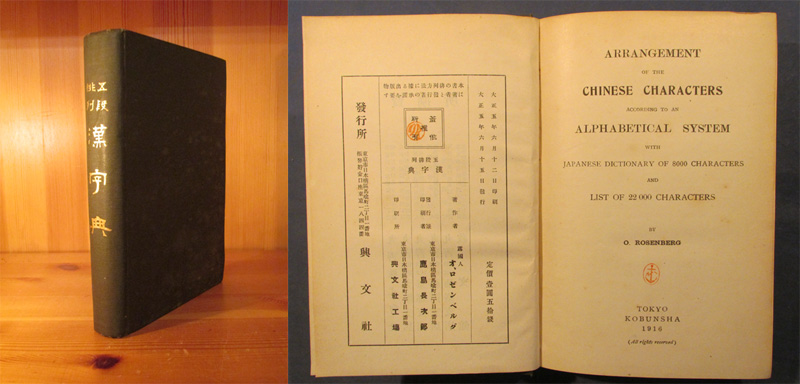
1916rif. SB-13568Tokyo, Kobunsha, 1916. 15, (546) pp. Green clothbound (original) volume with gold-embossed title along spine and blind-tooled publisher's mark on front. Illustrated endpaper with floral ornamentation. Famous study of Russian Orientalist, Sinologist and scholar of Japanese Studies Otto Julius Rosenberg (1888 - 1919) on a system of classification of Chinese characters. Rosenberg studied from 1906 to 1911 at the Institute of Oriental Studies of the University of St. Petersburg, lectured by, among others, the founder of the Russian school of Indology, Sergei Oldenburg (1863 - 1934). During a study stay in Bonn in 1909, Rosenberg befriended Hermann Jacobi (1850-1937), the greatest Indologist and Sanskrit scholar of that time. As part of an internship at the Department of Oriental Languages (SOS) at the Friedrich-Wilhelms-Universität two years later, he also befriended the German linguist and scholar of Japanese studies, Rudolf Lange (1850 - 1933). From 1912 to 1916 he studied Buddhist Literature and Tradition at the University of Tokyo. Here Rosenberg became acquainted with the then leading Buddhist Scholars of Japan. In the course of this stay, he explored the school of Zen Buddhism as one of the first Western scientists and also became an expert for Japanese and Chinese characters used in the writing of Chinese and Japanese. In 1924, his work "The problems of Buddhist philosophy" was published in German. Based on ideas of Russian Sinologist and Buddhologist Vasily Vasilyev (1818 - 1900), Rosenberg developed a method of classification of Chinese and Japanese characters. He published the results of his research in a dictionary which was published in English and Japanese and which formed the basis of the so-called "Four Corner Method", which is still employed today in the creation of Chinese and Japanese dictionaries. This volume is extremely rare and, according to the world's largest bibliographic database, WorldCat, it is only found in six libraries worldwide. The copy offered here was purchased from a Japanese private collection.
1988rif. 1163MONACO. EDITIONS ARTS ET COULEURS. 1988-1990. 2 VOLUMES IN-FOLIO (30 X 39,5 X 13 CENTIMETRES ENVIRON) DE 140 + (8) ET 134 + (8) PAGES, RELIURES DE L'EDITEUR PLEIN CHAGRIN NOIR ET PLEIN CHAGRIN ROUGE, DOS A NERFS ORNE D'UN DECOR A FROID ET EN DORE, TITRE DORE, PLATS BISEAUTES ORNES D'UN DECOR A FROID ET EN DORE, LETTRES CHINOISES METALLIQUES LAQUEES EN NOIR ET EN ROUGE AU CENTRE DES PLATS SUPERIEURS, DENTELLE INTERIEURE DOREE, TETE DOREE, NON ROGNES, SOUS ETUI BORDE DE L’EDITEUR RECOUVERT DE SOIE MOIREE. ILLUSTRE DE NOMBREUSES COMPOSITIONS IN ET HORS-TEXTE, DANS LE STYLE DE L'ENLUMINURE, MISES EN COULEURS A LA MAIN. PREMIER TIRAGE LIMITE A 1280 EXEMPLAIRES NUMEROTES, DONT 30 HORS-COMMERCE. UN DES 200 SUR VELIN D'ARCHES COMPORTANT UNE PLANCHE HORS-TEXTE, ENCADREE, ET UNE SUITE DU TRAIT EN LAQUE ROUGE DES ILLUSTRATIONS IN ET HORS-TEXTE, CELUI-CI PORTANT LE NUMERO 274 ET ACCOMPAGNE DE SON CERTIFICAT D'AUTHENTICITE AU MEME NUMERO SIGNE PAR L'ARTISTE ET L'EDITEUR. EXEMPLAIRE ENRICHI D'UN ENVOI AU CRAYON DE L'ILLUSTRATEUR : «HOMMAGE DE L'ARTISTE, J. GRADASSI». TRES BEL EXEMPLAIRE.
1686rif. PHO-1723Paris, Arnould Seneuze, Daniel Horthemels, 1686-1689, 2 vol. in-4 : 16ff.-424pp. 8ff., 8ff.-416pp.-5ff., illustré de 26 planches (20+6) dont certaines dépliantes ou à double pages, gravées par Cornelis Vermeulen, d'après les dessins de P. Sevin, relié plein veau chiné (légèrement différentes), dos à nerfs orné avec titre, frottements, manques en tête et en queue du tome I, coins du tome I émoussés, dos, mors et coins du tome II réparés, tache d'encre dans les marges inférieures des pp.305-307 du tome I, pl. p. 91 du tome I colorié à la main, déchirure au titre du tome II renforcé.
1988rif. 3789NICE. EDITIONS D'ART SEFER. LE CHANT DES SPHERES. MONACO. EDITIONS ARTS ET COULEURS. 1988-1990. 2 VOLUMES IN-FOLIO DE 140 + (8) ET 134 + (8) PAGES, RELIURE DE L'EDITEUR PLEIN CHAGRIN NOIR, DIFFERENTE POUR CHACUN DES 2 VOLUMES (SEFER RELIEUR) :TOME I. DOS A NERFS ORNE D'UN DECOR A FROID ET EN DORE, TITRE DORE, PLATS BISEAUTES ORNES D'UN DECOR A FROID ET EN DORE, LETTRES CHINOISES METALLIQUES LAQUEES EN NOIR ET EN ROUGE AU CENTRE DU PLAT SUPERIEUR, DENTELLE INTERIEURE DOREE, TETE DOREE, NON ROGNE, SOUS EMBOITAGE 1/2 CHAGRIN NOIR (34 X 42,5 X 8,5 CENTIMETRES ENVIRON), DOS IDENTIQUE A CELUI DE L'OUVRAGE, LE RESTE RECOUVERT D'UNE SOIE MOIREE ROUGE. TOME II. DOS ORNE D'UN CAISSON EN CREUX AVEC DECOR FLORAL ET TITRE DORES, PLATS BISEAUTES, PLAT SUPERIEUR RICHEMENT ORNE D'UNE PAGODE EN RELIEF EN ROUGE ET EN DORE, AVEC INCRUSTATIONS DE PLAQUES EMAILLEES A DECOR POLYCHROME D'UNE PAGODE ET DE DRAGONS, TETE DOREE, NON ROGNE, SOUS EMBOITAGE 1/2 CHAGRIN NOIR (33,5 X 40 X 9,5 CENTIMETRES ENVIRON), DOS IDENTIQUE A CELUI DE L'OUVRAGE, LE RESTE RECOUVERT D'UNE SOIE MOIREE ROUGE.ILLUSTRE DE NOMBREUSES COMPOSITIONS IN ET HORS-TEXTE, DANS LE STYLE DE L'ENLUMINURE, MISES EN COULEURS A LA MAIN. PREMIER TIRAGE LIMITE A 1280 EXEMPLAIRES NUMEROTES, DONT 30 HORS-COMMERCE. UN DES 100 SUR VELIN D'ARCHES RESERVES AU CERCLE DES BIBLIOPHILES ARTS ET COULEURS NUMEROTES AC 1 A AC 100, CELUI-CI PORTANT LE NUMERO AC 10 DANS CHACUN DES VOLUMES, ET COMPORTANT 2 ILLUSTRATIONS ORIGINALES SIGNEES, UNE PLANCHE HORS-TEXTE, ENCADREE ET UNE SUITE EN COULEURS DES ILLUSTRATIONS HORS-TEXTE. ACCOMPAGNE DE SON CERTIFICAT D'AUTHENTICITE AU MEME NUMERO SIGNE PAR L'ARTISTE ET L'EDITEUR. LES ILLUSTRATIONS ORIGINALES ET LA SUITE SONT INSEREES DANS DEUX CHEMISES RECOUVERTES DE SUEDINE NOIRE AVEC LE PLAT SUPERIEUR ORNE D'IDEOGRAMMES CHINOIS DORES. INFIMES PETITS DEFAUTS EXTERIEURS SANS GRAVITE, SINON TRES BEL EXEMPLAIRE.
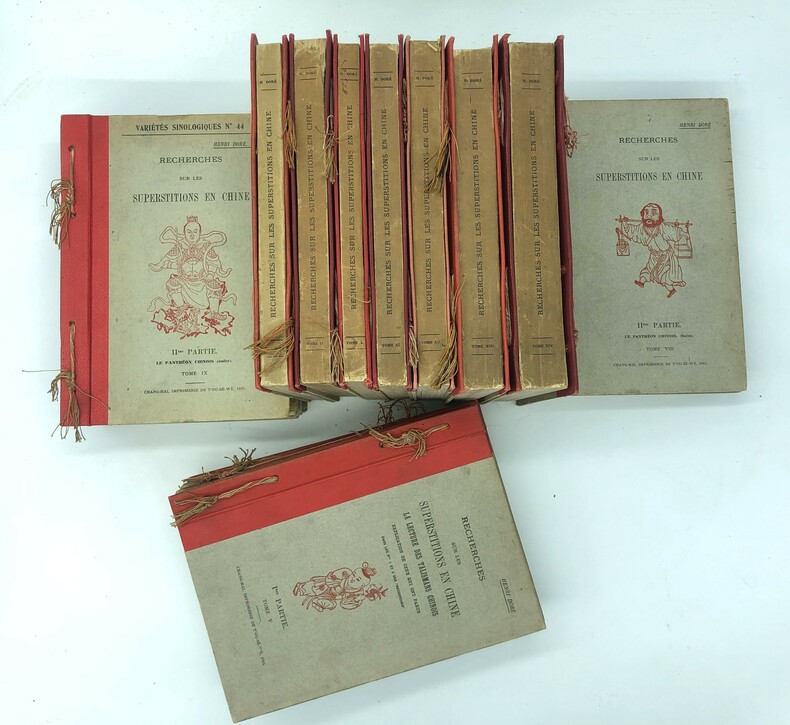
1911rif. PHO-73615 volumes, in-8 (235 x 160 mm)avec une profusion de planches souvent en couleur. Chaque volume est relié de style chinois: des blocs de texte soutenus par des doublures de dos imprimées, placés entre des planches imprimées avec des charnières en tissu rouge et cousus avec des faisceaux de fils à travers quatre trous percés à travers les charnières .
1988rif. 3444NICE. EDITIONS D'ART SEFER. LE CHANT DES SPHERES. MONACO. EDITIONS ARTS ET COULEURS. 1988-1990. 2 VOLUMES IN-FOLIO DE 140 + (8) ET 134 + (8) PAGES, DANS UNE MAGNIFIQUE RELIURE DE L'EDITEUR PLEIN CHAGRIN NOIR, DOS ORNE D'UN CAISSON EN CREUX AVEC DECOR FLORAL ET TITRE DORES, PLATS BISEAUTES, PLAT SUPERIEUR RICHEMENT ORNE D'UNE PAGODE EN RELIEF EN ROUGE ET EN DORE, AVEC INCRUSTATIONS DE PLAQUES EMAILLEES A DECOR POLYCHROME D'UNE PAGODE ET DE DRAGONS, TETE DOREE, NON ROGNES, SOUS EMBOITAGES 1/2 CHAGRIN NOIR (33,5 X 39,5 X 18,5 CENTIMETRES ENVIRON), DOS IDENTIQUES A CELUI DE L'OUVRAGE, LE RESTE RECOUVERT D'UNE SOIE MOIREE ROUGE (SEFER RELIEUR). ILLUSTRE DE NOMBREUSES COMPOSITIONS IN ET HORS-TEXTE, DANS LE STYLE DE L'ENLUMINURE, MISES EN COULEURS A LA MAIN. PREMIER TIRAGE LIMITE A 1280 EXEMPLAIRES NUMEROTES, DONT 30 HORS-COMMERCE. UN DES 150 SUR VELIN D'ARCHES COMPORTANT 2 ILLUSTRATIONS ORIGINALES SIGNEES, UNE PLANCHE HORS-TEXTE, ENCADREE ET UNE SUITE DU TRAIT EN LAQUE ROUGE DES ILLUSTRATIONS IN ET HORS-TEXTE, CELUI-CI PORTANT LE NUMERO 149 ET ACCOMPAGNE DE SON CERTIFICAT D'AUTHENTICITE AU MEME NUMERO SIGNE PAR L'ARTISTE ET L'EDITEUR. LES ILLUSTRATIONS ORIGINALES ET LA SUITE SONT INSEREES DANS UNE CHEMISE RECOUVERTE DE SUEDINE NOIRE AVEC LE PLAT SUPERIEUR ORNE D'IDEOGRAMMES CHINOIS DORES. INFIMES PETITS DEFAUTS EXTERIEURS SANS AUCUNE GRAVITE, SINON SUPERBE EXEMPLAIRE.
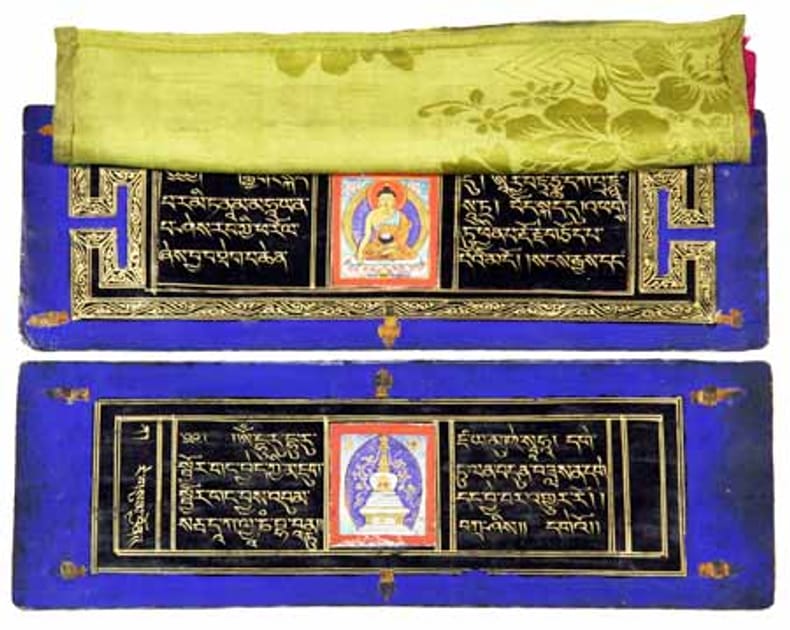
rif. 83817aafTibet, s.d., (vers 1800), 26 x 8.5 cm, 62 (von 63 ?) doppelseitig beschriftete lose Blätter mit Goldschrift auf schwarzem Grund u. dunkelblauer/schwarzer Umrandung, davon 3 Blätter illuminiert (Deckblatt mit 3 verschiedenfarbenen Seidenvorhängen zeigt in der Mitte Shakyamuni, Blatt 2 Subhuti, Blatt 3 einen Stupa), guter Zustand.
1976rif. 43497San Francisco CA Buddhist Text Translation Society 1976. Paperback First Edition First Printing so stated. First Edition First Printing so stated. Very Near Fine in Wraps: shows only the most minute indications of use: just a hint of rubbing and the faintest toning to the white background field of the wrapper covers; there is a small very faint thumb smudge at the fore-edge; faint foxing at the top edge. The Binding shows barely discernible lean while remaining perfectly secure; the text is clean. Very close to 'As New'. NOT a Remainder Book-Club or Ex-Library. 8vo. 339pp. Primary Translation by Bhikshuni Heng Yin and reviewed by Bhikshuni Heng Ch'ih. Edited by Bhikshu Heng Kuan and Upasaka Kuo Chou Rounds. Trade Paperback. Buddhist Text Translation Society, paperback
rif. 190864Nara: late 13th century. A superb example of 13th-century printing A well-preserved example of early temple printing in Japan inscribed by Tachibana Otome a daughter of the influential Tachibana family. This type of scroll was printed between the 12th and 14th centuries and this example has the thick bold strokes typical of the process. "Kasuga-ban" scrolls refer to woodblock printed sutras originating in the early-mid Kamakura period. The first examples were produced at Kofuku-ji temple and all contained the word "Kasuga" the patron deity of the temple in their colophons. However over time "the term Kasuga-ban became used more loosely in a wider sense to denote publications of the Nara monasteries in general not only of the Kofuku-ji. The printing of Kasuga-ban in this broader sense flourished throughout the Kamakura period and up to the end of Muromachi ca. 1570" Gardner p. 159. This example was printed using blocks first cut at Kofuku-ji in the Karoku period 1222-1227 sometimes referred to as the "Karoku-ban" set. The inscription at the end of the scroll reveals that it was commissioned by Tachibana Otome. We have traced two other complete chapters with the same inscription held at the National Museum of Japanese History and Tsurumi University Library which were commissioned in approximately 1285. The Tachibana was one of the four noble houses that held the most sway in the Nara and Heian periods although they were eclipsed by the Fujiwara family in the 10th century and scattered across the country. Handscroll 261 mm wide unravelling to 850 cm 19 conjoined text sheets on yellow Japanese paper each approximately 265 x 43 cm contemporary wooden rod dowel and endsheet. Lacking cord. With 17 characters per line; text in Chinese occasional punctuation in red. Manuscript paper labels on endsheet recto. Wrapped in modern cloth and housed in modern wooden box. Signs of age as expected some light staining on endsheet verso worm-holing along top edge especially on sheets 9 and 10 but rarely encroaching on text: a very good example. K. B. Gardner "Centres of Printing in Medieval Japan: late Heian to early Edo period" British Library Occasional Papers 11. Japanese Studies 1990. hardcover
rif. 190967Japan: c. 11-12th century. Spreading the word of the Buddha in the 12th century An early Japanese manuscript of one of the core texts of Mahayana Buddhism. This example was brushed in mid-late Heian period during a period of religious fervour brought on by fears of a coming dark age. The approximate age of the manuscript can be pinpointed by the scented paper and more free-flowing calligraphic style compared to older Chinese models. In the late Heian period fear of the mappo dark age led wealthy temple donors and patrons to invest in increasingly extravagant gifts. In Buddhist cosmic history the death of the Buddha would be followed by three ages: the "true law" shobo the "copied law" zobo and the "degeneration of the law" mappo the latter of which would only be fixed by the future incarnation of the boddhisatva Maitreya Miroku in Japanese. Japanese buddhists calculated the final age to being in approximately 1052 AD leading the rise of many new sects such as True Land and Nichiren Buddhism. Sutras were naturally a popular option for wealthy temple donors and texts such as the Great Sutra of the Perfection of Wisdom were copied in great quantities. During this time handwriting styles became softer and smoother developing a distinctly Japanese style that would give rise to the hiragana alphabet. The Great Sutra of the Perfection of Wisdom Sanskrit: Mahaprajnaparamita sutra is a 600-volume collection of 16 different sutras including the Diamond Sutra each traditionally believed to represent teachings conveyed by the Buddha to a different assembly of followers. The sutra expands on the idea that the path to finding one's true self lies in detachment from the vanity of everything. The collection was first translated into Chinese by the Tang dynasty monk Xuanzang 602-664 and subsequently introduced into Japan. Handscroll 246 mm wide unravelling to 7267 mm 19 conjoined text sheets on yellow Japanese paper each approximately 246 x 390 mm contemporary wooden rod dowel and endsheet recent orange cloth cord paper infused with camphor perfume. With 17 characters per line pale ink guidelines; text in Chinese. Housed in recent cypress box and brown card sleeve. Worn and creased worm-holing along edges sometime heavily repaired on verso with Japanese paper one line on sheet 1 repaired with old paper and a few characters retouched in manuscript: a very good example. hardcover