2 580 résultats
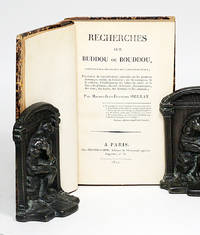
1817réf. 2238Paris: Chez Brunot-Labbe 1817. First edition. contemporary morocco over marbled boards. Very Good. EXTREMELY RARE FIRST EDITION OF THE FIRST WESTERN BOOK ON BUDDHISM. "Although the Western encounter with Asia's largest religion may be the vastest and most consequential spiritual encounter in human history its protagonists and historical development are still barely known. Thus it comes as no surprise that even specialists have hitherto failed to appreciate the earliest Western book about Buddhism: Michel-Jean-François Ozeray's Recherches sur Buddou ou Bouddou instituteur religieux de l'Asie orientale Paris 1817. ". Ozeray's book represents a landmark in the history of the Western discovery of Buddhism. Published three years after the establishment of Europe's first academic chairs for indology and sinology and just before the organized academic study of Buddhist texts began Ozeray's reliance on images and reports by embassies and European residents in Asian countries rather than missionary literature marks a watershed as does the author's firm advocacy of a single historical founder his unwillingness to engage in etymological and mythological flights of fancy and his insistence on Buddhism's status as the largest of all religions of the Orient or even of the entire world. Though the book did not reach a large pan-European readership it was read by intellectuals interested in Buddhism such as the philosopher Arthur Schopenhauer Europe's first professor of Sinology Abel-Rémusat and the linguist Julius Klaproth. Klaproth and Abel-Rémusat were around the time of publication expressing increasing interest in Buddhism and its history. Both were involved in the birth of France's earliest Orientalist journal the Journal Asiatique which from the early 1820s became one of Europe's most important sources of information about Buddhism. Ozeray's book thus stands near the end of the mythological speculation period and near the beginning of organized research on Asia's greatest religion" Urs App The First Western Book on Buddhism and Buddha. Paris: Chez Brunot-Labbe 1817. Octavo contemporary half-morocco marbled boards and endpapers. Complete with half-title. Some scuffing to binding small closed tear to half-title. Text in outstanding condition with large margins. SCARCE. Chez Brunot-Labbe unknown books
1817réf. 2238Paris: Chez Brunot-Labbe 1817. First edition. contemporary morocco over marbled boards. Very Good. EXTREMELY RARE FIRST EDITION OF THE FIRST WESTERN BOOK ON BUDDHISM. "Although the Western encounter with Asia's largest religion may be the vastest and most consequential spiritual encounter in human history its protagonists and historical development are still barely known. Thus it comes as no surprise that even specialists have hitherto failed to appreciate the earliest Western book about Buddhism: Michel-Jean-François Ozeray's Recherches sur Buddou ou Bouddou instituteur religieux de l'Asie orientale Paris 1817. ". Ozeray's book represents a landmark in the history of the Western discovery of Buddhism. Published three years after the establishment of Europe's first academic chairs for indology and sinology and just before the organized academic study of Buddhist texts began Ozeray's reliance on images and reports by embassies and European residents in Asian countries rather than missionary literature marks a watershed as does the author's firm advocacy of a single historical founder his unwillingness to engage in etymological and mythological flights of fancy and his insistence on Buddhism's status as the largest of all religions of the Orient or even of the entire world. Though the book did not reach a large pan-European readership it was read by intellectuals interested in Buddhism such as the philosopher Arthur Schopenhauer Europe's first professor of Sinology Abel-Rémusat and the linguist Julius Klaproth. Klaproth and Abel-Rémusat were around the time of publication expressing increasing interest in Buddhism and its history. Both were involved in the birth of France's earliest Orientalist journal the Journal Asiatique which from the early 1820s became one of Europe's most important sources of information about Buddhism. Ozeray's book thus stands near the end of the mythological speculation period and near the beginning of organized research on Asia's greatest religion" Urs App The First Western Book on Buddhism and Buddha. Paris: Chez Brunot-Labbe 1817. Octavo contemporary half-morocco marbled boards and endpapers. Complete with half-title. Some scuffing to binding small closed tear to half-title. Text in outstanding condition with large margins. SCARCE. Chez Brunot-Labbe unknown
réf. 84051aafTibet / Mongolei, 19. Jhd, verschiedene Grössen, 49 Miniaturen, Gouache auf Leinwand, unter insgesamt 28 Passepartouts (meist leinenbezogen, in Blau u. Grün) gerahmt, bei kleinformatigen (ca. 8x6 cm) Miniaturen je 2 übereinander gerahmt, guter Zustand. some waterstanes to some of the plates.
réf. 191103Kawachi Province: c. 12th century. The dharma burns An exceptional example of late Heian-period sutra production bearing the telltale burn marks from when flames engulfed the temple where it was stored. "The accidental incineration is a reminder of the transience of all material phenomena and fragments. are cherished by collectors and connoisseurs of calligraphy" Carpenter p. 20. Only the lower margin was damaged; the manuscript is untouched. This fragment is from Volume 35 of a 60-volume Flower Ornament Sutra thought to have been held in Senpuku-ji in Kawachi province now Osaka Prefecture. This temple burned down sometime in the Edo period although no concrete records of this event survive and since then the remains of its manuscripts have entered the market. The majority of these fragments are only a couple of lines in length and suffer extensive fire damage encroaching onto the text itself whereas this example is both long and barely touched by flames. The only fragment comparable to this one in length and condition in the West is held at the Metropolitan Museum of Art 2024.412.1. Others are held at the National Museum of Asian Art F2014.6.4 Waseda University Keio University the Naritasan Museum of Calligraphy and the Tokyo National Museum. In the late Heian period the idea of "one character one Buddha" began to become prominent wherein every individual character of a piece of scripture was viewed as a manifestation of the Buddha and should be treated accordingly. As such high-quality sutras on dyed papers became popular as expressions of devotion. We have traced one other fragment at a Western auction Christies 22 March 2022 Japanese and Korean Art Including the Collection of David and Nayda Utterberg Lot 1. Single sheet of pale indigo-dyed paper flecked with gold 246 x 377 mm gold manuscript guidelines 21 columns 17 characters per column 2 contemporary manuscript corrections; text in Chinese. Mounted on 20th-century orange patterned cloth hanging scroll 1094 x 566 mm green cloth backing ribbed orange cloth inner mount manuscript framed with green-and-gilt-patterned cloth infused with camphor perfume wooden brackets upper bracket covered with green cloth lower bracket capped with foliate-engraved metal two decorative green and gilt cloth hanging cords white and black thread hanging. With 5 burn marks in lower margin each approximately 10 x 40 mm. Lower bracket protected with modern cypress hinged tube. Housed in modern cypress box and black lacquered wood box with purple ties. Outer box with recent manuscript paper label. Fragment in exceptional condition green cloth backing rubbed copper mounts slightly tarnished. John Carpenter The Three Perfections Japanese Poetry Calligraphy and Painting 2025. hardcover
1501réf. 192527Japan: 1150-1185. Commissioned by the emperor in the late 12th century A bright and shining example of a late-Heian period sutra stored for 800 years in Jingoji Temple Kyoto. The complete set was commissioned by Emperors Toba and Go Shirakawa from 1150 to 1185 exemplifying the highest standard of craftsmanship available at the time. Other examples have been named Important Cultural Properties in Japan. The Jingoji Tripitaka refers to a set of approximately 5390 scrolls written in gold on indigo-dyed paper; a complete canon of Buddhist scripture. According to the Jingoji ryakuki "Records of Jingoji" the project was started by Emperor Toba and completed by his successor Go Shirakawa over 35 years. The Jingoji Tripitaka scrolls can be identified by three main features: the foliate hosoge design on the cover the frontispiece showing the Buddha teaching at the foot of Vulture Mountain his preferred location to give sermons and the red seal of Jingoji Temple found on the first text sheet. Of the approximately 5390 scrolls currently 2317 reside in the temple. The remainder were sold over the 19th century to finance repairs and the majority of those are now untraced. In the West examples are found in many of the principal art museums such as the Art Institute of Chicago British Museum Cincinnati Art Museum Detroit Institute of Arts Harvard University Metropolitan Museum of Art and Smithsonian Institution. Jujuritsu ch. Shisong lu Taisho 1435 Nanjio 1135 is a collection of vinayas monastic rules and precepts dating from the fifth century. It was the first Vinaya text to be translated into Chinese and "introduced standardized terminology that significantly influenced subsequent translations of Vinaya texts and profoundly impacted Chinese Buddhism during the Six Dynasties period" Chi p. 1. These precepts governed adherents' daily lives eating habits personal possessions and interpersonal relations laying the groundwork for Buddhist ethics. Handscroll 295 x 55 mm unravelling to 12635 mm 23 conjoined text sheets each approximately 530 mm opening sheet with gilt frontispiece illustration of the Buddha teaching at foot of Vulture Mountain first text sheet with red stamp of Jingoji Temple final sheet blank with silver guidelines only. Manuscript in gilt 17 characters per column silver ink guidelines; text in Chinese. Contemporary indigo-dyed paper cover decorated with feather patterns in gilt manuscript title in gilt wooden rod with contemporary copper ends engraved with foliate pattern wooden dowel lacking cord. Housed in 20th-century cypress wood box. Twentieth-century manuscript lettering and shelf label on box. Manuscript bright frontispiece unfaded minor worm-holing at margins and occasionally in text repaired in some cases: a stunning example. Limei Chi "The Transmission and Textual Transformation of the Shisong lü from the 6th to 13th Centuries" Religions vol. 15 no. 1057 2024. unknown