3.030 Ergebnisse
Best.-Nr. 84051aafTibet / Mongolei, 19. Jhd, verschiedene Grössen, 49 Miniaturen, Gouache auf Leinwand, unter insgesamt 28 Passepartouts (meist leinenbezogen, in Blau u. Grün) gerahmt, bei kleinformatigen (ca. 8x6 cm) Miniaturen je 2 übereinander gerahmt, guter Zustand. some waterstanes to some of the plates.
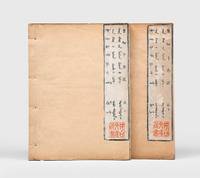
1774Best.-Nr. 159690Likely Beijing: no stated publisher 1774. One polity many languages First edition of this unusual quintilingual work exhibiting the artistic skill of Chinese woodblock carvers. Compiled by the personal Buddhist tutor to the Qianlong emperor - China's Louis XIV - it lists slightly over 1000 buddhas destined to appear in the present Buddhist aeon. We have traced just three institutional copies. Print was a vital vehicle for spreading Buddhist thought throughout the multicultural Qing empire. This compilation based on the Bhadrakalpa Sutra served as an invaluable scholarly and devotional reference for practising and aspiring Buddhists as well as for those charged with producing religious commentaries. It begins with Kakusandha an esteemed buddha of antiquity and lists four names per page with the five different languages Chinese Manchu Mongolian Tibetan and Sanskrit phoneticized in Tibetan arranged vertically. The compilation process was led by the senior court figure Changkya Rölpé Dorjé 1717-1786 Qianlong's principal Buddhist advisor who also oversaw the translation of the Tibetan Buddhist canon into Mongolian and Manchu. The Bhadrakalpa Sutra is a key text in Mahayana Buddhism. Without it the names of many buddhas would otherwise have been lost. The text was first translated into Chinese by Dharmaraska c.233-310 one of the most significant scholarly influences on the growth of Buddhism in East Asia. China's Qing emperors presided over an ethnically heterogeneous empire which continued to expand in the early 18th century with the conquest of Tibet in 1720. Buddhism enjoyed significant state support; for example Qianlong 1735-1796 commissioned paintings depicting him in the form of a Buddhist in an advanced stage of enlightenment. Provenance: several ownership seals of Taijun Inokuchi 1922-2018 a leading Japanese scholar of Buddhism at Kyoto's Ryukoku University with his manuscript cataloguing notes on a sheet of personalized notepaper affixed to the lower flap of the folding case. In 1989 he published a preliminary catalogue of the famous manuscripts unearthed by Paul Pelliot at Dunhuang now housed in the Bibliothèque Nationale de France which have revolutionized scholarly understanding of Buddhism. Volume I contains in-text numerical annotations in red pencil most likely by Inokuchi. This copy then passed to a private collector in the UK. Copies can be found in the Library of Congress Harvard and the Austrian National Library. 2 vols quarto 270 x 200 mm. Original brown paper wrappers recently renewed xianzhuang stitching front covers with original quadrilingual xylographic title labels. Housed in 19th-century custom blue cloth folding case bone toggles. Wrappers with some chips and nicks as well as a few small closed tears one sometime repaired by pasting vol. II front wrapper to first blank at head moderate foxing and browning internally. A very good copy in the like case. hardcover
Best.-Nr. 191103Kawachi Province: c. 12th century. The dharma burns An exceptional example of late Heian-period sutra production bearing the telltale burn marks from when flames engulfed the temple where it was stored. "The accidental incineration is a reminder of the transience of all material phenomena and fragments. are cherished by collectors and connoisseurs of calligraphy" Carpenter p. 20. Only the lower margin was damaged; the manuscript is untouched. This fragment is from Volume 35 of a 60-volume Flower Ornament Sutra thought to have been held in Senpuku-ji in Kawachi province now Osaka Prefecture. This temple burned down sometime in the Edo period although no concrete records of this event survive and since then the remains of its manuscripts have entered the market. The majority of these fragments are only a couple of lines in length and suffer extensive fire damage encroaching onto the text itself whereas this example is both long and barely touched by flames. The only fragment comparable to this one in length and condition in the West is held at the Metropolitan Museum of Art 2024.412.1. Others are held at the National Museum of Asian Art F2014.6.4 Waseda University Keio University the Naritasan Museum of Calligraphy and the Tokyo National Museum. In the late Heian period the idea of "one character one Buddha" began to become prominent wherein every individual character of a piece of scripture was viewed as a manifestation of the Buddha and should be treated accordingly. As such high-quality sutras on dyed papers became popular as expressions of devotion. We have traced one other fragment at a Western auction Christies 22 March 2022 Japanese and Korean Art Including the Collection of David and Nayda Utterberg Lot 1. Single sheet of pale indigo-dyed paper flecked with gold 246 x 377 mm gold manuscript guidelines 21 columns 17 characters per column 2 contemporary manuscript corrections; text in Chinese. Mounted on 20th-century orange patterned cloth hanging scroll 1094 x 566 mm green cloth backing ribbed orange cloth inner mount manuscript framed with green-and-gilt-patterned cloth infused with camphor perfume wooden brackets upper bracket covered with green cloth lower bracket capped with foliate-engraved metal two decorative green and gilt cloth hanging cords white and black thread hanging. With 5 burn marks in lower margin each approximately 10 x 40 mm. Lower bracket protected with modern cypress hinged tube. Housed in modern cypress box and black lacquered wood box with purple ties. Outer box with recent manuscript paper label. Fragment in exceptional condition green cloth backing rubbed copper mounts slightly tarnished. John Carpenter The Three Perfections Japanese Poetry Calligraphy and Painting 2025. hardcover
1501Best.-Nr. 192527Japan: 1150-1185. Commissioned by the emperor in the late 12th century A bright and shining example of a late-Heian period sutra stored for 800 years in Jingoji Temple Kyoto. The complete set was commissioned by Emperors Toba and Go Shirakawa from 1150 to 1185 exemplifying the highest standard of craftsmanship available at the time. Other examples have been named Important Cultural Properties in Japan. The Jingoji Tripitaka refers to a set of approximately 5390 scrolls written in gold on indigo-dyed paper; a complete canon of Buddhist scripture. According to the Jingoji ryakuki "Records of Jingoji" the project was started by Emperor Toba and completed by his successor Go Shirakawa over 35 years. The Jingoji Tripitaka scrolls can be identified by three main features: the foliate hosoge design on the cover the frontispiece showing the Buddha teaching at the foot of Vulture Mountain his preferred location to give sermons and the red seal of Jingoji Temple found on the first text sheet. Of the approximately 5390 scrolls currently 2317 reside in the temple. The remainder were sold over the 19th century to finance repairs and the majority of those are now untraced. In the West examples are found in many of the principal art museums such as the Art Institute of Chicago British Museum Cincinnati Art Museum Detroit Institute of Arts Harvard University Metropolitan Museum of Art and Smithsonian Institution. Jujuritsu ch. Shisong lu Taisho 1435 Nanjio 1135 is a collection of vinayas monastic rules and precepts dating from the fifth century. It was the first Vinaya text to be translated into Chinese and "introduced standardized terminology that significantly influenced subsequent translations of Vinaya texts and profoundly impacted Chinese Buddhism during the Six Dynasties period" Chi p. 1. These precepts governed adherents' daily lives eating habits personal possessions and interpersonal relations laying the groundwork for Buddhist ethics. Handscroll 295 x 55 mm unravelling to 12635 mm 23 conjoined text sheets each approximately 530 mm opening sheet with gilt frontispiece illustration of the Buddha teaching at foot of Vulture Mountain first text sheet with red stamp of Jingoji Temple final sheet blank with silver guidelines only. Manuscript in gilt 17 characters per column silver ink guidelines; text in Chinese. Contemporary indigo-dyed paper cover decorated with feather patterns in gilt manuscript title in gilt wooden rod with contemporary copper ends engraved with foliate pattern wooden dowel lacking cord. Housed in 20th-century cypress wood box. Twentieth-century manuscript lettering and shelf label on box. Manuscript bright frontispiece unfaded minor worm-holing at margins and occasionally in text repaired in some cases: a stunning example. Limei Chi "The Transmission and Textual Transformation of the Shisong lü from the 6th to 13th Centuries" Religions vol. 15 no. 1057 2024. unknown
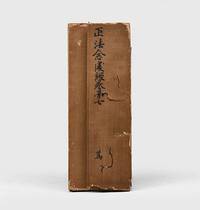
Best.-Nr. 159500Huzhou: c. 1250. Printed almost 800 years ago A surviving fascicle from a famous early Chinese edition of the Buddhist canon printed during the Song dynasty at the Yuanjue later Zifu temple in Huzhou. The respect given to Buddhist texts has ensured the institutional survival of a couple of near-complete Yuanjue sets but any examples of Chinese printing of this age are exceptionally scarce in commerce. We have traced only three works on paper printed before 1300 in Western auctions since 1980. Multiple characteristics suggest that this particular example is from the Yuanjue edition. Phonetic glosses at the end the size of the printed area and the number of pages columns and characters per sheet are consistent with other examples. The first sheet also gives the name of the block carver as Shi Hong. A carver of the same name was active in the Huzhou region during the Southern Song period and was involved in other projects including editions of the Shuijing zhu an ancient geographical treatise and the Lotus Sutra. Carving of the blocks for the Yuanjue edition commenced at some point between the 1110s and 1140s. The blocks were used to print copies until being burned by Mongol invaders in 1276. Subsequently this edition was unknown in China until the bibliophile Yang Shoujing 1839-1915 brought an almost complete set back from Japan in the late 19th century. Li & He write that surviving volumes from the Yuanjue edition "are already very rare in China". Near-complete copies are held at the National Library of China and Tokyo's Sanenzan Zojo Temple. Scattered volumes are found in other institutions including the Gansu Provincial Library the National Palace Museum in Taipei and several other temples in Japan. Slim quarto concertina-style 305 x 115 mm. With 17 xylographic sheets each with 5 pages of 6 columns of 17 characters joined sequentially with adhesive near-contemporary semi-stiff brown paper wallet binding strengthened with bamboo rod front cover with manuscript title in Chinese single page from another sutra used as binder's waste on rear cover verso. Housed in custom blue cloth folding case. Wallet binding fragile with losses rear cover detached and front cover just holding at head worming and splits to first leaf with old paper repair along one fold contents otherwise unaffected. A well-preserved example. Li Fuhua & He Mei Hanwen Fojiao dazangjing yanjiu "Research on the Chinese Buddhist Canon" 2003. hardcover