3.456 Ergebnisse
1927Best.-Nr. 23734BBHeidelberg, Carl Winters Universitätsbuchhandlung, 1927. VII, 93 Seiten. kart. Buchrücken u. Kanten etwas gebräunt, ans. guter, altersgem. Zustand.
1921Best.-Nr. 1263712München, O. Schloss, 1921. Gr.-8vo. 2 Bl., 387, (3) S., 6 Taf. OPpbd (lichtrandig, Papier gebräunt).
1913Best.-Nr. 1512529Leipzig, 1913. Gr.-8vo. 8, 76 S., 1 Bl. Br.
1916Best.-Nr. 1158832Leipzig Berlin, Reichsdruckerei, 1916. 1 Bl., 77 S. Br. (angestaubt).
1960Best.-Nr. 1083408Heidelberg, 1960. 186 S. Br.
1942Best.-Nr. 1313304München, Verlag der Bayerischen Akademie der Wissenschaften, 1942. 46 S., 1 Bl. (Bayerische Akademie der Wiss., Phil.-hist. Klasse, Sitzungsberichte 1942/8). OBr. (Stempel a. Titel, unaufgeschnitten).
1929Best.-Nr. 1267812Gotha, Klotz, 1929. 4to. 8, 52 S., 68 fotogr. Taf., 2 Bl. OKart. (Kapitale m. kl. Fehlstellen, Buchblock gelockert u. eselsohrig, Tafeln durch Nässewirkung am Innensteg aneinander haftend, teils m. Rasurspuren, Einrissen u. Fehlstellen, jedoch nur mit geringen Beeinträchtigungen der Abb.).
1919Best.-Nr. 10341621919. Gr.-8vo. 91, (1) S., 29 Taf. OPp. (Rücken fehlt).
1957Best.-Nr. 1018524(1957). 317, (1) S., 1 Bl. m. 1 ganzs. Karte. OLwd.
1923Best.-Nr. 1193331(Berlin-)Zehlendorf, Neubuddhist. Vlg, 1923. 1 Bl., 353, (1) S., 1 Bl. Neuer Lwdbd mit aufgezogenem OUmschl.
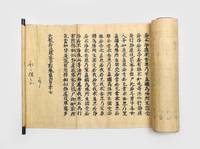
Best.-Nr. 190864Nara: late 13th century. A superb example of 13th-century printing A well-preserved example of early temple printing in Japan inscribed by Tachibana Otome a daughter of the influential Tachibana family. This type of scroll was printed between the 12th and 14th centuries and this example has the thick bold strokes typical of the process. "Kasuga-ban" scrolls refer to woodblock printed sutras originating in the early-mid Kamakura period. The first examples were produced at Kofuku-ji temple and all contained the word "Kasuga" the patron deity of the temple in their colophons. However over time "the term Kasuga-ban became used more loosely in a wider sense to denote publications of the Nara monasteries in general not only of the Kofuku-ji. The printing of Kasuga-ban in this broader sense flourished throughout the Kamakura period and up to the end of Muromachi ca. 1570" Gardner p. 159. This example was printed using blocks first cut at Kofuku-ji in the Karoku period 1222-1227 sometimes referred to as the "Karoku-ban" set. The inscription at the end of the scroll reveals that it was commissioned by Tachibana Otome. We have traced two other complete chapters with the same inscription held at the National Museum of Japanese History and Tsurumi University Library which were commissioned in approximately 1285. The Tachibana was one of the four noble houses that held the most sway in the Nara and Heian periods although they were eclipsed by the Fujiwara family in the 10th century and scattered across the country. Handscroll 261 mm wide unravelling to 850 cm 19 conjoined text sheets on yellow Japanese paper each approximately 265 x 43 cm contemporary wooden rod dowel and endsheet. Lacking cord. With 17 characters per line; text in Chinese occasional punctuation in red. Manuscript paper labels on endsheet recto. Wrapped in modern cloth and housed in modern wooden box. Signs of age as expected some light staining on endsheet verso worm-holing along top edge especially on sheets 9 and 10 but rarely encroaching on text: a very good example. K. B. Gardner "Centres of Printing in Medieval Japan: late Heian to early Edo period" British Library Occasional Papers 11. Japanese Studies 1990. hardcover
Best.-Nr. 191103Kawachi Province: c. 12th century. The dharma burns An exceptional example of late Heian-period sutra production bearing the telltale burn marks from when flames engulfed the temple where it was stored. "The accidental incineration is a reminder of the transience of all material phenomena and fragments. are cherished by collectors and connoisseurs of calligraphy" Carpenter p. 20. Only the lower margin was damaged; the manuscript is untouched. This fragment is from Volume 35 of a 60-volume Flower Ornament Sutra thought to have been held in Senpuku-ji in Kawachi province now Osaka Prefecture. This temple burned down sometime in the Edo period although no concrete records of this event survive and since then the remains of its manuscripts have entered the market. The majority of these fragments are only a couple of lines in length and suffer extensive fire damage encroaching onto the text itself whereas this example is both long and barely touched by flames. The only fragment comparable to this one in length and condition in the West is held at the Metropolitan Museum of Art 2024.412.1. Others are held at the National Museum of Asian Art F2014.6.4 Waseda University Keio University the Naritasan Museum of Calligraphy and the Tokyo National Museum. In the late Heian period the idea of "one character one Buddha" began to become prominent wherein every individual character of a piece of scripture was viewed as a manifestation of the Buddha and should be treated accordingly. As such high-quality sutras on dyed papers became popular as expressions of devotion. We have traced one other fragment at a Western auction Christies 22 March 2022 Japanese and Korean Art Including the Collection of David and Nayda Utterberg Lot 1. Single sheet of pale indigo-dyed paper flecked with gold 246 x 377 mm gold manuscript guidelines 21 columns 17 characters per column 2 contemporary manuscript corrections; text in Chinese. Mounted on 20th-century orange patterned cloth hanging scroll 1094 x 566 mm green cloth backing ribbed orange cloth inner mount manuscript framed with green-and-gilt-patterned cloth infused with camphor perfume wooden brackets upper bracket covered with green cloth lower bracket capped with foliate-engraved metal two decorative green and gilt cloth hanging cords white and black thread hanging. With 5 burn marks in lower margin each approximately 10 x 40 mm. Lower bracket protected with modern cypress hinged tube. Housed in modern cypress box and black lacquered wood box with purple ties. Outer box with recent manuscript paper label. Fragment in exceptional condition green cloth backing rubbed copper mounts slightly tarnished. John Carpenter The Three Perfections Japanese Poetry Calligraphy and Painting 2025. hardcover
1501Best.-Nr. 192527Japan: 1150-1185. Commissioned by the emperor in the late 12th century A bright and shining example of a late-Heian period sutra stored for 800 years in Jingoji Temple Kyoto. The complete set was commissioned by Emperors Toba and Go Shirakawa from 1150 to 1185 exemplifying the highest standard of craftsmanship available at the time. Other examples have been named Important Cultural Properties in Japan. The Jingoji Tripitaka refers to a set of approximately 5390 scrolls written in gold on indigo-dyed paper; a complete canon of Buddhist scripture. According to the Jingoji ryakuki "Records of Jingoji" the project was started by Emperor Toba and completed by his successor Go Shirakawa over 35 years. The Jingoji Tripitaka scrolls can be identified by three main features: the foliate hosoge design on the cover the frontispiece showing the Buddha teaching at the foot of Vulture Mountain his preferred location to give sermons and the red seal of Jingoji Temple found on the first text sheet. Of the approximately 5390 scrolls currently 2317 reside in the temple. The remainder were sold over the 19th century to finance repairs and the majority of those are now untraced. In the West examples are found in many of the principal art museums such as the Art Institute of Chicago British Museum Cincinnati Art Museum Detroit Institute of Arts Harvard University Metropolitan Museum of Art and Smithsonian Institution. Jujuritsu ch. Shisong lu Taisho 1435 Nanjio 1135 is a collection of vinayas monastic rules and precepts dating from the fifth century. It was the first Vinaya text to be translated into Chinese and "introduced standardized terminology that significantly influenced subsequent translations of Vinaya texts and profoundly impacted Chinese Buddhism during the Six Dynasties period" Chi p. 1. These precepts governed adherents' daily lives eating habits personal possessions and interpersonal relations laying the groundwork for Buddhist ethics. Handscroll 295 x 55 mm unravelling to 12635 mm 23 conjoined text sheets each approximately 530 mm opening sheet with gilt frontispiece illustration of the Buddha teaching at foot of Vulture Mountain first text sheet with red stamp of Jingoji Temple final sheet blank with silver guidelines only. Manuscript in gilt 17 characters per column silver ink guidelines; text in Chinese. Contemporary indigo-dyed paper cover decorated with feather patterns in gilt manuscript title in gilt wooden rod with contemporary copper ends engraved with foliate pattern wooden dowel lacking cord. Housed in 20th-century cypress wood box. Twentieth-century manuscript lettering and shelf label on box. Manuscript bright frontispiece unfaded minor worm-holing at margins and occasionally in text repaired in some cases: a stunning example. Limei Chi "The Transmission and Textual Transformation of the Shisong lü from the 6th to 13th Centuries" Religions vol. 15 no. 1057 2024. unknown
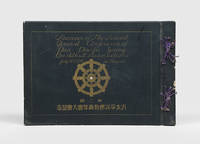
1934Best.-Nr. 196537Tokyo: Bukkyo shashin tsushinsha 1934. First edition celebrating this conference held from 18 to 23 July 1934 against a backdrop of growing condemnation of the invasion of Manchuria. Over 600 delegates gathered for the event and the photographic illustrations show the cultural performances speeches visits to temples and military hospitals and workshops that they participated in. We have traced no copies on WorldCat. Inspired by the 1915 World Buddhist Conference and the 1925 East Asian Buddhist Conference the Pan-Pacific conferences were established to galvanize "international and ecumenical Buddhist solidarity as a means to transform East Asia and the world" Stein p. 1468. Delegates gathered from across the Japanese Empire and further afield to listen to prominent Japanese speakers who emphasized the role of Buddhism in uniting the world. However the conference's themes were in sharp contrast to the realities of the situation in Manchuria. Only eight delegates represented China as the conference chose to treat Manchukuo as a separate country causing outrage in the Chinese press. Several speakers were also involved with the invasion such as foreign minister Hirota Koki and vice-foreign minister Shigemitsu Mamoru. This made the conference a "flashpoint in the relationship between Japanese and Chinese Buddhists" Stein p. 1487. Oblong folio. With halftone photographic illustrations throughout title-page vignette of Buddhist prayer wheel; title page and text printed in brown text in Japanese. Original black leather-grain paper over bevelled boards spine wrapped in brown cloth and tied through four holes with purple string front board lettered and decorated with vignette of Buddhist prayer wheel in gilt light green endpapers. Binding rubbed and scratched with boards exposed at spine front board a little cockled endpapers lightly browned contents clean and bright: a very good copy. Justin B. Stein "Japanese imperialism and the Chinese delegation to the Second General Conference of Pan-Pacific Young Buddhists' Associations 1934" Modern Asian Studies vol. 58 no. 6 2024. hardcover
Best.-Nr. 191076Korea: c. 14th century. An example of ritualized sutra-copying in Korea the Chinese text presenting part of the foundational text of Huayan Buddhism. The calligraphy is balanced and well-composed indicative of the hand of a professional copyist. This fragment comes from a copy of Volume 42 of the sutra. Provenance: Ekky Chung collection Indonesia and Beverly Hills California; acquired by the London bookseller Sam Fogg in May 1998 - Martin Schøyen b. 1940 the Norwegian collector of rare books and manuscripts with his pencilled pressmark on the card sheet. Sheet of white paper 290 x 55 mm ruled into 3 columns in gilt gilt calligraphic characters 17 characters per column. Sheet sometime lined with tissue on verso. Recently tipped to sheet of white card 315 x 158 mm calligraphic label. Traces of old bookseller's sticker at foot of sheet of card. A little black spotting large central stain lighter mark at foot worming touching one character: very good. unknown
Best.-Nr. DADAX0367156075New unknown
Best.-Nr. DADAX0415646286New unknown
Best.-Nr. DADAX0199362386New unknown
Best.-Nr. DADAX0367583682New unknown
Best.-Nr. DADAX0367660393New unknown
Best.-Nr. DADAX0415511496New unknown
Best.-Nr. DADAX0415515211New unknown
Best.-Nr. DADAX0415721660New unknown
Best.-Nr. SONG0195620690Used: Good unknown
Best.-Nr. DADAX041586562XNew unknown