1966Best.-Nr. 4Y-RCTH-AX6V1966. Hardcover. Very Good. Second printing Simon and Schuster 1966. Jacket has moderate wear nicks and fading. Book has light wear clean somewhat yellowed pages firm binding. hardcover
1909Roy. 8vo., First English Edition, with a portrait frontispiece in photogravure, 10 plates (one large and folding) in photogravure, 63 illustrations in the text and a large folding coloured map (lightly spotted; one short tear without material loss in one fold); original cloth gilt, gilt back, mildly rubbed at joints, corners lightly bruised else a remarkably bright, clean copy of a very scarce work. Classic account of a journey by a Japanese monk through Tibet to Nepal between 1897-1903, and including a year's residence in the forbidden city of Lhasa disguised as a local doctor. His extraordinary narrative, detailing a series of events that ought never to have occurred at all, was originally published in a long series of articles written for two leading Japanese newspapers, and subsequently issued in book form (in Japanese) by Hakubunkwan. This is the first appearance in English. ONE OF THE RAREST MODERN BOOKS ON TIBET AND A VALUABLE PRIMARY SOURCE. EXTREMELY SCARCE IN THE ORIGINAL EDITION OF WHICH THIS IS A WELL ABOVE AVERAGE COPY. Cordier BS 4382; Yakushi K35.
Best.-Nr. 185523Korea: c. 14th century. An example of ritualized sutra-copying in Korea the Chinese text presenting part of the foundational text of Huayan Buddhism. The calligraphy is balanced and well-composed indicative of the hand of a professional copyist. This fragment comes from a copy of Volume 42 of the sutra. Provenance: Ekky Chung collection Indonesia and Beverly Hills California; acquired by the London bookseller Sam Fogg in May 1998 - Martin Schøyen b. 1940 the Norwegian collector of rare books and manuscripts with his pencilled pressmark on the card sheet. Sheet of white paper 290 x 55 mm ruled into 3 columns in gilt gilt calligraphic characters 17 characters per column. Sheet sometime lined with tissue on verso. Recently tipped to sheet of white card 315 x 158 mm calligraphic label. Traces of old bookseller's sticker at foot of sheet of card. Large central stain lighter mark at foot a little worming touching one character: very good. unknown
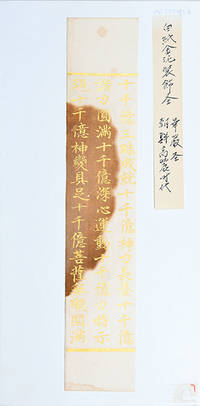
Best.-Nr. 191076Korea: c. 14th century. An example of ritualized sutra-copying in Korea the Chinese text presenting part of the foundational text of Huayan Buddhism. The calligraphy is balanced and well-composed indicative of the hand of a professional copyist. This fragment comes from a copy of Volume 42 of the sutra. Provenance: Ekky Chung collection Indonesia and Beverly Hills California; acquired by the London bookseller Sam Fogg in May 1998 - Martin Schøyen b. 1940 the Norwegian collector of rare books and manuscripts with his pencilled pressmark on the card sheet. Sheet of white paper 290 x 55 mm ruled into 3 columns in gilt gilt calligraphic characters 17 characters per column. Sheet sometime lined with tissue on verso. Recently tipped to sheet of white card 315 x 158 mm calligraphic label. Traces of old bookseller's sticker at foot of sheet of card. A little black spotting large central stain lighter mark at foot worming touching one character: very good. unknown
Best.-Nr. 185522Korea: c. 16th century. An example of ritualized sutra-copying in Korea the Chinese text presenting one of the 48 vows of Amitabha a highly revered Buddha in the Pure Land tradition. The style of gold characters on blue paper was popular in Korea in the 14th-16th centuries. Here the characters have the look of a private devotee rather than a professional copyist. This vow the 33rd of the 38 in the Amitayus Sutra pledges Amitabha to the spiritual nourishment of countless beings. Provenance: Ekky Chung collection Indonesia and Beverly Hills California; acquired by the London bookseller Sam Fogg in May 1998 - Martin Schøyen b. 1940 the Norwegian collector of rare books and manuscripts with his pencilled pressmark on the card sheet. Sheet of indigo-dyed paper 295 x 58 mm ruled into 3 columns in silver gilt calligraphic characters 17 characters per column. Recently tipped to sheet of white card 315 x 156 mm calligraphic label. Traces of old bookseller's sticker at foot of sheet of card. Old repair at foot: very good. unknown
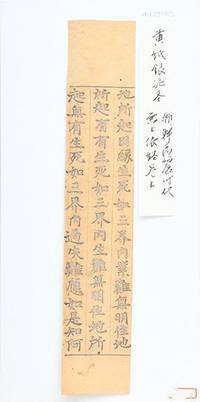
Best.-Nr. 185524Korea: c. 14th century. An example of ritualized sutra-copying in Korea the Chinese text presenting part of a Mahayana sutra on the innate buddhahood of all things. The calligraphy is balanced and well-composed indicative of the hand of a professional copyist. Provenance: Ekky Chung collection Indonesia and Beverly Hills California; acquired by the London bookseller Sam Fogg in May 1998 - Martin Schøyen b. 1940 the Norwegian collector of rare books and manuscripts with his pencilled pressmark on the card sheet. Sheet of yellow paper 290 x 55 mm ruled into 3 columns in silver silver calligraphic characters 17 characters per column. Sheet sometime lines with tissue on verso. Recently tipped to sheet of white card 315 x 158 mm calligraphic label. Traces of old bookseller's sticker at foot of sheet of card. A little soiling faint stain along left edge: very good. unknown
1974Best.-Nr. 10320Paris, Fayard, coll. "Documents spirituels". 1974. In-8°, 150 pp., qqs. Ill. dans le texte. Br., couv. à rabats (bon état).
2009Best.-Nr. 31434Paris Edito - Citadelles et Mazenod 2009 Petit In-8 à L'italienne Collection "Citadelles-Variations - Album panoramique de 240 prises de vue - 227 pp - 4 ff indx (table)
1996Best.-Nr. M1635281996 Indigène Couverture souple 1996 TIBET . Les formes du vide. Indigène, 1996. In4° broché, 100 pp. Edité à l' occasion de l' exposition de Strasbourg Octobre-Novembre 1996 sous la direction de Sylvie Crossman et Jean Pierre Barou . Belle mise en page , couverture très légèrement défraichie.
1989Best.-Nr. S53834Brussel, 1989 194pp.rijkelijk geïll., 27cm., Catalogus van gelijknamige tentoonstelling (Koninklijke Musea voor Kunst en Geschiedenis, Jubelpark Brussel, 17 febr.-14 mei 1989),
1991Best.-Nr. 026928Wien 1991 Arbeitskreis für Tibetische und Buddhistische Studien Soft cover
Best.-Nr. 64540aafNew-Delhi, Inter-India Publications, 1983, in-8vo, 356 p. + plates + Maps, diagrams, and threee other illustrations by K. Johnston. orig. cloth, with DJ, very good to fine copy.
2008Best.-Nr. GITb475Editions de Noyelles 2008. In-8 broché couverture illustrée 236pp.
1996Best.-Nr. 98121996 L'Harmattan, 1996. Un volume in-4 cartonnage illustré, 143 pages, nombreuses illustrations en couleurs. Bon état.
1997Best.-Nr. X68999Dharamsala, Library of Tibetan Works and Archives 1997 [4] + 309pp., 25cm., revised and enlarged edition, cloth, dustwrapper, G, X68999
1926Best.-Nr. 110649London and New York George Routledge, E.P. Dutton, coll. "Broadway Translations" 1926 1 vol. relié in-8, cartonnage demi-percaline ivoire de l'éditeur, XLV + 368 + 12 pp. (sans jaquette, cartonnage un peu défraîchi), index. Traduit du tibétain en allemand par A. Von Schiefner, et de l'allemand en anglais par W.R.S. Ralston. Nouvelle édition avec une préface de C.A.F. Rhys Dacids. Texte en anglais. Bon état.
1989194pp.rijkelijk geïll., 27cm., Catalogus van gelijknamige tentoonstelling (Koninklijke Musea voor Kunst en Geschiedenis, Jubelpark Brussel, 17 febr.-14 mei 1989)
1996A clean, unmarked copy with a tight binding. Previous owner's inscription inside, which bleeds through lightly onto the following page. 9 1/4"w x 9 1/4"h.
1996A clean, unmarked copy with a tight binding. Marks on dust jacket. Previous owner's inscription inside, which bleeds through lightly onto the following page. 9 1/4"w x 9 1/4"h.
1875Best.-Nr. 75492Tibet: N.p. ca. 1875. This Sutra comprises Volume 33 of the Narthang Kangyur. The dimensions including both wooden covers are 24 1/4 inches long; 6 3/8 inches wide; 4 1/2 inches high. This exemplar contains 448 leaves made of Tibetan rice paper and printed using carved wooden blocks on both recto an verso for a total of 896 pp. The leaves and the holder are in very good condition. We know that the Narthang Kangyur printing blocks were carved in the Narthang Monastery around 1730-1732. The legibility of this copy argues for a date of about 1875 but it could be as late as 1920. The upper wooden board has a nice Sanskrit inscription in Landza / Ranjana script. With the original saffron carrying cloth. A rare offering.The text is a sutra named The Perfection of Wisdom in Eight Thousand Lines. Copies of this text are often used for devotional purposes which may be why it has not been kept with the other volumes. This particular sutra was initially translated from Sanskrit into Tibetan in the 8th century then the translation was revised in the 11th. The original composition of the Sutras is unknown. the traditional answer to this is that these sutras were spoken by the Buddha then concealed by the Nagas for centuries before being revealed by Nagarjuna in the 3-4th century. While they are usually thought of as later compositions the sutras of the Perfection of Wisdom and especially this text are interestingly among the oldest physical Buddhist manuscripts preserved. The sutra deals with a number of topics but is primarily concerned with the conduct of a bodhisattva the realiation and attainment of the Perfection of Wisdom as one of the Six Perfections the realization of thusness tath t the attainment of irreversibility on the path to buddhahood avaivartika non-conceptualisation and abandonment of views as well as the worldly and spiritual benefit of worshipping the s tra.The s tra is among the most well-established in the Mahayana tradition and "was the first philosophical text to be translated from the Mahayana literature into Chinese." It was translated seven times into Chinese9 five times into Tibetan and eight times into Mongolan. The first Tibetan edition was in the eighth century. It remains one of the most relevant of all sutras. Even the dalai Lama acknowledges it preiminence - "“Now Khyongla Rato Rinpoche and I are both students of the late Kyabje Ling Rinpoche. He is the senior student but I the younger one have the name Dalai Lama. I have a close bond with him and with Richard Gere who is a friend of mine and a friend of Tibet. They asked me to give this teaching. For many years Rinpoche has requested me to give the oral transmission of the Perfection of Wisdom Sutra in 8000 lines. As we drove in from the airport yesterday he mentioned it again and I thought “Let’s start now.” The book is about 500 pages long so looking at it I feel somewhat daunted but I won’t try to read it all now I’ll just begin today.”He explained that the Perfection of Wisdom Sutras form a large part of the Buddhist scriptures. Of those sections translated into Tibetan the longest is in 100000 lines and consists of 12 volumes the version in 25000 lines is in 3 volumes this edition in 8000 lines is only one volume while the shortest sutra simply consists of the syllable ‘A’. N.p. hardcover
1997[4] + 309pp., 25cm., revised and enlarged edition, cloth, dustwrapper, G, X68999
1990Best.-Nr. 36733Couverture souple. Broché. 21 x 28 cm. 215 pages + planches.
1990Best.-Nr. 36731Couverture souple. Broché. 21 x 28 cm. 120 pages + planches.