Filliozat JeanLivre Rare Book

3.447 Ergebnisse
1957Best.-Nr. kk969Hachette Dans les pas... Dos carré collé 1957 In-4°(24 x 29,5 cm), dos carré collé avec couverture en noir et blanc, 126 pp., iconographie en noir et blanc et en couleurs in-texte ; quatrième plat jauni et abimée, coiffes usées, état correct. Livraison a domicile (La Poste) ou en Mondial Relay sur simple demande.
Best.-Nr. 544008Paris, Hachette, 1957 Gr. in-4, broché, couverture illustrée, 126 p., reproduction en couleurs et en noir à pleine page.
Best.-Nr. 706in-8° broché, couverture souple illustrée, 182 pages, très bon état, avec 2 cartes en fin de texte, ISBN : 9782702815793
1972Best.-Nr. 207396Couverture souple. Broché. 200 pages. Marques de bibliothèque. Légèrement défraîchi.
1997Best.-Nr. 55208Maisonneuve & Larose, coll. « Références » 1997 In-8 21 cm sur 14,6. 170 pages. Bon état d’occasion.
2016Subervie, 2016. In-8 carré broché de 135 pages illustrées.Texte français - anglais. Bon état
2002xxv + 404pp., illustrated softcover, 23cm., very good, X78853
1992Best.-Nr. 028077Bonn 1992 Indica et Tibetica verlag Soft cover
2002Best.-Nr. X78853Boston & London, Shambhala 2002 xxv + 404pp., illustrated softcover, 23cm., very good, X78853
1912Best.-Nr. 2092902141900118French Book Publishing Association 1912. Soft Cover. Fine. Size: 22.5cm French Book Publishing Association paperback
Best.-Nr. 76567Cottonwood Creek Valley OR: Yeshe Melong N.d. Revised edition. Quarto. 252 pp. Original laminated red wrappers with a comb binding. No records of this publication.Tashi Chöling is a Buddhist temple and center for Buddhist studies located in the Cottonwood Creek Valley of Southern Oregon. It was founded in 1980 by Venerable Gyatrul Rinpoche and its primary purpose is to preserve and transmit the teachings and rituals of Tibetan Buddhism specifically the Nyingmapa tradition. Yeshe Melong unknown
1998Best.-Nr. 2091202133202926Heiraku tera shoten 1998. Soft Cover. Fine. Volume: 1 Heiraku tera shoten paperback
2013Best.-Nr. 2092902141300292Karinzan Bunko Guhoin School Room 2013. Soft Cover. Fine. Number of books: 1 Karinzan Bunko Guhoin School Room paperback
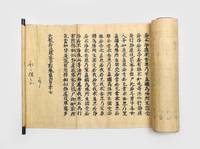
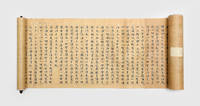
Best.-Nr. 190864Nara: late 13th century. A superb example of 13th-century printing A well-preserved example of early temple printing in Japan inscribed by Tachibana Otome a daughter of the influential Tachibana family. This type of scroll was printed between the 12th and 14th centuries and this example has the thick bold strokes typical of the process. "Kasuga-ban" scrolls refer to woodblock printed sutras originating in the early-mid Kamakura period. The first examples were produced at Kofuku-ji temple and all contained the word "Kasuga" the patron deity of the temple in their colophons. However over time "the term Kasuga-ban became used more loosely in a wider sense to denote publications of the Nara monasteries in general not only of the Kofuku-ji. The printing of Kasuga-ban in this broader sense flourished throughout the Kamakura period and up to the end of Muromachi ca. 1570" Gardner p. 159. This example was printed using blocks first cut at Kofuku-ji in the Karoku period 1222-1227 sometimes referred to as the "Karoku-ban" set. The inscription at the end of the scroll reveals that it was commissioned by Tachibana Otome. We have traced two other complete chapters with the same inscription held at the National Museum of Japanese History and Tsurumi University Library which were commissioned in approximately 1285. The Tachibana was one of the four noble houses that held the most sway in the Nara and Heian periods although they were eclipsed by the Fujiwara family in the 10th century and scattered across the country. Handscroll 261 mm wide unravelling to 850 cm 19 conjoined text sheets on yellow Japanese paper each approximately 265 x 43 cm contemporary wooden rod dowel and endsheet. Lacking cord. With 17 characters per line; text in Chinese occasional punctuation in red. Manuscript paper labels on endsheet recto. Wrapped in modern cloth and housed in modern wooden box. Signs of age as expected some light staining on endsheet verso worm-holing along top edge especially on sheets 9 and 10 but rarely encroaching on text: a very good example. K. B. Gardner "Centres of Printing in Medieval Japan: late Heian to early Edo period" British Library Occasional Papers 11. Japanese Studies 1990. hardcover
Best.-Nr. 190967Japan: c. 11-12th century. Spreading the word of the Buddha in the 12th century An early Japanese manuscript of one of the core texts of Mahayana Buddhism. This example was brushed in mid-late Heian period during a period of religious fervour brought on by fears of a coming dark age. The approximate age of the manuscript can be pinpointed by the scented paper and more free-flowing calligraphic style compared to older Chinese models. In the late Heian period fear of the mappo dark age led wealthy temple donors and patrons to invest in increasingly extravagant gifts. In Buddhist cosmic history the death of the Buddha would be followed by three ages: the "true law" shobo the "copied law" zobo and the "degeneration of the law" mappo the latter of which would only be fixed by the future incarnation of the boddhisatva Maitreya Miroku in Japanese. Japanese buddhists calculated the final age to being in approximately 1052 AD leading the rise of many new sects such as True Land and Nichiren Buddhism. Sutras were naturally a popular option for wealthy temple donors and texts such as the Great Sutra of the Perfection of Wisdom were copied in great quantities. During this time handwriting styles became softer and smoother developing a distinctly Japanese style that would give rise to the hiragana alphabet. The Great Sutra of the Perfection of Wisdom Sanskrit: Mahaprajnaparamita sutra is a 600-volume collection of 16 different sutras including the Diamond Sutra each traditionally believed to represent teachings conveyed by the Buddha to a different assembly of followers. The sutra expands on the idea that the path to finding one's true self lies in detachment from the vanity of everything. The collection was first translated into Chinese by the Tang dynasty monk Xuanzang 602-664 and subsequently introduced into Japan. Handscroll 246 mm wide unravelling to 7267 mm 19 conjoined text sheets on yellow Japanese paper each approximately 246 x 390 mm contemporary wooden rod dowel and endsheet recent orange cloth cord paper infused with camphor perfume. With 17 characters per line pale ink guidelines; text in Chinese. Housed in recent cypress box and brown card sleeve. Worn and creased worm-holing along edges sometime heavily repaired on verso with Japanese paper one line on sheet 1 repaired with old paper and a few characters retouched in manuscript: a very good example. hardcover
Best.-Nr. 2111902158402676Shingon Buddhism Daigo Sect Headquarters N.A. Soft Cover. Fine. Number of pages: 1 book Size: 21cm Shingon Buddhism Daigo Sect Headquarters paperback
1995298pp., 23cm., softcover, G, X71763
1997Best.-Nr. 61433Cerf | Paris 1997 | 13.50 x 21.50 cm | broché
1995Best.-Nr. X71763Chicago, The University of Chicago Press 1995 298pp., 23cm., softcover, G, X71763
2011Best.-Nr. gu4785Suny Press Buddhist Studies - Philosophy Dos carré collé 2011 In-8 (15,3 x 23 cm), dos carré collé, 309 pages, texte en anglais ; très bon état. Livraison a domicile (La Poste) ou en Mondial Relay sur simple demande.
1987Best.-Nr. 18174Milano, Archè, Coll. "Sebastiani". 1987, réimpr. de l'éd. Chang-Hai 1893. In-8°, 282 pp., exemplaire non coupé (tampon ex-libris ésotér!que sur la garde sup.). Très bon état intérieur. Broché (pâle mouillure en queue du 1er de couv. et traces noires sur la couv.).
1987Best.-Nr. 18174Milano, Archè, Coll. "Sebastiani". 1987, réimpr. de l'éd. Chang-Hai 1893. In-8°, 282 pp., exemplaire non coupé (tampon ex-libris ésotér!que sur la garde sup.). Très bon état intérieur. Broché (pâle mouillure en queue du 1er de couv. et traces noires sur la couv.).
1970Broch?. 219 pages. Format de poche.
Best.-Nr. 12150Paris, Chez l'auteur, 1879 ; in-8, broché. 2ff.-356pp.-1f. Couiverture frottée et salie. Quelques pâles rousseurs.
Best.-Nr. 105053Paris 1956 (juin) 1 vol. Broché in-4, agrafé, sous couverture illustrée, 58 pp., nombreuses illustrations. Numéro spécial : 2500 ans d'art et de pensée bouddhiques. Exemplaire provenant de la bibliothèque de Georges Bataille avec tampon à l'encre noire sur le premier feuillet "Bibliothèque de Georges Bataille".