Saint AugustineBiblio.com

856 results
ref. ANAIS-0911782893New City Press of the Focolare. hardcover. Good. 9.5X6.5X1.5. Buy with confidence. Excellent Customer Service & Return policy. New City Press of the Focolare hardcover
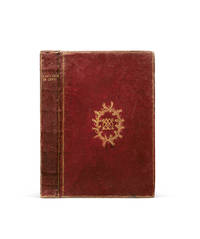
ref. LCS-18353Superbe exemplaire sur grand papier de Hollande revêtu de reliures en maroquin de l’époque à dentelle. Paris, de l’Imprimerie Royale, 1758. 3 volumes in-12, plein maroquin vert olive, riche dentelle dorée sur les plats, dos lisses richement ornés, doublures et gardes de tabis rose, tranches dorées. Reliure de l’époque. 166 x 93 mm.
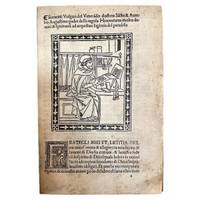
1505ref. RMP655Florencia Gian Stefano di Carlo da Pavia CA 1505. Post-incunable "Sermoni Volgari del Venerado Doctore Sancto & Aurelio Augustino: Padre della Regola Heremitana Molto Devoti & Spirituali ad Acquistare la Gloria del Paradiso" 4o ff. 34. Encuadernación en tafilete rojo reciente; filetes dorados; dentelles interiores dorados; bordes dorados. Pequeña reparación marginal en título; algunas manchas menores en textos. Un muy buen ejemplar de esta muy rara y escasa edición florentina impresa de manera impecable. Atribuidos durante mucho tiempo a San Agustín estos 18 sermones invitan a la contemplación del ascetismo con la traducción italiana de Agostino da Scarperia siglo XIV médico de la Sorbona y uno de los teólogos más importantes del Studio Fiorentino una universidad fundada en 1348. Sus traducciones al italiano de los sermones de San Agustín se consideran textos fundacionales de la literatura vernácula en prosa. Los Sermones ad fraters in eremo o Sermones ad heremitas son textos apócrifos atribuidos a san Agustín que empezaron a circular conjuntamente a partir de los inicios del siglo XIV. En lo que respecta a la tradición impresa latina italiana y española se verifica asimismo una oscilación en el número de sermones dependiendo de las ediciones. A partir de aquí hemos podido distinguir dos grupos diferentes a la hora de imprimir los Sermones ad heremitas entre 1477 fecha de la primera edición latina del texto y 1515 fecha de la primera edición italiana en las prensas venecianas. La presente edición pertenece al grupo de las ediciones florentinas: Florencia: Francesco di Dino 1493 5 de junio; Florencia: Antonio Miscomini 1493 28 de junio; y Florencia: Gian Stephano di Carlo da Pavia ca. 1505-1510 presente edición. Estos impresos se caracterizan por el número de sermones que incluyen solamente 18 y se singularizan por ser los primeros en no incluir los textos añadidos al final de los Sermones. Elegantemente impreso fechado por Goff alrededor de 1500 y atribuido a las imprentas de Lorenzo Morgiani y Johannes Petri está ilustrado por un fino grabado en madera sobre un fondo negro de San Agustín en su scriptorium. Goff A-1323; Sander 689; IGI 1042; BMC VII 1209; GW 3011; Kristeller 11a. Gian Stefano di Carlo da Pavia hardcover
1584ref. 118Rare French edition of St Augustine'sDe Civitate Dei The City of God one of the founding texts of European culture. A beautiful copy preserved in its 17th century morocco binding. A rare edition of St Augustine'sDe Civitate Dei Contra Paganos The City of God one of the founding texts of european culture. This was the translation by Gentian Hervet d'Orléans canon of Reims complemented by the commentaries of Louis Vivès. 'Montaigne was an attentive reader of La Cité de Dieu The City of Godand he kept a copy of the 1570 edition containing the commentary by Vivès' Gisèle Mathieu-Castellani. 'The name of Jean-Louis Vivès was mentioned by Montaigne in his writings as the commentator of La Cité de Dieu which confirms that the edition of La Cité de Dieu owned by Montaigne did indeed include the comments by Vivès. The Vivès commentaries seem to have contributed to the commentary constituted by the Essais.' Jean Céard 'In The City of God theology is shown in relation to the history of mankind and God's action in the world is explained. The book remained authoritative until the seventeenth and eighteenth centuries when Bossuet was the last "Augustinian" historian.' PMM 3 for the 1467 edition A rare and beautiful edition with commentaries by Vivés. There were close links between the Protestant religion and Augustinianism which made Catholics suspicious of St Augustine's texts. Hence all ancient editions of St Augustine's work are rare and particularly in French. In his preface Jean Louis Vivés declares that he added these commentaries on the request of Erasmus who had not time to do so himself. 'De Civitate DeiThe City of Godis an apology of Christianity written by St Augustine 354–430 CE towards the end of his life. It is all at once a philosophy of the historical evolution of human society the metaphysics of society and an interpretation of individual and social life in the light of the fundamental principles of Christianity. Luther Calvin Voltaire and many theologies and philosophies were inspired by this major work. An attractive copy preserved in its old morocco binding. Michel Sonnius hardcover
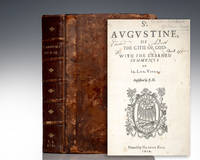
1610ref. 149448London: George Eld 1610. Rare first edition in English of Augustine's monumental work. Translated by John Healey. Folio bound in full brown calf gilt titles to the spine morocco spine label raised bands. Large woodcut printer's device on title McKerrow 375. Decorative woodcut head-pieces and decorative and woodcut initials including three twelve-line initials. In very good condition ownership signature on title page dated 1790. First editions are rare. One of the great cornerstones in the history of Christian thought The City of God is vital to an understanding of modern Western society and how it came into being. Begun in A.D. 413 the book's initial purpose was to refute the charge that Christianity was to blame for the fall of Rome which had occurred just three years earlier. Indeed Augustine produced a wealth of evidence to prove that paganism bore within itself the seeds of its own destruction. However over the next thirteen years that it took to complete the work the brilliant ecclesiastic proceeded to his larger theme: a cosmic interpretation of history in terms of the struggle between good and evil. By means of his contrast of the earthly and heavenly cities--the one pagan self-centered and contemptuous of God and the other devout God-centered and in search of grace--Augustine explored and interpreted human history in relation to eternity. George Eld hardcover
ref. LCS-18473«On n’en connait pas d’exemplaires» (Brunet, I, 560-561). 2a. Tauola et capittoli del primo libro || sācto Augnstino de la cita dio. 13a. Queste illibro di sancto Augustino de || lacita didio ilquale ediuiso ī. xxii libri || Iquali sono īcōfusiōe delrito dilliddii de || pagani... comīcia ilprologo tracto || del secundo libro delere-tractaciōe de Au||gustino:... 333b. COLOPHON : DEO GRATIAS. [P]Armi con laiutorio didio ha||uere renduto il debito di que||sta grande opera. Adcui pare troppo : o || adcui pare poco miperdonino. Ma ad || cui basta non adme: ma adio congratu||landosi meco ne rendano gratie. Glo||ria et honore alpadre et al figliuolo et || allo spirito sancto omnipotente idio in || secula seculorum. Amen. Chancery folio, 322 leaves (of 324, without first and last blank leaves), a12 a-k L m-z10 A-G10 H12, double column, 47 lines, roman type, initial spaces (the first supplied in red, a few others supplied later in brown ink), book number supplied in manuscript at head of each recto (faded), eighteenth-century cat's-paw calf, spine gilt in compartments with red morocco lettering-pieces, red edges. Reliure du XVIIIe siècle. 286 x 198 mm.