AIT KAKI MaximeLivre Rare Book
2 535 résultats
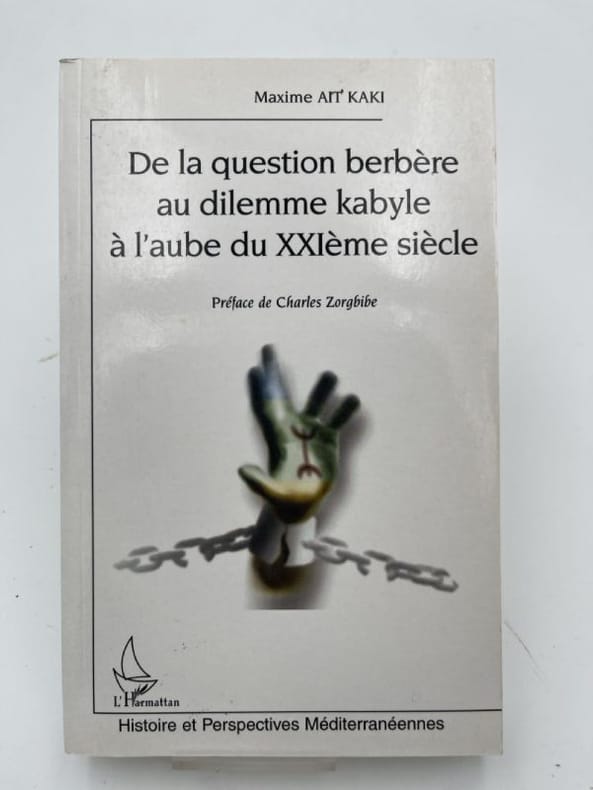
2004réf. 194123L'Harmattan L'Harmattan, 2004. In-8 broché de 317 pages. Bon état
2006New English Paperback. Pbo. Roy. 8vo. In Turkish. 551 p. International relations of the Ottoman Empire and Africa. Osmanli - Afrika iliskileri.
1730Very Good Turkish, Ottoman (1500-1928) Original b/w map from Kitab-i Cihannuma which is one of the most important Turkish incunabula. Oblong large 4to. (31 x 37 cm). In Ottoman script. It shows Venice and Venetian Bay and Algerian shores at North Africa (Maghrib). Toponyms are in Turkish with Arabic letters. Written directions (Simal, Cenûb, Sark and Garb) on corners of the map, and decorative compass on Mediterranean Sea. Scale can be seen at left upper side (El-mikyas: Mil-i Islâmiyân Mil-i Frençe, and Mil-i Italiya]. It's one of the thirteen maps and plates from the book of Cihannuma. The story of Cihannuma can be considered as an effort to keep up with the speed that knowledge spread around the world at a time when literacy was highly limited. Kâtip Çelebi began to rewrite Cihannuma in 1654. During the next six years, he added to his books the knowledge he gained from the books he read. Kâtip Çelebi was vastly influenced by nonreligious positive knowledge, especially by the Atlas and later the Atlas Minor of Gerardus Mercator. He had the book translated from Latin to Turkish by a French recruit andenriched his own book with the new information. He brought together in Cihannuma the knowledge of geography and astronomy existing in Western sources (1654). Cihannüma has 13 charts and 27 maps. Mercator's maps are distinguished by their distinct properties. However, there are such maps which depict Istanbul, Anatolia, the Caucasus and the Orient that have to have been borrowed from other sources and there are those with relatively less detail that might have been prepared by Muslim geographers. Sources cite Ahmed El Kirimî (Ahmed the Crimean) and Galatali Migirdich as mapmakers for Cihannüma. Their names are placed on the maps. Another name that is mentioned is Tophaneli Ibrahim. Researchers agree on the fact that he is Ibrahim Müteferrika. Perhaps he wished to hasten the printing of the book. Perhaps he enjoyed making this contribution to a book he half owned. There is one map in Cihannüma which definitely does not belong to Mercator. Nor is there any information that it was originally charted by Müteferrika's team. Historians state that the 'invertedness' can be found in other maps made by Muslim cartographers. Since it is amap of Turkey, the difference can easily be perceived. The Mediterranean coasts of Turkey are at the top of the map while the Black Sea coasts are at the bottom. The compass on the map correctly indicates the North. The map seems to be inverted but it is not considered scientifically wrong to draw maps in this fashion...". (Source: Boyut; Kitab-i Cihannuma). Extremely rare.
1841Very Good Arabic Original autograph document/letter sealed by Ahmad I of Tunisia. 54x42 cm. 1 p. 6 long lines. The letter includes full of poetic praise. It must be sent after successful diplomatic intercourse with Naples. Ferdinand II (Ferdinando Carlo) was King of the Two Sicilies from 1830 until his early death in 1859. It starts with 'Thank God alone', and goes on 'From poor Ahmad Pasha to Lord Almighty Field Marshal Amîr [ruler]. Sealed by the seal of Ahmad Basha Beg including an impressive qasidah in Arabic. Ahmed I (ibn Mustafa), born 2 December 1805 in Tunis died May 1855 at La Goulette, was the tenth Husainid Bey of Tunis, ruling from 1837 until his death. He was responsible for the abolition of slavery in Tunisia in 1846. He succeeded his father Mustafa Bey on 10 October 1837. He had grand ambitions - to expand his army and create a modern navy; to build a new royal residence, a mint and modern institutions of education but neither he nor his brother-in-law the young Mustapha Khaznadar who served as his finance minister, had a clear idea of what such initiatives would cost. As a result, many of his projects became expensive failures which damaged the financial health of the country. Soon after his accession, Ahmad Bey received the traditional Firman from the Sublime Porte which formally invested him with authority to rule from the Ottoman Empire and furnished him with the insignia of office. The Ottoman envoy, Osman Bey, arrived in la Goulette on 15 May 1838 onboard a frigate. The following day, Osman Bey made his official entry into Tunis on horseback, preceded by all the ministers of the beylical cabinet who went before him until he was two leagues from the city. Before he were carried the sword of honor and the caftan to be presented to the Bey. He was escorted by spahis and followed by a large contingent of regular troops an Arab cavalry. Three days after his official entry into the city, the envoy presented himself at the Bardo Palace to formally invest Ahmad Bey with his insignia of office and present gifts. Named as a Divisional General in the Ottoman army in May 1838, he was later promoted by the Sultan to the rank of Marshal on 14 August 1840. This was the first time that a Bey of Tunis had held a rank higher than Divisional General. The purpose of these honors was to emphasize the supremacy of the Ottoman Empire over the Regency of Tunis. Under a treaty with France signed in 1830 by Hussein Bey, a piece of land in Carthage had been ceded to allow the erection of a monument to Louis IX of France who had died there during the Eighth Crusade. On 25 August 1840, the first stone was laid in the cathedral of Carthage. Ahmad Bey also permitted the Christian community of Tunis, consisting mainly of European merchants, to enlarge their small church near the Bab el Bhar. In June and July 1846 the Duke of Montpensier, son of King Louis Philippe of France visited Tunis and Carthage. He was received with great solemnity by Ahmad Bey. According to the Tunisian historian Mohamed Bayram V, Bey's reforms were focused on state structures, the army, and education. He established a modern structure of government and gave his high officials the title of 'minister'. His senior ministers were his Grand Vizier Mustafa Sahib at-Taba'a, Mustapha Khaznadar, Minister of Finance and of the Interior, Mustafa Agha as Minister of War, Mahmoud Khodja as Minister of the Navy and Giuseppe Raffo as Foreign Minister. At certain times Mahmoud Ben Ayed also served as Trade Minister, Kuchuk Muhammad in the honorific post of Minister in charge of the security home of Ahmad Bey's reforms wasted money, such as the large frigate built at La Goulette that could not make it through the channel to the sea. of Tunis and Mohamed Lasram IV as Minister of the Pen. The historian Ibn Abi Dhiaf was the Bey's private secretary. Among Ahmad Bey's successes may be counted as the abolition of slavery in January 1846. To this may be added the formation of the military academy at...
1993réf. 30147Nouvelles Editions Debresse 1993 In-8 broché 21 cm sur 13. 96 pages. Bon état d’occasion.
réf. 13979335Paris: Presses Universitaires de France, 1972 in-8, 291 pages. Reliure moderne basane rouge, dos à nerfs. Collection "Hier".
1976Very Good English Rebound to modern cloth made as saved original covers on cloth's faces. Cr. 8vo. (20 x 14 cm). Color ills. 273, [1] p. Economic doctrines of Islam Vol. III.
1922réf. 53858- Une feuille 20 x 29 cm.
réf. 31749Paris Pierre Belfond 1979 in 8 (24x15,5) 1 volume broché, couverture illustrée, 252 pages [4]. Bel exemplaire ( Photographies sur demande / We can send pictures of this book on simple request )
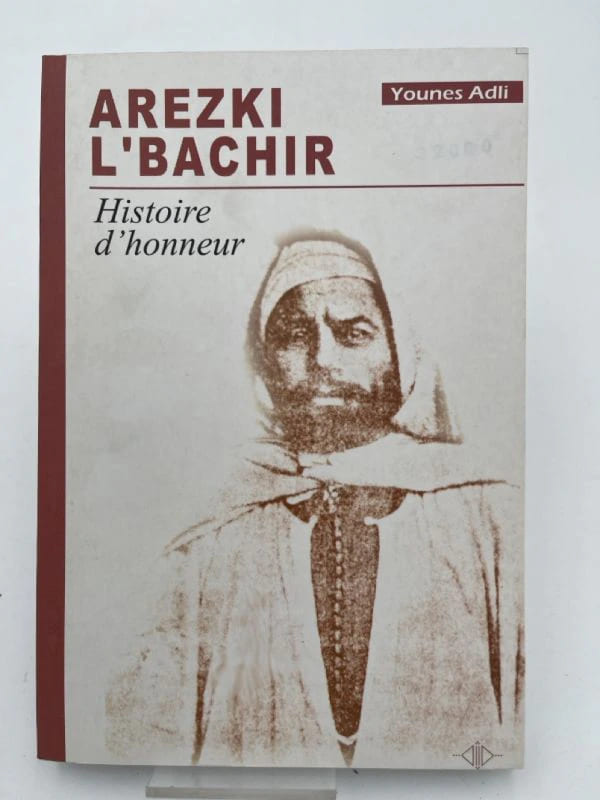
2001réf. 194590Chez l'auteur Chez l'auteur, 2001. In-12 broché de 223 pages. Étude historique consacrée par l'universitaire et essayiste Younes Adli à la figure mythique d'Arezki El Bachir (Arezki L'Bachir), héros populaire de Kabylie de la fin du XIXe siècle. À la fin des années 1880 et au début des années 1890, à la suite des insurrections kabyles, Arezki L'Bachir prend le maquis et incarne la figure du « bandit d'honneur » et du résistant. L'auteur restitue la trajectoire de cette figure historique guillotinée en 1895 à Azazga, en s'appuyant sur des documents d'époque et la mémoire orale régionale. Peu courant. Très bon état
1972réf. 141505Le Concours du CNRS 1972 In-8 broché 24,4 cm sur 16. 353 pages. Bon état d’occasion.
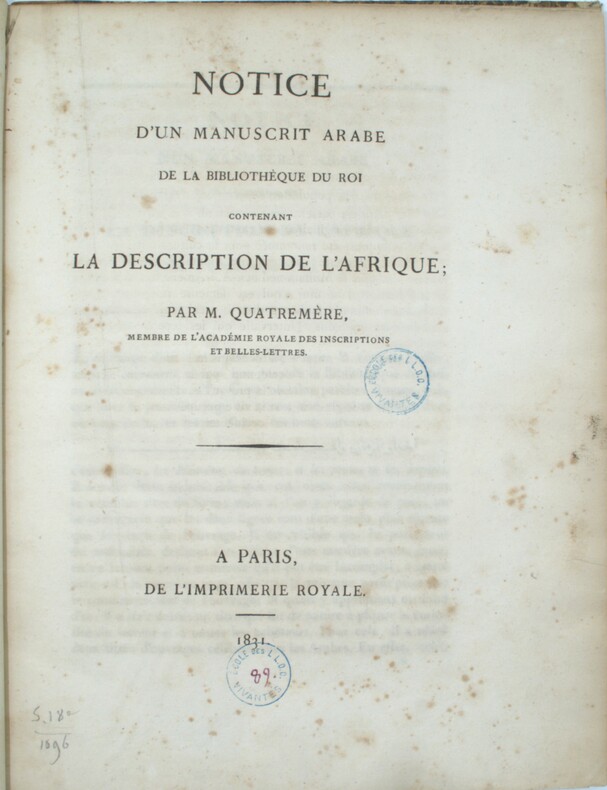
1831réf. PHO-1372Paris , Imprimerie Royale , 1831 , in-4 , 230pp. , relié demi veau époque , tranches cailloutées ,ex-libris T.E. Mionnet (numismate ) , cachet ,dos manquant , frottements aux plats , rousseurs éparses.
1964réf. DZN-2351Publié avec le concours du Centre Universitaire de la Recherche Scientifique par les soins de l'Institut Moulay El-Hassan des recherches Marocaines (c. 1964)In-8, 10-117 pages, 1 HT sur double face. Broché, dos bruni.(CXIV)-(200gr.).
réf. 11127Paris G.-P. Maisonneuve et Larose 1983 in 8 (24x16) 1 volume broché, couverture illustrée, 220 pages. Collection "Judaïsme en terre d'Islam", 2. En attendant Vichy: Les juifs d'Afrique du Nord à la veille de la seconde guerre mondiale; L''Afrique du Nord à l'heure de Vichy; Une libération difficile. Etat neuf
réf. 057607Paris Société Parisienne d'Edition 1931 in 8 (21x13,5) 1 volume broché, XVI et 270 pages [1], avec des illustrations. Bon exemplaire
1992New English Paperback. Pbo. Roy. 8vo. [xv], 200, [2] p., maps. In French. Contents: Table des Matieres; Introduction: Les Turcs au Maghreb, do Mina Tion Turque en Tunisie, Rapports Franco Tunisiens et Turco Tunisiens. Les Turcs au Maghreb, do Mina Tion Turque en Tunisie, Rapports Franco Funisiens et Turco Tunisiens. Chapitre 1: Offre de Tunis à la France, Rivalité Franco-Italienne et Intervention Française. Offre de Tunis à la France, Rivalité franco-Italienne et Intervention Française. 1 - Offre de Tunis à la France au Congrès de Berlin. 2 - Hésitations Françaises et Rivalité Franco-Italienne 3 - Intervention Française. Chapitre 2 : Intervention de la Sublime Porte. Intervention de la Sublime Porte. 1 - Intervention Diplomatique de la Sublime Porte. 2 - Intention D'intervention Navale de la Sublime Porto Dans les Eaux Tunisiennes 3 - La signature du Traite du 12 mai et la Protestation du Gouvernement Ottoman. a) La Signature du Traite du 12 mai b) La Protestation de la Sublime Porte, Contre le traite de Kasr Said c) La Protection des Tunisiens par les Agents Consulaires et Diplomatiques de la France et la Protestation de la Sublime Porte. Chapitre 3: Moures Militaires Prises par la Sublime Porte en Tripolitaine, Insurrection en Tunisie et Pour Parlers Relatifs. Moures Militaires Prises par la Sublime Porte en Tripolitaine, insurrection en Tunisie et Pour parlers Relatifs.
réf. DADAX1789622336New unknown
réf. 101.083s.l., s.d. (ca 1896). 14 x 22, 269 pp., reliure dos/coins cuir bordé de filets dorés, dos orné de filets et de 4 fleurons dorés, 3 ex-libris, bon état (pas de page de titre).
réf. 19977L'Harmattan, collection "Histoire et perspectives mediterraneennes", 1990. Format 16x24 cm, broche, 277 pages.Tres bon etat.
1988réf. LFA-126730372Un ouvrage de 197 pages, format 135 x 215 mm, illustré, broché, publié en 1988, Editions La Pensée Sauvage, bon état
2006réf. 22854Maisonneuve & Larose 2006 In-8 broché, 364 pp. le présent ouvrage s’intéresse au système élitaire au Maghreb sur la longue durée, de l’Antiquité à nos jours. Il en étudie la dynamique en rapport avec les formes historiques du pouvoir et montre comment la notabilité a pris avec le temps des figurs changeantes et des nominations successives....
2015New Persian Paperback. Roy. 8vo. (24 x 17 cm). Text in Persian with a bilingual title in English and Persian on cover. 373 p. Maghreb in Marinids era.= Farhang va tamaddun-i Maghrib-i Islâmî dar 'asr-i Banî Marîn.
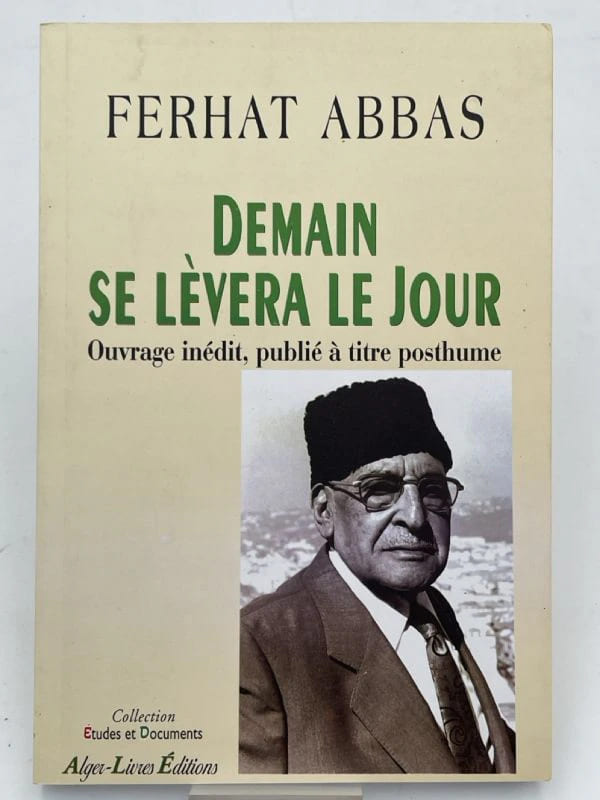
2010réf. 195339Alger Livres éditions Alger, Alger Livres Éditions, 2010. In-8 broché, c ouverture à rabats de 169 pages. Ferhat Abbas (1899-1985) est l'une des figures politiques majeures de l'Algérie du XX siècle. Pharmacien de profession, auteur du célèbre Manifeste du peuple algérien (1943), fondateur de l'UDMA (Union Démocratique du Manifeste Algérien), il deviendra en 1958 le premier président du Gouvernement Provisoire de la République Algérienne (GPRA), puis le premier président de l'Assemblée Nationale Constituante de l'Algérie indépendante. Rédigé et publié à l'origine en 1947 dans le contexte de l'après-Massacres de Sétif (mai 1945) et de sa propre incarcération, ce texte constitue un plaidoyer politique visionnaire et un réquisitoire contre le système colonial. Ferhat Abbas y retrace l'échec des réformes assimilationnistes, dénonce le déni de justice, l'inégalité des droits et l'aveuglement des autorités françaises, tout en affirmant l'inéluctabilité de l'émancipation et de la souveraineté du peuple algérien. Très bon état, peu courant
2012réf. 193706Koukou Koukou, 2012. Grand In-8 broché de 211 pages. Professeur de médecine et neveu d'Abane Ramdane, Belaïd Abane est l'un des historiens-biographes les plus engagés dans la réhabilitation de la mémoire du « Cerveau de la Révolution ». Après ses ouvrages majeurs sur le Congrès de la Soummam, il signe ici une démonstration à charge contre les déconstructions et les attaques posthumes subies par l'architecte du FLN.