[AFRICA - GUINEA - CONAKRY]Biblio.com
889 résultats
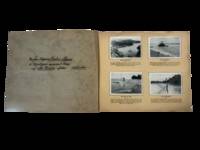
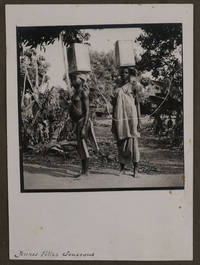
réf. PC23Oblong Octavo album ca. 19x27 cm 7 ¼ x 10 ½ in. 23 stiff card leaves. With 44 mounted original photographs of various sizes including 42 gelatin silver and platinum photos ca. 13x18 cm 5x7 in and two smaller gelatin silver photos ca. 9x14 cm 3 ½ x 4 ½ in. With six loosely inserted platinum photos image size in average ca. 12x17 cm 4 ¾ x 6 ½ in. Nine photos captioned signed “Bés” and /or numbered in negative twenty-eight with period pencil ink captions in French on the margins. Loose photos: three captioned or signed “Bés” or “Yann” in negative five with period manuscript ink captions in French on the mounts. Period brown card binding fastened with a string. A painted scene with an African hut and a manuscript title “Conakry 1935” on the front board. Boards soiled with chipping and minor losses on extremities one photo with a corner torn off but present one of the smaller photos stained one loose photo with a loss of a corner not affecting the image several photos slightly faded but overall a very good album. A historically interesting album with original photos of pre-World War II Conakry and interior French Guinea. Seventeen photos of Conakry show the Corniche promenade four views with two featuring the lighthouse on one of the Los Islands the Lazaret in the Boulbinet Bay Conakry railway station Place le Moal with the monument to Dr. Victor le Moal 1876-1908 the director of the public hygiene of Conakry’s Coronthie district in 1905-1907 the head of the Pastoria Station of the Paster Institute near Kindia in 1907 “Jardin du Gouvernement” “Salle des Fêtes” Camayenne beach parking changing cabins and two Frenchmen resting in beach chairs Camayenne gardens Ballay Hospital now Ignace Deen Hospital Conakry public gardens. There is also a nice scene of “baptism” of a Morane plane of Conakry “aero-club” featuring Joseph Vadier the governor of French Guinea in 1931-36 and his wife breaking a bottle of champagne over the side of the plane a group portrait of European children from a costume ball organized by the government in Conakry in March 1935 and a portrait of seamen in the Conakry “port des caboteurs.” Other interesting images show the photographer’s car going across a river on a small cable ferry a bridge over the Kolente River under construction a Susu village eight views of the Samou River rapids and waterfalls including two group portraits taken during a “picnic européen aux Grandes-Chutes” two views of a road in Bass-Guinée under construction portraits of Susu women and girls and others. Overall a nice atmospheric album with some unusual views of French Guinea in the 1930s’. hardcover
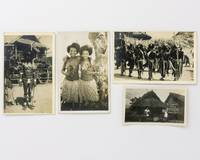
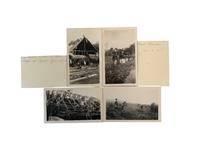
1930réf. 128061New Guinea: Unknown Photographer 1930. Very Good. New Guinea Unknown Photographer circa 1930s. Postcard-format gelatin silver photographs 140 × 89 mm or the reverse one on Kodak Post Card stock the others on plain stock. One bottom margin unevenly trimmed; minor silvering-out and trifling signs of handling; in excellent condition. Two photographs show ornately decorated men in a village. The other one features two young girls in grass skirts holding posies or something similar; the word 'lusious sic' is written in ink on the verso. A fourth snapshot 64 × 108 mm on 'Velox' paper with the words 'Native Huts' written on the verso is included: a small group of people including two white men and two local women are shown at the front of one of the dwellings. 4 items. Unknown Photographer unknown
réf. ARCH0186Santander - Madrid Union Internationale des Sciences Prehistoriques et Protohistoriques 1972. 4° 645 S. 1 Bl. mit zahlr. Abb. u. einigen gef. Taf. lam. OPpbd. geringe Gebrauchsspuren. Beiträge in Spanisch Englisch und Französisch. Santander - Madrid, Union Internationale des Sciences Prehistoriques et Protohistoriques 1972. unknown
1827réf. 42716Copenhagen 1827 1828-29. 4to. Uden omslag. Første bind ubeskåret. Rent frisk eksemplar på skrivepapir. Fra Extracted "Det Kongelige Danske Videnskabernes Selskabs Skrifter" Pp. 21-248 samt pp. 1-236. First printing of this important botanical work describing in total 345 new species of Guinean plants 245 is supplied with Latin descriptions made by Thonning and about 100 by Schumacher. There is 18 new genera described. - Stafleu & Cowan 11.360. - Carl Christensen Bd.2: p. 116. unknown
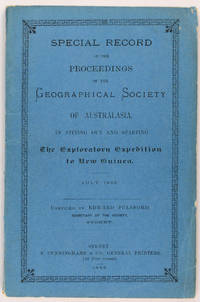
1885réf. 17715Sydney: Geographical Society of Australasia F. Cunninghame & Co. General Printers 1885. First Edition. Paperback. Very Good. Sydney Geographical Society of Australasia F. Cunninghame & Co. General Printers 1885. Octavo 80 pages. Original blue wrappers with the full title page details repeated on the front cover within a decorative border; foot of the spine and the leading edges slightly chipped with minimal expert conservation to the latter; light scattered foxing; an excellent copy. A scientific expedition from June to December 1885 under the leadership of Captain Henry Charles Everill on SS 'Bonito'; it explored the Fly and Strickland Rivers. Everill's short report was published in 1886. Ferguson 14504; not in McLaren but see 8031 for a separately issued portion of it. Geographical Society of Australasia (F. Cunninghame & Co., General Printers) paperback
réf. 9788485041343-3-001Paperback. ESTADO: BUENO. Libro en buen estado. Puede presentar marcas de uso. paperback
1936réf. 230101936. Neuendettelsau Mission publisher. Bilder aus der Neuguinea Mission late 1920s-mid 1930s documents German Protestant missionary activity and Indigenous life in New Guinea during the interwar period following the end of formal German colonial rule. Produced as a cigarette card album with printed German captions the work records village life subsistence practices missionary institutions and ceremonial activity situating Indigenous communities within a visual framework shaped by religious and colonial perspectives. The album supports research into Pacific history missionary networks and the role of photography in documenting and interpreting Indigenous societies under colonial influence. Oblong album containing a substantial series of mounted photographic cigarette cards on captioned leaves with printed German text throughout. The cover title reads "Bilder aus der Neuguinea-Mission" and includes a commemorative image captioned "Gedenkt des 50 jährigen Jubiläums der Neuendettelsauer Mission auf Neuguinea!" depicting three Indigenous men in traditional dress with spears. The album includes numerous images of daily life in coastal New Guinea including fishing hunting boat building village environments and ceremonial gatherings with captions such as "Mit Pfeil und Bogen" and "Mit dem Jagenetz" describing subsistence practices. Additional images depict mission infrastructure including churches schools workshops and settlements alongside scenes of education labor and communal activity. Photographs are systematically arranged and mounted presenting both ethnographic subjects and missionary-built environments within a unified visual sequence. The album was produced during a transitional period when German missionary societies continued operations in New Guinea under Australian administration after World War I maintaining institutional presence despite the loss of formal colonial control. The Neuendettelsau Mission founded in Bavaria in the nineteenth century had established networks of religious and educational institutions in the region contributing to broader systems of cultural transformation and documentation. The images reflect both local practices and the interpretive framework imposed by missionary observers revealing how photography functioned within colonial and religious contexts to classify record and disseminate knowledge about Indigenous populations. Mild toning foxing and edge wear to covers and pages; cards remain securely mounted with images largely clean and crisp; overall very good condition. This album provides sustained visual documentation of missionary activity and Indigenous life in New Guinea during the interwar period. unknown
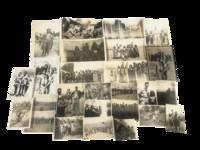
1940réf. 230081940. Photographs of Indigenous communities in New Guinea during World War II document direct encounters between local populations and United States military personnel as Allied forces established operational infrastructure across the island beginning in 1942. Taken in the early to mid 1940s these images record the presence of Indigenous men women and children alongside uniformed servicemen situating them within a major Pacific theater of war where military expansion reshaped local environments and social conditions. The archive supports research into Indigenous history wartime contact zones and the impact of global conflict on colonial territories. Archive consists of 26 original black and white photographic prints likely silver gelatin depicting group portraits staged encounters and environmental views in New Guinea. Multiple images show Indigenous individuals arranged in lines or clusters often positioned with U.S. servicemen standing behind or among them indicating organized or facilitated photographic documentation. Dress and adornment vary with women wearing traditional skirts and beadwork and men and children appearing in customary attire. Several photographs include visible military infrastructure including aircraft fuselages transport planes and trucks suggesting proximity to airstrips supply depots or forward bases. A group of images captures a ceremonial dance or ritual with participants wearing elaborate headdresses and woven garments photographed in mid action. These photographs were produced during a period when New Guinea became a strategic center of Allied military operations in the Pacific bringing new systems of transportation labor demands and administrative control into Indigenous regions. Wartime conditions altered patterns of daily life through the introduction of foreign personnel the construction of military facilities and the expansion of colonial oversight. Visual documentation of these encounters reflects both the logistical realities of military presence and the asymmetrical relationships between Indigenous communities and external authority. Minor handling wear and edge wear with occasional fading; overall very good condition. This archive provides primary visual documentation of wartime contact between Indigenous populations and Allied forces in New Guinea during World War II. unknown
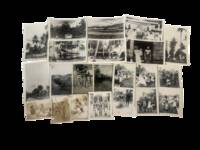
1910réf. 230071910. New Guinea photo archive group of 22 photographs dating to the early twentieth century documenting Indigenous communities and the colonial environments imposed around them. The material captures village life family groups communal activity and built spaces associated with missionary and administrative expansion providing direct visual evidence of how Indigenous people in New Guinea were photographed during a period of accelerating colonial intervention. These images are historically significant for the study of Indigenous life under colonial rule especially where domestic ceremonial and communal scenes appear alongside roads chapels and other introduced structures. Twenty-two black-and-white photographs including real photo postcards and original prints depicting Indigenous men women and children in both portrait and wider landscape formats. The archive includes captioned views such as "Native Huts New Guinea" "A Chapel in New Guinea" "One of Many New Guinea Highways" and "A Native Family of New Guinea." Several images focus on Indigenous dwellings family groupings and village settings while others show larger gatherings outdoor performances or dances communal scenes domestic labor and construction activity. A second grouping centers on colonial-built environments including palm-lined roads formal structures mission buildings and organized settlements. Closer portraits emphasize bodily presentation hairstyle adornment posture and dress while broader views show the spatial relationship between Indigenous communities and the altered colonial landscape. Sizes vary with the group consisting of postcard-format and similarly sized original photographs. Produced during a period of intensified missionary presence road building and colonial administration in New Guinea these photographs document the coexistence of Indigenous continuity and imposed colonial systems. The images show how photography was used to record classify and circulate views of Indigenous people and colonial development while also preserving visual evidence of community structure and daily life under conditions of outside control. The archive supports research into Indigenous history colonial visual culture missionary activity and the transformation of built and social environments in the Pacific. Minor handling wear and light edge wear; overall very good condition. A cohesive visual record of Indigenous life and colonial transformation in early twentieth-century New Guinea. unknown
1944réf. 221181944. Papua New Guinea Photo Archive of 33 original silver gelatin photographs taken in Papua New Guinea circa 1944-1945 as dated in pencil on several versos. The images document traditional village life among Indigenous New Guineans many shown in ceremonial attire performing subsistence labor or posed outside grass-thatched huts. Several photos include White men in Western dress likely visiting for military anthropological or missionary purposes during the World War II Pacific campaign a period that brought foreign occupation and anthropological interest to many previously uncolonized or semi-isolated Papuan regions. Each measure approximately 3.5" x 2.5". Many images showcase Indigenous men and women wearing elaborate ritual regalia: skirts of plant fibers necklaces of shell and bone nose and ear ornaments and headpieces adorned with feathers. In some photos male villagers are shown carrying large slit-gong drums strapped over their shoulders with rope-likely part of a ceremonial performance as these drums were used in both musical and communicative traditions across the Sepik and Highlands regions One series captures local men holding American Esquire magazines and smoking cigarettes suggesting both the imposition of and interaction with the visiting Westerners. The historical context of these photographs is rooted in the Allied occupation of Papua New Guinea during World War II particularly by U.S. and Australian forces. While combat operations were widespread in New Guinea from 1942 to 1945 the final years of the war saw increased documentation by visiting soldiers anthropologists and missionaries many of whom sought to capture what they perceived as "vanishing" cultures. Indigenous Papuans during this era lived primarily in small clan-based villages practicing subsistence horticulture ritual exchange and complex oral traditions. The intrusion of Westerners especially during the war had deep and lasting impacts on social structures religious practices and material culture and this archive reflects the tension between visibility objectification and resilience. Minor curling and edgewear overall very good condition. A rich and rare visual record of traditional Indigenous life in Papua New Guinea on the cusp of dramatic wartime and postwar transformation with significant documentary value for visual anthropology Pacific studies and the wartime colonial encounter. unknown
2010réf. Alibris.0043257University of Papua New Guinea Press. 2010. Hard cover. New. Sewn binding. Cloth over boards. 596 p. Audience: General/trade. University of Papua New Guinea Press hardcover
2010réf. Alibris.0043255University of Papua New Guinea Press. 2010. Hard cover. New. Sewn binding. Cloth over boards. 820 p. Audience: General/trade. University of Papua New Guinea Press hardcover
2010réf. Alibris.0043256University of Papua New Guinea Press. 2010. Hard cover. New. Sewn binding. Cloth over boards. 784 p. Audience: General/trade. University of Papua New Guinea Press hardcover
2017réf. Alibris.0037475The Bible Society of India. 2017. Hard cover. Very good. 369 p. Includes illustrations. . Inai be Buka Helaga ena sivarai Hiri Motu gado ai maragi idia duahia diba gauna. Ena hereva be auka lasi dainai maragi ese Buka Helaga ena hadibaia hereva do idia abia dae diba. Mauri henia sivaraidia; Inia be Dirava ena Hereva iena Lauma ese ia gwauraia gauna. Laulau namodia 200 mai kahana ese Buka Helaga ia herevalaia taudia edia kara idia hedinaraia namo herea. The Bible Society of India hardcover
2004réf. Alibris.0031118The Bible Society of Papua New Guinea. 2004. 2nd ed. Trade paperback. Fine. 652 p. The Bible Society of Papua New Guinea paperback
2009réf. Alibris.0031297The Bible Society of Papua New Guinea. 2009. 3rd ed. Trade paperback. Fine. 715 p. Includes illustrations. The Bible Society of Papua New Guinea paperback
2012réf. Alibris.0030226The Bible Society of Papua New Guinea. 2012. 2nd ed. Trade paperback. Very good. small chip on front cover corner. The Bible Society of Papua New Guinea paperback
1999réf. Alibris.0030112Papua New Guinea Office of National Planning. 1999. Trade paperback. Very good. 320 p. Includes: illustrations diagrams maps bibliography. Papua New Guinea Office of National Planning paperback
1992réf. Alibris.0030302The Bible Society of Papua New Guinea. 1992. Hard cover. Fine. 649 p. Includes illustrations. The Bible Society of Papua New Guinea hardcover
1996réf. Alibris.0026790Department of Agriculture and Livestock Papua New Guinea. 1996. Trade paperback. Good. back cover and pages 107-135 have a crease. 135 p. Department of Agriculture and Livestock, Papua New Guinea paperback
2010réf. Alibris.0017091National AIDS Council of Papua New Guinea. 2010. Trade paperback. Fine. No dust jacket as issued. 55 p. National AIDS Council of Papua New Guinea paperback
1980réf. Alibris.0017499S.l. : Library University of Papua New Guinea. 1980. Trade paperback. Fair. No dust jacket as issued. Ex-library. ex-library strip along spine partly removed and partly coming off unaffecting binding label on back cover stamps on title page stamps on table of contents stamps & label on last blank page unmarked text. 142p. Library, University of Papua New Guinea paperback
1995réf. Alibris.0010567Department of Health Papua New Guinea. 1995. Trade paperback. Very good. No dust jacket as issued. 222 p. Includes diagrams. Department of Health, Papua New Guinea paperback
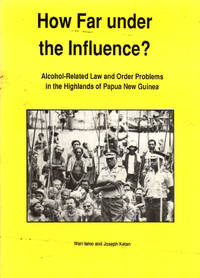
1992réf. Alibris.0008360Boroko Papua New Guinea: National Research Institute. 1992. Trade paperback. Very good. No dust jacket as issued. xiv 145 p. : ill. maps; 25 cm. Includes: Illustrations Maps. . "Based on a report to the Highlands Premiers' Council commissioned by the Highlands Regional Secretariat Inc. " Includes bibliographical references p. 134-145. National Research Institute paperback
1980réf. Alibris.0008441Lae Papua New Guinea: Department of Forests Division of Botany. 1980. Trade paperback. Very good. No dust jacket as issued. iv 153 p. 24 p. of plates: ill.; 25 cm. Includes: Illustrations Plates. . Includes index. Bibliography: p. 141-143. Department of Forests, Division of Botany paperback