893 risultati
1930rif. 57796Paris: Société d'Éditions Géographiques Maritimes et Coloniales 1930. First edition. Folding map. 114 pp plates 350 pp. 1 vols. 4to. Original wrappers. Bottom third of spine missing else Near Fine. First edition. Folding map. 114 pp plates 350 pp. 1 vols. 4to. Société d'Éditions Géographiques, Maritimes et Coloniales unknown
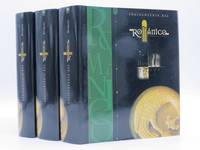
2014rif. 18944Fundación Santa María La Real Centro De Estudios Del Románico. Near Fine in Very Good dust jacket. Hardcover. Volumes 1 2 and 3. Maroon cloth covers are rubbed at corners othewise pristine. Boards and spines are straight. Bindings are tight. Pages are clean and pristine. Books have never been cracked open. Dust jackets have modest wear to the extremities and scuffing and volume 2 has a 3/4" tear but clean bright and very good please note the photography lights created glare on dust jackets which creates the appearance of whitish discoloration on the dust jackets but isn't actually present. DJs protected by a brand new clear acid-free mylar cover. We add mylar covers to all books with DJs to preserve the DJs and add luster to magnify their beauty. If pictured shown without the mylar cover for an accurate representation of dust jacket. . 2014. Fundación Santa María La Real Centro De Estudios Del Románico hardcover
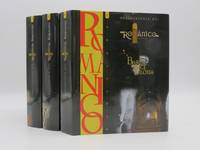
2017rif. 18945Fundación Santa María La Real Centro De Estudios Del Románico. Near Fine in Very Good dust jacket. Hardcover. Volumes 3 and 4 only of a 4 volume set. Maroon cloth covers are rubbed at corners othewise pristine. Boards and spines are straight. Bindings are tight. Pages are clean and pristine. Books have never been cracked open. Dust jackets have modest wear to the extremities but clean bright and very good please note the photography lights created glare on dust jackets which creates the appearance of whitish discoloration on the dust jackets but isn't actually present. DJs protected by a brand new clear acid-free mylar cover. We add mylar covers to all books with DJs to preserve the DJs and add luster to magnify their beauty. If pictured shown without the mylar cover for an accurate representation of dust jacket. . 2017. Fundación Santa María La Real Centro De Estudios Del Románico hardcover
2009rif. 18943Fundación Santa María La Real Centro De Estudios Del Románico. Near Fine in Very Good dust jacket. Hardcover. Volumes 1 2 and 3 of a 4 volume set. Maroon cloth covers are rubbed at corners othewise pristine. Boards and spines are straight. Bindings are tight. Pages are clean and pristine. Books have never been cracked open. Dust jackets have modest wear to the extremities but clean bright and very good please note the photography lights created glare on dust jackets which creates the appearance of whitish discoloration on the dust jackets but isn't actually present. DJs protected by a brand new clear acid-free mylar cover. We add mylar covers to all books with DJs to preserve the DJs and add luster to magnify their beauty. If pictured shown without the mylar cover for an accurate representation of dust jacket. . 2009. Fundación Santa María La Real Centro De Estudios Del Románico hardcover
2000rif. 175461Springer 2000-02-29. hardcover. Very Good. 7x1x10. Springer hardcover
1965rif. 100096763Ministerio de asuntos exteriores 1965. Bon état couverture ternie intérieur propre bonne tenue. in4. 1965. Cartonné. Ministerio de asuntos exteriores unknown
rif. 19561432-nnew. unknown
rif. 19561432like new. unknown
1984rif. SBBIH-COFR73WERYYPThe Bible Society of Papua New G 1984. paperback. Good. Our good condition books are generally good for reading but not for gifting or collecting. They could have imperfections such as creasing fanning inscriptions margin notes yellowing staining on edge or cover or pages bumps scuffs etc etc sometimes multiple of these. It's a wide category that encompasses anything that isn't almost-new down to anything that is slightly better than poor. We would NOT recommend gifting Good books - these should be considered reading copies. Our books are dispatched from a Yorkshire former cotton mill. We list via barcode/ISBN so please note that the images are stock images and may not be the exact copy you receive furthermore the details about edition and year might not be accurate as many publishers reuse the same ISBN for multiple editions and as we simply scan a barcode or enter an ISBN we do not check the validity of the edition data when listing. If you're looking for an exact edition please don't order at least not without checking with us first although we don't always have time to check. We aim to dispatch prompty the service used will depend on order value and book size. We can ship to most countries see our shipping policies. Payment is via Abe only. The Bible Society of Papua New G paperback
rif. 788250like new. unknown
rif. 788368like new. unknown
rif. V00C-03318Delroisse. Used - Good. Good condition. Acceptable dust jacket. French and English. A copy that has been read but remains intact. May contain markings such as bookplates stamps limited notes and highlighting or a few light stains. Delroisse unknown
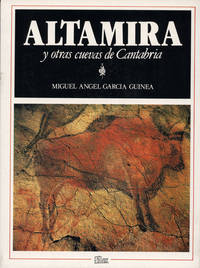
rif. ARCH0186Santander - Madrid Union Internationale des Sciences Prehistoriques et Protohistoriques 1972. 4° 645 S. 1 Bl. mit zahlr. Abb. u. einigen gef. Taf. lam. OPpbd. geringe Gebrauchsspuren. Beiträge in Spanisch Englisch und Französisch. Santander - Madrid, Union Internationale des Sciences Prehistoriques et Protohistoriques 1972. unknown
1827rif. 42716Copenhagen 1827 1828-29. 4to. Uden omslag. Første bind ubeskåret. Rent frisk eksemplar på skrivepapir. Fra Extracted "Det Kongelige Danske Videnskabernes Selskabs Skrifter" Pp. 21-248 samt pp. 1-236. First printing of this important botanical work describing in total 345 new species of Guinean plants 245 is supplied with Latin descriptions made by Thonning and about 100 by Schumacher. There is 18 new genera described. - Stafleu & Cowan 11.360. - Carl Christensen Bd.2: p. 116. unknown
rif. 9788485041343-3-001Paperback. ESTADO: BUENO. Libro en buen estado. Puede presentar marcas de uso. paperback
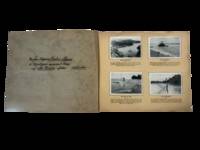
1936rif. 230101936. Neuendettelsau Mission publisher. Bilder aus der Neuguinea Mission late 1920s-mid 1930s documents German Protestant missionary activity and Indigenous life in New Guinea during the interwar period following the end of formal German colonial rule. Produced as a cigarette card album with printed German captions the work records village life subsistence practices missionary institutions and ceremonial activity situating Indigenous communities within a visual framework shaped by religious and colonial perspectives. The album supports research into Pacific history missionary networks and the role of photography in documenting and interpreting Indigenous societies under colonial influence. Oblong album containing a substantial series of mounted photographic cigarette cards on captioned leaves with printed German text throughout. The cover title reads "Bilder aus der Neuguinea-Mission" and includes a commemorative image captioned "Gedenkt des 50 jährigen Jubiläums der Neuendettelsauer Mission auf Neuguinea!" depicting three Indigenous men in traditional dress with spears. The album includes numerous images of daily life in coastal New Guinea including fishing hunting boat building village environments and ceremonial gatherings with captions such as "Mit Pfeil und Bogen" and "Mit dem Jagenetz" describing subsistence practices. Additional images depict mission infrastructure including churches schools workshops and settlements alongside scenes of education labor and communal activity. Photographs are systematically arranged and mounted presenting both ethnographic subjects and missionary-built environments within a unified visual sequence. The album was produced during a transitional period when German missionary societies continued operations in New Guinea under Australian administration after World War I maintaining institutional presence despite the loss of formal colonial control. The Neuendettelsau Mission founded in Bavaria in the nineteenth century had established networks of religious and educational institutions in the region contributing to broader systems of cultural transformation and documentation. The images reflect both local practices and the interpretive framework imposed by missionary observers revealing how photography functioned within colonial and religious contexts to classify record and disseminate knowledge about Indigenous populations. Mild toning foxing and edge wear to covers and pages; cards remain securely mounted with images largely clean and crisp; overall very good condition. This album provides sustained visual documentation of missionary activity and Indigenous life in New Guinea during the interwar period. unknown
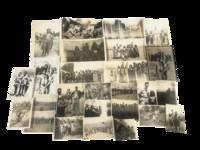
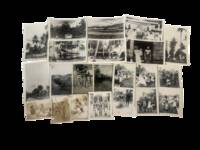
1940rif. 230081940. Photographs of Indigenous communities in New Guinea during World War II document direct encounters between local populations and United States military personnel as Allied forces established operational infrastructure across the island beginning in 1942. Taken in the early to mid 1940s these images record the presence of Indigenous men women and children alongside uniformed servicemen situating them within a major Pacific theater of war where military expansion reshaped local environments and social conditions. The archive supports research into Indigenous history wartime contact zones and the impact of global conflict on colonial territories. Archive consists of 26 original black and white photographic prints likely silver gelatin depicting group portraits staged encounters and environmental views in New Guinea. Multiple images show Indigenous individuals arranged in lines or clusters often positioned with U.S. servicemen standing behind or among them indicating organized or facilitated photographic documentation. Dress and adornment vary with women wearing traditional skirts and beadwork and men and children appearing in customary attire. Several photographs include visible military infrastructure including aircraft fuselages transport planes and trucks suggesting proximity to airstrips supply depots or forward bases. A group of images captures a ceremonial dance or ritual with participants wearing elaborate headdresses and woven garments photographed in mid action. These photographs were produced during a period when New Guinea became a strategic center of Allied military operations in the Pacific bringing new systems of transportation labor demands and administrative control into Indigenous regions. Wartime conditions altered patterns of daily life through the introduction of foreign personnel the construction of military facilities and the expansion of colonial oversight. Visual documentation of these encounters reflects both the logistical realities of military presence and the asymmetrical relationships between Indigenous communities and external authority. Minor handling wear and edge wear with occasional fading; overall very good condition. This archive provides primary visual documentation of wartime contact between Indigenous populations and Allied forces in New Guinea during World War II. unknown
1910rif. 230071910. New Guinea photo archive group of 22 photographs dating to the early twentieth century documenting Indigenous communities and the colonial environments imposed around them. The material captures village life family groups communal activity and built spaces associated with missionary and administrative expansion providing direct visual evidence of how Indigenous people in New Guinea were photographed during a period of accelerating colonial intervention. These images are historically significant for the study of Indigenous life under colonial rule especially where domestic ceremonial and communal scenes appear alongside roads chapels and other introduced structures. Twenty-two black-and-white photographs including real photo postcards and original prints depicting Indigenous men women and children in both portrait and wider landscape formats. The archive includes captioned views such as "Native Huts New Guinea" "A Chapel in New Guinea" "One of Many New Guinea Highways" and "A Native Family of New Guinea." Several images focus on Indigenous dwellings family groupings and village settings while others show larger gatherings outdoor performances or dances communal scenes domestic labor and construction activity. A second grouping centers on colonial-built environments including palm-lined roads formal structures mission buildings and organized settlements. Closer portraits emphasize bodily presentation hairstyle adornment posture and dress while broader views show the spatial relationship between Indigenous communities and the altered colonial landscape. Sizes vary with the group consisting of postcard-format and similarly sized original photographs. Produced during a period of intensified missionary presence road building and colonial administration in New Guinea these photographs document the coexistence of Indigenous continuity and imposed colonial systems. The images show how photography was used to record classify and circulate views of Indigenous people and colonial development while also preserving visual evidence of community structure and daily life under conditions of outside control. The archive supports research into Indigenous history colonial visual culture missionary activity and the transformation of built and social environments in the Pacific. Minor handling wear and light edge wear; overall very good condition. A cohesive visual record of Indigenous life and colonial transformation in early twentieth-century New Guinea. unknown
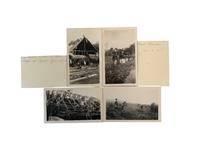
1944rif. 221181944. Papua New Guinea Photo Archive of 33 original silver gelatin photographs taken in Papua New Guinea circa 1944-1945 as dated in pencil on several versos. The images document traditional village life among Indigenous New Guineans many shown in ceremonial attire performing subsistence labor or posed outside grass-thatched huts. Several photos include White men in Western dress likely visiting for military anthropological or missionary purposes during the World War II Pacific campaign a period that brought foreign occupation and anthropological interest to many previously uncolonized or semi-isolated Papuan regions. Each measure approximately 3.5" x 2.5". Many images showcase Indigenous men and women wearing elaborate ritual regalia: skirts of plant fibers necklaces of shell and bone nose and ear ornaments and headpieces adorned with feathers. In some photos male villagers are shown carrying large slit-gong drums strapped over their shoulders with rope-likely part of a ceremonial performance as these drums were used in both musical and communicative traditions across the Sepik and Highlands regions One series captures local men holding American Esquire magazines and smoking cigarettes suggesting both the imposition of and interaction with the visiting Westerners. The historical context of these photographs is rooted in the Allied occupation of Papua New Guinea during World War II particularly by U.S. and Australian forces. While combat operations were widespread in New Guinea from 1942 to 1945 the final years of the war saw increased documentation by visiting soldiers anthropologists and missionaries many of whom sought to capture what they perceived as "vanishing" cultures. Indigenous Papuans during this era lived primarily in small clan-based villages practicing subsistence horticulture ritual exchange and complex oral traditions. The intrusion of Westerners especially during the war had deep and lasting impacts on social structures religious practices and material culture and this archive reflects the tension between visibility objectification and resilience. Minor curling and edgewear overall very good condition. A rich and rare visual record of traditional Indigenous life in Papua New Guinea on the cusp of dramatic wartime and postwar transformation with significant documentary value for visual anthropology Pacific studies and the wartime colonial encounter. unknown
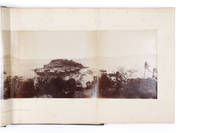
1885rif. 4504633Sydney: Thomas Richards Government Printer 1885. Slight rubbing to binding in handsome & original condition; interior lightly foxed in places; map with repaired tear; images all bright and crisp. Large square folio with a folding map three coloured lithograph plates 33 original silver albumen photographs 283 x 212 mm mounted on card with printed captions and borders and two superb panoramas one of them double-page 240 x 553 mm and the other on four sheets 242 x 1053 mm; original dark blue grained morocco binding bevelled edges spine banded and sides with multiple borders in gilt front cover lettered in gilt all edges gilded. This rare and sumptuous album published in very small numbers and illustrated with original photographs has been described as the first example of Australian photo-journalism: "the most magnificent example of an Australian work in this genre the high point in relation to which all other examples can be considered" Holden. It is equally significant as one of the earliest ethnographic photographic albums produced in the South Pacific. The photographs record the 1884 expedition during which Commodore Sir James Erskine proclaimed a British protectorate over the south coast of New Guinea. Although unpublished at the time they were produced by the New South Wales Government Printing Office and were principally the work of Augustine Dyer 1873-1923. Intended as a visual record of the expedition they also reveal the strategic importance attached to the Hood Lagoon region represented by six photographs together forming almost one-sixth of the completed album. Printed and assembled in Sydney in a small presentation edition the album is remarkable in treating photographs not simply as illustrations but as the narrative itself. Official ceremonies are interwoven with topographical views and portraits producing a visual account of first contact between Imperial officers and local communities. Particularly striking is the photograph of Erskine addressing assembled chiefs aboard HMS Nelson one of whom holds an ebony staff distributed by Erskine as an emblem of authority "with a florin let in at the top the Queen's Head being uppermost" Lyne. Although produced to commemorate the proclamation of the British Protectorate the album is equally important as an early ethnographic record of coastal Papua New Guinea. Despite its official purpose its photographs frequently possess an immediacy and humanity uncommon in imperial publications of the period. A complete list of the photographs appears on the Hordern House website. Sir James Erskine R.N. 1838-1911 then Commodore of the Australian Station had assumed command in January 1882. While in Sydney he leased Carthona the grand Gothic Revival house at Darling Point built for the explorer Sir Thomas Mitchell. During the expedition he commanded the Australian Squadron charged with proclaiming British authority over the south coast of New Guinea. The motivation for the expedition was explicitly imperial. As Erskine explained the Imperial Government had resolved to establish a protectorate over the unclaimed southern coast of New Guinea "with the double object of preventing any foreign occupation of the country and of protecting the inhabitants from aggression.". Yet the tone of his published Narrative frequently departs from official language reading more as a travel account than a governmental report. "Picturesque" is among his favourite descriptions while passages celebrating "the striking variety and beauty of the colour in the adjacent water" reveal genuine admiration for the landscape. The same contrast appears in Erskine's address to the assembled chiefs long regarded as a "Declaration of Rights" for New Guinea. Whereas the formal Proclamation speaks in the language of imperial administration Erskine's speech looks instead to the practical benefits of British protection urging the assembled people to "look upon white persons whom the Queen permits to reside amongst you as your friends.". The album's photographs reinforce this more nuanced narrative. Images of proclamation ceremonies are balanced by landscapes villages and portraits creating what is arguably the earliest sustained photographic reportage produced in Australia. Particularly memorable is the scene aboard HMS Nelson showing Erskine addressing the Hood Bay chiefs one grasping the ebony staff symbolising his authority. The photographs comprise: 1 "Port Moresby from the Mission Station." Four-sheet panorama. 2 "H.M.S. 'Nelson' at Port Moresby S.W." 3 "General View of Settlement at Port Moresby N.N.E." 4 "Commodore shaking hands with Native Chief 'OBE Vagi' on board H.M.S. 'Nelson' at Port Moresby." 5 "Native Village Port Moresby W." 6 "Ethel Island and landing-place at Native Village Port Moresby S.W." 7 "Native Houses Port Moresby." 8 "Native Village Port Moresby S." 9 "Native Village Port Moresby N.W." 10 "Hoisting Flag at Port Moresby N.W." 11 "Yule Island from Delena Hall Sound N.W." 12 "Landing-place at Delena Hall Sound N." 13 "Hoisting flag at Delena Hall Sound." 14 "Koloka the Queen of the Lolo Tribe at Delena." 15 "Landing at Motumotu." 16 "Landing at Motumotu." 17 "Firing the Feu de joie Motumotu." 18 "New Guinea Chief Motumotu." 19 "Native Village Kerepunu Hood Lagoon S.W." 20 "Commodore reading Proclamation at Kerepunu Hood Lagoon W." 21 "H.M.S. 'Espiegle' saluting Flag Hood Lagoon." 22 "Scene near Kerepunu Hood Lagoon N.E." 23 "A Chief's House Kerepunu Hood Lagoon S.W." 24 "Commodore addressing Chiefs on board H.M.S. 'Nelson' Hood Bay." 25 "Argyll Bay W.N.W." Two-sheet panorama. 26 "Commodore reading Proclamation at Argyll Bay N.W." 27 "H.M.S. 'Nelson' saluting Flag at Mission Station Suau Stacey Island South Cape." 28 "View from Stacey Island N." 29 "Native Village Suau S.W." 30 "Native House at Suau." 31 "View from Dinner Island China Strait-H.M. Ships 'Nelson' and 'Espiegle' at anchor N.W." 32 "View from Dinner Island S.W." 33 "Natives on board H.M.S. 'Nelson' at Dinner Island." 34 "View from Anchorage N. side of Teste Island W. by N." 35 "West end of Teste Island from Anchorage S.W." A presentation copy was prepared for Queen Victoria noted in the preface as "a keen supporter of photography." . Provenance: A Paré "Elgin" Durban Rd. Wynberg South Africa pencil inscription on front flyleaf. Thomas Richards, Government Printer unknown
1946rif. 00234345Madrid Direccion De Agricultura De Los Territorios Espanoles Del golfo De Guinea 1946. Hardcover. Good. Num. tipped-in col. plates and ills. orig. giltlettered cl. large 4to.; Spine sl. sunned. Madrid, Direccion De Agricultura De Los Territorios Espanoles Del golfo De Guinea hardcover
1939rif. 124917c.1939. Very Good. quarto. Cloth photo album 20pp. 108 photographs of PNG scenes & people; natives patrol officers etc. also many of ships & sailing boats inc. several named vessels. Many appear to be Rabaul area hardcover
1947rif. 15446MADRID: Instituto de Estudios Africanos 1947. 4º mayor.- Rústica cubiertas originales.- 156 páginas.- 2 hojas.- Ilustraciones entre texto.- Láminas fuera de texto. . Instituto de Estudios Africanos paperback
rif. 2506RS219d'après les travaux du Docteur R.G. Hamer. Por Dr. Edição ao Autor. Daves. 2004. De 25x18 cm. Com ix 406 págs. Brochado. SACO RS643-17 unknown