1 024 résultats
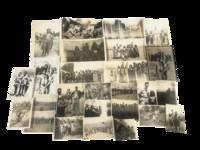
1910réf. 230071910. New Guinea photo archive group of 22 photographs dating to the early twentieth century documenting Indigenous communities and the colonial environments imposed around them. The material captures village life family groups communal activity and built spaces associated with missionary and administrative expansion providing direct visual evidence of how Indigenous people in New Guinea were photographed during a period of accelerating colonial intervention. These images are historically significant for the study of Indigenous life under colonial rule especially where domestic ceremonial and communal scenes appear alongside roads chapels and other introduced structures. Twenty-two black-and-white photographs including real photo postcards and original prints depicting Indigenous men women and children in both portrait and wider landscape formats. The archive includes captioned views such as "Native Huts New Guinea" "A Chapel in New Guinea" "One of Many New Guinea Highways" and "A Native Family of New Guinea." Several images focus on Indigenous dwellings family groupings and village settings while others show larger gatherings outdoor performances or dances communal scenes domestic labor and construction activity. A second grouping centers on colonial-built environments including palm-lined roads formal structures mission buildings and organized settlements. Closer portraits emphasize bodily presentation hairstyle adornment posture and dress while broader views show the spatial relationship between Indigenous communities and the altered colonial landscape. Sizes vary with the group consisting of postcard-format and similarly sized original photographs. Produced during a period of intensified missionary presence road building and colonial administration in New Guinea these photographs document the coexistence of Indigenous continuity and imposed colonial systems. The images show how photography was used to record classify and circulate views of Indigenous people and colonial development while also preserving visual evidence of community structure and daily life under conditions of outside control. The archive supports research into Indigenous history colonial visual culture missionary activity and the transformation of built and social environments in the Pacific. Minor handling wear and light edge wear; overall very good condition. A cohesive visual record of Indigenous life and colonial transformation in early twentieth-century New Guinea. unknown books
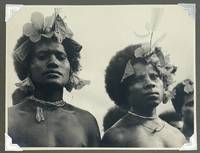
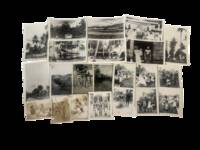
1940réf. 230081940. Photographs of Indigenous communities in New Guinea during World War II document direct encounters between local populations and United States military personnel as Allied forces established operational infrastructure across the island beginning in 1942. Taken in the early to mid 1940s these images record the presence of Indigenous men women and children alongside uniformed servicemen situating them within a major Pacific theater of war where military expansion reshaped local environments and social conditions. The archive supports research into Indigenous history wartime contact zones and the impact of global conflict on colonial territories. Archive consists of 26 original black and white photographic prints likely silver gelatin depicting group portraits staged encounters and environmental views in New Guinea. Multiple images show Indigenous individuals arranged in lines or clusters often positioned with U.S. servicemen standing behind or among them indicating organized or facilitated photographic documentation. Dress and adornment vary with women wearing traditional skirts and beadwork and men and children appearing in customary attire. Several photographs include visible military infrastructure including aircraft fuselages transport planes and trucks suggesting proximity to airstrips supply depots or forward bases. A group of images captures a ceremonial dance or ritual with participants wearing elaborate headdresses and woven garments photographed in mid action. These photographs were produced during a period when New Guinea became a strategic center of Allied military operations in the Pacific bringing new systems of transportation labor demands and administrative control into Indigenous regions. Wartime conditions altered patterns of daily life through the introduction of foreign personnel the construction of military facilities and the expansion of colonial oversight. Visual documentation of these encounters reflects both the logistical realities of military presence and the asymmetrical relationships between Indigenous communities and external authority. Minor handling wear and edge wear with occasional fading; overall very good condition. This archive provides primary visual documentation of wartime contact between Indigenous populations and Allied forces in New Guinea during World War II. unknown books
réf. SONG3791350552Used: Good unknown
réf. SONG9027978484Used: Good unknown
réf. DADAX0393304264New unknown
réf. DADAX0785813098New unknown
réf. DADAX9027978484New unknown
réf. DADAX3791350552New unknown
réf. DADAX0810906015New unknown
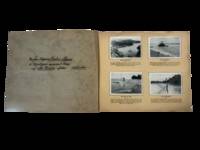
1936réf. 230101936. Neuendettelsau Mission publisher. Bilder aus der Neuguinea Mission late 1920s-mid 1930s documents German Protestant missionary activity and Indigenous life in New Guinea during the interwar period following the end of formal German colonial rule. Produced as a cigarette card album with printed German captions the work records village life subsistence practices missionary institutions and ceremonial activity situating Indigenous communities within a visual framework shaped by religious and colonial perspectives. The album supports research into Pacific history missionary networks and the role of photography in documenting and interpreting Indigenous societies under colonial influence. Oblong album containing a substantial series of mounted photographic cigarette cards on captioned leaves with printed German text throughout. The cover title reads "Bilder aus der Neuguinea-Mission" and includes a commemorative image captioned "Gedenkt des 50 jährigen Jubiläums der Neuendettelsauer Mission auf Neuguinea!" depicting three Indigenous men in traditional dress with spears. The album includes numerous images of daily life in coastal New Guinea including fishing hunting boat building village environments and ceremonial gatherings with captions such as "Mit Pfeil und Bogen" and "Mit dem Jagenetz" describing subsistence practices. Additional images depict mission infrastructure including churches schools workshops and settlements alongside scenes of education labor and communal activity. Photographs are systematically arranged and mounted presenting both ethnographic subjects and missionary-built environments within a unified visual sequence. The album was produced during a transitional period when German missionary societies continued operations in New Guinea under Australian administration after World War I maintaining institutional presence despite the loss of formal colonial control. The Neuendettelsau Mission founded in Bavaria in the nineteenth century had established networks of religious and educational institutions in the region contributing to broader systems of cultural transformation and documentation. The images reflect both local practices and the interpretive framework imposed by missionary observers revealing how photography functioned within colonial and religious contexts to classify record and disseminate knowledge about Indigenous populations. Mild toning foxing and edge wear to covers and pages; cards remain securely mounted with images largely clean and crisp; overall very good condition. This album provides sustained visual documentation of missionary activity and Indigenous life in New Guinea during the interwar period. unknown
1910réf. 230071910. New Guinea photo archive group of 22 photographs dating to the early twentieth century documenting Indigenous communities and the colonial environments imposed around them. The material captures village life family groups communal activity and built spaces associated with missionary and administrative expansion providing direct visual evidence of how Indigenous people in New Guinea were photographed during a period of accelerating colonial intervention. These images are historically significant for the study of Indigenous life under colonial rule especially where domestic ceremonial and communal scenes appear alongside roads chapels and other introduced structures. Twenty-two black-and-white photographs including real photo postcards and original prints depicting Indigenous men women and children in both portrait and wider landscape formats. The archive includes captioned views such as "Native Huts New Guinea" "A Chapel in New Guinea" "One of Many New Guinea Highways" and "A Native Family of New Guinea." Several images focus on Indigenous dwellings family groupings and village settings while others show larger gatherings outdoor performances or dances communal scenes domestic labor and construction activity. A second grouping centers on colonial-built environments including palm-lined roads formal structures mission buildings and organized settlements. Closer portraits emphasize bodily presentation hairstyle adornment posture and dress while broader views show the spatial relationship between Indigenous communities and the altered colonial landscape. Sizes vary with the group consisting of postcard-format and similarly sized original photographs. Produced during a period of intensified missionary presence road building and colonial administration in New Guinea these photographs document the coexistence of Indigenous continuity and imposed colonial systems. The images show how photography was used to record classify and circulate views of Indigenous people and colonial development while also preserving visual evidence of community structure and daily life under conditions of outside control. The archive supports research into Indigenous history colonial visual culture missionary activity and the transformation of built and social environments in the Pacific. Minor handling wear and light edge wear; overall very good condition. A cohesive visual record of Indigenous life and colonial transformation in early twentieth-century New Guinea. unknown
1885réf. 187509Australia: The Geographical Society of Australasia 1885 & 1886. Two elaborately decorated manuscripts presented to Captain Henry Charles Everill congratulating him and the members of the New Guinea Exploratory Expedition on a successful voyage. The quarto manuscript was presented by the Geographical Society of Australasia who funded the expedition and the folio by the Victorian Branch of the Geographical Society specifically 12 members of which have signed it at the end. Everill's party left Sydney on 10 June 1885 and returned home on 3 December 1885 having spent five months in New Guinea. The object of the expedition was to map unexplored territory in the Fly river region to gather information on local flora and fauna and to perform an anthropological investigation into the indigenous people. However the underlying motivations of the expedition were likely linked to Australian state expansion into the Pacific. In 1883 the Colony of Queensland attempted to annex the east of the island of New Guinea and then again shortly after the federation of Australia in 1901. The expedition left Sydney in the steamer Bonito journeying to New Guinea and up the Fly river into the Strickland River. The river was named during the expedition in honour of Sir Edward Strickland the president of the Geographical Society. The Bonito was stranded in the Strickland at which point Everill led a party another 80 miles up the river in a whaleboat. Purchased by Martin Schøyen b. 1940 the Norwegian collector of rare books and manuscripts Two manuscripts on paper quarto 335 x 265 mm 2 pages and folio 460 x 385 mm single page text in gothic and cursive script in black ink illuminated initials and titles intricate border designs in multiple colours all heightened in gilt. Contemporary black and brown morocco the folio by Thedel and Co. of Melbourne and with silk moiré doublure the quarto by John Sands of Sydney is rebacked lettered and decorated in gilt. Refurbished a few corners restored covers lightly scuffed and marked silverfishing with loss of several words in both texts heavier in the folio affecting signatures light damp staining. A very good set. unknown
1940réf. 230081940. Photographs of Indigenous communities in New Guinea during World War II document direct encounters between local populations and United States military personnel as Allied forces established operational infrastructure across the island beginning in 1942. Taken in the early to mid 1940s these images record the presence of Indigenous men women and children alongside uniformed servicemen situating them within a major Pacific theater of war where military expansion reshaped local environments and social conditions. The archive supports research into Indigenous history wartime contact zones and the impact of global conflict on colonial territories. Archive consists of 26 original black and white photographic prints likely silver gelatin depicting group portraits staged encounters and environmental views in New Guinea. Multiple images show Indigenous individuals arranged in lines or clusters often positioned with U.S. servicemen standing behind or among them indicating organized or facilitated photographic documentation. Dress and adornment vary with women wearing traditional skirts and beadwork and men and children appearing in customary attire. Several photographs include visible military infrastructure including aircraft fuselages transport planes and trucks suggesting proximity to airstrips supply depots or forward bases. A group of images captures a ceremonial dance or ritual with participants wearing elaborate headdresses and woven garments photographed in mid action. These photographs were produced during a period when New Guinea became a strategic center of Allied military operations in the Pacific bringing new systems of transportation labor demands and administrative control into Indigenous regions. Wartime conditions altered patterns of daily life through the introduction of foreign personnel the construction of military facilities and the expansion of colonial oversight. Visual documentation of these encounters reflects both the logistical realities of military presence and the asymmetrical relationships between Indigenous communities and external authority. Minor handling wear and edge wear with occasional fading; overall very good condition. This archive provides primary visual documentation of wartime contact between Indigenous populations and Allied forces in New Guinea during World War II. unknown
réf. PA66Oblong Quarto album ca. 215x28 cm or 8 ½ x 11 ¼ in. 26 card stock leaves. With 43 gelatin silver photos 42 mounted one loosely inserted including sixteen larger photos one photo in two copies ca. 105x15 cm 4x6 in; the rest of the photos are from ca. 7x115 cm 2 ¾ x 4 ½ in to ca. 6x85 cm 2 ¼ x 3 ¼ in. With seventeen mounted printed photo reproductions ca. 7x11 cm 2 ¾ x 4 ¼ in. No captions. Sixteen large photos with period ink stamps “Commonwealth of Australia. Department of Information” on versos. Period white ink manuscript title on the inner side of the front cover. Period olive green full cloth binding fastened with a string. Boards rubbed and soiled on extremities binding loosened on the hinges several images with minor creases on the corners but overall a very good album of strong rare photos. Interesting album with official and amateur gelatin silver photos most likely taken and collected by an Australian military man during his service in the New Guinea Campaign of WW2 January 1942 – August 1945. According to the manuscript title the album covers the period of 1943-1944 when the Allied Australian and American forces drove Japanese troops off the eastern New Guinea then the Australian-administrated Territory of New Guinea along the Kokoda Track and fought for the interior and coastal villages of Wau Salamaua Buna Gona &c. The album opens with sixteen official photographs issued by the Department of Information of the Australian Commonwealth. Among the images is a portrait of General Sir Thomas Blamey 1884-1951 then Commander of the Allied Land Forces in the Southwest Pacific Area and General Robert L. Eichelberger 1886-1951 Commander of the Eighth U.S. Army in the Southwest Pacific Area taken next to a Japanese pillbox in the Buna area Australian War Memorial. Another photo portrays General Blamey talking with Australian military officers. There are also photos of a detachment of the Royal Papuan Constabulary State Library of New South Wales scenes with Australian soldiers and Papuans transporting the wounded in the Papuan jungle women on service in the U.S. Army bathing in a stream see more Australian soldiers crossing jungle resting in a tent taking part in a Papuan celebration Papuans carrying loads or taking them in canoes portraits of Papuan people &c. The amateur snapshot photos show Australian soldiers posing with the Papuans in native villages portraits of local families dancers girls a Papuan boy reading the issue of the New York “Variety” Magazine with the headline “D-Day Biggest Radio Story” Vol. 154 No. 13 June 7 1944 views of coastal defence structures &c. Seventeen photo reproductions include portraits of Papuans views of jungle bridges roads a village destroyed by the Japanese &c. Overall an interesting collection of original photos illustrating the New Guinea Campaign of WW2. hardcover
réf. 13982064New York: The Museum of primitive art, 1963 in-4, 10 pages, illustrations. Agrafé, bon état.
1911réf. 300656Verlag Dietrich Reimer (Ernst Vohsen) Berlin 1911. 4°. Brauner Original-Ganzleinenband mit blau-schwarz geprägten Titeln und Verzierungen im Original-Schutzumschlag. VII, 336 Tafeln mit 764 Zinkätzungen, eine mehrfach gefaltete Karte "Völkerkarte von Kaiser-Wilhelmsland mit dem Verzeichnis der Tafeln von Band 2 " im Maßstab 1:2000000. Der vorliegende Band hat einen Wasserschaden erlitten, dadurch sind Feuchtränder vorhanden. Die Deckel sind etwas verzogen. Wegen der Kunstdruckpapierverwendung ist der Buchblock trotzdem fest, die Blätter wenig im Randbereich gewellt. Ich habe jedes Blatt einzeln trennen müssen, wodurch teilweise am seitlichen Rand Fehlstellen entstanden sind. Diese sind auf einigen Blättern bis zu einem Centimeter breit, niemals jedoch reichen Sie in die Abbildungen hinein. Der Innenerhalt ist sauber. [7 Warenabbildungen]
1911réf. 281979Berlin: Reimer 1911. XIV, 534 Seiten, 334 Zinkätzungen, 1 Karte / VIII, 356 Seiten, 764 Zinkätzungen, 1 Karte. Lex 8° Ln. *ohne den meist fehlenden Bd 3 - die Blätter im Kopfsteg leicht gewellt* bei Bd 2: Einband gelockert, im Gelenk 2-3cm aufgeplatzt* Deckelbezug ebenfalss etwas gewellt* Samo*.
1979réf. SBBI-mon0000102250Australian National University P 1979. hardcover. Acceptable. Please see the condition note after this for details if this is missing please consider Acceptable to mean poor quality that could include major staining water damage writing missing dustjacket etc etc. Our books are dispatched from a Yorkshire former cotton mill. We list via barcode/ISBN so please note that the images are stock images and may not be the exact copy you receive furthermore the details about edition and year might not be accurate as many publishers reuse the same ISBN for multiple editions and as we simply scan a barcode or enter an ISBN we do not check the validity of the edition data when listing. If you're looking for an exact edition please don't order at least not without checking with us first although we don't always have time to check. We aim to dispatch prompty the service used will depend on order value and book size. We can ship to most countries see our shipping policies. Payment is via Abe only. Australian National University P hardcover
réf. SLIVCN-9782863643723PARENTHESES EDITIONS
réf. DADAX0804705208New unknown
réf. DADAX0804705194New unknown
Madrid, Imprenta Nacional, 1859, 24 x 16 cm., holandesa piel de época con puntas con desgarro en la parte superior del lomo, 167 págs.
1983réf. Alibris.0008769Waigani: National Library Service of Papua New Guinea. 1983. Spiralbound. Very good in very good dust jacket. 369 p. . Continues in part: New Guinea bibliography / University of Papua New Guinea. National Library Service of Papua New Guinea unknown
2010réf. Alibris.0017091National AIDS Council of Papua New Guinea. 2010. Trade paperback. Fine. No dust jacket as issued. 55 p. National AIDS Council of Papua New Guinea paperback
1997réf. 2111902160901453Nagano Prefecture New Guinea Association 1997. Soft Cover. Fine. Number of pages: 318p Nagano Prefecture New Guinea Association paperback