34 résultats
1909réf. feb09891Librariei Alcalay 1909. Used. 1909; Romanian Edition of CAPITANUL ROPOTA; For more details please contact me Librariei Alcalay unknown
1909réf. feb09890Librariei Alcalay 1909. Used. 1909; Romanian Edition of CAPITANUL ROPOTA; For more details please contact me Librariei Alcalay unknown
1908réf. feb1193871908. Used. For more details please contact me unknown
1976réf. DADAX3110068273De Gruyter 1976-12-01. Reprint 2012. hardcover. New. 6.69x0.63x9.61. Buy with confidence. Excellent Customer Service & Return policy. De Gruyter hardcover
1877réf. 003781original letter. CROWTHER Samuel Ajayi c.1809-1891 First African Bishop in the Anglican Church. Autograph Letter Signed. Ware 16 June 1877. Single sheet written in ink on the recto; original horizontal folds. Light creasing from folding; small loss to top left. Very good. A letter written during Crowther's episcopate as Bishop of the Niger declining an invitation to preach at Red Lion Church on account of his impending departure: "no Sunday or week day available in June and in July I shall be on the voyage for Africa." Samuel Ajayi Crowther born in present-day Nigeria was captured and enslaved as a child liberated by the Royal Navy and educated in Sierra Leone. Ordained in the Church of England he became in 1864 the first African bishop in the Anglican Communion serving over the Niger mission during a formative period of missionary expansion in West Africa. The present letter dates from a return visit to England and refers directly to his voyage back to Africa during his tenure as bishop. Letters from Crowther are uncommon on the market. . Very Good. Soft cover. 1st Edition. 1st Printing. 1877. original letter paperback
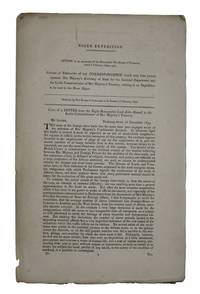
1840réf. AQ24366London: s.n. 1840. 6pp. Docket title to verso of final leaf. A trifle creased some very short tears to margins. A rare survival ordered to be printed by the House of Commons of copies of correspondence concerning the setting up of a British expedition to Niger to attempt to repress the foreign slave trade. The expedition organised by the Society for the Extinction of the Slave Trade and for the Civilization of Africa was ultimately mounted in 1841 using three British iron steam vessels to travel to Lokoja at the confluence of the Niger River and Benue River where treaties against the slave trade where achieved - despite significant casualties from illness amongst members of the expedition - with the cities of Aboh and Idah. OCLC records copies at four locations Florida Harvard NYPL and Oxford; COPAC adds no further. . First edition. Folio. [s.n.] unknown
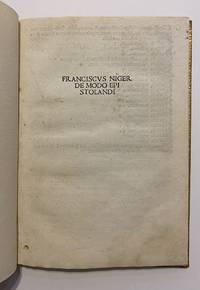
1508réf. 4421Venice: Ioannes Rubeus Vercellensis 1508. Very good. Small 4to. 32 ff. some stains and repairs. Later inscriptions in Italian on final blank page. Bound in 20th-century French crushed niger morocco five raised bands on spine title lettered direct in the second compartment turn-ins gilt marbled pastedowns and endpapers edges plain. An attractive copy. A FOUNDATIONAL TEXT IN HUMANIST EDUCATION AND "ONE OF THE MOST POPULAR AND DISTINGUISHED GUIDES" TO LETTER WRITING WITH MODELS AND DETAILED INSTRUCTIONS FOR SECRETARIES ON HOW NOT TO WRITE A LETTER. Burckhardt "Civilization of the Renaissance" emphasizes the importance of epistolography as an achievement of the true humanist: "To maintain a faultless style under all circumstances was a rule of good breeding and a result of habit." The present pamphlet reached Europe-wide fame and was published in 43 editions in the fifteenth century alone. Salloch describing the need of humanists for exacting manuals for letter-writing states: "One of the most popular and most distinguished of these guides was Franciscus Niger's published first in 1488 recte: 1487. He gives a review of the different kinds of letters from 'Epistola Commendaticia' to amatoria gratulatoria invectiva jocosa etc. furnishes examples of perfect letters from classical as well as contemporary sources and combines them with concise practical rules. Faultless Latin and a select use of the principles of rhetoric seem to be the characteristic features" Salloch Catalogue 234 no. 973. Venetian grammarian Francesco Negri 1452-1523 was a teacher at the Hungarian court of Hippolito d'Este who had attracted a number of distinguished scholars in his Italian retinue. See Farkas Gabor Kiss "Renaissance humanism in the age of the Jagiellonian kings in Hungary 1490-1526" in: Hungarian Studies Volume 36 issue 5 uploaded 2022. See also: Giovanni Mercati "Francesco Pescennio Negro Veneto protonotario Apostolico" in: Ultimi contributi alla storia degli umanisti Vatican City 1939 III 24-109 1-75. Ours is the earliest of the two copies currently on the market; the other was published 35 years later in 1543. EDIT16 CNCE 61805 locating five copies. Inexplicably omitted from Erdmann's massive 771-page "Ars Epistolica" catalogue 2014. Ioannes Rubeus Vercellensis unknown
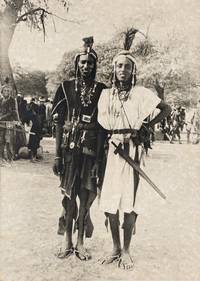
réf. PF64Eighty-two loose original gelatin silver photos all ca. 9x12 cm 3 ½ x 4 ¾ in. All images with period ink numbers and dates either “26.6.72” or “16.6.72” on verso. Mild foxing otherwise a very good collection of rare interesting photos. Interesting extensive collection of 82 original rare gelatin silver photos of the Republic of Niger and its people dating back to the early 1970s. A part of French West Africa since the 1900s Niger declared independence in 1960. The collection features a scene with Niger’s first president Hamani Diori 1916-1989 driving in an open car with an African military commander possibly in the country’s capital Niamey being greeted by a crowd of spectators. There are also views of the mosque in Agadez Tchirozerine Department central Niger and a cenotaph to the soldiers fallen in WW1 a fort with a waving flag of Niger is seen in the background. A series of six photos documents a public parade featuring representatives of different ethnic groups in traditional clothing walking or riding camels or horses down a street possibly in Niamey. All six photos display a sign for the “British Petroleum” company and two images also show the waving flags of Niger. The remaining images focus on the lives and traditional cultures of the people of Niger. About a dozen photos depict a Guerewol ceremony of the Fula people young men face-painted and dressed in elaborate outfits young women with elaborate hairdos and headdresses in a crowd of spectators. Several images show native villages of traditional mud huts. The other photos portray native craftsmen market buyers and sellers cattle herders women grinding grains elders dancers families and children a man transporting firewood on his donkeys a Muslim congregation during prayer Tuareg riders and their camels and others. Overall an interesting collection of original photos of Niger and its people during the first decades of the country’s independence. hardcover
1517réf. 132° mm 270x194; cc. 18 211 recte: 210 14. Carattere romano con numerose citazioni in carattere greco. Legatura settecentesca in pergamena rigida; dorso a scomparti con titolo e autore in oro su etichetta in marocchino. Bellissimo esemplare dai margini pressoché intonsi Provenienza: Biblioteca Archinto ex-libris araldico. Editio princeps. In testa al volume si trovano legati con segnature indipendenti aa-bb8-cc4 due altri testi del medesimo Autore: la Consolatoria oratio ad Apollinium e il De Fraterna benevolentia opusculum verosimilmente estratti dall'edizione degli Opuscula di Plutarco pubblicati a Basilea nel 1530 'In Officina And. Cratandri'. Negri's work is introduced by a dedicatory epistle to Jean Grolier de Servières 1479-1565 General Treasurer of France and famous bibliophile on whose association cf. A. Hobson Renaissance book collecting: Jean Grolier and Diego Hurtado de Mendoza. Their books and bindings Cambridge 1999 pp. 28-30. The Dialogus printed after Philostratus's Heroica finds its philological fulcrum in a commentary on the Periegesis of Pausanias still essential today: "the extraordinary Latin paraphrase of the Periegesis in the form of a dialogue published by Stefano Negri in 1517 only a year after the publication of the editio princeps. In his introduction Negri extols the didactic value of the text: the literary journey upon which Pausanias takes the reader can in Negri's view go some way toward replicating the illumination from actual travel to antique lands an experience that was no longer available to the young Philhellenes of Renaissance Europe" W.E. Hutton. "Livre excellent et très rare qui conserve encore une haute reputation" Brunet III 519. Stefano Negri allievo di Demetrio Chalcondylas fu professore di Greco a Milano dapprima presso la scuola dell'Ospedale Maggiore fondata grazie al lascito di Costantino Lascaris in seguito al Collegio dei Giovani Greci che Giano Lascaris fece finanziare da Francesco I cfr. Storia di Milano VIII 437. in officina Minutiana