BRAZZAVILLE CONGOBiblio.com
3,035 results
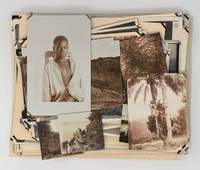
ref. PF73123 loose gelatin silver photos including 71 large images ca. 175x235 cm 6 ¾ x 9 in one photo ca. 175x205 cm 7x8 in and over forty images from ca. 13x18 cm 5x7 in to ca. 85x13 cm 3 ¼ x 5 in; five small photos are from ca. 8x105 cm 3 ¼ x 4 ¼ in to ca. 55x6 cm 2 x 2 ¼ in; six images are printed as real photo postcards. Three photos with period pencil captions in French on verso; one photo with an ink stamp “Compagnie Aérienne Française 18 Rue de Nanterre Suresnes” on verso. The images were previously removed from an album so most have remnants of mounting on the corners ca. 15 with minor tears or losses to corners. Several images with minor creases on extremities several slightly faded but overall a very good collection. Historically significant extensive collection of original gelatin silver photos showing a copper ore processing plant of the “Compagnie Minière du Congo Français” on the M’Vouvou River near the town of Mindouli French Congo modern-day Pool Department in the middle Congo region of the Republic of Congo. “Compagnie Minière du Congo Français” or CMCF 1911-1962 was established mainly for the extraction of the mineral resources of the Mindouli district reaching the height of its operations in the 1930s after the construction of the ore processing plant on the M’Vouvou River a tributary of the Loukouni which flows into the Niari – the main regional river in 1929. The company was closed shortly after the Republic of Congo gained independence in 1960. The photos include over twenty photos of the M’Vouvou processing plant and the adjacent French residential compound general and close-up views of the plant and the bungalows including six aerial views the factory French compound native villages and roads. Two photos have period pencil captions on verso reading: “Usine de la C.M.C.F. à Mindouli – M’Vouvou;” “Usine de traitement de minerai <…> à Mindouli Vouvou. Proprieté C.M.C.F…” Over seventy photos depict the Loukouni River one image is captioned “Les gorge de la Loukouni” and also most likely its tributaries M’Vouvou and Mindouli which surrounded the area where the plant was constructed. The photos show river valleys and gorges overhanging cliffs rapids and waterfalls with French residents swimming picnicking on the banks posing on a hanging bridge under the cliffs &c. There are also photos of native villages with thatched-roof houses a Congolese town street with an open-air restaurant the interior of a local infirmary with a Congolese caretaker; a biplane sign “O-BAHT” painted on the side with a group of French colonial residents; views of a capsized rail cart on a slope being examined by Congolese workers; portraits of French residents posing next to their bungalows or pretending to do a boxing match Congolese boatsmen and their pirogues workers and their families posing in front of their cottages women working in a field a young man climbing up a palm tree a mother with child and others. Overall an interesting extensive collection of original gelatin silver photos of the Mindouli ore processing plant and district in the middle Congo River in the 1930s. unknown
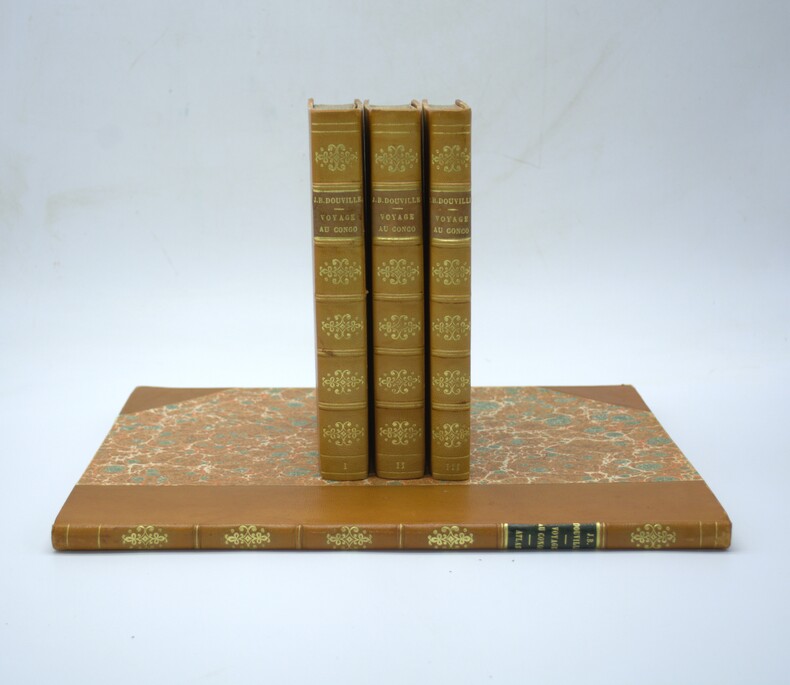
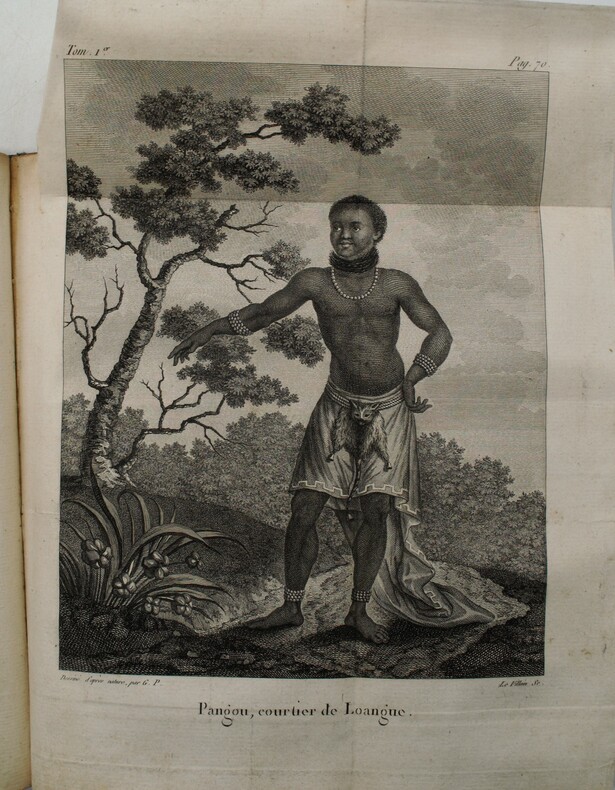
1832ref. PHO-2260Paris, Jules Renouard, 1832. 3 vol. in-8° (21,5x14cm) de xxxj, 1 bl., 328 pp. ; 380 pp. ; 272 pp. et son Atlas in-folio (37x29cm) de titre, [1] p., 1 grande carte dépliante et 21 planches lithographiées (la n° 6 en double). Demi-chagrin miel à coins, dos à 5 faux-nerfs orné, p. de t. en maroquin fauve, tomaison dorée en pied, tête dorée, couverture et dos conservé (Reliure moderne). Des rousseurs, quelques pl. de l'Atlas légèrement brunies, coiffe sup. de l’atlas légèrement frottée. Étiquette de librairie, le frontispice figurant la médaille reçue par l’auteur est en déficit. Bel ensemble.
1801ref. PHO-1139Paris, Dentu, 1801. 2 vol. in-8, (2) ff., 226 pp. ; (2) ff., 320 pp., 2 cartes, un plan et 8 pl. dépl., mouillures claires, relié demi-veau à coins de l'époque , dos lisse avec pièce d’auteur et titre , mouillure au 1er tome sur les 10 premiers feuillets , déchirures aux plis de 2 gravures.
1801ref. 0032601801 Paris, Dentu, An IX - 1801. Deux volumes in-8 (197 X 130 mm) demi-veau fauve à petits coins, dos lisse orné de filets gras et perlés, larges fleurons dorés, pièces de titre et de tomaison veau vert lierre, la tomaison est frappée au centre d'un blason doré et orné (reliure de l'époque). Tome I : faux-titre, titre, 32 pages, XXVIII pages, 226 pages, 1 carte et 7 planches dépliantes ; Tome II : faux-titre, titre, 320 pages, 1 plan, 1 carte et 1 planche dépliante. Tache brune en marge de quelques feuillets du premier tome et en marge de deux gravures, sans gravité.
ref. 13978188s. l.: Sur les Presses de l'Auteur, 1932 1 vol. in-4 (22 x 32 cm) en feuilles, [5] ff., 10 eaux-fortes. Couverture rempliée. 10 eaux-fortes à pleine page et 2 vignettes de H. Kerels. Tirage limité à 32 exemplaires, celui-ci n° 24. Quelques piqûres sur les premiers feuillets. (Benezit VII, 761)
1960ref. 014528Paris Galerie Iris Clert 1960 In-8 à l'italienne Broché
ref. 13981038Paris: 2004 Portofolio in folio (43 x 31 cm) de douze PHOTOGRAPHIES ORIGINALES éditées à VINGT EXEMPLAIRES signés et numérotés, estampillées au sceau de l'atelier, plus deux exemplaires "épreuves d'artistes", réalisé à l'occasion de l'exposition du même nom présenté au Musée royal de l'Afrique centrale de Tervuren (Belgique) en avril 2004. Exemplaire n° 11/20.
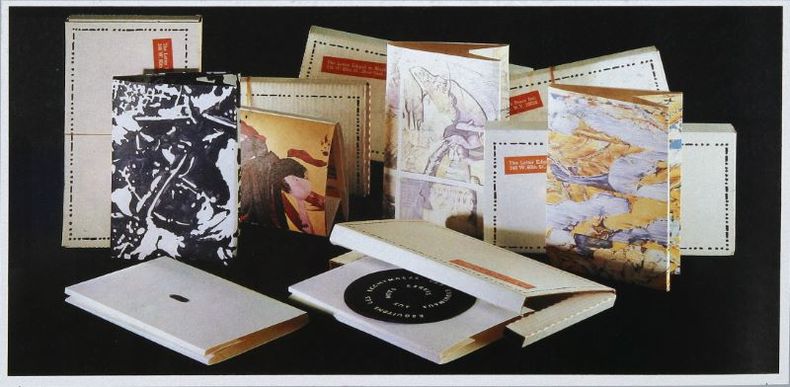
1968ref. 100144New York The Letter Edged in Black Press, 1968. 1968 6 17.8 x 27.9 cm. New York, The Letter Edged in Black Press, 1968. Six portefeuilles 178 x 279 mm, présentés dans leurs emballages postaux d’origine, contenant chacun un sommaire, pour un total de 73 multiples originaux.
1901ref. 100107AG1901. Laeken / Brussels Château de Laeken Palace of Laeken 1901 - 1906. 16 pages of MLS Manuscript Letters signed on 10 leaves of Leopold's official stationery "Château de Laeken" and "Palais de Bruxelles". The leaves with different sizes 135 cm x 9 cm and 18 cm x 115 cm. Excellent condition. Unsigned. Tremendously rare to find original letters by Leopold II on the open market in which the Colonial Free State and the protection against inquisitive visitors is discussed in such clear and instructive fashion. Leopold's correspondence with Adolphe de Cuvelier shows how he is very much trying to still protect and influence the narrative of his Colonial Slavery Outpost even in the final years of his life. Adolphe de Cuvelier 1860-1931 Secretary General of the Ministry of Foreign Affairs of the Congo Free State President of the Syndicate for Studies and Enterprises in Congo. He was given the title of knight in 1893 and baron in 1908 each transferable at first birth. Wikipedia _______________________________ Leopold II French: Léopold Louis Philippe Marie Victor; 9 April 1835 17 December 1909 was the second King of the Belgians from 1865 to 1909 and through his own efforts the owner and absolute ruler of the Congo Free State from 1885 to 1908. Born in Brussels as the second but eldest surviving son of Leopold I and Louise of Orléans he succeeded his father to the Belgian throne in 1865 and reigned for exactly 44 years until his deaththe longest reign of any Belgian monarch. He died without surviving legitimate sons. The current Belgian king descends from his nephew and successor Albert I. Leopold was the founder and sole owner of the Congo Free State a private project undertaken on his own behalf as a personal union with Belgium. He used Henry Morton Stanley to help him lay claim to the Congo the present-day Democratic Republic of the Congo. At the Berlin Conference of 18841885 the colonial nations of Europe authorized his claim and committed the Congo Free State to him. Leopold ran the Congo using the mercenary Force Publique for his personal gain. He extracted a fortune from the territory initially by the collection of ivory and after a rise in the price of natural rubber in the 1890s by forced labour from the native population to harvest and process rubber. Leopold's administration of the Congo Free State was characterised by atrocities and systematic brutality including torture murder and the amputation of the hands of men women and children when the quota of rubber was not met. In 1890 George Washington Williams used the term "crimes against humanity" to describe the practices of Leopold II of Belgium's administration of the Congo Free State. Colonial accounts typically emphasized Leopold's modernizing changes in the Congo and not the mass death he facilitated. These and other facts were established at the time by eyewitness testimony on-site inspection by an international commission of inquiry and the 1904 Casement Report. Modern estimates range from 1 million to 15 million Congolese deaths with a consensus growing around 10 million. Some historians argue against these figures citing the lack of reliable censuses the enormous mortality caused by smallpox and African trypanosomiasis and the fact that there were only 175 administrative agents in charge of rubber exploitation. In 1908 the reports of deaths and abuse and pressure from the Congo Reform Association and other international groups induced the Belgian government to take over the administration of the Congo from Leopold as a new territory Belgian Congo. Wikipedia unknown
1956ref. 49942Arthaud, 1956. Format 16+x21 cm, 293 pages. Sous couverture plastique. Très bon état.