3,062 results
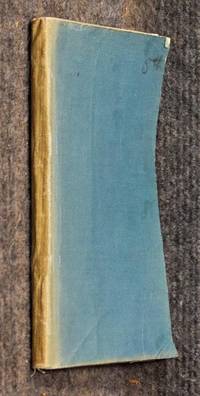
1899ref. 91742London: Her Majesty's Stationery Office 1899. Presumed First Edition First Printing. Wraps. Good. 9 1 pages and 36 pages. Tabular Data. This item has been disbound from a larger volume and now has a stiff blue cover protecting it. The British Central Africa Protectorate BCA was a British protectorate proclaimed in 1889 and ratified in 1891 that occupied the same area as present-day Malawi: it was renamed Nyasaland in 1907. British interest in the area arose from visits made by David Livingstone from 1858 onward during his exploration of the Zambezi area. This encouraged missionary activity that started in the 1860s undertaken by the Universities' Mission to Central Africa the Church of Scotland and the Free Church of Scotland and which was followed by a small number of settlers. The Portuguese government attempted to claim much of the area in which the missionaries and settlers operated but this was disputed by the British government. To forestall a Portuguese expedition claiming effective occupation a protectorate was proclaimed first over the south of this area then over the whole of it in 1889. After negotiations with the Portuguese and German governments on its boundaries the protectorate was formally ratified by the British government in May 1891. As late as 1888 the British Foreign Office declined to accept responsibility for protecting the rudimentary British settlements in the Shire Highlands despite unsubstantiated claims by the African Lakes Company of Portuguese interference with their trading activities. However it also declined to negotiate with the Portuguese government on their claim that the Shire Highlands should be considered part of Portuguese East Africa as it was not regarded by the Foreign Office as under effective Portuguese occupation. In order to prevent Portuguese occupation the British government sent Henry Hamilton Johnston as British consul to Mozambique and the Interior with instructions to report on the extent of Portuguese rule in the Zambezi and Shire valleys and the vicinity and to make conditional treaties with local rulers beyond Portuguese jurisdiction. These conditional treaties of friendship did not amount to the establishment of a British protectorate but prevented those rulers from accepting protection from another state. In response to a Portuguese incursion Johnston's deputy John Buchanan declared a Shire Highlands Protectorate in Johnston's absence despite the contrary Foreign Office instructions. It seems probable that Buchanan's action made without reference to the Foreign Office but following instructions that Johnston had left was to prevent any further advance by the Portuguese rather than to establish British rule in the area. Johnston's proclamation of a further protectorate the Nyasaland Districts Protectorate west of Lake Malawi was also contrary to Foreign Office instructions. However it was endorsed by the Foreign Office in May 1891. This was because the discovery of the Chinde channel in the Zambezi delta which was deep enough to allow sea-going ships to enter the Zambezi which was an international waterway without having to enter Portuguese territory whereas previously such ships had to use the port of Quelimane. There followed an Anglo-Portuguese Crisis in which a British refusal of arbitration was followed by the 1890 British Ultimatum of 11 January 1890. This demanded that the Portuguese give up all claims to territories beyond the Ruo River and west of Lake Malawi. The Portuguese government accepted under duress and ordered their troops in the Shire valley to withdraw to the south bank of the Ruo. This order was received by the commander at Katunga on 8 March 1890 and all Portuguese forces had evacuated Katunga and Chiromo by 12 March. An 1891 Anglo-Portuguese treaty fixed the southern borders of what had been renamed the British Central Africa Protectorate. The treaty also granted Britain a 99-year lease over Chinde a port at one of the Zambezi delta mouths where sea-going ships could transfer goods and passengers to river boats. The northern border of the protectorate was agreed at the Songwe River as part of the Anglo-German Convention in 1890. Its western border with Northern Rhodesia was fixed in 1891 at the drainage divide between Lake Malawi and the Luangwa River by agreement with the British South Africa Company which governed what is today Zambia under Royal Charter until 1924. After this until 1898 troops were used to assist the locally recruited police force to suppress the slave trade. The three main groups resisting British occupation were Yao chiefs in the south of the protectorate and Swahili groups around the center and north of Lake Nyasa both involved in the slave trade and Ngoni people who had formed two aggressively expansionists kingdoms in the west and north. As the northern Ngoni kingdom did not threaten European trading interests as it was far from European-owned estates and as the Scottish mission at Livingstonia was influential within the kingdom Johnston did not use force against it. It accepted British rule in 1904 on condition of retaining its own traditions. Its king was recognized as a paramount chief the only one in the protectorate at that time. Her Majesty's Stationery Office paperback
ref. 2343104786.Gpaperback. Good. Access codes and supplements are not guaranteed with used items. May be an ex-library book. paperback
ref. 2747523659.Gpaperback. Good. Access codes and supplements are not guaranteed with used items. May be an ex-library book. paperback
ref. 2738450695.Gpaperback. Good. Access codes and supplements are not guaranteed with used items. May be an ex-library book. paperback
ref. 0428004121.Gpaperback. Good. Access codes and supplements are not guaranteed with used items. May be an ex-library book. paperback
ref. 0331703777.Ghardcover. Good. Access codes and supplements are not guaranteed with used items. May be an ex-library book. hardcover
ref. 0259475807.Gpaperback. Good. Access codes and supplements are not guaranteed with used items. May be an ex-library book. paperback
ref. 6208456266.Gpaperback. Good. Access codes and supplements are not guaranteed with used items. May be an ex-library book. paperback
1918ref. 40631Bolenge: Congo. Very Good with no dust jacket. 1918. Fifth Edition. Flexible cloth. Small 8vo ; 231 pages; Belgian Congo. Bonkanda wa Nsao ya Nzakomba. Fifth Edition Enlarged and Revised. 231 hymns on 76 leaves in Bobangi. 8vo contemporary plain limp cloth; moderate wear spine sunned. Bolenge Congo Belge 1918. Not too many of these survive African Congo exposure in good shape. Mainly comprised of Christian hymns in Bobangi. . Congo hardcover
ref. 2296050697.Gpaperback. Good. Access codes and supplements are not guaranteed with used items. May be an ex-library book. paperback
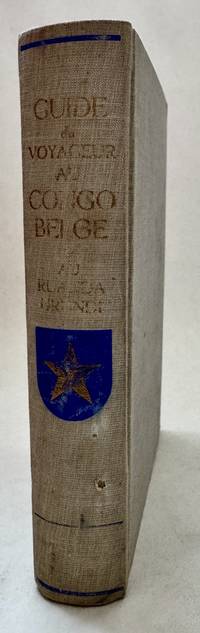
1949ref. 105063Bruxelles: R. Dupriez 1949. First Edition. Hardcover. Very good ; some mild wear to exterior and rubbing to spine; binding solid; pages clean and fold-out maps in excellent condition. Octavo in grey cloth boards with blue and gilt spine title; 757 pages: illustrations some color; portraits; maps; index; 21 cm. In French. Uncommon. A fascinating relic of the Belgian congo and Rwanda/Burundi and a glimpse into the language and attitudes of the colonial regime that lasted until 1960 and their attempts to encourage tourism and development in the region. Flora fauna culture art peoples economics geography and architecture are explored with significant detail illustrations and tables. // Burundi Burundi Guidebooks Congo Democratic Republic Democratic Republic of the Congo Democratic Republic of the Congo. R. Dupriez hardcover
2018ref. 2-6202272333Éditions universitaires européennes 2018. Paperback. New. 56 pages. French language. 8.66x5.91x0.13 inches. Éditions universitaires européennes paperback
1958ref. 16299Leopoldville Kinshasa: Le Conseil Protestant Du Congo Léopoldville. Very Good- with no dust jacket. 1958. Pamphlet. Light rub light tone light wear. Oversize paperback stapled pamphlet. ; French language. Pictorial history of Protestant missionary activities in Kinshasa during the Belgian Congo years on the 80th anniversary of the 1878 landing of George Grenfell and Thomas Comber of the Baptist Missionary Society. Published for the booth of "des Missions Protestantes au Congo" at the Brussels World's Fair - Expo 58. The first major World's Fair after World War II it also featured an inhabited exhibition Congolese village. Two years later in 1960 the Republic of the Congo was declared independent. An uncommon missionary publication from the last colonial years. . Le Conseil Protestant Du Congo, Léopoldville unknown
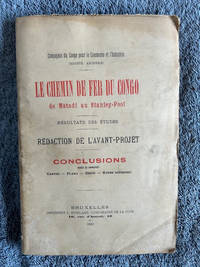
1889ref. 1250325.28L. Bourlard Bruxelles 1889. . Very Good. 8vo paperback. Vg condition. Covers lightly soiled. contents clean no marking or writing: appears unread - most pages still uncut. . Binding square and tight. 127 pp. text plus maps and charts. An interesting original publication outlining the ambitious project to ultimately traverse the Congo by rail line. L. Bourlard, Bruxelles paperback
1907ref. 30722London: Religious Tract Society 1907. First Edition. Illustrated with 17 full-page plates and a folding map of Congo at the end of the volume. Thick 8vo publisher's original brick-red cloth the spine and upper cover lettered in gilt top edge gilt. xx 446 14 ads. pp. A fine and handsome copy clean and very well preserved. FIRST EDITION AN EXPANSIVE AND ELUSIVE BIOGRAPHY OF A CONGO PIONEER WRITTEN BY HIS WIFE. A fine work with extensive commentary on the geography the people and the social and cultural interactions of the period. An enlightening look into Congo at a time that the Belgian's were establishing rule over a vast area of the territory. Religious Tract Society hardcover
ref. 1273505123.Gpaperback. Good. Access codes and supplements are not guaranteed with used items. May be an ex-library book. paperback
ref. 386820 May 1916; on letterhead '3 PARLIAMENT HILL MANSIONS HIGHGATE ROAD N.W.'. Editor 1857-1921 of the manuscript newspaper 'Congo Mirror' who 'drew attention to irregularities in Congo Free State 1886; . and accused Congo officials of murders and atrocities; with help he carried on the agitation until the Congo Reform Association was formed; in a series of letters to the African Mail entitled the Lower Congo he pointed out the injustice of the French rule and the concessionnaire system in Congo Francais' Who's Who. Three pages 12mo. On grey paper. Very good. Docketed in pen and green pencil. 'I have the honour to submit a paper on the foundations of government which I shd like to read to the members of the Society. I hope I have made the discovery of the hidden "elemental factor" in all government quite clear as well as the harm which must follow any sic the exclusion of any one of the factors in government.' Refers to previous works 'At the Back of the Blackmans mind' 'Nigerian Studies' and claims to 'have got at the elemental factors after many years of a close study of the West African languages & philosophy.' Asks 'as an old member of the Society' 'for any advice you may be willing to give me that may help me to propogate the knowledge which I believe to be so necessary for right ruling.' 'In the event of your seeing your way to giving me a platform I should like the chair to be taken by Mr. Sidney Low.' Signed 'R. E. Dennett'. In postscript states that he is 'Senior Conservator of Forests Southern Provinces Nigeria'. 20 May 1916; on letterhead '3 PARLIAMENT HILL MANSIONS, | HIGHGATE ROAD, N.W.' unknown
1922ref. 7647Luebo Congo Belge Africa: The J. Leighton Wilson Press American Presbyterian Congo Mission 1922. First Edition. Hardcover. Very good. Plain mauve cloth 5 x 7 inches 58 pp. index clean text. No entries for any edition at WorldCat. We have seen three binding varieties for this issue: blue pebble cloth dark green pebble cloth and a mauve plain cloth.There are 38 articles in the Constitution - these define the work the officers & workers the powers of the officers the election of officers &c. The By-Laws start with no. 39 and run to no. 113. These treat with standing committees and their duties how appointed then practical matters of budgets ordering supplies hospital and medical fees &c. Ends with a 8 pp. index. The J. Leighton Wilson Press | American Presbyterian Congo Mission hardcover
1922ref. 7646Luebo Congo Belge Africa: The J. Leighton Wilson Press American Presbyterian Congo Mission 1922. First Edition. Hardcover. Very good. Dark green pebble cloth 5 x 7 inches a few blotchy stains to the binding 58 pp. index clean text. No entries for any edition at WorldCat. We have seen three binding varieties for this issue: blue pebble cloth dark green pebble cloth and a mauve plain cloth.There are 38 articles in the Constitution - these define the work the officers & workers the powers of the officers the election of officers &c. The By-Laws start with no. 39 and run to no. 113. These treat with standing committees and their duties how appointed then practical matters of budgets ordering supplies hospital and medical fees &c. Ends with a 8 pp. index. The J. Leighton Wilson Press | American Presbyterian Congo Mission hardcover
ref. 19807Temple London . 21 May 1867. 2pp. 12mo. With mourning border. In good condition lightly aged. When Twiss 'suggested the circumstance' Sir R. Palmer 'had some doubts about the United States Courts having limited the criminal consequences of violating neutrality to the cruise last word underlined'. There was also 'some doubt about the effect of a sale by a <> of a Prize Court to a third party. Twiss thinks 'it might be desirable to print & circulate the enclosed observations bearing upon those two points'. Temple [ London ]. 21 May 1867. unknown
ref. 1022314459.Gpaperback. Good. Access codes and supplements are not guaranteed with used items. May be an ex-library book. paperback
ref. 1020598980.Ghardcover. Good. Access codes and supplements are not guaranteed with used items. May be an ex-library book. hardcover
1951ref. EXP015Brussels: The Tourist Bureau for the Belgian Congo and Ruanda-Urundi 1951. 1st. Hardcover. Good. Brussels: The Tourist Bureau for the Belgian Congo and Ruanda-Urundi 1951 Good Traveller's guide to the Belgian Congo and Ruanda-Urundi First Edition 1951 757 pp Book is an Ex-Library copy in good condition No DJ Blue-gray cloth cover with gold gilt lettering & blue decoration on spine All edges have blue-gray stippled/staining Rubbing/bumping to spine edges & corners Sunning on spine Library markings including written publisher & catalog number on spine bookplate & usual stampingsThere are signs of visible wear which may include markings bookplate or authors name bumping small tears non-major spine or binding defects but book is still wholly intact SEE PICTURES for any wear or defects Condition based on age of book To ensure you receive the quality of book expected we provide pictures of NOTICEABLE WEAR for ALL books we sell with marked conditions of GOOD If you have any questions at all don't hesitate to send us an email The Tourist Bureau for the Belgian Congo and Ruanda-Urundi hardcover
1950EI2 Saggi Einaudi 138
2010br. Dal 1996 la Repubblica Democratica del Congo è sprofondata in una guerra atroce e di difficile soluzione. Secondo alcune stime i morti supererebbero i cinque milioni. Attraverso un approccio storico-antropologico, l'autore si interroga sulle radici e sulle molteplici dimensioni del conflitto, gettando luce sulla sua estrema complessità. La predazione e il traffico delle risorse naturali - in particolare oro, coltan, diamanti e legname - alimentano un'economia di guerra dalle ramificazioni globali. Ma non basta: il collasso dello stato, insieme alla profonda crisi economica e sociale, colpisce in particolare le nuove generazioni, sempre più povere e ai margini della società. La "crisi giovanile" è dunque una delle ragioni di questa guerra. L'autore si concentra in particolare sui bambini soldato e sui giovani combattenti che hanno militato nei numerosi eserciti e milizie del Congo. In un contesto dove la scuola rappresenta un costo eccessivo per la maggior parte delle famiglie e dove le opportunità lavorative sono limitate, l'arruolamento rappresenta una delle rare possibilità di mobilità sociale e un'alternativa a una condizione di povertà e marginalità. D'altra parte la violenza in Congo non regola soltanto la sfera politica ed economica, ma si insinua nei rapporti sociali più intimi, al punto che molti bambini trovano nelle milizie un luogo più sicuro delle loro famiglie. II libro è il frutto di una lunga ricerca sul campo condotta principalmente nel Kivu, la regione epicentro del conflitto.