3 133 résultats
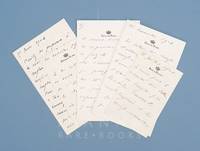
1901réf. 100107AG1901. Laeken / Brussels Château de Laeken Palace of Laeken 1901 - 1906. 16 pages of MLS Manuscript Letters signed on 10 leaves of Leopold's official stationery "Château de Laeken" and "Palais de Bruxelles". The leaves with different sizes 135 cm x 9 cm and 18 cm x 115 cm. Excellent condition. Unsigned. Tremendously rare to find original letters by Leopold II on the open market in which the Colonial Free State and the protection against inquisitive visitors is discussed in such clear and instructive fashion. Leopold's correspondence with Adolphe de Cuvelier shows how he is very much trying to still protect and influence the narrative of his Colonial Slavery Outpost even in the final years of his life. Adolphe de Cuvelier 1860-1931 Secretary General of the Ministry of Foreign Affairs of the Congo Free State President of the Syndicate for Studies and Enterprises in Congo. He was given the title of knight in 1893 and baron in 1908 each transferable at first birth. Wikipedia _______________________________ Leopold II French: Léopold Louis Philippe Marie Victor; 9 April 1835 17 December 1909 was the second King of the Belgians from 1865 to 1909 and through his own efforts the owner and absolute ruler of the Congo Free State from 1885 to 1908. Born in Brussels as the second but eldest surviving son of Leopold I and Louise of Orléans he succeeded his father to the Belgian throne in 1865 and reigned for exactly 44 years until his deaththe longest reign of any Belgian monarch. He died without surviving legitimate sons. The current Belgian king descends from his nephew and successor Albert I. Leopold was the founder and sole owner of the Congo Free State a private project undertaken on his own behalf as a personal union with Belgium. He used Henry Morton Stanley to help him lay claim to the Congo the present-day Democratic Republic of the Congo. At the Berlin Conference of 18841885 the colonial nations of Europe authorized his claim and committed the Congo Free State to him. Leopold ran the Congo using the mercenary Force Publique for his personal gain. He extracted a fortune from the territory initially by the collection of ivory and after a rise in the price of natural rubber in the 1890s by forced labour from the native population to harvest and process rubber. Leopold's administration of the Congo Free State was characterised by atrocities and systematic brutality including torture murder and the amputation of the hands of men women and children when the quota of rubber was not met. In 1890 George Washington Williams used the term "crimes against humanity" to describe the practices of Leopold II of Belgium's administration of the Congo Free State. Colonial accounts typically emphasized Leopold's modernizing changes in the Congo and not the mass death he facilitated. These and other facts were established at the time by eyewitness testimony on-site inspection by an international commission of inquiry and the 1904 Casement Report. Modern estimates range from 1 million to 15 million Congolese deaths with a consensus growing around 10 million. Some historians argue against these figures citing the lack of reliable censuses the enormous mortality caused by smallpox and African trypanosomiasis and the fact that there were only 175 administrative agents in charge of rubber exploitation. In 1908 the reports of deaths and abuse and pressure from the Congo Reform Association and other international groups induced the Belgian government to take over the administration of the Congo from Leopold as a new territory Belgian Congo. Wikipedia unknown
réf. c5896Sans lieu, ni nom, ni date ( 1991) ; in-4° ( format 21 X 20, 7 cm), ouvrage ronéoté, dos collé de toile noire, couverture de papier fort illustrée d'une photographie en couleurs de lion occupant tout le 1er plat avec titre en noir (sous rhodoid transparent ) ; 1f. ( titre), 317pp. Ouvrage illustré de photographies et cartes en noir dans le texte ou à pleine page et hors texte de photographies en couleurs tirées sur papier et contrecollées.
réf. R100037370Non Renseigné. Non daté. In-12. Broché. Bon état, Couv. convenable, Dos satisfaisant, Intérieur frais. Bon état.. . . . Classification : 291.1-Moderne
1906Reliure de l'éditeur. 550 pages. Manques au dos. 25x32cm.
réf. 3604Liège/Bruxelles, Compagnie Générale de Publicité et Information, s.d. ca 1945-1950 23 x 31, 126 pp., très nombreuses illustrations, broché, bon état (2 cachets)
réf. 36638Bruxelles, Cultura, 1969. 24 x 31, 50 planches en couleurs + fascicule catalogue, non broché, en feuilles sous chemise carton et étui en bois, très bon état (sauf 1ère page du catalogue+ salie).
réf. 9052Bruxelles, 1906. 24,5 x 16 cm, 100 pp. et deux cartes dépliantes in fine. Broché, déchirure au dos sinon bon exemplaire. Nombreuses illustrations photographiques. Édition originale.
réf. 9052Bruxelles, 1906. 24,5 x 16 cm, 100 pp. et deux cartes dépliantes in fine. Broché, déchirure au dos sinon bon exemplaire. Nombreuses illustrations photographiques. Édition originale.
réf. 0266991424.Ghardcover. Good. Access codes and supplements are not guaranteed with used items. May be an ex-library book. hardcover
réf. B9781016065702Hardback. New. hardcover
1954réf. 100071790Clarence Denis imp. 1954. Bon état sous papier de soie couverture un peu défraîchie intérieur propre. in8. 1954. Broché. illustrations en noir et blanc Clarence Denis (imp.) unknown
réf. 9458P. Edt. Dillen, 1936. In-8, 186 pages. Broché.
1936réf. 139421936 broché in-octavo (paperback in-octavo), dos marron clair (light brown spine), couverture illustrée (cover illustrated), tranches non rognées (edges no smooth), pages de garde grises (grey endapers), page de faux-titre (half title page), illustrations in et hors-texte - dont des illustrations hors-texte au début et in fine entre les pages de garde et la couverture (illustrations in text and full page engraving - of which illustrations full page engraving between the endpapers and the cover), 194 pages, 1936 à Paris Editions Dillen - Maison Mère des Pères du Saint-Esprit,
réf. 13980703Bruxelles: Goemaere, 1923 in-8, 87 pages. Broché, couv. défr. Extrait de la revue Congo.
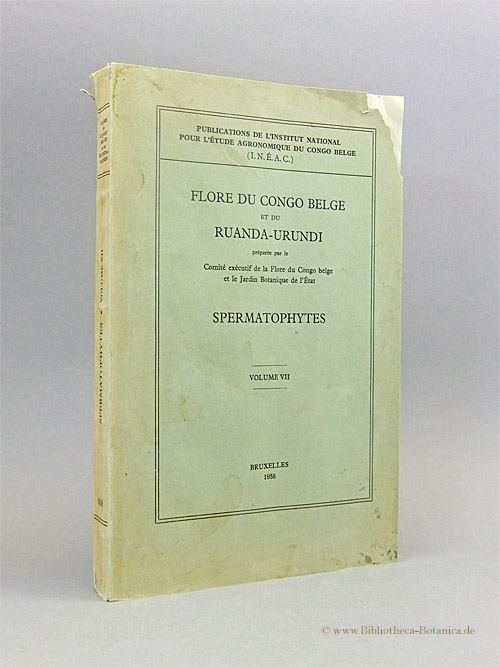
1958réf. 17271ABBruxelles, Publications de l'Institut National pour l'Étude Agronomique du Congo Belge [Hrsg.], 1958. 24,5 cm. (3) Bl., 367 S., mit 36 Tafeln und 11 Strichzeichnungen im Text, 1 Karte. Originalbroschur (Softcover), Fadenheftung. Vol. VII. Gutes Exemplar. Einband am Kapital einseitig eingerissen, mit einem Fehlteil und etwas angefleckt. Buchblock fest und sauber.
1959réf. R160133058. 1959. In-8. Broché. Bon état, Couv. partiel. décollorée, Dos satisfaisant, Intérieur acceptable. 166 pages. Nombreuses photos en noir et blanc dans le texte et hors texte.. . . . Classification Dewey : 70.49-Presse illustrée, magazines, revues
réf. 36087Verviers (Belgique), Marabout, 1971. 11 x 18, 281 pp., très nombreuses illustrations en couleurs et en N/B, reliure plein cuir, très bon état.
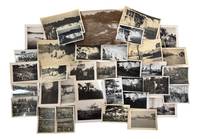
1946réf. 232341946. Belgian Congo photo archive documenting colonialism and segregated settlement in Paulis Jadotville and at Kiubo Falls in 1946-1947 while Belgian rule expanded displacing Congolese communities from political power and control over local resources. Made by an unidentified traveler or colonial observer the group moves between industrial sites river traffic town streets waterfalls village compounds and posed encounters with Congolese residents placing daily life beside the infrastructure of empire. Jadotville in Katanga had been built within the orbit of Union Minière du Haut-Katanga and the copper economy that tied the Congo to European industry; Paulis belonged to the northeastern colonial administrative network that extended surveillance mission activity and commercial penetration into local societies. By the later 1940s these systems were producing wealth for Belgium and foreign markets through forced and controlled labor regimes. Photo archive of 36 black and white silver gelatin photographs various sizes ranging from 2.5" x 3.5" to 5" x 7" Belgian Congo 1946-1947. Nine photographs are identified to the Paulis region in 1946 including versos inscribed in French with "Habitations Européens à Paulis" "Pavillon de l'hotel" and "Le Kigoma sur le fleuve." These images show European-style houses set among palms a large riverside or lakeside steamer a broad colonial street with automobiles and low commercial buildings thatched structures and Congolese figures posed near village compounds and along a tree-lined road. The remaining photographs from Jadotville and Kiubo Falls in 1947 include multiple views of the falls from overlooks and near the waterline several repeated compositions of cascades and riverbanks a dense electrical installation with transformers and steel framing public crowd scenes dugout canoes on calm water groups standing beside temporary camp structures and additional views of thatched settlements large shade trees and Congolese men women and children positioned before houses or in open clearings. Several photographs set European-built environments against Congolese dwellings and occupied landscapes making the colonial dichotomy apparent within this grouping. Waterfalls river steamers electric infrastructure and ordered streets mark the channels through which copper labor and administrative authority moved outward to Belgian and international markets while the photographs of Congolese settlements and residents show the populations who bore that reorganization of land and economy. In the late colonial Congo extraction and transport depended on African labor under coercive conditions and urban growth in places such as Jadotville advanced through racially unequal housing wage structures and civic access leaving Congolese people concentrated in subordinate quarters or rural zones even when their work sustained the entire system. Light wear and occasional creasing; several versos inscribed in French; overall very good condition. An intimate look into Belgian colonial rule at the point where industrial wealth infrastructure and local displacement met on the ground. unknown books
1946réf. 232341946. Belgian Congo photo archive documenting colonialism and segregated settlement in Paulis Jadotville and at Kiubo Falls in 1946-1947 while Belgian rule expanded displacing Congolese communities from political power and control over local resources. Made by an unidentified traveler or colonial observer the group moves between industrial sites river traffic town streets waterfalls village compounds and posed encounters with Congolese residents placing daily life beside the infrastructure of empire. Jadotville in Katanga had been built within the orbit of Union Minière du Haut-Katanga and the copper economy that tied the Congo to European industry; Paulis belonged to the northeastern colonial administrative network that extended surveillance mission activity and commercial penetration into local societies. By the later 1940s these systems were producing wealth for Belgium and foreign markets through forced and controlled labor regimes. Photo archive of 36 black and white silver gelatin photographs various sizes ranging from 2.5" x 3.5" to 5" x 7" Belgian Congo 1946-1947. Nine photographs are identified to the Paulis region in 1946 including versos inscribed in French with "Habitations Européens à Paulis" "Pavillon de l'hotel" and "Le Kigoma sur le fleuve." These images show European-style houses set among palms a large riverside or lakeside steamer a broad colonial street with automobiles and low commercial buildings thatched structures and Congolese figures posed near village compounds and along a tree-lined road. The remaining photographs from Jadotville and Kiubo Falls in 1947 include multiple views of the falls from overlooks and near the waterline several repeated compositions of cascades and riverbanks a dense electrical installation with transformers and steel framing public crowd scenes dugout canoes on calm water groups standing beside temporary camp structures and additional views of thatched settlements large shade trees and Congolese men women and children positioned before houses or in open clearings. Several photographs set European-built environments against Congolese dwellings and occupied landscapes making the colonial dichotomy apparent within this grouping. Waterfalls river steamers electric infrastructure and ordered streets mark the channels through which copper labor and administrative authority moved outward to Belgian and international markets while the photographs of Congolese settlements and residents show the populations who bore that reorganization of land and economy. In the late colonial Congo extraction and transport depended on African labor under coercive conditions and urban growth in places such as Jadotville advanced through racially unequal housing wage structures and civic access leaving Congolese people concentrated in subordinate quarters or rural zones even when their work sustained the entire system. Light wear and occasional creasing; several versos inscribed in French; overall very good condition. An intimate look into Belgian colonial rule at the point where industrial wealth infrastructure and local displacement met on the ground. unknown
1988réf. 0252571988 academie des sciences d'outremer, koninklijke academie voor overzeese wetenschappen Hardcover
1983réf. 0252561983 academie des sciences d'outremer, koninklijke academie voor overzeese wetenschappen Hardcover
1992réf. 0252581992 academie des sciences d'outremer, koninklijke academie voor overzeese wetenschappen Hardcover
in-12° de 302 pages, illustrations, broché. Bel exemplaire. [FRA-4] Tout ce qui faut savoir du Congo belge.
Hard Cover in-folio non paginé (± 250 pages), avec de nombreuses photos et reproductions n&b, cartonnage de l'éditeur. Bon état. [P-44]