VERMOESEN (C.)Livre Rare Book

3 135 résultats
1931réf. WOC-2424Les Essences forestières du Congo Belge. I-Manuel des Essences forestières de la région équatoriale et du Mayombe, par C. Vermoesen (Docteur en sciences naturelles. Conservateur au jardin botanique d'Etat. Ancien directeur du jardin botanique d'Eala (Congo Belge). Professeur à l'Université de Louvin. Planches coloriées et dessins par E. Lange (préparateur d'histoire naturelle), 30 planches en couleurs et 38 planches en noir et blanc. Bruxelles, Imprimerie Industrielle & Financière, 1931. In-8 (18,5x2x10cm) percaline éditeur. XII,282 [8]pp.
réf. 48423, S.l., 1954, Paperback, 14pp texte, 13 planches n/b., belle exemplaire.
réf. 39749Bruxelles, Editions J.M. Collet, 1987. 11 x 18, 274 pp., quelques illustrations en N/B, broché, bon état.
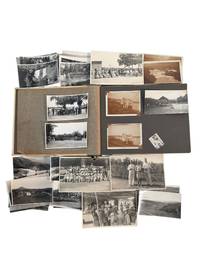
1920réf. 236781920. Belgian Congo colonial residence and indigenous locals photo archive documenting European family life Congolese communities river navigation agricultural districts and travel in the eastern colony circa 1920s to 1930s. The photographs center on Kabalo and related routes through Ituri and Lubero regions integrated into Belgian administration through railways river steamers plantation production and stations built to move personnel and commodities across the interior. European residents appear as travelers hosts sports participants and household members while Congolese people are frequently photographed in large assembled groups at village sites beside transport facilities and within agricultural landscapes shaped by colonial labor demands. Photo album and loose archive of silver gelatin photographs 53 photos with 32 loose most approximately 2.5" x 4" bound in a beige and green board album measuring 7.25" x 10" Belgian Congo circa 1920s to 1930s. Many captioned with name and place identifications. The photographs show European men and women posed in cultivated grounds beside residences on railway platforms and aboard passenger steamers; organized tennis parties and formal gatherings; Congolese crowds assembled beneath palms; workers and families near village buildings; rivers waterfalls upland roads agricultural fields and broad mountain valleys. Several views record launches and larger steam vessels carrying names beginning "Commandant" and "Gouverneur" linking domestic travel to the colonial river fleet. Other images show floodwater submerged or eroded terrain plantation rows administrative or club buildings swimming parties and European visitors observing Congolese gatherings from shaded structures. French inscriptions identify "Kabalo" "Lubero Parc" "Route dans l'Ituri" or "Road in Ituri" and "Petite Halle" or "Small hall." One caption reads in part "L'inondation . de Kabalo mai 1930" or "The flooding . at Kabalo May 1930." Names and surnames visible on versos appear to include Henniger Jordens or Jordaens and possibly Mayenberg; the handwriting does not permit firm identification. Belgian rule after 1908 organized the Congo through concessionary companies missionary institutions administrative posts mines plantations railways and steamer routes intended to extract rubber copper palm products ivory and agricultural commodities while moving European officials and commercial employees through the colony. Kabalo became a strategic junction between the Lualaba River and the rail lines extending toward Lake Tanganyika and the Katanga mining region making it a point where river traffic rail transport labor recruitment and European settlement converged. Minor fading and wear occasional creasing loose photographs and several missing mounts; inscriptions remain generally legible. Overall in good condition. A view at European domestic life in the Belgian Congo depended upon river transport colonial labor agricultural production and the administrative geography of Kabalo and the eastern interior. unknown
1920réf. 236781920. Belgian Congo colonial residence and indigenous locals photo archive documenting European family life Congolese communities river navigation agricultural districts and travel in the eastern colony circa 1920s to 1930s. The photographs center on Kabalo and related routes through Ituri and Lubero regions integrated into Belgian administration through railways river steamers plantation production and stations built to move personnel and commodities across the interior. European residents appear as travelers hosts sports participants and household members while Congolese people are frequently photographed in large assembled groups at village sites beside transport facilities and within agricultural landscapes shaped by colonial labor demands. Photo album and loose archive of silver gelatin photographs 53 photos with 32 loose most approximately 2.5" x 4" bound in a beige and green board album measuring 7.25" x 10" Belgian Congo circa 1920s to 1930s. Many captioned with name and place identifications. The photographs show European men and women posed in cultivated grounds beside residences on railway platforms and aboard passenger steamers; organized tennis parties and formal gatherings; Congolese crowds assembled beneath palms; workers and families near village buildings; rivers waterfalls upland roads agricultural fields and broad mountain valleys. Several views record launches and larger steam vessels carrying names beginning "Commandant" and "Gouverneur" linking domestic travel to the colonial river fleet. Other images show floodwater submerged or eroded terrain plantation rows administrative or club buildings swimming parties and European visitors observing Congolese gatherings from shaded structures. French inscriptions identify "Kabalo" "Lubero Parc" "Route dans l'Ituri" or "Road in Ituri" and "Petite Halle" or "Small hall." One caption reads in part "L'inondation . de Kabalo mai 1930" or "The flooding . at Kabalo May 1930." Names and surnames visible on versos appear to include Henniger Jordens or Jordaens and possibly Mayenberg; the handwriting does not permit firm identification. Belgian rule after 1908 organized the Congo through concessionary companies missionary institutions administrative posts mines plantations railways and steamer routes intended to extract rubber copper palm products ivory and agricultural commodities while moving European officials and commercial employees through the colony. Kabalo became a strategic junction between the Lualaba River and the rail lines extending toward Lake Tanganyika and the Katanga mining region making it a point where river traffic rail transport labor recruitment and European settlement converged. Minor fading and wear occasional creasing loose photographs and several missing mounts; inscriptions remain generally legible. Overall in good condition. A view at European domestic life in the Belgian Congo depended upon river transport colonial labor agricultural production and the administrative geography of Kabalo and the eastern interior. unknown books
réf. 13978674Lochem: De Tijdstroom, 1975 in-8, 154 pages, illustrations. Broché, couv. frottée, bon état. Armes d'Afrique centrale. Texte néerlandais.
1960réf. C97703s.l. [Louvain?], s.d. [ca. anné&es 1960's] ii + 96pp., 27cm., brochure originale illustrée, bon état, rare, [L'Ikeleve, langue africaine, créée dans la province de Léopoldville au Congo belge, la base lontaine en est le Haut-Kikongo des Bampangu de Kisantu], C97703
1960ii + 96pp., 27cm., brochure originale illustrée, bon état, rare, [L'Ikeleve, langue africaine, créée dans la province de Léopoldville au Congo belge, la base lontaine en est le Haut-Kikongo des Bampangu de Kisantu], C97703
200722,5 cm, rilegatura editoriale con titolo al dorso, sovracop. illustrata; p. 349, una carta geografica.
1928In-16 gr., brossura muta, copertina originale applicata al piatto anteriore, pp. 330, con 12 belle tavv. f.t., da acqueforti di U.C. Veneziani. Prima edizione. Pagine leggermente ingiallite per la qualità della carta, peraltro ben conservato.
193918 cm, ril. editoriale, p. 349, 4 tavole ripiegate di cui una a colori f.t
1939IN 16°, pp.349, COPERTINA EDITORIALE CARTONATA RIGIDA CON TITOLO IN ROSSO RIPORTATO ANCHE AL DORSO. UNA CARTA A COLORI E CINQUE IN NERO, TUTTE RIPIEGATE f.t. OPERA FACENTE PARTE DELLA COLLANA MANUALI DI POLITICA INTERNAZIONALE, 20. OTTIMA CONSERVAZIONE. ID 2851
Milano,ISPI, 1939. In 16°pp.350n.+5 Cartine geograf.t. ripiegate. Cartonato Editoriale.
1963Firenze, 1963, 8vo stralcio con copertina posticcia muta, pp. 14 con 17 illustrazioni fotografiche. - !! ATTENZIONE !!: Con il termine estratto (o stralcio) intendiamo riferirci ad un fascicolo contenente un articolo, completo in se, sia che esso sia stato stampato a parte utilizzando la stessa composizione sia che provenga direttamente da una rivista. Le pagine sono indicate come "da/a", ad esempio: 229/231 significa che il testo è composto da tre pagine. Quando la rivista di provenienza non viene indicata é perché ci è sconosciuta. - !! ATTENTION !!: : NOT A BOOK : “extract” or “excerpt” means simply a few pages, original nonetheless, printed in a magazine. Pages are indicated as in "from” “to", for example: 229/231 means the text comprises three pages (229, 230 and 231). If the magazine that contained the pages is not mentioned, it is because it is unknown to us.
1969Milano, Jaka Book, 1969, 8vo brossura editoriale, pp. 83
1913Roma, Società Geografica Italiana, 1913, 8vo stralcio con copertina posticcia muta, pp. 41/58. - !! ATTENZIONE !!: Con il termine estratto (o stralcio) intendiamo riferirci ad un fascicolo contenente un articolo, completo in se, sia che esso sia stato stampato a parte utilizzando la stessa composizione sia che provenga direttamente da una rivista. Le pagine sono indicate come "da/a", ad esempio: 229/231 significa che il testo è composto da tre pagine. Quando la rivista di provenienza non viene indicata é perché ci è sconosciuta. - !! ATTENTION !!: : NOT A BOOK : “extract” or “excerpt” means simply a few pages, original nonetheless, printed in a magazine. Pages are indicated as in "from” “to", for example: 229/231 means the text comprises three pages (229, 230 and 231). If the magazine that contained the pages is not mentioned, it is because it is unknown to us.
1960Roma, 1960, 24 luglio, copertina illustrata a colori in fascicolo originale completo di, pp. 32 de "La Tribuna illustrata" .
1961Vol. cinque uniti in-8° di pp. 121-101-152-162-121. leg. in mezza tela coeva, conservate le bross. edit.
1961Roma, 1961, 3 dicembre, copertina illustrata da una tavola a colori, a pagina doppia, in fascicolo originale completo di, pp. 32 de "La Tribuna illustrata" .
1953Milano, 1953, estratto cop. muta, pp. 1149/1166 con ill. - !! ATTENZIONE !!: Con il termine estratto (o stralcio) intendiamo riferirci ad un fascicolo contenente un articolo, completo in se, sia che esso sia stato stampato a parte utilizzando la stessa composizione sia che provenga direttamente da una rivista. Le pagine sono indicate come "da/a", ad esempio: 229/231 significa che il testo è composto da tre pagine. Quando la rivista di provenienza non viene indicata é perché ci è sconosciuta. - !! ATTENTION !!: : NOT A BOOK : “extract” or “excerpt” means simply a few pages, original nonetheless, printed in a magazine. Pages are indicated as in "from” “to", for example: 229/231 means the text comprises three pages (229, 230 and 231). If the magazine that contained the pages is not mentioned, it is because it is unknown to us.
1953Milano, 1953, stralcio con copertina posticcia muta, pp. 1149/1166 con una cartina e numerose fotografie. - !! ATTENZIONE !!: Con il termine estratto (o stralcio) intendiamo riferirci ad un fascicolo contenente un articolo di rivista, sia che esso sia stato stampato a parte utilizzando la stessa composizione sia che provenga direttamente da una rivista. Le pagine sono indicate come "da/a", ad esempio: 229/231 significa che il testo è composto da tre pagine. Quando la rivista di provenienza non viene indicata é perchè ci è sconosciuta. - !! ATTENTION !!: : NOT A BOOK : “estratto” or “stralcio” means simply a few pages, original nonetheless, printed in a magazine. Pages are indicated as in "from” “to", for example: 229/231 means the text comprises three pages (229, 230 and 231). If the magazine that contained the pages is not mentioned, it is because it is unknown to us.
1960Roma, 1960, 31 luglio, copertina illustrata a colori in fascicolo originale completo di, pp. 32 de "La Tribuna illustrata" .
1902Mm 290x415 Fascicolo in folio di 12 pp. con prima e ultima carta illustrate a colori, illustrazioni in nero e una tavola a colori "Francesco Tamagno". Fioriture ai margini. SPEDIZIONE IN 24 ORE DALLA CONFERMA DELL'ORDINE.
1955(Firenze, IGM, 1955) stralcio con copertina posticcia muta, pp. 473/484 con 3 illustrazioni. - !! ATTENZIONE !!: Con il termine estratto (o stralcio) intendiamo riferirci ad un fascicolo contenente un articolo di rivista, sia che esso sia stato stampato a parte utilizzando la stessa composizione sia che provenga direttamente da una rivista. Le pagine sono indicate come "da/a", ad esempio: 229/231 significa che il testo è composto da tre pagine. Quando la rivista di provenienza non viene indicata é perchè ci è sconosciuta. - !! ATTENTION !!: : NOT A BOOK : “estratto” or “stralcio” means simply a few pages, original nonetheless, printed in a magazine. Pages are indicated as in "from” “to", for example: 229/231 means the text comprises three pages (229, 230 and 231). If the magazine that contained the pages is not mentioned, it is because it is unknown to us.