3062 risultati
1955rif. 519426Tervuren Koninklijk Museum Van Belgisch-Congo 1955 175+188+131+232 pages in-8. 1955. Broché. 175+188+131+232 pages.
1941rif. 519406Tervuren Koninklijk Museum van Belgisch-Kongo 1941 136 pages Publications du bureau de documentation ethnographiques série I Vol III Fasc 4. in-8. 1941. Broché. 136 pages.
1955rif. 519426Tervuren Koninklijk Museum Van Belgisch-Congo 1955. Bon état Bordures de couverture et dos brunis intérieur en excellent état pour les 4 volumes. in-8. 1955. Broché. 175188131232 pages. Tervuren Koninklijk Museum Van Belgisch-Congo unknown
rif. 13978788Paris: Galerie Ratton Hourdé, 1998 in-4, 64 pages, 27 illustrations. Broché, bon état.
1957Un volume cartonné de forrmat petit in 8° ; illustrations en noir dans le texte. Enfantina se déroulant au Congo Brazzaville. Volume manié; voir photos.
192340pp.geïllustreerd + uitvouwbare kaart in kleur ("kaart Europa-Afrika met de verkeerswegen 1923, opgemaakt door J.Flamme"), 24cm., geïllustreerde omslag (rug verstevigd), goed, C84130
1923rif. C84130Brussel, 1923 40pp.geïllustreerd + uitvouwbare kaart in kleur ("kaart Europa-Afrika met de verkeerswegen 1923, opgemaakt door J.Flamme"), 24cm., geïllustreerde omslag (rug verstevigd), goed, C84130
rif. 13686, zonder uitgever, zonder titelblad, zeer waarschijnlijk privaat uitgave van Lode van Gent, met portret ,, Gebonden, kunstleder versierd met vergulde titel op de voorplat en de rug, 20,5x15,5cm, 251pp+16pp, geillustreerd z/w.
rif. 80825Sans lieu, Chocolat Aiglon - Chocolade Aiglon sans date, vers 1940, 305x245mm, 13pages, illustrations en couleurs hors texte / complet des vignettes des 58 en couleurs / Compleet van 58 chromos in gelamineerde kleuren. Broché / Paperback. Edition bilingue: français-néerlandais. Tweetalige editie: Frans-Nederlands. Leuke kopie / bel exemplaire.
rif. 80837Sans lieu, Chocolat Aiglon - Chocolade Aiglon sans date, vers 1940, 305x245mm, 13pages, illustrations en couleurs hors texte. Complet des vignettes des 62 en couleurs, nos° 59 - 120 / Compleet van 60 chromos in gelamineerde kleuren, nos.° 59 - 120. Broché / Paperback. Edition bilingue: français-néerlandais. Tweetalige editie: Frans-Nederlands.
in-12° de 80 pages, broché. Bel exemplaire. [HA-5] A propos d'un entretien inédit du baron Lambermont avec S.A.R. le prince Albert.
rif. 48041962 Imprimerie des sciences broché, 80p. bon état.
1917Broché. 123 pages.
MEXICO, Editorial Jus S.A. - 1947 - In-8 - Broché - Couverture illustrée - Exemplaire non coupé - Carte, photographies NB HT - En espagnol - 454 pages - Très propre
rif. 8810MEXICO, Editorial Jus S.A. - 1947 - In-8 - Broché - Couverture illustrée - Exemplaire non coupé - Carte, photographies NB HT - En espagnol - 454 pages - Très propre
rif. 79568Bruxelles, Société d'édition Dotreville, 1958. 24 x 30, 79 pp., nombreuses illustrations en couleurs et en N/B, reliure d'édition pleine toile, bon état (cachets du Collège jésuite Saint Stanislas à Mons).
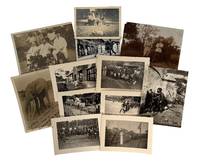
1900rif. 235051900. Belgian colonial Congo photo archive depicting European officials Indigenous Congolese adults and children public ceremony domestic labor and railway grounds between the early twentieth century and 1950. Belgium formally ruled the Congo from 1908 until June 30 1960 after King Leopold II's Congo Free State became notorious for forced labor and violence against Congolese people. A few scenes highlight colonial hierarchy as one photo shows white men in suits helmets and uniforms pose formally in chairs while Congolese men women and children appear as attendants or anthropological subjects surrounding the trio. A 1947 inscription identifying "le régent Charles" places part of the group during the Belgian prince regent's postwar tour of the Congo eight years before King Baudouin visited in 1955 and thirteen years before Congolese independence on June 30 1960. Photo archive of 12 silver gelatin photographs ranging from 3" x 4" to 3.5" x 4.75" Belgian Congo 1900-1950. French inscriptions include "Congo Belge août 1950"; "le régent Charles 1947"; "lundi le 18 janvier 1943 avec notre meilleur bonjour de tous les trois"; and "travailleur portant à l'eau" meaning "worker carrying water." Other scenes show a uniformed colonial procession outside a brick building helmeted men posed in the bush an elephant captioned with French notes Congolese children at a water spout men carrying water a compound walkway a railway yard and Congolese drummers and dancers assembled before mixed local and colonial audiences. The dichotomy of colonists occupying the pose of command travel inspection and ownership while Indigenous Congolese people appear in the surrounding labor ceremony and service spaces make for a compelling collection. Belgian rule in the Congo depended on racial separation administrative paternalism extraction mission education and controlled public ceremony while Congolese political demands intensified after the Second World War and culminated in independence on June 30 1960. Light toning handling and corner wear; photos remain clear and several inscriptions legible en verso; overall in very good condition. This archive gives Belgian colonialism a concrete human scale through officials posed with indigenous children workers ceremonial performers industrial railway spaces and royal reception scenes arranged around the unequal encounter between European power and Indigenous Congolese life. unknown books
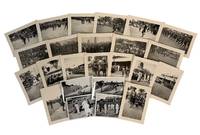
1946rif. 235061946. Congolese ceremonial and colonial encounter photo archive showing indigenous ceremonial dance dress and culture uniformed troops and Belgian officials in the Belgian Congo during the late 1940s and early 1950s. Key scenes are tied to the 1947 visit of Prince Regent Charles to Paulis. Belgium ruled the Congo from 1908 until independence on June 30 1960 after the Belgian parliament took over King Leopold II's Congo Free State following international exposure of forced labor and mass abuses. Several captions appear to place the photographs during the governorship of Eugène Jungers Governor General of the Belgian Congo from December 31 1946 to January 1 1952 a period when Belgian rule promoted "paternal" administration while Congolese political pressure and demands for advancement were growing. The strongest scenes center Congolese public ceremony rather than colonial officials alone: men dancing in lines drummers seated before large instruments children gathered for viewing and performers facing crowds in open fields and palm-lined roads. Chief Tongolo and his daughter appear among colonial representatives during the Prince Regent's visit giving the archive a named Indigenous presence within a public ceremony shaped by Belgian authority. Photo archive of 24 silver gelatin photographs measuring approximately 3" x 4" each Belgian Congo 1940s-1950s. Several French captions can be translated; "Governor General Jungers"; "the regiment's standard at the cemetery"; "parade of the veterans"; and "Congolo gives his speech." Congolese men dance in feathered or fiber headdresses body ornaments patterned waist cloths shields and drums sometimes advancing across open ground before lines of onlookers. Belgian men in white suits and pith helmets stand with Congolese adults and children outside official buildings and in outdoor assembly areas while other scenes show African soldiers in formation a ceremony near railroad tracks a colonial cemetery observance and a station or compound with crowds gathered along walls and platforms. After the Second World War Belgium's Congo policy remained formally paternalist while urbanization war service missionary education and wage labor created new Congolese claims to political recognition that colonial rule could not contain;within thirteen years of Prince Regent Charles's 1947 visit the Congo gained it's independence and became Republic of the Congo. Light handling wear toning and minor curling; captions remain legible on several versos images remain clean and clear. Overall in very good condition. The archive records Congolese ceremonial life at the point where public dance veteran commemoration colonial ceremony military display and Belgian administrative power occupied the same public spaces. unknown books
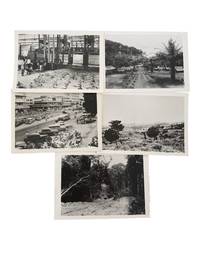
1950rif. 235541950. Belgian Congo colonial photo archive circa 1950s documenting how the Belgian state presented the colony to Western viewers through coffee production planned workers' housing road building urban commerce and managed landscape. Issued through the Belgian Government Information Center in New York the photographs translate colonial rule into a sequence of alluring scenes such as African labor inside an industrial coffee facility a rural workers' village at Bosulo automobiles and commercial buildings in Léopoldville road infrastructure through forest and savannah country in the Kibali Ituri district. The group belongs to the late colonial period when Belgium framed the Congo as a development project while its economy remained structured around extractive agriculture mineral wealth compulsory labor histories and racial hierarchy. Photo archive of five silver gelatin photographs New York: Belgian Government Information Center: Belgium and Belgian Congo each 5 x 7 inches Belgian Congo circa 1950s. The photos show workers handling sacks in a coffee facility; a thatched workers' village with a central road palms and surrounding hills captioned "Workers' village - Bosulo"; a busy Léopoldville commercial district filled with cars pedestrians bicycles storefronts and hotel signage captioned "Commercial center at Leopoldville city life vol. 10"; open savannah in the Kibali Ituri district captioned in handwritten script "In the Kibali Ituri district at a height of about 3000 feet there is a plain covered with savannah. Vegetation and countryside vol. 3"; and a forest road captioned "Vegetatikon and Countryside vol. 3 / Road through the jungle." Belgium ruled the Congo from 1908 after the international scandal of King Leopold II's Congo Free State until Congolese independence in 1960. By the mid twentieth century official Belgian publicity emphasized welfare labor housing roads agriculture and urban modernization recasting colonial control as technical improvement and economic order. These images present coffee production labor housing urban commerce and road construction as evidence of Belgian economic development in the Congo. For native Congolese that industrial system meant wage labor in export agriculture and processing residence in employer or state planned settlements movement through colonial transport networks and participation in an urban economy controlled by Belgian administration and business. Light surface wear and scattered verso stamps and annotations; images remain clean and clear. Overall very good condition. An archive of Congolese labor and land as the basis of late colonial industry in Belgian Congo. unknown books
1950rif. 235541950. Belgian Congo colonial photo archive circa 1950s documenting how the Belgian state presented the colony to Western viewers through coffee production planned workers' housing road building urban commerce and managed landscape. Issued through the Belgian Government Information Center in New York the photographs translate colonial rule into a sequence of alluring scenes such as African labor inside an industrial coffee facility a rural workers' village at Bosulo automobiles and commercial buildings in Léopoldville road infrastructure through forest and savannah country in the Kibali Ituri district. The group belongs to the late colonial period when Belgium framed the Congo as a development project while its economy remained structured around extractive agriculture mineral wealth compulsory labor histories and racial hierarchy. Photo archive of five silver gelatin photographs New York: Belgian Government Information Center: Belgium and Belgian Congo each 5 x 7 inches Belgian Congo circa 1950s. The photos show workers handling sacks in a coffee facility; a thatched workers' village with a central road palms and surrounding hills captioned "Workers' village - Bosulo"; a busy Léopoldville commercial district filled with cars pedestrians bicycles storefronts and hotel signage captioned "Commercial center at Leopoldville city life vol. 10"; open savannah in the Kibali Ituri district captioned in handwritten script "In the Kibali Ituri district at a height of about 3000 feet there is a plain covered with savannah. Vegetation and countryside vol. 3"; and a forest road captioned "Vegetatikon and Countryside vol. 3 / Road through the jungle." Belgium ruled the Congo from 1908 after the international scandal of King Leopold II's Congo Free State until Congolese independence in 1960. By the mid twentieth century official Belgian publicity emphasized welfare labor housing roads agriculture and urban modernization recasting colonial control as technical improvement and economic order. These images present coffee production labor housing urban commerce and road construction as evidence of Belgian economic development in the Congo. For native Congolese that industrial system meant wage labor in export agriculture and processing residence in employer or state planned settlements movement through colonial transport networks and participation in an urban economy controlled by Belgian administration and business. Light surface wear and scattered verso stamps and annotations; images remain clean and clear. Overall very good condition. An archive of Congolese labor and land as the basis of late colonial industry in Belgian Congo. unknown
1946rif. 235061946. Congolese ceremonial and colonial encounter photo archive showing indigenous ceremonial dance dress and culture uniformed troops and Belgian officials in the Belgian Congo during the late 1940s and early 1950s. Key scenes are tied to the 1947 visit of Prince Regent Charles to Paulis. Belgium ruled the Congo from 1908 until independence on June 30 1960 after the Belgian parliament took over King Leopold II's Congo Free State following international exposure of forced labor and mass abuses. Several captions appear to place the photographs during the governorship of Eugène Jungers Governor General of the Belgian Congo from December 31 1946 to January 1 1952 a period when Belgian rule promoted "paternal" administration while Congolese political pressure and demands for advancement were growing. The strongest scenes center Congolese public ceremony rather than colonial officials alone: men dancing in lines drummers seated before large instruments children gathered for viewing and performers facing crowds in open fields and palm-lined roads. Chief Tongolo and his daughter appear among colonial representatives during the Prince Regent's visit giving the archive a named Indigenous presence within a public ceremony shaped by Belgian authority. Photo archive of 24 silver gelatin photographs measuring approximately 3" x 4" each Belgian Congo 1940s-1950s. Several French captions can be translated; "Governor General Jungers"; "the regiment's standard at the cemetery"; "parade of the veterans"; and "Congolo gives his speech." Congolese men dance in feathered or fiber headdresses body ornaments patterned waist cloths shields and drums sometimes advancing across open ground before lines of onlookers. Belgian men in white suits and pith helmets stand with Congolese adults and children outside official buildings and in outdoor assembly areas while other scenes show African soldiers in formation a ceremony near railroad tracks a colonial cemetery observance and a station or compound with crowds gathered along walls and platforms. After the Second World War Belgium's Congo policy remained formally paternalist while urbanization war service missionary education and wage labor created new Congolese claims to political recognition that colonial rule could not contain;within thirteen years of Prince Regent Charles's 1947 visit the Congo gained it's independence and became Republic of the Congo. Light handling wear toning and minor curling; captions remain legible on several versos images remain clean and clear. Overall in very good condition. The archive records Congolese ceremonial life at the point where public dance veteran commemoration colonial ceremony military display and Belgian administrative power occupied the same public spaces. unknown
1900rif. 235051900. Belgian colonial Congo photo archive depicting European officials Indigenous Congolese adults and children public ceremony domestic labor and railway grounds between the early twentieth century and 1950. Belgium formally ruled the Congo from 1908 until June 30 1960 after King Leopold II's Congo Free State became notorious for forced labor and violence against Congolese people. A few scenes highlight colonial hierarchy as one photo shows white men in suits helmets and uniforms pose formally in chairs while Congolese men women and children appear as attendants or anthropological subjects surrounding the trio. A 1947 inscription identifying "le régent Charles" places part of the group during the Belgian prince regent's postwar tour of the Congo eight years before King Baudouin visited in 1955 and thirteen years before Congolese independence on June 30 1960. Photo archive of 12 silver gelatin photographs ranging from 3" x 4" to 3.5" x 4.75" Belgian Congo 1900-1950. French inscriptions include "Congo Belge août 1950"; "le régent Charles 1947"; "lundi le 18 janvier 1943 avec notre meilleur bonjour de tous les trois"; and "travailleur portant à l'eau" meaning "worker carrying water." Other scenes show a uniformed colonial procession outside a brick building helmeted men posed in the bush an elephant captioned with French notes Congolese children at a water spout men carrying water a compound walkway a railway yard and Congolese drummers and dancers assembled before mixed local and colonial audiences. The dichotomy of colonists occupying the pose of command travel inspection and ownership while Indigenous Congolese people appear in the surrounding labor ceremony and service spaces make for a compelling collection. Belgian rule in the Congo depended on racial separation administrative paternalism extraction mission education and controlled public ceremony while Congolese political demands intensified after the Second World War and culminated in independence on June 30 1960. Light toning handling and corner wear; photos remain clear and several inscriptions legible en verso; overall in very good condition. This archive gives Belgian colonialism a concrete human scale through officials posed with indigenous children workers ceremonial performers industrial railway spaces and royal reception scenes arranged around the unequal encounter between European power and Indigenous Congolese life. unknown
rif. 13976942Bruxelles: Adam Biro, 2001 in-4, 56 pages, illustrations. Bibliographie. Broché, très bon état.
1968Ex-library book with the usual stamps and markings. Unpaginated. Oblong format: 9 3/4"w x 8"h. Wonderful color illustrations by the author.
rif. 13973969Bruxelles: Crédit Communal, 1992 pet. in-4, 264 pages, nombreuses illustrations. Bibliographie. Broché, marques d'usage, etiquette avec un numéro sur le premier plat de couverture, bon état.