State, Congo FreeBiblio.com

146 résultats
réf. 1247094324.Gpaperback. Good. Access codes and supplements are not guaranteed with used items. May be an ex-library book. paperback
réf. 1271977397.Gpaperback. Good. Access codes and supplements are not guaranteed with used items. May be an ex-library book. paperback
réf. 1272237311.Gpaperback. Good. Access codes and supplements are not guaranteed with used items. May be an ex-library book. paperback
réf. 1279966203.Gpaperback. Good. Access codes and supplements are not guaranteed with used items. May be an ex-library book. paperback
réf. 1278675477.Gpaperback. Good. Access codes and supplements are not guaranteed with used items. May be an ex-library book. paperback
réf. 1279296569.Gpaperback. Good. Access codes and supplements are not guaranteed with used items. May be an ex-library book. paperback
réf. 127895466X.Gpaperback. Good. Access codes and supplements are not guaranteed with used items. May be an ex-library book. paperback
réf. 2343104786.Gpaperback. Good. Access codes and supplements are not guaranteed with used items. May be an ex-library book. paperback
1918réf. 40631Bolenge: Congo. Very Good with no dust jacket. 1918. Fifth Edition. Flexible cloth. Small 8vo ; 231 pages; Belgian Congo. Bonkanda wa Nsao ya Nzakomba. Fifth Edition Enlarged and Revised. 231 hymns on 76 leaves in Bobangi. 8vo contemporary plain limp cloth; moderate wear spine sunned. Bolenge Congo Belge 1918. Not too many of these survive African Congo exposure in good shape. Mainly comprised of Christian hymns in Bobangi. . Congo hardcover
1954réf. 4520Belgian Congo: Congo Tours 1954. First Edition. Soft cover. Fine. Belgian Congo BIG GAME HUNTING Promotional Brochure issued September 1954. 3 part fold-out brochure. 6 pp 7.5 x 5/1/5 pages. Covering all hunting areas Lake Albert Kamanda Aba Beni Tayala's Semliki River and Gabios. Giving safari rates what they include costs of licenses trophy fees and a full page map. Area hunted is contiguous to Soudan Uganda and Tanganyika i.e. the best big game areas in the Belgian Congo. Fine. Congo Tours unknown
1955réf. 519426Tervuren Koninklijk Museum Van Belgisch-Congo 1955. Bon état Bordures de couverture et dos brunis intérieur en excellent état pour les 4 volumes. in-8. 1955. Broché. 175188131232 pages. Tervuren Koninklijk Museum Van Belgisch-Congo unknown
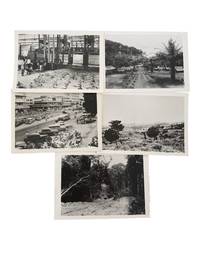
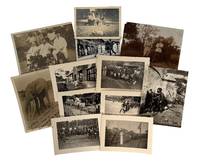
1950réf. 235541950. Belgian Congo colonial photo archive circa 1950s documenting how the Belgian state presented the colony to Western viewers through coffee production planned workers' housing road building urban commerce and managed landscape. Issued through the Belgian Government Information Center in New York the photographs translate colonial rule into a sequence of alluring scenes such as African labor inside an industrial coffee facility a rural workers' village at Bosulo automobiles and commercial buildings in Léopoldville road infrastructure through forest and savannah country in the Kibali Ituri district. The group belongs to the late colonial period when Belgium framed the Congo as a development project while its economy remained structured around extractive agriculture mineral wealth compulsory labor histories and racial hierarchy. Photo archive of five silver gelatin photographs New York: Belgian Government Information Center: Belgium and Belgian Congo each 5 x 7 inches Belgian Congo circa 1950s. The photos show workers handling sacks in a coffee facility; a thatched workers' village with a central road palms and surrounding hills captioned "Workers' village - Bosulo"; a busy Léopoldville commercial district filled with cars pedestrians bicycles storefronts and hotel signage captioned "Commercial center at Leopoldville city life vol. 10"; open savannah in the Kibali Ituri district captioned in handwritten script "In the Kibali Ituri district at a height of about 3000 feet there is a plain covered with savannah. Vegetation and countryside vol. 3"; and a forest road captioned "Vegetatikon and Countryside vol. 3 / Road through the jungle." Belgium ruled the Congo from 1908 after the international scandal of King Leopold II's Congo Free State until Congolese independence in 1960. By the mid twentieth century official Belgian publicity emphasized welfare labor housing roads agriculture and urban modernization recasting colonial control as technical improvement and economic order. These images present coffee production labor housing urban commerce and road construction as evidence of Belgian economic development in the Congo. For native Congolese that industrial system meant wage labor in export agriculture and processing residence in employer or state planned settlements movement through colonial transport networks and participation in an urban economy controlled by Belgian administration and business. Light surface wear and scattered verso stamps and annotations; images remain clean and clear. Overall very good condition. An archive of Congolese labor and land as the basis of late colonial industry in Belgian Congo. unknown
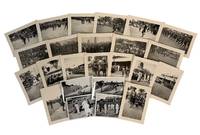
1946réf. 235061946. Congolese ceremonial and colonial encounter photo archive showing indigenous ceremonial dance dress and culture uniformed troops and Belgian officials in the Belgian Congo during the late 1940s and early 1950s. Key scenes are tied to the 1947 visit of Prince Regent Charles to Paulis. Belgium ruled the Congo from 1908 until independence on June 30 1960 after the Belgian parliament took over King Leopold II's Congo Free State following international exposure of forced labor and mass abuses. Several captions appear to place the photographs during the governorship of Eugène Jungers Governor General of the Belgian Congo from December 31 1946 to January 1 1952 a period when Belgian rule promoted "paternal" administration while Congolese political pressure and demands for advancement were growing. The strongest scenes center Congolese public ceremony rather than colonial officials alone: men dancing in lines drummers seated before large instruments children gathered for viewing and performers facing crowds in open fields and palm-lined roads. Chief Tongolo and his daughter appear among colonial representatives during the Prince Regent's visit giving the archive a named Indigenous presence within a public ceremony shaped by Belgian authority. Photo archive of 24 silver gelatin photographs measuring approximately 3" x 4" each Belgian Congo 1940s-1950s. Several French captions can be translated; "Governor General Jungers"; "the regiment's standard at the cemetery"; "parade of the veterans"; and "Congolo gives his speech." Congolese men dance in feathered or fiber headdresses body ornaments patterned waist cloths shields and drums sometimes advancing across open ground before lines of onlookers. Belgian men in white suits and pith helmets stand with Congolese adults and children outside official buildings and in outdoor assembly areas while other scenes show African soldiers in formation a ceremony near railroad tracks a colonial cemetery observance and a station or compound with crowds gathered along walls and platforms. After the Second World War Belgium's Congo policy remained formally paternalist while urbanization war service missionary education and wage labor created new Congolese claims to political recognition that colonial rule could not contain;within thirteen years of Prince Regent Charles's 1947 visit the Congo gained it's independence and became Republic of the Congo. Light handling wear toning and minor curling; captions remain legible on several versos images remain clean and clear. Overall in very good condition. The archive records Congolese ceremonial life at the point where public dance veteran commemoration colonial ceremony military display and Belgian administrative power occupied the same public spaces. unknown
1900réf. 235051900. Belgian colonial Congo photo archive depicting European officials Indigenous Congolese adults and children public ceremony domestic labor and railway grounds between the early twentieth century and 1950. Belgium formally ruled the Congo from 1908 until June 30 1960 after King Leopold II's Congo Free State became notorious for forced labor and violence against Congolese people. A few scenes highlight colonial hierarchy as one photo shows white men in suits helmets and uniforms pose formally in chairs while Congolese men women and children appear as attendants or anthropological subjects surrounding the trio. A 1947 inscription identifying "le régent Charles" places part of the group during the Belgian prince regent's postwar tour of the Congo eight years before King Baudouin visited in 1955 and thirteen years before Congolese independence on June 30 1960. Photo archive of 12 silver gelatin photographs ranging from 3" x 4" to 3.5" x 4.75" Belgian Congo 1900-1950. French inscriptions include "Congo Belge août 1950"; "le régent Charles 1947"; "lundi le 18 janvier 1943 avec notre meilleur bonjour de tous les trois"; and "travailleur portant à l'eau" meaning "worker carrying water." Other scenes show a uniformed colonial procession outside a brick building helmeted men posed in the bush an elephant captioned with French notes Congolese children at a water spout men carrying water a compound walkway a railway yard and Congolese drummers and dancers assembled before mixed local and colonial audiences. The dichotomy of colonists occupying the pose of command travel inspection and ownership while Indigenous Congolese people appear in the surrounding labor ceremony and service spaces make for a compelling collection. Belgian rule in the Congo depended on racial separation administrative paternalism extraction mission education and controlled public ceremony while Congolese political demands intensified after the Second World War and culminated in independence on June 30 1960. Light toning handling and corner wear; photos remain clear and several inscriptions legible en verso; overall in very good condition. This archive gives Belgian colonialism a concrete human scale through officials posed with indigenous children workers ceremonial performers industrial railway spaces and royal reception scenes arranged around the unequal encounter between European power and Indigenous Congolese life. unknown
1959réf. 353370Brussels: Office de l'information et des relations publiques pour le Congo belge et le Ruanda-Urund 1959. Hardback edition. Hardcover. Near fine copy in the original gilt-blocked boards. Slightest suggestion only of dust-dulling to the spine and panel edges. Remains particularly well-preserved overall; tight bright clean and strong. Physical description; 2 volumes : color maps part folded diagrams part color tables ; 22 cm. Subjects; Congo Democratic Republic. Congo Democratic Republic; history. Congo Democratic Republic; description and travel. Brussels: Office de l'information et des relations publiques pour le Congo belge et le Ruanda-Urund hardcover
réf. 2296050697.Gpaperback. Good. Access codes and supplements are not guaranteed with used items. May be an ex-library book. paperback
1930réf. 82301New York: Farrar & Rinehart 1930. First Edition. First printing. Octavo. Publisher's brown cloth; dustjacket; xiv318pp; color frontispiece and seven unnumbered leaves of b/w plates after André Durenceau who also designed the endpapers and dustwrapper. A sound generally clean copy; text over-opened at p.70 a few faint spots of foxing; Very Good. In the original dustwrapper unclipped but tattered with losses along upper margin and spine ends closed tears and age-toning; just Good. With the engraved bookplate of Portland Oregon collector Frederick W. Skiff d.1947. A colorful but cringingly condescending account by an Anglo-American trader who spent the years 1882-1896 in what was then French Equatorial Africa today called the Republic of the Congo. Includes chapters on cannibalism native African slaveholders and sexual customs about which the author warns he ".shall speak with the utmost frankness.for the reason that they are the most powerful and dominating factor" in the lives of the natives of Equatorial Africa. With illustrations in dramatic Art Deco style by Franco-American illustrator and muralist André Durenceau. Farrar & Rinehart unknown
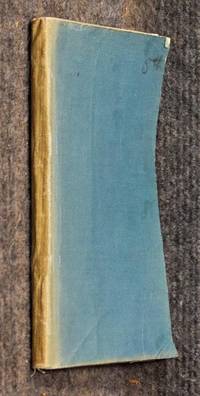
1899réf. 91742London: Her Majesty's Stationery Office 1899. Presumed First Edition First Printing. Wraps. Good. 9 1 pages and 36 pages. Tabular Data. This item has been disbound from a larger volume and now has a stiff blue cover protecting it. The British Central Africa Protectorate BCA was a British protectorate proclaimed in 1889 and ratified in 1891 that occupied the same area as present-day Malawi: it was renamed Nyasaland in 1907. British interest in the area arose from visits made by David Livingstone from 1858 onward during his exploration of the Zambezi area. This encouraged missionary activity that started in the 1860s undertaken by the Universities' Mission to Central Africa the Church of Scotland and the Free Church of Scotland and which was followed by a small number of settlers. The Portuguese government attempted to claim much of the area in which the missionaries and settlers operated but this was disputed by the British government. To forestall a Portuguese expedition claiming effective occupation a protectorate was proclaimed first over the south of this area then over the whole of it in 1889. After negotiations with the Portuguese and German governments on its boundaries the protectorate was formally ratified by the British government in May 1891. As late as 1888 the British Foreign Office declined to accept responsibility for protecting the rudimentary British settlements in the Shire Highlands despite unsubstantiated claims by the African Lakes Company of Portuguese interference with their trading activities. However it also declined to negotiate with the Portuguese government on their claim that the Shire Highlands should be considered part of Portuguese East Africa as it was not regarded by the Foreign Office as under effective Portuguese occupation. In order to prevent Portuguese occupation the British government sent Henry Hamilton Johnston as British consul to Mozambique and the Interior with instructions to report on the extent of Portuguese rule in the Zambezi and Shire valleys and the vicinity and to make conditional treaties with local rulers beyond Portuguese jurisdiction. These conditional treaties of friendship did not amount to the establishment of a British protectorate but prevented those rulers from accepting protection from another state. In response to a Portuguese incursion Johnston's deputy John Buchanan declared a Shire Highlands Protectorate in Johnston's absence despite the contrary Foreign Office instructions. It seems probable that Buchanan's action made without reference to the Foreign Office but following instructions that Johnston had left was to prevent any further advance by the Portuguese rather than to establish British rule in the area. Johnston's proclamation of a further protectorate the Nyasaland Districts Protectorate west of Lake Malawi was also contrary to Foreign Office instructions. However it was endorsed by the Foreign Office in May 1891. This was because the discovery of the Chinde channel in the Zambezi delta which was deep enough to allow sea-going ships to enter the Zambezi which was an international waterway without having to enter Portuguese territory whereas previously such ships had to use the port of Quelimane. There followed an Anglo-Portuguese Crisis in which a British refusal of arbitration was followed by the 1890 British Ultimatum of 11 January 1890. This demanded that the Portuguese give up all claims to territories beyond the Ruo River and west of Lake Malawi. The Portuguese government accepted under duress and ordered their troops in the Shire valley to withdraw to the south bank of the Ruo. This order was received by the commander at Katunga on 8 March 1890 and all Portuguese forces had evacuated Katunga and Chiromo by 12 March. An 1891 Anglo-Portuguese treaty fixed the southern borders of what had been renamed the British Central Africa Protectorate. The treaty also granted Britain a 99-year lease over Chinde a port at one of the Zambezi delta mouths where sea-going ships could transfer goods and passengers to river boats. The northern border of the protectorate was agreed at the Songwe River as part of the Anglo-German Convention in 1890. Its western border with Northern Rhodesia was fixed in 1891 at the drainage divide between Lake Malawi and the Luangwa River by agreement with the British South Africa Company which governed what is today Zambia under Royal Charter until 1924. After this until 1898 troops were used to assist the locally recruited police force to suppress the slave trade. The three main groups resisting British occupation were Yao chiefs in the south of the protectorate and Swahili groups around the center and north of Lake Nyasa both involved in the slave trade and Ngoni people who had formed two aggressively expansionists kingdoms in the west and north. As the northern Ngoni kingdom did not threaten European trading interests as it was far from European-owned estates and as the Scottish mission at Livingstonia was influential within the kingdom Johnston did not use force against it. It accepted British rule in 1904 on condition of retaining its own traditions. Its king was recognized as a paramount chief the only one in the protectorate at that time. Her Majesty's Stationery Office paperback
1991réf. Q-0840732368Thomas Nelson Inc 1991-02-01. Paperback. New. In shrink wrap. Looks like an interesting title! Thomas Nelson Inc paperback
1897réf. 37040New York: Fleming H. Revell Co. 1897. 8vo. 316 pp. Frntsp. numerous photos plates 1 large folding map. Green cloth gilt lettrng & decrtn mnr soilng shlfwr frnt hnge startng still VG- copy. First edition of this excellent biography of A.C. Good who was the first white to penetrate far into the Bulu region of German Congo. There he was initiated into the tribe preached in the language and even translated the Gospel. Fleming H. Revell Co., hardcover
réf. DADAX0195374207New unknown
réf. DADAX0367589176New unknown
réf. DADAX3030446980New unknown
réf. DADAX038500771XNew unknown
réf. DADAX1610391071New unknown