1 341 résultats
réf. 20503XVIIIème ou début XIXème. Ais de bois, sans cuir, plats et dos à nu. in-8 de 294 pages manuscrites, texte en 2 couleurs (encre noire et rouge) sur parchemin (peau de chèvre) avec 6 peintures a pleine page, bandeaux décoratifs, marge extérieure percée d'une rangée de petits trous d'aiguille dans lequels on pouvait insérer des fils de différentes couleurs servant de marque page, petits manques en marge de 1 feuillet, sans perte de texte, patine dans les marges, petites coupures recousues dans la marge de 3 feuillets.
1915réf. 508297N.P. 1915. Hardcover. NEAR FINE. An extraordinary portfolio of early 20th-century photographs of Ethiopia featuring eight large-format scenes from a Coptic Orthodox wedding in addition to eight 3x5 photos of Ethiopian children. The wedding photos depict a very formal liturgical ceremony with the bride and groom in ornate robes and crowns attended by priests acolytes deacons cantors and other ecclesiastics in fine vestments carrying the sacred liturgical items including many golden crosses and a richly ornamented Holy Gospel. One photo of the long procession shows a great crowd of attendees dressed in white robes. A previous dealer's description of this porfolio speculates that the great pomp of this ceremony might indicate that it was a royal wedding perhaps even the marriage of Esther Akhnoukh and Fahmy Bey Wissa described by the English Ethnographer S. H. Leeder. But in Leeder's own account he notes that the crowns and regalia are the property of the church a communal holding and the wearing of which is the right and privilege of all baptised faithful for one day in their lives. Photos mounted on original 11x14' mattes with just a bit of rubbing and toning to the extremities one photo with a tiny dampstain to the margin otherwise all photos are FINE entirely clean and sharp. The 3x5' photos of children are mounted four to a matte. These photos show children in joyful poses particularly showcasing their hairstyles one of which includes a oder girl with a large water gourd; two of the photos show children being swarmed by flies. The phtographer is unnamed but there are a fairly limited number of possibilities. It was almost certainly purchased by Rosenberg on his Travelling fellowship around 1921 putting the date of the actual photos sometime in the previous decade. Prior to the Italian invasion in the 30's Ethiopia was not an easy place to access and was simply not a destination for European travellers making professional photo-documentations of it far less common than its neighbor Egypt in the same time period. One tempting and plausible source would be one of the photographers of the Enno Littman-led 'Deutsche Aksum Expedition' which included extensive ethnographic investigations in the course of their larger mission of investigating the archaeological sites of the Kingdom of Aksum in northern Ethiopia and Eritrea. A noted Semiticist Littman lived among the Tigre people of Eritrea for a year before directing the Aksum expedition doing research for later linguistic and ethnographic publications including 'Tales Customs Names and Dirges of the Tigre Tribes' which includes ample descriptions of religious ceremony. Housed in a contemporary 11x16' portfolio sold by C. Roberson of London half black cloth over printed paste paper and ties to all three sides with moderate wear to the extremities and French liquor labels to the endpapers. With owner's label to the rear cover ex-libris Louis Conrad Rosenberg a noted architect whose 171 etchings and architectural illustrations and renderings have been archived in the University of Oregon Special Collections Division. After serving in the US Army and American Expeditionary Force during WWI Rosenberg joined the factulty of the University of Oregon. He and his wife Marie Louise Allen of Portland took advantage of a Traveling Fellowship granted by the UO and travelled extensively throughout the Mediterranean and the Levant for 2 years beginning in 1920. N.P. hardcover
1900réf. K3ME5C11OCGBLondon: Harrison and sons 1900. Bound as sewn. Folio. With a folding lithographed map with some coloured details. Diplomatic document presented to the Houses of Parliament on the trade of the Ethiopian cities Addis Ababa and Harar. It includes many letterpress tables showing imported and exported tradeware its quantities prices and origin occasionally with some other remarks. The maps shows various trade routes from the two cities to other cities towns and ports. In very good condition. Harrison and sons, unknown
1898Very Good Turkish, Ottoman (1500-1928) Modern full morocco in Ottoman traditional style. Roy. 8vo. (25 x 17 cm). In Ottoman script (Old Turkish with Arabic letters). 119 p., 15 unnumbered b/w plates, and 1 color double-paged map of Northwest Africa and the Sahara Desert. First and only edition of this exceedingly rare book of Sahara and other territories of North Africa, written by Sadik El-Müeyyed, including his surviving report and travel account written to be presented to the Ottoman Sultan Abdulhamid II. It's a reference text that specifies the military and the political measures of the Sahara exploration, gives extensive information about the Benghazi region of Tripoli and about Muhammad al-Senusi, the leader of the Senûsî (Senussi) movement there, and his followers. With the impressive and enthusiastic expression of Sadik el-Müeyyed's descriptions, this work reveals not only the affairs of the Ottoman government but also the mysteries of the journeys that have taken months in the Sahara desert, uncovers the living standards of the desert peoples, and sheds light on an unknown aspect of the North African history. Özege 132.; Not in Kursun.
1885In-4 gr. (mm. 340x245), 12 volumi in 6 tomi, mz. pergam. coeva (piatti con qualche abras.), tit. oro su tassello al dorso, pp. compl. 2.717, testo inquadrato in doppio filetto, ornato da elaborati grandi capilettera figur. a vignetta, testate e finali; con numerosiss. xilografie nel t., incluso il ritratto del Cardinal Massaja, e con 2 carte geografiche, a doppia pag., della part Nord e Sud dell’Etiopia. E' questa l'opera piu' importante sulla storia ed i costumi dell'impero etiopico, redatta (su istanza di Leone XIII) dal missionario ed esploratore astigiano Guglielmo Massaja (1809-1886), nominato cardinale nel 1884. Di grande interesse la parte iconografica (carte geografiche, vedute, costumi, ritratti, scene di vita del popolo, flora, fauna, ecc.). "Prima edizione". Cfr. CLIO,IV, p.2906. Solo un vol. con tracce d’uso e lievi arross., altrim. esemplare ben conservato.
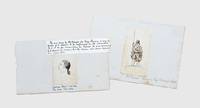
1863réf. 162461Ethiopia: c. 1863. A duplicitous envoy at the heart of the Abyssinian court Two sketches attributed to M. Bardel a French diplomat who befriended Emperor Tewodros II in the build-up to the Abyssinia Expedition. They show an Ethiopian's head in profile as a mock-up for a cannon engraving and Bardel dressed in the emperor's armour. When Charles Cameron British consul to Abyssinia arrived in the country in 1862 he was accompanied by one Bardel a Frenchman who was assumed to be his secretary. A dispute led the the two to part ways after which Bardel entered the service of the emperor. Keen to deepen his European connections Tewodros entrusted Bardel to carry a letter to Napoleon III. However the Frenchman never received an audience and returned with a likely forged reply telling Tewodros that Napoleon did not approve of his erratic and often violent actions. He also informed Tewodros of uncomplimentary journal entries written by the Anglican missionary Henry Aaron Stern. This combined with the emperor's growing mistrust of Europeans and anger at being snubbed by their royal houses led him to order the arrest and torture of Cameron Stern and all other Europeans in 1864. The treatment of the prisoners resulted in the 1868 British expedition to Abyssinia led by Charles Napier. The captions on the first sketch read "Abyssian sic Head & the way they part their hair" and "This was done by Mr. Bardel for King Theodore & was a design of a warrior to be engraved on the celebrated big gun as per instructions in French he was rewarded by a present of 10 cows but the design was never carried out - June 1868". There are reports that Tewodros had the words "Theodore the Scourge of the Peverse" inscribed on his cannon. The captions on the second sketch read "Abyssian sic native prisoner being led to execution" and "Mr Bardel dressed in King Theodore's armour". Two ink sketches with brown watercolour on paper 89 x 65 mm and 133 x 70 mm each mounted on larger sheet 145 x 255 mm and 172 x 253 mm. Contemporary ink and pencil captions paper slip with contemporary manuscript ink caption affixed onto one sheet. Foxing and toning larger sheets chipped along one edge: very good. unknown
1790réf. 1211790 Hôtel de Thou puis Plassan [Panckoucke], Paris, 1790-1792. 6 volumes dont un d'atlas, 21 x 26 cm (R), in-4°, (I) 2 ffnc + viii pp. + 620 pp., (II) 2 ffnc + 784 pp., (III) 2 ffnc + 858 pp., (IV) 2 ffnc + 752 pp., (V) 2 ffnc + 328 pp. + clxiii pp., (Atlas) 2 ffnc (page de titre et liste des planches du tome V) + 3 grandes cartes repliées (sur 4) + 65 planches à simple page + 19 planches à double page, soit 87 planches sur les 88 que compte normalement l'ouvrage, reliure moderne en pleine basane prune, dos à nerfs ornés, toutes tranches rognées.
1857réf. PHO-1753Paris : Arthus Bertrand, 1857, 2 volumes sur 4, un Atlas in-folio, demi-veau blond, dos lisse orné, tranches mouchetées (reliure de l'époque). Frottements au dos, fentes aux charnières, coiffes arrachées, coins émoussés. Première garde blanche déchirée. Petites rousseurs et mouillures claires en marge et 1 volume du texte de l’Histoire du Voyage, première partie (sur 2), brochage éditeur, xxiii-556pp., catalogue éditeur broché in fine, rousseurs, manque de papier aux coins (dernière de couv.)
1814First Edition; E.O. Un volume in 4to (25x33 cm) di XI-(4)-506-LXXV pagine. In barbe, quindi a larghi margini. 7 carte geografiche di cui 5 ripiegate (1 colorata a mano); 27 pagine ft di incisioni (con 28 tavole); 2 vignette incise. Completa quindi di tutte le carte e le incisioni. Bella legatura in mezza pelle moderna con dorso ornato e tassello di titolo. Sontuoso esemplare di questa prima edizione del più famoso libro illustrato di viaggi nel Corno d'Africa dell'Ottocento. (Extra postage cost is required for international shipping. Please email us for the new shipping cost).
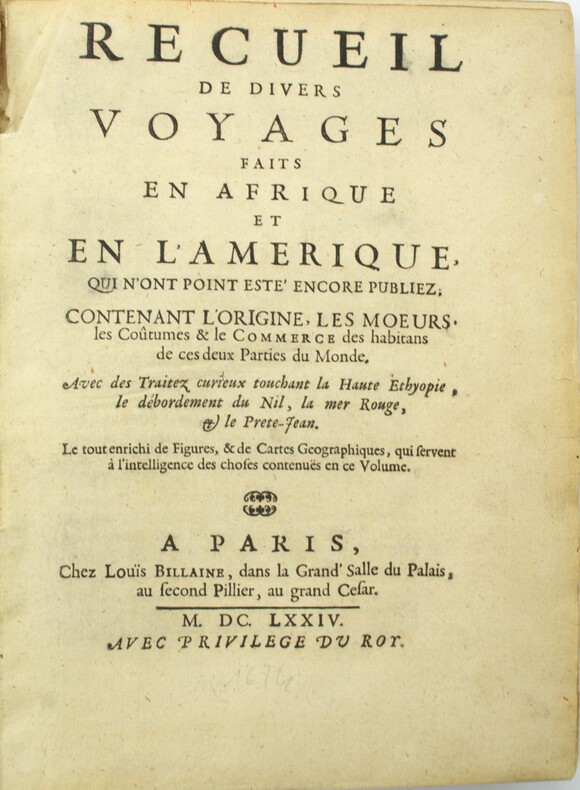
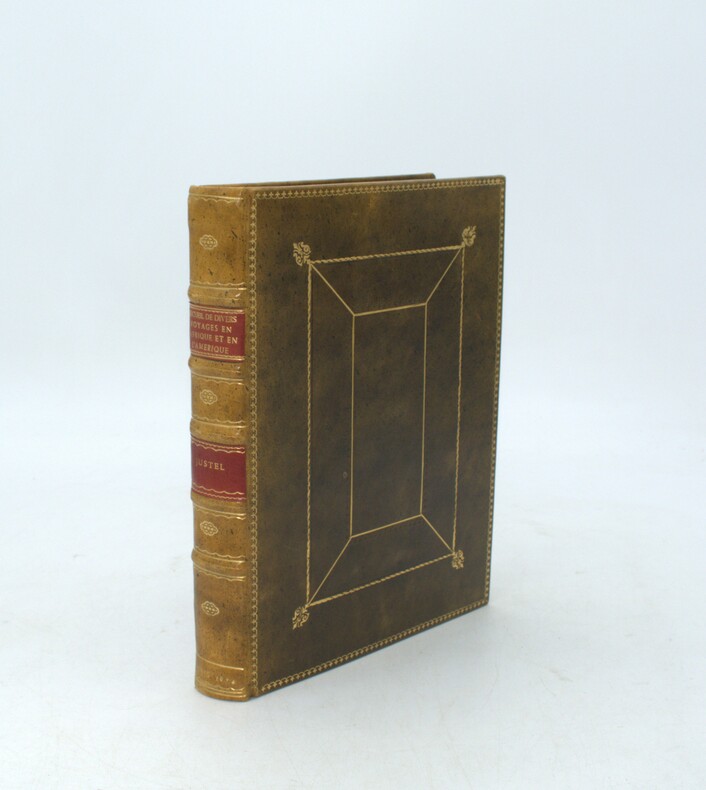
1674réf. PHO-2243Paris, Louis Billaine, 1674, in-4 (228x164), basane postérieure (19eme), dos à nerfs avec titre, lieu et date, tranches marbrées, réparations au dos et aux coins, petite réparation au pli de la carte des Barbades, intérieur frais, illustré de 12 planches (13) et trois cartes dépliantes (Barbades, Jamaïque et Virginie, Maryland et la Nouvelle-Angleterre) manque la carte du Nil comme souvent et un faux titre
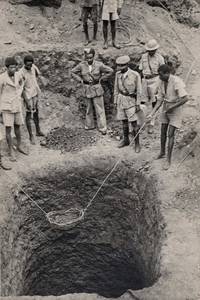
réf. PF66223 loose gelatin silver photos vast majority are ca. 8x12 cm 3 x 4 ½ in; nine smaller images are ca. 75x11 cm 3 x 4 ¼ in to ca. 65x10 cm 2 ½ x 3 ¾ in. No captions; most photos with period ink or pencil numbers on verso. Two photos with minor defects of negatives several with minor creases on the extremities a few photos mildly faded but overall a very good collection of interesting photos. Interesting extensive collection of 223 original gelatin silver snapshot photos taken during a mining survey expedition possibly prospecting for gold in Italian East Africa modern-day Eritrea and Ethiopia in the late 1930s. Possibly set up after the Second Italo-Ethiopian War 1935-1937 the photos follow a party consisting of a European civilian likely the Italian expedition leader several military officers native soldiers and military trucks driving across East African landscapes crossing bridges posing in front of various geological rock formations or caves looking for samples in streams &c. Over a dozen close-up images show a geologist’s hammer taken in the field next to different rock and earth formations. Four photos show the scenes with Africans performing artisanal gold panning in the streams; one image depicts miners operating a sluice box. There are also several photos of damaged or destroyed bridges and remnants of a tank in a field likely the echo of the Second Italo-Ethiopian War. Other photos show East African mountains and valleys rivers forests roads bridges villages cattle herds native people &c. There are also views of the Obelisk of Axum and Ethiopian megalithic stellae possibly in Tuto Fela Gedeo Zone of Ethiopia a military memorial with the Italian fascist eagle emblem and sign “Direzione Lavori … Eritrea” a gravestone for “Morts pour la Belgique” two Italian modernist buildings &c. Overall an interesting extensive collection of original snapshot photos of mineral surveys in Ethiopia and Eritrea during the Italian occupation in the 1930s. The colonial Mining Service in Italian Ethiopia commenced gold exploration in 1936 initially focusing on placer mining near Tulu Kapi in the south-west of the country. “The valorization of Western regions of Ethiopia was entrusted to S.A.P.I.E.-PRASSO and to the Societa Mineraria Italo-Tedesca S.M.I.T. <…> The operational infrastructure of S.A.P.I.E. had a clear military setting: the prospecting groups called “Colonne” corps reported to the General Directorate of Research with offices in Yubdo and were coordinated by a specialist engineer. In Yubdo there was also a laboratory for the analysis of samples collected during the various prospecting stages. Each corps was formed by 35/40 Italian and indigenous men often escorted by Ascari Eritrean soldiers embedded in the Italian colonial army and was dedicated to the exploration of a specific district <…>” Granitzio F. & others. Tulu Kapi Gold Project: a History of repeated discoveries in Western Ethiopia// KEFI Gold & Copper Co.; see more. unknown
1674réf. PHO-2032Paris, Louis Billaine, 1674. in-4 (228x164) , relié plein veau , filets sur les plats , dos à nerfs orné avec titre , auteur et date (reliure pastiche),tranches rouge. L'ouvrage est illustré de 12 planches hors texte, une carte de l'Éthiopie dans le texte, trois cartes dépliantes (Barbades, Jamaïque et Virginie, Maryland et la Nouvelle-Angleterre) manque la carte du Nil, mouillures, déchirure et réparation au pli (carte des Barbardes)
réf. 90642aaf19. Jh., auf braunem Lederriemchen aufgezogen sind 8 Pergamentschriftrollen, jede im eigens gefertigten ziselierten Lederetui, 6 Büchlein, ebenfalls in ziserlierten Lederetuis, 7 Schmuckelemente aus Messing, 1 Teil aus Knochen, 2 Elemente aus Holz, 14 kl. Perlen aus Metall und Glas. // pendentif sur fil de cuir brun avec 8 parchemins enroulés, chacun dans son étui en cuir ciselé fait sur mesure, 6 livres également dans leurs étuis, 7 pièces décoratives en cuivre jaune, un élément en os, 2 éléments en bois, 14 petits éléments (perles) en métal et en verre.
réf. 005460Paris, Louis Billaine, 1674. Cinq parties reliées en un volume in-quarto (180 X 250 mm) basane fauve marbrée, dos brun à nerfs orné de fers dorés, titre doré, tranches mouchetées en rouge (Reliure de l’époque) ; (8) ff. de titre, avis au lecteur, extrait du privilège, 262 pages, 14 planches h.-t. (dont 7 dépliantes) - 23 pages - 49 pages, 3 planches h.-t. - 83 pages [et non 81 pages, il y a en effet deux pages 54/55], 1 planche dépliante h.-t. - 35 pages, 1 planche dépliante h.-t. Discrètes et habiles restaurations à la reliure, épidermures sur les plats, infime travail de ver en fond de cahier sans atteinte au texte du premier tiers de l'ouvrage. SANS le faux titre "Colonies Anglaises" ni la CARTE de la "Description Topographique et mesure de l'Isle des Barbades aux Indes Occidentales" qui manque souvent.
réf. 34710Datation: d'après la paléographie XIXéme ou début XXéme siècle - Langue: Ge'ez - Codicologie: Parchemin; in-folio 43 x37 x8 cm - 3 col.; 31 lg.; 122 folios qui sont numérotés avec un tampon en chiffre arabe à l'encre noire, au centre de la marge infèrieure de chaque recto - Reliure : Ais de bois - Le second plat à été brisé dans sa longueur et recollé - Bon état de conservation - Les feuillets ont été abimés anciennement par un liquide dans le coin inférieur et externe -
16662 volumi in 4, cm 21 x 30, pp. (32) + 396 + (42). Con frontespizio inciso e 11 tavole fuori testo ripiegate incise all'acquaforte, 1 incisione e 9 illustrazioni xilografiche nel testo; (8) + 968 + (2). Con frontespizio inciso e 6 ( su 8) tavole fuori testo in xilografia ripiegate, 1 incisione e 19 xilografie nel testo a piena pagina. Firme di proprieta' ottocentesche ai frontespizi. Mezza pelle ottocentesca con alcuni segni d'uso, fregi oro e nervature al dorso. Edizione originale dei primi 2 volumi pubblicati nel 1666 (per Valente de Oliveira) e nel 1674 (per Antonio Craesbeeck). Successivamente, nel 1675, usci' un terzo volume (sempre per Craesbeeck). Rarissima opera dedicata ai rapporti commerciali, militari e amministrativi con i paesi dell'Asia da parte del Regno di Portogallo. L'opera fu pubblicata postuma (Faria y Sousa era morto nel 1649) a cura del figlio che aveva ereditato libri e materiali manoscritti e rappresenta una importantissima fonte di informazioni relative a Goa e alle Indie portoghesi (governo di Don Garcia de Norona, di Estevan De Gama, Martin Alfonso de Sousa, Francisco Barreto, ecc), all'Etiopia, all'opera missionaria ivi operata da Padre Manuel de la Vega, Padre Iacinto Francisco ecc. e alle erbe, piante, animali, leggi, costumi e vicende militari. Tratta poi del Giappone e dei suoi usi e costumi, dei frequenti terremoti, descrive la Cina, la divisione amministrativa, i cibi e le produzioni agricole, la cultura cinese, la religione, i tribunali e le carceri ecc. L'isola di Ceylon, lo stretto di Ormutz ecc. Le tavole fuori testo raffigurano: L'isola di S. Elena; Cochim (Kerala); Quiloa (Tanzania); Fortaleza de Cananor (Kerala); Fortaleza (Brasile); Goa; Fortaleza de Malaca (Malesia); Fortaleza de Ormutz (Golfo Persico); Fortaleza de Chaul (Maharhasta, India); Fortaleza de Bacaim (Maharhasta, India); Fortaleza de Dio (Costa Ovest dell'India); Fortaleza de Mocambique (Monzambico); Fortaleza de Daman (Costa Ovest dell'India); Fortaleza de Manar (India); Fortaleza de Mangalor (India); Fortaleza De Onor (Karnataka, India); Barcalor. Sousa, importante storico, erudico e scrittore portoghese, scrisse gran parte della sua opera in spagnolo. Oltre a varie opere storiche dedicate al Portogallo, scrisse i Comentarios dos Lusiadas e i Comentarios das rimas varias de Luis De Camoes, considerati tra le piu' importanti fonti storiche su Luis De Camoes. Cordier, Sinica, 2039. Sabin, 28001. Palau, 86692